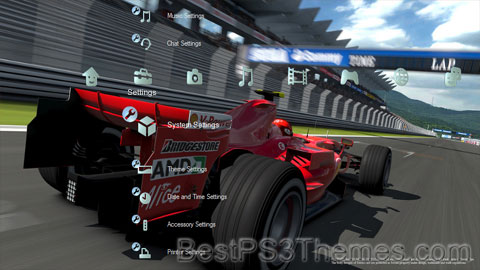
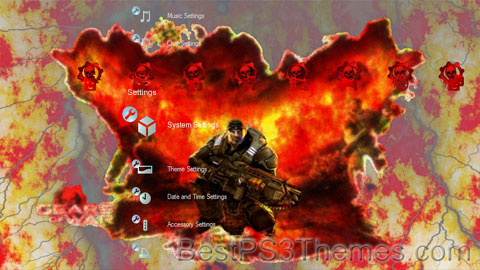
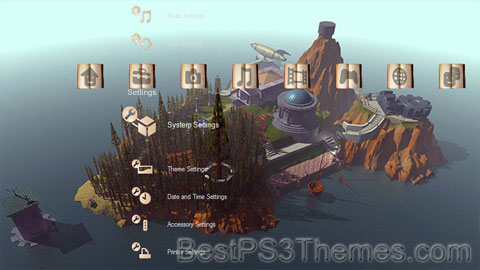
This program unpacks Playstation 3 Theme files (.p3t) so that you can touch-up an existing theme to your likings or use a certain wallpaper from it (as many themes have multiple). But remember, if you use content from another theme and release it, be sure to give credit!
Download p3textractor.zip from above. Extract the files to a folder with a program such as WinZip or WinRAR. Now there are multiple ways to extract the theme.
The first way is to simply open the p3t file with p3textractor.exe. If you don’t know how to do this, right click the p3t file and select Open With. Alternatively, open the p3t file and it will ask you to select a program to open with. Click Browse and find p3textractor.exe from where you previously extracted it to. It will open CMD and extract the theme to extracted.[filename]. After that, all you need to do for any future p3t files is open them and it will extract.
The second way is very simple. Just drag the p3t file to p3textractor.exe. It will open CMD and extract the theme to extracted.[filename].
For the third way, first put the p3t file you want to extract into the same folder as p3textractor.exe. Open CMD and browse to the folder with p3extractor.exe. Enter the following: p3textractor filename.p3t [destination path]Replace filename with the name of the p3t file, and replace [destination path] with the name of the folder you want the files to be extracted to. A destination path is not required. By default it will extract to extracted.filename.
This program unpacks Playstation 3 Theme files (.p3t) so that you can touch-up an existing theme to your likings or use a certain wallpaper from it (as many themes have multiple). But remember, if you use content from another theme and release it, be sure to give credit!
Download p3textractor.zip from above. Extract the files to a folder with a program such as WinZip or WinRAR. Now there are multiple ways to extract the theme.
The first way is to simply open the p3t file with p3textractor.exe. If you don’t know how to do this, right click the p3t file and select Open With. Alternatively, open the p3t file and it will ask you to select a program to open with. Click Browse and find p3textractor.exe from where you previously extracted it to. It will open CMD and extract the theme to extracted.[filename]. After that, all you need to do for any future p3t files is open them and it will extract.
The second way is very simple. Just drag the p3t file to p3textractor.exe. It will open CMD and extract the theme to extracted.[filename].
For the third way, first put the p3t file you want to extract into the same folder as p3textractor.exe. Open CMD and browse to the folder with p3extractor.exe. Enter the following: p3textractor filename.p3t [destination path]Replace filename with the name of the p3t file, and replace [destination path] with the name of the folder you want the files to be extracted to. A destination path is not required. By default it will extract to extracted.filename.
Gears of War is a media franchise centered on a series of video games created by Epic Games, developed and managed by The Coalition, and owned and published by Xbox Game Studios. The franchise is best known for its third-person shooter video games, which has been supplemented by spin-off video game titles, a DC comic book series, seven novels, a board game adaptation and various merchandise.
The original trilogy focuses on the conflict between humanity and the subterranean reptilian humanoid known as the Locust Horde on the world of Sera. The first installment, Gears of War, was released on November 7, 2006 for the Xbox 360. The game follows protagonist Marcus Fenix, a soldier in the Coalition of Ordered Governments tasked to lead a last-ditch effort to destroy the Locust Horde and save humanity. Two subsequent titles, Gears of War 2 (2008) and Gears of War 3 (2011), featured a three-way conflict between humanity, the Locust Horde and their mutated counterparts, the Lambent. Gears of War: Judgment, a spin-off prequel to the series' first title, was released in 2013; it focuses on Damon Baird, one of Fenix's squad-mates.[1]Gears of War: Ultimate Edition was released for the Xbox One and Microsoft Windows between August 2015 to March 2016.[2] The fourth installment in the main series, Gears of War 4, is set 25 years after Gears of War 3 and follows Marcus Fenix's son, JD and his friends as they battle security forces deployed by a totalitarian COG government as well as the Swarm, a reconstituted version of the Locust Horde that once again threatens humanity.[3]Gears 5 (2019) is the direct sequel to Gears of War 4 and revolves around Kait Diaz, a friend of JD, who embarks on an adventure to learn the truth about her past and the connections between her history and the Locust Horde.
Gears of War was developed by Epic Games. Cliff Bleszinski, who has previously worked on Epic's Unreal Tournament games, served as the series' lead game designer for the first three installments. He was inspired by gameplay elements from Resident Evil 4.Kill Switch, and Bionic Commando.[4] The series was guided by Rod Fergusson, the executive producer and director of development of Epic Games until 2012.[5][6] The first four installments of the Gears of War series used a modified version of the Unreal Engine 3 engine.[7][8] In January 2014, Microsoft acquired rights to the franchise from Epic Games. Canadian studio The Coalition developed Gears of War 4, which was released on October 11, 2016 for the Xbox One and Windows 10.[9] A sequel, Gears 5, was released in September 2019. All six installments in Gears of War featured several multiplayer modes that allowed players to compete against each other or team-up to battle AI opponents on Xbox Live.
Gears of War became one of the best-selling franchises for the Xbox 360.[10] The series puts emphasis on cover-based combat, in which players can use objects to avoid gunfire or safely engage enemies.[11] The Gears of War games have been amongst the most popular and most played titles on Xbox Live.[10][12]
The Gears of War series takes place in an alternate universe on Sera, a fictional Earth-like planet. Human civilization develops and endures a millennia-long conflict that leaves humanity on the brink of extinction. Sera's leaders broker an era of peace that ushers scientific advancements and a cultural renaissance. Humanity's population sporadically grows and demands more energy provided by fossil fuel and nuclear power. Sera's scientists discover Imulsion, a naturally occurring substance that can be refined into a potent energy source. Imulsion solves Sera's energy crisis but ultimately creates great economic disparity as nations with direct access to Imulsion prosper, while other nations fall into financial turmoil.
Sera's citizens balkanize into two warring factions: the Coalition of Ordered Governments (COG) and Union of Independent Republics (UIR). The ensuing 79-year strife, known as the Pendulum Wars, consumes millions of lives with both sides locked in a virtual stalemate. The UIR develops the 'Hammer of Dawn', a system of satellites capable of delivering precise and destructive orbital-to-surface laser strikes. A contingent of COG commandos, led by Marcus Fenix, Dominic Santiago, and Victor Hoffman launch a daring raid on a UIR stronghold to steal the schematics for the Hammer of Dawn. The UIR surrenders after witnessing the Hammer of Dawn (completed by Marcus Fenix's father, Professor Adam Fenix) devastate one of their naval vessels.
Six weeks after the COG and UIR agreed to an armistice, a race of subterranean creatures known as the Locust Horde emerge from Sera's depths and begin assaulting human cities, wiping out 25% of the world population in the first 26 hours, referred to as 'Emergence Day'. The Locust overwhelm the already battle-worn COG forces during this surprise attack, causing them to retreat to the Jacinto Plateau, where the Locust cannot dig through its granite bedrock, and reluctantly bombard their own cities with the Hammer of Dawn to halt the Locust's advance. The ensuing scorched earth tactic destroys much of Sera's cities and human population. The COG continues to operate out of their capital city of Ephyra and other cities on the plateau such as Jacinto City, while the surviving humans, known as Stranded, are left to wander through Sera's charred ruins.
The Locust reemerge and begin a campaign of occupying human cities on the Jacinto Plateau to act as stepping stones. The Locust are eventually able to emerge and overrun Ephyra 10 years after Emergence Day. During the chaos, Marcus Fenix leads an unauthorized rescue mission to save his father from the Locust assault. During the evacuation, a helicopter is shot down by the Locust and crashes into the Fenix Estate, presumably killing Adam. The COG's leadership court martials Marcus and sentences him to 40 years in prison. After losing Ephyra, the remainder of the COG retreats to Jacinto City.
Gears of War is set 14 years after the Locust emerged, and four years into Marcus Fenix's imprisonment. The COG forces devise a last-ditch offensive to destroy the Locust by detonating the Lightmass Bomb in their tunnels. Marcus is reinstated into the COG army to supplement their depleted ranks and joins Dominic Santiago in Delta Squad on a mission to map the Locust tunnel network in preparation for the bombing. Their unit is ambushed by Locust forces and sustain heavy casualties. Fenix is repromoted to Sergeant and leads Delta with two other soldiers, Augustus Cole and Damon Baird. While the Sonic Resonator fails to map the tunnels, Delta uncovers mapping data already created by Adam Fenix. Marcus retrieves the tunnel data from his father's lab, who had been studying the Locust, and successfully deploys the Lightmass Bomb. Many of the Locust are killed. The Locust Queen, Myrrah, pledges to continue the war effort.
In the months following the Lightmass Offensive, the human population begins to suffer from a respiratory condition known as Rustlung, caused by the inhalation of Imulsion evaporated by the bombings. The Locust reemerge and bring with them a force that can sink entire cities on the Jacinto Plateau. After the destruction of Tollen and Montevado, the COG fears the Locust are trying to destroy Jacinto. Threatened with extinction, COG leader Chairman Richard Prescott devises Operation: Hollow Storm, in which thousands of soldiers will be deployed into the Hollow, locate the Locust stronghold, and eliminate them once and for all.
Gears of War 2 is set six months after the Lightmass Offensive. COG soldiers, including Delta, are deployed into the Hollow and battle the Locust to stop their plans of sinking Jacinto. The COG discovers the Locust have been using a gargantuan worm to sink the cities. After killing the Riftworm, Delta is ordered to locate the Locust stronghold by accessing intel from New Hope, a decommissioned COG research facility. The lab contains genetically altered humans called Sires, experiments on children ill with Rustlung that led to the creation of the Locust. Files there reveal the New Hope scientists fled to Mount Kadar to continue their work in solitude after the COG shut them down. The COG attacks Mount Kadar, where the Locust established their capital of Nexus. As the COG invades Nexus, they learn the Locust are mutating into the "Lambent", organisms infected with Imulsion. They have been forcing the Locust out of the Hollow for the surface world. Acting on advice from Adam Fenix, Queen Myrrah intends to sink Jacinto and use the surrounding seawater to flood the Hollow, drowning the Lambent and denying the humans their last safe city. The COG intentionally sinks Jacinto before the Locust can evacuate, drowning them in their tunnels and destroying their civilization. Adam Fenix is revealed to be alive through a radio transmission.
The remaining human population rediscover an island unscathed by the Locust War called Vectes. The Stranded gangs on the island threaten the safety of the COG, but the two groups ceasefire when the Lambent begin to emerge and overrun the island. Due to the Hollow being flooded, the Imulsion has begun to pollute the surface - causing a pandemic that aims to turn all life into Lambent organisms. Chairman Prescott is believed to be hiding secrets from the population about the origins of the Locust and Lambent, and loses their trust. Prescott abandons the COG, forcing them to disband and live as nomads, surviving against the Lambent and Locust stragglers on their own.
Gears of War 3 is set three years after Jacinto's sinking. Prescott returns to the COG and reveals to Marcus that Adam Fenix is alive. After the helicopter crash, Adam was rescued and brought to a secret island facility called Azura where he has been working the past seven years on the Imulsion countermeasure, a targeted radiation weapon which will neutralize both the Lambent and Locust. The island was sieged by Queen Myrrah's remaining forces. It is revealed that Adam knew of the Locust before E-Day and worked with Myrrah to solve the Lambent problem so the Locust wouldn't invade the surface, but was unable to provide a solution for them in time. Delta manages to locate Azura, liberate Adam, and release his countermeasure. Adam is killed by the radiation wave as he was exposed to Imulsion while developing the weapon. The countermeasure vaporizes all Lambent organisms, including Adam. The Locust are instead crystallized in an impenetrable shell. Marcus kills Queen Myrrah and humanity is able to start rebuilding.
Gears of War: RAAM's Shadow is set nine years after E-Day, shortly before the Locust invade Ephyra. High General RAAM leads a siege against Ilima City to use as a stepping stone in reaching Ephyra. Zeta Squad is ordered to locate and rescue civilians for evacuation before RAAM's forces occupy the city. The occupation of Ilima is successful and leads to the Locust taking Ephyra.
Gears of War: Judgment focuses on Baird and Cole during the early months of the Locust War. With military cadet Sofia Hendrick and former UIR soldier Garron Paduk in Kilo Squad, they disobey orders and deploy the Lightmass Missile to the destroy Locust forces occupying Halvo Bay. The squad is court-martialed, but Kilo is acquitted due to their actions resulting in victory. A separate campaign, Aftermath, features Baird, Cole, and Paduk in the hours before the activation of the Imulsion countermeasure in Gears of War 3 as they prepare for reinforcements in the upcoming battle of Azura.
Following the end of the Locust War, the humans of Sera reform the COG, led by First Minister Anya Stroud, wife of Marcus Fenix. With the assistance of robotic DeeBees created by Baird, the COG builds New Ephyra and other walled cities known as Settlements. Anya gives birth to Marcus' son, James Dominic "JD" Fenix. Anya dies from complications during pregnancy, and the COG becomes more authoritarian under First Minister Mina Jinn - prompting many civilians to abandon the COG and live off the land, known as Outsiders. After joining the military, both JD and Delmont "Del" Walker are forced to execute civilians during a protest in Settlement 2, prompting them to leave the COG and becoming Outsiders. They join the village of Fort Umson, led by Reyna Diaz and her brother-in-law, Oscar. Reyna's daughter, Kait, becomes close with JD and Del.
Gears of War 4 takes place 25 years after human victory. Fort Umson is ambushed by creatures called the Swarm. Reyna and the other villagers are captured. With JD, Kait, and Del left - they recruit Marcus to save their people. The COG pursues the group after erroneously believing they are behind a string of kidnappings. The four reach a Locust burial site where they learn the Imulsion countermeasure caused the Locust to evolve into the Swarm and have been capturing humans to transform them into soldiers for their new army. The group receives assistance from Baird and Cole as they battle their way to the Swarm's hive, but discover Reyna has been forcefully integrated in their network. Kait separates and euthanizes her mother upon her request. Kait is given the necklace that belonged to Reyna's mother, which bears the symbol of the Locust Horde.
Kait, JD, Del, and Marcus rejoin the COG and offer their intelligence to Jinn in order to help fight the Swarm. After Reyna's death, Kait begins to have nightmares and visions related to the Swarm, caused by Queen Myrrah, whose consciousness is still alive and connected to Kait's mind. Kait refuses to tell the others about her connection to the Locust out of fear. Marcus and Baird believe the Hammer of Dawn will be needed back online to defend against the upcoming war with the Swarm. Baird uncovers intel on additional Hammer of Dawn satellites at Azura.
Gears 5 begins with Delta returning to Azura to launch the Hammer satellites as the Swarm starts to attack COG Settlements. Kait is captured by the Swarm and is connected to the hivemind, in which she controls the Swarm army, resulting in her Uncle Oscar's death. After being rescued, Kait reveals her visions and believes them to be messages from the Locust, as evidenced by her grandmother's necklace. Marcus has Kait find answers at the New Hope facility and a secret lab in Mount Kadar where the scientists fled. Kait learns the Locust were the result of genetic experiments on human children sick with Rustlung and mutated with the DNA of creatures from the Hollow. The Sires were used to fertilize the stem cells of Myrrah, who was genetically immune to Imulsion. Myrrah was Reyna's mother, making Kait the next in line for queen. Kait disconnects herself from the hivemind, forcing Myrrah to possess Reyna's reanimated body. The Swarm, becoming stronger with their queen, launches an attack against New Ephyra. Using the Hammer of Dawn, the COG repels the Swarm attack. Kait vows to kill Queen Reyna before she can attack again.
Gears 5: Hivebusters follows Jeremiah Keegan, Lahni Kaliso, and Leslie Macallister shortly after the Battle of New Ephyra. Victor Hoffman, and Cole's daughter, Hana, have devised a potential solution for ending the Swarm by having soldiers infiltrate their hives and planting venom bombs to take down all the Swarm connected. They are successful in infiltrating and destroying the Swarm hive. Although it fails to kill all the Swarm, it's an advantage the COG has in the war against them.
Gears Tactics takes place a year after E-Day. Sgt. Gabriel Diaz, Kait's father and Oscar's brother, and Major Sid Redburn are tasked with assassinating Locust scientist, Ukkon, who is physically immortal by regenerating any damage done to him. Redburn reveals he was a guard at New Hope and was responsible for creating the Locust and Ukkon. Redburn is able to replicate the chemical New Hope used to counteract Ukkon's healing as a fail-safe. Diaz liberates a Locust prison camp and rescues Reyna, Kait's mother, from Ukkon's capture. Using the chemical, Reyna kills Ukkon. Diaz and Redburn abandon the COG after Prescott tries to kill them for learning about New Hope. Reyna joins them in their hunt of Ukkon's creations.
Gears of War: E-Day takes place fourteen years before the first game on Emergence Day, the day on which the Locust Horde emerged on the surface of Sera to war against humanity, and follows Marcus Fenix and Dominic Santiago.
Marcus Fenix, the player-controlled character, takes aim at a Locust Drone with a Lancer from behind cover. The game uses an over-the-shoulder camera angle when displaying the targeting reticle.
Gears of War is a third-person shooter game, with its core concepts being derived from Resident Evil 4's "over the shoulder" perspective, Kill Switch's cover system, and Bionic Commando's swinging action akin to moving between points of cover.[13] The series focuses on using cover to tactically engage the enemy in battle to avoid taking damage. While behind cover, the player can fire blindly and inaccurately at their opponent, or can look around the cover and aim carefully, though exposing to enemy fire; the player can slide along cover, move between nearby cover, or vault over cover to race to a new point of cover. As the player takes damage, the "Crimson Omen" appears on the HUD, becoming more defined as the player nears low health levels. The player can regenerate their health by staying out of harm's way for a short while. Should the player take too much damage, they will become incapacitated unless revived by a teammate; depending on game mode, the player may be able to recover from this state on their own, or may die after a short amount of time if not revived. When a combatant is down, a member of the other side may attempt to execute the downed player via a "curb stomp" or other brutal methods. Some types of damage will immediately kill the player with no chance of revival, such as explosive damage. There are five levels on the first two games; they are referred to as "acts" and each act is formed into a certain number of chapters.
Players in Gears of War can carry four different weapons, with the exception of the fourth game, allowing two primary weapon slots that can carry weapons which include, but are not limited to: assault rifles, shotguns, a sniper rifle, grenade launchers and an explosive bow; one grenade slot, which may be filled with up to four grenades of a specific type (Fragmentation, Smoke, Ink and Incendiary), and one pistol-type weapon. Players can either obtain ammo or swap out their current weapons with any weapon dropped by a downed foe or from those scattered around the various maps. Most weapons feature the "Active Reload" ability: either after a weapon has depleted an ammo magazine or when the player starts a manual reload, a meter is shown on screen, and the player can attempt to stop the meter in a certain marked area. If the player stops the meter in the marked area, their reload will be completed faster than if they did not attempt an Active Reload, and if the player can stop the meter at a specific section of the marked area, they will gain a temporary slight damage boost with each reloaded shot and a faster reload. If the player stops the meter outside this area, their gun will become temporarily jammed and slow down the reload time. While most of the weapons are based on standard shooter archetypes, Gears of War's signature weapon is the Lancer Assault Rifle, which has a mounted chainsawbayonet that can be used in close quarter combat to instantly kill a standard foe. Another notable weapon is the Gnasher Shotgun, which is one of the most-used weapons in multiplayer modes for the series, as well as its most divisive.[14] The Gnasher Shotgun, like many other weapons, can be used to bash opponents in melee, or in the case of grenades, can be stuck to a foe, exploding a few seconds later. In Gears of War 2 and Gears of War 3, all four types of grenades can be planted on any reachable surface, detonating when an opponent comes close to it. If the opponent spots the grenade, they can detonate it from a safe distance by shooting it.
All Gears of War games feature a campaign mode that can be played cooperatively with one other player. The two players take the roles of two COG soldiers, Marcus Fenix and Dominic "Dom" Santiago, as they fight the Locust. In the third game the campaign allows for up to four players to play together at the same time. The campaign mode features several levels of difficulty. At various times, the campaign will offer a choice of paths the first player can select; if the second player is present, they will be forced to take the other path. The third and fourth players in Gears of War 3 will be separated between the paths of the first and second players. In these areas, all players generally have to work together to get them through the section, such as by one player providing covering fire while the second player opens a switch that allows the first player to proceed.
The competitive multiplayer mode in Gears of War features 8 players while in Gears of War 2 features up to ten players split between COG and Locust forces in a number of gameplay types. Modes include "Warzone" and "Execution", both similar to a typical deathmatch, and "Annex" and "King of the Hill" where teams have to control a marked zone on the map. In the mode "Guardian" (only in Gears of War 2) one member of each team is designated as the leader. As long as the leader is still alive, their teammates can respawn indefinitely. As soon as the leader is executed, their teammates can no longer respawn.
Gears of War is a third-person shootervideo game developed by Epic Games and published by Microsoft Studios. It was initially released for the Xbox 360 on November 7, 2006 in North America, and on November 17 in Europe.[15] It was released for Microsoft Windows on June 11, 2007. Gears of War follows Delta Squad's efforts to help deploy a Lightmass bomb deep in the Locust tunnels to wipe out the Locust threat.
Gears of War 2 is a third-person shooter video game published by Microsoft Studios.[17] It is the sequel to Gears of War and was released worldwide on November 7, 2008. The game uses a heavily upgraded version of the Unreal Engine 3.[18]Gears of War 2 takes place 6 months after the first game, where the Locust are attempting to sink Jacinto Plateau, and the COG forces have decided to launch a counter-offensive to stop them before they can complete their attempt. Ultimately the COG sinks Jacinto themselves to flood the home of the Locust (the Hollow) and drown them.
A PC version of the game was originally planned before being cancelled by the developers, citing poor sales of the original PC version of Gears of War as well as concerns over piracy.
Gears of War 3 is the concluding part to the trilogy. Originally with an April 6, 2011 release date, it was moved to September 20 to anchor Microsoft Studios' holiday portfolio for the Xbox 360.[19]
Gears of War 3 takes place 18 months after the end of Gears of War 2. Marcus, Dom, and the last remnants of humanity must band together to survive against the Locust and Lambent, while trying to find Marcus's father and end the war.[20] In the end, a weapon developed by Marcus' father Adam Fenix is detonated, wiping out the Locust and the Lambent, as well as ending the war.
RAAM's Shadow is a secondary campaign for Gears of War 3 introduced as a DLC. Taking place several years before the original Gears of War game, RAAM's Shadow follows Zeta-Six during the Evacuation of Ilima, a city that appeared in ruins in Gears of War 2 as well as taking place from the perspective of Locust General RAAM. Zeta-Six is made up of Lieutenant Minh Young Kim from Gears of War, Tai Kaliso from Gears of War 2, Michael Barrick from the comic book series and Alicia Valera. Supporting character Jace Stratton previously appeared as a member of Delta Squad in Gears of War 3.
The game's plot is set 25 years after Gears of War 3 and focuses on JD Fenix, the son of Marcus Fenix, who joins his father and two new characters: Delmont "Del" Walker and Kait Diaz against the "Swarm", a new threat risen from the remnants of the Locust.[22]
Gears 5 is a sequel to Gears of War 4. It was released for Windows and Xbox One on September 10, 2019.[23]
The game focusing on Kait Diaz, as she looks for the means to counter the Swarm, learning about the true origin of the Locust and their connection with her family.
Hivebusters is a single-player downloadable contentexpansion pack for Gears 5. Taking place before the events of the Gears of War: Hivebusters comic book series, Hivebusters follows Team Scorpio — Corporal Jeremiah Keegan, Lieutenant Lahni Kaliso and Outsider Leslie "Mac" Macallister — as they investigate a method to infiltrate and destroy the Swarm's hives from within as seen in the "Escape" multiplayer mode of Gears 5.
Gears of War: Judgment is a spin-off/prequel, released on March 19, 2013.[26] The characters include Baird, accompanied by Augustus "Cole Train" Cole and two new characters, Garron Paduk and Sofia Hendrik,[27] who make up Kilo Squad. Kilo Squad is put on trial by another new character, Ezra Loomis.[27]
Gears Pop! was a spin-off for mobile devices based on Funko's POP! toyline and released on August 22, 2019. However, the game was eventually discontinued on April 26, 2021.
Gears Tactics is a turn-based strategy spin-off for Xbox One and Windows, developed by Splash Damage[28] and released on April 28, 2020.[29] Set before the events of the first game, it follows a military unit led by Sgt. Gabriel Diaz, who would later become Kait's father.
Characters from the Gears of War series have made guest appearances in games outside of the Gears of War franchise. Marcus Fenix and Dominic Santiago are playable in the Xbox 360 version of Lost Planet 2.[30] General RAAM was announced as a playable character in Killer Instinct: Season Three during Microsoft's E3 2016 press conference on June 13, 2016, and was released following the presentation's conclusion.[31]
Microsoft revealed on August 3, 2015 that the four Gears of War titles that launched on Xbox 360 — Gears of War, Gears of War 2, Gears of War 3, and Gears of War: Judgment — are compatible on Xbox One through the backwards compatibility program.[32] In 2021, all aforementioned games got 60 FPS support on Xbox Series X and Series S as part of the Xbox FPS Boost program.[33]
Myst is an adventurevideo game designed by Rand and Robyn Miller. It was developed by Cyan, Inc., published by Broderbund, and first released in 1993 for the Macintosh. In the game, the player travels via a special book to a mysterious island called Myst. The player interacts with objects and traverses the environment by clicking on pre-rendered imagery. Solving puzzles allows the player to travel to other worlds ("Ages"), which reveal the backstory of the game's characters and help the player make the choice of whom to aid.
The Miller brothers had started in game development creating black-and-white, largely plotless works aimed at children. They wanted Myst to be a graphically impressive game with a nonlinear story and mystery elements aimed at adults. The game's design was limited by the small memory footprint of video game consoles and by the slow speed of CD-ROM drives. The game was created on Apple Macintosh computers and ran on the HyperCard software stack, though ports to other platforms subsequently required the creation of a new engine.
Myst was a critical and commercial success. Critics lauded the ability of the game to immerse players in its fictional worlds. It has been called one of the most influential and best video games ever made. Selling more than six million copies, Myst was the best-selling PC game for nearly a decade. The game helped drive adoption of the CD-ROM drive, spawned a multimedia franchise, and inspired clones, parodies, and new video game genres, as well as spin-off novels and other media. The game has been ported to multiple platforms and remade multiple times.
Screenshot of the eponymous Myst Island. Solving a puzzle raises the ship in the foreground and allows the player to reach the Stoneship Age. The library in the background contains books that describe the different Ages the player can link to.
Myst's gameplay consists of a first-person journey through an interactive world. Players can interact with specific objects on some screens by clicking or dragging them.[2]: 5–6 The player moves by clicking on locations shown on the screen; the scene then crossfades into another frame, and the player can explore the new area. Myst has an optional "Zip" feature to assist in rapidly crossing areas already explored; when a lightning bolt cursor appears, players can click and skip several frames to another location. While this provides a rapid method of travel, it can also cause players to miss important items and clues.[2]: 9 Some items can be carried by the player and read, including journal pages which provide backstory. Players can only carry a single page at a time, and pages return to their original locations when dropped.[2]: 13
To complete the game, the player must fully explore the island of Myst.[3] There, the player discovers and follows clues to be transported via "linking books" to several "Ages", each of which is a self-contained mini-world. Each of the Ages—named Selenitic, Stoneship, Mechanical, and Channelwood—requires the user to solve a series of logical, interrelated puzzles to complete its exploration. Each Age must be explored to solve the game's primary puzzle on Myst.
Apart from its predominantly nonverbal storytelling,[4]Myst's gameplay was unusual among adventure games in several ways. The player is provided with very little backstory at the beginning of the game, and no obvious goals or objectives are laid out. There are no obvious enemies, no physical violence, no time limit to complete the game, and no threat of dying at any point.[3] The game unfolds at its own pace and is solved through a combination of patience, observation, and logical thinking.[4]
Players assume the role of an unnamed person who stumbles across an unusual book titled "Myst". The player reads the book and discovers a detailed description of an island world. Placing their hand on the last page, the player is transported to the world described and is left with no choice but to explore the island.[2]: 2 [5] In the island's library, two books can be found, colored red and blue. These books are traps that hold Sirrus and Achenar, the sons of Atrus, who once lived on Myst island with his wife Catherine. Atrus writes special linking books that transport people to the Ages that the books describe. From the panels of their books, Sirrus and Achenar tell the player that Atrus is dead; each brother blames the other for the death of their family, as well as the destruction of much of Atrus' library. Both plead for help to escape. The books are missing several pages, rendering the sons' messages unclear and riddled with static.
As the player continues to explore the island, books linking to more Ages are discovered hidden behind complex mechanisms and puzzles. The player must visit each Age, find the red and blue pages hidden there, and return to Myst Island. These pages can then be placed in the corresponding books. As the player adds more pages to these books, the brothers can be seen and heard more clearly. After collecting four pages, the brothers tell the player where the fifth and final missing page for their book is hidden; if the player can complete either book, that brother will be set free. The player is left with a choice to help Sirrus, Achenar, or neither.[6]
Sirrus and Achenar beg the player not to touch the green book located by their final pages, claiming it to be another trap book like their own. In truth, it leads to D'ni, where Atrus is imprisoned. When the book is opened, Atrus asks the player to bring him a final page that is hidden on Myst Island. The game has several endings, depending on the player's actions. Giving either Sirrus or Achenar the final page of their book causes the player to switch places with the son, leaving the player trapped inside the prison book as the son rips the pages out. Linking to D'ni without the page Atrus asks for leaves the player and Atrus trapped on D'ni. Bringing Atrus the page allows him to complete his Myst book and return to the island. Upon his return, Atrus returns to his writing and allows the player to explore Myst and its Ages at their leisure, while also asking them to be on hand to help in the future, as he was contending with a greater foe than his sons (setting the stage for Riven).[6] Upon returning to the library, the player finds the red and blue books gone, and burn marks on the shelves where they used to be.
In the late 1980s, brothers Rand and Robyn Miller were living apart in the United States. Robyn was taking a year off from university in Washington state, writing and trying to establish residency, while Rand worked in Texas as a computer programmer for a bank.[5] Rand approached his brother with the idea of making an interactive storybook using HyperCard.[7] The brothers were not big video game players themselves, although they were familiar with Dungeons & Dragons, and had played Zork.[8] In his parents' basement—Robyn did not own a computer himself—Robyn began drawing pictures and creating a nonlinear story that would eventually become their first game, The Manhole.[7]The Manhole and the games that followed—Cosmic Osmo and Spelunx—were specifically aimed at children and shared the same aesthetics: black-and-white graphics, point-and-click gameplay, a first-person point of view, and explorable worlds.[5][7] Robyn recalled that the games were more about exploration than narrative: "In the projects we did for children, we didn't really tell stories ... They were just these worlds that you would explore."[5]
Around 1990,[9] the brothers decided to create a game that would appeal to adults. Among their goals were believable characters, a non-linear story, and for the player as protagonist to make ethical choices. The Millers pitched the game to Activision under the title The Gray Summons; Robyn recalled that Activision told them to stick to children's games.[9] At the time of the rejection, they were not doing well financially—"we were eating rice and beans and government cheese and that [was] our diet."[10] Facing the end of their game-producing career, Japanese developer Sunsoft approached the Millers to create an adult-oriented game. Like with The Gray Summons, the Millers wanted their game to have a non-linear story with believable characters and an ethical choice. They also wanted to produce a game with far more impressive graphics than their previous efforts, at one point considering an entirely hand-drawn game. They also knew their story would be a mystery.[10][11]
Development of Myst began in 1991.[5] The game's creative team consisted of brothers Rand and Robyn, with help from sound designer Chris Brandkamp, 3D artist and animator Chuck Carter, Richard Watson, Bonnie McDowall and Ryan Miller, who together made up Cyan, Inc.Myst was the largest and most time-consuming collaboration Cyan had attempted at that point.[12] Cyan took inspiration from games like Zork, Star Wars' mythic universe, portals to other worlds like in C. S. Lewis' The Chronicles of Narnia, and the mysterious islands of old literature like the works of Jules Verne.[8] The game's name, as well as the overall solitary and mysterious atmosphere of the island, was inspired by the book The Mysterious Island by Verne.[3]
Sunsoft was not interested in the PC market and was focused on the video game console market instead. At the time, consoles had no hard drives and small memory buffers, meaning the game had to be designed around these technical constraints. To solve this issue, they compartmentalized parts of the game's environments into the different Ages.[13] The Millers decided that most people did not like puzzles. Thus, a good puzzle would feel familiar and part of the world—not like a puzzle, but something for players to figure out like a circuit breaker in their house, using observation and common sense.[14] Cyan did not have fans to please, and did not know exactly who the game would appeal to; Robyn felt like they did not have to second-guess their choices and could "explore the world as we were designing" and build a game for themselves.[15] Rand stated that they strived to design the puzzles in Myst and their subsequent games by trying to balance three aspects: the puzzles themselves, the environment and the story.[16] They wanted to make sure that clues to the solutions to puzzles were apparent and presented to the player in a manner for these connections to be made: "once the player finds the solution, if they blame us, then we haven't done a good job. But if they blame themselves, then we have."[16]
The Millers prepared a seven-page game proposal for Sunsoft from their ideas, mostly consisting of maps of the islands they had envisioned.[11] Cyan proposed Myst to Sunsoft for $265,000—more than double what they thought it would cost to develop the game, but ultimately less than the game's final cost.[17][a] Sunsoft had asked the brothers if their game would be as good as the upcoming The 7th Guest, another CD-ROM video game that had been shown in public preview demonstrations; the Millers assured them it would.[11] After getting the go-ahead, Cyan play-tested the entire game in a role-played Dungeons and Dragons form to identify any large issues before entering full production.[20]
Macintosh computers such as the Quadra 700 were used to develop Myst. Slow single-speed CD-ROM drives and game console memory limitations proved to be constraints.
Myst was not only the largest project Cyan had attempted, but also took the longest to develop.[12] The brothers spent months designing the look and puzzles of the Ages,[21] which were influenced by earlier whimsical worlds made for children.[22] Much of the early development time was spent devising puzzles and the Ages, and the story was secondary. "We were place designers [...] and the maps kind of fueled the story," Rand said. The plot evolved in tandem with the changing environment, developing new story details with each new building in the world.[5] They realized that the setting would require developing more story and history than the players would actually see.[22] The climactic ending with Atrus was a later development in the game's story, after Cyan realized they wanted to create a more complicated ending. In retrospect, Robyn felt that Myst did not quite provoke the emotional reaction and ethical quandary they set out to create.[23]
The game was created on Macintosh computers, principally the Macintosh Quadra 700, using the HyperCard software.[21] Cyan discovered using 3D rendering software was faster than the hand-drawn figures that they had used on their previous titles, and allowed the addition of color. The terrain for the Ages were created starting with grayscale heightmaps that were extruded to create changes in elevation. From this basic terrain, textures were painted onto a colormap that was wrapped around the landscapes. Objects such as trees were added to complete the design.[21] Rand noted that attention to detail allowed Myst to deal with the limitations of CD-ROM drives and graphics, stating: "A lot can be done with texture ... Like finding an interesting texture you can map into the tapestry on the wall, spending a little extra time to actually put the bumps on the tapestry, putting screws in things. These are the things you don't necessarily notice, but if they weren't there, would flag to your subconscious that this is fake."[24] The environments were rendered in StrataVision 3D, with some additional modeling in Macromedia MacroModel,[21] while Rand would place those images into HyperCard to link them up and test the puzzle aspects.[11] Overall, Myst contains 2,500 frames, one for each possible area the player can explore.[21] Some frames took hours to render, while others took days. The final images for the game were edited and enhanced using Photoshop 1.0.[21]
When Cyan began development, developing believable characters was a major hurdle. The brothers were limited to one-way communication with the player, and at any point, a player could choose to walk away and "break the spell" of the game. Displaying video in the game was initially infeasible. Designing around the limits, the designers created the trap books, which were location-specific, one-way communication devices. The release of QuickTime halfway through development of the game solved the video issue.[25]
The original HyperCard Macintosh version of Myst had each Age as a unique HyperCard stack. Navigation was handled by the internal button system and HyperTalk scripts, with image and QuickTime movie display passed off to various plugins; essentially, Myst functions as a series of separate multimedia slides linked together by commands.[26] The main technical constraint that impacted Myst was slow CD-ROM drive read speeds—few consumers had anything faster than single-speed drives, limiting the speed of streaming data off the disc.[11] Cyan had to go to great lengths to make sure all the game elements loaded as quickly as possible.[22] Images were stored as 8-bit PICT resources with custom color palettes and QuickTime still image compression. Animated elements such as movies and object animations were encoded as QuickTime movies with Cinepak compression; in total, there were more than 66 minutes of Quicktime animation.[21] This careful processing made the finished graphics look like truecolor images despite their low bit depth; the stills were reduced in size from 500 KB to around 80 KB.[21] The Millers tried to place related scenes and files close together on the disc's spiral track to reduce the seek time and in-game delay as the player transitions from scene to scene.[11]
Cyan play-tested the game with two people sitting in front of the game, finding that they would converse with each other and vocalize their likes and dislikes compared to one person silently playing. Rand and Robyn sat behind the testers taking notes, and could make on-the-fly changes and fixes. Cyan wanted the interface of the game to be invisible, and to craft a game that a wide audience would enjoy.[27] Early on they had decided that there would be no inventory, enemies, or ways to die; eventually, they included a save system as a concession to the fact that it would take most players months to complete the game.[5] Among the problems testers discovered with the story was that Myst had no inciting incident. In response, Cyan added a note that clued players in to a chamber that played a message explaining the game's objectives.[28]
Chris Brandkamp served as sound engineer on Myst; he also doubled as Cyan's chief financial officer.[29] Brandkamp produced most of the ambient and incidental sounds in the game. To make sure the sounds fit, Brandkamp had to wait until the game's visuals were placed in context.[21] Sound effects were drawn from unlikely sources; the noise of a fire in a boiler was created by driving slowly over stones in a driveway because recordings of actual fire did not sound like fire burning.[3] The chimes of a large clock tower were simulated using a wrench, then transposed to a lower pitch. Bubbles, which he recalled as "the most hateful sound", was created by blowing bubbles into differently-sized tubes in a toilet.[21]
At first, Myst had no music, because the Millers did not want music to interfere with the gameplay.[21] After a few tests, they realized that the background music did not adversely affect the game, alluding to Super Mario Bros. In fact, "seemed to really help the mood of certain places that you were at in the game."[21] Robyn Miller ended up composing 40 minutes of synthesized music that was used in the game and later published as Myst: The Soundtrack.[21] Mixing and effects were done on an E-muProteus MPS synthesizer. The soundtrack was recorded over the course of two weeks' evenings.[30] Initially, Cyan released the soundtrack via a mail-order service, but before the release of Myst's sequel, Riven, Virgin Records acquired the rights to release the soundtrack,[31] and the CD was re-released on April 21, 1998.[32]
Myst was released for Macintosh computers in September 1993, marketed with the tagline "The Surrealistic Adventure That Will Become Your World". Sample discs featuring a demo of the game's Myst Island portion were made available as previews.[33] The game was ported to Windows in March 1994.[34]: 3 Publicity for the game relied on word of mouth, especially over the internet.[3]
Myst became a massive commercial success. Prior to release, Rand Miller believed selling 100,000 copies would be "mind-blowing";[11] it sold double that amount in seven months.[34]: 4 The game quickly became Broderbund's most successful title,[3] selling more than 500,000 copies by the end of 1994,[35] and more than one million copies by March 1995.[29] It was the best-selling computer game in the United States for 52 months.[36][37]Myst sold more than 6.3 million units worldwide by 2000, including more than 4.3 million in the United States;[38] and was the bestselling PC game throughout the 1990s until The Sims exceeded its sales in 2002.[39][40][41] Along with The 7th Guest, Myst was a killer application that accelerated the sales of CD-ROM drives.[26][42][43] The game was the first CD-ROM title to sell more than two million units.[44]
This program unpacks Playstation 3 Theme files (.p3t) so that you can touch-up an existing theme to your likings or use a certain wallpaper from it (as many themes have multiple). But remember, if you use content from another theme and release it, be sure to give credit!
Download p3textractor.zip from above. Extract the files to a folder with a program such as WinZip or WinRAR. Now there are multiple ways to extract the theme.
The first way is to simply open the p3t file with p3textractor.exe. If you don’t know how to do this, right click the p3t file and select Open With. Alternatively, open the p3t file and it will ask you to select a program to open with. Click Browse and find p3textractor.exe from where you previously extracted it to. It will open CMD and extract the theme to extracted.[filename]. After that, all you need to do for any future p3t files is open them and it will extract.
The second way is very simple. Just drag the p3t file to p3textractor.exe. It will open CMD and extract the theme to extracted.[filename].
For the third way, first put the p3t file you want to extract into the same folder as p3textractor.exe. Open CMD and browse to the folder with p3extractor.exe. Enter the following: p3textractor filename.p3t [destination path]Replace filename with the name of the p3t file, and replace [destination path] with the name of the folder you want the files to be extracted to. A destination path is not required. By default it will extract to extracted.filename.
This program unpacks Playstation 3 Theme files (.p3t) so that you can touch-up an existing theme to your likings or use a certain wallpaper from it (as many themes have multiple). But remember, if you use content from another theme and release it, be sure to give credit!
Download p3textractor.zip from above. Extract the files to a folder with a program such as WinZip or WinRAR. Now there are multiple ways to extract the theme.
The first way is to simply open the p3t file with p3textractor.exe. If you don’t know how to do this, right click the p3t file and select Open With. Alternatively, open the p3t file and it will ask you to select a program to open with. Click Browse and find p3textractor.exe from where you previously extracted it to. It will open CMD and extract the theme to extracted.[filename]. After that, all you need to do for any future p3t files is open them and it will extract.
The second way is very simple. Just drag the p3t file to p3textractor.exe. It will open CMD and extract the theme to extracted.[filename].
For the third way, first put the p3t file you want to extract into the same folder as p3textractor.exe. Open CMD and browse to the folder with p3extractor.exe. Enter the following: p3textractor filename.p3t [destination path]Replace filename with the name of the p3t file, and replace [destination path] with the name of the folder you want the files to be extracted to. A destination path is not required. By default it will extract to extracted.filename.
This program unpacks Playstation 3 Theme files (.p3t) so that you can touch-up an existing theme to your likings or use a certain wallpaper from it (as many themes have multiple). But remember, if you use content from another theme and release it, be sure to give credit!
Download p3textractor.zip from above. Extract the files to a folder with a program such as WinZip or WinRAR. Now there are multiple ways to extract the theme.
The first way is to simply open the p3t file with p3textractor.exe. If you don’t know how to do this, right click the p3t file and select Open With. Alternatively, open the p3t file and it will ask you to select a program to open with. Click Browse and find p3textractor.exe from where you previously extracted it to. It will open CMD and extract the theme to extracted.[filename]. After that, all you need to do for any future p3t files is open them and it will extract.
The second way is very simple. Just drag the p3t file to p3textractor.exe. It will open CMD and extract the theme to extracted.[filename].
For the third way, first put the p3t file you want to extract into the same folder as p3textractor.exe. Open CMD and browse to the folder with p3extractor.exe. Enter the following: p3textractor filename.p3t [destination path]Replace filename with the name of the p3t file, and replace [destination path] with the name of the folder you want the files to be extracted to. A destination path is not required. By default it will extract to extracted.filename.
This program unpacks Playstation 3 Theme files (.p3t) so that you can touch-up an existing theme to your likings or use a certain wallpaper from it (as many themes have multiple). But remember, if you use content from another theme and release it, be sure to give credit!
Download p3textractor.zip from above. Extract the files to a folder with a program such as WinZip or WinRAR. Now there are multiple ways to extract the theme.
The first way is to simply open the p3t file with p3textractor.exe. If you don’t know how to do this, right click the p3t file and select Open With. Alternatively, open the p3t file and it will ask you to select a program to open with. Click Browse and find p3textractor.exe from where you previously extracted it to. It will open CMD and extract the theme to extracted.[filename]. After that, all you need to do for any future p3t files is open them and it will extract.
The second way is very simple. Just drag the p3t file to p3textractor.exe. It will open CMD and extract the theme to extracted.[filename].
For the third way, first put the p3t file you want to extract into the same folder as p3textractor.exe. Open CMD and browse to the folder with p3extractor.exe. Enter the following: p3textractor filename.p3t [destination path]Replace filename with the name of the p3t file, and replace [destination path] with the name of the folder you want the files to be extracted to. A destination path is not required. By default it will extract to extracted.filename.
Bubble Bobble[a] is a platform game series originally developed and published by Taito. The first entry in the series, Bubble Bobble, was released in 1986 as an arcade cabinet. In most entries in the series, players control two dragons named Bub and Bob. This was followed by many sequels in both the main Bubble Bobble series, as well as the spin-off Rainbow Islands series. They were published for and ported to a wide variety of arcade and home video game consoles. The most recent release in the series is Bubble Bobble 4 Friends in 2019.
The first game in the series is the platformingarcade game Bubble Bobble, originally released on June 16, 1986, in Japan. The game puts the players in control of two dragons named Bub (who is green) and Bob (who is blue) who need to save their girlfriends from a world known as the Cave of Monsters. In each level, Bub and Bob must defeat each enemy present by trapping them in bubbles blown from their mouths and then popping the bubbles. The enemies then drop bonus items when they hit the ground. There are 100 levels total, each becoming progressively more difficult.[1] The game was designed around two-player gameplay, and so by inserting another coin the second dragon, Bob, can be controlled.[2][3]
Five months after release, Game Machine listed Bubble Bobble as the second most successful arcade cabinet of the month.[5] The same publication later listed it as the fifth-highest grossing arcade cabinet in Japan of 1987.[6]Bubble Bobble is considered by many sources to be among the greatest video games of all time.
Bubble Bobble Part 2 is a sequel to Bubble Bobble which had simultaneous development by different teams on the Nintendo Entertainment System and the Game Boy. This led to each version of the game having different storylines while the gameplay was largely unchanged from the original. Both versions of the game were released in 1993.[7]
In the Game Boy version, a character named Robby has to rescue people from a village who have been captured by the floating skull character.[7]
In the NES version, Bub's friend Judy is kidnapped by a floating skull character. Bub and Bob then turn into dragons and head off to save her. In addition, unlike the original Bubble Bobble, the two players must take turns playing on every other level, rather than playing the levels cooperatively as in other entries in the series. The NES version also includes three bonus games which are located after the player defeats a boss, or through a certain door.[7]
In Japan, the NES version of the game was known as Bubble Bobble 2, and the Game Boy version was known as Bubble Bobble Junior.[7]
Bubble Symphony (also known as Bubble Bobble II), a sequel to Bubble Bobble was released in 1994 as an arcade game.[8] It makes many changes to the original gameplay formula. The changes that have been made are that a boss is now encountered every five to ten levels, which is similar to a feature in Rainbow Islands, and the player takes a branching route through the levels by selecting one of two doors after every boss. Two new playable female dragons were also added, Kululun (an amber dragon) and Cororon (a pink dragon).[9]
The players can now charge the bubble, and if released when the dragon's horns or bow is glowing, he/she will breathe three bubbles at once, with the specific formation dependent on the character chosen. The players must collect certain square cards with music notes inside, in order to get the four keys that lead to the final world or face an early false ending. Also, the characters have to collect a rod to turn their characters from their dragon to human forms during the course of the game.[9]
Bubble Memories: The Story of Bubble Bobble III is a sequel to Bubble Symphony, and was released in February 1996 (despite the title screen saying "1995") as an arcade game. In this game, the dragons must climb 80 levels of a tower to defeat the Super Dark Great Dragon and release his control over the tower. To access the last ten levels of the tower, seven potions must be collected, which are then combined into the Magical Rainbow Potion. The tower had previously used the Magical Rainbow Potion as a form of power, before the Potion was shattered by the Super Dark Great Dragon.[10]
Graphically this game is very similar to Bubble Symphony, with the addition of using photographs of animals and plants as the level backgrounds. It also includes a gameplay feature similar to Bubble Symphony's charged bubbles, in this game called Super Bubbles. By holding down the bubble button, the player can produce a giant bubble that can trap multiple enemies or one large enemy.[10]
Bubble Bobble Revolution (known in Japan as Bubble Bobble DS) was released on the Nintendo DS in 2005. It includes the entire original Bubble Bobble game, as well as a new mode called New Age, which features new graphics, larger levels, and faster enemies. Similar to Bubble Memories, it features photorealistic backgrounds, this time of Roman-style architecture. Unlike other games in the series, there is no cooperative mode within the New Age mode, instead it is replaced with a 4-player competitive mode, where players compete to earn points.[11]
Notably, this game features a bug in the New Age mode only in the North American release, which causes the boss on level 30 not to spawn, thereby preventing the player from progressing past level 30 and finishing the game. This bug, along with the new graphics, led the game to have a poor reception among critics.[11][12][13] The developer of the game later replaced the bugged cartidges with a non-bugged version and also gave out a free copy of Rainbow Islands Revolution to the affected customers as an apology.[14][15]
Bubble Bobble Evolution (known in Japan as Bubble Bobble: Magical Tower Daisakusen!!) was released to PlayStation Portable in 2006. Rather than controlling dragons, in this game the player controls two boys (also named Bub and Bob) dressed in dragon costumes. The game is set in 18th-century London. Evolution also features puzzle elements, with the two characters being split into two towers and being required to perform tasks to allow the other character to progress. These tasks can include flipping levers and transporting items across levels.[16][17][18]
This game does away with the photorealistic backgrounds of the previous two main series games, instead using a cartoonish style.[17]
Critics did not receive this game well largely due to the gameplay changes,[17] "monotonous music",[16] graphical changes,[18] and other issues.[19]
Bubble Bobble Double Shot released in 2007 on the Nintendo DS. The gameplay returns to a style similar to the original Bubble Bobble, with only a few twists. The player is able to switch between three dragons (the red dragon named Bubu being new) at will. This means that with three consoles, three players may play together, each controlling a different dragon, while still being able to switch between them.[20][21] Each dragon blows a bubble matching their color and bubbles of a certain color are required to capture and kill certain enemies. In addition, when the player runs out of lives, they are presented with one of three minigames which, if beaten, allow the player to keep playing the main game.[22][23][24]
Bubble Bobble Plus! (known in Japan as Bubble Bobble Wii) was released for the Wii in 2009. Later the same year, it released on Xbox 360 as Bubble Bobble Neo!. This game features the same 100 levels from the original Bubble Bobble in "Standard Mode" and 100 more levels in "Arrange Mode", the latter of which also feature a new mechanic, sloped surfaces. There is also "Super" versions of each of these modes, which are harder. This game also has an online leaderboard.[25][26][27] The Wii version also has two DLCs which each add 50 more harder maps with a boss at the end.[28][29]
In all modes, the gameplay is similar to the original Bubble Bobble, but in Arrange Mode there is new music. All modes have graphics clearly inspired by the original, but the dragons are rendered in 3D.[30]
Bubble Bobble 4 Friends was released in 2019 for the Nintendo Switch and later for the PlayStation 4 and Microsoft Windows. The gameplay is similar to the original Bubble Bobble with the additions of colored wind currents in later levels which control which way bubbles float. It also features boss battles similar to Bubble Symphony and Bubble Memories.[31] In addition, this game allows 4 players to play cooperatively, with 8 lives shared among them.[32] There are 100 levels, the last 50 of which are harder and require the first 50 to be beat to be unlocked. The Steam version of the game also included "The Baron's Workshop", a mode which allows the players to design levels, as well as share their creations with players through the Internet.[33][34][35]
Rainbow Islands: The Story of Bubble Bobble 2 released in 1987 for arcade.[36] This game is a sequel to the original Bubble Bobble and the story takes place right after the events of the previous game. Having defeated their enemy, Bub and Bob are returned to human form, which is the form they take throughout this game. Instead of blowing bubbles, they create rainbows, which they can use to defeat enemies and also as platforms to traverse the levels. The game has 7 levels each divided into 4 sections, with a boss at the end of each level.[37]
Parasol Stars: The Story of Bubble Bobble III is a sequel to Rainbow Islands. It was released in 1991 originally for the PC Engine. In this game, Bub and Bob are in their human forms again. The player grabs enemies using parasols, then throws the enemies to turn them into treats on impact. They can also use the parasols to launch the other player. The game features eight main themed worlds, such as Woodland World and Ocean World. Each world is made up of seven screens. However, the game also contains three hidden worlds. Graphically, this game is similar to Rainbow Islands and Bubble Bobble. It was later ported to the Amiga and other devices.[39]
CU Amiga reviewed the game favorably with a 95% rating, praising the "gentle learning curve", graphics, and the addition of minor puzzle elements.[39]
Rainbow Islands Revolution is an update of Rainbow Islands released in 2005 for the Nintendo DS. While many features are the same, this game removes the ability to jump or use the rainbows as a platform. These changes are likely due to the change to the way the player controls the character. The player moves Bub or Bob around using the stylus, and rainbows are only used to defeat enemies. However, the stylus must be used to draw the rainbows. The game also adds environmental hazards in the form of spikes and flowing air which push Bub and Bob around. Graphically this game is similar to other entries in this series such as Rainbow Islands and Parasol Stars.[40][41][42]
GameSpot reviewed it with a 6.2/10, praising it for including the levels from Rainbow Islands, the new control method, and the new enemies. However, the publication considers the gameplay too "old-school" and the graphics and music too "simplistic".[41] GameZone gave the game a 5.0/10, mentioning about dated graphics and audio.[42]
Rainbow Islands Evolution (known in Japan as New Rainbow Island: Hurdy Gurdy Daibōken!!) is a remake of Rainbow Islands for the PlayStation Portable released in 2007. This game features a Mexican theme and replaces Bub and Bob's weapons with hurdy-gurdies. The main adversary is an evil record studio. The rainbows are now limited starting at six at the beginning of the game. In addition, platforms in the foreground and background are added, and the player can travese forwards and backwards in the frame.[43]
The game had mixed reviews. Eurogamer called it a "garish mockery" and gave the game a 4/10.[43]GameSpot reviewed it at 4.5/10, noting the "grating soundtrack" and slow gameplay.[44] GameZone said it "should have been redone with more care" and rated the game at 6/10.[45]
Rainbow Islands: Towering Adventure! is a sequel to the Rainbow Islands series, but with several major gameplay tweaks. It was released for Wii and Xbox 360 in 2009. There is no longer a health bar, rather a time limit for each of seven levels. Time left over from each level is added onto the next one and getting hit by enemies incurs removes 30 seconds from the timer.[46] There are three modes in this entry: Story Mode, Challenge Mode, and Time Trial. Story Mode is the normal timed experience through the levels. Challenge Mode is the same but if the players die, all of their progress through the levels is lost. Time Trial allows players to try for the fastest time on individual levels.[47]
Towering Adventure! was reviewed middlingly. GamePro gave it a 2.5/5 for a lack of content and being "short".[47] GameSpot gave it a 6/10, praising the cooperative play and the core mechanics, while wanting online cooperative play and more gameplay variety.[46]GamesRadar+ reviewed it at 3 out of 5 stars, calling it "weird", indicating unlikeable characters and boring enemies.[48]
Many of the characters and musical themes of Bubble Bobble were used by Taito in a tile-matching video gamePuzzle Bobble (also known as Bust-a-Move) and its sequels.