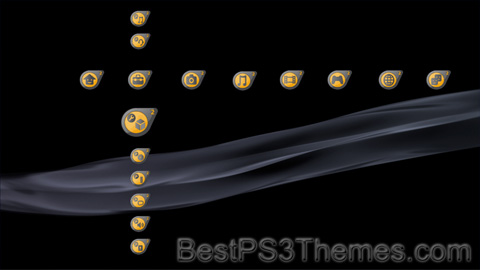
This program unpacks Playstation 3 Theme files (.p3t) so that you can touch-up an existing theme to your likings or use a certain wallpaper from it (as many themes have multiple). But remember, if you use content from another theme and release it, be sure to give credit!
Download p3textractor.zip from above. Extract the files to a folder with a program such as WinZip or WinRAR. Now there are multiple ways to extract the theme.
The first way is to simply open the p3t file with p3textractor.exe. If you don’t know how to do this, right click the p3t file and select Open With. Alternatively, open the p3t file and it will ask you to select a program to open with. Click Browse and find p3textractor.exe from where you previously extracted it to. It will open CMD and extract the theme to extracted.[filename]. After that, all you need to do for any future p3t files is open them and it will extract.
The second way is very simple. Just drag the p3t file to p3textractor.exe. It will open CMD and extract the theme to extracted.[filename].
For the third way, first put the p3t file you want to extract into the same folder as p3textractor.exe. Open CMD and browse to the folder with p3extractor.exe. Enter the following: p3textractor filename.p3t [destination path]Replace filename with the name of the p3t file, and replace [destination path] with the name of the folder you want the files to be extracted to. A destination path is not required. By default it will extract to extracted.filename.
The promotion was founded in 1953 as the Capitol Wrestling Corporation (CWC), a Northeastern territory of the National Wrestling Alliance (NWA). Following a dispute, CWC left the NWA and became the World Wide Wrestling Federation (WWWF) in April 1963. After rejoining the NWA in 1971, the WWWF was renamed the World Wrestling Federation (WWF) in 1980 before the promotion left the NWA for good in 1983. In 2002, following a legal dispute with the World Wildlife Fund, the WWF was renamed World Wrestling Entertainment (WWE). In 2011, the promotion ceased branding itself as World Wrestling Entertainment and began solely branding itself with the initials WWE.[10]
Prior to September 2023, the company's majority owner was its executive chairman, third-generation wrestling promoter Vince McMahon, who retained a 38.6% ownership of the company's outstanding stock and 81.1% of the voting power. The current entity, which was originally named Titan Sports, Inc., was incorporated on February 21, 1980, in South Yarmouth, Massachusetts, but reincorporated under Delaware General Corporation Law in 1987. It acquired Capitol Wrestling Corporation Ltd., the holding company for the WWF, in 1982. Titan was renamed World Wrestling Federation Entertainment, Inc. in 1999, and then World Wrestling Entertainment, Inc. in 2002. In 2023, its legal name was changed to World Wrestling Entertainment, LLC.[11]
As in other professional wrestling promotions, WWE shows are not true contests but entertainment-based performance theater, featuring storyline-driven, scripted, and partially choreographed matches; however, matches often include moves that can put performers at risk of injury, even death, if not performed correctly. The pre-determined aspect of professional wrestling was publicly acknowledged by WWE's then-owner Vince McMahon in 1989 in order to avoid taxes from athletic commissions. WWE markets its product as sports entertainment, acknowledging professional wrestling's roots in competitive sport and dramatic theater.
In 2023, WWE began to explore a potential sale of the company, amidst an employee misconduct scandal involving McMahon that had prompted him to step down as chairman and CEO, although he returned as executive chairman.[14] In April 2023, WWE made a deal with Endeavor Group Holdings, under which it would merge with Zuffa, the parent company of mixed martial arts promotion Ultimate Fighting Championship (UFC) to form TKO Group Holdings, a new public company majority-owned by Endeavor, with McMahon serving as executive chairman of the new entity, and Nick Khan becoming president. The merger was completed on September 12, 2023.[15] In 2024, McMahon, who was by now no longer the majority WWE stockholder, ended his ties with the company amid a sex trafficking scandal.[16]
The Packers are the last of the "small-town teams" that were common in the NFL during the league's early days of the 1920s and 1930s. Founded in 1919 by Earl "Curly" Lambeau and George Whitney Calhoun, the franchise traces its lineage to other semi-professional teams in Green Bay dating back to 1896. Between 1919 and 1920, the Packers competed against other semi-pro clubs from around Wisconsin and the Midwest, before joining the American Professional Football Association (APFA), the forerunner of today's NFL, in 1921. In 1933, the Packers began playing part of their home slate in Milwaukee until changes at Lambeau Field in 1995 made it more lucrative to stay in Green Bay full-time; Milwaukee is still considered a home media market for the team.[16][17][18] Although Green Bay is the smallest major league professional sports market in North America,[a][19]Forbes ranked the Packers as the world's 27th-most-valuable sports franchise in 2019, with a value of $2.63 billion.[20]
The Packers have won 13 league championships, the most in NFL history, with nine pre-Super BowlNFL titles and four Super Bowl victories. The Packers, under coach Vince Lombardi, won the first two Super Bowls in 1966 and 1967; they were the only NFL team to defeat the American Football League (AFL) before the AFL–NFL merger. After Lombardi retired, the Super Bowl trophy was named for him, but the team struggled through the 1970s and 1980s. Since 1993, the team has enjoyed much regular-season success, making the playoffs 23 times and winning two Super Bowls in 1996 under head coach Mike Holmgren and 2010 under head coach Mike McCarthy.[21] The Packers have the most wins (826) and the second-highest win–loss record (.571) in NFL history, including both regular season and playoff games.[22][23]
The Packers are longstanding adversaries of the Chicago Bears, Minnesota Vikings, and Detroit Lions, who today form the NFL's NFC North division (formerly known as the NFC Central Division). They have played more than 100 games against each of those teams, and have a winning overall record against all of them, a distinction only shared with the Kansas City Chiefs, Dallas Cowboys, and Miami Dolphins. The Bears–Packers rivalry is one of the oldest rivalries in U.S. professional sports history, dating to 1921.
The Green Bay Packers were founded on August 11, 1919,[1] by former high-school football rivals Earl "Curly" Lambeau and George Whitney Calhoun.[24] Lambeau solicited funds for uniforms from his employer, the Indian Packing Company, a meat packing company.[25] He was given $500 ($8,800 today) for uniforms and equipment, on the condition that the team be named after its sponsor.[26] The Green Bay Packers have played in their original city longer than any other team in the NFL.
On August 27, 1921, the Packers were granted a franchise in the American Professional Football Association, a new national pro football league that had been formed the previous year. The APFA changed its name to the National Football League a year later. Financial troubles plagued the team, and the franchise was forfeited within the year before Lambeau found new financial backers and regained the franchise the next year. These backers, known as "The Hungry Five", formed the Green Bay Football Corporation.[27]
After a near-miss in 1927, Lambeau's squad claimed the Packers' first NFL title in 1929 with an undefeated 12–0–1 campaign, behind a stifling defense which registered eight shutouts.[28] Green Bay would repeat as league champions in 1930 and 1931, bettering teams from New York, Chicago and throughout the league, with all-time greats and future Hall of Famers Mike Michalske, Johnny (Blood) McNally, Cal Hubbard and Green Bay native Arnie Herber.[29][30] Among the many impressive accomplishments of these years was the Packers' streak of 29 consecutive home games without defeat, an NFL record which still stands.[31]
Don Hutson with the Packers; his jersey number was the first retired by the Packers (1951)
The arrival of the end Don Hutson from Alabama in 1935 gave Lambeau and the Packers the most feared and dynamic offensive weapon in the game. Credited with inventing pass patterns, Hutson would lead the league in receptions in eight seasons and spur the Packers to NFL championships in 1936, 1939 and 1944. An Iron Man, Hutson played both ways, leading the league in interceptions as a safety in 1940. Hutson claimed 18 NFL records when he retired in 1945, many of which still stand.[32] In 1951, his number 14 was the first to be retired by the Packers, and he was inducted as a charter member of the Pro Football Hall of Fame in 1963.
After Hutson's retirement, Lambeau could not stop the Packers' slide. He purchased a large lodge near Green Bay for team members and families to live in. Rockwood Lodge was the home of the 1946–49 Packers. The 1947 and 1948 seasons produced a record of 12–10–1, and 1949 was even worse at 3–9. The lodge burned down on January 24, 1950, and insurance money paid for many of the Packers' debts.[33]
A 1950 depiction of Tony Canadeo, whose No. 3 was retired by the Packers in 1952
Curly Lambeau departed after the 1949 season. Gene Ronzani and Lisle Blackbourn could not coach the Packers back to their former magic, even as a new stadium was unveiled in 1957. The losing would descend to the disastrous 1958 campaign under coach Ray "Scooter" McLean, whose lone 1–10–1 year at the helm is the worst in Packers history.[34]
The Packers' first regular-season game under Lombardi was on September 27, 1959, a 9–6 victory over the Chicago Bears in Green Bay. After winning their first three, the Packers lost the next five before finishing strong by sweeping their final four. The 7–5 record represented the Packers' first winning season since 1947, enough to earn rookie head coach Lombardi the NFL Coach of the Year.
The "Golden Boy" Paul Hornung, featured on a 1961 sports card
The Packers returned to the NFL Championship game the following season and faced the New York Giants in the first league title game to be played in Green Bay. The Packers scored 24-second-quarter points, including a championship-record 19 by Paul Hornung, on special "loan" from the Army (one touchdown, four extra points, and three field goals), powering the Packers to a 37–0 rout of the Giants, their first NFL Championship since 1944.[35] It was in 1961 that Green Bay became known as "Titletown".
The Packers stormed back in the 1962 season, jumping out to a 10–0 start on their way to a 13–1 season. This consistent level of success would lead to Lombardi's Packers becoming one of the most prominent teams of their era, and to be featured as the face of the NFL on the cover of Time on December 21, 1962, as part of the magazine's cover story on "The Sport of the '60s".[36] Shortly after Time's article, the Packers faced the Giants in a much more brutal championship game than the previous year, but the Packers prevailed on the kicking of Jerry Kramer and the determined running of Jim Taylor. The Packers defeated the Giants in New York, 16–7.
The Packers returned to the championship game in 1965 following a two-year absence when they defeated the Colts in a playoff for the Western Conference title. That game would be remembered for Don Chandler's controversial tying field goal in which the ball allegedly went wide right, but the officials signaled "good". The 13–10 overtime win earned the Packers a trip to the NFL Championship game, where Hornung and Taylor ran through the defending champion Cleveland Browns, helping the Packers win, 23–12, to earn their third NFL Championship under Lombardi and ninth overall. Goalpost uprights would be made taller the next year.
Packers Willie Davis (left) and Henry Jordan tackling a Chiefs player in the first AFL-NFL Championship (Super Bowl I)
The 1966 season saw the Packers led to the first-ever Super Bowl by MVP quarterback Bart Starr. The team went 12–2, and as time wound down in the NFL Championship against the Dallas Cowboys, the Packers clung to a 34–27 lead. Dallas had the ball on the Packers' two-yard line, threatening to tie the ballgame. But on fourth down the Packers' Tom Brown intercepted Don Meredith's pass in the end zone to seal the win. The team crowned its season by rolling over the AFL champion Kansas City Chiefs 35–10 in Super Bowl I.
The 1967 season was the last for Lombardi as the Packers' head coach.[37] The NFL Championship game, a rematch of the 1966 contest against Dallas, became indelibly known as the "Ice Bowl" as a result of the brutally cold conditions at Lambeau Field.[38] Still the coldest NFL game ever played, it remains one of the most famous football games at any level in the history of the sport.[39] With 16 seconds left, Bart Starr's touchdown on a quarterback sneak brought the Packers a 21–17 victory and their still unequaled third straight NFL Championship. They then won Super Bowl II with a 33–14 victory over the Oakland Raiders. Lombardi stepped down as head coach after the game, and Phil Bengtson was named his suc
Fred Zollner owned the Zollner Corporation, a foundry that manufactured pistons, primarily for car, truck, and locomotive engines in Fort Wayne, Indiana.[9] In 1937, Zollner sponsored a semi-professional company basketball team called the Fort Wayne Zollner Pistons after he received a request from his workers.[10] In 1941, the Zollner Pistons shed their works team roots and joined the National Basketball League (NBL).[1] The Zollner Pistons were NBL champions in 1944 and 1945.[1] They also won the World Professional Basketball Tournament in 1944, 1945 and 1946.[11]
In 1948, the team became the Fort Wayne Pistons and jumped to the Basketball Association of America (BAA).[9] In 1949, Fred Zollner brokered the formation of the National Basketball Association from the BAA and the NBL at his kitchen table.[9]
There are suggestions that Pistons players conspired with gamblers to shave points and throw various games during the 1953–54 and 1954–55 seasons. In particular, there are accusations that the team may have intentionally lost the 1955 NBA Finals to the Syracuse Nationals.[12] In the decisive Game 7, the Pistons led 41–24 early in the second quarter before the Nationals rallied to win the game.[13][14] The Nationals won on a free throw by George King with 12 seconds left in the game.[13][14] The closing moments included a palming turnover by the Pistons' George Yardley with 18 seconds left, a foul by Frank Brian with 12 seconds left that enabled King's winning free throw, and a turnover by the Pistons' Andy Phillip in the final seconds which cost them a chance to attempt the game winning shot.[13][14] In the following season, the Pistons made it back to the NBA Finals. However, they were defeated by the Philadelphia Warriors in five games.[15]
Dave Bing joined the team in 1966, scoring 1,601 points in his rookie year.
Though the Pistons enjoyed a solid local following, Fort Wayne's small size made it difficult for them to be profitable, especially as other early NBA teams based in smaller cities started folding or relocating to larger markets.[1] After the 1956–57 season, Fred Zollner decided that Fort Wayne was too small to support an NBA team and announced the team would be playing elsewhere in the coming season. He ultimately settled on Detroit.[1] Although it was the fifth largest city in the United States at the time,[16] Detroit had not seen professional basketball in a decade.[1][17][18][19] They lost the Detroit Eagles due to World War II, both the Detroit Gems of the NBL (who became the Minneapolis Lakers) and the Detroit Falcons of the BAA in 1947, and the Detroit Vagabond Kings in 1949.[1][17][18][19] Zollner decided to keep the Pistons name, believing it made sense given Detroit's status as the center of the automobile industry.[1][9]George Yardley set the NBA single-season scoring record in the Pistons' first season in Detroit, becoming the first player to score 2,000 points in a season.[20][21]
During the 1960s and 1970s, the Pistons were characterized by talented players including George Yardley, Bailey Howell, Dave Debusschere, Dave Bing, and Bob Lanier, questionable trades, and frequent coaching changes.[22][23][24][25][26][27] At one point, DeBusschere was the youngest player-coach in the history of the NBA.[25] Then a trade during the 1968–69 season sent DeBusschere to the New York Knicks for Howard Komives and Walt Bellamy, both of whom had their best seasons behind them.[25] DeBusschere became a key player in leading the Knicks to two NBA titles.[25] Howell had previously been dealt to the Baltimore Bullets in 1964 and former Pistons guard Gene Shue, who was the head coach of the Bullets at the time, assessed the Pistons thusly: "Detroit has the worst management in the league."[28][29] Howell would go to win two championships as a member of the Boston Celtics. Yardley, Lanier, and Bing all ended their Pistons tenure being traded away, frustrated with the direction and opportunities with Detroit.[30][31][32]
In 1974, Zollner sold the team to glass magnate Bill Davidson, who remained the team's principal owner until his death in 2009.[33][34]
The team had a winning season in 1971, having spent the 1960s below .500, and then had a brief period of sustained success in the mid-1970s, qualifying for the playoffs in four straight seasons (1974, 1975, 1976 and 1977).[35][36][37][38] Hope was then placed in Dick Vitale in 1978, the former head coach at the University of Detroit, but he was fired the following season, and the team limped into the 1980s with a 16–66 record in 1979–80.[39] The 1979–80 team lost its last 14 games of the season which, when coupled with the seven losses at the start of the 1980–81 season, constituted a then-NBA record losing streak of 21 games.[40]
Over time, Davidson became displeased with Cobo Arena, but opted not to follow the Red Wings to the under-construction Joe Louis Arena next door. Instead, in 1978, he moved the team to the suburb of Pontiac, where they played in the 82,000 capacity Silverdome, a structure built for professional football (and the home of the Detroit Lions at the time).[22][41]
Isiah Thomas against the New York Knicks at Madison Square Garden on January 19, 1985.
Initially, the Pistons had difficulty moving up the NBA ladder. In 1984, the Pistons lost a tough five-game series to the underdog New York Knicks, 3–2.[45] In the 1985 playoffs, Detroit won its first-round series and faced the defending champion Boston Celtics in the conference semifinals. Though Boston prevailed in six games, Detroit's surprise performance promised that a rivalry had begun.[39] In the 1985 NBA draft, the team selected Joe Dumars 18th overall, a selection that proved to be very wise.[46] They also acquired Rick Mahorn in a trade with the Washington Bullets.[47] However, the team took a step backwards, losing in the first round of the 1986 playoffs to the more athletic Atlanta Hawks.[48] After the series, changes were made in order to make the team more defensive-minded.[39]
Prior to the 1986–87 season, the Pistons acquired more key players: John Salley (drafted 11th overall), Dennis Rodman (drafted 27th) and Adrian Dantley (acquired in a trade with the Utah Jazz).[49][50] The team adopted a physical, defense-oriented style of play, which eventually earned them the nickname "Bad Boys".[51]
In 1987, the team reached the Eastern Conference Finals against the Celtics. After pushing the defending champions to a 2–2 tie, the Pistons were on the verge of winning Game 5 at the Boston Garden with seconds remaining.[52][53] After a Celtics turnover, Isiah Thomas attempted to quickly inbound the ball and missed Chuck Daly's timeout signal from the bench. Larry Bird stole the inbound pass and passed it to Dennis Johnson for the game-winning layup.[52][53] While the Pistons did win Game 6 in Detroit, they lost the series in a tough Game 7 back in Boston.[52][53]
Chuck Daly, coach of the 1989 and 1990 NBA champions.A ticket for Game 1 of the 1988 NBA Finals at The Forum.
Motivated by their loss to the Celtics, the Pistons, aided by midseason acquisition James Edwards, improved to a then-franchise-record 54 victories and the franchise's first division title in 32 years.[39][54][55] In the postseason, the Pistons avenged their two previous playoff losses to the Celtics in the Eastern Conference Finals, defeating them in six games and advancing to the NBA Finals for the first time since the franchise moved to Detroit.[39]
The Pistons' first trip to the Finals in 32 years saw them face the Los Angeles Lakers, who were led by Magic Johnson, James Worthy, and Kareem Abdul-Jabbar.[15][39] After taking a 3–2 series lead back to Los Angeles, Detroit appeared poised to win their first NBA title in Game 6. In that game, Isiah Thomas scored an NBA Finals record 25 points in the third quarter while playing on a severely sprained ankle.[56] However, the Lakers won the game, 103–102, on a pair of last-second free throws by Abdul-Jabbar following a controversial foul called on Bill Laimbeer, referred to by many as a "phantom foul".[56][57][58] With Thomas unable to compete at full strength, the Pistons narrowly fell in Game 7, 108–105, as the Lakers became the first back-to-back NBA Champions since the 1969 Boston Celtics.[56][59]
Dennis Rodman, NBA Defensive Player of the Year in 1990 and 1991
Prior to the 1988–89 season, the Pistons moved to Auburn Hills to play at The Palace of Auburn Hills, the first NBA arena financed entirely with private funds.[60] The 1989 Pistons completed the building of their roster by trading Adrian Dantley for Mark Aguirre, a trade that Pistons fans criticized heavily initially, but later praised.[61][62][63][64] The team won 63 games, shattering their one-year-old franchise record, and steamrolled through the playoffs and into an NBA Finals rematch with the Lakers. This time, the Pistons came out victorious in a four-game sweep to win their first NBA championship. Joe Dumars was named NBA Finals MVP.[65]
The Pistons successfully defended their title in 1990, despite losing Rick Mahorn to the Minnesota Timberwolves in the expansion draft.[66][67] After winning 59 games and a third straight division title, the Pistons cruised through the first two rounds of the playoffs before playing a tough Eastern Conference Finals series against Michael Jordan, Scottie Pippen, and the Chicago Bulls. Facing each other for the third straight season, the Pistons and Bulls split the first six games before the Pistons finished the series with a decisive 93–74 victory in Game 7.[68][69][70] Advancing to their third consecutive NBA Finals, the Pistons faced the Portland Trail Blazers.[67] After splitting the first two games at The Palace, the Pistons went to Portland, where they had not won a game since 1974, to play Games 3, 4 and 5.[71] The Pistons won all three games in Portland, becoming the first NBA team to sweep the middle three games on the road.[72] The decisive game came down to the final second. Trailing 90–83 with two minutes remaining, the Pistons rallied to tie the game, then took a 92–90 lead when Vinnie Johnson sank a 15-foot jumper with 00.7 seconds left in the game; this shot earned Johnson a new nickname in Detroit, "007", to go with his original, "The Microwave".[67][73] Isiah Thomas was named NBA Finals MVP.[67]
The Pistons' championship run came to an end in the 1991 Eastern Conference Finals, as they were swept by the eventual NBA champion Chicago Bulls in four games.[74] The most critical injury during this time belonged to Isiah Thomas, who had suffered a wrist injury a few months prior to the NBA playoffs.[75] The Conference Finals is best remembered for the Pistons walking off the court in the last game just before it ended, willingly letting the final seconds tick away, unwilling to shake hands with the Bulls. After the series, Michael Jordan said, "You see two different styles with us and them. The dirty play and the flagrant fouls and unsportsmanlike conduct. Hopefully, that will be eliminated from the game. I think we play clean basketball. We don't go out and try to hurt people and dirty up the game. You never lose respect for the champions. But I haven't agreed with the methods they used. I think people are happy the game will get back to a clean game [with a Bulls triumph] and away from the 'Bad Boy' image."[76][77][78] It was later revealed that the real reason the Pistons walked off the court without shaking hands with the Bulls was due to comments said by Jordan in a pre-game interview before Game 4, where he said, "The Pistons are undeserving champions. The Bad Boys are bad for basketball."[79]
After getting swept by the Bulls, the Pistons traded James Edwards and waived Vinnie Johnson during the off-season.[80][81] In the
From other capitalisation: This is a redirect from a title with another method of capitalisation. It leads to the title in accordance with the Wikipedia naming conventions for capitalisation, or it leads to a title that is associated in some way with the conventional capitalisation of this redirect title. This may help writing, searching and international language issues.
If this redirect is an incorrect capitalisation, then {{R from miscapitalisation}} should be used instead, and pages that use this link should be updated to link directly to the target. Miscapitalisations can be tagged in any namespace.
Use this rcat to tag onlymainspace redirects; when other capitalisations are in other namespaces, use {{R from modification}}instead.
Yakuza 3 (Japanese: 龍が如く3, Hepburn: Ryū ga Gotoku 3, "Like a Dragon 3") is the third main entry in the Like a Dragon series, released for the PlayStation 3 in 2009. It was developed and published by Sega.[1][2] It was released in Japan and South East Asia on February 26, 2009, and in North America and Europe on March 9, 2010, and March 12, 2010.[2] A remaster containing all cut content was released in Japan on August 9, 2018, and worldwide on August 20, 2019, for the PlayStation 4, and on January 28, 2021, for Windows and Xbox One.[3][4] A sequel, Yakuza 4, was released on March 18, 2010, in Japan.[5]
Yakuza 3 introduces PlayStation Network Trophies to the series with 45 trophies[6] (50 in the Eastern releases).[7] It adds four gameplay elements:
Seamless Battle (シームレスバトル shimuresu batoru): Seamless Battle is a streaming data-based loading-free system that allows the game to directly connect the adventure mode and the battle mode (called "Kenka") without the usual loading black screen.
Chase Battle (チェイスバトル, cheisu batoru): Chase Battle is a new battle mode which replaces the regular brawling (Kenka) with a running sequence set within a certain area. Both the chaser and chased have a stamina gauge that decreases naturally as the character runs, by being hit with a thrown object or by colliding with a passer-by. When the stamina gauge is empty the exhausted character stops the chase. During the game a minor character, Mack Shinozuka, will train Kiryu to improve his running performance.
Revelation (天啓, tenkei): Ten revelations, spread throughout the game, will allow Kazuma Kiryu to learn new Heat Actions (ヒートアクション) in Adventure mode; it is similar to the system introduced in the previous game Ryū ga Gotoku: Kenzan!. This time Kazuma uses the built-in camera on his cell phone to record new moves and techniques. These are acquired through hints and incidents spotted in First Person View. Learned Heat Actions are posted on Kazuma's personal blog, called "Kamuroblo", which uses the same template as general director Toshihiro Nagoshi's own blog.[8]
First Person View: When pressing the DualShock 3's R3 button during the adventure mode, the standard third person view switches to a brand new first person mode. This perspective allows a better observation of the streets and people, but looking some people in the eyes using First Person View will provoke them and they will attack. First Person View is disabled in some indoor places and at certain angles.
The main story spans twelve chapters plus a prologue. As with the earlier games, each chapter is preceded by a cinematic, called an "event scene", which later becomes available in the Gallery mode. Skipping these scenes using the Start button can only be done after enabling the scene-skipping option in the menu, which is switched off by default. The western version of Yakuza 3 features 295 minutes of cutscenes according to the BBFC.[9]
Six sub-scenarios ("Date's Pride", "Two Fathers", "Hometown Girl", "The Finishing Touch", "Silver Screen Dragon", and "Murder at Café Alps") are special missions featuring "event scene" cinematics.
In the eastern releases, the main story is complemented with 123 unique side stories called "sub-scenarios" ("substory" in the original version, サブストーリーsabustori). These sub-scenarios are divided into two classes: Mission and Hitman. There are 103 standard missions, some of which are made up of different episodes, and 20 hitman sub-scenarios. Fifteen of these bounty hunter sidestories are located in Kamurocho, the remaining five in Ryukyu.
Twenty minigames are available within Adventure mode. These are aromatherapy massage (eastern releases only), darts, pool, karaoke, bowling, mahjong (eastern releases only), chinchirorin, shogi (eastern releases only), chō-han, koi-koi, oicho-kabu, roulette, poker, blackjack, Answer & Answer (eastern releases only), UFO Catcher, batting cage, golf, surf fishing and Boxcelios. 2-player support for some of these mini games and an expansion for Answer & Answer are added through DLC, as well as main menu direct access in the eastern releases. However, the quiz minigame's expansion was eventually removed from the western release and 2-player support became a time limited DLC exclusive to the North American release's Challenge Pack. Challenges like Mack Shinozuka's training, Inner Fighter 7 and Haruka's Request aren't considered either mini games or side stories.
Beating the game in "Hard" mode unlocks the "Ex-Hard" (extreme hard) extra difficulty level. Completing the game in any difficulty mode will create a "cleared data" save file and unlock "Premium New Game" and "Premium Adventure". The first allows to restart the game with all accumulated money, items, experience levels and fighting techniques. The latter is a free-run mode dedicated to exploration and completion as it doesn't include the main story, with only sub-scenarios remaining (though a small number of missions will only appear at a certain point in story mode, and cannot be triggered in Premium Adventure). Extra game contents are added through DLC.
As with the previous games, the Underground Coliseum (闘技場, Tōgijō) is available. An illicit mixed martial arts competition sponsored by Majima is held in the area beneath Kamurocho Hills, formerly Purgatory. The arena is inspired by real life Japanese cage fighting competitions such as K-1 World Grand Prix; gameplay is similar to fighting games Toshihiro Nagoshi previously worked on such as Virtua Fighter 5 and SpikeOut. Single Tournament has 50 unique international fighters (a minor character with its own profile) and 11 grand prix tournaments to choose from. These 3-round competitions have various rings, rules and difficulty levels; the different types of tournament are Exhibition Tournament, Street Fight GP, Breakout GP, Heat GP, Bounding GP, Bomber GP, Golden Glove GP, Weapon Master GP, Hyper GP, Magnum Force GP and Maximum GP. Tag Tournament is a two-partner team match including 20 unique teams. Each team is made of paired Single Tournament fighters enhanced with a special duo attack. There are 2 available grand prix named Tag Match GP and Twin Dragon GP. Three Single Tournament fighters and two Encounter Battle characters will join Kazuma Kiryu's "Team Dragon" ("Team The Dragon" in the original release) as tag partners once he finds them in the Adventure Mode; these are boxer Maxim Soldatov (マクシム・ソルダドフ), kenpō Bruce Ebinuma (ブルース海老沼), puroresu Daiji Hiyama (桧山 大治), Keigo Kanno (神野 慶吾) and Masaki Hatae (波多江 真幸). Orders can be given to these partners using the DualShock 3's arrow keys.
Completing the story mode unlocks 35 additional Battle Missions gathered in a bonus mode called Final Competition (究極闘技, Kyōkyoku Tōgi, Ultimate Contest). The first competition has 10 missions and is called "Melee Competition" (乱戦闘技, Ransen Tōgi), the second has 5 missions and is called "Showdown Competition" (対決闘技, Taiketsu Tōgi), the third has 10 missions and is called "Trial Competition" (試練闘技, Shiren Tōgi), and fourth competition has 5 missions and is called "Cooperation Competition". Completing these four competitions unlocks a fifth competition called the Final Competition (究極闘技, Kyōkyoku Tōgi) which has 5 missions. Completing all 35 missions with an "S" rank, the highest rank possible, unlocks a special item delivered by Bob Utsunomiya, which is a talisman called the Fighting God's Talisman ((闘神の護符, Tatagami no Gofū) that, when equipped, permanently maintains the Heat Gauge at maximum level.
Once story mode is completed the player can start a Premium Adventure and meet a hidden minor character (a clairvoyant woman) who allows access to four exclusive modes (専用モード, Senyō mōdo) added through DLC, only available in a special edition of the game in Europe, and as a preorder bonus in North America.[10] In Survival Battle Kazuma Kiryu must find and defeat the "Last Boss" (ラスボス, rasu bosu), Yoshitaka Mine; eight bonus bosses are disseminated within Kamurocho. In Survival Onigokko, Kazuma Kiryu is chased by Bob Utsunomiya in Kamurocho, with ten missions to complete in 3 minutes. All Star Tournament is an extra Arena single tournament that involves all 8 boss characters plus Goh Hamazaki, the latter of which can only be fought in this mode. All Star Tag Tournament is an extra tag tournament that pits Kazuma Kiryu and his fighting partner Goro Majima against 7 teams of bosses and bonus characters such as Kazuki, Yuya, Goh Hamazaki and Komaki.
The quest for the disseminated 100 coin lockers (half of them hidden in Kamurocho, the others in Ryukyu) is rewarded with the "Key Collector" Silver PSN Trophy. The latter was called "Kagi no Hōrōsha" (鍵の放浪者) (lit. "vagrant keys") and was only Bronze level in the Eastern releases. As a mixed game including elements of the sandbox game and RPG genres, Yakuza 3 includes a "Completion" feature that sums up what percentage of the game was actually completed by the player.
Only 100% completion (Completion + Sub-Scenario) will unlock the final mission involving a recurring hidden all-black character named Jo Amon 亞門 丈 (Amon Jo), a.k.a. "Mysterious Hitman",[11] a returning character from the spinoff[12] and a secret boss available since the original Yakuza title.[13] In Yakuza 3, Jo Amon's weapon is dual light sabers.[14]
Unlike Ryū ga Gotoku Kenzan! (the previous game in the series, released only in Japan), which was a Miyamoto Musashi-based spinoff set in Edo-era Kyoto, this installment continues the adventures of Kazuma Kiryu from Yakuza and Yakuza 2. The game takes place both in Kamurocho, a fictional version of Tokyo's red-light districtKabukicho, from the first two games, and in a brand new location called Ryukyu.
The area of Okinawa where the story takes place is a fictional area, based upon Naha's Makishi. It includes real life landmarks such as the Ichiba Hondori[15] (linked to Mutsumibashi Dori and Heiwa Dori) covered shopping arcade renamed "Karyushi Arcade" (かりゅしアーケード, karyushi ākēdo) in the game as well as the popular Makishi Public Market shortened "Public Market" (公設市場, Kōsetsu Ichiba),[16] the famous entertainment strip Kokusai Street called "Ryukyu Street" (琉球通り, Ryūkyū Doori),[17] the Okinawa MonorailKencho-mae Station as "Ryukyugai-mae Station" (琉球街前, Ryūkyūgai Mae) or the Mitsukoshi department store (Okinawa Mitsukoshi) which kept its actual name as part of the game's tie-in policy.
Compared with the earlier episodes, the Kamurocho area has some minor changes with additional backstreets and landmarks. South-East Kabukicho's European medieval castle-shaped karaoke box Royal Castle Bldg. (王城ビル) has been modeled and renamed "Kamuro Castle", and north-west Kamurocho love hotel Hotel Åland has been recreated in Kamurocho hotels quarter as the Hotel Tea Clipper.
Unlike previous episodes, the story is not written by Hase Seishu; instead, it was primarily penned by writer Masayoshi Yokoyama. Yakuza 3 takes a departure from the first two games with its choice of setting: instead of focusing on the gritty cityscapes of Tokyo and Osaka, it switches gears and sends Kazuma Kiryu to the rural Ryukyu Islands of Okinawa, where he runs the Morning Glory Orphanage ("Sunshine Orphanage" in the English PS3 version) with his adoptive daughter Haruka Sawamura (who calls him "Uncle Kaz").
In February 2007, after ending the war with the Omi Alliance, Kiryu and Haruka visit the cemetery where his adopted father, Shintaro Kazama (Tetsuya Watari), rests. They are joined by Kaoru Sayama (Yū Daiki), who leaves for the United States. Kiryu accepts custody of an orphanage in Okinawa, hoping to raise orphans like Kazama raised him. Before leaving, he enlists his rival, Goro Majima (Hidenari Ugaki), to assist Daigo Dojima (Satoshi Tokushige), Kiryu's successor, in his duties as clan chairman. Majima agrees, after Kiryu defeats him.
Six months later, Kiryu has settled into the orphanage and is dealing with eviction notices from the Ryudo Family, who own the land it's built on. He confronts two members of the clan, including the boss's right-hand man, Rikiya Shimabukuro, and meets the clan's patriarch, Shigeru Nakahara (Shigeru Izumiya). Nakahara informs Kiryu that the land is wanted for a seaside resort. Kiryu refuses to close the orphanage, despite Nakahara's threats.
The following week, Rikiya asks Kiryu for help in finding Nakahara's daughter, Saki (Umeka Shōji). Kiryu and Rikiya learn that Saki's mother is working with Tetsuo Tamashiro (Unshō Ishizuka), the patriarch of a rival family, who plans to use Saki as leverage to seize Nakahara's territory. Kiryu defeats Tamashiro and banishes his gang, and Saki returns to Nakahara when her mother rejects her. Nakahara pledges an oath to Kiryu in return. Daigo reveals that Tamashiro was recruited to secure the land in a scheme tied to Defense Minister Ryuzo Tamiya's (Akio Otsuka) "Military Base Expansion Bill". Daigo refuses to involve the Tojo Clan with the resort.
In March 2009, Daigo and Nakahara are shot in separate incidents, leaving Daigo comatose, and the deed to the orphanage is stolen. Kiryu travels to Kamurocho and meets Osamu Kashiwagi (Shunsuke Sakuya), Kazama's successor, who is assassinated by a gunship. Fleeing, Kiryu is rescued by his old friend, Makoto Date (Kazuhiro Yamaji, who informs him of three suspects for Kashiwagi's death: Yoshitaka Mine (Nakamura Shidō II), chairman of the Hakuho Clan, Goh Hamazaki (George Takahashi), a patriarch with ties to the Yokohamatriads, and Tsuyoshi Kanda (Hiroyuki Miyasako), who controls Akira Nishikiyama's former gang.
Kiryu and Rikiya interrogate Kanda, and learn he is uninvolved. Date informs Kiryu that Majima has been contracted to build the resort. After a rematch, Majima explains that Hamazaki got him the contract. Majima's associate, the Florist of Sai (Yoshiaki Fujiwara), informs Kiryu that his old enemy, Lau Ka Long (Shinichi Takizawa), is an ally of Hamazaki. Long has Rikiya kidnapped and forces Kiryu to fight him. Rikiya is saved by Nakahara's attacker, who kills Long. Kiryu later meets Mine, who presents him with Kanda's severed head and reveals that Hamazaki has disappeared, and his men have been killed, presumably by the triads.
Tamiya meets Kiryu, and reveals that the Military Base Expansion Bill is part of a CIA operation to eliminate an arms smuggling group known as "Black Monday", and Nakahara's attacker is senior CIA operative Joji Kazama (Shintaro Kazama's brother, also voiced by Tetsuya Watari). Tamiya agrees to stop the resort if Kiryu protects his former secretary from a planned hit by Joji. Kiryu intercepts Joji and defeats him. Returning home, Kiryu finds the orphanage in ruins; Mine had promised Tamashiro a share of the resort for securing the remaining land. Nakahara is trampled by bulls in Tamashiro's bullring hideout. Kiryu defeats Tamashiro, who then fires at him; Rikiya defends Kiryu and is fatally wounded. Joji kills Tamashiro, while the dying Rikiya asks Kiryu to stop Mine.
Joji has a jet fly Kiryu to Tokyo. Kiryu defeats the Hakuho Clan at the hospital where Daigo is being treated, then defeats a rogue CIA team led by Joji's colleague, Andre Richardson (Charles Glover). He locates Mine and Daigo on the hospital roof. Mine reveals that he idolizes Daigo, intending to euthanize him and take over the Tojo Clan. Kiryu defeats him. Richardson arrives with his team and reveals himself to be the leader of Black Monday. Before he can kill Mine and Kiryu, Daigo wakes up and kills Richardson's agents. Richardson attempts to kill Daigo and Kiryu, and Mine, inspired by Kiryu, sacrifices himself to save them by tackling Richardson off the roof to their deaths. Joji and Haruka arrive with a rescue chopper.
Kiryu bids farewell to his friends Kazuki (Hiroshi Tsuchida) and Yuya (Kenta Miyake) as he and Haruka meet before going home. Kiryu is confronted by Hamazaki, who blames him for his misfortune and stabs Kiryu for mine's death before Kazuki and Yuya subdue him. Badly wounded, Kiryu seemingly gives his dying words to Haruka.
In a post-credits scene, Kiryu is revealed to have survived as he rests at the orphanage.
Daisuke Tomoda, CS1 Team (Sega CS R&D) visual artist and character design team leader of the Yakuza series since the original episode,[18] partially unveiled Yakuza 3`s development at the 2009 Game Tools & Middleware Forum seminar held in Tokyo on June 15.[19]Yakuza 3 character designing began shortly after the completion of Ryū ga Gotoku Kenzan! in 2008 with a three-week project phase followed by an eight months production.[19] In the end, 110 high polygon characters, for they appear in Event Scene cinematics, plus 250 minor characters, were created by 60 teams producing a dozen characters each.[19] Thus, 360 characters were produced following a "one person one body" philosophy and a three-day-per-body target schedule.[19] As a comparison, the production of Yakuza on PlayStation 2 took ten months and had no more volume.[19] The series' production pace is one game per year since the original Yakuza in 2005.[19] CS1 used a slogan to describe the game's graphics: "Not Reality but Real (リアリティではなくリアル, Riariti de wa naku riaru).[20]
As with the previous PlayStation 3 Ryū ga Gotoku game, main characters have their face scanned through Cyberware's head & face color 3D scanner (model PS).[20] As detailed at the GTMF 2009, Event Scene cinematics are real-time and render highly detailed XSI 6.5 2.5MB data size characters using 18,000~20,000 polygons each;[20] 3D model bones are made of 107 meshes with 64 used for the body and the remaining 43 used for the face.[19] In addition, the PlayStation 3 employs advanced graphics technologies without LOD, texture size 512×512 front buffer with 512×512 back buffer, diffuse map and normal map, multi map (ambient occlusion, specular mask, 8-bit specular power RGB) within cutscene.[19] These Event Scene cinematics fully exploit Sega's in-house facial expressions engine called Magical V-Engine.[19] This engine is based on a unique "wrinkle shader" technology 皺シェーダー (Shiwa shēdā)[19] that allows for advanced facial animation from voice recordings alone.[21] By animating based upon not only the phonetic lip syncing but tone, the software can emulate the basic human emotions in full facial expression.[21]
This program unpacks Playstation 3 Theme files (.p3t) so that you can touch-up an existing theme to your likings or use a certain wallpaper from it (as many themes have multiple). But remember, if you use content from another theme and release it, be sure to give credit!
Download p3textractor.zip from above. Extract the files to a folder with a program such as WinZip or WinRAR. Now there are multiple ways to extract the theme.
The first way is to simply open the p3t file with p3textractor.exe. If you don’t know how to do this, right click the p3t file and select Open With. Alternatively, open the p3t file and it will ask you to select a program to open with. Click Browse and find p3textractor.exe from where you previously extracted it to. It will open CMD and extract the theme to extracted.[filename]. After that, all you need to do for any future p3t files is open them and it will extract.
The second way is very simple. Just drag the p3t file to p3textractor.exe. It will open CMD and extract the theme to extracted.[filename].
For the third way, first put the p3t file you want to extract into the same folder as p3textractor.exe. Open CMD and browse to the folder with p3extractor.exe. Enter the following: p3textractor filename.p3t [destination path]Replace filename with the name of the p3t file, and replace [destination path] with the name of the folder you want the files to be extracted to. A destination path is not required. By default it will extract to extracted.filename.
This program unpacks Playstation 3 Theme files (.p3t) so that you can touch-up an existing theme to your likings or use a certain wallpaper from it (as many themes have multiple). But remember, if you use content from another theme and release it, be sure to give credit!
Download p3textractor.zip from above. Extract the files to a folder with a program such as WinZip or WinRAR. Now there are multiple ways to extract the theme.
The first way is to simply open the p3t file with p3textractor.exe. If you don’t know how to do this, right click the p3t file and select Open With. Alternatively, open the p3t file and it will ask you to select a program to open with. Click Browse and find p3textractor.exe from where you previously extracted it to. It will open CMD and extract the theme to extracted.[filename]. After that, all you need to do for any future p3t files is open them and it will extract.
The second way is very simple. Just drag the p3t file to p3textractor.exe. It will open CMD and extract the theme to extracted.[filename].
For the third way, first put the p3t file you want to extract into the same folder as p3textractor.exe. Open CMD and browse to the folder with p3extractor.exe. Enter the following: p3textractor filename.p3t [destination path]Replace filename with the name of the p3t file, and replace [destination path] with the name of the folder you want the files to be extracted to. A destination path is not required. By default it will extract to extracted.filename.
Lost Planet is a video game series of third-person shooters published by Capcom. The series follows a number of protagonists on E.D.N III, a planet in the process of an ice age, as they survive and fight the environment, various alien creatures and those planning to colonize the planet.
The first Lost Planet game takes place in the year known in the game as T.C. -80 on the fictional planet of E.D.N. III. After the Earth's conditions become too hostile for humans due to war, global warming and pollution, a fictional interstellar megacorporation named Neo-Venus Construction (NEVEC) plans to colonize E.D.N. III, a new Earth-like planet in the grip of a brutal ice age. NEVEC discovers that E.D.N. III is inhabited by an aggressive and territorial insectoid alien species named the Akrid, which come in all shapes and sizes and generate their own precious thermal energy. 150 years after a great war was fought in which the humans lost to the Akrid, the plot of the game revolves around Wayne Holden, a "snow pirate" who attempts to overthrow the ruthless NEVEC, who still vie for control over E.D.N. III, and help colonization efforts for the remainder of the human race by destroying the Akrid, all the while attempting to survive both betrayals and the extreme conditions of the planet.
Lost Planet received mixed reviews on the PlayStation 3[3] and PC,[4] but more positive reception for the Xbox 360 version which was the original lead platform.[5] The game shipped over a million copies worldwide by January 2007 marking Capcom's second million seller for Xbox 360.[6] As of March 2016, the game has sold over 1,600,000 copies on the Xbox 360 alone including downloadable copies.[7]IGN gave the Xbox 360 version their Editor's Choice award, and it won the award for best Xbox 360 game at the Leipzig Games Convention.[8]
Lost Planet: Extreme Condition Colonies Edition (2008)[edit]
The Colonies Edition is a gold edition version of Extreme Condition for the Xbox 360 and PC with new multiplayer maps, a Human vs Akrid multiplayer mode, and a selection of new multiplayer characters and weapons.[9][10]
Colonies also introduces four new single-player modes: Score Attack (points are given for each kill using combos), Time Trial Battle Mode, first person shooter mode, and Unlimited Mode. The game also includes cross-platform play between Xbox Live and Games for Windows – Live users. The Colonies Edition is not compatible with the original Lost Planet save games or multiplayer game, so players of each release may only play with others who have the same release. The game was released in North America on May 27, 2008; in Japan on May 29; and in Europe on June 6.
The Xbox 360 version saw positive reception in comparison to a mixed response for the PC version.[11][12]
Lost Planet 2 is the sequel to Lost Planet: Extreme Condition, taking place ten years after the events of the first game, on the same fictional planet. It is both developed and published by Capcom. The game was released for the PlayStation 3 and Xbox 360 on May 11, 2010, in the United States and in Europe (on May 20 in Japan). It was also released for Microsoft Windows for North America on October 12 and for Europe on October 15.
Lost Planet 2 sold 1,900,000 copies between all platforms by March 2016 and across all platforms.[7] Reception for the PlayStation 3 version matched the Xbox 360 version,[13][14] however the PC version saw notable criticism.[15]
E.X. Troopers is a spin-off game of the Lost Planet series, it is developed by Capcom and released only in Japan for Nintendo 3DS and PlayStation 3 on November 22, 2012. The game added new and more dangerous hostile Akrid enemies along with several new weapons. Some revisions include a focus on lock-on-based movement and shooting both on foot and in Vital Suits akin to Gundam vs Gundam as well as a series of Monster Hunter elements as the title shared the producer of recent installments of that series.
The game saw lower sales than other games in the Lost Planet franchise, but positive reception from Famitsu.[16] It also possesses a cult following leading to the western Capcom branch addressing interest and the Japanese branch releasing music tracks on the anniversary of the game's release.
Lost Planet 3 is the third numbered entry in the series and was developed by Spark Unlimited instead of internally by Capcom.[1] It was released on the PlayStation 3, Xbox 360, and Microsoft Windows in August 2013 and takes place in the same ice-age like environment as the first instead of the varied environments of the second.[17][18]
While all versions of the game received a mixed reception,[19][20][21] Famitsu offered praise in their review for the renewed story focus.[22][23]
The main character, Wayne, shown in a promotional advertisement for the first Lost Planet
Capcom first introduced Lost Planet on December 10, 2005, at an invite only press conference announcing Jun Takeuchi as both the producer and executive producer, Kenji Oguro as the designer and Shin Kurosawa who wrote the original story. At the conference, Capcom announced that they would follow the tradition of basing the main character of their game after a real person. Capcom decided to base the main character Wayne after the famous Korean star, Byung Hun Lee.[24] To capture the full essence of Lee, Capcom used a program called Face Robot. This allowed Capcom to use Lee's basic expressions and translate them to Wayne in the game. Capcom had Lee dress up in a recreation of Waynes attire and then did full body 3D scan to translate Lee into Wayne using a function called GATOR. But instead of using Lee for character animations, the developers did so manually. As for environments, Capcom used up to 300,000 to 600,000 polygons in the screen at once for a single battle. They then used an XSI program and then manually added in elaborate details. One of the main focuses of Lost Planet was to make a game that could be a commercial success in both North America and Japan.[25]
Lost Planet 2 runs on the MT-Framework 2.0, an updated version of the engine used in several Capcom-developed games.[26] A support for the campaign mode can have up to 4 players working together via the internet.[27]
The first Lost Planet begins in the year of the game T.C. -80 where the Earth has become too hostile for human life. A company named NEVEC (Neo-Venus Construction) tries to start colonization on the planet E.D.N. III. Upon arriving on the planet, NEVEC discovers an alien race called Akrid and are forced off the planet, momentarily stopping colonization efforts. Returning to E.D.N. III with an army prepared to fight, they find that the Akrid can only function because their bodies contain reserves of thermal energy (T-ENG), humans must also carry supplies of thermal energy to survive on E.D.N. III. NEVEC builds the first Vital Suit (VS), a mecha powered by T-ENG, to fight the Akrid. Meanwhile, civilian colonists and bands of E.D.N. III military personnel continue to seek out a nomadic existence as "snow pirates", harvesting T-ENG from fallen Akrid.
The story of the sequel takes place back on E.D.N. III, 10 years after the events of the first game. The snow has melted to reveal jungles and more tropical areas that have taken the place of more frozen regions. The game centers on a civil war to gain T-ENG.[28] Player(s) can assume control of several different groups of soldiers, called Snow Pirates, and battle the Akrid. The Akrid have expanded their armies and return much more powerful in Lost Planet 2.
Lost Planet 3 is a prequel to the first two games in the series, following the story of Jim Peyton on E.D.N. III.
In July 2008, David Hayter (voice of Solid/Naked Snake in the video game series Metal Gear Solid and screenwriter of films such as X-Men, X2: X-Men United and Watchmen) was in talks with Warner Bros. to write and direct a film adaptation of Lost Planet.[31] On July 15, at the 2008 E3 Expo, Capcom announced their partnership with Warner Brothers to make the film based on this game.[32] Father and son producing team Avi and Ari Arad (The Incredible Hulk and Iron Man) also having been tapped to work on the project, and although no cast have yet been signed on, the film was initially set for release sometime in 2013.[32]
In 2010, Hayter told MTV that he penned a few drafts of the screenplay adaptation of the Capcom game, but he declared that they "had some internal issues between a couple of the companies, which I think has caused a delay there", indicating that the project had stalled.[33]
In 2014, Hayter revealed that plans for the film simply faded after the studio hit a "financial crash" around the time he submitted his draft.[34]










.JPG)


.JPG)
_(cropped).jpg)
.jpg)




![[icon]](http://upload.wikimedia.org/wikipedia/commons/thumb/1/1c/Wiki_letter_w_cropped.svg/20px-Wiki_letter_w_cropped.svg.png)