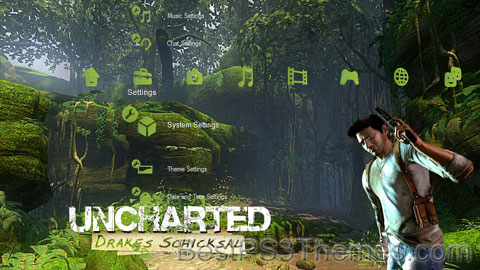
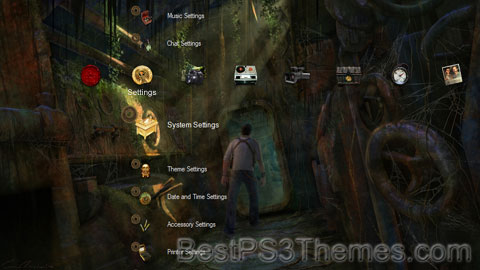
This program unpacks Playstation 3 Theme files (.p3t) so that you can touch-up an existing theme to your likings or use a certain wallpaper from it (as many themes have multiple). But remember, if you use content from another theme and release it, be sure to give credit!
Download p3textractor.zip from above. Extract the files to a folder with a program such as WinZip or WinRAR. Now there are multiple ways to extract the theme.
The first way is to simply open the p3t file with p3textractor.exe. If you don’t know how to do this, right click the p3t file and select Open With. Alternatively, open the p3t file and it will ask you to select a program to open with. Click Browse and find p3textractor.exe from where you previously extracted it to. It will open CMD and extract the theme to extracted.[filename]. After that, all you need to do for any future p3t files is open them and it will extract.
The second way is very simple. Just drag the p3t file to p3textractor.exe. It will open CMD and extract the theme to extracted.[filename].
For the third way, first put the p3t file you want to extract into the same folder as p3textractor.exe. Open CMD and browse to the folder with p3extractor.exe. Enter the following: p3textractor filename.p3t [destination path]Replace filename with the name of the p3t file, and replace [destination path] with the name of the folder you want the files to be extracted to. A destination path is not required. By default it will extract to extracted.filename.
This program unpacks Playstation 3 Theme files (.p3t) so that you can touch-up an existing theme to your likings or use a certain wallpaper from it (as many themes have multiple). But remember, if you use content from another theme and release it, be sure to give credit!
Download p3textractor.zip from above. Extract the files to a folder with a program such as WinZip or WinRAR. Now there are multiple ways to extract the theme.
The first way is to simply open the p3t file with p3textractor.exe. If you don’t know how to do this, right click the p3t file and select Open With. Alternatively, open the p3t file and it will ask you to select a program to open with. Click Browse and find p3textractor.exe from where you previously extracted it to. It will open CMD and extract the theme to extracted.[filename]. After that, all you need to do for any future p3t files is open them and it will extract.
The second way is very simple. Just drag the p3t file to p3textractor.exe. It will open CMD and extract the theme to extracted.[filename].
For the third way, first put the p3t file you want to extract into the same folder as p3textractor.exe. Open CMD and browse to the folder with p3extractor.exe. Enter the following: p3textractor filename.p3t [destination path]Replace filename with the name of the p3t file, and replace [destination path] with the name of the folder you want the files to be extracted to. A destination path is not required. By default it will extract to extracted.filename.
Crysis is a first-person shooter video game series created by Crytek. The series revolves around a group of military protagonists with "nanosuits", technologically advanced suits of armor that give them enhanced physical strength, speed, defense, and cloaking abilities. The protagonists face off against hostile North Korean soldiers, heavily armed mercenaries, and a race of technologically advanced aliens known as the Ceph, who arrived on Earth millions of years ago and have recently been awakened. The series consists of three main installments, a standalone spinoff of the first game with a separate multiplayer title, and a compilation. A fourth game, under the working title of Crysis 4, was announced by Crytek on January 26, 2022.
Characters in Crysis use nanosuits, advanced powered exoskeletons developed by the U.S. military that grants them special abilities through dedicated "modes", as well as the ability to switch between them at will. Nanosuit's "armor mode" enhances the suit's ability to withstand bullet and shrapnel impacts, "strength mode" greatly enhances the wearer's physical strength, to the point of being able to punch cars through the air; and "speed mode" allows the wearer to run and act extremely fast. Lastly, "cloak mode" activates the suit's optical cloaking device that makes the wearer near-invisible.
The first two games, Crysis and Crysis Warhead, take place in 2020 on the fictional Lingshan Islands, off the Philippines. The protagonists of both games both belong to the fictitious "Raptor Team", a United States ArmyDelta Force unit that is sent to the island to investigate aggressive behavior by North Korea. The player uses various weapons, including traditional projectile weapons like handguns, submachine guns, assault rifles, and sniper rifles (all of which can be modified with scopes and attachments in real-time), as well as explosives and the nanosuit's natural abilities. Multiplayer gameplay modes introduce fictional futuristic weapons based on the ice technology introduced by the alien antagonists who are later found to reside on the island. In single-player, Raptor Team faces off against both the North Korean military and these alien foes.
Crysis 2, the sequel to the original game, takes place in 2023 in New York City. The protagonist is a new character, a U.S. Marine named Alcatraz. The nanosuit in the game (dubbed "Nanosuit 2") is a streamlined version of the original, without separate "strength" and "speed" modes, rather performing context-sensitive acts of enhanced strength or agility, but retaining the separate "armor" and "cloak" modes.
After Helena Rosenthal sends a distress signal saying the North Koreans are invading the seemingly unimportant island on which her team is working, the US government dispatches Raptor Team, a group of nanosuit-clad soldiers. After arriving on the island, however, Raptor Team's ranks are thinned by mysterious flying creatures, eventually leaving only Nomad, Psycho, and Prophet, who is subsequently kidnapped by the organisms later called the Ceph. Nomad rescues Helena but is eventually trapped in the alien ship after it unleashes an "ice sphere" on the island, freezing a great deal of the island. Nomad escapes the island with Helena and an oddly-behaving Prophet, and returns to the US carrier fleet, where he finds Psycho. Prophet returns to the island, which is subsequently nuked in the attempt to kill the aliens. However, they only grow stronger from the energy. The aliens launch a massive attack on the carrier fleet, successfully destroying it. Nomad, Psycho, and Helena escape and receive a distress signal from the still-alive Prophet, and decide to return to the island.
During Psycho's own mission, he was sent to retrieve a captured alien from Colonel Lee and the Koreans. After numerous setbacks and the assistance of his friend O'Neill, Psycho successfully defeats Lee, obtains the alien, and brings it back to the carrier fleet. At this point, the story continues in the original title.
A sequel set 3 years after the first game, Crysis 2 takes place in New York City in 2023, which is infected by an unknown virus. The player controls Alcatraz, a U.S. Marine who is found almost dead by Prophet, and given the upgraded Nanosuit 2 before Prophet commits suicide. He is tasked by Prophet to rescue a scientist named Nathan Gould. At first, Alcatraz has to face Crynet's CELL agents, a mercenary force who is hired by the U.S. Department of Defense to police the chaotic Manhattan, still thinking that Alcatraz is Prophet who is infected by the virus. After discovering Ceph capsules and Catalyst, the Ceph take over as the main antagonists for the rest of the game. Alcatraz and Gould team up with Tara Strickland, an undercover CIA lieutenant, and Jacob Hargreave, the original creator of the nanosuit. Alcatraz eventually enters the Ceph core spire and wipes out all the Ceph in New York. Now facing death again, he meets a memory pattern of Prophet, whose DNA is merged into Alcatraz's. The game closes with Alcatraz being contacted by Karl Rasch, a nanosuit scientist, and vowing to continue the war against the Ceph.
As with its predecessor, Crysis 3 again takes place in New York. Set in 2047, the game sees Prophet return to the now nanodome-encased New York City, on a mission of revenge against CELL, having uncovered the truth behind their motives for building the quarantined nanodomes.[1]
With Crysis 3 being the end of the Crysis trilogy, Crytek teased that the series would have a "radical future". Yerli confirmed that the next installment would not be called Crysis 4, as he considered such a title "misleading".[2] On June 12, 2012, it was revealed that Crytek would focus only on free-to-play titles following the release of Crysis 3.[3]
A remastered version of the original Crysis was announced on April 16, 2020, and is the first game in the series to be self-published by Crytek.[4][5] The Nintendo Switch version was released first, on July 23, 2020.[6] The PlayStation 4, Xbox One, and PC versions were initially supposed to launch on the same date, but were delayed to September 18, 2020.[7]
On June 1, 2021 Crytek announced that, following Crysis Remastered, both Crysis 2 and Crysis 3 were similarly updated and will be released as part of Crysis Remastered Trilogy. The bundle launched on October 15, 2021, on Nintendo Switch, PlayStation 4, Xbox One and PC.[8] Each game is also available for purchase individually.
In January 2022, Crytek announced the 4th installment of the franchise on their social network platforms. The game is in its early stages of development and no storyline has been announced.[9][10]
A tie-in novel, Crysis: Escalation, by Gavin G. Smith is meant to bridge the events of Crysis 2 and Crysis 3.[12]
The novel covers Alcatraz and his ultimate fate after being assimilated with Prophet. After briefly taking control of his body and using it to visit his relatives for the last time, Alcatraz is persuaded by Prophet to give up his body for him which Alcatraz reluctantly agrees.
A turn-based strategy board game based on the Crysis mythos, subtitled Analogue Edition, was being developed by Frame6.[13] A Kickstarter campaign was held, but eventually cancelled following a decision over the funding and marketing.[14]
Crysis is a 6-issue series intended to bridge the gap between the storylines of Crysis and Crysis 2. The story focuses on the adventures of Prophet, Nomad, Psycho, and Helena Rosenthal after they return to Lingshan and explains their fates, and reveals much of Prophet's backstory. The comics were released as a single graphic novel on January 31, 2012.[15]
Crysis was awarded a 98% in the PC Gamer U.S. Holiday 2007 issue, making it one of the highest rated games in PC Gamer, tying with Half-Life 2 and Sid Meier's Alpha Centauri.[26] The UK edition of the magazine awarded the game 92%, describing the game as "A spectacular and beautiful sci-fi epic." GameSpot awarded Crysis a score of 9.5 out of 10, describing it as "easily one of the greatest shooters ever made."[27]GameSpy gave it a 4.5 out of 5 stating that the suit powers were fun but also criticizing the multiplayer portion of the game for not having a team deathmatch.[28]X-Play gave it a 3 out of 5 on its "Holiday Buyer's Guide" special episode, praising the graphics and physics, but criticized the steep hardware requirements as well as stating that the game is overhyped with average gameplay.[29]GamePro honored Crysis with a score of 4.75 out of 5, saying it was "a great step forward for PC gaming", but criticized the steep hardware requirements.[30]IGN awarded it a 9.4 out of 10, hailing it as "one of the more entertaining ballistic showdowns in quite some time."[31]
Commonly asked of nearly any electronic around the time of its release, even those that could not in any conceivable way run the program, was the phrase "But can it run Crysis?", referring to its very high system requirements. The phrase has continued in modern usage, as a snowclone, with any other high-end (or ironically low-end) game title replacing Crysis.[32]
Crysis Warhead, developed by Crytek Budapest, received largely positive reviews. Most reviewers praised the improvements over the original Crysis in areas like AI and gameplay pacing, citing the original game's criticism that battles were few and far between. The new protagonist, Psycho, was also received better than the original's less developed Nomad. The revamped multiplayer mode, Crysis Wars, was also praised for adding a team deathmatch mode, the lack of which most reviewers criticized in the original game. Criticism of the game by reviewers includes the short story mode and a lack of new features over the original game. Some continued to cite the game's high system requirements as unacceptable even a year after the original game, which has the same requirements. Indeed, some reviewers did not see any significant performance improvement with Warhead compared with Crysis, stating that only high-end GPUs could handle the game comfortably at decent frame rates.[33]
The development of Uncharted: Drake's Fortune began in 2005, and saw Naughty Dog altering their approach to development, as they sought to create a humanized video game that was distinct from their other entries, settling on an action-adventure game with platforming elements and a third-person perspective. The team regularly updated or wholly changed various aspects related to the story, coding, and the game's design which lead to delays. The development team found influence for many of the game's aesthetic elements from film, pulp magazines, and movie serials.
Extensively marketed as a PlayStation exclusive, Uncharted: Drake's Fortune received generally favorable reviews, with praise for its technical achievements, cast, characters, story, music, and production values, drawing similarities to blockbuster films. It faced some criticism for its graphical issues, short length, vehicle sections, and marked difficulty. Uncharted: Drake's Fortune sold one million copies after ten weeks of release. It was followed by the sequel Uncharted 2: Among Thieves in 2009, and was re-released on PlayStation 4 as part of Uncharted: The Nathan Drake Collection.
Treasure hunter Nathan "Nate" Drake, accompanied by reporter Elena Fisher, recovers the coffin of his self-proclaimed ancestor Sir Francis Drake, having located it from coordinates inscribed on a family heirloom: a ring Nate wears around his neck.[4] The coffin contains Sir Francis' diary, which gives the location of El Dorado. Pirates attack and destroy Nate's boat, but Nate's friend and mentor, Victor "Sully" Sullivan, rescues the two in his seaplane. Fearing Elena's reporting will attract potential rivals, Nate and Sully abandon her at a dock.
Nate and Sully discover an alcove that once held a large statue after following the diary to the indicated spot, and realize that El Dorado is not a city but rather a golden idol.[5] They find a NaziU-boat, which contains a page from Drake's diary showing the statue was taken to an island. However, mercenaries led by criminal Gabriel Roman (Simon Templeman), to whom Sully owes a substantial debt, and his lieutenant Atoq Navarro (Robin Atkin Downes), intercept Nate and Sully. Sully is shot in the chest and collapses, but Nate manages to escape, encounters Elena, and flies with her to the island.[6]
On the way, anti-aircraft fire forces Elena and Nate to bail out and they are separated. After retrieving supplies from the wrecked seaplane, Nate heads toward an old fort to find Elena. After Nate is briefly captured by pirates led by his old associate Eddy Raja (James Sie), Elena breaks him free and they flee to the island's old customs house. After finding records showing the statue was moved further inland to the monastery, they find that Sully is somehow alive and accompanying Roman and Navarro.[7] Nate and Elena find and rescue Sully who, having survived due to Drake's diary blocking the bullet, explains he was buying time for Nate by misleading Roman.
Searching through a mausoleum, Nate overhears an argument between Roman, Navarro, and Eddy, revealing that Roman hired Eddy to capture Nate and secure the island, with the reward being a share of El Dorado. Following Nate's escape, Roman doubts Eddy's abilities and ignores his claim that something cursed on the island is killing his men, leading him to dismiss Eddy and his crew. Regrouping, Nate and Elena find a passage leading to a treasure vault, in which they find the body of Drake, assuming that he died searching for the treasure. They encounter a terrified Eddy and a crew member, shortly before they are attacked by mutated humans who kill the crew member; despite Nate's efforts, Eddy is also killed when one drags him into a pit.
Nate and Elena escape and find themselves in an abandoned German bunker. Venturing into the base, Nate discovers that the Germans had sought the statue during World War II, but like the Spaniards before them, became cursed by the statue, causing them to become mutants. Sir Francis, knowing of the statue's power, attempted to keep it on the island by destroying the ships and flooding the city, before he too was killed by the mutants.[8]
Nate returns to find Elena has been captured by Roman and Navarro. Regrouping with Sully, he fails to stop them from reaching the statue. Navarro, aware of the curse, tricks Roman into opening the statue, revealing it to be a sarcophagus containing a mummy infected with an airborne mutagenic virus. Upon Roman turning into one of the mutants, Navarro kills him and takes control of his men. Berating Nate's group for not being imaginative, he plans to sell the virus as a biological weapon.[9] Nate jumps onto the sarcophagus and rides it as it is airlifted onto a boat in the bay. He engages and defeats Navarro and manages to sink both the sarcophagus and him to the bottom of the ocean.[10] Sully arrives, and after Nate and Elena display affection towards each other, they leave the island with several chests of treasure.[11]
During combat, the player as Nate (left) can use corners and walls as cover, then use blind or aimed fire from cover against his opponents.
Gameplay in Uncharted is a combination of action-adventure gameplay elements and some 3D platforming with a third-person perspective. Platforming elements allow Nate to jump, swim, grab and move along ledges, climb and swing from ropes, and perform other acrobatic actions that allow players to make their way along the ruins in the various areas of the island that Drake explores.[12]
When facing enemies, the player can either use melee and combo attacks at close range to take out foes or can opt to use weapons.[12] Melee attacks comprise a variety of single punches, while combo attacks are activated through specific sequences of button presses that, when timed correctly, offer much greater damage; the most damaging of these is the specific "brutal combo", which forces enemies to drop twice the ammunition they would normally leave.[12] Nate can only carry one pistol and one rifle at a time, and there is a limited amount of ammunition per gun. Picking up a different firearm switches that weapon for the new one. Grenades are also available at certain points, and the height of the aiming arc is adjusted by tilting the Sixaxis controller up or down. These third-person perspective elements were compared by several reviewers to Gears of War,[3][12] in that the player can have Drake take cover behind walls, and use either blind fire or aimed fire to kill enemies. In common with the aforementioned game, Uncharted lacks an actual on-screen health bar; instead, when the player takes damage, the graphics begin to lose color. While resting or taking cover for a brief period, Drake's health level, indicated by the screen color, returns to normal.[12]
The game also includes vehicle sections, where Drake must protect the jeep he and Elena are in using a mounted turret, and where Drake and Elena ride a jet ski along water-filled routes while avoiding enemy fire and explosive barrels. While players direct Drake in driving the jet ski, they may also control Elena by aiming the gun in order to use her weapon — either the grenade launcher or the Beretta, depending on the chapter — in defense, or to clear the barrels from their path.[12]
The game also features reward points, which can be gained by collecting 60 hidden treasures in the game that glimmer momentarily[13] or by completing certain accomplishments, such as achieving a number of kills using a specific weapon, performing a number of headshots, or using specific methods of killing enemies.[14] In subsequent playthroughs of the game, the player can use these rewards points to unlock special options; these include in-game bonuses such as alternate costumes and unlimited ammunition[13] but also non-game extras, such as making-of videos and concept art.[15] There are also several references to other Naughty Dog games, especially the Jak and Daxter series; this is done through the "Ottsel" branding on Drake and Fisher's wetsuits,[16] a reference to the species that mixes otter and weasel found in the game, and the strange relic found in one of the earlier chapters, which is actually a precursor orb from the same series.
The game is censored when playing on a Japanese console to remove blood, which normally appears when shooting enemies; this follows the trend of other censored console games in the region, such as Dead Rising and Resistance: Fall of Man.[17]
After completing Jak 3, Naughty Dog assembled their most technically talented staff members and began development of Uncharted: Drake's Fortune under the codename Big.[18][19] The game's development commenced in 2005 and it was in full production for about two years, with a small team of engineers working on the game for about a year beforehand.[20] Naughty Dog decided to create a brand new IP rather than opt to develop a PlayStation 3 Jak and Daxter game—they wanted to create a franchise suitable for the new hardware, in order to develop such ideas as realistic human characters instead of stylized ones owing to limitations of previous hardware, as well as create something "fresh and interesting", although termed as 'stylized realism'.[20] Inspiration was drawn from various sources in the action and adventure genres: pulp magazines, movie serials, and more contemporary titles like Indiana Jones and National Treasure.[21] The team felt the sources shared themes of mystery and "what-if scenarios" that romanticized adventure and aimed to include those in Uncharted.[18]
A platforming segment, showing Nathan attempting to scale the outer walls of the Fortress
The game was first unveiled at E3 2006.[22] From early previews of the game, inevitable comparisons of elements such as platforming and shooting between Uncharted and the well-known Tomb Raider series were drawn, earning the title the nickname of "Dude Raider".[21][23] However, the developers saw their game as concentrating more on third-person cover-based play, in contrast to Tomb Raider's "auto-aiming" play and greater puzzle-solving elements.[20] Other influences they cited include Resident Evil 4,[24]Kill Switch, and Gears of War.[25] Throughout the game's development the staff tried to remain flexible and detached from the original design concepts; attention was focused on the features that worked well, while features that did not work were removed.[26] The development team intended the game's main setting, the island, to play a big role in the overall experience. Feeling too many games used bleak, dark settings with monochromatic color schemes, they wanted the island to be a vibrant, believable game world that immersed the player and encouraged exploration.[18]
In designing the characters, the artists aimed for a style that was photorealistic.[21] The creators envisioned the main protagonist, Nathan Drake, as more of an everyman character than Lara Croft, shown as clearly under stress in the game's many firefights, with no special training and constantly living at the edge of his abilities.[20][23] Director Amy Hennig felt a heavily armored, "tough as nails" protagonist with a large weapon was not a suitable hero and decided a "tenacious and resourceful" character would portray more human qualities. Supporting characters (Elena Fisher and Victor Sullivan) were included to avoid a dry and emotionless story.[21] Fisher's character underwent changes during development; in early trailers for the game, the character had dark brown hair, but ultimately the color changed to blonde and the style was altered.[27][28] The writing of the story was led by Hennig with help from Neil Druckmann and Josh Scherr.[29] The lead game designer was Richard Lemarchand,[30] with the game co-designed by Hirokazu Yasuhara, a former Sega game designer best known for designing the early Sonic the Hedgehog games.[31]
The game went gold in the middle of October 2007.[20] A demo was then released on November 8 on the PlayStation Network[32] before its final release on November 19 in North America, December 6 in Australia, and December 7 in Europe.[33] The demo was first placed on the North American store, and was initially region-locked such that it would only play on a North American PS3,[34] but this was later confirmed as a mistake, as the developers were apparently unaware that people from different regions could sign up for a North American account and download the demo; a region-free demo was released soon after.[35]
Uncharted uses the Cell microprocessor to generate dozens of layered character animations to portray realistic expressions and fluid movements, which allow for responsive player control.[36] The PlayStation 3's graphics processing unit, the RSX Reality Synthesizer, employed several functions to provide graphical details that helped immerse the player into the game world: lighting models, pixel shaders, dynamic real-time shadowing, and advanced water simulation.[36] The new hardware allowed for processes that the team had never used in PlayStation 2 game development and required them to quickly familiarize themselves with the new techniques; for example, parallel processing and pixel shaders. While Blu-ray afforded greater storage space, the team became concerned with running out of room several times — Uncharted used more and bigger textures than previous games, and included several languages on the disc.[37] Gameplay elements requiring motion sensing, such as throwing grenades and walking across beams, or rear-ending massive logs up the scooter, were implemented to take advantage of the Sixaxis controller.[18] A new PlayStation 3 controller, the DualShock 3, was unveiled at the 2007 Tokyo Game Show, and featured force feedback vibration. Uncharted was also on display at the show with demonstrations that implemented limited support for vibration.[38]
Being Naughty Dog's first PlayStation 3 game, the project required the company to familiarize themselves with the new hardware and resulted in several development mistakes.[37] The switch from developing for the PlayStation 2 to the PlayStation 3 prompted the staff to implement changes to their development technology. Naughty Dog switched to the industry standard language C++ to participate in technology sharing among Sony's first-party developers—the company had previously used their own proprietary programming languageGOAL, a Lisp-based language. In rewriting their game code, they decided to create new programming tools as well. This switch, however, delayed the team's progress in developing a prototype, as the new tools proved to be unreliable and too difficult to use. Ten months into full production, the team decided to recreate the game's pipeline, the chain of processing elements designed to progress data through a system. In retrospect, Naughty Dog's Co-President Evan Wells considered this the greatest improvement to the project.[26] Additionally, the animation blending system was rewritten several times to obtain the desired character animations.[18]
The game was patched on August 4, 2008 in Europe and North America to version 1.01 to include support for the PlayStation 3's Trophy system.[39] There are 47 trophies in the game that match the medals that can already be won in the game and one further trophy, the Platinum trophy, awarded when all other trophies have been collected; Uncharted was the first Naughty Dog game to include the Platinum trophy type.[40] Similar to other PlayStation 3 titles that receive trophy support via downloaded patches, players must start a new save game to be awarded trophies, regardless of how many medals they received in previous playthroughs. This was enforced because the developers wanted to avoid the sharing of save data in order to gain trophies they did not earn.[41] The patch was described as "incredibly easy" to implement, owing to the game already containing preliminary support for Trophies via its Medals system; it was also stated that these hooks were already included due to Naughty Dog's belief that Sony would roll out the Trophy system before the game's launch in November 2007.[41] Despite mentioning that the game was developed as a franchise and that it lent itself to episodic content,[20] it was later stated that no downloadable content would be made for Uncharted.[42]
During the Closed Beta of PlayStation Home on October 11, 2008, Naughty Dog released an Uncharted themed game space for PlayStation Home. This space is "Sully's Bar" from the game. In this space, users can play an arcade mini-game called "Mercenary Madness", which during the Closed Beta, there were rewards. The rewards were removed with the release of the Home Open Beta. There are also three other rooms in this space: during the Closed Beta, users had to find out codes for the doors that accessed these rooms. The code entry to the rooms was also removed with the release of the Home Open Beta. The three other rooms are the "Artifact Room", "Archives", and "Smuggler's Den". There is an artifact viewer in the Archives and Smuggler's Den rooms. Also in the Archives, there is a video screen that previews Uncharted 2: Among Thieves. The Artifact Room only features seating and different artifacts for users to look at. This space was one of the first five-game spaces of the PlayStation Home Open Beta in North America, which Home went Open Beta on December 11.[43] This space was released to the European version on November 5, 2009, almost a year after the Open Beta release. Naughty Dog has also released a game space for Uncharted's sequel on October 23, making Uncharted the first game series to have a game space for both games in its series.[44]
Best Action Game (2007), PS3 Game of the Year (2007), Best Graphics Technology (PS3 2007), Best Original Score (PS3 2007)[51]
Uncharted: Drake's Fortune received generally favorable reviews from game critics.[45]Game Informer complimented the visuals and dialogue between the characters Drake and Fisher, calling them stunning and entertaining respectively.[28] They further added that the production values appeared high, citing the level of detail and musical score.[52]PlayStation Magazine echoed similar statements about the visuals and compared them to that of Crysis.[18][53]
The overall presentation of the game received unanimous praise from critics, who recognized the game's high production values, describing them as "top-notch",[54] "incredible"[15] or comparing them to those found in Hollywood.[14] When combined with the overall style of the game, this led many reviewers to compare Uncharted to summer blockbuster films,[3][55][56] with the action and theme of the game drawing comparisons to the Indiana Jones film series and Tomb Raider.[15][55] As part of the presentation, the game's story and atmosphere were also received well.[3][55] The depth of the characters was praised, each having "their own tone".[55] The voice acting was also received well, as the cast "nails its characterizations"; overall, the voice acting was described as a "big-star performance",[14] "superb"[56] and "stellar".[3] Game designer Tim Schafer, well known as the creator of the early LucasArts adventure games such as The Secret of Monkey Island, has also lauded the game, saying he "liked it a lot", and jokingly thanked it for teaching him a new fashion tip (Nathan Drake's "half-tucked" shirt).[57]
The technical achievements in creating this presentation were also lauded. The graphics and visuals were a big part of this, including appreciation of the "lush" jungle environments,[3][12][15] with lighting effects greatly adding to them.[56] The game's water effects were also appreciated.[54] Overall, many reviewers commented that, at the time, it was one of the best-looking PlayStation 3 games available.[48] Further to the graphical aspects, both facial animation and the animation of characters,[16][56] such as Nate's "fluid" animations as he performs platforming sections were noted,[3] although the wilder animations of enemies reacting to being shot were over-animated "to perhaps a laug
The development of Uncharted: Drake's Fortune began in 2005, and saw Naughty Dog altering their approach to development, as they sought to create a humanized video game that was distinct from their other entries, settling on an action-adventure game with platforming elements and a third-person perspective. The team regularly updated or wholly changed various aspects related to the story, coding, and the game's design which lead to delays. The development team found influence for many of the game's aesthetic elements from film, pulp magazines, and movie serials.
Extensively marketed as a PlayStation exclusive, Uncharted: Drake's Fortune received generally favorable reviews, with praise for its technical achievements, cast, characters, story, music, and production values, drawing similarities to blockbuster films. It faced some criticism for its graphical issues, short length, vehicle sections, and marked difficulty. Uncharted: Drake's Fortune sold one million copies after ten weeks of release. It was followed by the sequel Uncharted 2: Among Thieves in 2009, and was re-released on PlayStation 4 as part of Uncharted: The Nathan Drake Collection.
Treasure hunter Nathan "Nate" Drake, accompanied by reporter Elena Fisher, recovers the coffin of his self-proclaimed ancestor Sir Francis Drake, having located it from coordinates inscribed on a family heirloom: a ring Nate wears around his neck.[4] The coffin contains Sir Francis' diary, which gives the location of El Dorado. Pirates attack and destroy Nate's boat, but Nate's friend and mentor, Victor "Sully" Sullivan, rescues the two in his seaplane. Fearing Elena's reporting will attract potential rivals, Nate and Sully abandon her at a dock.
Nate and Sully discover an alcove that once held a large statue after following the diary to the indicated spot, and realize that El Dorado is not a city but rather a golden idol.[5] They find a NaziU-boat, which contains a page from Drake's diary showing the statue was taken to an island. However, mercenaries led by criminal Gabriel Roman (Simon Templeman), to whom Sully owes a substantial debt, and his lieutenant Atoq Navarro (Robin Atkin Downes), intercept Nate and Sully. Sully is shot in the chest and collapses, but Nate manages to escape, encounters Elena, and flies with her to the island.[6]
On the way, anti-aircraft fire forces Elena and Nate to bail out and they are separated. After retrieving supplies from the wrecked seaplane, Nate heads toward an old fort to find Elena. After Nate is briefly captured by pirates led by his old associate Eddy Raja (James Sie), Elena breaks him free and they flee to the island's old customs house. After finding records showing the statue was moved further inland to the monastery, they find that Sully is somehow alive and accompanying Roman and Navarro.[7] Nate and Elena find and rescue Sully who, having survived due to Drake's diary blocking the bullet, explains he was buying time for Nate by misleading Roman.
Searching through a mausoleum, Nate overhears an argument between Roman, Navarro, and Eddy, revealing that Roman hired Eddy to capture Nate and secure the island, with the reward being a share of El Dorado. Following Nate's escape, Roman doubts Eddy's abilities and ignores his claim that something cursed on the island is killing his men, leading him to dismiss Eddy and his crew. Regrouping, Nate and Elena find a passage leading to a treasure vault, in which they find the body of Drake, assuming that he died searching for the treasure. They encounter a terrified Eddy and a crew member, shortly before they are attacked by mutated humans who kill the crew member; despite Nate's efforts, Eddy is also killed when one drags him into a pit.
Nate and Elena escape and find themselves in an abandoned German bunker. Venturing into the base, Nate discovers that the Germans had sought the statue during World War II, but like the Spaniards before them, became cursed by the statue, causing them to become mutants. Sir Francis, knowing of the statue's power, attempted to keep it on the island by destroying the ships and flooding the city, before he too was killed by the mutants.[8]
Nate returns to find Elena has been captured by Roman and Navarro. Regrouping with Sully, he fails to stop them from reaching the statue. Navarro, aware of the curse, tricks Roman into opening the statue, revealing it to be a sarcophagus containing a mummy infected with an airborne mutagenic virus. Upon Roman turning into one of the mutants, Navarro kills him and takes control of his men. Berating Nate's group for not being imaginative, he plans to sell the virus as a biological weapon.[9] Nate jumps onto the sarcophagus and rides it as it is airlifted onto a boat in the bay. He engages and defeats Navarro and manages to sink both the sarcophagus and him to the bottom of the ocean.[10] Sully arrives, and after Nate and Elena display affection towards each other, they leave the island with several chests of treasure.[11]
During combat, the player as Nate (left) can use corners and walls as cover, then use blind or aimed fire from cover against his opponents.
Gameplay in Uncharted is a combination of action-adventure gameplay elements and some 3D platforming with a third-person perspective. Platforming elements allow Nate to jump, swim, grab and move along ledges, climb and swing from ropes, and perform other acrobatic actions that allow players to make their way along the ruins in the various areas of the island that Drake explores.[12]
When facing enemies, the player can either use melee and combo attacks at close range to take out foes or can opt to use weapons.[12] Melee attacks comprise a variety of single punches, while combo attacks are activated through specific sequences of button presses that, when timed correctly, offer much greater damage; the most damaging of these is the specific "brutal combo", which forces enemies to drop twice the ammunition they would normally leave.[12] Nate can only carry one pistol and one rifle at a time, and there is a limited amount of ammunition per gun. Picking up a different firearm switches that weapon for the new one. Grenades are also available at certain points, and the height of the aiming arc is adjusted by tilting the Sixaxis controller up or down. These third-person perspective elements were compared by several reviewers to Gears of War,[3][12] in that the player can have Drake take cover behind walls, and use either blind fire or aimed fire to kill enemies. In common with the aforementioned game, Uncharted lacks an actual on-screen health bar; instead, when the player takes damage, the graphics begin to lose color. While resting or taking cover for a brief period, Drake's health level, indicated by the screen color, returns to normal.[12]
The game also includes vehicle sections, where Drake must protect the jeep he and Elena are in using a mounted turret, and where Drake and Elena ride a jet ski along water-filled routes while avoiding enemy fire and explosive barrels. While players direct Drake in driving the jet ski, they may also control Elena by aiming the gun in order to use her weapon — either the grenade launcher or the Beretta, depending on the chapter — in defense, or to clear the barrels from their path.[12]
The game also features reward points, which can be gained by collecting 60 hidden treasures in the game that glimmer momentarily[13] or by completing certain accomplishments, such as achieving a number of kills using a specific weapon, performing a number of headshots, or using specific methods of killing enemies.[14] In subsequent playthroughs of the game, the player can use these rewards points to unlock special options; these include in-game bonuses such as alternate costumes and unlimited ammunition[13] but also non-game extras, such as making-of videos and concept art.[15] There are also several references to other Naughty Dog games, especially the Jak and Daxter series; this is done through the "Ottsel" branding on Drake and Fisher's wetsuits,[16] a reference to the species that mixes otter and weasel found in the game, and the strange relic found in one of the earlier chapters, which is actually a precursor orb from the same series.
The game is censored when playing on a Japanese console to remove blood, which normally appears when shooting enemies; this follows the trend of other censored console games in the region, such as Dead Rising and Resistance: Fall of Man.[17]
After completing Jak 3, Naughty Dog assembled their most technically talented staff members and began development of Uncharted: Drake's Fortune under the codename Big.[18][19] The game's development commenced in 2005 and it was in full production for about two years, with a small team of engineers working on the game for about a year beforehand.[20] Naughty Dog decided to create a brand new IP rather than opt to develop a PlayStation 3 Jak and Daxter game—they wanted to create a franchise suitable for the new hardware, in order to develop such ideas as realistic human characters instead of stylized ones owing to limitations of previous hardware, as well as create something "fresh and interesting", although termed as 'stylized realism'.[20] Inspiration was drawn from various sources in the action and adventure genres: pulp magazines, movie serials, and more contemporary titles like Indiana Jones and National Treasure.[21] The team felt the sources shared themes of mystery and "what-if scenarios" that romanticized adventure and aimed to include those in Uncharted.[18]
A platforming segment, showing Nathan attempting to scale the outer walls of the Fortress
The game was first unveiled at E3 2006.[22] From early previews of the game, inevitable comparisons of elements such as platforming and shooting between Uncharted and the well-known Tomb Raider series were drawn, earning the title the nickname of "Dude Raider".[21][23] However, the developers saw their game as concentrating more on third-person cover-based play, in contrast to Tomb Raider's "auto-aiming" play and greater puzzle-solving elements.[20] Other influences they cited include Resident Evil 4,[24]Kill Switch, and Gears of War.[25] Throughout the game's development the staff tried to remain flexible and detached from the original design concepts; attention was focused on the features that worked well, while features that did not work were removed.[26] The development team intended the game's main setting, the island, to play a big role in the overall experience. Feeling too many games used bleak, dark settings with monochromatic color schemes, they wanted the island to be a vibrant, believable game world that immersed the player and encouraged exploration.[18]
In designing the characters, the artists aimed for a style that was photorealistic.[21] The creators envisioned the main protagonist, Nathan Drake, as more of an everyman character than Lara Croft, shown as clearly under stress in the game's many firefights, with no special training and constantly living at the edge of his abilities.[20][23] Director Amy Hennig felt a heavily armored, "tough as nails" protagonist with a large weapon was not a suitable hero and decided a "tenacious and resourceful" character would portray more human qualities. Supporting characters (Elena Fisher and Victor Sullivan) were included to avoid a dry and emotionless story.[21] Fisher's character underwent changes during development; in early trailers for the game, the character had dark brown hair, but ultimately the color changed to blonde and the style was altered.[27][28] The writing of the story was led by Hennig with help from Neil Druckmann and Josh Scherr.[29] The lead game designer was Richard Lemarchand,[30] with the game co-designed by Hirokazu Yasuhara, a former Sega game designer best known for designing the early Sonic the Hedgehog games.[31]
The game went gold in the middle of October 2007.[20] A demo was then released on November 8 on the PlayStation Network[32] before its final release on November 19 in North America, December 6 in Australia, and December 7 in Europe.[33] The demo was first placed on the North American store, and was initially region-locked such that it would only play on a North American PS3,[34] but this was later confirmed as a mistake, as the developers were apparently unaware that people from different regions could sign up for a North American account and download the demo; a region-free demo was released soon after.[35]
Uncharted uses the Cell microprocessor to generate dozens of layered character animations to portray realistic expressions and fluid movements, which allow for responsive player control.[36] The PlayStation 3's graphics processing unit, the RSX Reality Synthesizer, employed several functions to provide graphical details that helped immerse the player into the game world: lighting models, pixel shaders, dynamic real-time shadowing, and advanced water simulation.[36] The new hardware allowed for processes that the team had never used in PlayStation 2 game development and required them to quickly familiarize themselves with the new techniques; for example, parallel processing and pixel shaders. While Blu-ray afforded greater storage space, the team became concerned with running out of room several times — Uncharted used more and bigger textures than previous games, and included several languages on the disc.[37] Gameplay elements requiring motion sensing, such as throwing grenades and walking across beams, or rear-ending massive logs up the scooter, were implemented to take advantage of the Sixaxis controller.[18] A new PlayStation 3 controller, the DualShock 3, was unveiled at the 2007 Tokyo Game Show, and featured force feedback vibration. Uncharted was also on display at the show with demonstrations that implemented limited support for vibration.[38]
Being Naughty Dog's first PlayStation 3 game, the project required the company to familiarize themselves with the new hardware and resulted in several development mistakes.[37] The switch from developing for the PlayStation 2 to the PlayStation 3 prompted the staff to implement changes to their development technology. Naughty Dog switched to the industry standard language C++ to participate in technology sharing among Sony's first-party developers—the company had previously used their own proprietary programming languageGOAL, a Lisp-based language. In rewriting their game code, they decided to create new programming tools as well. This switch, however, delayed the team's progress in developing a prototype, as the new tools proved to be unreliable and too difficult to use. Ten months into full production, the team decided to recreate the game's pipeline, the chain of processing elements designed to progress data through a system. In retrospect, Naughty Dog's Co-President Evan Wells considered this the greatest improvement to the project.[26] Additionally, the animation blending system was rewritten several times to obtain the desired character animations.[18]
The game was patched on August 4, 2008 in Europe and North America to version 1.01 to include support for the PlayStation 3's Trophy system.[39] There are 47 trophies in the game that match the medals that can already be won in the game and one further trophy, the Platinum trophy, awarded when all other trophies have been collected; Uncharted was the first Naughty Dog game to include the Platinum trophy type.[40] Similar to other PlayStation 3 titles that receive trophy support via downloaded patches, players must start a new save game to be awarded trophies, regardless of how many medals they received in previous playthroughs. This was enforced because the developers wanted to avoid the sharing of save data in order to gain trophies they did not earn.[41] The patch was described as "incredibly easy" to implement, owing to the game already containing preliminary support for Trophies via its Medals system; it was also stated that these hooks were already included due to Naughty Dog's belief that Sony would roll out the Trophy system before the game's launch in November 2007.[41] Despite mentioning that the game was developed as a franchise and that it lent itself to episodic content,[20] it was later stated that no downloadable content would be made for Uncharted.[42]
During the Closed Beta of PlayStation Home on October 11, 2008, Naughty Dog released an Uncharted themed game space for PlayStation Home. This space is "Sully's Bar" from the game. In this space, users can play an arcade mini-game called "Mercenary Madness", which during the Closed Beta, there were rewards. The rewards were removed with the release of the Home Open Beta. There are also three other rooms in this space: during the Closed Beta, users had to find out codes for the doors that accessed these rooms. The code entry to the rooms was also removed with the release of the Home Open Beta. The three other rooms are the "Artifact Room", "Archives", and "Smuggler's Den". There is an artifact viewer in the Archives and Smuggler's Den rooms. Also in the Archives, there is a video screen that previews Uncharted 2: Among Thieves. The Artifact Room only features seating and different artifacts for users to look at. This space was one of the first five-game spaces of the PlayStation Home Open Beta in North America, which Home went Open Beta on December 11.[43] This space was released to the European version on November 5, 2009, almost a year after the Open Beta release. Naughty Dog has also released a game space for Uncharted's sequel on October 23, making Uncharted the first game series to have a game space for both games in its series.[44]
Best Action Game (2007), PS3 Game of the Year (2007), Best Graphics Technology (PS3 2007), Best Original Score (PS3 2007)[51]
Uncharted: Drake's Fortune received generally favorable reviews from game critics.[45]Game Informer complimented the visuals and dialogue between the characters Drake and Fisher, calling them stunning and entertaining respectively.[28] They further added that the production values appeared high, citing the level of detail and musical score.[52]PlayStation Magazine echoed similar statements about the visuals and compared them to that of Crysis.[18][53]
The overall presentation of the game received unanimous praise from critics, who recognized the game's high production values, describing them as "top-notch",[54] "incredible"[15] or comparing them to those found in Hollywood.[14] When combined with the overall style of the game, this led many reviewers to compare Uncharted to summer blockbuster films,[3][55][56] with the action and theme of the game drawing comparisons to the Indiana Jones film series and Tomb Raider.[15][55] As part of the presentation, the game's story and atmosphere were also received well.[3][55] The depth of the characters was praised, each having "their own tone".[55] The voice acting was also received well, as the cast "nails its characterizations"; overall, the voice acting was described as a "big-star performance",[14] "superb"[56] and "stellar".[3] Game designer Tim Schafer, well known as the creator of the early LucasArts adventure games such as The Secret of Monkey Island, has also lauded the game, saying he "liked it a lot", and jokingly thanked it for teaching him a new fashion tip (Nathan Drake's "half-tucked" shirt).[57]
The technical achievements in creating this presentation were also lauded. The graphics and visuals were a big part of this, including appreciation of the "lush" jungle environments,[3][12][15] with lighting effects greatly adding to them.[56] The game's water effects were also appreciated.[54] Overall, many reviewers commented that, at the time, it was one of the best-looking PlayStation 3 games available.[48] Further to the graphical aspects, both facial animation and the animation of characters,[16][56] such as Nate's "fluid" animations as he performs platforming sections were noted,[3] although the wilder animations of enemies reacting to being shot were over-animated "to perhaps a laug
This page is a redirect. The following categories are used to track and monitor this redirect:
From other capitalisation: This is a redirect from a title with another method of capitalisation. It leads to the title in accordance with the Wikipedia naming conventions for capitalisation, or it leads to a title that is associated in some way with the conventional capitalisation of this redirect title. This may help writing, searching and international language issues.
If this redirect is an incorrect capitalisation, then {{R from miscapitalisation}} should be used instead, and pages that use this link should be updated to link directly to the target. Miscapitalisations can be tagged in any namespace.
Use this rcat to tag onlymainspace redirects; when other capitalisations are in other namespaces, use {{R from modification}}instead.
When appropriate, protection levels are automatically sensed, described and categorized.
This program unpacks Playstation 3 Theme files (.p3t) so that you can touch-up an existing theme to your likings or use a certain wallpaper from it (as many themes have multiple). But remember, if you use content from another theme and release it, be sure to give credit!
Download p3textractor.zip from above. Extract the files to a folder with a program such as WinZip or WinRAR. Now there are multiple ways to extract the theme.
The first way is to simply open the p3t file with p3textractor.exe. If you don’t know how to do this, right click the p3t file and select Open With. Alternatively, open the p3t file and it will ask you to select a program to open with. Click Browse and find p3textractor.exe from where you previously extracted it to. It will open CMD and extract the theme to extracted.[filename]. After that, all you need to do for any future p3t files is open them and it will extract.
The second way is very simple. Just drag the p3t file to p3textractor.exe. It will open CMD and extract the theme to extracted.[filename].
For the third way, first put the p3t file you want to extract into the same folder as p3textractor.exe. Open CMD and browse to the folder with p3extractor.exe. Enter the following: p3textractor filename.p3t [destination path]Replace filename with the name of the p3t file, and replace [destination path] with the name of the folder you want the files to be extracted to. A destination path is not required. By default it will extract to extracted.filename.
This disambiguation page lists articles associated with the title Oblivion. If an internal link led you here, you may wish to change the link to point directly to the intended article.