Hellgate London theme by Shawn
Download: HellgateLondon.p3t

(1 background)
Redirect to:
This page is a redirect. The following categories are used to track and monitor this redirect:
|
The #1 spot for Playstation themes!
Hellgate London theme by Shawn
Download: HellgateLondon.p3t
(1 background)
Redirect to:
This page is a redirect. The following categories are used to track and monitor this redirect:
|
PixelJunk theme by Shawn
Download: PixelJunk.p3t

(2 backgrounds)
| PixelJunk | |
|---|---|
 | |
| Developer(s) | Q-Games Double Eleven (ports) |
| Publisher(s) | Q-Games Sony Computer Entertainment (2007–12) Spike Chunsoft (2018) |
| Platform(s) | Android, Apple Arcade, Facebook, Google Stadia, iOS, Linux, macOS, Microsoft Windows, Nintendo Switch, PlayStation 3, PlayStation 4, PlayStation 5, PlayStation Portable, PlayStation Vita, Wii U |
| First release | PixelJunk Racers July 11, 2007 |
| Latest release | PixelJunk Raiders March 1, 2021 |
PixelJunk is a series of downloadable games developed by Q-Games. The series made its debut on PlayStation 3 with PixelJunk Racers, released July 11, 2007.[1]
The series was published by Sony Computer Entertainment for PlayStation platforms until 2012, with Q-Games themselves publishing on other platforms and for PlayStation in Japan. Spike Chunsoft handled worldwide publishing for PixelJunk Monsters 2 in 2018.
![[icon]](https://en.wikipedia.org/wiki/File:Wiki_letter_w_cropped.svg) | This section needs expansion. You can help by adding to it. (May 2009) |
PixelJunk is developed by Q-Games, headed by Dylan Cuthbert. The series began in 2007 with the release of PixelJunk Racers. While Racers was met with modest critical and commercial reception,[2] 2008 and 2009 saw the releases of the more popular, critically acclaimed titles PixelJunk Monsters, PixelJunk Eden and PixelJunk Shooter.
In an interview at TGS 2009, Q-Games stated that proper development on PixelJunk 1-5 would start in 2010.[3] A PixelJunk title known tentatively as PixelJunk Dungeons, and was in the conceptual phase of production in 2008.[4] Q-Games officially revealed PixelJunk 1-5 as PixelJunk Lifelike on September 16, 2010 during the SCEI's 2010 Tokyo Game Show conference. However, it was later renamed PixelJunk 4am. It is unclear if PixelJunk Dungeons is still under development.
On May 18, 2010 PixelJunk Shooter 2 was revealed on the official PlayStation blog due for release in 2011.[5]
The first series of PixelJunk games are all described by Q-Games president Dylan Cuthbert as having "simplicity, familiarity, and originality" in common.[4] Games in the first series are also two-dimensional and run in 1080p HD at 60fps.
| # | Title | Year | Platform(s) | Notes |
|---|---|---|---|---|
| 1-1 | PixelJunk Racers | 2007 | PlayStation 3 | An expanded version, 1-1a PixelJunk Racers 2nd Lap, was released in 2010. |
| 1-2 | PixelJunk Monsters | 2007 | PlayStation 3, PlayStation Portable, PlayStation Vita, Windows, macOS, Linux, Wii U | An expansion, 1-2a PixelJunk Monsters Encore, was released in 2008. An expanded version for PSP, PixelJunk Monsters Deluxe, was released in 2009. A remastered version, PixelJunk Monsters Ultimate, was released in 2013. |
| 1-3 | PixelJunk Eden | 2008 | PlayStation 3, Windows | An expansion, 1-3a PixelJunk Eden Encore, was released in 2009. |
| 1-4 | PixelJunk Shooter | 2009 | PlayStation 3, PlayStation 4, PlayStation Vita, Windows, macOS, Linux | A remastered version, PixelJunk Shooter Ultimate, was released in 2014 combining both parts with updated graphics. |
| 1-4a | PixelJunk Shooter 2 | 2011 | PlayStation 3, PlayStation 4, PlayStation Vita, Windows | |
| 1-4b | PixelJunk SideScroller | 2011 | PlayStation 3 | A full game based on the bonus level of Shooter 2 |
| 1-5 | PixelJunk 4am | 2012 | PlayStation 3 | Titled PixelJunk Lifelike during development. Compatible with PlayStation Move. |
| 1-6 | PixelJunk Nom Nom Galaxy | 2015 | PlayStation 4, Windows | Titled PixelJunk Inc. during development. |
The second series was planned concurrently with the first. In 2008, Cuthbert suggested that games of the second series could "take some of the old 3D looks and bring them up to the full HD kind of style."[4] He later confirmed Series 2 would "venture into aesthetically pleasing 3D."[6]
| # | Title | Year | Platform(s) | Notes |
|---|---|---|---|---|
| 2-1 | PixelJunk Monsters 2 | 2018 | PlayStation 4, Nintendo Switch, Windows | Two expansions, 2-1a PixelJunk Monsters 2 Encore and 2-1b PixelJunk Monsters 2 Danganronpa, were released in 2018. |
| 2-2 | PixelJunk Scrappers | 2020 | PlayStation 4, PlayStation 5, Nintendo Switch, Windows, Apple Arcade | An expanded version, PixelJunk Scrappers Deluxe, is to be released in 2023.[7] Discontinued from Apple Arcade in 2023. |
| 2-3 | PixelJunk Eden 2 | 2020 | PlayStation 4, PlayStation 5, Nintendo Switch, Windows | |
| 2-4 | PixelJunk Raiders | 2021 | Google Stadia | Discontinued with Stadia's closure in 2023. |
| # | Title | Year | Platform(s) | Notes |
|---|---|---|---|---|
| 1 | PixelJunk Monsters Online | 2011 | A free-to-play version of Monsters released as a social network game. Discontinued between 2013 and 2014. | |
| 2 | PixelJunk VR: Dead Hungry | 2016 | PlayStation 4, Windows | Compatible with PlayStation VR, Oculus Rift and HTC Vive. |
| 3 | PixelJunk Eden Obscura | 2018 | iOS, Android | A "reimagining" of Eden that utilises the smartphone's camera to create background effects within the game. |
| 4 | PixelJunk Monsters: Trouble in Paradise | 2021 | iOS, Android | Titled PixelJunk Monsters Duo during development. |
On September 24, 2009, Q-Games released a virtual space for PlayStation Home. Titled PixelJunk Museum (PixelJunk Exhibition in North America), the space included virtual displays for PixelJunk Racers, PixelJunk Monsters, and PixelJunk Eden, as well as a virtual gift shop where users could buy PixelJunk and Q Games-branded Home items. A separate "room" featuring the interior of the "Ers Piñita Colada" space center from PixelJunk Shooter was added to the space on December 17, 2009 in the NA region.
The Japanese version of the space included an exclusive "Q-Games virtual public TGS Booth" — a recreation of the Q-Games booth at the 2009 Tokyo Games Show where users could claim a free T-shirt for their Home avatar.
Half-Life 2 theme by unknown
Download: HalfLife2_2.p3t

(1 background)
| Half-Life 2 | |
|---|---|
 Box art featuring Gordon Freeman | |
| Developer(s) | Valve |
| Publisher(s) | Valve |
| Artist(s) | Viktor Antonov |
| Writer(s) | Marc Laidlaw |
| Composer(s) | Kelly Bailey |
| Series | Half-Life |
| Engine | Source |
| Platform(s) | |
| Release | November 16, 2004
|
| Genre(s) | First-person shooter |
| Mode(s) | Single-player |
Half-Life 2 is a 2004 first-person shooter (FPS) game developed and published by Valve Corporation. It was published for Windows on Valve's digital distribution service, Steam. Like the original Half-Life (1998), Half-Life 2 combines shooting, puzzles, and storytelling, and adds new features such as vehicles and physics-based gameplay. The player controls Gordon Freeman, who joins a resistance to liberate Earth from the Combine, an interplanetary alien empire.
Half-Life 2 was created using Valve's Source game engine, which was developed simultaneously. Development lasted five years and cost US$40 million. Valve's president, Gabe Newell, set his team the goal of redefining the FPS genre. They integrated Havok, which simulates real-world physics, to reinforce the sense of presence and create new gameplay. They also developed the characterization, with more detailed character models and animations.
Valve announced Half-Life 2 at E3 2003 with a release date of September of that year. They failed to meet the release date, leading to fan backlash. A year before its release, an unfinished version was stolen by a hacker and published online, which damaged the team’s morale and slowed their work.
Half-Life 2 was released on Steam on November 16, 2004. It won 39 Game of the Year awards and has been cited as one of the best games ever made. It was ported to Xbox, Xbox 360, PlayStation 3, macOS and Linux. By 2011, it had sold 12 million copies. Half-Life 2 was followed by the free extra level Lost Coast (2005) and the episodic sequels Episode One (2006) and Episode Two (2007). In 2020, after canceling Episode Three and several further Half-Life projects, Valve released a prequel, Half-Life: Alyx.
 | This section needs additional citations for verification. (January 2024) |

Like the original Half-Life (1998), Half-Life 2 is a single-player first-person shooter (FPS) in which players control Gordon Freeman. It has similar mechanics to Half-Life, including health-and-weapon systems (though with fewer overall weapons) and periodic physics puzzles, except with the newer Source engine and improved graphics. The player starts without items and widens their arsenal over the course of the game. While the game is mainly linear, effort was put into making exploration rewarding and interesting; many optional areas can be missed or avoided.[1]
A diverse set of enemies is present, which usually require being approached with different tactics: some coordinate in groups to out-maneuver or out-position the player; others, such as the Manhack, fly directly at the player through small openings and tight corridors.[2] Others use predictable but powerful attacks, while others hide before swiftly attacking the player. Gordon can kill most enemies with his weapons, or make use of indirect means, exploiting environmental hazards such as explosive pressurized canisters, gas fires or improvised traps. In chapters ten and eleven, Gordon can be joined by up to four armed Resistance soldiers or medics and can send his team further from him or call them back.
Many of the features use the Source engine's detailed physics simulation. Two sections of the game involve driving vehicles. Instead of button-oriented puzzles from Half-Life, environmental puzzles are also introduced with makeshift mechanical systems, revolving around the player's new ability to pick up, move, and place objects. Solutions involve objects' physical properties, such as shape, weight, and buoyancy. For example; In chapter three, "Route Kanal", the player is required to stack cinder blocks on a makeshift see-saw ramp to proceed over a wall. Alternatively, the player can build a crude staircase with the blocks, so the puzzle may be solved in multiple ways.
Part-way through the game, Gordon acquires the Gravity Gun, which allows him to draw distant objects towards himself or forcefully push them away, as well as the ability to manipulate larger and heavier objects which he otherwise cannot control. These abilities are required to solve puzzles later in the game. They can also be used in combat, to throw heavy objects at enemies or to shield themselves from gunfire.
The game never separates the player with pre-rendered cutscenes or events; the story proceeds via exposition from other characters and in-world events, and the player can control Gordon for the entirety of the game. Most of the backstory to the game is simply alluded to or told through the environment. Even tutorials are mostly placed in the environment or in dialogue. The few pop-ups that appear inform the player only of keyboard bindings for actions.
After the alien invasion at the Black Mesa Research Facility, a multidimensional alien empire known as the Combine invaded and subjugated Earth. Approximately twenty years after being placed in stasis, Gordon Freeman, the player character, is awoken by the G-Man (Michael Shapiro), who cryptically informs Gordon that "his time has come again" before celestially inserting him into a moving passenger train bound for City 17, an Eastern European city (probably in Russia as most of the posters and signs are in Russian) which houses the Citadel, a several-miles-tall tower which serves as the headquarters of the Combine on Earth. Helped by undercover Resistance member Barney Calhoun (Shapiro), Gordon attempts to reach the laboratory of Dr. Isaac Kleiner (Harry S. Robins) before being beaten and arrested by Combine officers. He is rescued by Alyx Vance (Merle Dandridge), who takes him to Dr. Kleiner's lab. During Dr. Kleiner’s attempt to teleport Gordon to the main Resistance base at Black Mesa East, Gordon is accidentally, briefly teleported to the Citadel office of Dr. Wallace Breen (Robert Culp), the Combine’s puppet ruler of Earth, alerting Dr. Breen to Gordon’s presence. Gordon is subsequently forced to progress to the base using the city's canal system, navigating it on an airboat.
Upon his arrival at Black Mesa East, Gordon reunites with Eli Vance (Robert Guillaume) and meets Dr. Judith Mossman (Michelle Forbes). Alyx introduces Gordon to her pet robot Dog and gives Gordon a Gravity Gun. Black Mesa East is suddenly attacked by Combine forces, who capture Eli and Judith; Gordon is forced to escape through the zombie-infested ghost town of Ravenholm, aided by its lone inhabitant, Father Grigori (Jim French). Escaping the town, Gordon reaches a Resistance outpost, whose inhabitants provide him with a dune buggy. He drives across Highway 17 to reach the Combine prison of Nova Prospekt, where Eli and Judith are being held. He breaks into the prison and reunites with Alyx. They locate Eli and discover that Judith is a Combine spy. Before they can stop her, Judith teleports herself and Eli to the Citadel. The teleporter explodes moments after Gordon and Alyx use it to escape Nova Prospekt.
Returning to Dr. Kleiner's lab, Gordon and Alyx learn that the teleporter malfunctioned and that a week has passed, during which time the Resistance has launched a full-scale armed rebellion against the Combine. Aided by Barney and Dog, Gordon fights his way inside the Citadel. He makes some progress in climbing the tower before he is captured and taken in a transport pod to Dr. Breen’s private office, near the tower’s apex, where he and Judith are waiting with Eli and Alyx as captives. Dr. Breen reveals that he intends to use his captives as leverage during negotiations with the Combine, which contradicts what he had previously told Judith.[3] Angered, Judith frees the three captives before Dr. Breen can teleport them off-world. Dr. Breen attempts to escape using a teleporter on the Citadel’s roof, but Gordon destroys the Citadel's reactor using the Gravity Gun, causing Dr. Breen to fall into the abyss, although it is uncertain if he had died as a result. Just as the reactor explodes, the G-Man reappears and freezes time, praising Gordon’s actions and placing him back into stasis.

Development of Half-Life 2 began in June 1999, six months after the release of the original Half-Life. It was developed by a team of 82.[4] With voice actors included, this number is 100.[5][6] Valve's president, Gabe Newell, wanted to redefine the FPS genre, saying: "Why spend four years of your life building something that isn't innovative and is basically pointless? If Half-Life 2 isn't viewed as the best PC game of all time, it's going to completely bum out most of the guys on this team."[4] Newell gave his team no deadline and a "virtually unlimited" budget, promising to fund the project himself if necessary.[4] They used Valve's new in-house game engine, Source, developed simultaneously.[4]
Whereas Half-Life was set in a single location, the Black Mesa research facility, Valve wanted "a much more epic and global feel" for the sequel. One concept had the player teleporting between planets, which was discarded as it would make continuity between levels difficult. At the suggestion of the art director, Viktor Antonov, who was Bulgarian, the team settled on a city in an Eastern European location. In this early concept, players would start the game by boarding the Borealis, an icebreaker bound for the city.[4] Nova Prospekt was conceived as a small rail depot built on an old prison in the wasteland and grew from a stopping-off point to the destination itself.[7][page needed]
After observing how players had connected to minor characters in Half-Life, the team developed the characterization, with more detailed character models and realistic animation. The animator Ken Birdwell studied the work of psychologist Paul Ekman, who had researched how facial muscles express emotion.[4] The writer Marc Laidlaw created family relationships between the characters, saying as it was a "basic dramatic unit everyone understands" rarely used in games.[4]
The team integrated the Havok physics engine, which simulates real-world physics,[8] to reinforce the player's sense of presence and create new gameplay.[4] To experiment, the team created a minigame, Zombie Basketball, in which players used a physics-manipulating gun to throw zombies through hoops.[4] In mid-2001, to test the engine, Valve built a street war between rioting citizens and police, featuring tanks, Molotov cocktails, hand-to-hand fighting, and looting. The designer John Guthrie described it as "an early attempt at getting something – anything – in the game that used non-player characters and physics".[4]
In late 2001, Valve began creating a showreel, hoping to demonstrate it at E3 2002.[4] For several months, Newell let the team work without his input so he could provide unbiased feedback, and focused on developing Steam, Valve's upcoming digital distribution service. The team presented the showreel to Newell, showcasing physics, environments such as the Borealis, and a dialogue-heavy scene with the scientist character Dr. Kleiner. Newell felt the showreel did not adequately show how the physics would affect gameplay and that the Kleiner scene was overlong. Reflecting on the feedback, Laidlaw said: "The dramatic scenes with the characters are important, but they have to be in service of the interactivity and gameplay."[4]
In September 2002, the team completed a second showreel, featuring a buggy race along the City 17 coast, an encounter with headcrabs on a pier, an alien strider attacking the city, and a greatly shortened Kleiner sequence. In October, Newell told the team they would announce Half-Life 2 at E3 2003 and release it by the end of the year.[4] As with the original Half-Life, the team split into "cabals" working on different levels. Designers created levels using placeholder shapes and surfaces, which then were worked on by the artists.[4]

Valve announced Half-Life 2 at E3 2003, with demonstrations of the characters, animation and physics. The reaction was positive, and the game won the E3 Game of the Show award.[9] Newell also announced a release date of September 30, 2003, hoping this would motivate the team. They worked long hours to meet the deadline, but by July it was clear they would miss it. Rumors spread of a delay. On September 23, Valve released a statement targeting a release for the holiday season, leading to fan backlash.[4]
Newell had been hesitant to announce a delay without a new release date. He said later: "We were paralyzed. We knew we weren't going to make the date we promised, and that was going to be a huge fiasco and really embarrassing. But we didn't have a new date to give people either."[4] The graphics card manufacturer ATI had arranged a promotional event on Alcatraz Island to coincide with the planned release of Half-Life 2. Unable to pull out of the event, Newell gave a prepared speech, demonstrated the Source engine, and left without addressing questions.[4]
On September 19, the Half-Life 2 source code was obtained by a German hacker, Axel Gembe, who had infiltrated Valve's internal network months earlier. According to Gembe, he shared it with another person, who leaked the code online in early October.[10] Fans soon compiled a playable version of Half-Life 2, revealing how unfinished it was. The leaks damaged morale at Valve and slowed development.[4] In March 2004, Gembe contacted Newell and identified himself, saying he was a fan and had not acted maliciously. Newell worked with the FBI to invite Gembe to a fake job interview, planning to have him arrested in the United States; however, police arrested him in Germany.[10] In November 2006, Gembe was sentenced to two years' probation.[10]
In 2004, the Valve staff returned after Christmas to long hours, stressful working conditions, and no guarantee that the game, which was costing $1 million a month to develop, would be finished soon. However, Newell felt that progress was speeding up, with the team producing about three hours of gameplay per month. In March, they created the first version playable from start to finish and stopped production for a week to play through the game. Major changes by this point included the cutting of the Borealis, the replacement of the jet ski with a hovercraft, and introducing the physics-manipulating gravity gun earlier in the game. Feedback was positive across the company. Newell recalled: "The fact that you could go from one end of the game to the other was a really big thing for us. Then we knew it just had to get better – but it was all there."[4] After several months of bug fixes and playtesting, Half-Life 2 was completed on October 13, 2004.[4]
Valve made a 1 GB portion of Half-Life 2 available for download in an encrypted format through Steam on August 26, 2004. On the day of release, Steam customers were able to pay, unlock the files, and play the game immediately, without having to wait for the game to download.[11] In retail, distribution of the game was handled by Vivendi Universal Games through their Sierra Entertainment subsidiary.[12]
Half-Life 2 was simultaneously released through Steam, CD, and on DVD in several editions. Through Steam, Half-Life 2 had three packages that a customer could order. The basic version ("Bronze") includes only Half-Life 2 and Counter-Strike: Source, whereas the "Silver" and "Gold" (collector's edition) versions also include Half-Life: Source (ports of the original Half-Life and Day of Defeat mod to the new engine). The collector's edition/"Gold" version additionally includes merchandise, such as a baseball cap, a strategy guide and CD containing the soundtrack used in Half-Life 2. Both the disc and Steam versions require Steam to be installed and active for play to occur.[13] The retail copies of the game came in two versions, standard and Collector's Edition. The Collector's Edition differed from the physical items in the "Gold" edition, and included a T-shirt and sample of the Prima strategy guide.[14]
A demo version with the file size of a single CD was made available in December 2004 at the website of graphics card manufacturer ATI Technologies, who teamed up with Valve for the game. The demo contains a portion of two chapters: Point Insertion and "We Don't Go To Ravenholm...". In September 2005, Electronic Arts distributed the Game of the Year edition of Half-Life 2. Compared to the original CD-release of Half-Life 2, the Game of the Year edition also includes Half-Life: Source.[15]
The soundtrack was written by Kelly Bailey. The Soundtrack of Half-Life 2, containing most of the music from Half-Life 2 and many tracks from the original Half-Life, was included with the Half-Life 2 "Gold" edition and sold separately from Valve's online store.[16] Valve released a deathmatch mode in 2004.[17] In 2022, fans discovered that the texture used for a corpse model originated from a real photograph of a corpse published in a medical textbook on treating burns, leading to criticism.[18][19]
On September 20, 2004, GameSpot reported that Sierra's parent company, Vivendi Universal Games, was in a legal battle with Valve over the distribution of Half-Life 2 to cyber cafés. Cyber cafés were important for the gaming market in Asia, where PC and broadband penetration per capita were much lower in most territories.[20]
According to Vivendi, the distribution contract they signed with Valve included cyber cafés. This would mean that only Vivendi could distribute Half-Life 2 to cyber cafés — not Valve through the Steam system. On November 29, 2004, Judge Thomas S. Zilly, of U.S. Federal District Court in Seattle, Washington, ruled that Vivendi and its affiliates are not authorized to distribute (directly or indirectly) Valve games through cyber cafés for pay-to-play activities according to the parties' current publishing agreement. Zilly also ruled in favor of the Valve motion regarding the contractual limitation of liability, allowing Valve to recover copyright damages for any infringement as allowed by law without regard to the publishing agreement's limitation of liability clause.[21]
On April 29, 2005, Valve and Vivendi announced a settlement. Vivendi would cease distributing all retail packaged versions of Valve games by August 31, 2005. Vivendi was also to notify distributors and cyber cafés that had been licensed by Vivendi that only Valve had the authority to distribute cyber café licenses; their licenses were revoked and switched to Valve's.[22] Valve partnered with Electronic Arts for the retail distribution of its games, including the Xbox version of Half-Life 2.[23]
In 2005, Valve released an extra level, Lost Coast, as a free download to anyone who purchased Half-Life 2.[24] Lost Coast acted as a technology demonstration, showing off new lighting techniques and high-dynamic-range rendering in the Source engine. On December 22, Valve released a 64-bit version of the Source engine for x86-64 processor-based systems running Windows XP Professional x64 Edition, Windows Server 2003 x64, Windows Vista x64, or Windows Server 2008 x64. This update enabled Half-Life 2 and other Source games to run natively on 64-bit processors, bypassing the 32-bit compatibility layer. Newell said it was "an important step in the evolution of our game content and tools", and that the game benefited greatly from the update.[25] Some users reported major performance improvements, though the technology site Techgage found stability problems and no notable frame rate improvement.[26]
In 2006, Valve partnered with Taito to release Half-Life 2: Survivor, an arcade game for the Japanese market.[27][28] Valve rereleased Half-Life 2 as part of the 2007 compilation The Orange Box for Windows, Xbox 360 and PlayStation 3.[29] On May 26, 2010, Half-Life 2, Episode One and Episode Two were released for Mac OS X.[30] In 2013, Valve ported Half-Life 2 to Linux[31] and released a free update adding support for the Oculus Rift virtual reality headset.[32] An NVIDIA Shield Tablet-exclusive port for Android was released on May 12, 2014.[33] In January 2022, a new UI designed for Valve's portable Steam Deck device was released.[34]
| Aggregator | Score |
|---|---|
| Metacritic | 96/100 (PC)[35] 90/100 (Xbox)[36] |
| Publication | Score | |||||||||||||||||||||||||||||||||||||||||||||||||||||||||||||||||||||||||||||||||||||||||||||||||||||||||||||||||||||
|---|---|---|---|---|---|---|---|---|---|---|---|---|---|---|---|---|---|---|---|---|---|---|---|---|---|---|---|---|---|---|---|---|---|---|---|---|---|---|---|---|---|---|---|---|---|---|---|---|---|---|---|---|---|---|---|---|---|---|---|---|---|---|---|---|---|---|---|---|---|---|---|---|---|---|---|---|---|---|---|---|---|---|---|---|---|---|---|---|---|---|---|---|---|---|---|---|---|---|---|---|---|---|---|---|---|---|---|---|---|---|---|---|---|---|---|---|---|---|
| 1Up.com | A+[37] | |||||||||||||||||||||||||||||||||||||||||||||||||||||||||||||||||||||||||||||||||||||||||||||||||||||||||||||||||||||
| Edge | 10/10 (PC)[38] | |||||||||||||||||||||||||||||||||||||||||||||||||||||||||||||||||||||||||||||||||||||||||||||||||||||||||||||||||||||
| Eurogamer | 10/10 (PC)[39] 9/10 (Xbox)[40] | |||||||||||||||||||||||||||||||||||||||||||||||||||||||||||||||||||||||||||||||||||||||||||||||||||||||||||||||||||||
| GamePro | 
Ninja Gaiden SigmaNinja Gaiden Sigma theme by YASAI Download: NinjaGaidenSigma.p3t
Uncharted: Drake’s Fortune #2Uncharted: Drake’s Fortune theme by Marconelly Download: UnchartedDrakesFortune_2.p3t
Uncharted: Drake's Fortune is a 2007 action-adventure game developed by Naughty Dog and published by Sony Computer Entertainment. It is the first game in the Uncharted series and was released in November 2007 for PlayStation 3. The game follows Nathan Drake, the supposed descendant of explorer Sir Francis Drake, as he searches for the lost treasure of El Dorado with journalist Elena Fisher and mentor Victor Sullivan. The development of Uncharted: Drake's Fortune began in 2005, and saw Naughty Dog altering their approach to development, as they sought to create a humanized video game that was distinct from their other entries, settling on an action-adventure game with platforming elements and a third-person perspective. The team regularly updated or wholly changed various aspects related to the story, coding, and the game's design which lead to delays. The development team found influence for many of the game's aesthetic elements from film, pulp magazines, and movie serials. Extensively marketed as a PlayStation exclusive, Uncharted: Drake's Fortune received generally favorable reviews, with praise for its technical achievements, cast, characters, story, music, and production values, drawing similarities to blockbuster films. It faced some criticism for its graphical issues, short length, vehicle sections, and marked difficulty. Uncharted: Drake's Fortune sold one million copies after ten weeks of release. It was followed by the sequel Uncharted 2: Among Thieves in 2009, and was re-released on PlayStation 4 as part of Uncharted: The Nathan Drake Collection. Synopsis[edit]Setting and characters[edit]The central character of Uncharted: Drake's Fortune is Nathan Drake (voiced by Nolan North), a renowned adventurer who claims to be the descendant of the famous explorer Sir Francis Drake. Together with his mentor Victor Sullivan (voiced by Richard McGonagle) and journalist Elena Fisher (voiced by Emily Rose), Drake embarks on a quest to discover the hidden riches of El Dorado.[3] Plot[edit]Treasure hunter Nathan "Nate" Drake, accompanied by reporter Elena Fisher, recovers the coffin of his self-proclaimed ancestor Sir Francis Drake, having located it from coordinates inscribed on a family heirloom: a ring Nate wears around his neck.[4] The coffin contains Sir Francis' diary, which gives the location of El Dorado. Pirates attack and destroy Nate's boat, but Nate's friend and mentor, Victor "Sully" Sullivan, rescues the two in his seaplane. Fearing Elena's reporting will attract potential rivals, Nate and Sully abandon her at a dock. Nate and Sully discover an alcove that once held a large statue after following the diary to the indicated spot, and realize that El Dorado is not a city but rather a golden idol.[5] They find a Nazi U-boat, which contains a page from Drake's diary showing the statue was taken to an island. However, mercenaries led by criminal Gabriel Roman (Simon Templeman), to whom Sully owes a substantial debt, and his lieutenant Atoq Navarro (Robin Atkin Downes), intercept Nate and Sully. Sully is shot in the chest and collapses, but Nate manages to escape, encounters Elena, and flies with her to the island.[6] On the way, anti-aircraft fire forces Elena and Nate to bail out and they are separated. After retrieving supplies from the wrecked seaplane, Nate heads toward an old fort to find Elena. After Nate is briefly captured by pirates led by his old associate Eddy Raja (James Sie), Elena breaks him free and they flee to the island's old customs house. After finding records showing the statue was moved further inland to the monastery, they find that Sully is somehow alive and accompanying Roman and Navarro.[7] Nate and Elena find and rescue Sully who, having survived due to Drake's diary blocking the bullet, explains he was buying time for Nate by misleading Roman. Searching through a mausoleum, Nate overhears an argument between Roman, Navarro, and Eddy, revealing that Roman hired Eddy to capture Nate and secure the island, with the reward being a share of El Dorado. Following Nate's escape, Roman doubts Eddy's abilities and ignores his claim that something cursed on the island is killing his men, leading him to dismiss Eddy and his crew. Regrouping, Nate and Elena find a passage leading to a treasure vault, in which they find the body of Drake, assuming that he died searching for the treasure. They encounter a terrified Eddy and a crew member, shortly before they are attacked by mutated humans who kill the crew member; despite Nate's efforts, Eddy is also killed when one drags him into a pit. Nate and Elena escape and find themselves in an abandoned German bunker. Venturing into the base, Nate discovers that the Germans had sought the statue during World War II, but like the Spaniards before them, became cursed by the statue, causing them to become mutants. Sir Francis, knowing of the statue's power, attempted to keep it on the island by destroying the ships and flooding the city, before he too was killed by the mutants.[8] Nate returns to find Elena has been captured by Roman and Navarro. Regrouping with Sully, he fails to stop them from reaching the statue. Navarro, aware of the curse, tricks Roman into opening the statue, revealing it to be a sarcophagus containing a mummy infected with an airborne mutagenic virus. Upon Roman turning into one of the mutants, Navarro kills him and takes control of his men. Berating Nate's group for not being imaginative, he plans to sell the virus as a biological weapon.[9] Nate jumps onto the sarcophagus and rides it as it is airlifted onto a boat in the bay. He engages and defeats Navarro and manages to sink both the sarcophagus and him to the bottom of the ocean.[10] Sully arrives, and after Nate and Elena display affection towards each other, they leave the island with several chests of treasure.[11] Gameplay[edit] Gameplay in Uncharted is a combination of action-adventure gameplay elements and some 3D platforming with a third-person perspective. Platforming elements allow Nate to jump, swim, grab and move along ledges, climb and swing from ropes, and perform other acrobatic actions that allow players to make their way along the ruins in the various areas of the island that Drake explores.[12] When facing enemies, the player can either use melee and combo attacks at close range to take out foes or can opt to use weapons.[12] Melee attacks comprise a variety of single punches, while combo attacks are activated through specific sequences of button presses that, when timed correctly, offer much greater damage; the most damaging of these is the specific "brutal combo", which forces enemies to drop twice the ammunition they would normally leave.[12] Nate can only carry one pistol and one rifle at a time, and there is a limited amount of ammunition per gun. Picking up a different firearm switches that weapon for the new one. Grenades are also available at certain points, and the height of the aiming arc is adjusted by tilting the Sixaxis controller up or down. These third-person perspective elements were compared by several reviewers to Gears of War,[3][12] in that the player can have Drake take cover behind walls, and use either blind fire or aimed fire to kill enemies. In common with the aforementioned game, Uncharted lacks an actual on-screen health bar; instead, when the player takes damage, the graphics begin to lose color. While resting or taking cover for a brief period, Drake's health level, indicated by the screen color, returns to normal.[12] The game also includes vehicle sections, where Drake must protect the jeep he and Elena are in using a mounted turret, and where Drake and Elena ride a jet ski along water-filled routes while avoiding enemy fire and explosive barrels. While players direct Drake in driving the jet ski, they may also control Elena by aiming the gun in order to use her weapon — either the grenade launcher or the Beretta, depending on the chapter — in defense, or to clear the barrels from their path.[12] The game also features reward points, which can be gained by collecting 60 hidden treasures in the game that glimmer momentarily[13] or by completing certain accomplishments, such as achieving a number of kills using a specific weapon, performing a number of headshots, or using specific methods of killing enemies.[14] In subsequent playthroughs of the game, the player can use these rewards points to unlock special options; these include in-game bonuses such as alternate costumes and unlimited ammunition[13] but also non-game extras, such as making-of videos and concept art.[15] There are also several references to other Naughty Dog games, especially the Jak and Daxter series; this is done through the "Ottsel" branding on Drake and Fisher's wetsuits,[16] a reference to the species that mixes otter and weasel found in the game, and the strange relic found in one of the earlier chapters, which is actually a precursor orb from the same series. The game is censored when playing on a Japanese console to remove blood, which normally appears when shooting enemies; this follows the trend of other censored console games in the region, such as Dead Rising and Resistance: Fall of Man.[17] Development[edit]After completing Jak 3, Naughty Dog assembled their most technically talented staff members and began development of Uncharted: Drake's Fortune under the codename Big.[18][19] The game's development commenced in 2005 and it was in full production for about two years, with a small team of engineers working on the game for about a year beforehand.[20] Naughty Dog decided to create a brand new IP rather than opt to develop a PlayStation 3 Jak and Daxter game—they wanted to create a franchise suitable for the new hardware, in order to develop such ideas as realistic human characters instead of stylized ones owing to limitations of previous hardware, as well as create something "fresh and interesting", although termed as 'stylized realism'.[20] Inspiration was drawn from various sources in the action and adventure genres: pulp magazines, movie serials, and more contemporary titles like Indiana Jones and National Treasure.[21] The team felt the sources shared themes of mystery and "what-if scenarios" that romanticized adventure and aimed to include those in Uncharted.[18]  The game was first unveiled at E3 2006.[22] From early previews of the game, inevitable comparisons of elements such as platforming and shooting between Uncharted and the well-known Tomb Raider series were drawn, earning the title the nickname of "Dude Raider".[21][23] However, the developers saw their game as concentrating more on third-person cover-based play, in contrast to Tomb Raider's "auto-aiming" play and greater puzzle-solving elements.[20] Other influences they cited include Resident Evil 4,[24] Kill Switch, and Gears of War.[25] Throughout the game's development the staff tried to remain flexible and detached from the original design concepts; attention was focused on the features that worked well, while features that did not work were removed.[26] The development team intended the game's main setting, the island, to play a big role in the overall experience. Feeling too many games used bleak, dark settings with monochromatic color schemes, they wanted the island to be a vibrant, believable game world that immersed the player and encouraged exploration.[18] In designing the characters, the artists aimed for a style that was photorealistic.[21] The creators envisioned the main protagonist, Nathan Drake, as more of an everyman character than Lara Croft, shown as clearly under stress in the game's many firefights, with no special training and constantly living at the edge of his abilities.[20][23] Director Amy Hennig felt a heavily armored, "tough as nails" protagonist with a large weapon was not a suitable hero and decided a "tenacious and resourceful" character would portray more human qualities. Supporting characters (Elena Fisher and Victor Sullivan) were included to avoid a dry and emotionless story.[21] Fisher's character underwent changes during development; in early trailers for the game, the character had dark brown hair, but ultimately the color changed to blonde and the style was altered.[27][28] The writing of the story was led by Hennig with help from Neil Druckmann and Josh Scherr.[29] The lead game designer was Richard Lemarchand,[30] with the game co-designed by Hirokazu Yasuhara, a former Sega game designer best known for designing the early Sonic the Hedgehog games.[31] The game went gold in the middle of October 2007.[20] A demo was then released on November 8 on the PlayStation Network[32] before its final release on November 19 in North America, December 6 in Australia, and December 7 in Europe.[33] The demo was first placed on the North American store, and was initially region-locked such that it would only play on a North American PS3,[34] but this was later confirmed as a mistake, as the developers were apparently unaware that people from different regions could sign up for a North American account and download the demo; a region-free demo was released soon after.[35] Graphics and technology[edit]Uncharted uses the Cell microprocessor to generate dozens of layered character animations to portray realistic expressions and fluid movements, which allow for responsive player control.[36] The PlayStation 3's graphics processing unit, the RSX Reality Synthesizer, employed several functions to provide graphical details that helped immerse the player into the game world: lighting models, pixel shaders, dynamic real-time shadowing, and advanced water simulation.[36] The new hardware allowed for processes that the team had never used in PlayStation 2 game development and required them to quickly familiarize themselves with the new techniques; for example, parallel processing and pixel shaders. While Blu-ray afforded greater storage space, the team became concerned with running out of room several times — Uncharted used more and bigger textures than previous games, and included several languages on the disc.[37] Gameplay elements requiring motion sensing, such as throwing grenades and walking across beams, or rear-ending massive logs up the scooter, were implemented to take advantage of the Sixaxis controller.[18] A new PlayStation 3 controller, the DualShock 3, was unveiled at the 2007 Tokyo Game Show, and featured force feedback vibration. Uncharted was also on display at the show with demonstrations that implemented limited support for vibration.[38] Being Naughty Dog's first PlayStation 3 game, the project required the company to familiarize themselves with the new hardware and resulted in several development mistakes.[37] The switch from developing for the PlayStation 2 to the PlayStation 3 prompted the staff to implement changes to their development technology. Naughty Dog switched to the industry standard language C++ to participate in technology sharing among Sony's first-party developers—the company had previously used their own proprietary programming language GOAL, a Lisp-based language. In rewriting their game code, they decided to create new programming tools as well. This switch, however, delayed the team's progress in developing a prototype, as the new tools proved to be unreliable and too difficult to use. Ten months into full production, the team decided to recreate the game's pipeline, the chain of processing elements designed to progress data through a system. In retrospect, Naughty Dog's Co-President Evan Wells considered this the greatest improvement to the project.[26] Additionally, the animation blending system was rewritten several times to obtain the desired character animations.[18] Trophies integration[edit]The game was patched on August 4, 2008 in Europe and North America to version 1.01 to include support for the PlayStation 3's Trophy system.[39] There are 47 trophies in the game that match the medals that can already be won in the game and one further trophy, the Platinum trophy, awarded when all other trophies have been collected; Uncharted was the first Naughty Dog game to include the Platinum trophy type.[40] Similar to other PlayStation 3 titles that receive trophy support via downloaded patches, players must start a new save game to be awarded trophies, regardless of how many medals they received in previous playthroughs. This was enforced because the developers wanted to avoid the sharing of save data in order to gain trophies they did not earn.[41] The patch was described as "incredibly easy" to implement, owing to the game already containing preliminary support for Trophies via its Medals system; it was also stated that these hooks were already included due to Naughty Dog's belief that Sony would roll out the Trophy system before the game's launch in November 2007.[41] Despite mentioning that the game was developed as a franchise and that it lent itself to episodic content,[20] it was later stated that no downloadable content would be made for Uncharted.[42] PlayStation Home[edit]During the Closed Beta of PlayStation Home on October 11, 2008, Naughty Dog released an Uncharted themed game space for PlayStation Home. This space is "Sully's Bar" from the game. In this space, users can play an arcade mini-game called "Mercenary Madness", which during the Closed Beta, there were rewards. The rewards were removed with the release of the Home Open Beta. There are also three other rooms in this space: during the Closed Beta, users had to find out codes for the doors that accessed these rooms. The code entry to the rooms was also removed with the release of the Home Open Beta. The three other rooms are the "Artifact Room", "Archives", and "Smuggler's Den". There is an artifact viewer in the Archives and Smuggler's Den rooms. Also in the Archives, there is a video screen that previews Uncharted 2: Among Thieves. The Artifact Room only features seating and different artifacts for users to look at. This space was one of the first five-game spaces of the PlayStation Home Open Beta in North America, which Home went Open Beta on December 11.[43] This space was released to the European version on November 5, 2009, almost a year after the Open Beta release. Naughty Dog has also released a game space for Uncharted's sequel on October 23, making Uncharted the first game series to have a game space for both games in its series.[44] Reception[edit]Critical response[edit]Reception
Uncharted: Drake's Fortune received generally favorable reviews from game critics.[45] Game Informer complimented the visuals and dialogue between the characters Drake and Fisher, calling them stunning and entertaining respectively.[28] They further added that the production values appeared high, citing the level of detail and musical score.[52] PlayStation Magazine echoed similar statements about the visuals and compared them to that of Crysis.[18][53] The overall presentation of the game received unanimous praise from critics, who recognized the game's high production values, describing them as "top-notch",[54] "incredible"[15] or comparing them to those found in Hollywood.[14] When combined with the overall style of the game, this led many reviewers to compare Uncharted to summer blockbuster films,[3][55][56] with the action and theme of the game drawing comparisons to the Indiana Jones film series and Tomb Raider.[15][55] As part of the presentation, the game's story and atmosphere were also received well.[3][55] The depth of the characters was praised, each having "their own tone".[55] The voice acting was also received well, as the cast "nails its characterizations"; overall, the voice acting was described as a "big-star performance",[14] "superb"[56] and "stellar".[3] Game designer Tim Schafer, well known as the creator of the early LucasArts adventure games such as The Secret of Monkey Island, has also lauded the game, saying he "liked it a lot", and jokingly thanked it for teaching him a new fashion tip (Nathan Drake's "half-tucked" shirt).[57] The technical achievements in creating this presentation were also lauded. The graphics and visuals were a big part of this, including appreciation of the "lush" jungle environments,[3][12][15] with lighting effects greatly adding to them.[56] The game's water effects were also appreciated.[54] Overall, many reviewers commented that, at the time, it was one of the best-looking PlayStation 3 games available.[48] Further to the graphical aspects, both facial animation and the animation of characters,[16][56] such as Nate's "fluid" animations as he performs platforming sections were noted,[3] although the wilder animations of enemies reacting to being shot were over-animated "to perhaps a laug Cloud StrifeCloud Strife theme by PSPMAN07 Download: CloudStrife.p3t
Cloud Strife (Japanese: クラウド・ストライフ, Hepburn: Kuraudo Sutoraifu) is the protagonist of Square Enix's (previously Square's) role-playing video game Final Fantasy VII (1997), Final Fantasy VII Remake (2020), Final Fantasy VII Rebirth (2024) & the animated film Final Fantasy VII: Advent Children (2005). He acts in a supporting role in other Compilation of Final Fantasy VII titles, and is featured in several other games in the wider Final Fantasy series. He has also made guest appearances in various titles outside the franchise, such as the Kingdom Hearts series by Square Enix and Disney and the Super Smash Bros. series by Nintendo. Cloud was designed by Tetsuya Nomura, a character artist for the Final Fantasy series, whose role expanded during the title's development to include supervision over Cloud's personality. Yoshinori Kitase, director of VII, and Kazushige Nojima, one of the game's events planners, developed the story and wanted to create a mysterious character who acted atypically for a hero. After VII, Nomura redesigned Cloud for Advent Children, giving him a more realistic appearance alongside new weaponry and a new outfit. For Remake, the team aimed to adapt his classic design for a more realistic artstyle. Cloud has garnered primarily positive reception from critics, and has been described as one of the most iconic video game protagonists. He has also been cited favorably as an example of complex character writing in video games, as one of its first unreliable narrators and for the game's depiction of his mental disorder. Additionally, he is seen as a messiah figure in both the game and film for opposing Sephiroth's schemes and supported by his allies. Concept[edit] In contrast to Final Fantasy VI, which featured multiple "main characters", Square's staff decided in the beginning of Final Fantasy VII's development that the game would follow a single identifiable protagonist.[1] In Hironobu Sakaguchi's first plot treatment, a prototype for Cloud's character belonged to an organization attempting to destroy New York City's "Mako Reactors".[2] Kitase and Nomura discussed that Cloud would be the lead of three protagonists,[3] but Nomura did not receive character profiles or a completed scenario in advance.[4] Left to imagine the stories behind the characters he designed, Nomura shared these details in discussions with staff or in separately penned notes.[4] Frustrated by the continued popularity of Final Fantasy IV's characters despite the release of two sequels, Nomura made it his goal to create a memorable cast.[3] The contrast between Cloud, a "young, passionate boy", and Sephiroth, a "more mature and cool" individual, struck Amano as "intriguing", though not unusual as a pairing.[5] When designing Cloud and Sephiroth, Nomura imagined a rivalry mirroring that of Miyamoto Musashi and Sasaki Kojirō, with Cloud and Sephiroth representing Musashi and Kojirō, respectively.[6] Kitase and Nojima developed Cloud's backstory and his relationship to Sephiroth.[7] While drafting the game's scenario, Nojima saw a standing animation created by event planner Motomu Toriyama that depicted "Cloud showing off".[4] The animation impressed Nojima and inspired the idea that Cloud had developed a false persona.[4] This later led Nojima to create Zack Fair, a SOLDIER whom Cloud aspired to be like, to expand on the mystery of Cloud's past.[8] Nojima left the unfolding of events regarding Cloud's identity unwritten,[8] and Kitase was unaware of the significance of Zack's addition until playtesting.[4] Kitase reviewed Nojima's scenario and felt that Cloud, who was neither single-minded nor righteous, offered a fresh take on a protagonist.[4] The love triangle between Cloud, Tifa Lockhart, and Aerith Gainsborough was also viewed as novel for the series.[4] Nojima likened Cloud and Tifa's relationship to one of friends since nursery school, and compared Aerith to a transfer student arriving mid-term.[4] In early scripts, Sephiroth would have deceived Cloud into thinking that he had created him, and he had the ability to exert control over Cloud's movements.[9] As in the finished game, Cloud would discover that Shinra's experiments and his own insecurities had made him susceptible to Sephiroth's manipulation.[9] Cloud would have also somehow injured Tifa prior to the game's events, leaving her with memory loss of the event and a large scar on her back.[10] Kitase rejected a proposed scene written by Masato Kato involving Cloud and Tifa walking out of a Chocobo stable the morning before the final battle, with Tifa following only after checking around.[4] Kitase found it "too intense" and Nojima described the proposal as "extreme"; however, Kitase maintained a toned-down scene written by Kato depicting the night before, which has Tifa speak a risqué line of dialogue before a fade to black.[4] According to Nojima, none of the staff expected that the scene, despite "the line in question", "would be something so important".[4] Nojima wanted to write scenes in such a way that players themselves could decide what Cloud was thinking.[11] Nojima used Cloud's foggy memories as a device to provide details about the world that would be unknown to the player but considered common knowledge to its inhabitants.[12] To emphasize Cloud's personality, event planners repeated elements they found interesting, such as Toriyama's standing animation and Cloud's use of the phrase "not interested".[4] In retrospective, Nomura and Final Fantasy VII Remake co-director Naoki Hamaguchi have described Cloud as a "dorky character".[13] According to Nomura, although post-Final Fantasy VII titles featuring Cloud have emphasized his "cool side", "in the original game, Cloud had many comical or lame moments".[14] Nomura believes that the reason Cloud became popular with audiences is due to the impact his personality made on Nojima's scenario.[15] Designs[edit]In addition to testing models ported from Square's 1995 SIGGRAPH demo, Nomura and several other artists created new characters, including an early design of Cloud.[2] Sakaguchi, impressed with Nomura's illustrations and detailed handwritten notes for Final Fantasy V and VI,[16] tasked him with designing Final Fantasy VII's main characters.[17] Nomura's notes listed Cloud's job as magic swordsman (魔法剣士, mahō kenshi).[10] Cloud's design underwent several revisions.[18] Nomura's first draft of Cloud featured slicked-back black hair to contrast with the long silver hair of the game's primary antagonist, Sephiroth,[19] and to minimize the model's polygon count.[20] However, to make Cloud stand out more and emphasize his role as the game's lead protagonist, Nomura altered Cloud's design to give him spiky, bright blond hair.[21] Nomura also made Cloud taller than he appeared in the SGI Onyx demo,[2] while a discarded iteration drawn "more on the realistic side" depicted Cloud with a taller head and body and more muscular physique.[18] Yoshitaka Amano, who handled character illustrations for previous Final Fantasy titles, painted promotional images for the game by taking Nomura's "drawings and put[ting his] own spin on them".[22] According to Amano, because of the hardware limitations of the PlayStation, the platform Square had settled on for Final Fantasy VII, characters could not be rendered realistically.[23] Amano thought that Cloud's baggy pants, which taper at the bottom, reflected a "very ... Japanese style", resembling the silhouette of a hakama.[5] Early renditions of Cloud's weapon, the Buster Sword (バスターソード, Basutā Sōdo), depicted a smaller, thinner blade.[15] Variations included additions such as a small chain connected to the pommel, magnets securing the blade to Cloud's back,[10] and a more detailed design that resembled a "Western-style sword".[18] The Buster Sword's blade grew in subsequent illustrations,[24] and Nomura called it "the Giant Kitchen Knife", envisioning it as unrefined steel.[24] Square's staff conceived of a minigame involving Cloud driving a motorcycle at the start of the game's development,[25] and Nomura's illustrations included Cloud riding a "Hardy-Daytona" (ハーディ=デイトナ, Hādi-Deitona), a Shinra motorcycle based on a real-life motorbike, the Yamaha VMAX.[26] Further development[edit]Advent Children characterization[edit]For Advent Children, Nomura agreed to direct the project largely because of his attachment to Cloud's character.[27] Although Nomura stated that Cloud was a more positive character in Final Fantasy VII than in Advent Children, he did not believe that such an "'upbeat' image of him is what stuck in the minds of the fans", and the script was written to explain why Cloud returned to a state of mind "consistent with the fans' view of him".[28] Nomura describes Cloud's life as peaceful but, hurt by the losses he experienced during the original game, one which he grew scared of losing.[29] Blaming himself for things outside of his control, Cloud, Nomura elaborated, needed to overcome himself.[30] In contrast to other heroes, who Nomura sees as typically possessing character defects amounting only to quirks, he believed Cloud's weakness to be humanizing.[31] Nojima viewed the theme of the story as one of forgiveness, which he believed required hardship; by taking up his sword and fighting, Cloud struggles to achieve it.[32] Nojima sought to establish Cloud's withdrawn personality by depicting him as having a cell phone, but never answering any calls. He originally intended for Aerith's name to be the last one displayed in the backlog of ignored messages that appear as Cloud's cell phone sinks into the water, but altered the scene because it "sounded too creepy".[33] The wolf which Cloud imagines "represents the deepest part of Cloud's psyche" and "appears in response to some burden that Cloud is carrying deep in his heart",[34] vanishing at the film's end. Nomura cites one of the film's final scenes, in which Cloud smiles, as his favorite, highlighting the lack of dialogue and Cloud's embarrassment.[35] The scene influenced composer Nobuo Uematsu's score, who grew excited after coming across it in his review of the script, commenting on the difficulty players who had finished Final Fantasy VII would have had imagining Cloud's smile.[35] Nomura sought to make Cloud's design distinctly different from the other characters.[24] About thirty different designs were made for Cloud's face, and his hair was altered to give it a more realistic look and illustrate that two years had passed since the game's conclusion.[36] The staff attempted rendering Cloud based on the game's original illustrations, but concluded that doing so left his eyes unrealistically big, which "looked gross".[37] Further revisions were made to Cloud's face after completion of the pilot film, which featured a more realistic style.[38] In contrast to his hair, Cloud's clothes were difficult to make in the film.[39] After deciding to give Cloud a simple costume consistent with the concept of "clothes designed for action", the staff began with the idea of a black robe, eventually parring it down to a "long apron" shifted to one side.[36] Cloud's weaponry was based on the joking observation that because his sword in the original game was already enormously tall, in the sequel, he should use sheer numbers.[40] Referred to as "The Fusion Swords" (合体剣, Gattai Ken) during the film's development,[41] early storyboard concepts included Cloud carrying six swords on his back,[40] although the idea was later modified to six interlocking swords. While the idea wasn't "logically thought out" and the staff did not think that they could "make it work physically", it was believed to provide "an interesting accent to the story".[42] Cloud's new motorcycle, Fenrir (フェンリル, Fenriru), was designed by Takayuki Takeya, who was asked by the staff to design an upgraded version of Cloud's "Hardy-Daytona" motorcycle from Final Fantasy VII. The bike got bigger as development continued, with Takeya feeling its heaviness provided an impact that worked well within the film.[43] In the original game, Cloud's strongest technique was the Omnislash (超究武神覇斬, Choukyūbushinhazan, lit. "Super-ultimate War-god Commanding Slash"). For his fight against Sephiroth in the film, Nomura proposed a new move, the Omnislash Ver. 5 (超究武神覇斬ver.5, Choukyūbushinhazan ver.5), a faster version of the original Omnislash. The staff laughed at the name of Cloud's move during the making of it, as Nomura was inspired by a sports move from Final Fantasy X, whose protagonist, Tidus, explained the addition of a more specific name would make people more excited.[44] Themes expanded upon in the director's cut Advent Children Complete include Cloud's development with links to other Final Fantasy VII media in which he appeared.[45] To further focus on Cloud's growth, Square decided to give him more scenes when he interacts with children. Additionally, the fight between Cloud and Sephiroth was expanded by several minutes, and includes a scene in which Sephiroth impales Cloud on his sword and holds him in the air, mirroring the scene in the game where he performs the same action. The decision to feature Cloud suffering from blood loss in the fight was made in order to make his pain feel realistic.[46] Remake handling[edit]In the making of the fighting game Dissidia: Final Fantasy, Nomura stated that Cloud's appearance was slightly slimmer than in Final Fantasy VII because of the detail the 3D of the PlayStation Portable could give him. While also retaining his original design and his Advent Children appearance, Cloud was given a more distinct look based on his Final Fantasy VII persona.[47] Cloud's initial redesign for Final Fantasy VII Remake was initially more different than the original, but was later altered to more closely resemble Nomura's original design.[13] Early on in Final Fantasy VII, Cloud crossdresses in order to find Tifa, and Nomura noted this event was popular with the fans and reassured that the remake would keep this part. On the other hand, the character designer stated that their final design was not decided yet.[48] Kazushige Nojima worked on making Cloud's interactions with Tifa and Barret natural. Despite fear of the possible result, Nojima also wanted players to connect with the character once again.[49] Kitase further claimed that in the remake they aimed to make Cloud more inexperienced and informal than in Advent Children, due to him not being fully mature.[50] Co-director Naoki Hamaguchi noted that since the original game offered the option for the player to decide Cloud's interest in a female character, he wanted the remake to retain this in the form of an intimate conversation when splitting from the main team.[51] The theme song "Hollow" is meant to reflect Cloud's state of mind, with Nomura placing high emphasis on the rock music and male vocals.[52] Voice actors[edit]Takahiro Sakurai (left) and Cody Christian (right) voiced Cloud Strife. The original Final Fantasy VII did not have voice acting. For the Ehrgeiz fighting game, Kenyu Horiuchi voiced Cloud in the arcade version and Nozomu Sasaki voiced him in the home console version.[53] Since Kingdom Hearts, Takahiro Sakurai has been the Japanese voice of Cloud, with Teruaki Sugawara, the voice director at Square, recommending him to Nomura based on prior experience.[54] Nomura had originally asked Sakurai to play the protagonist of The Bouncer, Sion Barzahd, but found that his voice best suited Cloud after hearing him speak.[54] Sakurai received the script without any accompanying visuals, and first arrived for recording under the impression that he would be voicing a character other than Cloud.[55] For Advent Children, Nomura wanted to contrast Cloud and Vincent's voices because of their similar personalities.[56] As a sequel to the highly popular Final Fantasy VII, Sakurai felt greater pressure performing the role than he did when he voiced Cloud for Kingdom Hearts. Sakurai received comments from colleagues revealing their love of the game, some of them jokingly threatening that they would not forgive him if he did not meet their expectations.[55] During recording, Sakurai was told that "[n]o matter what kind of odds are stacked against him, Cloud won't be shaken".[57] Sakurai says that while he recorded most of his work individually, he performed alongside Ayumi Ito, who voiced Tifa, for a few scenes. These recordings left him feeling "deflated", as the "exchanges he has with Tifa can be pretty painful", with Sakurai commenting that Cloud—whom he empathized with as his voice actor—has a hard time dealing with straight talk.[58] Sakurai says that there were scenes that took over a year to complete, with very precise directions being given requiring multiple takes.[59] According to Sakurai, Cloud's silence conveys more about him than when he speaks. While possessing heroic characteristics, Sakurai describes Cloud's outlook as negative, and says that he is delicate in some respects.[55] A fan of VII, Sakurai had believed Cloud to be a colder character based on his original impression of him, but later came to view him as more sentimental.[54] After the final product was released, Sakurai was anxious to hear the fans' response, whether positive or negative, and says that most of the feedback he received praised him.[55] While recording Crisis Core, Sakurai felt that Cloud, though still introverted, acted more like a normal teenager, and modified his approach accordingly. Cloud's scream over Zack's death left a major impression on Sakurai, who says that he worked hard to convey the emotional tone of the ending.[55] Sakurai has come to regard Cloud as an important role, commenting that Cloud reminds him of his own past, and that, as a Final Fantasy VII fan himself, he is happy to contribute.[55] For the remake of Final Fantasy VII, Sakurai found Cloud more difficult to portray than his previous performances. He re-recorded his lines multiple times, and credited the voice director with guiding him.[60] Nomura elaborated that the remake's interpretation of Cloud has a distinct personality; he attempts to act cool, but often fails to do so and instead comes across as awkward, which Nomura asked Sakurai to reflect in his acting. Another challenge for the developers was finding a suitable voice for the teenage Cloud seen during flashbacks. In order to better match Cloud's rural upbringing, they decided to hire a child from a rural area rather than an established actor, and ultimately went with 13-year-old Yukihiro Aizawa.[61][62] In most English adaptations, Cloud is voiced by Steve Burton, who was first hired to voice Cloud after a Square employee saw his role in the 2001 film The Last Castle.[63] Burton's work as Cloud in Advent Children served as his first feature-length role, an experience he enjoyed.[64] Calling the character a rare opportunity for him as an actor, Burton describes Cloud as having a "heaviness about him".[65] Burton says he is surprised when fans recognize him for his work as Cloud, whom he has referred to as "[one of the] coolest characters there is", and considers himself lucky to have voiced him.[64] Although Burton expressed his desire to voice Cloud for the remake of Final Fantasy VII, he was replaced by Cody Christian; Burton thanked Square for his work, and wished Christian luck.[66][67] Christian said that he was honored to portray what he described as an iconic character, and vowed to give his best performance.[68] He also commented on Burton's previous work, stating, "Steve, you paved the way. You made this character what it is and have contributed in shaping a legacy".[69] Christian used Burton's works as an inspiration for his portrayal of the character.[70] Teenage Cloud was voiced in English by Major Dodson.[71] For the next installment, Christian said that that the character differed from Remake as he aimed to explore more his sensitive side like his past or intimate relationships he is often involved.[72] Appearances[edit]In Final Fantasy VII[edit]Cloud is introduced as a mercenary employed by AVALANCHE, an eco-terrorist group opposed to the Shinra Company, and who claims to be formerly of SOLDIER 1st Class, an elite Shinra fighting unit.[73] Beginning the game with the placeholder name "Ex-SOLDIER" (元ソルジャー, Moto Sorujā), Cloud assists AVALANCHE's leader, Barret Wallace, in bombing a Mako reactor, power plants which drain the planet's "Lifestream". Despite appearing detached [74] and more interested in the pay of his work, Cloud demonstrates moments of camaraderie, such as prioritizing Jesse's security over his escape during the Mako Reactor 1's explosion.[75] Players can choose to interact in a friendlier manner with AVALANCHE's members.[76] After being approached by his childhood friend and AVALANCHE member, Tifa Lockhart,[77] Cloud agrees to continue helping AVALANCHE.[78][79] Cloud encounters Aerith Gainsborough, a resident of Midgar's slums, and agrees to serve as her bodyguard in exchange for a date.[80] He helps her evade Shinra, who are pursuing her because she is the sole survivor of a race known as the Cetra. During the course of their travels, a love triangle develops between Cloud, Tifa and Aerith.[81][82] Following the player's departure from Midgar, Cloud narrates his history with Sephiroth, a legendary member of SOLDIER and the game's primary antagonist, and the events that led to his disappearance five years prior. Cloud joined SOLDIER to emulate Sephiroth, and explains that he would sign up for a "big mission" whenever they became available, as the conclusion of Shinra's war with the people of Wutai ended his chances for military fame.[83] Sephiroth started questioning his humanity after accompanying him on a job to Cloud's hometown of Nibelheim and discovering documents concerning Jenova, an extraterrestrial lifeform and Sephiroth's "mother".[84] This ultimately led to Sephiroth burning down Nibelheim. Cloud confronted Sephiroth at Mt Nibel's Mako Reactor and was believed to have killed him, but Cloud dismisses this as a lie, as he knows he would be no match for Sephiroth. He is troubled with the fact that although he most likely would have lost the fight, he lived after challenging Sephiroth. However, numerous visual and audio clues suggest the unreliability of Cloud's memory. Cloud will spontaneously remember words or scenes from his past, sometimes collapsing to the ground while cradling his head,[85] and appears not to remember things that he should, such as the existence of a SOLDIER First Class named Zack.[86] As Sephiroth begins manipulating his mind,[87] he takes advantage of his memory by telling him that his past is merely fiction and that Shinra created him in an attempt to clone Sephiroth.[88] Cloud learns he cannot remember things such as how or when he joined SOLDIER and resigns himself as a "failed experiment",[89] then goes missing. The party later discovers a comatose Cloud suffering from Mako poisoning. It is revealed that Cloud never qualified for SOLDIER, and instead enlisted as an infantryman in Shinra's army. During the mission to Nibelheim, he served under Sephiroth and Zack and hid his identity from the townspeople out of embarrassment. Following Sephiroth's defeat of Zack at the Mt. Nibel Mako reactor, Cloud managed to ambush him and throw him into the Lifestream, and believed him to be dead. Both he and Zack were then imprisoned by Shinra's lead scientist, Hojo, for experimentation. Zack later escaped with Cloud to the outskirts of Midgar before Shinra soldiers gunned him down. As a result of exposure to Mako radiation and the injection of Jenova's cells,[90] Cloud's mind created a false personality largely based on Zack's, inadvertently erasing the latter from his memory.[91] After piecing together his identity, Cloud resumes his role as leader and silently expresses his mutual feelings with Tifa the night before the final battle. At the game's conclusion, Sephiroth reappears in Cloud's mind a final time, but is defeated in a one-on-one fight.[92] In Compilation of Final Fantasy VII[edit] Cloud appears in a minor role in the mobile game Before Crisis, a prequel set six years before the events of Final Fantasy VII. The player, a member of the Shinra covert operatives group, the Turks, encounters Cloud during his time as a Shinra infantryman working to join SOLDIER. The game portrays Cloud's natural talent for swordsmanship,[93] and recounts his role during Nibelheim's destruction. In the 2005 animated film Advent Children, which is set two years after the conclusion of Final Fantasy VII,[94] Cloud lives with Tifa in the city of Edge along with Marlene, Barret's adopted daughter, and Denzel, an orphan affected by a rampant and deadly disease called Geostigma. Having given up his life as a mercenary,[95] Cloud now works as a courier for the "Strife Delivery Service" (ストライフ・デリバリーサービス, Sutoraifu Deribarī Sābisu), which Tifa set up in her new bar. After Tifa confronts him following the disappearance of Denzel and Marlene, it is revealed that he also suffers from the effects of Geostigma, and he responds that he is unfit to protect his friends and new family.[96] However, after Tifa urges him to let go of the past,[97] Cloud sets out for the Forgotten City in search of the children. There, he confronts Kadaj, Loz, and Yazoo, genetic remnants of Sephiroth left behind before he diffused into the Lifestream completely.[98] Cloud's battle with Kadaj takes them back to Aerith's church, where Cloud recovers from his Geostigma with Aerith's help.[99] After merging with the remains of Jenova, Kadaj, resurrects Sephiroth. Cloud, having overcome his doubts, defeats Sephiroth once more, leaving a dying Kadaj in his place.[100] At the film's conclusion, Cloud, seeing Aerith and Zack, assures them that he will be fine and reunites with his friends. Cloud appears in On the Way to a Smile, a series of short stories set between Final Fantasy VII and Advent Children. "Case of Tifa" serves as an epilogue to VII, and portrays Cloud's life alongside Tifa, Marlene, and Denzel. "Case of Denzel" relates how Cloud first met Denzel,[101] and was later adapted as a short original video animation for the release of Advent Children Complete, On the Way to a Smile - Episode: Denzel.[102] Cloud appears in a supporting role in the PlayStation 2 game Dirge of Cerberus. A year after the events of Advent Children,[103] Cloud, working alongside Barret and Tifa, lends his support to the ground forces of the God of War #5God of War theme by sectah666 Download: GodOfWar_5.p3t
A god of war is a deity associated with war. God of War or Gods of War may also refer to: Books[edit]
Film and television[edit]
Video games[edit]
Music[edit]Albums[edit]
Songs[edit]
See also[edit] This disambiguation page lists articles associated with the title God of War.
If an internal link led you here, you may wish to change the link to point directly to the intended article. God of War #4God of War theme by Harry Download: GodOfWar_4.p3t
A god of war is a deity associated with war. God of War or Gods of War may also refer to: Books[edit]
Film and television[edit]
Video games[edit]
Music[edit]Albums[edit]
Songs[edit]
See also[edit]This disambiguation page lists articles associated with the title God of War.
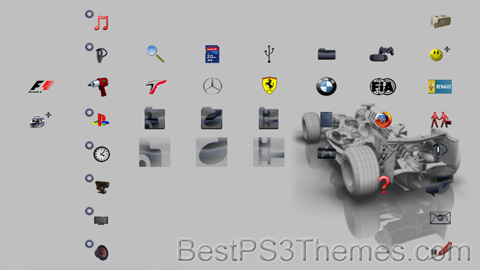
If an internal link led you here, you may wish to change the link to point directly to the intended article. Formula OneFormula One theme by Louxx Download: FormulaOne.p3t
Formula One, commonly known as Formula 1 or F1, is the highest class of international racing for open-wheel single-seater formula racing cars sanctioned by the Fédération Internationale de l'Automobile (FIA). The FIA Formula One World Championship has been one of the world's premier forms of racing since its inaugural running in 1950. The word formula in the name refers to the set of rules all participants' cars must follow. A Formula One season consists of a series of races, known as Grands Prix. Grands Prix take place in multiple countries and continents on either purpose-built circuits or closed public roads. A point-system is used at Grands Prix to determine two annual World Championships: one for the drivers, and one for the constructors (the teams). Each driver must hold a valid Super Licence, the highest class of racing licence the FIA issues, and the races must be held on grade one tracks, the highest grade rating the FIA issues for tracks. Formula One cars are the world's fastest regulated road-course racing cars, owing to very high cornering speeds achieved by generating large amounts of aerodynamic downforce. Much of this downforce is generated by front and rear wings, which have the side effect of causing severe turbulence behind each car. The turbulence reduces the downforce the cars following directly behind generate, making it hard to overtake. Major changes made to the cars for the 2022 season have resulted in greater use of ground effect aerodynamics and modified wings to reduce the turbulence behind the cars, with the goal of making overtaking easier.[1] The cars depend on electronics, aerodynamics, suspension, and tyres. Traction control, launch control, and automatic shifting, and other electronic driving aids were first banned in 1994. They were briefly reintroduced in 2001, and have more recently been banned since 2004 and 2008, respectively.[2] With the average annual cost of running a team—designing, building, and maintaining cars, pay, transport—at approximately £220,000,000 (or $265,000,000),[3] Formula One's financial and political battles are widely reported. The Formula One Group is owned by Liberty Media, which acquired it in 2017 from private-equity firm CVC Capital Partners for £6.4 billion ($8 billion).[4][5] History[edit]Formula One originated from the World Manufacturers' Championship (1925–1930) and European Drivers' Championship (1931–1939). The formula is a set of rules that all participants' cars must follow. Formula One was a formula agreed upon in 1946 to officially become effective in 1947. The first Grand Prix in accordance with the new regulations was the 1946 Turin Grand Prix, anticipating the formula's official start.[citation needed] Before World War II, a number of Grand Prix racing organisations made suggestions for a new championship to replace the European Championship, but due to the suspension of racing during the conflict, the new International Formula for cars did not become formalised until 1946, to become effective in 1947. The new World Championship was instituted to commence in 1950.[citation needed] The first world championship race, the 1950 British Grand Prix, took place at Silverstone Circuit in the United Kingdom on 13 May 1950.[6] Giuseppe Farina, competing for Alfa Romeo, won the first Drivers' World Championship, narrowly defeating his teammate Juan Manuel Fangio. Fangio won the championship in 1951, 1954, 1955, 1956, and 1957.[7] This set the record for the most World Championships won by a single driver, a record that stood for 46 years until Michael Schumacher won his sixth championship in 2003.[7] .jpg) A Constructors' Championship was added in the 1958 season. Stirling Moss, despite being regarded as one of the greatest Formula One drivers in the 1950s and 1960s, never won the Formula One championship.[8] Between 1955 and 1961, Moss finished second in the championship four times and third the other three times.[9][10] Fangio won 24 of the 52 races he entered—still the record for the highest Formula One winning percentage by an individual driver.[11] National championships existed in South Africa and the UK in the 1960s and 1970s. Promoters held non-championship Formula One events for many years. Due to the increasing cost of competition, the last of these was held in 1983.[12] This era featured teams managed by road-car manufacturers, such as Alfa Romeo, Ferrari, Mercedes-Benz and Maserati. The first seasons featured prewar cars like Alfa Romeo's 158, which were front-engined, with narrow tyres and 1.5-litre supercharged or 4.5-litre naturally aspirated engines. The 1952 and 1953 seasons were run to Formula Two regulations, for smaller, less powerful cars, due to concerns over the dearth of Formula One cars.[13][14] When a new Formula One formula for engines limited to 2.5 litres was reinstated for the 1954 world championship, Mercedes-Benz introduced its W196, which featured things never seen on Formula One cars before, such as desmodromic valves, fuel injection, and enclosed streamlined bodywork. Mercedes drivers won the championship for the next two years, before the team withdrew from all motorsport competitions due to the 1955 Le Mans disaster.[15] Technological developments[edit] The first major technological development in the sport was Bugatti's introduction of mid-engined cars. Jack Brabham, the world champion in 1959, 1960, and 1966, soon proved the mid-engine's superiority over all other engine positions. By 1961 all teams had switched to mid-engined cars. The Ferguson P99, a four-wheel drive design, was the last front-engined Formula One car to enter a world championship race. It entered the 1961 British Grand Prix, the only front-engined car to compete that year.[16] During 1962, Lotus introduced a car with an aluminium-sheet monocoque chassis instead of the traditional space-frame design. This proved to be the greatest technological breakthrough since the introduction of mid-engined cars. In 1968, sponsorship was introduced to the sport. Team Gunston became the first team to run cigarette sponsorship on its Brabham cars, which privately entered in orange, brown and gold colours of Gunston cigarettes in the 1968 South African Grand Prix on 1 January 1968.[17] Five months later, the first works team, Lotus, followed this example when it entered its cars painted in the red, gold, and white colours of the Imperial Tobacco's Gold Leaf livery at the 1968 Spanish Grand Prix. Aerodynamic downforce slowly gained importance in car design with the appearance of aerofoils during the 1968 season. In the late 1970s, Lotus introduced ground-effect aerodynamics, previously used on Jim Hall's Chaparral 2J in 1970, that provided enormous downforce and greatly increased cornering speeds. The aerodynamic forces pressing the cars to the track were up to five times the car's weight. As a result, extremely stiff springs were needed to maintain a constant ride height, leaving the suspension virtually solid. This meant that the drivers depended entirely on the tyres for any small amount of cushioning of the car and driver from irregularities of the road surface.[18] Big business[edit]Beginning in the 1970s, Bernie Ecclestone rearranged the management of Formula One's commercial rights; he is widely credited with transforming the sport into the multibillion-dollar business it now is.[19][20] When Ecclestone bought the Brabham team during 1971, he gained a seat on the Formula One Constructors' Association, and in 1978, he became its president.[21] Previously, the circuit owners controlled the income of the teams and negotiated with each individually; Ecclestone persuaded the teams to "hunt as a pack" through FOCA.[20] He offered Formula One to circuit owners as a package they could take or leave. In return for the package, almost all that was required was to surrender trackside advertising.[19] The formation of the Fédération Internationale du Sport Automobile (FISA) in 1979 set off the FISA–FOCA war, during which FISA and its president Jean-Marie Balestre argued repeatedly with FOCA over television revenues and technical regulations.[22] The Guardian said that Ecclestone and Max Mosley "used [FOCA] to wage a guerrilla war with a very long-term aim in view". FOCA threatened to establish a rival series and boycotted a Grand Prix, and FISA withdrew its sanction from races.[19] The result was the 1981 Concorde Agreement, which guaranteed technical stability, as teams were to be given reasonable notice of new regulations.[23] Although FISA asserted its right to the TV revenues, it gave FOCA the administration of those rights.[24] FISA imposed a ban on ground-effect aerodynamics during 1983.[25] But by then, turbocharged engines, which Renault had pioneered in 1977, were producing over 520 kW (700 bhp) and were essential to be competitive. By 1986, a BMW turbocharged engine achieved a flash reading of 5.5 bar (80 psi) pressure, estimated[who?] to be over 970 kW (1,300 bhp) in qualifying for the Italian Grand Prix. The next year, power in race trim reached around 820 kW (1,100 bhp), with boost pressure limited to only 4.0 bar.[26] These cars were the most powerful open-wheel circuit racing cars ever. To reduce engine power output and thus speeds, the FIA limited fuel tank capacity in 1984, and boost pressures in 1988, before banning turbocharged engines completely in 1989.[27] The development of electronic driver aids began in the 1980s. Lotus began to develop a system of active suspension, which first appeared during 1983 on the Lotus 92.[28] By 1987, this system had been perfected and was driven to victory by Ayrton Senna in the Monaco Grand Prix that year. In the early 1990s, other teams followed suit and semi-automatic gearboxes and traction control were a natural progression. The FIA, due to complaints that technology was determining races' outcomes more than driver skill, banned many such aids for the 1994 season. This resulted in cars that previously depended on electronic aids becoming very "twitchy" and difficult to drive. Observers felt the ban on driver aids was in name only, as they "proved difficult to police effectively".[29] The teams signed a second Concorde Agreement in 1992 and a third in 1997.[30]  On the track, the McLaren and Williams teams dominated the 1980s and 1990s. Brabham was also competitive during the early 1980s, winning two Drivers' Championships with Nelson Piquet. Powered by Porsche, Honda, and Mercedes-Benz, McLaren won 16 championships (seven constructors' and nine drivers') in that period, while Williams used engines from Ford, Honda, and Renault to also win 16 titles (nine constructors' and seven drivers'). The rivalry between racers Ayrton Senna and Alain Prost became F1's central focus during 1988 and continued until Prost retired at the end of 1993. Senna died at the 1994 San Marino Grand Prix after crashing into a wall on the exit of the notorious curve Tamburello. The FIA worked to improve the sport's safety standards since that weekend, during which Roland Ratzenberger also died in an accident during Saturday qualifying. No driver died of injuries sustained on the track at the wheel of a Formula One car for 20 years until the 2014 Japanese Grand Prix, where Jules Bianchi collided with a recovery vehicle after aquaplaning off the circuit, dying nine months later from his injuries. Since 1994, three track marshals have died, one at the 2000 Italian Grand Prix,[31] one at the
Formula 1 theme by Bimmer3 Download: Formula1_2.p3t Redirect to: | |||||||||||||||||||||||||||||||||||||||||||||||||||||||||||||||||||||||||||||||||||||||||||||||||||||||||||||||||||||


.jpg)


.svg)