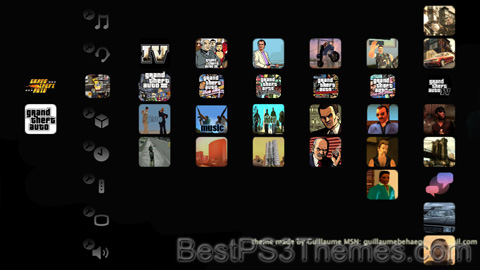
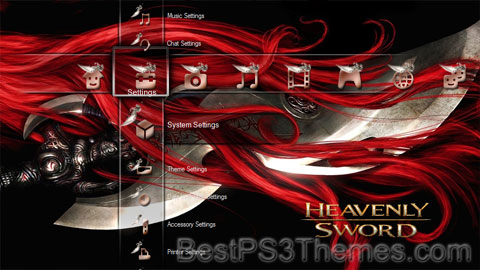
This program unpacks Playstation 3 Theme files (.p3t) so that you can touch-up an existing theme to your likings or use a certain wallpaper from it (as many themes have multiple). But remember, if you use content from another theme and release it, be sure to give credit!
Download p3textractor.zip from above. Extract the files to a folder with a program such as WinZip or WinRAR. Now there are multiple ways to extract the theme.
The first way is to simply open the p3t file with p3textractor.exe. If you don’t know how to do this, right click the p3t file and select Open With. Alternatively, open the p3t file and it will ask you to select a program to open with. Click Browse and find p3textractor.exe from where you previously extracted it to. It will open CMD and extract the theme to extracted.[filename]. After that, all you need to do for any future p3t files is open them and it will extract.
The second way is very simple. Just drag the p3t file to p3textractor.exe. It will open CMD and extract the theme to extracted.[filename].
For the third way, first put the p3t file you want to extract into the same folder as p3textractor.exe. Open CMD and browse to the folder with p3extractor.exe. Enter the following: p3textractor filename.p3t [destination path]Replace filename with the name of the p3t file, and replace [destination path] with the name of the folder you want the files to be extracted to. A destination path is not required. By default it will extract to extracted.filename.
This program unpacks Playstation 3 Theme files (.p3t) so that you can touch-up an existing theme to your likings or use a certain wallpaper from it (as many themes have multiple). But remember, if you use content from another theme and release it, be sure to give credit!
Download p3textractor.zip from above. Extract the files to a folder with a program such as WinZip or WinRAR. Now there are multiple ways to extract the theme.
The first way is to simply open the p3t file with p3textractor.exe. If you don’t know how to do this, right click the p3t file and select Open With. Alternatively, open the p3t file and it will ask you to select a program to open with. Click Browse and find p3textractor.exe from where you previously extracted it to. It will open CMD and extract the theme to extracted.[filename]. After that, all you need to do for any future p3t files is open them and it will extract.
The second way is very simple. Just drag the p3t file to p3textractor.exe. It will open CMD and extract the theme to extracted.[filename].
For the third way, first put the p3t file you want to extract into the same folder as p3textractor.exe. Open CMD and browse to the folder with p3extractor.exe. Enter the following: p3textractor filename.p3t [destination path]Replace filename with the name of the p3t file, and replace [destination path] with the name of the folder you want the files to be extracted to. A destination path is not required. By default it will extract to extracted.filename.
The main games in the series follow the events of the King of Iron Fist Tournament, hosted by the Mishima Zaibatsu, where players control a plethora of characters to win the tournament and gain control of the company; the conflict between the Mishima family serves as the main focus of the series' plot, while players explore other characters' motivations in aiming to control the Zaibatsu.
Gameplay focuses on hand-to-hand combat with an opponent, with the gameplay system including blocks, throws, escapes, and ground fighting. The series later introduced combos and special moves, with characters also able to stage break arenas. Tekken is noted as being one of the first fighting games at the time to use 3D animation.
Japanese video game developer Namco began the series in 1994, with the release of the self-titled first entry. As of 2017, it has nine additional entries, eight spin-off games, and has been adapted into three feature films and other media. Tekken 2, as well as the third game Tekken 3, are considered landmark titles; they received critical acclaim for their gameplay and more immersive experience. Subsequent titles have followed this concept and received generally positive critical responses. It has been mentioned as early as 2015 by the Guinness Book of World Records as the longest running story in video games without reboots, retcons, or revisions. The Mishima saga covering the first ten games until Tekken 8 was described as a story revolving around the Iron Fist Tournament and a family aiming to destroy each other.[1]
The series has been universally acclaimed and commercially successful, having shipped over 57 million copies by 2024, making it the third best-selling fighting game franchise. The main series has been widely credited by critics and video game publications for raising the standards of fighting games and praised for its gameplay mechanics and replay value.
All major installments of the series are originally arcade games, and the boards used to run them have traditionally been based on PlayStation hardware. Following their release in arcades, home releases in the series have mainly been for consoles in the PlayStation line.
^ abcArcade versions re-released and included in the home version of Tekken 5
^Re-released on the PlayStation 3 via the PlayStation Network as part of the PSone Classics line on June 3, 2011.
^Re-released on the PlayStation Portable, PlayStation 3, and PlayStation Vita via the PlayStation Network as part of the PSone Classics line on December 4, 2006 and May 3, 2007, respectively.
^Re-released for the Zeebo via 3G in Brazil and Mexico on October 8 and November 4, 2009, respectively.
^Remastered in HD as part of the Tekken Hybrid package for PlayStation 3 on November 22, 2011.
^Re-released on the PlayStation 3 via the PlayStation Network on December 12, 2006 and updated with an online component and renamed Tekken 5: Dark Resurrection Online on August 1, 2007.
^Scaled down version was released for the PlayStation Portable on November 24, 2009.
The first game in the series, Tekken, was released in 1994, first as an arcade game and as a port for the PlayStation in 1995.[3] The game features eight playable characters, each with their own sub-boss. The PlayStation version features remixes of the stage themes and also made the sub-bosses playable for a total of eighteen characters, including a costume swap for Kazuya (Devil Kazuya). In addition, a cutscene is unlocked when the player finishes arcade mode with each of the original eight characters. The canon ending of the game consists of Kazuya exacting revenge on his father Heihachi Mishima, beating him in the tournament and tossing him off the same cliff that he was thrown off by Heihachi.[4]
Tekken 2 was released in 1995 in arcades and in 1996 for the PlayStation. A port was also made several years later for Zeebo. There are ten playable characters as well as fifteen to unlock, for a total of twenty-five characters. The home version features four new modes that would become staples to the series, which were Survival, Team Battle, Time Attack, and Practice. The game features remixes of the arcade versions' characters' themes, and a cutscene unlocked once the player completes the arcade mode. The canon ending of this game consists of Heihachi surviving the fall, entering the King of Iron Fist Tournament 2 and defeating Kazuya, throwing him into an erupting volcano and reclaiming the Mishima Zaibatsu.[4] During the events of the second King of Iron First Tournament, Kazuya and Jun Kazama were mysteriously drawn to one another and became intimate.
Tekken 3 was released in arcades and for the PlayStation in 1997 and 1998, respectively. Due to the 19-year storyline span between the game and its predecessor, the game largely features a new cast of characters, including the debut of staple main character Jin Kazama, the child of Kazuya and Jun, as well as now-staple characters Ling Xiaoyu and Hwoarang, with a total of twenty-three characters. The home version includes a mode called Tekken Force, as well as the bonus Tekken Ball mode, and also includes remixes to the characters' themes from the arcade version.[5] The canon ending of Tekken 3 consists of Paul Phoenix defeating Ogre and leaving victorious. After its defeat, Ogre transforms into a monstrous creature, "True Ogre". Jin Kazama faces True Ogre and defeats him, avenging his mother. With Ogre out of the way, Jin's grandfather Heihachi shoots him, leaving him for dead. However, Jin survives, being revived by the Devil Gene he inherited from his father.[4]
1999–2004: Debut of team-battle oriented games[edit]
Tekken Tag Tournament was released in 1999 in arcades and as a launch title for the PlayStation 2 in 2000. Tekken Tag Tournament features tag battles and includes almost all of the Tekken characters in the series up until that point in time, for a total of 34 characters. The game ran on the same arcade board with an updated Tekken 3 engine, and thus saw major graphical upgrades when ported to the PlayStation 2. The home version features remixes of the characters' themes from the arcade version, and also features a bonus Tekken Bowl mode. A remastered version of the game, Tekken Tag Tournament HD, is included in the 2011 collection Tekken Hybrid,[6] which also contained a playable demo of Tekken Tag Tournament 2 and the film Tekken: Blood Vengeance.[7]
Tekken 4 is the fifth installment of the series, released in 2001 in arcades and 2002 for the PlayStation 2. The home version includes a new Story mode that unlocks cutscenes when played, in contrast to previous installments in which such cutscenes were unlocked from playing the Arcade Mode. Gameplay revisions include the ability for the player to move about before the round begins, as well as walled-stages. For the first time, the themes used in the arcade mode are the same ones put into the home version. There are 23 characters to choose from. The story reveals that Kazuya survived the fall into the volcano from 20 years prior, and enters the King of Iron Fist Tournament 4 to take back the Mishima Zaibatsu. In the canonical ending, Kazuya and Heihachi are both defeated by Jin. Jin unwillingly transforms into his Devil form, but after glimpsing a vision of his mother, Jun (whom he had not seen in six years), he refrains from executing Heihachi.[4]
Tekken 5 was released in arcades in 2004 and 2005 for the PlayStation 2, with a short period of time of transition from arcade to PlayStation, of two months in North America and four months in Japan.[8][9] There are 32 characters to choose from, including staple newcomers Devil Jin and Osaka's Asuka Kazama. Many of the characters who were removed in Tekken 3 returned in Tekken 5. The home version includes a mode known as Devil Within, a variant of the Tekken Force mode introduced in Tekken 3. In the canonical ending, Jin Kazama defeats his great-grandfather Jinpachi Mishima (who took over the Mishima Zaibatsu shortly after the ending events of Tekken 4), and inherits the Mishima Zaibatsu.[4]
Although Tekken games normally saw updates to the arcade versions, Tekken 5 was the first installment in the series that had a revision significant enough that it was rereleased, with the subtitle Dark Resurrection in 2005. The game was ported to the PlayStation Portable in 2006 and features two new characters: Emilie "Lili" De Rochefort and Sergei Dragunov. Armor King was also reintroduced as a playable character in this revision. The game also introduces a ranking system to the series. The home version featured new modes, such as Ghost Mode, Tekken Dojo Mode, and the two bonus modes, Gold Rush mode, and a revised version of the Tekken Bowl mode introduced in Tekken Tag Tournament. The Devil Within mode from the PlayStation 2 version however, was absent. Namco Bandai saw the fan demand for a console version and a port for the PlayStation 3 via the PlayStation Network was released in 2007, in full 1080p HD.[10][11] The PlayStation 3 version also saw an update and was retitled Tekken 5: Dark Resurrection ONLINE, marking the first time in the series that online play was featured. The PlayStation 3 version also made Jinpachi Mishima playable (but not online).
Tekken 6 was originally released in arcades in 2007, followed by an updated version in 2008 titled Tekken 6: Bloodline Rebellion.[12] The home version was based on Bloodline Rebellion and was released for the PlayStation 3 and Xbox 360, marking the first time in the series that a game was multiplatform.[13][14] The game features a Scenario Campaign mode, which follows gameplay from previous Tekken Force modes, which was playable online alongside standard versus. In the Scenario Campaign ending, after being defeated by Heihachi's illegitimate son Lars Alexandersson (who suffered amnesia at one point during the Scenario Campaign), Jin Kazama is revealed to have wreaked havoc and waged war on the world to fill it with negative energy and generate a physical manifestation of Azazel, so that he himself can face and kill him, as he believed that killing Azazel may purge Jin himself from the Devil Gene inside his body. After the battle, Jin's body is found by Raven, and the Devil Gene is still intact in his body.[4]
Tekken Tag Tournament 2 was released in Japanese arcades in 2011.[15] Its console version was released the next year and is based on the updated arcade version called Tekken Tag Tournament 2 Unlimited that contained new features.[16] The Wii U version, which served as a launch title for the console, includes a revised version of the Tekken Ball mode from Tekken 3 and exclusive Nintendo themed costumes for each character, as well as a new mode that makes use of the mushrooms from the Super Mario Bros. franchise. Like the previous iteration, Tekken Tag Tournament 2 includes nearly every character up to that point and a few exclusive characters. Lili's butler Sebastian, Eddy Gordo’s disco-oriented alter ego Tiger Jackson, a new female wrestler character named Jaycee, who is actually Julia Chang in disguise but was made to differentiate the play style of Julia and her mother Michelle Chang, and Slim Bob a slender version of Bob. A demo version of Tekken Tag Tournament 2 was released as part of Tekken Hybrid including exclusive designs for Devil and Devil Jin from the film Tekken: Blood Vengeance. American rapper Snoop Dogg was featured in the game with his own stage and an original song by the rapper titled “Knocc ‘em Down”.
In early 2014, Katsuhiro Harada expressed interest in continuing the series on PlayStation 4.[17]Tekken 7 was released in Japanese and Korean arcades in 2015. It is the first game in the series to be powered by the Unreal Engine.[18] The game received an update, subtitled Fated Retribution and released to arcades on July 5, 2016, and featured the series' second, third, fourth and fifth guest characters, the guest characters appearing are Akuma from the Street Fighter franchise by Capcom, Geese Howard from SNK's fighting game franchises, Noctis Lucis Caelum from the Final Fantasy franchise by Square Enix and Negan Smith from The Walking Dead franchise. The PlayStation 4 version was confirmed at Paris Games Week 2015, and features exclusive content as well as virtual reality support. The Xbox One and Microsoft Windows versions were released on June 2, 2017, alongside the PlayStation 4 version, and are based on the Fated Retribution.[19] In the canonical ending, considered the conclusion of the Mishima saga, Heihachi takes control of the Zaibatsu, and attempts to expose Kazuya of the Devil Gene, after a failed attempt on capturing a missing Jin, who was found safely by his uncles Lars and Lee. In their final battle, Kazuya permanently kills Heihachi and throws him into an erupting volcano, whereas Jin, who recovered from his coma thanks to Lars and Lee, declares that he must kill Kazuya to end the cursed Mishima bloodline. It was also revealed that Heihachi killed his wife Kazumi in self-defense because of her possession of the Devil Gene and the fact that she had gained a split personality because of it, shortly after Kazuya was born. Few side playable characters’ storylines have their endings from Tekken Tag Tournament 2 ties to this game.[4]
A teaser for a new mainline entry in the series was shown during Tekken 7's tournament at EVO 2022, before being formally announced on September 13, 2022 during Sony's State of Play presentation. It was released on the PlayStation 5, Xbox Series X/S, and PC through Steam on January 26, 2024. As a continuation from the seventh mainline game, it focuses on a conclusion of Kazuya and Jin's enmity.[20] In contrast to the seventh mainline game's utility of Unreal Engine 4, Tekken 8 will utilize Unreal Engine 5, making it the first fighting game to do so.[21] This game was announced on January 6, 2023 to be co-developed with Arika, who also handles the recent patch(es) for Tekken 7.[22]
Tekken 3 was also ported to the Game Boy Advance as Tekken Advance in 2001.[23]Tekken 6-based Tekken 3D: Prime Edition was released for the Nintendo 3DS in 2012. A free to play version of Tekken was released in 2013 for PSN as Tekken Revolution. Tekken Card Challenge was released on the WonderSwan, a Japan-exclusive handheld, in 1999.[24] A spin-off action adventure game featuring series' character Nina Williams as the protagonist, Death by Degrees, released for the PS2 in 2005.[25] Two mobile Tekken spin-off games were released in 2011: a 2D fighting game Tekken Resolute, which was the first game not to include Heihachi Mishima,[26] and Tekken Bowl, the bowling mini-game from Tekken Tag Tournament, for the iOS operating system. Tekken Bowl was first game not to include Yoshimitsu, Nina Williams, Paul Phoenix, or King.[27] In 2013, a third mobile game titled Tekken Card Tournament was released by Namco Bandai to the App Store for iOS and Google Play Store on Android.[28][29] That same year, Namco Bandai also released Tekken Arena to the Google Play Store on Android.&#
Gameplay focuses on an open world where the player can complete missions to progress an overall story, as well as engage in various side activities. Most of the gameplay revolves around driving and shooting, with occasional role-playing and stealth elements. The series also has elements of the earlier beat 'em up games from the 16-bit era. The games in the Grand Theft Auto series are set in fictional locales modelled after real-life cities, at various points in time from the early 1960s to the 2010s. The original game's map encompassed three cities—Liberty City (based on New York City), San Andreas (based on San Francisco),[a] and Vice City (based on Miami)—but later titles tend to focus on a single setting and expand upon the original three locales. Each game in the series centres on different respective protagonist who attempts to rise through the criminal underworld due to various motives, often accompanying themes of betrayal. Several film and music veterans have voiced characters in the games, including Ray Liotta, Dennis Hopper, Samuel L. Jackson, William Fichtner, James Woods, Debbie Harry, Axl Rose and Peter Fonda.[3]
DMA Design began the series in 1997, with the release of the Grand Theft Auto. As of 2020[update], the series consists of seven standalone titles and four expansion packs. The third main title, Grand Theft Auto III, released in 2001, is considered a landmark game, and brought the series into a three-dimensional environment for the first time. Subsequent titles have followed and built upon the format established by Grand Theft Auto III, receiving significant acclaim. The games influenced other open-world games, and led to the label Grand Theft Auto clone on similar titles.[4]
The series has been critically acclaimed, with all the main 3D entries in the franchise frequently ranked among the greatest and best-selling video games;[5] it has shipped more than 425 million units, making it one of the best-selling video game franchises. In 2006, Grand Theft Auto was featured in a list of British design icons in the Great British Design Quest organised by the BBC and the Design Museum.[6] In 2013, The Telegraph ranked Grand Theft Auto among Britain's most successful exports.[7] The series has also been controversial for its adult nature and violent themes, as well as for cut content.
The Grand Theft Auto series is split into separate fictional universes, named after the primary level of graphics capability used in each era.[8] The original Grand Theft Auto, its expansions and its sequel are considered the "2D universe". Grand Theft Auto III and its sequels are considered the "3D universe". Grand Theft Auto IV, its expansions and Grand Theft Auto V are considered the "HD universe". Each universe is considered separate with only brands, place names and background characters shared between them.[8]
On 4 February 2022, Rockstar confirmed that development of a new entry in the series was "well underway".[19] In-development footage of the game leaked in September 2022;[20][21] Rockstar noted that it was "extremely disappointed" by the manner in which the game was first demonstrated, but that it did not anticipate long-term effects on development.[22] In December 2023, the game was officially announced as Grand Theft Auto VI, with a projected release date of 2025 for the PlayStation 5 and Xbox Series X/S.[23]
Grand Theft Auto has spawned numerous additional games and expansion packs. In 1999, the original game received two expansion packs: Grand Theft Auto: London 1969 and Grand Theft Auto: London 1961, which, as their names suggest, featured a different setting – a fictional version of London – and new missions and characters.[9]Grand Theft Auto Advance, released in 2004 exclusively for the Game Boy Advance, featured a top-down perspective, similarly to the first two main games in the series, and the same setting as Grand Theft Auto III, to which it served as a prequel. Three games were released for the PlayStation Portable: Grand Theft Auto: Liberty City Stories in 2005, which is also a prequel to Grand Theft Auto III; Grand Theft Auto: Vice City Stories in 2006, which is a prequel to Vice City; and Grand Theft Auto: Chinatown Wars in 2009, which features the same setting as Grand Theft Auto IV, but the two games are otherwise unrelated. Both Liberty City Stories and Vice City Stories were later ported to the PlayStation 2, while Chinatown Wars was originally released for the Nintendo DS and later ported to PlayStation Portable.[24] In 2009, The Lost and Damned and The Ballad of Gay Tony were released for the Xbox 360 as expansion packs to Grand Theft Auto IV; a "strategic alliance" between Rockstar and Microsoft resulted in the timed exclusivity. The expansions focus on characters who played a relatively minor role in the main game, and whose stories take place simultaneously with Grand Theft Auto IV's. Both were later released for the PlayStation 3 and Windows as part of a compilation, titled Grand Theft Auto: Episodes from Liberty City, also available on Xbox 360.[25]
Numerous titles in the series have received ports to mobile devices. Chinatown Wars was released for iOS in 2010 and for Android and Fire OS in 2014.[26] For their tenth anniversaries, Grand Theft Auto III and Vice City were both re-released for iOS and Android in 2011 and 2012, respectively.[27][28] In 2013, San Andreas was ported to iOS, Android and Windows Phone and RT;[29] the mobile port was later re-released for Xbox 360 in 2014, the year of the game's tenth anniversary,[30] and the following year for PlayStation 3.[31] In 2015, Liberty City Stories was ported to iOS, Android and Fire OS.[32][33]
Grand Theft Auto Double Pack was released in 2003 for the PlayStation 2 and Xbox, and includes both Grand Theft Auto III and Vice City.[34]Grand Theft Auto: The Trilogy is a compilation of III, Vice City, and San Andreas, and was first released in 2005 for the Xbox.[35] It was later re-released for the PlayStation 2, Windows, Mac OS X, and PlayStation 4.[36][37][38][39]The Trilogy also served as the revised package for San Andreas, which had to be pulled from shelves due to the controversial Hot Coffee mod.[40] A report in August 2021 suggested that Rockstar Dundee was leading development on a remastered version of the trilogy, using Unreal Engine;[41] following some leaks,[42][43][44] Rockstar officially announced Grand Theft Auto: The Trilogy – The Definitive Edition on 8 October 2021. The game features graphical and gameplay upgrades, and replaced existing versions on digital retailers. It was released for the Nintendo Switch, PlayStation 4, PlayStation 5, Windows, Xbox One, and Xbox Series X/S on 11 November 2021,[45] and for Android and iOS on 14 December 2023.[46]
Grand Theft Auto: Episodes from Liberty City is a standalone compilation of the two episodes for Grand Theft Auto IV. It contains both The Lost and Damned and The Ballad of Gay Tony on one disc. It was released on 29 October 2009 for the Xbox 360 and on 13 April 2010 for PlayStation 3 and Windows. Microsoft added Episodes from Liberty City to its backwards compatibility list for Xbox One platforms in February 2017.[47] The standalone release of Episodes from Liberty City for Windows was discontinued and replaced by a single-player-only version of Grand Theft Auto IV: Complete Edition in 2020.[48]
The game is an action-adventure title with heavy elements of hack and slash gameplay. The gameplay of the game resembles a martial arts title focused on melee combat while featuring opportunities for ranged attacks. The main character, Nariko, uses a weapon called the "Heavenly Sword" which changes into one of three forms depending on what attack stance the player uses as part of a unique fighting style. Speed Stance provides an even balance between damage and speed, where the sword takes the form of two separate blades.[1] Range Stance allows fast, long-range, but weaker attacks, with the sword being two blades chained together. Power Stance is the most powerful, but slowest style, where attacks are made with the sword in the shape of one large, two-handed blade.
For exploration and certain battles, the game also makes use of quick time events (QTE). During a QTE, a symbol for a certain button or for an action such as moving the analog stick to the right or left appears on-screen and the player must match what is shown to successfully complete the scene.[1]
In addition to Nariko, a secondary character, Kai, is controlled for some portions of the game.[1] Many of Kai's stages take the form of sniping missions, using her crossbow to pick off enemies, in some cases to protect characters. While Kai cannot perform hand-to-hand combat,[1] in stages that call for her to explore the level she is able to hop over objects and to free herself from an enemy's grasp by temporarily stunning them.
Projectiles can be maneuvered to their targets using the motion-sensing capabilities of the Sixaxis controller through a feature known as Aftertouch. Such projectiles include guiding Kai's arrows after she has launched them, and for Nariko, guiding a cannon or rocket launcher, or picking up and throwing objects.
The game's story and mythos revolves around the titular Heavenly Sword, a blade said to have been wielded by an unnamed Heavenly deity against a demonic warlord called the Raven Lord.[2] After the battle was won and the Raven Lord defeated, the sword was left in the mortal world, becoming the center of wars over its power.[3] The fighting made the sword lust after the life of its users, eventually killing them after a short time.[4][5] A warrior tribe finally took charge of the sword, ending the wars and pledging to keep it safe and unused for the world's own good.[6] Among the tribe, a legend said that the sword's original wielder would be reborn in the year of the "fire-horse", and that this figure would unite the world's scattered tribes and lead the world to peace.[7]
The game's narrator and main protagonist is Nariko (Anna Torv), a headstrong red-headed woman who was born in the year of the prophesied divine warrior: because she was a woman, her clan saw her as a mockery of the prophecy and a portent of doom.[8] The game's main antagonist is King Bohan (Andy Serkis), a tyrannical ruler who is determined to bring the world's tribes to heel and pave the way for a new golden age.[9] Nariko is trained as a warrior by her father, Master Shen (Ewan Stewart), who both cares for her as a child and has difficulty coping with her role in the clan's seeming undoing and the death of his wife.[10] Nariko's only friend is Kai (Lydia Baksh), a wild and erratic young girl who is the last member of a clan destroyed by the armies of Bohan.[11] Among Bohan's servants are his general, Flying Fox (Steven Berkoff): his serpentine mistress Whiptail (Race Davies): and Roach (Richard Ridings), Bohan's son, of whom the king is so ashamed because of Roach's obese appearance that he will not even acknowledge Roach as his own.[12]
The game begins in medias res, with Nariko fighting the forces of Bohan. As she is fighting the sword finishes draining her life and she seemingly dies, waking in a field and speaking to the power within the sword about what has happened. Five days before, Nariko's clan is assaulted by King Bohan's forces. Before she joins the fight, Shen thrusts the sword into the ground next to her demanding that she take care of it. Nariko fights alongside her father and her clansmen as their defenses are weakened and stretched by scores of Bohan's warriors scaling the city walls accompanied by catapults. As the warriors and Shen escape from Bohan's Army, Nariko protects them until spotting a catapult moving toward the fort. As Shen had earlier instructed her, she flees, as the fortress is apparently destroyed behind her. She passes a large black bird with a golden head, the animal form of the Raven Lord. When Bohan's army captures her father and corners her Nariko has no choice but to wield the sword to defend herself in order to escape. She takes a flying leap off a cliff edge as Bohan's archers begin firing at her. Kai finds Nariko after disobeying Shen's orders to hide and informs her of the temple where her father and clansmen are held captive. Nariko infiltrates the temple and is ambushed by Flying Fox. She defeats the general and continues on to rescue her father. Meanwhile, King Bohan plots to set up a trap for Nariko with Whiptail. Nariko falls into the trap, and Whiptail, after watching most of her personal guards defeated, tells Nariko the truth behind her father's original feelings about her birth - Shen wanted to kill Nariko shortly after her birth, but was unable to bring himself to do so.[13] Nariko tells her father to leave her and fights with Whiptail. After Nariko impales Whiptail with the sword, King Bohan turns up and snaps Whiptail's neck in her dying moments, then captures the sword and an incapacitated Nariko.
As Shen escapes, Kai makes her way to Nariko's cell. Kai is able to find where Nariko is imprisoned and begs that she comes home with her. Nariko explains to Kai that she needs to reacquire the Heavenly Sword to kill King Bohan. She asks Kai to retrieve the sword and Kai accepts the task. Kai succeeds in finding the Heavenly Sword, only to also discover her mother's skeleton. In a flashback, it is revealed that, some years ago, Kai's mother was murdered in front of her eyes by Flying Fox. Returning to the present, Kai is confronted by Flying Fox and barely manages to escape from him with the sword. Meanwhile, Nariko is forced by Bohan to fight before his army against Orangumen, pets of Roach's. During the battle, Kai arrives and throws Nariko the sword. When Nariko defeats all the Orangumen, Bohan orders Roach to murder Nariko. After defeating Roach, both Nariko and Kai flee from the pit. Bohan then commands Flying Fox to kill Kai while his soldiers take on Nariko. As the two try to escape, Flying Fox cuts Kai off from Nariko and they are separated. Nariko desperately tails Flying Fox, but when she finally catches up, he seemingly hangs Kai in front of her. Believing Kai dead, Nariko flies into a rage and battles with Flying Fox. As Nariko and Flying Fox duel, Kai, who survived the drop, uses her crossbow to shoot an arrow into Flying Fox's head, killing him. Nariko releases the injured Kai from the noose and returns her to the care of the clan.
King Bohan rallies his men to launch a final attack to regain the Heavenly Sword. Nariko fights alongside her father and clansmen once more. Nariko kills countless numbers of Bohan's troops with ease and destroys his catapults. Despite her efforts, the sword kills her, bringing the events of the game full circle. But this time, Nariko reverses her death by making a pact with the sword to protect it from becoming a useless and dusty relic, since it needs her more than her clan needs it.[14] Nariko returns as a goddess-like figure, and proceeds to slaughter Bohan's troops. Desperate, Bohan begs the Raven Lord (who has been seen repeatedly throughout the game watching Nariko or being with Bohan) to give him the power to destroy Nariko. Bohan gets his wish and the Raven Lord merges with him.[15] An epic battle ensues similar to the one foretold in the prophecy. After Nariko manages to defeat Bohan, the raven leaves his body, and, despite Bohan begging for mercy, pecks his eyes out and flies away.
As Nariko raises the sword to strike the final blow, Roach comes to his father's side and begs Nariko to let him take Bohan. Nariko relents, then Roach and Bohan leave, with Bohan calling Roach his son for the first time.[16] Though successful in protecting the sword from coming into the hands of Bohan, Nariko still must give her life for wielding it, for that is the price for using the almighty sword, and the story comes to its end. Nariko reflects that she believes they have fought in vain for the prophecy, that the sword was not from Heaven, but feels gratified that she chose to be the one who was going to save her people from evil: she took the sword, paid the price and ultimately defeated Bohan's army, but nevertheless she was still a normal woman.[17] Nariko heals Kai, and gives her the sword for safekeeping, before passing away. At the funeral, Nariko's body is placed into a boat filled with blossoms, and Kai and Shen cast her out to sea.
Heavenly Sword began development in 2002.[18] After establishing early concept, a CGI trailer was produced which helped guide future development, described by the team as an iterative process where many other things changed around the central concept. The team began production without a specific console in mind, tailoring gameplay elements to the PlayStation 3 when the game was picked up by Sony as an exclusive for their upcoming platform.[19] The game was developed using Havok Complete, a combination of Havok Physics and Havok Animation.[20] Production began with the aim of telling a cinematic action adventure inspired by recent films including Crouching Tiger, Hidden Dragon and Hero, with a later fantasy influence inspired by the themes of The Lord of the Rings.[21] Other influences included the game Ico (2001), the graphic novel La Tour, and the South Korean movie Musa.[19] The game eventually developed a distinct visual and narrative identity while maintaining elements from these early inspirations.[21] Nariko's three combat styles drew direct inspiration from the dragon forms in Panzer Dragoon Orta (2002).[19]
The character designs were intended to stand out from each other, with distinct elements ranging from color coding to how a character moved. Nariko was made recognisable both with her unique red hair and the simplicity of her outfit compared to other characters.[21] The early concept designs were heavily influenced by Japanese art, and while it retained a strong Far Eastern theme with influences from Japan and China, the team also incorporated references to Mongolian and South American environments and architecture.[19]
Character movement was an important element for the team. Kai's movements were based on several elements, including cats and Princess Mononoke protagonist San.[19] While they were still faced with technical restrictions, the team had access to hardware which better enabled them to realise their world and character design. Ninja Theory collaborated with Peter Jackson's company Wētā FX to create realistic facial expressions both during cutscenes and in gameplay.[21] All of the actors involved in the project had previously been involved in film or television.[19] Actor Andy Serkis performs as the voice and motion capture actor for King Bohan, one of the major characters in Heavenly Sword; he also acts as dramatic director for the game and is one of the writers of the story of the game. Nariko is voiced by Australian actress Anna Torv.[22]
A demo was released to the PlayStation Store on July 26, 2007, featuring a short, cinematic clip at the beginning and two brief enemy battles, lasting approximately five to ten minutes. An eight-second clip of the game was seen in an episode of the TV series Heroes entitled "Parasite", ostensibly being played by Jessica Sanders and her son, Micah. It featured Nariko running across ropes as they were cut by Bohan's soldiers, before landing on the platform to face them.[23] While the episode was broadcast over four months before the actual release of the game, the level displayed remained in the released build, including the rope sequence shown; the icons in the final game used to inform the player which buttons to press were changed from large, central icons as seen in the clip, to be smaller and positioned at the bottom of the screen. Sony and Ninja Theory have made five 'making-of' videos about the production of Heavenly Sword, with each one detailing a certain aspect of the game's production, from music to motion capture. The videos can either be unlocked while playing the game or downloaded from the PlayStation Store.
Nitin Sawhney composed the music for the soundtrack. It was performed by the City of Prague Philharmonic Orchestra conducted by Stephen Hussey. Tameem Antoniades of Ninja Theory said "we have our big orchestral soundtrack but we wanted to add a more ethnic element and marry those two together. There are actually very few musicians in the world who are experts in both areas. Nitin Sawhney is one of them."[24] Sawhney stated that his creation of "musical textures take in everything from Hollywood, European and Chinese cinema to Indian and middle eastern instrumentation through the orchestras and soloists hovering between sonic tidal waves and reflective moments of intimate grace."[25]
Nariko as represented in Part I of the animated series
A series of Heavenly Sword animated episodes were released prior to the launch of the game itself, acting as a prologue to the events of the game. The series, which consists of five episodes, was produced by London production company Blinkink and animated by CHASE Animation Studios, headed by Robert Chandler. The videos were made available both online[26] and through the PlayStation Store. The first two videos were also included on the retail version of the game; the latter three videos were not ready in time to be included.[27]
The style of the animated series differs from the graphics of the game itself. The animated series relies on a simple and stylized 2D look, which allowed director Ben Hibon to "create a complete visual re-interpretation of the world and its inhabitants".[28] The videos were produced using a combination of Adobe Photoshop, Flash and After Effects. Initial reference frames were created with Photoshop, which were then animated in Flash and exported as separate layers into After Effects. The layers were composed onto a 3D stage with multiple foreground, middle ground and background elements, which allowed the use of 3D cameras and lighting to give depth and movement to the video.[28]
Heavenly Sword sold over one million copies by May 2008.[50][51] Tameem Antoniades stated in March 2010 that sales were approximately one-and-a-half million but that the developer did not break even.[52] The game was praised for its graphics[35] and combat system, while criticism stemmed from the short length of the game and lack of online capabilities. It received "generally favorable reviews" according to video game review aggregatorMetacritic.[32]
USA Today gave the game nine stars out of ten, saying, "PlayStation 3 fans hungry for more satisfying first-party content from Sony will be satiated with the feverish pace Heavenly Sword provides."[48]Digital Spy gave it four stars out of five, saying, "The lavish sword combat system and the awesome presentation are what make this title a worthy buy. Sony seems to have created this game as a showcase for the PS3 and forgot about getting the gameplay up to scratch. But despite its failings, Heavenly Sword is a great buy for the excellent sword fighting sections and for those who simply want to show their friends just what the PS3 is capable of."[53]The New York Times gave it a favorable review, saying, "The scenery is breathtaking, battles can be exciting, and the intelligent, cruel King Bohan — voiced brilliantly by Andy Serkis (...) — is one of the best video game villains ever. The game is frustrating because it seems as if it should have been a great game and as if its creators tried to make it a great game, but it managed to be only a pretty good one."[54]Maxim gave it a score of six out of ten, saying, "A few of the puzzles are a total bitch, the button-press sequence/finishing moves that the game steals directly from God of War require too much precision, and the sniper sequences wind up being even more tedious than the fighting. It's fun for a little while, and very flashy, but in the end, for everything Heavenly Sword does right, it does two more things wrong."[55]The A.V. Club gave it a C+ and stated that "If Metal Gear Solid and Halo had acting this good, we'd be on to something."[47] In Japan, Famitsu gave the game a score of two sevens and two eights, for a total of 30 out of 40.[36]
GamesRadar featured Kai in the article "Freakish fashion" in 2007,[57] and Nariko as a "game babe" sex symbol in 2007 and 2009.[58][59] In 2009, MSN featured Nariko in the article "Gaming's Hottest Babes".[60]UGO featured her among the "Top Animated Hotties" in 2008[61] and in their list of the best girls in video games in 2011,[62] and also in the article "11 Strong Gaming Girls We Never Saw Again" in 2010.[63] In 2010, Lisa Foiles of The Escapist ranked Nariko first in the "Top 5 Impractical Female Character Hairstyles".[64] In 2013, she was ranked as the 18th greatest heroine in video game history by Complex.[65]
According to Ninja Theory co-founder Tameem Antoniades, the story for the sequel has already been written; in fact a whole trilogy is being planned. He stated, "We've had the story for the sequel for a while now. Hopefully, if this game is successful, then there's no reason why there shouldn't be a sequel and we'd very much like to go into that."[66]
In March 2008, it was confirmed that Ninja Theory is not planning to create a sequel for Heavenly Sword, and instead has decided to work on a new project[67] (most likely Enslaved: Odyssey to the West). Sony Computer Entertainment retains the intellectual property of Heavenly Sword, and there is always the possibility of production on a sequel being outsourced to another developer.[68] In June 2008, it was reported that a sequel to Heavenly Sword was in-development at SCE Studio Cambridge, but was canceled due to Sony no longer seeing it as a commercially viable product.[69] Concept art for the title later surfaced in 2012.[70][71]
The game is an action-adventure title with heavy elements of hack and slash gameplay. The gameplay of the game resembles a martial arts title focused on melee combat while featuring opportunities for ranged attacks. The main character, Nariko, uses a weapon called the "Heavenly Sword" which changes into one of three forms depending on what attack stance the player uses as part of a unique fighting style. Speed Stance provides an even balance between damage and speed, where the sword takes the form of two separate blades.[1] Range Stance allows fast, long-range, but weaker attacks, with the sword being two blades chained together. Power Stance is the most powerful, but slowest style, where attacks are made with the sword in the shape of one large, two-handed blade.
For exploration and certain battles, the game also makes use of quick time events (QTE). During a QTE, a symbol for a certain button or for an action such as moving the analog stick to the right or left appears on-screen and the player must match what is shown to successfully complete the scene.[1]
In addition to Nariko, a secondary character, Kai, is controlled for some portions of the game.[1] Many of Kai's stages take the form of sniping missions, using her crossbow to pick off enemies, in some cases to protect characters. While Kai cannot perform hand-to-hand combat,[1] in stages that call for her to explore the level she is able to hop over objects and to free herself from an enemy's grasp by temporarily stunning them.
Projectiles can be maneuvered to their targets using the motion-sensing capabilities of the Sixaxis controller through a feature known as Aftertouch. Such projectiles include guiding Kai's arrows after she has launched them, and for Nariko, guiding a cannon or rocket launcher, or picking up and throwing objects.
The game's story and mythos revolves around the titular Heavenly Sword, a blade said to have been wielded by an unnamed Heavenly deity against a demonic warlord called the Raven Lord.[2] After the battle was won and the Raven Lord defeated, the sword was left in the mortal world, becoming the center of wars over its power.[3] The fighting made the sword lust after the life of its users, eventually killing them after a short time.[4][5] A warrior tribe finally took charge of the sword, ending the wars and pledging to keep it safe and unused for the world's own good.[6] Among the tribe, a legend said that the sword's original wielder would be reborn in the year of the "fire-horse", and that this figure would unite the world's scattered tribes and lead the world to peace.[7]
The game's narrator and main protagonist is Nariko (Anna Torv), a headstrong red-headed woman who was born in the year of the prophesied divine warrior: because she was a woman, her clan saw her as a mockery of the prophecy and a portent of doom.[8] The game's main antagonist is King Bohan (Andy Serkis), a tyrannical ruler who is determined to bring the world's tribes to heel and pave the way for a new golden age.[9] Nariko is trained as a warrior by her father, Master Shen (Ewan Stewart), who both cares for her as a child and has difficulty coping with her role in the clan's seeming undoing and the death of his wife.[10] Nariko's only friend is Kai (Lydia Baksh), a wild and erratic young girl who is the last member of a clan destroyed by the armies of Bohan.[11] Among Bohan's servants are his general, Flying Fox (Steven Berkoff): his serpentine mistress Whiptail (Race Davies): and Roach (Richard Ridings), Bohan's son, of whom the king is so ashamed because of Roach's obese appearance that he will not even acknowledge Roach as his own.[12]
The game begins in medias res, with Nariko fighting the forces of Bohan. As she is fighting the sword finishes draining her life and she seemingly dies, waking in a field and speaking to the power within the sword about what has happened. Five days before, Nariko's clan is assaulted by King Bohan's forces. Before she joins the fight, Shen thrusts the sword into the ground next to her demanding that she take care of it. Nariko fights alongside her father and her clansmen as their defenses are weakened and stretched by scores of Bohan's warriors scaling the city walls accompanied by catapults. As the warriors and Shen escape from Bohan's Army, Nariko protects them until spotting a catapult moving toward the fort. As Shen had earlier instructed her, she flees, as the fortress is apparently destroyed behind her. She passes a large black bird with a golden head, the animal form of the Raven Lord. When Bohan's army captures her father and corners her Nariko has no choice but to wield the sword to defend herself in order to escape. She takes a flying leap off a cliff edge as Bohan's archers begin firing at her. Kai finds Nariko after disobeying Shen's orders to hide and informs her of the temple where her father and clansmen are held captive. Nariko infiltrates the temple and is ambushed by Flying Fox. She defeats the general and continues on to rescue her father. Meanwhile, King Bohan plots to set up a trap for Nariko with Whiptail. Nariko falls into the trap, and Whiptail, after watching most of her personal guards defeated, tells Nariko the truth behind her father's original feelings about her birth - Shen wanted to kill Nariko shortly after her birth, but was unable to bring himself to do so.[13] Nariko tells her father to leave her and fights with Whiptail. After Nariko impales Whiptail with the sword, King Bohan turns up and snaps Whiptail's neck in her dying moments, then captures the sword and an incapacitated Nariko.
As Shen escapes, Kai makes her way to Nariko's cell. Kai is able to find where Nariko is imprisoned and begs that she comes home with her. Nariko explains to Kai that she needs to reacquire the Heavenly Sword to kill King Bohan. She asks Kai to retrieve the sword and Kai accepts the task. Kai succeeds in finding the Heavenly Sword, only to also discover her mother's skeleton. In a flashback, it is revealed that, some years ago, Kai's mother was murdered in front of her eyes by Flying Fox. Returning to the present, Kai is confronted by Flying Fox and barely manages to escape from him with the sword. Meanwhile, Nariko is forced by Bohan to fight before his army against Orangumen, pets of Roach's. During the battle, Kai arrives and throws Nariko the sword. When Nariko defeats all the Orangumen, Bohan orders Roach to murder Nariko. After defeating Roach, both Nariko and Kai flee from the pit. Bohan then commands Flying Fox to kill Kai while his soldiers take on Nariko. As the two try to escape, Flying Fox cuts Kai off from Nariko and they are separated. Nariko desperately tails Flying Fox, but when she finally catches up, he seemingly hangs Kai in front of her. Believing Kai dead, Nariko flies into a rage and battles with Flying Fox. As Nariko and Flying Fox duel, Kai, who survived the drop, uses her crossbow to shoot an arrow into Flying Fox's head, killing him. Nariko releases the injured Kai from the noose and returns her to the care of the clan.
King Bohan rallies his men to launch a final attack to regain the Heavenly Sword. Nariko fights alongside her father and clansmen once more. Nariko kills countless numbers of Bohan's troops with ease and destroys his catapults. Despite her efforts, the sword kills her, bringing the events of the game full circle. But this time, Nariko reverses her death by making a pact with the sword to protect it from becoming a useless and dusty relic, since it needs her more than her clan needs it.[14] Nariko returns as a goddess-like figure, and proceeds to slaughter Bohan's troops. Desperate, Bohan begs the Raven Lord (who has been seen repeatedly throughout the game watching Nariko or being with Bohan) to give him the power to destroy Nariko. Bohan gets his wish and the Raven Lord merges with him.[15] An epic battle ensues similar to the one foretold in the prophecy. After Nariko manages to defeat Bohan, the raven leaves his body, and, despite Bohan begging for mercy, pecks his eyes out and flies away.
As Nariko raises the sword to strike the final blow, Roach comes to his father's side and begs Nariko to let him take Bohan. Nariko relents, then Roach and Bohan leave, with Bohan calling Roach his son for the first time.[16] Though successful in protecting the sword from coming into the hands of Bohan, Nariko still must give her life for wielding it, for that is the price for using the almighty sword, and the story comes to its end. Nariko reflects that she believes they have fought in vain for the prophecy, that the sword was not from Heaven, but feels gratified that she chose to be the one who was going to save her people from evil: she took the sword, paid the price and ultimately defeated Bohan's army, but nevertheless she was still a normal woman.[17] Nariko heals Kai, and gives her the sword for safekeeping, before passing away. At the funeral, Nariko's body is placed into a boat filled with blossoms, and Kai and Shen cast her out to sea.
Heavenly Sword began development in 2002.[18] After establishing early concept, a CGI trailer was produced which helped guide future development, described by the team as an iterative process where many other things changed around the central concept. The team began production without a specific console in mind, tailoring gameplay elements to the PlayStation 3 when the game was picked up by Sony as an exclusive for their upcoming platform.[19] The game was developed using Havok Complete, a combination of Havok Physics and Havok Animation.[20] Production began with the aim of telling a cinematic action adventure inspired by recent films including Crouching Tiger, Hidden Dragon and Hero, with a later fantasy influence inspired by the themes of The Lord of the Rings.[21] Other influences included the game Ico (2001), the graphic novel La Tour, and the South Korean movie Musa.[19] The game eventually developed a distinct visual and narrative identity while maintaining elements from these early inspirations.[21] Nariko's three combat styles drew direct inspiration from the dragon forms in Panzer Dragoon Orta (2002).[19]
The character designs were intended to stand out from each other, with distinct elements ranging from color coding to how a character moved. Nariko was made recognisable both with her unique red hair and the simplicity of her outfit compared to other characters.[21] The early concept designs were heavily influenced by Japanese art, and while it retained a strong Far Eastern theme with influences from Japan and China, the team also incorporated references to Mongolian and South American environments and architecture.[19]
Character movement was an important element for the team. Kai's movements were based on several elements, including cats and Princess Mononoke protagonist San.[19] While they were still faced with technical restrictions, the team had access to hardware which better enabled them to realise their world and character design. Ninja Theory collaborated with Peter Jackson's company Wētā FX to create realistic facial expressions both during cutscenes and in gameplay.[21] All of the actors involved in the project had previously been involved in film or television.[19] Actor Andy Serkis performs as the voice and motion capture actor for King Bohan, one of the major characters in Heavenly Sword; he also acts as dramatic director for the game and is one of the writers of the story of the game. Nariko is voiced by Australian actress Anna Torv.[22]
A demo was released to the PlayStation Store on July 26, 2007, featuring a short, cinematic clip at the beginning and two brief enemy battles, lasting approximately five to ten minutes. An eight-second clip of the game was seen in an episode of the TV series Heroes entitled "Parasite", ostensibly being played by Jessica Sanders and her son, Micah. It featured Nariko running across ropes as they were cut by Bohan's soldiers, before landing on the platform to face them.[23] While the episode was broadcast over four months before the actual release of the game, the level displayed remained in the released build, including the rope sequence shown; the icons in the final game used to inform the player which buttons to press were changed from large, central icons as seen in the clip, to be smaller and positioned at the bottom of the screen. Sony and Ninja Theory have made five 'making-of' videos about the production of Heavenly Sword, with each one detailing a certain aspect of the game's production, from music to motion capture. The videos can either be unlocked while playing the game or downloaded from the PlayStation Store.
Nitin Sawhney composed the music for the soundtrack. It was performed by the City of Prague Philharmonic Orchestra conducted by Stephen Hussey. Tameem Antoniades of Ninja Theory said "we have our big orchestral soundtrack but we wanted to add a more ethnic element and marry those two together. There are actually very few musicians in the world who are experts in both areas. Nitin Sawhney is one of them."[24] Sawhney stated that his creation of "musical textures take in everything from Hollywood, European and Chinese cinema to Indian and middle eastern instrumentation through the orchestras and soloists hovering between sonic tidal waves and reflective moments of intimate grace."[25]
Nariko as represented in Part I of the animated series
A series of Heavenly Sword animated episodes were released prior to the launch of the game itself, acting as a prologue to the events of the game. The series, which consists of five episodes, was produced by London production company Blinkink and animated by CHASE Animation Studios, headed by Robert Chandler. The videos were made available both online[26] and through the PlayStation Store. The first two videos were also included on the retail version of the game; the latter three videos were not ready in time to be included.[27]
The style of the animated series differs from the graphics of the game itself. The animated series relies on a simple and stylized 2D look, which allowed director Ben Hibon to "create a complete visual re-interpretation of the world and its inhabitants".[28] The videos were produced using a combination of Adobe Photoshop, Flash and After Effects. Initial reference frames were created with Photoshop, which were then animated in Flash and exported as separate layers into After Effects. The layers were composed onto a 3D stage with multiple foreground, middle ground and background elements, which allowed the use of 3D cameras and lighting to give depth and movement to the video.[28]
Heavenly Sword sold over one million copies by May 2008.[50][51] Tameem Antoniades stated in March 2010 that sales were approximately one-and-a-half million but that the developer did not break even.[52] The game was praised for its graphics[35] and combat system, while criticism stemmed from the short length of the game and lack of online capabilities. It received "generally favorable reviews" according to video game review aggregatorMetacritic.[32]
USA Today gave the game nine stars out of ten, saying, "PlayStation 3 fans hungry for more satisfying first-party content from Sony will be satiated with the feverish pace Heavenly Sword provides."[48]Digital Spy gave it four stars out of five, saying, "The lavish sword combat system and the awesome presentation are what make this title a worthy buy. Sony seems to have created this game as a showcase for the PS3 and forgot about getting the gameplay up to scratch. But despite its failings, Heavenly Sword is a great buy for the excellent sword fighting sections and for those who simply want to show their friends just what the PS3 is capable of."[53]The New York Times gave it a favorable review, saying, "The scenery is breathtaking, battles can be exciting, and the intelligent, cruel King Bohan — voiced brilliantly by Andy Serkis (...) — is one of the best video game villains ever. The game is frustrating because it seems as if it should have been a great game and as if its creators tried to make it a great game, but it managed to be only a pretty good one."[54]Maxim gave it a score of six out of ten, saying, "A few of the puzzles are a total bitch, the button-press sequence/finishing moves that the game steals directly from God of War require too much precision, and the sniper sequences wind up being even more tedious than the fighting. It's fun for a little while, and very flashy, but in the end, for everything Heavenly Sword does right, it does two more things wrong."[55]The A.V. Club gave it a C+ and stated that "If Metal Gear Solid and Halo had acting this good, we'd be on to something."[47] In Japan, Famitsu gave the game a score of two sevens and two eights, for a total of 30 out of 40.[36]
GamesRadar featured Kai in the article "Freakish fashion" in 2007,[57] and Nariko as a "game babe" sex symbol in 2007 and 2009.[58][59] In 2009, MSN featured Nariko in the article "Gaming's Hottest Babes".[60]UGO featured her among the "Top Animated Hotties" in 2008[61] and in their list of the best girls in video games in 2011,[62] and also in the article "11 Strong Gaming Girls We Never Saw Again" in 2010.[63] In 2010, Lisa Foiles of The Escapist ranked Nariko first in the "Top 5 Impractical Female Character Hairstyles".[64] In 2013, she was ranked as the 18th greatest heroine in video game history by Complex.[65]
According to Ninja Theory co-founder Tameem Antoniades, the story for the sequel has already been written; in fact a whole trilogy is being planned. He stated, "We've had the story for the sequel for a while now. Hopefully, if this game is successful, then there's no reason why there shouldn't be a sequel and we'd very much like to go into that."[66]
In March 2008, it was confirmed that Ninja Theory is not planning to create a sequel for Heavenly Sword, and instead has decided to work on a new project[67] (most likely Enslaved: Odyssey to the West). Sony Computer Entertainment retains the intellectual property of Heavenly Sword, and there is always the possibility of production on a sequel being outsourced to another developer.[68] In June 2008, it was reported that a sequel to Heavenly Sword was in-development at SCE Studio Cambridge, but was canceled due to Sony no longer seeing it as a commercially viable product.[69] Concept art for the title later surfaced in 2012.[70][71]
Haze over the Mojave Desert from a brush fire in Santa Barbara, California, seen as the Sun descends on the 2016 June solstice, allows the Sun to be photographed without a filter.Bushfire haze in Sydney, AustraliaHaze as smoke pollution over the Mojave from fires in the Inland Empire, June 2016, demonstrates the loss of contrast to the Sun, and the landscape in general.Haze causing red sky, due to the scattering of light on smoke particles, also known as Rayleigh scattering during Mexico's forest fire seasonHaze in Monterrey, Mexico, during grassland fires
Haze is traditionally an atmospheric phenomenon in which dust, smoke, and other dry particulates suspended in air obscure visibility and the clarity of the sky. The World Meteorological Organization manual of codes includes a classification of particulates causing horizontal obscuration into categories of fog, ice fog, steam fog, mist, haze, smoke, volcanic ash, dust, sand, and snow.[1] Sources for particles that cause haze include farming (ploughing in dry weather), traffic, industry, windy weather, volcanic activity and wildfires.
Seen from afar (e.g. an approaching airplane) and depending on the direction of view with respect to the Sun, haze may appear brownish or bluish, while mist tends to be bluish grey instead. Whereas haze often is considered a phenomenon occurring in dry air, mist formation is a phenomenon in saturated, humid air. However, haze particles may act as condensation nuclei that leads to the subsequent vapor condensation and formation of mist droplets; such forms of haze are known as "wet haze".
In meteorological literature, the word haze is generally used to denote visibility-reducing aerosols of the wet type suspended in the atmosphere. Such aerosols commonly arise from complex chemical reactions that occur as sulfur dioxide gases emitted during combustion are converted into small droplets of sulfuric acid when exposed. The reactions are enhanced in the presence of sunlight, high relative humidity, and an absence of air flow (wind). A small component of wet-haze aerosols appear to be derived from compounds released by trees when burning, such as terpenes. For all these reasons, wet haze tends to be primarily a warm-season phenomenon. Large areas of haze covering many thousands of kilometers may be produced under extensive favorable conditions each summer.
Haze often occurs when suspended dust and smoke particles accumulate in relatively dry air. When weather conditions block the dispersal of smoke and other pollutants they concentrate and form a usually low-hanging shroud that impairs visibility and may become a respiratory health threat if excessively inhaled. Industrial pollution can result in dense haze, which is known as smog.
Since 1991, haze has been a particularly acute problem in Southeast Asia. The main source of the haze has been smoke from fires occurring in Sumatra and Borneo which dispersed over a wide area. In response to the 1997 Southeast Asian haze, the ASEAN countries agreed on a Regional Haze Action Plan (1997) as an attempt to reduce haze. In 2002, all ASEAN countries signed the Agreement on Transboundary Haze Pollution, but the pollution is still a problem there today. Under the agreement, the ASEAN secretariat hosts a co-ordination and support unit.[2] During the 2013 Southeast Asian haze, Singapore experienced a record high pollution level, with the 3-hour Pollutant Standards Index reaching a record high of 401.[3]
In the United States, the Interagency Monitoring of Protected Visual Environments (IMPROVE) program was developed as a collaborative effort between the US EPA and the National Park Service in order to establish the chemical composition of haze in National Parks and establish air pollution control measures in order to restore the visibility of the air to pre-industrial levels.[4] Additionally, the Clean Air Act requires that any current visibility problems be addressed and remedied, and future visibility problems be prevented, in 156 Class I Federal areas located throughout the United States. A full list of these areas is available on EPA's website.[5]
In addition to the severe health issues caused by haze from air pollution, dust storm particles, and bush fire smoke, reduction in irradiance is the most dominant impact of these sources of haze and a growing issue for photovoltaic production as the solar industry grows.[6] Smog also lowers agricultural yield and it has been proposed that pollution controls could increase agricultural production in China.[7] These effects are negative for both sides of agrivoltaics (the combination of photovoltaic electricity production and food from agriculture).
Haze is no longer just a confined as a domestic problem. It has become one of the causes of international disputes among neighboring countries. Haze can migrate to adjacent countries in the path of wind and thereby pollutes other countries as well, even if haze does not first manifest there. One of the most recent problems occur in Southeast Asia which largely affects the nations of Indonesia, Malaysia and Singapore. In 2013, due to forest fires in Indonesia, Kuala Lumpur and surrounding areas became shrouded in a pall of noxious fumes dispersed from Indonesia, that brings a smell of ash and coal for more than a week, in the country's worst environmental crisis since 1997.
The main sources of the haze are Indonesia's Sumatra Island, Indonesian areas of Borneo, and Riau, where farmers, plantation owners and miners have set hundreds of fires in the forests to clear land during dry weather. Winds blew most of the particulates and fumes across the narrow Strait of Malacca to Malaysia, although parts of Indonesia in the path are also affected.[8] The 2015 Southeast Asian haze was another major crisis of air quality, although there were occasions such as the 2006 and 2019 haze which were less impactful than the three major Southeast Asian haze of 1997, 2013 and 2015.
Haze causes issues in the area of terrestrial photography and imaging, where the penetration of large amounts of dense atmosphere may be necessary to image distant subjects. This results in the visual effect of a loss of contrast in the subject, due to the effect of light scattering and reflection through the haze particles. For these reasons, sunrise and sunset colors and possibly the sun itself appear subdued on hazy days, and stars may be obscured by haze at night. In some cases, attenuation by haze is so great that, toward sunset, the sun disappears altogether before even reaching the horizon.[9]
Haze can be defined as an aerial form of the Tyndall effect therefore unlike other atmospheric effects such as cloud, mist and fog, haze is spectrally selective in accordance to the electromagnetic spectrum: shorter (blue) wavelengths are scattered more, and longer (red/infrared) wavelengths are scattered less. For this reason, many super-telephoto lenses often incorporate yellow light filters or coatings to enhance image contrast.[10] Infrared (IR) imaging may also be used to penetrate haze over long distances, with a combination of IR-pass optical filters and IR-sensitive detectors at the intended destination.





.jpg)


