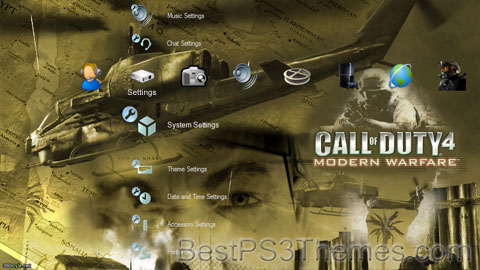
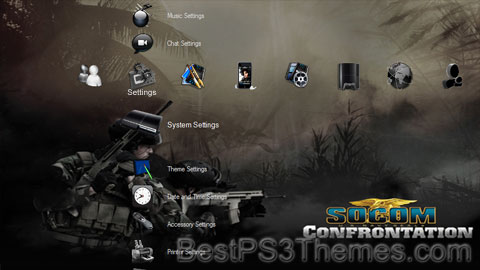
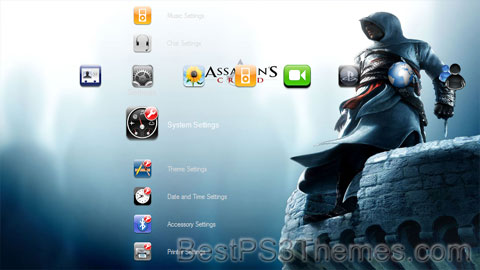
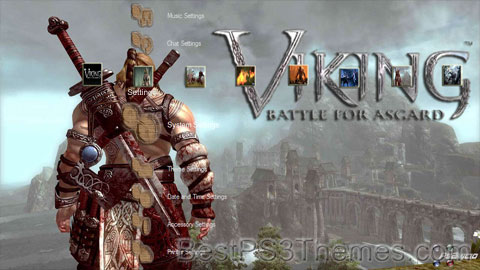
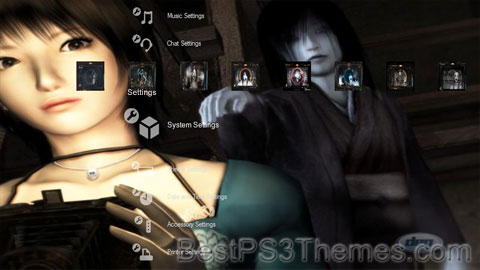
This program unpacks Playstation 3 Theme files (.p3t) so that you can touch-up an existing theme to your likings or use a certain wallpaper from it (as many themes have multiple). But remember, if you use content from another theme and release it, be sure to give credit!
Download p3textractor.zip from above. Extract the files to a folder with a program such as WinZip or WinRAR. Now there are multiple ways to extract the theme.
The first way is to simply open the p3t file with p3textractor.exe. If you don’t know how to do this, right click the p3t file and select Open With. Alternatively, open the p3t file and it will ask you to select a program to open with. Click Browse and find p3textractor.exe from where you previously extracted it to. It will open CMD and extract the theme to extracted.[filename]. After that, all you need to do for any future p3t files is open them and it will extract.
The second way is very simple. Just drag the p3t file to p3textractor.exe. It will open CMD and extract the theme to extracted.[filename].
For the third way, first put the p3t file you want to extract into the same folder as p3textractor.exe. Open CMD and browse to the folder with p3extractor.exe. Enter the following: p3textractor filename.p3t [destination path]Replace filename with the name of the p3t file, and replace [destination path] with the name of the folder you want the files to be extracted to. A destination path is not required. By default it will extract to extracted.filename.
This program unpacks Playstation 3 Theme files (.p3t) so that you can touch-up an existing theme to your likings or use a certain wallpaper from it (as many themes have multiple). But remember, if you use content from another theme and release it, be sure to give credit!
Download p3textractor.zip from above. Extract the files to a folder with a program such as WinZip or WinRAR. Now there are multiple ways to extract the theme.
The first way is to simply open the p3t file with p3textractor.exe. If you don’t know how to do this, right click the p3t file and select Open With. Alternatively, open the p3t file and it will ask you to select a program to open with. Click Browse and find p3textractor.exe from where you previously extracted it to. It will open CMD and extract the theme to extracted.[filename]. After that, all you need to do for any future p3t files is open them and it will extract.
The second way is very simple. Just drag the p3t file to p3textractor.exe. It will open CMD and extract the theme to extracted.[filename].
For the third way, first put the p3t file you want to extract into the same folder as p3textractor.exe. Open CMD and browse to the folder with p3extractor.exe. Enter the following: p3textractor filename.p3t [destination path]Replace filename with the name of the p3t file, and replace [destination path] with the name of the folder you want the files to be extracted to. A destination path is not required. By default it will extract to extracted.filename.
The original three games and their updates, Mortal Kombat (1992), Mortal Kombat II (1993), Mortal Kombat 3 (1995), Ultimate Mortal Kombat 3 (1995), and Mortal Kombat Trilogy (1996), are 2Dfighting games. The arcade cabinet versions of the first two used a joystick and five buttons: high punch, low punch, high kick, low kick, and block; Mortal Kombat 3 and its updates added a sixth "run" button.[1] Characters in the early Mortal Kombat games play virtually identically to one another, with the only major differences being their special moves.[2] Through the 1990s, the developer and publisher Midway Games kept their single-styled fighting moves with four attack buttons for a different array of punches, kicks and blocks. Mortal Kombat 4 was the first Mortal Kombat game in which the characters could move in three dimensions and the first to use 3D computer graphics. From Deadly Alliance to Mortal Kombat: Deception, characters had three fighting styles per character: two unarmed styles, and one weapon style.[3] While most of the styles used in the series are based on real martial arts, some are fictitious.[4]Goro's fighting styles, for example, are designed to take advantage of the fact that he has four arms. For Armageddon, fighting styles were reduced to a maximum of two per character (generally one hand-to-hand combat style and one weapon style) due to the sheer number of playable characters.[5]Mortal Kombat vs. DC Universe dropped multiple fighting styles for most characters in favor of giving each character a wider variety of special moves[6][7] 2011's Mortal Kombat returned to a single 2D fighting plane, although characters are rendered in 3D;[8] unlike previous Mortal Kombat games, each of the controller's four attack buttons corresponds to one of the character's limbs, the buttons thus becoming front punch, back punch, front kick and back kick ("front" indicates the limb that is closer to the opponent, and "back" indicates the limb that is farther away from the opponent).
Mortal Kombat: Deception and Mortal Kombat: Armageddon feature "Konquest", a free-roamingaction-adventure mode. Both games include distinct minigame modes such as "Chess Kombat", an action-strategy game. Two other bonus minigames, "Puzzle Kombat" inspired by Puzzle Fighter and "Motor Kombat" inspired by Mario Kart, feature super deformed versions of Mortal Kombat characters.[1] The games contain various unlockable content and hidden cheats.[9]
I think [Mortal Kombat] represents the difference in philosophy. [....] So in Street Fighter when you're playing it's the moment to moment gameplay that should be the best, whether you win or lose doesn't really matter. Whereas in Mortal Kombat the fighting and playing is just a pathway to get to the result – it's the Fatality you want to see and you almost want to skip the fighting bit and get to the Fatality because that is the result.[11]
One of the most notable features of the Mortal Kombat series is its brutal and gruesome finishing moves, known as "Fatalities". The basic Fatalities are finishing moves that allow the victorious characters to end a match by murdering their defeated, defenseless opponent.[12] Usually Fatalities are exclusive to each character, the exception being Mortal Kombat: Armageddon, which instead features Kreate-A-Fatality, a feature that allows players to perform their own Fatalities by conducting a series of violent moves chosen from a pool that is common to all characters.[1][13]
Other finishing moves in the various Mortal Kombat games include Animalities (introduced in Mortal Kombat 3), in which the victor turns into an animal to violently finish off the opponent;[14] Brutality (introduced in Ultimate Mortal Kombat 3) which consists of bashing the opponent into pieces with a long combo of hits; and Stage Fatalities/Death Traps (introduced in the original Mortal Kombat Pit Stage where the victor can uppercut their opponent off of the platform into a bed of spikes below, later made more difficult in Mortal Kombat II by requiring a character-specific button sequence) utilizing parts of certain stages to execute a lethal finishing move (such as a pool of acid). Mortal Kombat: Deception added the Hara-Kiri, a move that allows the loser to perform a suicidal finishing move, giving way to a potential race between both players to see if the winner can finish off their opponent before they can kill themselves.[12][15]
The series takes place in a fictional universe consisting of numerous realms which, according to in-game backstories, were created by an ancient, eternal, and ethereal pantheon of preternatural divine beings known as the Elder Gods. The Mortal Kombat: Deception manual described six of the realms as: "Earthrealm, home to such legendary heroes as Liu Kang, Kung Lao, Sonya Blade, Johnny Cage, and Jax Briggs, and under the protection of the Thunder God Raiden; Netherrealm, the fiery depths of which are inhospitable to all but the most vile, a realm of demons and shadowy warriors such as Quan Chi and Noob Saibot; Outworld, a realm of constant strife which Emperor Shao Kahn claims as his own; Seido, the Realm of Order, whose inhabitants prize structure and order above all else; the Realm of Chaos, whose inhabitants do not abide by any rules whatsoever, and where constant turmoil and change are worshiped; and Edenia, which is known for its beauty, artistic expression, and the longevity of its inhabitants."[17][18] The Elder Gods decreed that the denizens of one realm could only conquer another realm by defeating the defending realm's greatest warriors in ten consecutive martial arts tournaments, called Mortal Kombat.
The first Mortal Kombat game takes place in Earthrealm (Earth) where seven different warriors with their own reasons for entering the tournament with the prize being the continued freedom of their realm under threat of a takeover by Outworld. Among the established warriors were Liu Kang, Johnny Cage, and Sonya Blade. With the help of the thunder god Raiden, the Earthrealm warriors were victorious, and Liu Kang became the new champion of Mortal Kombat.[19] In Mortal Kombat II, unable to deal with his minion Shang Tsung's failure, Outworld Emperor Shao Kahn lures the Earthrealm warriors to Outworld for a do-over, winner-take-all tournament, where Liu Kang eventually defeats Shao Kahn. By the time of Mortal Kombat 3, Shao Kahn merged Edenia with his empire and revived its former queen Sindel in Earthrealm, combining it with Outworld as well. He attempts to invade Earthrealm, but is ultimately defeated by Liu Kang once more. After the Kahn's defeat, Edenia was freed from his grasp and returned to a peaceful realm, ruled by Princess Kitana. The following game, Mortal Kombat 4, features the fallen elder god Shinnok attempting to conquer the realms and kill Raiden. He is defeated by Liu Kang.
In Mortal Kombat: Deadly Alliance, the evil sorcerers Quan Chi and Shang Tsung join forces to conquer the realms, killing series protagonist Liu Kang in the process. By Mortal Kombat: Deception, after several fights, the sorcerers emerge victorious, having killed most of Earthrealm's warriors until Raiden steps forth to oppose them. The Dragon King Onaga, former ruler of Outworld, returned to merge all realms back together, but was eventually defeated by the game's protagonist, Shujinko.[20]
In Mortal Kombat: Armageddon, the titular catastrophe begins. Centuries before the first Mortal Kombat, Queen Delia foretold the realms would be destroyed because the power of all of the realms' warriors would rise to such greatness that it would overwhelm and destabilize the realms, triggering a destructive chain of events. King Argus had his sons, Taven and Daegon, put into incubation so one day they can be awakened to save the realms from Armageddon by defeating a firespawn known as Blaze. In the end, Shao Kahn is the one who defeats Blaze and wins the war, causing Armageddon.[21]
The crossover Mortal Kombat vs. DC Universe does not share continuity with the other games. After the simultaneous defeats of both Shao Kahn and the alien warlord Darkseid in the DC Universe causes both villains to fuse into the entity "Dark Kahn", both the Mortal Kombat and DC Universes begin to merge. This brings the warriors and heroes into conflicts after suffering bouts of uncontrollable rage. The heroes and villains of both universes repeatedly battle each other, believing each other to be responsible for the catastrophe, until only Raiden and Superman remain. The two confront Dark Kahn and team up to defeat their common foe. After Dark Kahn's defeat, the two realms defuse, with Shao Kahn and Darkseid trapped in each other's universes to face eternal imprisonment.
In the 2011 Mortal Kombat soft reboot, the battle of Armageddon culminated in only two survivors: Shao Kahn and Raiden. On the verge of death by the former's hand, the latter sent visions to his past self in a last-ditch attempt to prevent this outcome. Upon receiving the visions, the past Raiden attempts to alter the timeline to avert Armageddon amidst the tenth Mortal Kombat tournament, during the original game. His attempts to alter history mean that events play out differently to the original series. While he succeeds in preventing Shao Kahn's victory with help from the Elder Gods, he accidentally kills Liu Kang in self-defense and loses most of his allies to Queen Sindel, leaving Earthrealm vulnerable to Shinnok and Quan Chi's machinations.
Mortal Kombat X sees Shinnok and Quan Chi enacting their plan, leading an army of undead revenants of those that were killed in Shao Kahn's invasion of Earthrealm. A team of warriors led by Raiden, Johnny Cage, Kenshi Takahashi, and Sonya Blade oppose them, and in the ensuing battle, Shinnok is imprisoned within his amulet and various warriors are resurrected and freed from his control, though Quan Chi escapes. Twenty-five years later, the sorcerer resurfaces alongside the insectoid D'Vorah to facilitate Shinnok's return. A vengeful Scorpion kills Quan Chi, but fails to stop him from freeing Shinnok. To combat him, Cassie Cage, daughter of Johnny Cage and Sonya Blade, leads a team composed of the next generation of Earthrealm's heroes in defeating him. With Shinnok and Quan Chi defeated, Liu Kang and Kitana's revenants assume control of the Netherrealm while Raiden taps into Shinnok's amulet.
Mortal Kombat 11 and its expansion, Aftermath, sees the architect of time and Shinnok's mother, Kronika, working to alter the timeline following her son's defeat and Raiden's tampering with her work. In doing so, she brings past versions of the realm's heroes to the present, aligning herself with some while the rest work to defeat her. After nearly killing Liu Kang a second time, Raiden discovers Kronika has manipulated them into fighting across multiple timelines as she fears their combined power. Despite her interference and attacks by her minions, Raiden gives Liu Kang his power, turning him into a god of fire and thunder so he can defeat Kronika. In the Aftermath expansion, it is revealed that Liu Kang inadvertently destroyed Kronika's crown, the item needed to restart the timeline. Her defeat also revives Shang Tsung, who was absent in the base game due to his imprisonment by Kronika. To recover the crown, Liu Kang sends Shang Tsung and other Earthrealm heroes back in time to obtain it before Kronika, though Shang Tsung manipulates events so that he comes into possession of the crown. At the end, either Liu Kang or Shang Tsung becomes the Keeper of Time, depending on the player's choice (who they want to fight with in the final battle) and the outcome of the battle.
Mortal Kombat 1, the second reboot on the series' timeline, sees Lord Liu Kang has created his New Era and strives to maintain peace between all the realms. However, his plans begin to unravel when Shang Tsung and Quan Chi, despite his attempts to have them de-powered and unable to cause trouble, ally with General Shao in order to conquer Earthrealm and Outworld. Investigating the matter, Liu Kang discovers that the Shang Tsung from MK11: Aftermath is responsible, as Liu Kang's attempts to access the Hourglass' power resulted in a break where every character in Mortal Kombat's universe defeated Kronika and gained control of the Hourglass. In an attempt to stop the sorcerer from taking control of all of the multiple timelines, Liu Kang leads an army of good variations in an assault on Titan Shang Tsung's dimension, where, after an intense battle with all their evil counterparts, Liu Kang and a player-decided champion defeat him and erase his timeline from existence.
Mortal Kombat started development in 1991 with four people: Ed Boon (programming), John Tobias (art and story), John Vogel (graphics), and Dan Forden (sound design).[22][23] According to Mortal Kombat actors Richard Divizio and
This page is a redirect. The following categories are used to track and monitor this redirect:
Semi-protected: This is a redirect from a title that is semi-protected from editing for any of several possible reasons.
Please do not replace these redirected links with links directly to the target page unless expressly advised to do so below or elsewhere on this page, or if the change is supported by a policy or guideline.
From a page move: This is a redirect from a page that has been moved (renamed). This page was kept as a redirect to avoid breaking links, both internal and external, that may have been made to the old page name.
To its plural form: This is a redirect from a singular noun to its plural form.
Redirects of this sort exist for reader convenience in cases of singular–plural pairs. It is also used for "false singulars", wherein the plural or plural-looking form is better attested in usage, such that the normal "prefer the singular" Wikipedia naming convention is not followed. Examples:
Use this rcat to tag qualified mainspace redirects only; if qualified singular forms are found in other namespaces, use {{R from modification}}instead.
When appropriate, protection levels are automatically sensed, described and categorized.
Fatal Frame, titled Zero[a] in Japan and Project Zero in Europe and Australia, is a Japanese survival horror video game series that was created, published and developed by Koei Tecmo (originally Tecmo). Debuting in 2001 with the first entry in the series for the PlayStation 2, the series consists of five main entries. The series is set in 1980s Japan, with each entry focusing on a location beset by hostile supernatural events. In each scenario, the characters involved in the present investigation use Camera Obscura, objects created by Dr. Kunihiko Asou that can capture and pacify spirits. The series draws on staple elements of Japanese horror, and is noted for its frequent use of female protagonists.
The series was conceived by Makoto Shibata and Keisuke Kikuchi. After being introduced to the PlayStation 2 hardware and after the success of the Silent Hill series, the pair decided to develop a horror series inspired by Shibata's own spiritual experiences and popular Japanese horror films of the time. Their main goal was to make the most frightening game experience possible. Later installments have refined the gameplay mechanics while also adding more complex narrative elements.
The series is recognized as one of the best-known horror video game franchises, and the second game in the series, Crimson Butterfly, is considered one of the scariest horror games ever made. While the sales of individual games have never been high, the series as a whole has sold over one million copies worldwide as of April 2014. Multiple Japanese media adaptations have been made, including manga and a 2014 live-action feature film.
As of 2014, the series consists of five mainline video games, not counting remakes, re-releases and spin-offs.[1]Fatal Frame: Mask of the Lunar Eclipse was originally only released in Japan. While a European release was planned, it was eventually cancelled, and no North American release was planned.[2] A fan translation of the fourth game was released in 2010, which enabled the game to be played on any Wii system.[3] Outside their international releases, the Fatal Frame games are not numbered. This was due to the series' creators considering each entry to be a standalone game, with minimal connections to previous titles.[4] Since the fourth game, new Fatal Frame titles have been funded and co-developed by Nintendo, resulting in new series titles since the fourth game originally only appearing on Nintendo consoles.[5] Koei Tecmo would later purchase Nintendo's publishing rights for multi platform rereleases of Fatal Frame: Mask of the Lunar Eclipse and Fatal Frame: Maiden of Black Water.
The first two titles have received expanded re-releases. An expanded port of the original game was released for the Xbox in 2002 in Japan and 2003 in Western territories. It featured additional story elements, gameplay refinements and a new difficulty setting.[8][21][22] For Crimson Butterfly, a "Director's Cut" for the Xbox was released in 2004 in Japan and North America, and 2005 in Europe.[11][23][24] A new expanded remake for the Wii was released in Japan and Europe in 2012.[25][26]
A mobile title, Real Zero, was released in 2004 for FOMA and DoCoMo mobile devices. The game involves users taking pictures of their environments and superimposing ghost images somewhere in the frame. Seventy different ghosts were available to collect, with each new ghost triggering the sending of an email to provide clues for finding the next ghost or other messages.[27][28] The game's service was terminated in 2011.[29] A spin-off for the Nintendo 3DS, Spirit Camera,[g] was released in all regions in 2012.[30][31][32] The story follows a girl named Maya, who is trapped in a haunted house controlled by a mysterious woman in black, and seeks to escape the woman's control.[31]
In May 2020, a pachislot machine simply titled Pachislot Zero was announced by Yamasa Group. Set to be released in Japan for pachinko parlors in July 2020, the game recreates scenes from the first game in the series with updated graphics, along with additions like new characters and a third ending.[33]
To commemorate the release of Crimson Butterfly, a special interactive attraction titled Zero4D opened in 2004. It featured movie scenes designed by the same team behind the CGI movies for Crimson Butterfly.[27] A manga based on the series written by Shin Kibayashi, Fatal Frame: Shadow Priestess,[h] was released in both Japanese and English through DeNA's website in July 2014.[34] A Japanese live-action movie directed by Mari Asato for Kadokawa Pictures was released in cinemas in 2014. The novel it was based on, Fatal Frame: A Curse Affecting Only Girls by Eiji Ohtsuka, was released a few months prior to the movie.[35][36]
A Hollywood film adaptation of the first game was announced in 2003. Robert Fyvolent and Mark R. Brinker were hired as the project's writers, and John Rogers was hired as its producer. The title was being produced by DreamWorks.[37] Later that year, Steven Spielberg was helping Rogers to polish the game's script, and that sessions to find a director and cast the movie would follow.[38] In 2014 alongside the formal announcement of Maiden of Black Water, it was confirmed that the Hollywood film was still planned. Now produced by Samuel Hadida, it was set to begin production after the completion and release of the game.[35] Christophe Gans said in an interview that the movie will take place in Japan in an attempt to capture its Japanese haunted house setting.[39]
The gameplay has remained consistent through the series' lifetime. Each environment is filled with ghosts, with separate games having different attack behaviors for them.[40][41] While navigating these environments, the main character's only means of defense is the Camera Obscura, which can be used to damage ghosts, capturing them on film and pacifying them. When using the camera, the view switches from a third-person to a first-person perspective. The camera locks onto a ghost, with the amount of damage dealt depending on how much of a focus the Camera Obscura has on the ghost, but ghosts fade in and out of existence, making focusing more challenging. Shots of varying closeness and angles also affect how much damage the ghost takes. The most damaging is a "Fatal Frame", which is performed by taking a photo just before a ghost's attack lands, dealing massive damage and allowing a combo if subsequent shots are timed correctly. A ghost's captured spirit energy is converted into points, which can be used to buy items to upgrade the Camera Obscura and obtain more powerful film.[42][43][44]
In addition to hostile ghosts, there are passive ghosts encountered in parts of the environment: if they are not caught on film at once, they vanish from the rest of the game. Ghosts captured on film are added to a list, which reveals a ghost's past.[40] For the first three games, navigation is done using semi-fixed third-person view of environments, with characters moving at a slow pace through them. For Mask of the Lunar Eclipse and later entries, the camera perspective was altered to a third-person over-the-shoulder view and character movement was increased a little to speed up gameplay. The ability to either dodge or break free from a ghost's grip was added in Maiden of Black Water.[1][4][42][43]
The Fatal Frame / Project Zero series is set in the 1980s, before mobile phones were commonly used in Japan. Aside from a few recurring characters, each game has a self-contained story focusing on a different supernatural threat. The main unifying factor is navigating through haunted locations struck by a supernatural catastrophe, with a recurring setting being abandoned Japanese mansions.[4] Recurring characters include Dr. Kunihiko Asou, an occultist who lived in the 1800s and created objects such as the Camera Obscura;[40] and Miku Hinasaki, the protagonist of Fatal Frame and one of three protagonists in The Tormented, who also appears in Maiden of Black Water as one of the main characters' missing mother. A second recurring feature is the exclusive or frequent use of female characters in the leading role. This was explained as being due to the overall tone of the series: since traditional violence was not used, it was better to use a female character to convey this. It was also felt that women were more spiritually aware than men.[45] Another recurring concept is a pseudo-physical location bridging the physical and spiritual worlds, inspired by a tanka written by Japanese poet Taeko Kuzuhara: these were represented by the Hellish Abyss in Crimson Butterfly and the lake in Maiden of Black Water.[46]
The first chronological entry in the series, Mask of the Lunar Eclipse, takes place in 1980. The story revolves around three girls who travel back to the fictional Rougetsu Island to recover memories of being kidnapped while they lived there ten years before. On the island, they must investigate the secrets behind a local ritual dance and an ancient mask related to the ritual.[4]Fatal Frame is set in 1986, with Crimson Butterfly being set in 1988 The Tormented is set two months after the second game's events.[45]Maiden of Black Water is set at an unspecified date after the third game. It takes place around the fictional Mount Hikami, a site infamous for suicides and rituals associated with local bodies of water. The main protagonists are each drawn to the mountain intent on rescuing someone, confronting hostile ghosts along the way.[17][47]
The concept for Fatal Frame / Project Zero first occurred by Makoto Shibata. The idea occurred after the development of Tecmo's Deception: Invitation to Darkness. Inspired by his own experiences of supernatural events, and heartened by the success of the Silent Hill series, Shibata and Keisuke Kikuchi set to work on creating the basics for the game. Shibata was in charge of the majority of game and scenario development, while Kikuchi was in charge of general oversight.[48] When creating the atmosphere, the team watched both high and low-budget Japanese horror films, and war films. One of their goals was to make the game as scary as possible.[4][49][50] The Camera Obscura was not in the initial discussions between Shibata and Kikuchi, with the original idea being that ghosts would be avoided and repelled by light. Ultimately, they decided to have a type of offensive power, which resulted in the Camera's creation. Kikuchi was initially opposed to the idea, but saw that it fitted very well into the game's context as development progressed.[4][49] The first game was marketed in the West as being based on a true story, and while this was not accurate, the story of Fatal Frame was inspired by both real locations noted for apparent haunting and local ghost-related folklore.[51]
For Crimson Butterfly, the team toned down the frightening aspects so players would be willing to complete a playthrough, alongside creating a stronger story. The story was inspired by a dream Shibata had, with the interpretive nature of the game's events being inspired by his feelings about the dream.[52] For The Tormented, they decided to focus on horror elements emerging out of everyday life, focusing on the effects of dreams upon reality.[53]Mask of the Lunar Eclipse was co-produced by Koei Tecmo, Nintendo and Grasshopper Manufacture, with Grasshopper Manufacture's Goichi Suda acting as a co-director with Shibata.[4][54] The gameplay was constructed around the Wii hardware, with the main concept being for players to feel the fear physically. The entire concept occurred by Kikuchi when he saw the specifications for the Wii.[4][47]Maiden of Black Water originated when Kikuchi saw the Wii U hardware, and was co-produced by Koei Tecmo and Nintendo. As they wanted to bring more people into the series, they included a stronger narrative and new gameplay elements to make the experience easier for newcomers.[47][55]
Since Crimson Butterfly, theme songs have been created for each title, primarily performed by Japanese singer Tsuki Amano. The development team wanted an image song for Crimson Butterfly, and Shibata found the then-newly debuted Amano in the Japanese independent community. Amano created the song using documents on the game's story, themes and setting.[56] Amano returned multiple times to create theme songs for The Tormented, Mask of the Lunar Eclipse, and a new theme song for the Wii remake of Crimson Butterfly.[57] She again returned for Maiden of Black Water, and a second new singer AnJu contributed a second theme song to the title.[1]
In Japan, each title in the Fatal Frame / Project Zero series has seen modest success: the first game's lifetime sales are the lowest in the series, while Mask of the Lunar Eclipse currently stands as the best-selling title in the series to date.[2][75] Since its debut in 2001, the Fatal Frame series has sold 1.3 million copies worldwide.[76]
Multiple video game journalists have singled out the series. IGN's Clara Barraza, in an article on the evolution of the survival horror genre, said that the first game "broke away from the use of weapons like guns and planks of wood to switch it up and try something completely different", praising the use of the Camera Obscura in evoking a sense of fear and calling the game "[a] unique spin on the genre".[77] In a different article for IGN on the history of survival horror, editor Travis Fahs stated that the series gave a much-needed boost to the genre during a period of decline in the early 2000s, highlighting the Japanese horror aesthetic as a selling point that attracted players in tandem with the popularity of The Ring.[78] As part of an interview with the series' creators in 2006, GameSpy writer Christian Nutt referred to it as one of the three best-known horror video game series alongside Resident Evil and Silent Hill.[45] Similarly, as part of a review of Maiden of Black Water, Dennis Scimeca of The Daily Dot ranked the Fatal Frame series alongside Resident Evil and Silent Hill.[79] In an article on the series, Kotaku writer Richard Eisenbeis said that Fatal Frame succeeded in drawing his attention when most other horror games did not, generally praising the settings and the "master stroke" of the Camera Obscura in gameplay.[80] In an interview, F.E.A.R. 2: Project Origin art leader Dave Matthews stated that the gameplay of F.E.A.R. 2 was influenced by the Fatal Frame series.[81] In multiple articles, Crimson Butterfly has been singled out by video game publications and industry developers as one of the scariest games of the horror genre in general.[82][83][84][85]
^Titled 零 〜zero〜 (零) in Japan and Project Zero in Europe.
^Titled Zero 〜Akai Chō〜 (零 〜紅い蝶〜) and Project Zero 2: Crimson Butterfly in Europe.
^Titled Zero: Shisei no Koe (零〜刺青ノ聲〜, lit. Zero: Voice of the Tattoo.) and Project Zero 3: The Tormented in Europe.
^Titled Zero: Tsukihami no Kamen (零〜月蝕の仮面〜, lit. Zero: Mask of the Lunar Eclipse) in Japan and Project Zero: Mask of the Lunar Eclipse in Europe.
^Titled Zero: Nuregarasu no Miko (零 〜濡鴉ノ巫女〜, lit. Zero: The Raven-haired Shrine Maiden) in Japan and Project Zero: Maiden of Black Water in Europe.
^Titled Spirit Camera: The Possessed Notebook (心霊カメラ 〜憑いてる手帳〜, Shinrei Camera ~Tsuiteru Techou~) in Japan and Spirit Camera: The Cursed Memoir in Western territories.
This program unpacks Playstation 3 Theme files (.p3t) so that you can touch-up an existing theme to your likings or use a certain wallpaper from it (as many themes have multiple). But remember, if you use content from another theme and release it, be sure to give credit!
Download p3textractor.zip from above. Extract the files to a folder with a program such as WinZip or WinRAR. Now there are multiple ways to extract the theme.
The first way is to simply open the p3t file with p3textractor.exe. If you don’t know how to do this, right click the p3t file and select Open With. Alternatively, open the p3t file and it will ask you to select a program to open with. Click Browse and find p3textractor.exe from where you previously extracted it to. It will open CMD and extract the theme to extracted.[filename]. After that, all you need to do for any future p3t files is open them and it will extract.
The second way is very simple. Just drag the p3t file to p3textractor.exe. It will open CMD and extract the theme to extracted.[filename].
For the third way, first put the p3t file you want to extract into the same folder as p3textractor.exe. Open CMD and browse to the folder with p3extractor.exe. Enter the following: p3textractor filename.p3t [destination path]Replace filename with the name of the p3t file, and replace [destination path] with the name of the folder you want the files to be extracted to. A destination path is not required. By default it will extract to extracted.filename.
This program unpacks Playstation 3 Theme files (.p3t) so that you can touch-up an existing theme to your likings or use a certain wallpaper from it (as many themes have multiple). But remember, if you use content from another theme and release it, be sure to give credit!
Download p3textractor.zip from above. Extract the files to a folder with a program such as WinZip or WinRAR. Now there are multiple ways to extract the theme.
The first way is to simply open the p3t file with p3textractor.exe. If you don’t know how to do this, right click the p3t file and select Open With. Alternatively, open the p3t file and it will ask you to select a program to open with. Click Browse and find p3textractor.exe from where you previously extracted it to. It will open CMD and extract the theme to extracted.[filename]. After that, all you need to do for any future p3t files is open them and it will extract.
The second way is very simple. Just drag the p3t file to p3textractor.exe. It will open CMD and extract the theme to extracted.[filename].
For the third way, first put the p3t file you want to extract into the same folder as p3textractor.exe. Open CMD and browse to the folder with p3extractor.exe. Enter the following: p3textractor filename.p3t [destination path]Replace filename with the name of the p3t file, and replace [destination path] with the name of the folder you want the files to be extracted to. A destination path is not required. By default it will extract to extracted.filename.
Thomas Leo Clancy Jr. (April 12, 1947 – October 1, 2013) was an American novelist. He is best known for his technically detailed espionage and military-science storylines set during and after the Cold War. Seventeen of his novels have been bestsellers and more than 100 million copies of his books have been sold.[1] His name was also used on screenplays written by ghostwriters, nonfiction books on military subjects occasionally with co-authors, and video games. He was a part-owner of his hometown Major League Baseball team, the Baltimore Orioles, and vice-chairman of their community activities and public affairs committees.
Clancy was born on April 12, 1947, at Franklin Square Hospital in Baltimore, Maryland,[4] and grew up in the Northwood neighborhood in northeast Baltimore.[2][4][5] The family was Irish-American.[6] He was the second of three children to Thomas Leo Clancy (1918–1995), who worked for the United States Postal Service, and Catherine Mary Clancy (née Langan; 1918–2001), who worked in a store's credit department.[7][8] He was a member of Troop 624 of the Boy Scouts of America.[9] Clancy's siblings are Patrick and Margaret.
Clancy's mother worked to send him to Loyola High School in Towson, Maryland, a private Catholic secondary school taught by the Jesuit religious order (Society of Jesus). He graduated from Loyola High School in 1965.[4][5][7] He then attended the associated Loyola College (now Loyola University Maryland) in Baltimore. Clancy began his college career as a physics major. Due to poor grades, he later changed his concentration to English since, "...it was an easy major." Despite the academic change, he continued to be an indifferent student spending a majority of his time reading books on military and naval history instead of tending to his studies. Clancy graduated with a Bachelor of Arts in English Literature in 1969 receiving a 1.9/4.0 GPA.[4][8] While at Loyola College, he was president of the chess club.[7] He joined the Army Reserve Officers' Training Corps; however, he was ineligible to serve due to his myopia (nearsightedness), which required him to wear thick eyeglasses.[1][7]
In 1973, Clancy joined the O. F. Bowen Agency, a small insurance agency based in Owings, Maryland, founded by his wife's grandfather.[1][7][8][10] In 1980, he purchased the insurance agency from his wife's grandmother and wrote novels in his spare time.[8][11] While working at the insurance agency, he wrote his debut novel, The Hunt for Red October (1984).[1]
Clancy's literary career began in 1982 when he started writing The Hunt for Red October, which in 1984 he sold for publishing to the Naval Institute Press for $5,000.[1][2] The publisher was impressed with the work; Deborah Grosvenor, the Naval Institute Press editor who read through the book, said later that she convinced the publisher: "I think we have a potential best seller here, and if we don't grab this thing, somebody else would." She believed Clancy had an "innate storytelling ability, and his characters had this very witty dialogue".[1] Clancy, who had hoped to sell 5,000 copies, ended up selling over 45,000.[2][11] After publication, the book received praise from President Ronald Reagan, who called the work "the best yarn", subsequently boosting sales to 300,000 hardcover and two million paperback copies of the book, making it a national bestseller.[1][2][10] The book was critically praised for its technical accuracy, which led to Clancy meeting several high-ranking officers in the U.S. military, as well as Steve Pieczenik, and to inspiration for recurring characters in his works.[1][12] Clancy's novels focus on the hero, most notably Jack Ryan and John Clark, both Irish Catholics like himself. He repeatedly uses the formula whereby the heroes are "highly skilled, disciplined, honest, thoroughly professional, and only lose their cool when incompetent politicians or bureaucrats get in their way. Their unambiguous triumphs over evil provide symbolic relief from the legacy of the Vietnam War."[13]
The Cold War epic Red Storm Rising (1986)[14] was co-written (according to Clancy in the book's foreword) with fellow military-oriented author Larry Bond. The book was published by Putnam and sold almost a million copies within its first year.[15] Clancy became the cornerstone of a publishing list by Putnam which emphasized authors like Clancy who would produce annually. His publisher, Phyllis E. Grann, called these "repeaters."[15]
Clancy has author status on the cover of dozens of books. Seventeen of his novels made it to the top of the New York Times best seller list. He co-authored memoirs of top generals, and produced numerous guided tours of the elite aspects of the American military.[citation needed]Andrew Bacevich states:
Clancy did for military pop-lit what Starbucks did for the preparation of caffeinated beverages: he launched a sprawling, massively profitable industrial enterprise that simultaneously serves and cultivates an insatiable consumer base. Whether the item consumed provides much in terms of nourishment is utterly beside the point. That it tastes yummy going down more than suffices to keep customers coming back.[16]
By 1988, Clancy had earned $1.3 million for The Hunt for Red October and had signed a $3 million contract for his next three books.[17] In 1992, he sold North American rights to Without Remorse for $14 million, a record for a single book.[18] By 1997, Penguin Putnam Inc. (part of Pearson Education) paid Clancy $50 million for world rights to two new books and another $25 million to Red Storm Entertainment for a four-year book/multimedia deal.[19] Clancy followed this up with an agreement with Penguin's Berkley Books for 24 paperbacks to tie in with the ABC television miniseries Tom Clancy's Net Force, which aired in the fall/winter of 1998. The Op-Center universe has laid the ground for the series of books written by Jeff Rovin, which was in an agreement worth $22 million, bringing the total value of the package to $97 million.[19]
Clancy wrote several nonfiction books about various branches of the U.S. Armed Forces (see nonfiction listing, in the bibliography article). He also branded several lines of books and video games with his name that are written by other authors, following premises or storylines generally in keeping with Clancy's works.[5]
In 2008, the French video game manufacturer Ubisoft purchased the use of Clancy's name for an undisclosed sum. It has been used in conjunction with video games and related products such as movies and books.[24] Based on his interest in private spaceflight and his US$1 million investment in the launch vehicle company Rotary Rocket,[25]
Clancy was interviewed in 2007 for the documentary film Orphans of Apollo (2008).[26]
On September 11, 2001, Clancy was interviewed by Judy Woodruff on CNN.[29] During the interview, he noted that orthodox "Islam does not permit suicide." Among other observations during this interview, Clancy cited discussions he had with military experts on the lack of planning to deal with a hijacked plane being used in a suicide attack and criticized the news media's treatment of the United States Intelligence Community. Clancy appeared again on PBS's Charlie Rose, to discuss the implications of the day's events with Richard Holbrooke, New York Times journalist Judith Miller, and Senator John Edwards, among others.[30] Clancy was interviewed on those shows because his book Debt of Honor[31] (1994) included a scenario wherein a disgruntled Japanese airline pilot crashes a fueled Boeing 747 into the U.S. Capitol dome during an address by the President to a joint session of Congress, killing the President and most of Congress. In the book, Clancy also implies that Japan's prosperity is due primarily to unequal trading terms.[32] In the book's sequel Executive Orders (1996), the president announces a new foreign policy doctrine, under which the United States will hold personally accountable any foreign leader who orders attacks on U.S. citizens, territory, or possessions in the future.[33]
Numerous scholars have examined the political dimensions of Clancy's books, especially in the context of the Cold War. Historian Walter Hixson has argued that Clancy's novels, especially The Hunt for Red October and Red Storm Rising, were "popular representations of Reagan-era Cold War values. They reflect both popular perceptions of Soviet behavior and the predominant national security values of the Reagan era."[34]
Clancy's first wife, Wanda Thomas King, was a nurse.[8][35] They married in 1969 and had four children.[1] The couple separated briefly in 1995, and they permanently separated in December 1996.[1][36] Wanda Clancy filed for divorce in November 1997,[37][38] which became final in January 1999.[39] As part of the divorce, she and Clancy split his minority stake in the Baltimore Orioles.[40]
On June 26, 1999, Clancy married freelance journalist Alexandra Marie Llewellyn, whom he had met in 1997.[41] Llewellyn is the daughter of J. Bruce Llewellyn and a family friend of Colin Powell, who originally introduced the couple to each other.[42] They remained together until Clancy's death in October 2013.[43] The two had one daughter.[1][42]
Clancy was a Roman Catholic. The plot of his novel Red Rabbit revolves around John Paul II.[44] In a June 27, 1993, interview with The Washington Post, he was quoted as saying, "I've had [sex scenes] in my books before, but you had to look real fast because, you know, I'm a married Catholic and I don't do that."[45] In a 2002 interview with Lev Grossman for Time magazine, Clancy lamented what he perceived as society's double standard in the way Catholics are viewed by some people in society in relation to other demographic segments: "You can't hate black people any more, of course, and you can't hate homosexuals any more, but you can hate all the Catholics you want."[44]
Clancy's 80-acre estate, which was once a summer camp, is located in Calvert County, Maryland. It has a panoramic view of the Chesapeake Bay.[46] The stone mansion, which cost $2 million, has 24 rooms and features a shooting range in the basement.[35][46] The property also features a World War II–era M4 Shermantank, a Christmas gift from his first wife.[46][47]
Clancy also purchased a 17,000-square-foot penthouse condominium in the Ritz-Carlton, in Baltimore's Inner Harbor, for $16 million.[10] Clancy and his wife combined four units to create the apartment.[48]
His Chesapeake Bay estate sold for $4.9 million in 2020.[49]
Clancy died of heart failure on October 1, 2013,[3] at Johns Hopkins Hospital, near his Baltimore home. John D. Gresham, a co-author and researcher with Clancy on several books, said Clancy had been suffering heart problems for some time prior: "Five or six years ago Tom suffered a heart attack and he went through bypass surgery. It wasn't that he had another heart attack, his heart just wore out."[50]
The Chicago Tribune quoted Pulitzer Prize–winning film critic and author Stephen Hunter as saying, "When he published The Hunt for Red October, he redefined and expanded the genre, and as a consequence of that, many people were able to publish such books who had previously been unable to do so."[51]
On March 31, 2014, the Orioles honored Clancy with a video tribute during their home opener, and the team wore a tribute patch on their jerseys through the season.[52]
Clancy was one of only three authors to sell two million copies on a first printing in the 1990s (the others were John Grisham and J. K. Rowling). Clancy's novel Clear and Present Danger (1989) sold 1,625,544 hardcover copies, making it the #1 bestselling novel of the 1980s.[53]
Clancy received the Golden Plate Award of the American Academy of Achievement in 1988.[54] Clancy was the Host of the 1995 Achievement Summit in Colonial Williamsburg and the 1997 Achievement Summit in Baltimore.[55][56][57]
Clancy was an honorary Yeoman Warder of the Tower of London and received the title "Supernumerary Yeoman"; he had been arrested for scaling the walls in his younger years.[59]
A 114-minute action/political thriller which was edited down from a 170-minute, 4-hour TV mini-series of the same name that aired in two parts on NBC in February 1995
An American eight-episode actionpolitical thrillerweb television series, based on characters from the fictional "Ryanverse", that premiered on August 31, 2018, on Amazon Video. The second season premiered on November 1, 2019, following the same eight-episode pattern. It serves as a sequel to the first season, taking Jack on a similar adventure through Venezuela. The third season, aired December 2022, pits Ryan in the midst of a conspiracy involving Russia and the United States. In the fourth and final season, aired June and July 2023, "Jack is tasked with unearthing internal corruption. As he investigates, Jack discovers the convergence of a drug cartel with a terrorist organization, ultimately revealing a conspiracy much closer to home and testing our hero's belief in the system he has always fought to protect." It is 6 episodes. Citation at https://www.amazon.com/Tom-Clancys-Jack-Ryan-Trailer/dp/B0BYTDKMPX/ref=sr_1_1
Officially licensed games based on The Hunt for Red October and Red Storm Rising were released in the late 1980s and early 1990s for various 8-bit home computers such as the Commodore 64[60] and ZX Spectrum. Those included a submarine combat simulation (based on the book) and an action game (based on the film).
More recently, Ubisoft has made many video game series based on Tom Clancy's books, or which were endorsed by Clancy and use his name in the series' titles.
This program unpacks Playstation 3 Theme files (.p3t) so that you can touch-up an existing theme to your likings or use a certain wallpaper from it (as many themes have multiple). But remember, if you use content from another theme and release it, be sure to give credit!
Download p3textractor.zip from above. Extract the files to a folder with a program such as WinZip or WinRAR. Now there are multiple ways to extract the theme.
The first way is to simply open the p3t file with p3textractor.exe. If you don’t know how to do this, right click the p3t file and select Open With. Alternatively, open the p3t file and it will ask you to select a program to open with. Click Browse and find p3textractor.exe from where you previously extracted it to. It will open CMD and extract the theme to extracted.[filename]. After that, all you need to do for any future p3t files is open them and it will extract.
The second way is very simple. Just drag the p3t file to p3textractor.exe. It will open CMD and extract the theme to extracted.[filename].
For the third way, first put the p3t file you want to extract into the same folder as p3textractor.exe. Open CMD and browse to the folder with p3extractor.exe. Enter the following: p3textractor filename.p3t [destination path]Replace filename with the name of the p3t file, and replace [destination path] with the name of the folder you want the files to be extracted to. A destination path is not required. By default it will extract to extracted.filename.