Burnout Paradise theme by Tom Clatworthy
Download: BurnoutParadise_5.p3t
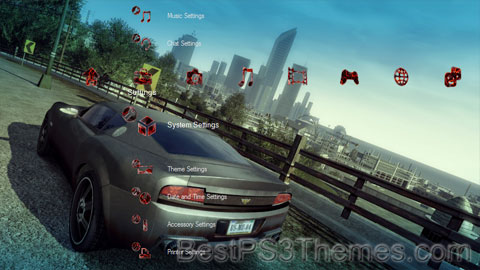
(10 backgrounds)
| Burnout Paradise | |
|---|---|
| Developer(s) | Criterion Games[a] |
| Publisher(s) | Electronic Arts |
| Director(s) | Alex Ward |
| Producer(s) | Peter Lake San Shepherd Matt Webster Hamish Young |
| Designer(s) | Craig Sullivan |
| Programmer(s) | Olly Read Paul Ross |
| Artist(s) | Steve Uphill |
| Series | Burnout |
| Engine | RenderWare |
| Platform(s) | Original version PlayStation 3 Xbox 360 Microsoft Windows Remastered PlayStation 4 Xbox One Microsoft Windows Nintendo Switch |
| Release | Original versionThe Ultimate BoxRemastered
|
| Genre(s) | Racing |
| Mode(s) | Single-player, multiplayer |
Burnout Paradise is a 2008 racing video game developed by Criterion Games and published by Electronic Arts for PlayStation 3, Xbox 360 and Microsoft Windows. It was also released on the PlayStation Store and via Xbox Live Marketplace's Games on Demand. It was later added to the libraries of Greatest Hits and Platinum Hits titles and was made backward compatible with the Xbox One in November 2016. It is the first game in the Burnout series to be released on Microsoft Windows.
Paradise's gameplay is set in the fictional "Paradise City", an open world in which players can compete in several types of races. Players can also compete online, which includes additional game modes, such as "Cops and Robbers". Several free game updates introduce new features such as a time-of-day cycle and motorcycles. The game also features paid downloadable content in the form of new cars and the fictional "Big Surf Island".
The game was very well received upon release, with aggregate score sites GameRankings reporting an average score of 88% and Metacritic reporting an average score of 88 out of 100. The game won several awards in 2008, with Spike TV, GameTrailers and GameSpot all awarding it Best Driving Game. Reviewers felt the game had an excellent sense of speed, and praised the open world gameplay, a first for the Burnout series. Burnout Paradise is considered by some to be one of the greatest video games ever made.
A remastered version, titled Burnout Paradise Remastered, which includes all downloadable content (except the Time Savers Pack) and support for higher-resolution displays, was released on 16 March 2018 for PlayStation 4 and Xbox One, and on 21 August for Windows via EA's Origin platform. The online service for the original version of the game was permanently discontinued in August 2019.[4] The remastered version for Nintendo Switch with refreshed online servers was released on 19 June 2020.[5][6]
Gameplay[edit]
Burnout Paradise is set in an open-world environment.[7] Players have the opportunity to progress at their own pace and level; the game, unlike others, is not actually set to a rigid gameplay framework.[8] According to Alex Ward, creative director of the game at developer Criterion Games, this game is a "complete reinvention" of the Burnout series. He also said that "to create truly next-generation gameplay, they needed to create a truly next-generation game from the ground up".[9] Initially day and night cycles were not included in the game but a software update entitled "Davis" added this element to the game. For the first time in the series, records are now kept on a player's drivers license, including statistics such as fastest time and biggest crash for every street in the game. Completing events raises the driver rank, which unlocks access to new cars.[10]
In previous Burnout games, "Crash Mode" was a dedicated mode in which players were given multiple scenarios in which to cause the biggest crash. In Burnout Paradise, "Crash Mode", now called "Showtime", can be initiated at any time and place in the game. Showtime does differ from the previous incarnation of Crash Mode being that instead of crashing into a busy intersection and watching a crash play out, Showtime has bouncing the vehicle around for as long as possible to gain points. During a race players may now take any route to get to the destination.[11] Races and other events are started by simply stopping at any of the traffic lights and applying the accelerator and brake at the same time. The game features the ability to customize race settings, such as traffic, race routes, and including/excluding cars based on their boost types.[11][12]
Paradise's damage system has also been reworked. There are now two different types of crashes based on the car's condition after the crash.[13] If the player's car manages to retain all four wheels and does not break its chassis, the player can drive out of the crash and continue playing; this is called a "driveaway". If a player's car loses any wheels, the engine is damaged too much from an impact, the car lands on its side or roof or lands outside of the game's map, the car is in a "wrecked" state and the player will have to wait until their car is reset. Cars dynamically compress and deform around objects they crash into.
Cars now have manufacturer and model names, which are loosely based on real-world cars. Cars may not be "tuned up" or customized apart from color changes, which may be done in real-time by driving through the forecourt of a paint shop, or by selecting the color during vehicle selection.[14] Other real-time changes include driving through the forecourt of a gas station to automatically refill the vehicle's boost meter, and driving through the forecourt of a repair shop to automatically repair the vehicle.[15]
Multiplayer[edit]
The online lobby system used by most video games has been replaced by a streamlined system known as "Easy Drive". While driving, players simply hit right on the D-pad and the 'Easy Drive' menu appears in the corner of their screen. From there, players are able to invite other players from their friends list. Once friends have joined the game, the host can select the event to play. A "Mugshots" camera feature is available for the PC via webcam, PlayStation 3 via a PS3-compatible webcam, Xbox 360 via Xbox Live Vision,[16] PlayStation 4 via PlayStation Camera, and Xbox One via Kinect. When a player is taken down, their photo, or 'Mugshot', is shown to the aggressor, and vice versa. These photos can then be saved to the PC or console's storage device.[17]
Development[edit]
The concept of Burnout Paradise came from director Alex Ward's experience playing open world games, specifically Crackdown, Test Drive Unlimited and Mercenaries: Playground of Destruction. Ward found that with a title like Mercenaries the game's world provided more entertainment than the developers likely planned and gave him a sense of freedom in playing around with inconsequential elements of the game. He wanted to take this idea into Burnout Paradise: "My philosophy was that if me and you both played it for three hours, we'd both do different things".[18] By focusing on discovery and exploration, the game ended up being a racing game without any defined tracks, a novel element at the time, which has since influenced several other racing game developers in their approaches.[18] Ward also wanted to develop the game as a social platform, leading to some of its design choices for multiplayer formats.[18]
Ward, in an interview in 2018, noted the difficulty he had in convincing Electronic Arts to follow his vision. The Burnout series at the time was already seen as a less lucrative property compared to the Need for Speed series by EA, and further, Ward found that EA was not amendable to the open world idea he presented.[18] Ward took steps that he could to make Burnout Paradise a desirable game prior to its release to show his superiors that his ideas were sound, which proved out when the game sold more than one million copies within the first three months of release.[18]
Updates[edit]

Burnout Paradise has undergone significant changes since its initial release. These have been implemented through several free patches and downloadable packs. In 2008, the first major update, codenamed "Bogart", fixed several glitches and was scheduled to be released on 24 April.[19] It was made available to Xbox 360 users on 18 April and to PlayStation 3 users on the originally scheduled date of 24 April, but this prevented store exclusive cars from being obtainable.
The "Cagney" update was released on schedule on 10 July for PlayStation 3 and on 4 August for the Xbox 360. The update introduced three new Freeburn multiplayer modes: Online Stunt Run, Marked Man and Road Rage. Online Stunt Run involves up to 8 players who simultaneously compete for the highest stunt score within 2 minutes. Road Rage features two teams; one must race to a checkpoint while the other tries to stop them through takedowns. Marked Man is like a game of tag, with one player as the Marked Man who cannot see the other players and has no boost. In addition there are 70 new online challenges. These new challenges are different from Free Burn challenges, being timed. Timed challenges start once all players gather at a point of interest. The players then must all complete an objective within a certain time, such as jumping a ramp. "Cagney" also brought custom soundtracks and 1080i support to the PlayStation 3 version.[20]
An update in which involved motorbikes and night-day cycles appear in the Bikes Pack (originally codenamed the "Davis" update), along with tailored locations, challenges and game modes.[21] The update featured a new dynamic weather system, two starter bikes in the player's junkyard, 70 new bike-only challenges, and special "Midnight Rides" challenges that appear only at night.[22] The Bikes pack was released on 18 September on both the PlayStation 3 and Xbox 360.
On 25 September another update was made available which introduced support for the PlayStation 3 trophies system. Criterion Games originally stated that the trophies could be awarded retroactively to players who had already made certain achievements, but when the update was released they said that this had proved to be impossible and that users would have to start a new game in order to achieve some of the goals.[23] Later on February 5, 2009, Criterion released the free 1.6 update, which included the addition of an in-game browser for the PC and PlayStation 3 versions, which gave users access to the Criterion Games Network. An in-game store was also added to all versions which allowed users to purchase content from within the game. Tweaks were also made to the vehicles (not including the freeburn exclusives) to steer the game more toward beginners and casual players. The stats of all of the cars were lowered, and the beginning cars were changed specifically to make them control better, and harder to crash. Events were also made easier to compensate for the vehicle changes.[24]
Windows version[edit]
Burnout Paradise is the first game in the Burnout series to be released for the PC. Criterion made use of existing graphics technology and introduced enhanced visuals and the ability to play the game across multiple monitors to enhance widescreen playing. Players can link three 4:3 monitors to play in a Polyvision aspect ratio. PC users are also able to download a trial version of the game for free. It includes the entire map and three cars but will expire after thirty minutes. All saved data will be carried over if the user decides to purchase the full game.[25]
Marketing and release[edit]
A demo was made available on 13 December 2007 for both PlayStation 3 via PlayStation Store and Xbox 360 via Xbox Live Marketplace.[26][27] From January 4 through 14, Criterion raised the maximum number of players for the online Freeburn in the Paradise demo to 8 players (online play for the demo has since been shut down completely). With it, a total of 13 new Freeburn challenges were made available for players to play.[28] In 2008, Paradise was made available for download on the PlayStation Store.[29] Upon installation and first execution, all updates are downloaded and installed, which allows the player to have the latest version of Burnout Paradise.
Burnout Paradise features in-game advertisements for a number of brands, including Burger King, JL Audio, Nvidia, Gillette, Vizio, CompUSA and EVGA. From 6 October 2008, in-game billboards featured ads for the then United States Democratic Presidential Candidate Barack Obama. Electronic Arts confirmed that the Obama campaign paid for the advertisements, marking the first time that a United States presidential candidate has bought in-game advertising.[30] The Obama campaign ran only on the Xbox 360 version of the game.[30]
The Xbox 360 version of Burnout Paradise was made available for backward compatibility with the Xbox One in November 2016.[31] On 16 December, it was made available to Xbox Live Gold members for free until 31 December.[32]
Criterion has disabled the optional online features for the original releases in August 2019.[33]
Burnout Paradise Remastered[edit]
A remastered version of Burnout Paradise was released for PlayStation 4 and Xbox One consoles on 16 March 2018; a version for Windows was released for Origin Access subscribers on 16 August and was fully released on 21 August via Origin platform.[34]
The remaster contains all the previously released downloadable content, except for the Time Savers Pack (a DLC pack that unlocks all vehicles in the game without the need to progress through single-player), and support for higher-resolution monitors (up to 4K resolutions) with 60 frames per second support.[3] A version for Nintendo Switch was released on 19 June 2020.[5][35] Unlike the original, the Remastered version does not have real life in-game advertisements and are instead replaced by fictional ones.
Downloadable content[edit]
In addition to the free updates, Criterion has released several optional, premium packs that add content like new cars, areas and modes. The first update was the "Burnout Party Pack" and launched on 5 February 2009 in North America and the United Kingdom.[36] It focuses on hotseat multiplayer gameplay, which offers a Freeburn Challenge-like setting but for players on the same console, who pass a single controller between players to complete challenges. The challenges are split into 'Speed', 'Stunt' and 'Skill' with up to 8 rounds and up to 8 players can play at once. Criterion also announced the combo pack Burnout Paradise: The Ultimate Box that launched around the same time which contains the original game, plus the Cagney, Bikes, Party pack and Update pack all in the same package which contained "a mountain of new refinements".[37]
The first premium content pack called "Legendary Cars" featured four cars inspired by famous vehicles from film and television:[38] the Jansen P12 88 Special (based on the DeLorean time machine from the Back to the Future films), the Hunter Manhattan Spirit (based on the Ecto-1 from the Ghostbusters films), the Carson GT Nighthawk (based on KITT from the television series, Knight Rider), and the Hunter Cavalry Bootlegger (based on The General Lee from the TV series The Dukes of Hazzard).[39] The Legendary Cars pack was released on 19 February 2009 for the PlayStation 3 and the Xbox 360, and later in 2009 for the PC.[40]
The second one is "Toy Cars" pack. It features a collection of new vehicles designed with a "toy car" aesthetic, although modelled as full-size cars. The Toy Cars pack has been released in three packs. The full pack offers all toy cars along with the Nakamura Firehawk, a toy motorcycle, while the others split the content into two parts, minus the Firehawk.[41]
On 12 March 2009, the "Boost Specials" pack was released. It featured two cars: the Carson Extreme Hotrod and the Montgomery Hawker Mech. The Carson was described as the fastest car in the game and featured a 'locked' boost; the car continues to boost until it is brought to a stop in any manner. The vehicle dynamics system were rewired so that the Carson performs more realistically than any other car in the game. The Montgomery Hawker Mech also featured a unique boost system, which allows the player to willingly switch between the three different boost types at the touch of a button.[42]
In 2009, Criterion released "Cops & Robbers" on 30 April for PlayStation 3 and Xbox 360.[43] The content does not involve AI Police patrol cars but instead borrows from the Pursuit modes of older Burnout games, notably Burnout 2: Point of Impact. Players are split into teams, the Cops and the Robbers. Teams attempt to return gold bars to their respective bases to score points.[44] Every Paradise car (except Carbon and Premium DLC cars) receives a Police livery with the content.[45]
Originally announced as the "Eastwood pack coming in Fall 2008",[46] the expansion known as "Big Surf Island" was released on 11 June 2009.[47] Design for the island was guided by the principle of "if you can see it, you can drive it".[48][49] The island puts emphasis on the playground aspect of Burnout. The developers mentioned that in their telemetry they noticed that players congregate in areas of Paradise City that lend themselves to stunt-driving, and so the idea was to create an entire island to accommodate player desire. Big Surf Island also features new vehicles, which includes the Carson Dust Storm buggy, a car tailor-made for stunts. In addition to the Dust Storm buggy two specially featured cars, the Hunter Olympus "Governor" and the Carson Annihilator Street Rod are also included. The unlockable cars also include toy versions of all four "Legendary Cars" pack vehicles and a special Jansen P12 Diamond awarded once all 500 freeburn challenges were completed.[50] It features several new events, billboards, smash gates, and mega jumps. New Trophies and Achievements were also added along with a new 'Big Surf Island License' to obtain.[51]
Reception[edit]
| Aggregator | Score |
|---|---|
| Metacritic | (X360) 88/100[52] (PS3) 87/100[53] (PC) 87/100[54] (PS4) 82/100[55] (XONE) 79/100[56] (NS) 78/100[57] |
| Publication | Score |
|---|---|
| 1Up.com | A[58] |
| Eurogamer | 8/10[59] |
| GameTrailers | 8.8/10[60] |
| IGN | 8.8/10[61] |
| Official Xbox Magazine (US) | 9/10[62] |
| Play | 74%[63] |
| Publication | Award |
|---|---|
| Spike | Best Racing/Driving Game[64] |
| GameSpot | Best Downloadable Content[65] Best Driving Game[66] |
| GameTrailers | Best Racing Game[67] |
| Academy of Interactive Arts & Sciences | Racing Game of the Year[68] |
Critical reception[edit]
Upon release, Burnout Paradise was met with very positive reviews, according to review aggregator Metacritic.[54][53][55][52][56]
Reviewers praised the game's open world, stating "Burnout Paradise is an amazing open-world racing game that stays true to the Burnout legacy", but that the large world may "feel a little daunting at first".[69] New gameplay mechanics such as gas stations and body repair shops were also praised which "mitigate potential frustration when the heat is on".[59] Hyper's Daniel Wilks commends the game for its "great sense of speed and things that go boom".[70] IGN's Chris Roper praised the vehicle unlock system, which gives the player a new vehicle with each license, and also gives the player the opportunity to "take down" certain vehicles, which earns the player a reward if completed.[61] He further lauded the game as "controlled chaos".[61] The Guardian's Keith Stuart added that the game "feels incredibly good to drive".[71]
However, some reviewers were disappointed that there was no option to restart a race or event.[61] Instead the player had to either fail the event, or cancel the race by bringing the vehicle to a stop for a few seconds, and then return to the specific place on the map to try that particular race or event again. Criterion responded to this criticism by stating that they don't feel that this is a problem and that adding a "retry" option would introduce loading screens, which they "hate with a passion".[72] Despite this, the option to restart an event was later added to the game via a free software update.[24] Eurogamer found DJ Atomika, the game's guide, to be "instantly dislikeable".[59]
The Remastered release was met with similarly positive reviews, albeit slightly less than the original release. Metacritic gave the PlayStation 4 version a score of 82 out of 100, and the Xbox One version a score of 79 out of 100.
Awards[edit]
Paradise won several awards in 2008, with Spike TV, GameTrailers and GameSpot all awarding it Best Driving Game.[64][66][67] Additionally, Paradise won GameSpot's award for Best Downloadable Content in 2008.[65] During the 12th Annual Interactive Achievement Awards, the Academy of Interactive Arts & Sciences awarded Burnout Paradise with "Racing Game of the Year".[73]
Use in academia[edit]
The game has been the subject of several academic papers investigating a range of fields, often connected to the title's intensity and need for fast reaction time. These include studies on gamer cardiology,[74] phenomenological correspondence and control abstraction[75] and computer game pedagogy.[76]
Notes[edit]
References[edit]
- ^ Robert Purchese (6 December 2007). "Burnout gets Euro date News". Eurogamer.net. Archived from the original on 21 February 2013. Retrieved 1 June 2009.
- ^ a
Warhawk #3
Warhawk theme by Fluffy Penguin
Download: Warhawk_3.p3t
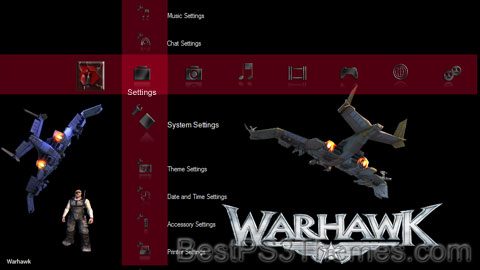
(1 background)
A war hawk is a person who actively supports a war.
War hawk, Warhawk or similar may also refer to:
Military[edit]
- Curtiss P-40 Warhawk, an American World War II-era fighter aircraft
- 195th Fighter Squadron, a unit of the Arizona Air National Guard stationed in Tucson, Arizona
- 314th Fighter Squadron, a training unit of the United States Air Force stationed in New Mexico
- 480th Fighter Squadron, a unit of the United States Air Force stationed in Germany
Athletic teams in the United States[edit]
- Arrowhead High School, Merton Town, Wisconsin
- Auburn Montgomery Warhawks, Auburn University at Montgomery, Alabama
- Calhoun Community College, Tanner, Alabama
- Great Crossing High School, Georgetown, Kentucky
- James Madison High School (California)
- James Madison High School (Fairfax County, Virginia)
- Louisiana–Monroe Warhawks, University of Louisiana at Monroe
- McMurry University
- Mount Vernon–Enola High School, Arkansas
- North Chicago Community High School, Chicago, Illinois
- North Mahaska Community High School, North Mahaska Community School District, New Sharon, Iowa
- Seminole High School (Pinellas County, Florida)
- Westerville Central High School, Ohio
- Wisconsin–Whitewater Warhawks, University of Wisconsin–Whitewater
- Veterans High School, Kathleen, Georgia
Video games[edit]
- Warhawk (1986 video game), a vertically scrolling video game, released by Firebird software
- Warhawk (1995 video game), a Sony PlayStation game
- Warhawk (2007 video game), a multiplayer-only PlayStation 3 remake of the PlayStation game
Other[edit]
- Warhawk (comics), a number of comic characters
Clan HSS – Call of Duty 4
Clan HSS – Call of Duty 4 theme by MannyDhesi
Download: ClanHSSCoD4.p3t
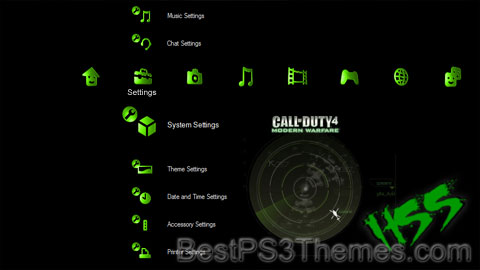
(1 background)
P3T Unpacker v0.12
Copyright (c) 2007. Anoop MenonThis program unpacks Playstation 3 Theme files (.p3t) so that you can touch-up an existing theme to your likings or use a certain wallpaper from it (as many themes have multiple). But remember, if you use content from another theme and release it, be sure to give credit!
Download for Windows: p3textractor.zip
Instructions:
Download p3textractor.zip from above. Extract the files to a folder with a program such as WinZip or WinRAR. Now there are multiple ways to extract the theme.
The first way is to simply open the p3t file with p3textractor.exe. If you don’t know how to do this, right click the p3t file and select Open With. Alternatively, open the p3t file and it will ask you to select a program to open with. Click Browse and find p3textractor.exe from where you previously extracted it to. It will open CMD and extract the theme to extracted.[filename]. After that, all you need to do for any future p3t files is open them and it will extract.
The second way is very simple. Just drag the p3t file to p3textractor.exe. It will open CMD and extract the theme to extracted.[filename].
For the third way, first put the p3t file you want to extract into the same folder as p3textractor.exe. Open CMD and browse to the folder with p3extractor.exe. Enter the following:
p3textractor filename.p3t [destination path]Replace filename with the name of the p3t file, and replace [destination path] with the name of the folder you want the files to be extracted to. A destination path is not required. By default it will extract to extracted.filename.Unofficial Metal Gear Solid 4 Theme
Unofficial Metal Gear Solid 4 theme by Batzi & TMK
Download: UnofficialMGS4.p3t
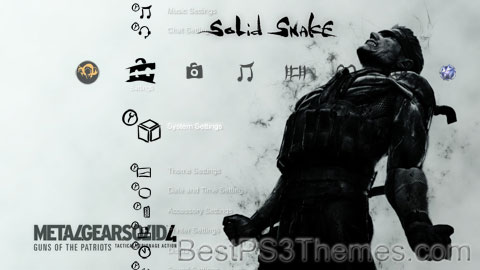
(1 background)
P3T Unpacker v0.12
Copyright (c) 2007. Anoop MenonThis program unpacks Playstation 3 Theme files (.p3t) so that you can touch-up an existing theme to your likings or use a certain wallpaper from it (as many themes have multiple). But remember, if you use content from another theme and release it, be sure to give credit!
Download for Windows: p3textractor.zip
Instructions:
Download p3textractor.zip from above. Extract the files to a folder with a program such as WinZip or WinRAR. Now there are multiple ways to extract the theme.
The first way is to simply open the p3t file with p3textractor.exe. If you don’t know how to do this, right click the p3t file and select Open With. Alternatively, open the p3t file and it will ask you to select a program to open with. Click Browse and find p3textractor.exe from where you previously extracted it to. It will open CMD and extract the theme to extracted.[filename]. After that, all you need to do for any future p3t files is open them and it will extract.
The second way is very simple. Just drag the p3t file to p3textractor.exe. It will open CMD and extract the theme to extracted.[filename].
For the third way, first put the p3t file you want to extract into the same folder as p3textractor.exe. Open CMD and browse to the folder with p3extractor.exe. Enter the following:
p3textractor filename.p3t [destination path]Replace filename with the name of the p3t file, and replace [destination path] with the name of the folder you want the files to be extracted to. A destination path is not required. By default it will extract to extracted.filename.Lost Planet Official
Lost Planet theme by Capcom
Download: LostPlanetOfficial.p3t
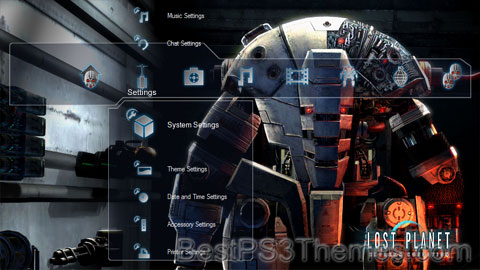
(4 backgrounds)
P3T Unpacker v0.12
Copyright (c) 2007. Anoop MenonThis program unpacks Playstation 3 Theme files (.p3t) so that you can touch-up an existing theme to your likings or use a certain wallpaper from it (as many themes have multiple). But remember, if you use content from another theme and release it, be sure to give credit!
Download for Windows: p3textractor.zip
Instructions:
Download p3textractor.zip from above. Extract the files to a folder with a program such as WinZip or WinRAR. Now there are multiple ways to extract the theme.
The first way is to simply open the p3t file with p3textractor.exe. If you don’t know how to do this, right click the p3t file and select Open With. Alternatively, open the p3t file and it will ask you to select a program to open with. Click Browse and find p3textractor.exe from where you previously extracted it to. It will open CMD and extract the theme to extracted.[filename]. After that, all you need to do for any future p3t files is open them and it will extract.
The second way is very simple. Just drag the p3t file to p3textractor.exe. It will open CMD and extract the theme to extracted.[filename].
For the third way, first put the p3t file you want to extract into the same folder as p3textractor.exe. Open CMD and browse to the folder with p3extractor.exe. Enter the following:
p3textractor filename.p3t [destination path]Replace filename with the name of the p3t file, and replace [destination path] with the name of the folder you want the files to be extracted to. A destination path is not required. By default it will extract to extracted.filename.Lost Planet versionD
Lost Planet versionD theme by Deemy
Download: LostPlanet_versionD.p3t
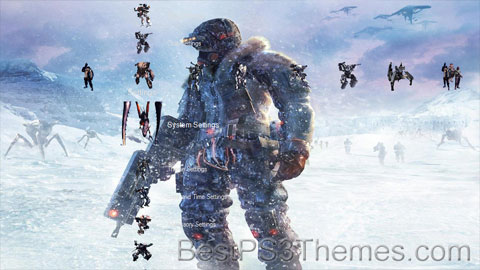
(6 backgrounds)
P3T Unpacker v0.12
Copyright (c) 2007. Anoop MenonThis program unpacks Playstation 3 Theme files (.p3t) so that you can touch-up an existing theme to your likings or use a certain wallpaper from it (as many themes have multiple). But remember, if you use content from another theme and release it, be sure to give credit!
Download for Windows: p3textractor.zip
Instructions:
Download p3textractor.zip from above. Extract the files to a folder with a program such as WinZip or WinRAR. Now there are multiple ways to extract the theme.
The first way is to simply open the p3t file with p3textractor.exe. If you don’t know how to do this, right click the p3t file and select Open With. Alternatively, open the p3t file and it will ask you to select a program to open with. Click Browse and find p3textractor.exe from where you previously extracted it to. It will open CMD and extract the theme to extracted.[filename]. After that, all you need to do for any future p3t files is open them and it will extract.
The second way is very simple. Just drag the p3t file to p3textractor.exe. It will open CMD and extract the theme to extracted.[filename].
For the third way, first put the p3t file you want to extract into the same folder as p3textractor.exe. Open CMD and browse to the folder with p3extractor.exe. Enter the following:
p3textractor filename.p3t [destination path]Replace filename with the name of the p3t file, and replace [destination path] with the name of the folder you want the files to be extracted to. A destination path is not required. By default it will extract to extracted.filename.LittleBigPlanet #3 Edited
LittleBigPlanet theme by Tony
Download: LBP_3Edited.p3t
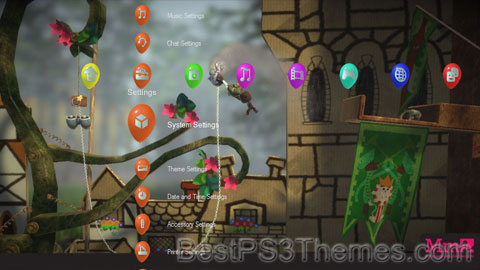
(3 backgrounds)
LittleBigPlanet 
Genre(s) Platform, endless running Developer(s) Media Molecule (2008-2014)
SCE Studio Cambridge (2009)
Supermassive Games (2010)
XDev (2010-2012)
Double Eleven (2012)
Tarsier Studios (2012)
United Front Games (2012)
San Diego Studio (2012)
Firesprite (2014)
Sumo Digital (2014-2020)
Exient Entertainment (2023)Publisher(s) Sony Interactive Entertainment
PlayStation Mobile (2014)Platform(s) PlayStation 3
PlayStation Portable
PlayStation Vita
PlayStation 4
PlayStation 5
WindowsFirst release LittleBigPlanet
27 October 2008Latest release Ultimate Sackboy
March 3, 2023LittleBigPlanet (LBP - stylised as LittleBIGPlanet) is a puzzle platform video game series created and produced by British developer Media Molecule and published by Sony Interactive Entertainment. Most games in the series put a strong emphasis on user-generated content and are based on the series' tagline "Play, Create, Share". The tagline represents the three core elements of the series: playing alone or with others locally (on the same console) or online, creating new content using the in-game creation tools, and sharing creations and discoveries online with other players.
Tarsier Studios, Fireproof Games and Supermassive Games also contribute to the development of the PlayStation 3 games, creating in-game assets (downloadable content) including costumes, backgrounds, objects, and stickers. Some of these assets will also provide the player more tools and gadgets to use in the level editor.[1]
The series comprises six games across five gaming platforms. The series was launched in 2008 with the PlayStation 3 game LittleBigPlanet, which was followed in 2009 by a PlayStation Portable version of the same name, initially developed by Studio Liverpool[2] and later handed to SCE Studio Cambridge. The sequel to the PlayStation 3 version, LittleBigPlanet 2, was released in January 2011 alongside a smaller spin-off title called Sackboy's Prehistoric Moves. LittleBigPlanet PS Vita was developed by Tarsier Studios and Double Eleven, released in September 2012 for the PlayStation Vita. At E3 2014, Sony announced LittleBigPlanet 3, a PlayStation 4 instalment that was developed by Sumo Digital and released in November 2014.[3] The games are all published by Sony Computer Entertainment. The latest instalment for the LittleBigPlanet franchise titled Sackboy: A Big Adventure was revealed during the PS5 live event and released on the PlayStation 4 and PlayStation 5 in November 2020. A Windows version was released on 27 October 2022.[4]
On 17 January 2015, it was announced that all LittleBigPlanet servers in Japan would shut down on 31 July, along with the PlayStation Portable version and LittleBigPlanet Karting in late August in all regions. Due to attacks on the online servers, all LittleBigPlanet servers were taken down in May 2021 (the Vita version had remained closed since March).[5] The servers for the PS4 version of LittleBigPlanet 3 were brought back up on 13 September 2021, however, in the same announcement, it mentioned that the servers for LittleBigPlanet, LittleBigPlanet 2, LittleBigPlanet PS Vita and the PS3 version of LittleBigPlanet 3 will remain closed permanently.[6] On 8 January, 2024, it was announced that, presumably due to more attacks on the online servers, the servers for the PS4 version of LittleBigPlanet 3 were being temporarily closed while they investigate them.[7][8][9]
On 19 April 2024, the servers for the PlayStation 4 version of LittleBigPlanet 3 were permanently shut down due to ongoing technical issues.[10]
Gameplay[edit]
The core mechanics of the series revolve around its tagline, "Play, Create, Share".[11]
Play[edit]
In the first two instalments of the series, gameplay consist primarily of traditional two-dimensional look in a three-dimensional style platforming like jumping and avoiding obstacles to successfully navigate to the end of a level to win.[12] Since LittleBigPlanet 2, the series has included mini-games, including ones that do not follow the platformer genre. Most LittleBigPlanet games involve a player playing solo or co-operatively with friends to navigate through a level whilst collecting various "bubbles" along the way, which can take the form of either points or collectibles. In-game collectibles can be used in level creation or to customize Sackboy, the player character. There are also numerous co-operative parts of levels whereby certain prize bubbles can be earned. In LittleBigPlanet 3 and Sackboy: A Big Adventure, Collectables are also present, being used in various shops to purchase more costumes.
Create[edit]
The Create component primarily refers to level creation in the game, along with other features like character customisation. Players can create their own levels with the built-in level creator. Many items that are collected while playing through the story mode and from LittleBigPlanet's community can be used to help with level creation.[13] These levels can remain as the original LittleBigPlanet platforming gameplay, or they can include other game types, such as racing, fighting, shooting and sports.[12] The player can also make non-gaming creations such as music and films (commonly known in-game as cut-scenes).[14] In LittleBigPlanet 2, Sackbots were introduced to give players more control over non-player characters in their levels as well as make the levels in their entirety more intelligent. The creation technique introduced on the game gave the possibility for logic, and it gave the ability to build sets of machines and complex contraptions.[14]
[edit]
Lastly, the Share component relates to sharing creations with the game's community by uploading levels to the PlayStation Network. To-date there were an excess of ten million user-created levels available to play on the LittleBigPlanet server in the PlayStation 3 games.[15] After the release of LittleBigPlanet 2 and the LBP.me community website, the Share component also had a strong emphasis sharing discoveries. Players were encouraged to share levels they found with other players by writing reviews and comments in-game and by sharing links to creations' LBP.me pages via social networks.
Overview[edit]
The series takes place in a world known as LittleBigPlanet. Each curator is in charge of a part of LittleBigPlanet and they govern them independently. LittleBigPlanet has geography inspired by the real-life Earth. All games in the series follow the main protagonist Sackboy, a small anthropomorphic creature made of brown fabric with a zip fastener and button eyes. He can be customized to the player's liking using costumes that are either unlocked in the game or bought as downloadable content from the PlayStation Store. The player can control Sackboy's four emotions; happiness, sadness, worry and anger, each of which has three levels of intensity. The English language version of each game is narrated by Stephen Fry and in all formats Fry's scripts are written by Dean Wilkinson.
Games[edit]
Release timeline 2008 LittleBigPlanet 2009 LittleBigPlanet (PSP) 2010 Sackboy's Prehistoric Moves 2011 LittleBigPlanet 2 2012 LittleBigPlanet PS Vita LittleBigPlanet Karting 2013 2014 Run Sackboy! Run! LittleBigPlanet 3 2015 2016 2017 2018 2019 2020 Sackboy: A Big Adventure 2021 2022 2023 Ultimate Sackboy Main series[edit]
LittleBigPlanet[edit]
The first game in the series was released on the PlayStation 3 platform in 2008 and was the first title developed by Media Molecule, under the name The Next Big Thing. The player controls Sackboy as he travels around the titular LittleBigPlanet, helping the eight creator curators of LittleBigPlanet with their problems in their own respective realms. Throughout the story, Sackboy tries to stop The Collector, one of the eight creator curators who has gone rogue, kidnapping the creations of LittleBigPlanet.[16] The game received widespread acclaim for its design, gameplay, and customization afforded to the player, particularly the built-in level editor. After its release, it received numerous industry awards.[17]
LittleBigPlanet 2[edit]
The second game in the series is a direct sequel to the first LittleBigPlanet and was developed by Media Molecule for the PlayStation 3 for a release in 2011. The sequel saw a major shift in the direction of the series, going from a primarily traditional platform game in the first two entries to a more varied style of gameplay called a "platform for games". The second game gave players a wider variety of options when it came to level design, which saw the creation of levels other than platforming such as racing, puzzles, and fighting games.[18] Following the events of the first two entries in the series, the game takes place when an antagonist known as the Negativitron invades LittleBigPlanet and begins to suck up all its inhabitants. Sackboy must team up with a secret organization known as "The Alliance", led by Larry Da Vinci, to save LittleBigPlanet from the Negativitron.[19] The game also supported the PlayStation Move, with an update post-launch.
LittleBigPlanet 3[edit]
LittleBigPlanet 3 is a game for the PlayStation 3[20][21][22] and PlayStation 4. Announced at E3 2014, it was developed by Sumo Digital and was released in November 2014. In the game, Sackboy is transported to another world, Bunkum, where he has to awaken its three missing heroes, OddSock, Toggle and Swoop, who are new playable characters. Sackboy travels through different worlds in order to free the 3 new characters and stop Newton.[23]
Handheld[edit]
LittleBigPlanet (PlayStation Portable)[edit]
A portable entry of the series was developed primarily by SCE Studio Cambridge in association with Media Molecule for the PlayStation Portable. The game, released in 2009, shared the same name as the original game; however, it was not a port of the PlayStation 3 game, but rather a new entry in the series. It has a story-mode with levels and features many of the same mechanics of its PlayStation 3 counterpart, such as customizations, albeit without the multiplayer component of the game. The game takes place after the events of the PlayStation 3 version of LittleBigPlanet, in which The Collector has been defeated. A carnival is being held and Sackboy decides to go around the world to invite the eight curators of LittleBigPlanet to the carnival whilst finding materials for his own carnival float.[24]
LittleBigPlanet PS Vita[edit]
The fourth game in the series was developed by Tarsier Studios, Double Eleven, and XDev for the PlayStation Vita handheld and had a 2012 release.[25] The game features the same core mechanics from LittleBigPlanet 2, with the focus being on a "platform for games" rather than a platformer like previous entries in the series before LittleBigPlanet 2. The game utilizes the unique controls of the PlayStation Vita by using its multi-touch touchscreen and its rear touchpad to navigate through various obstacles in stages as well as for level creation by users.[26] The game supports cross-buy of DLC costume packs between LittleBigPlanet 2, as well as LittleBigPlanet Karting.
Spinoff games[edit]
LittleBigPlanet Karting[edit]
LittleBigPlanet Karting is a kart racing game developed by United Front and San Diego Studio in conjunction with series creator Media Molecule for the PlayStation 3.[27] In its story mode, the player ventures through worlds including: LittleBigPlanet, Monster Islands, Victoria's Laboratory, The Progress Emporium, Eve's Asylum, The Space Bass, and Hoard, Sweet Hoard, to put an end to the Hoard racers, who snatch many pieces of the different planets to stash them in the Garage at the End of the Universe. Sony Entertainment America shut down the North American LittleBigPlanet Karting online servers on 31 August 2016.[28]
Sackboy's Prehistoric Moves[edit]
The game was developed by XDev as a spin-off from the LittleBigPlanet series utilizing the PlayStation Move on the PlayStation 3. It was released in December 2010, as a downloadable title from the PlayStation Store and was later bundled with LittleBigPlanet 2. The game was described as a "demo" and featured 10 prehistoric inspired story levels. In the game, Sackboy must save Little Big Planet from the T-Rex. Unlike the main games, which can be played as a single-player experience, the game required a minimum of two players to work.[29] This was due to the main mechanics of the spin-off whereby one player would control Sackboy traditionally using the gamepad for platforming while a second player had to use a PlayStation Move similar to a pointer to move obstacles and objects out of the way in order to successfully navigate a level.[30]
Run Sackboy! Run![edit]
Run Sackboy! Run! is a free-to-play endless running game developed by Firesprite and published by PlayStation Mobile that was released on iOS on 30 October 2014,[31] Android on 17 December 2014[32] and PlayStation Vita on 31 March 2015.[33] The game has no real plot, except for Sackboy running through Craftworld from the Negativitron. The game awarded players with exclusive costumes for LittleBigPlanet 3 (which was released at a similar time) by reaching point goals and collecting stickers.[34]
LittleBigPlanet Hub[edit]
LittleBigPlanet Hub is an unreleased free-to-play game for the PlayStation 3.[35] It was planned to be a downloadable title from the PlayStation Store which would have allowed players to create levels and play a curated selection of community levels from LittleBigPlanet and LittleBigPlanet 2 as well as 16 levels from the games' story modes. LittleBigPlanet Hub would also have contained weekly challenges, not found in other LittleBigPlanet games. Downloadable content purchased in other games were to be compatible with LittleBigPlanet Hub, and users were rumoured to be also able to access additional content from the PlayStation Store.[citation needed]
Since its announcement in August 2013, no further details about LittleBigPlanet Hub were revealed.[36] In February 2024, a beta tester posted a video showing gameplay from a beta build onto YouTube, and shortly afterwards, with assistance, dumped it online for download. This makes the build playable through unofficial means, such as emulations like RPCS3 or PlayStation 3 homebrew.[37]
Sackboy: A Big Adventure[edit]
Sackboy: A Big Adventure is a 2020 platform game developed by Sumo Digital and published by Sony Interactive Entertainment for the PlayStation 5 and the PlayStation 4. It was announced at the PlayStation 5 reveal event on June 11, 2020, and was released on November 12, 2020; a version for Windows was released on October 27, 2022, marking the series's first release on PCs. Unlike previous LittleBigPlanet entries with 2.5D platforming, A Big Adventure features a range of perspectives and 3D movement.
Ultimate Sackboy[edit]
Ultimate Sackboy is a free-to-play endless running game developed by Exient Entertainment and released on mobile on 21 February 2023. It is the first LittleBigPlanet game to feature limited-time paid subscriptions known as "Marathons." In contrast to Run Sackboy! Run!, it adopts the style from Sackboy: A Big Adventure and is played in 3D.
Reception[edit]
Aggregate review scores Game Metacritic LittleBigPlanet (PlayStation 3) 95/100[38] LittleBigPlanet (PlayStation Portable) 87/100[39] Sackboy's Prehistoric Moves 66/100[40] LittleBigPlanet 2 91/100[41] LittleBigPlanet PS Vita 88/100[42] LittleBigPlanet Karting 74/100[43] LittleBigPlanet 3 79/100[44] Run Sackboy! Run! 65/100[45] Sackboy: A Big Adventure 80/100[46] Ultimate Sackboy 57/100[47] Most of the games in the series have been well received by critics with the LittleBigPlanet on PlayStation 3 and PlayStation Portable gaining Metacritic scores of 95/100[38] and 87/100[39] respectively. LittleBigPlanet 2 garnered nearly as much acclaim as the first game, with an average score of 91/100.[48] LittleBigPlanet PS Vita also received very positive reviews and was the highest-ranked PS Vita game at the time of its release with an average score of 88/100.[49] However, the release of LittleBigPlanet 3 did not receive critical acclaim, garnering a mostly positive average of 79/100.[50] Critically, LittleBigPlanet Karting is the worst-performing major game in the series so far but still gained a "mixed or average" Metacritic score of 74/100.[51] However, the mobile game Run Sackboy! Run! performed worse, with a Metacritic score of 65/100.[52] Additionally, the character of Sackboy is often seen as a PlayStation mascot.[53] In 2011, readers of Guinness World Records Gamer's Edition voted Sackboy as the 50th-top video game character of all time.[54]
References[edit]
- ^ "Introducing the Extended LittleBigPlanet Family - Media Molecule - We make games". Media Molecule. Archived from the original on 21 February 2016. Retrieved 6 December 2010.
- ^ "LittleBigPlanet coming to PSP - CVG". Computerandvideogames.com. 8 April 2008. Archived from the original on 15 April 2014. Retrieved 14 June 2014.
- ^ "LittleBigPlanet 3 coming to PS4 this November". 10 June 2014. Archived from the original on 14 July 2014. Retrieved 10 June 2014.
- ^ "Sackboy: A Big Adventure coming to PC on October 27". Gematsu. 29 September 2022. Retrieved 29 September 2022.
- ^ "LittleBigPlanet Servers Taken Down After Hackers Post Hate Speech". PlayStation LifeStyle. 24 May 2021. Archived from the original on 13 September 2021. Retrieved 13 September 2021.
- ^ Yin-Poole, Wesley (13 September 2021). "Sony shuts down online for older LittleBigPlanet games "to protect the community"". Eurogamer. Archived from the original on 2 April 2022. Retrieved 13 September 2021.
Space Invaders
Space Invaders theme by stealthassassin
Download: SpaceInvaders.p3t
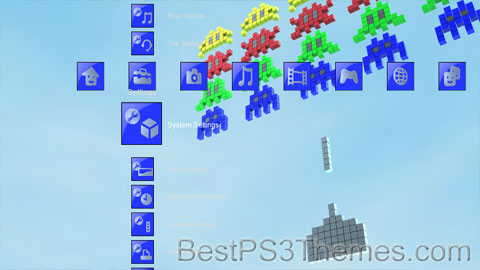
(1 background)
Space Invaders
Arcade flyerDeveloper(s) Taito Publisher(s) Atari, Inc. (home) Designer(s) Tomohiro Nishikado Series Space Invaders Platform(s) Arcade, Atari 2600, Atari 5200, Atari 8-bit, MSX, handheld, tabletop, watch, calculator,[9] NES,[10] SG-1000,[11] WonderSwan,[12] VG Pocket,[13] mobile,[14] iOS[15] Release Arcade Genre(s) Fixed shooter Mode(s) 1–2 players alternating turns Space Invaders[b] is a 1978 shoot 'em up arcade video game, developed and released by Taito in Japan and licensed to Midway Manufacturing for overseas distribution. Commonly considered to be one of the most influential video games of all time, Space Invaders was the first fixed shooter and the first video game with endless gameplay (meaning there was no final level or endscreen) and set the template for the genre. The goal is to defeat wave after wave of descending aliens with a horizontally moving laser cannon to earn as many points as possible.
Designer Tomohiro Nishikado drew inspiration from North American target shooting games like Breakout (1976) and Gun Fight (1975), as well as science fiction narratives such as the novel The War of the Worlds (1897), the anime Space Battleship Yamato (1974), and the film Star Wars (1977). To complete development, he had to design custom hardware and development tools. Upon release, Space Invaders was an immediate commercial success; by 1982, it had grossed $3.8 billion ($14 billion in 2023-adjusted terms),[16] with a net profit of $450 million ($1.7 billion in 2023 terms). This made it the best-selling video game and highest-grossing entertainment product at the time, and the highest-grossing video game of all time.
Space Invaders is considered one of the most influential video games ever made, having ushered in the golden age of arcade video games. It was the inspiration for numerous video games and game designers across different genres, and has been ported and re-released in various forms. The 1980 Atari VCS version quadrupled sales of the VCS, thereby becoming the first killer app for video game consoles. More broadly, the pixelated enemy alien has become a pop culture icon, often representing video games as a whole.
Gameplay[edit]

The player-controlled laser cannon shoots the aliens as they descend. Space Invaders is a fixed shooter in which the player moves a laser cannon horizontally across the bottom of the screen and fires at aliens overhead. The aliens begin as five rows of eleven that move left and right as a group, shifting downward (advancing on the shooter) each time they reach a screen edge. The goal is to eliminate all of the aliens by shooting them. While the player has three lives, the game ends immediately if the invaders reach the bottom of the screen.[17][18][10][19] The aliens attempt to destroy the player's cannon by firing projectiles. The laser cannon is partially protected by stationary defense bunkers which are gradually destroyed from the top by the aliens and, if the player fires when beneath one, the bottom gets destroyed.
As aliens are defeated, their movement and the music both speed up. Defeating all the aliens brings another wave which starts lower, a loop which can continue endlessly.[17][18][10][19] A special "mystery ship" will occasionally move across the top of the screen and award bonus points if destroyed.
Development[edit]
Space Invaders was developed by Japanese designer Tomohiro Nishikado, who spent a year designing it and developing the necessary hardware to produce it.[20] The game was a response to Atari's arcade game Breakout (1976). Nishikado wanted to adapt the same sense of achievement and tension from destroying targets one at a time, combining it with elements of target shooting games.[20][21][22] The game uses a similar layout to that of Breakout but with different game mechanics; rather than bounce a ball to attack static objects, players are given the ability to fire projectiles at moving enemies.[23]
Nishikado added several interactive elements that he found lacking in earlier video games, such as the ability for enemies to react to the player's movement and fire back, and a game over triggered by the enemies killing the player (either by getting hit or enemies reaching the bottom of the screen) rather than simply a timer running out.[21] He replaced the timer, typical of arcade games at the time, with descending aliens who effectively served a similar function, where the closer they came, the less time the player had left.[22]
Early enemy designs included tanks, combat planes, and battleships.[20] Nishikado, however, was not satisfied with the enemy movements; technical limitations made it difficult to simulate flying.[20][24] Humans would have been easier to simulate, but the designer considered shooting them immoral.[24][25] After seeing the release of the 1974 anime Space Battleship Yamato in Japan,[26][27] and seeing a magazine feature about Star Wars (1977), he thought of using a space theme.[20][21] Nishikado drew inspiration for the aliens from a novel by H. G. Wells, The War of the Worlds, and created initial bitmap images after the octopus-like aliens.[20][21][24] Other alien designs were modeled after squids and crabs.[20][24] The game was originally titled Space Monsters after a popular song in Japan at the time, "Monster", but was changed to Space Invaders by the designer's superiors.[20][21]
Hardware[edit]
Cocktail table arcade cabinetA modified Space Invaders arcade cabinetNishikado designed his own custom hardware and development tools for Space Invaders.[20][24] It uses an Intel 8080 central processing unit (CPU), displays raster graphics on a CRT monitor using a bitmapped framebuffer, and uses monaural sound hosted by a combination of analog circuitry and a Texas Instruments SN76477 sound chip.[28][25][29] The adoption of a microprocessor was inspired by Gun Fight (1975), Midway's microprocessor adaptation of Nishikado's earlier discrete logic game Western Gun, after the designer was impressed by the improved graphics and smoother animation of Midway's version.[30] Space Invaders also adopted the multi-chip barrel shifter circuit first developed by Midway for Gun Fight, which had been a key part of that game's smoother animation. This circuit allowed the 8080 CPU to shift pictures in the graphics framebuffer faster than it could using only its own native instructions.[31]
Despite the specially developed hardware, Nishikado was unable to program the game as he wanted—the Control Program board was not powerful enough to display the graphics in color or move the enemies faster—and considered the development of the hardware the most difficult part of the process.[20][24] While programming, Nishikado discovered that the processor was able to render each frame of the alien's animation graphics faster when there were fewer aliens on the screen. Since the alien's positions updated after each frame, this caused the aliens to move across the screen at an increasing speed as more and more were destroyed. Rather than design a compensation for the speed increase, he decided that it was a feature, not a bug, and kept it as a challenging gameplay mechanism.[21]
Taito released Space Invaders in July 1978.[5] They released both an upright arcade cabinet and a so-called "cocktail-table" cabinet; following its usual practice, Taito named the cocktail version T.T. Space Invaders ("T.T." for "table-top"). Midway released its upright version a few months later and its cocktail version several months after that. The cabinet artwork featured large humanoid monsters not present in the game; Nishikado attributes this to the artist basing the designs on the original title of "Space Monsters", rather than referring to the actual in-game graphics.[20] In the upright cabinets, the graphics are generated on a hidden CRT monitor and reflected toward the player using a semi-transparent mirror, behind which is mounted a plastic cutout of a moon bolted against a painted starry background. The backdrop is visible through the mirror and thus appears "behind" the graphics.[10] Both Taito's and Midway's first Space Invaders versions had black-and-white graphics with a transparent colored overlay using strips of orange and green cellophane over certain portions of the screen to add color to the image. Later Japanese releases used a rainbow-colored cellophane overlay,[10] and these were eventually followed by versions with a color monitor and an electronically generated color overlay.[10]
Music[edit]
Despite its simplicity, the music to Space Invaders was revolutionary for the gaming industry of the time. Video game scholar Andrew Schartmann identifies three aspects of the music that had a significant impact on the development of game music:
- Whereas video game music prior to Space Invaders was restricted to the extremities (i.e., a short introductory theme with game-over counterpart), the alien-inspired hit featured continuous music — the well-known four-note loop, consisting of the first four notes of the descending D minor natural scale — throughout, uninterrupted by sound effects: "It was thus the first time that sound effects and music were superimposed to form a rich sonic landscape. Not only do players receive feedback related directly to their actions through sound effects; they also receive stimulus in a more subtle, non-interactive fashion through music."[32]
- The music interacts with on-screen animation to influence the emotions of the player: "That seemingly pedestrian four-note loop might stir us in the most primitive of ways, but that it stirs us at all is worthy of note. By demonstrating that game sound could be more than a simple tune to fill the silence, Space Invaders moved video game music closer to the realm of art."[32]
- The music for Space Invaders popularized the notion of variability—the idea that music can change in accordance with the ongoing on-screen narrative. The variable in Space Invaders, the tempo, is admittedly simple, but its implications are not to be underestimated. "Over the years, analogous strategies of variation would be applied to pitch, rhythm, dynamics, form, and a host of other parameters, all with the goal of accommodating the nonlinear aspect of video games."[32]
At the deepest of conceptual levels, one would be hard-pressed to find an arcade game as influential to the early history of video game music as Space Invaders. Its role as a harbinger of the fundamental techniques that would come to shape the industry remains more or less unchallenged. And its blockbuster success ensured the adoption of those innovations by the industry at large.
— Andrew Schartmann, Thought Catalog (2013)Next Generation editor Neil West also cited the Space Invaders music as an example of great video game art, commenting on how the simple melody's increasing tempo and synchronization with the enemies' movement chills and excites the player.[33]
Reception and versions[edit]
ReceptionReview scores Publication Score AllGame 


(Arcade)[34]


(Atari 5200)[35]


(SNES)[36]Games World 80% (Game Boy)[37] Awards Publication Award Arcade Awards Game of the Year[38] VideoGames Best Game Boy Game (runner-up)[39] Guinness World Records Top Arcade Game of All Time[18] The Times Most Influential Video Game Ever[40] Arcade version[edit]
Space Invaders initially received mixed responses from within Taito and amusement arcade owners. Nishikado's colleagues praised it, applauding his achievement while queuing up to play, whereas his bosses predicted low sales as games often ended more quickly than other timer-based arcade games at the time. A number of amusement arcade owners initially rejected it, but some pachinko parlors and bowling alleys adopted it; it quickly caught on, with many parlors and alleys clearing space for more Space Invaders cabinets.[41] In the first few months following its release in Japan, Space Invaders became popular,[25] and specialty video arcades opened with nothing but Space Invaders cabinets.[20][25]
By the end of 1978, Taito had installed over 100,000 machines and grossed $670 million ($3.1 billion adjusted for inflation) in Japan alone.[9][42] By June 1979, Taito had manufactured about 200,000–300,000 Space Invaders machines in Japan, with each unit earning an average of ¥10,000 or $46 (equivalent to $193 in 2023) in 100 yen coins per day. However, this was not enough to meet the high demand, leading to Taito increasing production to 25,000–30,000 units per month and raising projections to 400,000 manufactured in Japan by the end of 1979.[5] In order to cope with the demand, Taito licensed the overseas rights to Midway for distribution outside of Japan. By the end of 1979, an estimated 750,000 Space Invaders machines were installed worldwide, including 400,000 in Japan, 85,000 in the United Kingdom,[6] and 60,000 within a year in the United States[43][44][45] (where prices ranged from $2,000 to $3,000 for each machine);[46] the game eventually sold 72,000 units in the United States by 1982.[47] By 1979, it had become the arcade game industry's all-time best-seller.[48]
Space Invaders had about 8 million daily players in Japan, with daily revenue peaking at ¥2.6 billion or $12,000,000 (equivalent to $56,000,000 in 2023).[49] Space Invaders machines had grossed more than four billion US quarters ($1 billion at the time, or $4.7 billion adjusted for inflation) by 1979.[50] It remained the top arcade game for three years through 1980.[9] In 1981, several years after its release, it still had weekly earnings of $7.7 million in the United States, second only to Pac-Man.[51] By 1982, it had crossed $2 billion in quarters[52][53] (equivalent to $9.34 billion adjusted for inflation),[54] with a net profit of $450 million[53] (equivalent to $2.1 billion adjusted for inflation).[54] This made it the best-selling video game and highest-grossing "entertainment product" of its time,[52] with comparisons made to the then highest-grossing film Star Wars,[52][55] which had grossed $486 million,[55] with a net profit of $175 million.[55] By 1982, it had grossed $3.8 billion, equivalent to over $13 billion as of 2016.[16] Space Invaders earned Taito profits of over $500,000,000 (equivalent to $2,300,000,000 in 2023).[20][56]
Home versions[edit]
The 1980 Atari VCS (Atari 2600) version was the first official licensing of an arcade game for consoles and became the first "killer app" for video game consoles after quadrupling the system's sales.[10][57] It sold over one million units in its first year on sale as a home console game, then over 4.2 million copies by the end of 1981, and over 5.6 million by 1982; it was the
Super Puzzle Fighter II Turbo HD Remix
Super Puzzle Fighter II Turbo HD Remix theme by Itachi1986
Download: SuperPuzzleFighterIITurbo.p3t
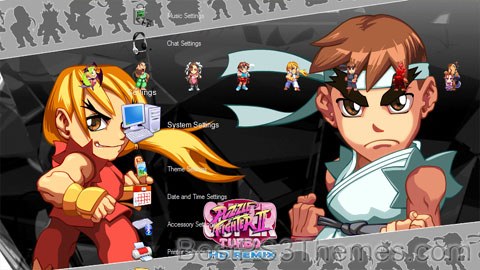
(3 backgrounds)
This page is a redirect. The following categories are used to track and monitor this redirect:- With history: This is a redirect from a page containing substantive page history. This page is kept as a redirect to preserve its former content and attributions. Please do not remove the tag that generates this text (unless the need to recreate content on this page has been demonstrated), nor delete this page.
- This template should not be used for redirects having some edit history but no meaningful content in their previous versions, nor for redirects created as a result of a page merge (use {{R from merge}} instead), nor for redirects from a title that forms a historic part of Wikipedia (use {{R with old history}} instead).
When appropriate, protection levels are automatically sensed, described and categorized.- To a section: This is a redirect from a topic that does not have its own page to a section of a page on the subject. For redirects to embedded anchors on a page, use {{R to anchor}} instead.
Into The Blue (Metal Gear Solid 4)
Into The Blue (Metal Gear Solid 4) theme by TKC-Muzzer
Download: IntoTheBlueMGS4.p3t
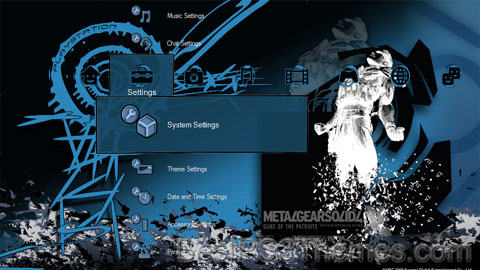
(1 background)
P3T Unpacker v0.12
Copyright (c) 2007. Anoop MenonThis program unpacks Playstation 3 Theme files (.p3t) so that you can touch-up an existing theme to your likings or use a certain wallpaper from it (as many themes have multiple). But remember, if you use content from another theme and release it, be sure to give credit!
Download for Windows: p3textractor.zip
Instructions:
Download p3textractor.zip from above. Extract the files to a folder with a program such as WinZip or WinRAR. Now there are multiple ways to extract the theme.
The first way is to simply open the p3t file with p3textractor.exe. If you don’t know how to do this, right click the p3t file and select Open With. Alternatively, open the p3t file and it will ask you to select a program to open with. Click Browse and find p3textractor.exe from where you previously extracted it to. It will open CMD and extract the theme to extracted.[filename]. After that, all you need to do for any future p3t files is open them and it will extract.
The second way is very simple. Just drag the p3t file to p3textractor.exe. It will open CMD and extract the theme to extracted.[filename].
For the third way, first put the p3t file you want to extract into the same folder as p3textractor.exe. Open CMD and browse to the folder with p3extractor.exe. Enter the following:
p3textractor filename.p3t [destination path]Replace filename with the name of the p3t file, and replace [destination path] with the name of the folder you want the files to be extracted to. A destination path is not required. By default it will extract to extracted.filename.