Multi-Theme theme by giovanni
Download: Multi-Theme.p3t
The #1 spot for Playstation themes!
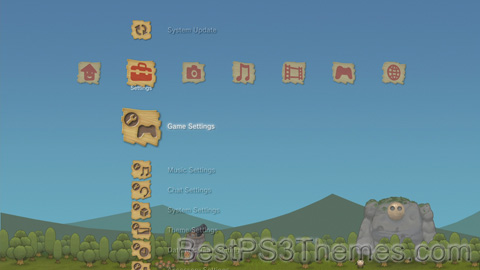
PixelJunk Monsters theme by Q-Games
Download: PixelJunkMonsters.p3t
![]()
(1 background)
| PixelJunk Monsters | |
|---|---|
PlayStation Store icon | |
| Developer(s) | Q-Games[a] Double Eleven (Ultimate HD, Wii U) |
| Publisher(s) |
|
| Series | PixelJunk |
| Platform(s) | PlayStation 3 PlayStation Portable PlayStation Vita Microsoft Windows Mac OS X Linux Wii U |
| Release | December 6, 2007
|
| Genre(s) | Tower defense |
| Mode(s) | Single-player; Two player co-op (local) |
PixelJunk Monsters is a tower defense video game developed by Q-Games for the PlayStation 3. The second game in the PixelJunk series, it was originally released in Japan on December 6, 2007 and worldwide by Sony Computer Entertainment on the PlayStation Store on January 24, 2008.[1] The game was released for the PlayStation Portable under the title PixelJunk Monsters Deluxe.
PixelJunk Monsters Encore, an expansion pack for the game, was released on April 24, 2008 in Japan;[citation needed] May 8, 2008 in North America; and May 15, 2008 in Europe.[2]
In 2013, an enhanced version developed by Double Eleven titled PixelJunk Monsters Ultimate HD was released in 2013 for the PlayStation Vita, Windows, Mac OS X and Linux. In May 2016, a port of the original game also developed by Double Eleven was released for the Wii U.[3]
In 2018, PixelJunk Monsters 2 was released, incorporating 3D graphics and new features.

Gameplay in PixelJunk Monsters has similarities to various tower defense titles. The objective is to build defense towers along the enemies' path to keep them from reaching a hut, or base. Several small creatures dwell at the base. For each enemy that survives the defense towers and reaches the hut, one creature is killed. If all creatures are wiped out, the level is failed.
Towers have distinct attributes, such as rapid fire, long range, air-focused, etc. Destroyed enemies usually drop coins and occasionally give gems, which then can be used to upgrade and research new towers.
There are a total of 21 different levels (36 with the expansion pack) at 3 stages of difficulty. There are also 3 special stages that unlock unique abilities for the player character. Several "Trophy Challenges" were also added to the game after a patch.
Unlike more traditional tower defense games, the player controls a character around the screen, collecting coins and building towers. This replaces the standard cursor controls. A second player can also join in and assist in building towers.
The PixelJunk Monsters Encore expansion pack includes an additional 15 levels, including layouts inspired by classic arcade games such as Pac-Man and Space Invaders. There are also small tweaks to gameplay; for instance, the ice tower is unlocked at the beginning of every level and the Tesla tower is less expensive to purchase.
A new version of PixelJunk Monsters was available for the PlayStation Portable. Titled PixelJunk Monsters Deluxe, it has been described by Dylan Cuthbert as the "ultimate version" of the game. It contains all of the level content from the original game and its Encore expansion pack, as well as new levels, enemies, and towers. Additional music, videos, concept art, and other special features are also included.[4]
| Dive into PixelJunk Monsters | |
|---|---|
| Studio album by | |
| Released | May 22, 2008 |
| Length | 40:53 |
The music for the game was developed by Otograph. On May 22, 2008, a soundtrack album for the game titled Dive into PixelJunk Monsters was released via the PlayStation Store. It is the first audio album to be released through PSN.
| Track listing | |
|---|---|
| |
The PlayStation 3 version of PixelJunk Monsters, Encore, Deluxe, and the Vita version of Ultimate received "favorable" reviews, while the PC version of Ultimate and the Wii U version of PixelJunk Monsters received "average" reviews, according to the review aggregation website Metacritic.[5][6][7][8][9][10]
| Aggregator | Score | ||||
|---|---|---|---|---|---|
| PC | PS Vita | PS3 | PSP | Wii U | |
| Metacritic | 72/100[5] | 84/100[6] | 83/100[7] (E.) 82/100[8] | 86/100[9] | 73/100[10] |
| Publication | Score | ||||
|---|---|---|---|---|---|
| PC | PS Vita | PS3 | PSP | Wii U | |
| 1Up.com | N/A | N/A | A[11] | A[12] | N/A |
| Destructoid | N/A | N/A | N/A | 9/10[13] | N/A |
| Edge | N/A | N/A | 7/10[14] | N/A | N/A |
| Eurogamer | N/A | N/A | 8/10[15] | N/A | N/A |
| GamePro | N/A | N/A | N/A | N/A | |
| GameSpot | N/A | N/A | 7.5/10[17] (E.) 7/10[18] | 8/10[19] | N/A |
| GameZone | N/A | N/A | 8/10[20] | 9/10[21] | N/A |
| IGN | N/A | 9/10[22] | 8.5/10[23] (E.) 7.9/10[24] | 9/10[25] | N/A |
| Nintendo Life | N/A | N/A | N/A | N/A | 8/10[26] |
| PlayStation Official Magazine – UK | N/A | 8/10[27] | 7/10[28] | 8/10[29] | N/A |
| The A.V. Club | N/A | N/A | B[30] | N/A | N/A |
Tom Raider theme by Telekill
Download: TombRaider_2.p3t
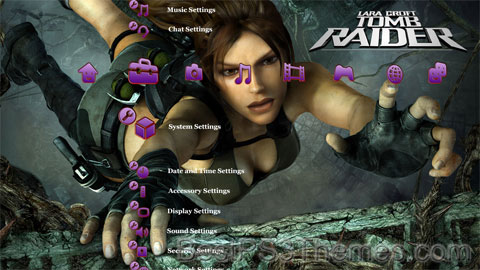
(1 background)
| Tomb Raider | |
|---|---|
The Tomb Raider logo from 2022 onwards | |
| Genre(s) | Action-adventure |
| Developer(s) |
|
| Publisher(s) |
|
| Platform(s) |
|
| First release | Tomb Raider 25 October 1996 |
| Latest release | Tomb Raider I–III Remastered 14 February 2024 |
Tomb Raider, known as Lara Croft: Tomb Raider from 2001 to 2008, is a media franchise that originated with an action-adventure video game series created by British video game developer Core Design. The franchise is currently owned by CDE Entertainment; it was formerly owned by Eidos Interactive, then by Square Enix Europe after Square Enix's acquisition of Eidos in 2009 until Embracer Group purchased the intellectual property alongside Eidos in 2022. The franchise focuses on the fictional British archaeologist Lara Croft, who travels around the world searching for lost artefacts and infiltrating dangerous tombs and ruins. Gameplay generally focuses on exploration, solving puzzles, navigating hostile environments filled with traps, and fighting enemies. Additional media has been developed for the franchise in the form of film adaptations, comics and novels.
Development of the first Tomb Raider began in 1994; it was released two years later. Its critical and commercial success prompted Core Design to develop a new game annually for the next four years, which put a strain on staff. The sixth game, Tomb Raider: The Angel of Darkness, faced difficulties during development and was considered a failure at release. This prompted Eidos to switch development duties to Crystal Dynamics, which has been the series' primary developer since. Other developers have contributed to spin-off titles and ports of mainline entries.
Tomb Raider games have sold over 95 million copies worldwide by 2022.[1] while the entire franchise generated close to $1.2 billion in revenue by 2002.[2] The series has received generally positive reviews from critics, and Lara Croft has become one of the most recognisable video game protagonists, winning accolades and earning places on the Walk of Game and Guinness World Records.

| 1996 | Tomb Raider |
|---|---|
| 1997 | Tomb Raider II |
| 1998 | Tomb Raider III |
| 1999 | Tomb Raider: The Last Revelation |
| 2000 | Tomb Raider |
| Tomb Raider: Chronicles | |
| 2001 | Tomb Raider: Curse of the Sword |
| 2002 | Tomb Raider: The Prophecy |
| 2003 | Tomb Raider: The Angel of Darkness |
| 2004–2005 | |
| 2006 | Tomb Raider: Legend |
| 2007 | Tomb Raider: Anniversary |
| 2008 | Tomb Raider: Underworld |
| 2009 | |
| 2010 | Lara Croft and the Guardian of Light |
| 2011–2012 | |
| 2013 | Tomb Raider |
| 2014 | Lara Croft and the Temple of Osiris |
| 2015 | Lara Croft: Relic Run |
| Lara Croft Go | |
| Rise of the Tomb Raider | |
| 2016–2017 | |
| 2018 | Shadow of the Tomb Raider |
| 2019–2022 | |
| 2023 | Tomb Raider Reloaded |
| The Lara Croft Collection | |
| 2024 | Tomb Raider I–III Remastered |
The first six Tomb Raider games were developed by Core Design, a British video game development company owned by Eidos Interactive. After the sixth game in the series was released to a mixed reception in 2003, development was transferred to American studio Crystal Dynamics, who have handled the main series since.[3] Since 2001, other developers have contributed either to ports of mainline games or with the development of spin-off titles.[3][4][5][6][7][8]
The first entry in the series Tomb Raider was released in 1996 for personal computers (PC), PlayStation and Sega Saturn consoles.[9][10] The Saturn and PlayStation versions were released in Japan in 1997.[11][12] Its sequel, Tomb Raider II, launched in 1997, again for Microsoft Windows and PlayStation. A month before release, Eidos finalised a deal with Sony Computer Entertainment to keep the console version of Tomb Raider II and future games exclusive to PlayStation until the year 2000.[9][10] The PlayStation version was released in Japan in 1998.[13] Tomb Raider III launched in 1998.[10] As with Tomb Raider II, the PlayStation version released in Japan the following year.[14] The fourth consecutive title in the series, Tomb Raider: The Last Revelation, released in 1999. In 2000, with the end of the PlayStation exclusivity deal, the game also released on the Dreamcast.[9][15] In Japan, both console versions released the following year.[16][17] Tomb Raider: Chronicles released in 2000 on the same platforms as The Last Revelation, with the PlayStation version's Japanese release as before coming the following year.[9][15][18]
After a three-year gap, Tomb Raider: The Angel of Darkness was released on Microsoft Windows and PlayStation 2 (PS2) in 2003. The PlayStation 2 version was released in Japan that same year.[15][19] The next entry, Tomb Raider: Legend, was released worldwide in 2006 for the Microsoft Windows, PlayStation 2, Xbox, Xbox 360, PlayStation Portable (PSP), GameCube, Game Boy Advance (GBA) and Nintendo DS.[8][20][21] The Xbox 360, PlayStation 2 and PlayStation Portable versions were released in Japan the same year.[22] A year later, a remake of the first game titled Tomb Raider: Anniversary was released worldwide in 2007 for Microsoft Windows, PlayStation 2, PlayStation Portable, Xbox 360 and the Wii.[23] The next entry, Tomb Raider: Underworld, was released in 2008 on Microsoft Windows, PlayStation 3 (PS3), PlayStation 2, Xbox 360, Wii and DS.[24][25][26] The PlayStation 3, PlayStation 2, Xbox 360 and Wii versions were released in Japan in 2009.[27][28][29][30]
In 2011, The Tomb Raider Trilogy was released for PlayStation 3 as a compilation release that included Anniversary and Legend remastered in HD resolution, along with the PlayStation 3 version of Underworld. The disc includes avatars for PlayStation Home, a Theme Pack, new Trophies, Developer's Diary videos for the three games, and trailers for Lara Croft and the Guardian of Light as bonus content.
A reboot of the series, titled Tomb Raider, was released worldwide in 2013 for Microsoft Windows, PlayStation 3 and Xbox 360.[31][32] Its sequel, Rise of the Tomb Raider, was released in 2015 on the Xbox 360 and Xbox One.[33][34] The game was part of a timed exclusivity deal with Microsoft.[35] Versions for the PlayStation 4 and Microsoft Windows were released in 2016.[36] Another sequel, Shadow of the Tomb Raider,[37] was released worldwide on PlayStation 4, Xbox One, and Microsoft Windows in 2018.[38] An arcade game based on this incarnation was released by Bandai Namco Amusement in Europe in 2018.[39]
Core Design developed two Game Boy Colour titles in the early 2000s. The first, a side-scrolling game simply titled Tomb Raider was released in 2000.[7][40] The second, its sequel, Tomb Raider: Curse of the Sword, was released in 2001.[7][41] A Game Boy Advance title called Tomb Raider: The Prophecy, was released in 2002. Unlike the first two Game Boy titles, this was developed by Ubi Soft Milan and published by Ubi Soft, adopting an isometric perspective and moving away from the side-scrolling platform-based gameplay.[7][42]
From 2010 to 2015, a subseries simply titled Lara Croft was in development at Crystal Dynamics, with different gameplay than the main series and existing in its own continuity.[43][44] The first game, Lara Croft and the Guardian of Light, was released in 2010 as a downloadable title for PC, PS3 and Xbox 360.[43] It was followed by Lara Croft and the Temple of Osiris, released for retail and download in 2014 for PC, PS4 and Xbox One.[45] Both titles were released in a compilation entitled The Lara Croft Collection for Nintendo Switch in 2023.[46] An entry for mobile devices, an endless runner platformer titled Lara Croft: Relic Run, was released in 2015.[44] Square Enix Montreal also released a platform-puzzler for mobile devices, Lara Croft Go in 2015.[47]
In 2003, four Tomb Raider titles for mobile phones were released.[48] Developed by Emerald City Games for iOS and Android devices, Tomb Raider Reloaded is an action arcade and free-to-play game released by CDE Entertainment in 2022.[49]
After the release of The Angel of Darkness in 2003, Core Design continued working on the franchise for another three years, but both of the projects under development in that period were cancelled. A sequel titled The Lost Dominion was undergoing preliminary development that year, but the negative reception of The Angel of Darkness caused it and a wider trilogy to be scrapped.[9][50] With Eidos's approval, Core Design then began development of an updated edition of the first game for the PSP called Tomb Raider: 10th Anniversary in late 2005, with a projected release date of Christmas 2006. Development continued while other Core Design staff were working on the platformer Free Running. When Core Design was sold to Rebellion Developments in June 2006,[51] Eidos requested the project's cancellation. It was suggested by staff that Eidos did not want to let outside developers handle the franchise.[52][53] An Indiana Jones "reskin" of the game was never completed, and Free Running was ultimately the studio's final title in 2007. Core Design—by then named Rebellion Derby—shut down in 2010. A January 2006 build of 10th Anniversary was leaked online in 2020, and remains available on the Internet Archive.[54][55][56]

Lara Croft is the main protagonist and playable character of the video game series. She travels around the world in search of many forgotten artefacts and locations, frequently connected to supernatural powers.[59][60][61] While her biography has changed throughout the series, her shared traits are her origins as the only daughter and heir of the aristocratic Croft family.[59][62][63] She is portrayed as intelligent, athletic, elegant, fluent in multiple languages, and determined to fulfil her own goals at any cost. She has brown eyes and brown hair worn in a braid or ponytail. The character's classic outfit consists of a turquoise singlet, light brown shorts, calf-high boots, and tall white socks. Recurring accessories include fingerless gloves, a backpack, a utility belt with holsters on either side, and twin pistols. Later games have multiple new outfits for her.[58][64][65][66]
Lara Croft has been voiced by five actresses in the video game series: Shelley Blond, Judith Gibbins, Jonell Elliott, Keeley Hawes, and Camilla Luddington. In other media, Croft was also voiced by Minnie Driver in the animated series and portrayed by Angelina Jolie and Alicia Vikander in feature films. Multiple models and body doubles have portrayed Croft in promotional material until the reboot in 2013. Eight different real-life models have portrayed her at promotional events.[67][68]
In January 2023, The Hollywood Reporter reported that Phoebe Waller-Bridge was set to write a TV show adaptation[69] of the video game franchise for Amazon. It was also reported that this would involve a tie-in video game and film in an interconnected universe, likened to the Marvel Cinematic Universe.[70]
The circumstances of her first adventures, along with the drive behind her adventures, differ depending on the continuity. In the original continuities, she is on a plane that crashes in the Himalayas: her journey back to civilization against the odds help to begin her journey towards her adult life as an adventuress and treasure hunter.[59][62] In the original continuity, after her ordeal in the Himalayas, she left behind her privileged life and made a living writing about her exploits as an adventurer, mercenary, and cat burglar. Shortly after these books she was disowned by her family.[71][72] In The Last Revelation, Lara was caught in a collapsing pyramid at the game's end, leaving her fate unknown: this was because the staff, exhausted from four years of non-stop development, wanted to move on from the character.[67] Chronicles was told through a series of flashbacks at a wake for Lara, while The Angel of Darkness was set an unspecified time after The Last Revelation, with Lara revealed to have survived. The circumstances of her survival were originally part of the game but were cut due to time constraints and the pushing of the publisher Eidos.[67][73]
In the Legend continuity, her mother Amelia was involved in the crash, and she is partially driven by the need to discover the truth behind her mother's disappearance and vindicate her father's theories about Amelia's disappearance.[74] This obsession with the truth is present in Anniversary, and ends up bringing the world to the brink of destruction during the events of Underworld.[75][76] Her father is referred to as Lord Henshingly Croft in the original games and Lord Richard Croft in the Legend continuity.[59][62] The Lara Croft subseries take place within their own separate continuity, devoting itself to adventures similar to earlier games while the main series goes in a different stylistic direction.[44]
In the 2013 reboot continuity, Lara's mother vanished at an early age, and her father became obsessed with finding the secrets of immortality, eventually resulting in an apparent suicide. Lara distanced herself from her father's memory, believing like many others that his obsession had caused him to go mad. After studying at university, Lara gets an opportunity to work on an archaeology program, in the search for the mythic kingdom of Yamatai. The voyage to find the kingdom results in a shipwreck on an island, which is later discovered to be Yamatai, but the island is also home to savage bandits, who were victims of previous wrecks. Lara's attempts to find a way off the island lead her to discover that the island itself is stopping them from leaving, which she discovered is linked to the still-living soul of the Sun Queen Himiko. Lara tries to find a way to banish the spirit of the sun queen in order to get home. The aftermath of the events of the game causes Lara to see that her father was right, and that she had needlessly distanced herself from him. She decides to finish his work, and uncover the mysteries of the world. The game's sequels portray Lara Croft in conflict with an ancient organization Trinity, in their quest to obtain supernatural items for their world domination.

The gameplay of Tomb Raider is primarily based around an action-adventure framework, with Lara navigating environments and solving mechanical and environmental puzzles, in addition to fighting enemies and avoiding traps. These puzzles, primarily set within ancient tombs and temples, can extend across multiple rooms and areas within a level. Lara can swim through water, a rarity in games at the time that has continued through the series.[20][67][77][78] According to original software engineer and later studio manager Gavin Rummery, the original set-up of interlinking rooms was inspired by Egyptian multi-roomed tombs, particularly the tomb of Tutankhamun.[67] The feel of the gameplay was intended to evoke that of the 1989 video game Prince of Persia.[79] In the original games, Lara utilised a "bulldozer" steering set-up, with two buttons pushing her forward and back and two buttons steering her left and right, and in combat Lara automatically locked onto enemies when they came within range. The camera automatically adjusts depending on Lara's action, but defaults to a third-person perspective in most instances. This basic formula remained unchanged through the first series of games. Angel of Darkness added stealth elements.[77][78][80][81]
For Legend, the control scheme and character movement was redesigned to provide a smooth and fluid experience. One of the key elements present was how buttons for different actions cleanly transitioned into different actions, along with these moves being incorporated into combat to create effects such as stunning or knocking down enemies. Quick-time events were added into certain segments within each level, and many of the puzzles were based around sophisticated in-game physics.[20][67][82][83] Anniversary, while going through the same locales of the original game, was rebuilt using the gameplay and environmental puzzles of Legend.[84] For Underworld, the gameplay was redesigned around a phrase the staff had put to themselves: "What Could Lara Do?". Using this set-up, they created a greater variety of moves and greater interaction with the environment, along with expanding and improving combat.[85]
The gameplay underwent another major change for the 2013 reboot. Gameplay altered from progression through linear levels to navigating an open world, with hunting for supplies and upgrading equipment and weapons becoming a key part of gameplay, yet tombs were mostly optional, and platforming was less present in comparison to combat. The combat was redesigned to be similar to the Uncharted series: the previous reticle-based lock-on mechanics were replaced by a free-roaming aim.[86] Rise of the Tomb Raider built on the 2013 reboot's foundation, adding dynamic weather systems, reintroducing swimming, and increasing the prevalence of non-optional tombs with more platforming elements.[87]

The concept for Tomb Raider originated in 1994 at Core Design, a British game development studio.[88] One of the people involved in its creation was Toby Gard, who was mostly responsible for creating the character of Lara Croft. Gard originally envisioned the character as a man: company co-founder Jeremy Heath-Smith was worried the character would be seen as derivative of Indiana Jones, so Gard changed the character's gender. Her design underwent mult
Screaming Mantis theme by cypher31
Download: ScreamingMantis.p3t
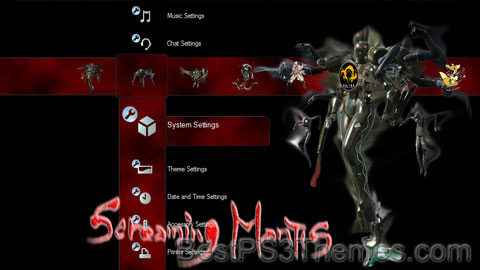
(1 background)
P3T Unpacker v0.12
Copyright (c) 2007. Anoop Menon
This program unpacks Playstation 3 Theme files (.p3t) so that you can touch-up an existing theme to your likings or use a certain wallpaper from it (as many themes have multiple). But remember, if you use content from another theme and release it, be sure to give credit!
Download for Windows: p3textractor.zip
Instructions:
Download p3textractor.zip from above. Extract the files to a folder with a program such as WinZip or WinRAR. Now there are multiple ways to extract the theme.
The first way is to simply open the p3t file with p3textractor.exe. If you don’t know how to do this, right click the p3t file and select Open With. Alternatively, open the p3t file and it will ask you to select a program to open with. Click Browse and find p3textractor.exe from where you previously extracted it to. It will open CMD and extract the theme to extracted.[filename]. After that, all you need to do for any future p3t files is open them and it will extract.
The second way is very simple. Just drag the p3t file to p3textractor.exe. It will open CMD and extract the theme to extracted.[filename].
For the third way, first put the p3t file you want to extract into the same folder as p3textractor.exe. Open CMD and browse to the folder with p3extractor.exe. Enter the following:
p3textractor filename.p3t [destination path]Replace filename with the name of the p3t file, and replace [destination path] with the name of the folder you want the files to be extracted to. A destination path is not required. By default it will extract to extracted.filename.
Metal Gear Solid theme by cypher31
Download: MGS_3_Updated.p3t
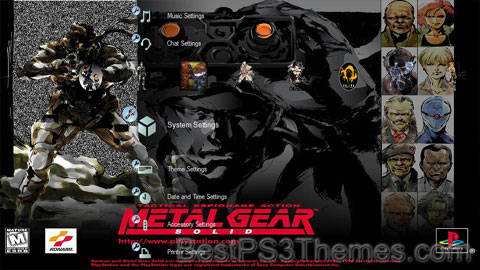
(1 background)
Redirect to:
Bionic Commando theme by PSPMAN07
Download: BionicCommando.p3t
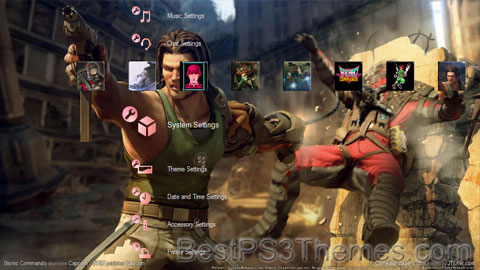
(3 backgrounds)
| Bionic Commando | |
|---|---|
In-game logo (NES) | |
| Genre(s) | Platform |
| Developer(s) | Capcom Nintendo NST |
| Publisher(s) | Capcom Nintendo of America |
| Composer(s) | Harumi Fujita (Arcade) Junko Tamiya (NES)[1] Tim Follin (C64, Amiga, Spectrum, ST) |
| Platform(s) | Arcade, NES, Game Boy, Game Boy Color, Amiga, Atari ST, Commodore 64, Amstrad CPC, MS-DOS, ZX Spectrum, PlayStation Network, Xbox Live Arcade, Nvidia Shield, Windows |
Bionic Commando is a video game franchise consisting of an original arcade video game released in 1987 and several later versions and sequels. The games are platform games in which, with two exceptions, the player cannot jump. A bionic arm is used to cross gaps and climb ledges. The player character, Nathan "Rad" Spencer, uses this as a grappling gun/hook to swing, climb and descend through levels. Seven games have been released, from the original 1987 Bionic Commando to 2011's Bionic Commando Rearmed 2. The series is based in an alternate timeline in which Nazism is not completely eradicated following World War II.
Each of the Bionic Commando titles have core gameplay elements that center on the use of protagonist Nathan "Rad" Spencer's bionic arm. This is used as a grappling gun/hook to swing, climb and descend through levels. It is further used in combat to pull towards or push away enemies. Until 2009's Bionic Commando Spencer could not jump as a gameplay mechanic, however this and the follow-up title Bionic Commando Rearmed 2 gave Spencer a simple jump mechanic that works in conjunction with the bionic arm gameplay.
All games but 2009's Bionic Commando are played from a 2D perspective; the game is played primarily from a side-view perspective as and action platform game. Some sequences are played in a top-down view. With the 2009 iteration the game was given full 3D exploration, with perspective being over the shoulder. Here, in addition to the arc of Spencer's swing, the player can control left-right sway of the swing to adjust for targets. For the Rearmed entries the games are rendered in 3D but gameplay is still restricted to a 2D plane, making these 2.5D platform games.
The Bionic Commando universe is set in a timeline in which Nazism is not completely eradicated following World War II. While fascist undertones were present in the 1987 game, it wasn't until the 1988 game's appearance on the Famicom and NES that these became more apparent. The Empire in the Japanese version was actually a neo-Nazi nation and the Imperial Army's insignia was a Nazi Swastika with a thunderbolt behind it. In the English version, the Nazis are referred as the "Badds", though the backstory in its manual refers to them as the "Nazz".[2]: 4 [3] The Imperial Army's Swastika insignia was changed into a new one resembling an eagle; and the leader of the villains, originally called Weizmann in the Japanese version,[4]: 4 was renamed Killt, although the soldiers and characters keep their same Nazi-like appearance. The difficulty of the game was rebalanced and some of the areas were made less difficult.[5] One of the most prominent differences is the identity of the ultimate antagonist of the game, who is meant to be a revived Adolf Hitler in the Japanese version. For the English version, the character was renamed "Master-D", however his appearance remained the same.[3] There is a gory ending sequence in which Hitler's face explodes, which was also kept intact in the English version.[6] Later games expanded on this alternate timeline and the fallout from the fascist regime toppling. Spencer goes on to confront terrorist groups and dictators.
| 1987 | Bionic Commando (Arcade/Home computer) |
|---|---|
| 1988 | Bionic Commando (Famicom/NES) |
| 1989–1991 | |
| 1992 | Bionic Commando (Game Boy) |
| 1993–1999 | |
| 2000 | Bionic Commando: Elite Forces |
| 2001–2007 | |
| 2008 | Bionic Commando Rearmed |
| 2009 | Bionic Commando (PS3/X360/WIN) |
| 2010 | |
| 2011 | Bionic Commando Rearmed 2 |
The original Japanese arcade game and its Famicom counterpart (Hitler's Resurrection) are called Top Secret (Japanese: トップシークレット,, Hepburn: Toppu Shīkuretto). The original arcade game was advertised in the United States as a sequel to Commando, going as far to refer to the game's main character as Super Joe (the protagonist of Commando) in the promotional brochure,[7] who was originally an unnamed member of a "special commando unit" in the Japanese and World versions.[8][9] In 1988, Capcom produced a home version for the Nintendo Entertainment System, also titled Bionic Commando, that was drastically different from the original arcade game. A version much truer to the coin-op original was released for the Amiga (OCS) in 1988;[10] it was also ported to the other leading micros: the Atari ST, Commodore 64,[11] Amstrad CPC and ZX Spectrum. They were "wire action" games created by Tokuro Fujiwara, based on his earlier 1983 arcade game Roc'n Rope. He originally intended Bionic Commando to be an expanded version of its predecessor Roc'n Rope.[12] The music for the original arcade game was developed by Harumi Fujita, a member of the then all-female Capcom Sound Team. Fellow female video game composer Junko Tamiya adapted two of the original arcade tracks (The "Bionic Commando Theme" and "The Powerplant") and expanded the soundtrack by adding several new songs in the console versions for the Japanese Famicom and the NES ports of the game.[1]
An adaptation of Bionic Commando for the Game Boy was released in 1992. There was also an MSdos/386 version of the game available circa 1991. A sequel, Bionic Commando: Elite Forces, was released in 1999 for the Game Boy Color. Though it borrows some elements from its predecessors, Elite Forces has a different plot from the rest of the series. Also, the characters (an unnamed male or female commando) have a few more moves, such as the ability to climb down from platforms, and can also utilize a sniper rifle in some segments to eliminate distant enemies.
An enhanced remake of the 1988 NES version was developed by Grin and published by Capcom for Microsoft Windows, PlayStation Network, and Xbox Live Arcade and was released on August 13, 2008, under the name, Bionic Commando Rearmed (バイオニック コマンドー マスターD復活計画, Bionic Commando: Master D Resurrection Project in Japan). The remake serves as a prelude to the 2009 video game Bionic Commando. A sequel, Bionic Commando Rearmed 2, was released in February 2011.
In November 2015, Capcom released the 5 Disc Senjo no Okami & Top Secret Original Sound Collection (戦場の狼&トップシークレットオリジナルサウンドコレクション)[13] It included the soundtrack from all in-house developed games from those two series. Manami Matsumae wrote the liner notes.[14]
Protagonist Nathan Spencer has been featured as a playable character in Marvel vs. Capcom 3: Fate of Two Worlds and a follow-up title, Marvel vs. Capcom: Infinite. The Capcom free-to-play card game Teppen featured an event that combined Bionic Commando themes with Cannon Spike. Here Nathan Spencer is available as a card to collect and use.
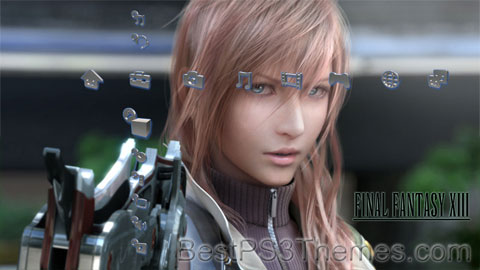
Final Fantasy XIII Lightning theme by Markiss614 (Syxx)
Download: FFXIIILightning.p3t
(1 background)
P3T Unpacker v0.12
Copyright (c) 2007. Anoop Menon
This program unpacks Playstation 3 Theme files (.p3t) so that you can touch-up an existing theme to your likings or use a certain wallpaper from it (as many themes have multiple). But remember, if you use content from another theme and release it, be sure to give credit!
Download for Windows: p3textractor.zip
Instructions:
Download p3textractor.zip from above. Extract the files to a folder with a program such as WinZip or WinRAR. Now there are multiple ways to extract the theme.
The first way is to simply open the p3t file with p3textractor.exe. If you don’t know how to do this, right click the p3t file and select Open With. Alternatively, open the p3t file and it will ask you to select a program to open with. Click Browse and find p3textractor.exe from where you previously extracted it to. It will open CMD and extract the theme to extracted.[filename]. After that, all you need to do for any future p3t files is open them and it will extract.
The second way is very simple. Just drag the p3t file to p3textractor.exe. It will open CMD and extract the theme to extracted.[filename].
For the third way, first put the p3t file you want to extract into the same folder as p3textractor.exe. Open CMD and browse to the folder with p3extractor.exe. Enter the following:
p3textractor filename.p3t [destination path]Replace filename with the name of the p3t file, and replace [destination path] with the name of the folder you want the files to be extracted to. A destination path is not required. By default it will extract to extracted.filename.
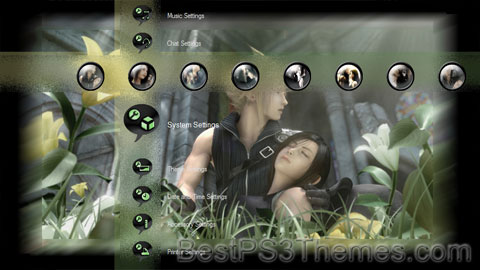
Tifa Cloud Edited theme by zee
Download: TifaCloudEdited.p3t
(2 backgrounds)
P3T Unpacker v0.12
Copyright (c) 2007. Anoop Menon
This program unpacks Playstation 3 Theme files (.p3t) so that you can touch-up an existing theme to your likings or use a certain wallpaper from it (as many themes have multiple). But remember, if you use content from another theme and release it, be sure to give credit!
Download for Windows: p3textractor.zip
Instructions:
Download p3textractor.zip from above. Extract the files to a folder with a program such as WinZip or WinRAR. Now there are multiple ways to extract the theme.
The first way is to simply open the p3t file with p3textractor.exe. If you don’t know how to do this, right click the p3t file and select Open With. Alternatively, open the p3t file and it will ask you to select a program to open with. Click Browse and find p3textractor.exe from where you previously extracted it to. It will open CMD and extract the theme to extracted.[filename]. After that, all you need to do for any future p3t files is open them and it will extract.
The second way is very simple. Just drag the p3t file to p3textractor.exe. It will open CMD and extract the theme to extracted.[filename].
For the third way, first put the p3t file you want to extract into the same folder as p3textractor.exe. Open CMD and browse to the folder with p3extractor.exe. Enter the following:
p3textractor filename.p3t [destination path]Replace filename with the name of the p3t file, and replace [destination path] with the name of the folder you want the files to be extracted to. A destination path is not required. By default it will extract to extracted.filename.
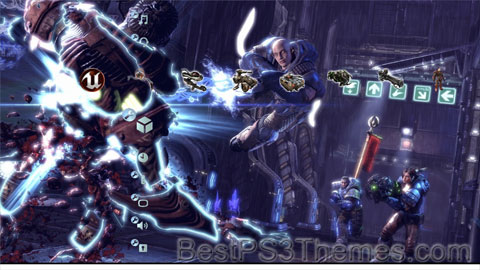
Unreal Tournament 3 theme by Shane LeClair
Download: UnrealTournament3_6.p3t
(5 backgrounds)
| Unreal Tournament 3 | |
|---|---|
| Developer(s) | Epic Games |
| Publisher(s) | Midway Games |
| Producer(s) | Jeffrey Kennedy Morris Michael V. Capps |
| Designer(s) | Steve Polge Jim Brown David Ewing |
| Programmer(s) | Steve Polge |
| Artist(s) | Jerry O'Flaherty Shane Caudle Paul David Jones |
| Writer(s) | Michael V. Capps |
| Composer(s) | Jesper Kyd Rom Di Prisco Kevin Riepl |
| Series | Unreal |
| Engine | Unreal Engine 3 |
| Platform(s) | Microsoft Windows PlayStation 3 Xbox 360 |
| Release | Microsoft WindowsPlayStation 3Xbox 360 |
| Genre(s) | First-person shooter |
| Mode(s) | Single-player, multiplayer |
Unreal Tournament 3 (UT3) is a first-person arena shooter video game developed by Epic Games and published by Midway Games. Part of the Unreal franchise, it is the fourth game in the Unreal Tournament series, and the eighth and final game overall; its name is in reflection of the game being the first in the franchise to use Unreal Engine 3. It was released on November 19, 2007, for Microsoft Windows, December 10 for the PlayStation 3, and on July 3, 2008, for the Xbox 360. OS X and Linux ports were planned, but they were eventually cancelled. A free-to-play version, entitled Unreal Tournament 3 X, was leaked in late 2022 and cancelled in 2023.[4]
Similar to its predecessors, Unreal Tournament 3 is primarily an online multiplayer title. There are eight modes, including Deathmatch, Capture the Flag, as well as modes like Duel, Warfare, Betrayal and Greed. In vehicle maps, the player is equipped with a hover board, which allows players to quickly traverse large maps and grapple onto other teammates' vehicles. The game's single-player campaign does not follow a plot based around the eponymous tournament, but rather a Necris attack that occurs on a colony on an unknown planet, releasing armed Kralls, a warlike race of aliens, on the humans.
The game received positive reviews from critics, and sold more than 1 million copies worldwide.
Similar to the prior entries of the series, the game is primarily an online multiplayer title offering several game modes, including large-scale Warfare, Capture the Flag, and Deathmatch. It also includes an extensive offline multiplayer game with an in-depth story, beginning with a simple tournament ladder and including team members with unique personalities. The following game modes are included:
Modes not returning from the prior Unreal Tournament games include Invasion, Mutant (having been later on partially replaced by the Titan mutator in the UT3 Titan Pack), Onslaught (replaced by Warfare), Bombing Run, Last Man Standing, Domination, and Double Domination. Assault was removed from the game during production.[5]
In this installment of Unreal Tournament, the vehicles are split into two factions, the Axon vehicles and Necris vehicles. The Axon vehicles are the same vehicles from Unreal Tournament 2004, but several have significant game play changes. In addition, on vehicle maps every player is equipped with a personal hover board, a skateboard-like device that allows players to quickly traverse large maps and grapple onto other teammates' vehicles. The hover board is vulnerable to attack, and any hit will knock the player off the board and disable him or her for several seconds, leaving the player exposed and vulnerable. The player cannot use any weapons while on the board.
Unlike the prior Unreal Tournament games, the single-player campaign does not follow a plot based around the Tournament Grand Championship, and therefore several of the teams within Unreal Tournament 3 are not Tournament competitors. The five playable factions are: the Iron Guard, a team of human mercenaries affiliated with the Axon; the Ronin, a band of four survivors of a Skaarj attack on a human colony; Liandri studius, a series of advanced humanoid robots custom-built or retrofitted for combat; the Krall, a warlike race of aliens formerly under the leadership of the Skaarj, returning from their initial appearance in the original Unreal; and the Necris, warriors who have undergone the process of the same name, making them stronger at the expense of replacing their biological processes with "Nanoblack", effectively turning them into undead soldiers (hence the name, Necris). In the Campaign, players control members of the Ronin, and the Necris serve as the chief antagonists.
In the game's story, a Necris attack occurs on the Twin Souls colony of Taryd, an Earth-like planet, releasing bloodthirsty reptilian Krall on the humans. The colony is defenseless, but a group of soldiers called 'Ronin' arrive on the scene, defending the survivors. Reaper, the group's leader, is caught in the explosion of an incoming rocket and passes out, but not before seeing an unknown Necris woman, revealed to be Necris High Inquisitor Akasha, executing a wounded soldier next to him. Reaper is rescued by Othello and Jester and wakes up in the base of the Izanagi, a megacorporation with a large private army, and meets with their leader Malcolm, a celebrated former tournament champion. Malcolm promises Reaper and the rest of Ronin that if they join the Izanagi, they will take the fight to the Necris and avenge the massacre of Twin Souls.
The missions of the campaign are identical to multiplayer matches, with the only difference being the enemies are computer-controlled bots instead of human players. The Izanagi pits Ronin against the Axon in a campaign to seize their vehicle technology, and then begins a campaign against the Liandri to seize their rich Tarydium mines, both of which are required for sustaining a war against the Necris. Shortly after this, the Necris launch a surprise invasion of Taryd, destroying cities and massacring civilians. The Necris are seen deploying tentacle-like tubes carrying Nanoblack into the planet's surface from orbit, in order to terraform the entire world. The Izanagi then mount a counterattack, and Ronin is sent on several missions to push the Necris back. After successfully repelling the Necris assault and ending the invasion, Reaper and the rest of Ronin decide to break ranks and pursue the Necris to their homeworld, Omicron-6, in an effort to kill Akasha for good.
Finally cornering Akasha in her last sanctuary on Omicron-6, Reaper defeats her in a duel and kills her with his rocket launcher. However, it is revealed that Malcolm has betrayed Ronin, allowing Necris troops to surround and kill Jester, Bishop, and Othello. Reaper swears revenge on Malcolm before powering up his rocket launcher and leaping to attack the Necris.
The game was announced in May 2005, as Unreal Tournament 2007 for a 2006 release,[6] but the game was delayed until the first half of 2007.[7] The game was renamed to Unreal Tournament 3.[8] The original Unreal Tournament uses the first Unreal Engine, while UT2003 and UT2004 use Unreal Engine 2. Since 2004 incorporates all of the content from 2003, they are regarded as part of the same generation. UT3 is the third generation, as it runs on Unreal Engine 3 and does not reuse any content.[9] The game also uses motion blur effects.
A limited collector's edition of the game features an exclusive collector's edition tin and a hardcover art book. A bonus DVD is also included, featuring more than twenty hours of Unreal Engine 3 tool kit video tutorials, the history of the Unreal Tournament series, and behind-the-scenes footage of the making of Unreal Tournament 3. The Limited Collector's Edition was sold in the United States, Canada, Latin America, Europe, South Africa, Australia and most other territories.[10]
The PlayStation 3 version supports community-made mods that can be uploaded and downloaded to the PS3's HDD or external media, as well as mouse and keyboard inputs. The 1.1 patch was released in March 2008. It adds the ability for players using the North American and European versions to play together, fixes problems with some USB headsets, and displays the lowest pinging servers at the top of the server list. Some updates are only applied on the North American version, since the PAL version released in March 2008 was already partially updated.[11] The 2.0 patch was released on March 5, 2009, and adds better PC mod support, split screen, smarter AI, forty-eight obtainable Trophies, server-side improvements, an improved map vote, local multiplayer, and a new user interface. Online and LAN multiplayer for this version was terminated in July 2014, following the shutdown of all GameSpy servers.
Upon release, the Xbox 360 version had five exclusive maps, two exclusive characters, a two-player split screen mode,[12] and all the downloadable content released by Epic already on the disc. With the release of the PS3 and PC "Titan Upgrade" patch on March 5, these versions offered the formerly exclusive Xbox 360 content, as well as other content.[13] The Xbox 360 version does not support user-generated mods, as additional content has to be verified by Microsoft before being released. It is the only version to support controllers only.
The Linux and Mac OS X versions of the game were planned to be released as downloadable installers that work with the retail disc. Ryan C. Gordon has uploaded screenshots of the game, dating from September 2008, running on both platforms.[14][15] In May 2009, Ryan stated that the UT3 port for Linux was still in process,[16] but later in December 2010, Steve Polge revealed that the Linux port would never be released, making it the second Unreal Tournament game not to be released on Linux.[17]
Unreal Tournament 3: The Soundtrack is primarily based on the original Unreal Tournament score, which was composed by Straylight Productions and Michiel van den Bos.[18][19] Jesper Kyd and Rom Di Prisco remixed many of UT99's tracks and composed several other original tracks, which were released on November 20, 2007, by Sumthing Else. Sandhya Sanjana was featured as a guest vocalist. Kevin Riepl did also contribute in music production for the game, scoring the cutscenes as well as a few in-game music tracks.[20]
A free update titled Titan Pack was released for the PC in March 2009; the PS3 version of the pack was released on March 19. The pack includes five maps and two characters that were formerly exclusive to the Xbox 360 version, along with eleven brand-new maps, two new game modes ("Greed" and "Betrayal"), and the Titan Mutator. The Titan Mutator causes a player to grow in size as they do better, while carrying alternative weapons and power-ups. The expansion also includes a new power-up, a new vehicle, two new deployables, and the addition of stinger turrets. A new patch was also released in conjunction with the Titan Pack, which allowed for various AI improvements (especially in vehicle modes), networking performance upgrades and added support for Steam Achievements (PC) and Trophies (PS3). It also adds a two-player split screen mode (formerly exclusive to the 360 version) and mod browsing for the PS3 version.
The Black Edition is a complete Unreal Tournament 3 package—included is the complete UT3 (with patch 2.0) as well as the Titan Pack.
The game's online servers for the Windows version were shutdown on in January 2023, in order to focus on supporting the Epic Online Services. In December 2022, a free-to-play version, entitled Unreal Tournament 3 X, was leaked on Steam, meaning that the game would be using the Epic Online Services and full cross-play between Steam, GOG.com, and the Epic Games Store, with the latter platform being added when it released. Epic Games was to self-publish this version, and was slated for a 2023 release, but the development of this version was cancelled and the Steam page was reverted to its original name without any announcement.
This section needs expansion. You can help by adding to it. (March 2016) |
| Aggregator | Score |
|---|---|
| GameRankings | PC: 83%[21] PS3: 86%[22] X360: 83%[23] |
| Metacritic | PC: 83/100[24] PS3: 86/100[25] X360: 82/100[26] |
| Publication | Score |
|---|---|
| Computer and Video Games | 8.9/10[27] |
| Edge | 8/10[28] |
| Eurogamer | PC: 8/10[29] PS3: 9/10[30] |
| GameSpot | PC: 8.5/10[31] PS3: 8.5/10[32] X360: 8/10[33] |
| GamesRadar+ | |
| GameZone | X360: 8.5/10[35] |
| Giant Bomb | X360: |
| IGN | PC: 9/10[37] PS3: 9/10[38] X360: 8.5/10[39] |
| The Guardian | X360: |
| PC Advisor | |
| PC Pro | |
| Thunderbolt | PC: 6/10[43] |
Unreal Tournament 3 received positive reviews from critics. Xbox Magazine rated it 8.5 out of 10.[44] PlayStation: the Official Magazine gave it 5 stars out of 5 in its February 2008 issue, commending the game for graphics and gameplay. By March 2008, UT3 had sold over a million copies worldwide.[45][46]