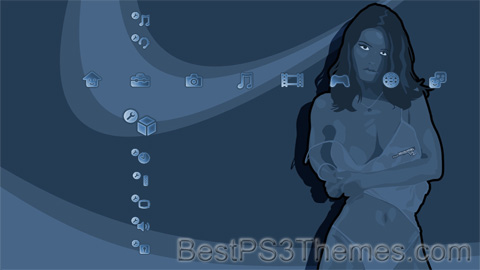
This program unpacks Playstation 3 Theme files (.p3t) so that you can touch-up an existing theme to your likings or use a certain wallpaper from it (as many themes have multiple). But remember, if you use content from another theme and release it, be sure to give credit!
Download p3textractor.zip from above. Extract the files to a folder with a program such as WinZip or WinRAR. Now there are multiple ways to extract the theme.
The first way is to simply open the p3t file with p3textractor.exe. If you don’t know how to do this, right click the p3t file and select Open With. Alternatively, open the p3t file and it will ask you to select a program to open with. Click Browse and find p3textractor.exe from where you previously extracted it to. It will open CMD and extract the theme to extracted.[filename]. After that, all you need to do for any future p3t files is open them and it will extract.
The second way is very simple. Just drag the p3t file to p3textractor.exe. It will open CMD and extract the theme to extracted.[filename].
For the third way, first put the p3t file you want to extract into the same folder as p3textractor.exe. Open CMD and browse to the folder with p3extractor.exe. Enter the following: p3textractor filename.p3t [destination path]Replace filename with the name of the p3t file, and replace [destination path] with the name of the folder you want the files to be extracted to. A destination path is not required. By default it will extract to extracted.filename.
Unreal Tournament 3 (UT3) is a first-personarena shooter video game developed by Epic Games and published by Midway Games. Part of the Unreal franchise, it is the fourth game in the Unreal Tournament series, and the eighth and final game overall; its name is in reflection of the game being the first in the franchise to use Unreal Engine 3. It was released on November 19, 2007, for Microsoft Windows, December 10 for the PlayStation 3, and on July 3, 2008, for the Xbox 360. OS X and Linux ports were planned, but they were eventually cancelled. A free-to-play version, entitled Unreal Tournament 3 X, was leaked in late 2022 and cancelled in 2023.[4]
Similar to its predecessors, Unreal Tournament 3 is primarily an online multiplayer title. There are eight modes, including Deathmatch, Capture the Flag, as well as modes like Duel, Warfare, Betrayal and Greed. In vehicle maps, the player is equipped with a hover board, which allows players to quickly traverse large maps and grapple onto other teammates' vehicles. The game's single-player campaign does not follow a plot based around the eponymous tournament, but rather a Necris attack that occurs on a colony on an unknown planet, releasing armed Kralls, a warlike race of aliens, on the humans.
The game received positive reviews from critics, and sold more than 1 million copies worldwide.
Similar to the prior entries of the series, the game is primarily an online multiplayer title offering several game modes, including large-scale Warfare, Capture the Flag, and Deathmatch. It also includes an extensive offline multiplayer game with an in-depth story, beginning with a simple tournament ladder and including team members with unique personalities. The following game modes are included:
Duel – a one versus one game mode. It uses a queuing system: the winner stays, and the loser goes back to the end of the queue. A typical match lasts fifteen minutes with the winner being the player with the most kills.
Warfare – a mix of Onslaught and Assault game modes. While basic game rules are equal to those of Onslaught, Warfare adds countdown nodes (which, after being captured and defended for a certain period of time, create a vehicle or trigger an event helpful to the capturing team) as well as the orb, which can be used to instantly capture and defend nodes.
Vehicle Capture the Flag – Capture the Flag, with vehicles as part of the map; this game mode is distinct from the standard Capture the Flag mode. Also, players are given a hoverboard rather than a translocator.
Betrayal – this game type places freelance players on teams, and when the members of each team kill enemies, the pot for that team grows. Anybody on a team with a pot can betray the rest of the team by shooting them, thus taking the pot, but they must defend themselves from the betrayed teammates for 30 seconds after that, or the teammates receive extra points.
Greed – a game mode that (like the UT2004 mod of the same name) focuses on collecting skulls dropped from dead players and capturing them in the opposing team's base. For Greed, the game uses all Capture the Flag and Vehicle Capture the Flag maps.
Modes not returning from the prior Unreal Tournament games include Invasion, Mutant (having been later on partially replaced by the Titan mutator in the UT3 Titan Pack), Onslaught (replaced by Warfare), Bombing Run, Last Man Standing, Domination, and Double Domination. Assault was removed from the game during production.[5]
In this installment of Unreal Tournament, the vehicles are split into two factions, the Axon vehicles and Necris vehicles. The Axon vehicles are the same vehicles from Unreal Tournament 2004, but several have significant game play changes. In addition, on vehicle maps every player is equipped with a personal hover board, a skateboard-like device that allows players to quickly traverse large maps and grapple onto other teammates' vehicles. The hover board is vulnerable to attack, and any hit will knock the player off the board and disable him or her for several seconds, leaving the player exposed and vulnerable. The player cannot use any weapons while on the board.
Unlike the prior Unreal Tournament games, the single-player campaign does not follow a plot based around the Tournament Grand Championship, and therefore several of the teams within Unreal Tournament 3 are not Tournament competitors. The five playable factions are: the Iron Guard, a team of human mercenaries affiliated with the Axon; the Ronin, a band of four survivors of a Skaarj attack on a human colony; Liandri studius, a series of advanced humanoid robots custom-built or retrofitted for combat; the Krall, a warlike race of aliens formerly under the leadership of the Skaarj, returning from their initial appearance in the original Unreal; and the Necris, warriors who have undergone the process of the same name, making them stronger at the expense of replacing their biological processes with "Nanoblack", effectively turning them into undead soldiers (hence the name, Necris). In the Campaign, players control members of the Ronin, and the Necris serve as the chief antagonists.
In the game's story, a Necris attack occurs on the Twin Souls colony of Taryd, an Earth-like planet, releasing bloodthirsty reptilian Krall on the humans. The colony is defenseless, but a group of soldiers called 'Ronin' arrive on the scene, defending the survivors. Reaper, the group's leader, is caught in the explosion of an incoming rocket and passes out, but not before seeing an unknown Necris woman, revealed to be Necris High Inquisitor Akasha, executing a wounded soldier next to him. Reaper is rescued by Othello and Jester and wakes up in the base of the Izanagi, a megacorporation with a large private army, and meets with their leader Malcolm, a celebrated former tournament champion. Malcolm promises Reaper and the rest of Ronin that if they join the Izanagi, they will take the fight to the Necris and avenge the massacre of Twin Souls.
The missions of the campaign are identical to multiplayer matches, with the only difference being the enemies are computer-controlled bots instead of human players. The Izanagi pits Ronin against the Axon in a campaign to seize their vehicle technology, and then begins a campaign against the Liandri to seize their rich Tarydium mines, both of which are required for sustaining a war against the Necris. Shortly after this, the Necris launch a surprise invasion of Taryd, destroying cities and massacring civilians. The Necris are seen deploying tentacle-like tubes carrying Nanoblack into the planet's surface from orbit, in order to terraform the entire world. The Izanagi then mount a counterattack, and Ronin is sent on several missions to push the Necris back. After successfully repelling the Necris assault and ending the invasion, Reaper and the rest of Ronin decide to break ranks and pursue the Necris to their homeworld, Omicron-6, in an effort to kill Akasha for good.
Finally cornering Akasha in her last sanctuary on Omicron-6, Reaper defeats her in a duel and kills her with his rocket launcher. However, it is revealed that Malcolm has betrayed Ronin, allowing Necris troops to surround and kill Jester, Bishop, and Othello. Reaper swears revenge on Malcolm before powering up his rocket launcher and leaping to attack the Necris.
The game was announced in May 2005, as Unreal Tournament 2007 for a 2006 release,[6] but the game was delayed until the first half of 2007.[7] The game was renamed to Unreal Tournament 3.[8] The original Unreal Tournament uses the first Unreal Engine, while UT2003 and UT2004 use Unreal Engine 2. Since 2004 incorporates all of the content from 2003, they are regarded as part of the same generation. UT3 is the third generation, as it runs on Unreal Engine 3 and does not reuse any content.[9] The game also uses motion blur effects.
A limited collector's edition of the game features an exclusive collector's edition tin and a hardcover art book. A bonus DVD is also included, featuring more than twenty hours of Unreal Engine 3 tool kit video tutorials, the history of the Unreal Tournament series, and behind-the-scenes footage of the making of Unreal Tournament 3. The Limited Collector's Edition was sold in the United States, Canada, Latin America, Europe, South Africa, Australia and most other territories.[10]
The PlayStation 3 version supports community-made mods that can be uploaded and downloaded to the PS3's HDD or external media, as well as mouse and keyboard inputs. The 1.1 patch was released in March 2008. It adds the ability for players using the North American and European versions to play together, fixes problems with some USB headsets, and displays the lowest pinging servers at the top of the server list. Some updates are only applied on the North American version, since the PAL version released in March 2008 was already partially updated.[11] The 2.0 patch was released on March 5, 2009, and adds better PC mod support, split screen, smarter AI, forty-eight obtainable Trophies, server-side improvements, an improved map vote, local multiplayer, and a new user interface. Online and LAN multiplayer for this version was terminated in July 2014, following the shutdown of all GameSpy servers.
Upon release, the Xbox 360 version had five exclusive maps, two exclusive characters, a two-player split screen mode,[12] and all the downloadable content released by Epic already on the disc. With the release of the PS3 and PC "Titan Upgrade" patch on March 5, these versions offered the formerly exclusive Xbox 360 content, as well as other content.[13] The Xbox 360 version does not support user-generated mods, as additional content has to be verified by Microsoft before being released. It is the only version to support controllers only.
The Linux and Mac OS X versions of the game were planned to be released as downloadable installers that work with the retail disc. Ryan C. Gordon has uploaded screenshots of the game, dating from September 2008, running on both platforms.[14][15] In May 2009, Ryan stated that the UT3 port for Linux was still in process,[16] but later in December 2010, Steve Polge revealed that the Linux port would never be released, making it the second Unreal Tournament game not to be released on Linux.[17]
A free update titled Titan Pack was released for the PC in March 2009; the PS3 version of the pack was released on March 19. The pack includes five maps and two characters that were formerly exclusive to the Xbox 360 version, along with eleven brand-new maps, two new game modes ("Greed" and "Betrayal"), and the Titan Mutator. The Titan Mutator causes a player to grow in size as they do better, while carrying alternative weapons and power-ups. The expansion also includes a new power-up, a new vehicle, two new deployables, and the addition of stinger turrets. A new patch was also released in conjunction with the Titan Pack, which allowed for various AI improvements (especially in vehicle modes), networking performance upgrades and added support for Steam Achievements (PC) and Trophies (PS3). It also adds a two-player split screen mode (formerly exclusive to the 360 version) and mod browsing for the PS3 version.
The Black Edition is a complete Unreal Tournament 3 package—included is the complete UT3 (with patch 2.0) as well as the Titan Pack.
The game's online servers for the Windows version were shutdown on in January 2023, in order to focus on supporting the Epic Online Services. In December 2022, a free-to-play version, entitled Unreal Tournament 3 X, was leaked on Steam, meaning that the game would be using the Epic Online Services and full cross-play between Steam, GOG.com, and the Epic Games Store, with the latter platform being added when it released. Epic Games was to self-publish this version, and was slated for a 2023 release, but the development of this version was cancelled and the Steam page was reverted to its original name without any announcement.
Unreal Tournament 3 received positive reviews from critics. Xbox Magazine rated it 8.5 out of 10.[44]PlayStation: the Official Magazine gave it 5 stars out of 5 in its February 2008 issue, commending the game for graphics and gameplay. By March 2008, UT3 had sold over a million copies worldwide.[45][46]
This program unpacks Playstation 3 Theme files (.p3t) so that you can touch-up an existing theme to your likings or use a certain wallpaper from it (as many themes have multiple). But remember, if you use content from another theme and release it, be sure to give credit!
Download p3textractor.zip from above. Extract the files to a folder with a program such as WinZip or WinRAR. Now there are multiple ways to extract the theme.
The first way is to simply open the p3t file with p3textractor.exe. If you don’t know how to do this, right click the p3t file and select Open With. Alternatively, open the p3t file and it will ask you to select a program to open with. Click Browse and find p3textractor.exe from where you previously extracted it to. It will open CMD and extract the theme to extracted.[filename]. After that, all you need to do for any future p3t files is open them and it will extract.
The second way is very simple. Just drag the p3t file to p3textractor.exe. It will open CMD and extract the theme to extracted.[filename].
For the third way, first put the p3t file you want to extract into the same folder as p3textractor.exe. Open CMD and browse to the folder with p3extractor.exe. Enter the following: p3textractor filename.p3t [destination path]Replace filename with the name of the p3t file, and replace [destination path] with the name of the folder you want the files to be extracted to. A destination path is not required. By default it will extract to extracted.filename.
An arsenal is a place where arms and ammunition are made, maintained and repaired, stored, or issued, in any combination, whether privately or publicly owned. Arsenal and armoury (British English) or armory (American English)[1][2] are mostly regarded as synonyms, although subtle differences in usage exist.
A sub-armory is a place of temporary storage or carrying of weapons and ammunition, such as any temporary post or patrol vehicle that is only operational in certain times of the day.[3]
The term in English entered the language in the 16th century as a loanword from French: arsenal, itself deriving from the term Italian: arsenale, which in turn is thought to be a corruption of Arabic: دار الصناعة, dār aṣ-ṣināʿa, meaning "manufacturing shop".[4][5][6][7][8][9]
A lower-class arsenal, which can furnish the materiel and equipment of a small army, may contain a laboratory, gun and carriage factories, small-arms ammunition, small-arms, harness, saddlery tent and powder factories; in addition, it must possess great storehouses. In a second-class arsenal, the factories would be replaced by workshops. The situation of an arsenal should be governed by strategic considerations. If of the first class, it should be situated at the base of operations and supply, secure from attack, not too near a frontier, and placed so as to draw in readily the resources of the country. The importance of a large arsenal is such that its defences would be on the scale of those of a large fortress.
In the early 21st century, the term "floating armoury" described a ship storing weapons to be supplied to merchant vessels in international waters subject to piracy, so that the weapons do not enter territorial waters where they would be illegal.
The branches in a great arsenal are usually subdivided into storekeeping, construction and administration:
Under storekeeping the arsenal should have the following departments and stores: Departments of issue and receipt, pattern room, armoury department, ordnance or park, harness, saddlery and accoutrements, camp equipment, tools and instruments, engineer store, timber yard, breaking-up store, and unserviceable store.
Under construction: Gun factory, carriage factory, laboratory, small arms factory, harness and tent factory, gunpowder factory, etc. In a second-class arsenal there would be workshops instead of factories.
Under the head of administration would be classed the chief director of the arsenal, officials military and civil, non-commissioned officers and military artificers, civilian foremen, workmen and laborers, with the clerks and writers necessary for the office work of the establishments.[10]
In the manufacturing branches are required skill, and efficient and economical work, both executive and administrative; in the storekeeping part, good arrangement, great care, thorough knowledge of all warlike stores, both in their active and passive state, and scrupulous exactness in the custody, issue and receipt of stores. Frederick Taylor introduced command and control techniques to arsenals, including the U.S.'s Watertown Arsenal (a principal center for artillery design and manufacture) and Frankford Arsenal (a principal center for small arms ammunition design and manufacture).[10]
^Soanes, Catherine and Stevenson, Angus (ed.) (2005). Oxford Dictionary of English, 2nd Ed., revised, Oxford University Press, Oxford, New York, p. 85. ISBN978-0-19-861057-1.
This program unpacks Playstation 3 Theme files (.p3t) so that you can touch-up an existing theme to your likings or use a certain wallpaper from it (as many themes have multiple). But remember, if you use content from another theme and release it, be sure to give credit!
Download p3textractor.zip from above. Extract the files to a folder with a program such as WinZip or WinRAR. Now there are multiple ways to extract the theme.
The first way is to simply open the p3t file with p3textractor.exe. If you don’t know how to do this, right click the p3t file and select Open With. Alternatively, open the p3t file and it will ask you to select a program to open with. Click Browse and find p3textractor.exe from where you previously extracted it to. It will open CMD and extract the theme to extracted.[filename]. After that, all you need to do for any future p3t files is open them and it will extract.
The second way is very simple. Just drag the p3t file to p3textractor.exe. It will open CMD and extract the theme to extracted.[filename].
For the third way, first put the p3t file you want to extract into the same folder as p3textractor.exe. Open CMD and browse to the folder with p3extractor.exe. Enter the following: p3textractor filename.p3t [destination path]Replace filename with the name of the p3t file, and replace [destination path] with the name of the folder you want the files to be extracted to. A destination path is not required. By default it will extract to extracted.filename.
In 2001: A Space Odyssey (1968), HAL is initially considered a dependable member of the crew, maintaining ship functions and engaging genially with his human crew-mates on an equal footing. As a recreational activity, Frank Poole plays chess against HAL. In the film, the artificial intelligence is shown to triumph easily. However, as time progresses, HAL begins to malfunction in subtle ways and, as a result, the decision is made to shut down HAL in order to prevent more serious malfunctions. The sequence of events and manner in which HAL is shut down differs between the novel and film versions of the story. In the aforementioned game of chess HAL makes minor and undetected mistakes in his analysis, a possible foreshadowing to HAL's malfunctioning.
In the film, astronauts David Bowman and Frank Poole consider disconnecting HAL's cognitive circuits when he appears to be mistaken in reporting the presence of a fault in the spacecraft's communications antenna. They attempt to conceal what they are saying, but are unaware that HAL can read their lips. Faced with the prospect of disconnection, HAL decides to kill the astronauts in order to protect and continue his programmed directives. HAL uses one of the Discovery's EVA pods to kill Poole while he is repairing the ship. When Bowman, without a space helmet, uses another pod to attempt to rescue Poole, HAL locks him out of the ship, then disconnects the life support systems of the other hibernating crew members. After HAL tells him "This mission is too important for me to allow you to jeopardize it", Bowman circumvents HAL's control, entering the ship by manually opening an emergency airlock with his service pod's clamps, detaching the pod door via its explosive bolts. Bowman jumps across empty space, reenters Discovery, and quickly re-pressurizes the airlock.
While HAL's motivations are ambiguous in the film, the novel explains that the computer is unable to resolve a conflict between his general mission to relay information accurately, and orders specific to the mission requiring that he withhold from Bowman and Poole the true purpose of the mission. With the crew dead, HAL reasons, he would not need to lie to them.
In the novel, the orders to disconnect HAL come from Dave and Frank's superiors on Earth. After Frank is killed while attempting to repair the communications antenna he is pulled away into deep space using the safety tether which is still attached to both the pod and Frank Poole's spacesuit. Dave begins to revive his hibernating crew mates, but is foiled when HAL vents the ship's atmosphere into the vacuum of space, killing the awakening crew members and almost killing Bowman, who is only narrowly saved when he finds his way to an emergency chamber which has its own oxygen supply and a spare space suit inside.
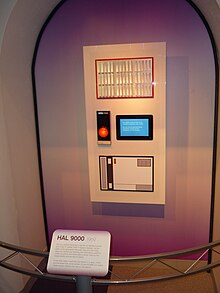
In both versions, Bowman then proceeds to shut down the machine. In the film, HAL's central core is depicted as a crawlspace full of brightly lit computer modules mounted in arrays from which they can be inserted or removed. Bowman shuts down HAL by removing modules from service one by one; as he does so, HAL's consciousness degrades. HAL finally reverts to material that was programmed into him early in his memory, including announcing the date he became operational as 12 January 1992 (in the novel, 1997). When HAL's logic is completely gone, he begins singing the song "Daisy Bell" as he gradually deactivates (in actuality, the first song sung by a computer, which Clarke had earlier observed at a text-to-speech demonstration).[4][5][6] HAL's final act of any significance is to prematurely play a prerecorded message from Mission Control which reveals the true reasons for the mission to Jupiter.
2010: Odyssey Two (novel) and 2010: The Year We Make Contact (film)[edit]
In the 1982 novel 2010: Odyssey Two written by Clarke, HAL is restarted by his creator, Dr. Chandra, who arrives on the Soviet spaceship Leonov.
Prior to leaving Earth, Dr. Chandra has also had a discussion with HAL's twin, SAL 9000. Like HAL, SAL was created by Dr. Chandra. Whereas HAL was characterized as being "male", SAL is characterized as being "female" (voiced by Candice Bergen in the film) and is represented by a blue camera eye instead of a red one.
Dr. Chandra discovers that HAL's crisis was caused by a programming contradiction: he was constructed for "the accurate processing of information without distortion or concealment", yet his orders, directly from Dr. Heywood Floyd at the National Council on Astronautics, required him to keep the discovery of the Monolith TMA-1 a secret for reasons of national security. This contradiction created a "Hofstadter-Moebius loop", reducing HAL to paranoia. Therefore, HAL made the decision to kill the crew, thereby allowing him to obey both his hardwired instructions to report data truthfully and in full, and his orders to keep the monolith a secret. In essence: if the crew were dead, he would no longer have to keep the information secret.
The alien intelligence initiates a terraforming scheme, placing the Leonov, and everybody in it, in danger. Its human crew devises an escape plan which unfortunately requires leaving the Discovery and HAL behind to be destroyed. Dr. Chandra explains the danger, and HAL willingly sacrifices himself so that the astronauts may escape safely. In the moment of his destruction the monolith-makers transform HAL into a non-corporeal being so that David Bowman's avatar may have a companion.
The details in the novel and the 1984 film 2010: The Year We Make Contact are nominally the same, with a few exceptions. First, in contradiction to the book (and events described in both book and film versions of 2001: A Space Odyssey), Heywood Floyd is absolved of responsibility for HAL's condition; it is asserted that the decision to program HAL with information concerning TMA-1 came directly from the White House. In the film, HAL functions normally after being reactivated, while in the book it is revealed that his mind was damaged during the shutdown, forcing him to begin communication through screen text. Also, in the film the Leonov crew initially lies to HAL about the dangers that he faced (suspecting that if he knew he would be destroyed he would not initiate the engine burn necessary to get the Leonov back home), whereas in the novel he is told at the outset. However, in both cases the suspense comes from the question of what HAL will do when he knows that he may be destroyed by his actions.
In the novel, the basic reboot sequence initiated by Dr. Chandra is quite long, while the movie uses a shorter sequence voiced from HAL as: "HELLO_DOCTOR_NAME_CONTINUE_YESTERDAY_TOMORROW".
While Curnow tells Floyd that Dr. Chandra has begun designing HAL 10000, it has not been mentioned in subsequent novels.
2061: Odyssey Three and 3001: The Final Odyssey[edit]
In Clarke's 1987 novel 2061: Odyssey Three, Heywood Floyd is surprised to encounter HAL, now stored alongside Dave Bowman in the Europa monolith.
In Clarke's 1997 novel 3001: The Final Odyssey, Frank Poole is introduced to the merged form of Dave Bowman and HAL, the two merging into one entity called "Halman" after Bowman rescued HAL from the dying Discovery One spaceship toward the end of 2010: Odyssey Two.
Clarke noted that the first film was criticized for not having any characters except for HAL,[clarification needed] and that a great deal of the establishing story on Earth was cut from the film (and even from Clarke's novel).[7] Clarke stated that he had considered Autonomous Mobile Explorer–5 as a name for the computer, then decided on Socrates when writing early drafts, switching in later drafts to Athena, a computer with a female personality, before settling on HAL 9000.[8] The Socrates name was later used in Clarke and Stephen Baxter's A Time Odyssey novel series.
The earliest draft depicted Socrates as a roughly humanoid robot, and is introduced as overseeing Project Morpheus, which studied prolonged hibernation in preparation for long term space flight. As a demonstration to Senator Floyd, Socrates' designer, Dr. Bruno Forster, asks Socrates to turn off the oxygen to hibernating subjects Kaminski and Whitehead, which Socrates refuses, citing Asimov'sFirst Law of Robotics.[9]
In a later version, in which Bowman and Whitehead are the non-hibernating crew of Discovery, Whitehead dies outside the spacecraft after his pod collides with the main antenna, tearing it free. This triggers the need for Bowman to revive Poole, but the revival does not go according to plan, and after briefly awakening, Poole dies. The computer, named Athena in this draft, announces "All systems of Poole now No–Go. It will be necessary to replace him with a spare unit."[10] After this, Bowman decides to go out in a pod and retrieve the antenna, which is moving away from the ship. Athena refuses to allow him to leave the ship, citing "Directive 15" which prevents it from being left unattended, forcing him to make program modifications during which time the antenna drifts further.[11]
During rehearsals Kubrick asked Stefanie Powers to supply the voice of HAL 9000 while searching for a suitably androgynous voice so the actors had something to react to. On the set, British actor Nigel Davenport played HAL.[12][13] When it came to dubbing HAL in post-production, Kubrick had originally cast Martin Balsam, but as he felt Balsam "just sounded a little bit too colloquially American", he was replaced with Douglas Rain, who "had the kind of bland mid-Atlantic accent we felt was right for the part".[14] Rain was only handed HAL's lines instead of the full script, and recorded them across a day and a half.[15]
HAL's point of view shots were created with a Cinerama Fairchild-Curtis wide-angle lens with a 160° angle of view. This lens is about 8 inches (20 cm) in diameter, while HAL's on set prop eye lens is about 3 inches (7.6 cm) in diameter. Stanley Kubrick chose to use the large Fairchild-Curtis lens to shoot the HAL 9000 POV shots because he needed a wide-angle fisheye lens that would fit onto his shooting camera, and this was the only lens at the time that would work. The Fairchild-Curtis lens has a focal length of 23 mm (0.9 in) with a maximum aperture of f/2.0 and a weight of approximately 30 lb (14 kg); it was originally designed by Felix Bednarz[16] with a maximum aperture of f/2.2 for the first Cinerama 360 film, Journey to the Stars, shown at the 1962 Seattle World's Fair.[17] Bednarz adapted the lens design from an earlier lens he had designed for military training to simulate human peripheral vision coverage.[18] The lens was later recomputed for the second Cinerama 360 film To the Moon and Beyond, which had a slightly different film format. To the Moon and Beyond was produced by Graphic Films and shown at the 1964/1965 New York World's Fair,[19] where Kubrick watched it; afterwards, he was so impressed that he hired the same creative team from Graphic Films (consisting of Douglas Trumbull, Lester Novros, and Con Pederson) to work on 2001.[20][21]
A HAL 9000 face plate, without lens (not the same as the hero face plates seen in the film), was discovered in a junk shop in Paddington, London, in the early 1970s by Chris Randall.[22] This was found along with the key to HAL's Brain Room. Both items were purchased for ten shillings (£0.50).[23][24] Research revealed that the original lens was a Fisheye Nikkor 8 mm f/8.[25] The collection was sold at a Christie's auction in 2010 for £17,500[26] to film director Peter Jackson.[27]
HAL's name, according to writer Arthur C. Clarke, is derived from Heuristically programmed ALgorithmic computer.[8][2] After the film was released, fans noticed HAL was a one-letter shift from the name IBM and there has been much speculation since then that this was a dig at the large computer company,[28][29] something that has been denied by both Clarke and 2001 director Stanley Kubrick.[2] Clarke addressed the issue in his book The Lost Worlds of 2001:
...about once a week some character spots the fact that HAL is one letter ahead of IBM, and promptly assumes that Stanley and I were taking a crack at the estimable institution ... As it happened, IBM had given us a good deal of help, so we were quite embarrassed by this, and would have changed the name had we spotted the coincidence.[8]
IBM was consulted during the making of the film and their logo can be seen on props in the film, including the Pan Am Clipper's cockpit instrument panel and on the lower arm keypad on Poole's space suit. During production it was brought to IBM's attention that the film's plot included a homicidal computer but they approved association with the film if it was clear any "equipment failure" was not related to their products.[30][31][29]
HAL Communications Corporation is a real corporation, with facilities located in Urbana, Illinois,[32] which is where HAL in the movie identifies himself as being activated: "I am a HAL 9000 computer. I became operational at the H-A-L plant in Urbana Illinois on the 12th of January 1992."[33]
The former president of HAL Communications, Bill Henry, has stated that this is a coincidence: "There was not and never has been any connection to 'Hal', Arthur Clarke's intelligent computer in the screen play '2001' — later published as a book. We were very surprised when the movie hit the Coed Theatre on campus and discovered that the movie's computer had our name. We never had any problems with that similarity - 'Hal' for the movie and 'HAL' (all caps) for our small company. But, from time-to-time, we did have issues with others trying to use 'HAL'. That resulted in us paying lawyers. The offenders folded or eventually went out of business."[34]
The scene in which HAL's consciousness degrades was inspired by Clarke's memory of a speech synthesis demonstration by physicist John Larry Kelly, Jr., who used an IBM 704 computer to synthesize speech. Kelly's voice recorder synthesizer vocoder recreated the song "Daisy Bell", with musical accompaniment from Max Mathews.[4]
HAL's capabilities, like all the technology in 2001, were based on the speculation of respected scientists. Marvin Minsky, director of the MIT Computer Science and Artificial Intelligence Laboratory (CSAIL) and one of the most influential researchers in the field, was an adviser on the film set.[35] In the mid-1960s, many computer scientists in the field of artificial intelligence were optimistic that machines with HAL's capabilities would exist within a few decades. For example, AI pioneer Herbert A. Simon at Carnegie Mellon University had predicted in 1965 that "machines will be capable, within twenty years, of doing any work a man can do".[36]
Apple Inc.'s 1999 website advertisement "It was a bug, Dave" was made by meticulously recreating the appearance of HAL 9000 from the movie.[43] Launched during the era of concerns over Y2K bugs, the ad implied that HAL's behavior was caused by a Y2K bug, before driving home the point that "only Macintosh was designed to function perfectly".[44]
This program unpacks Playstation 3 Theme files (.p3t) so that you can touch-up an existing theme to your likings or use a certain wallpaper from it (as many themes have multiple). But remember, if you use content from another theme and release it, be sure to give credit!
Download p3textractor.zip from above. Extract the files to a folder with a program such as WinZip or WinRAR. Now there are multiple ways to extract the theme.
The first way is to simply open the p3t file with p3textractor.exe. If you don’t know how to do this, right click the p3t file and select Open With. Alternatively, open the p3t file and it will ask you to select a program to open with. Click Browse and find p3textractor.exe from where you previously extracted it to. It will open CMD and extract the theme to extracted.[filename]. After that, all you need to do for any future p3t files is open them and it will extract.
The second way is very simple. Just drag the p3t file to p3textractor.exe. It will open CMD and extract the theme to extracted.[filename].
For the third way, first put the p3t file you want to extract into the same folder as p3textractor.exe. Open CMD and browse to the folder with p3extractor.exe. Enter the following: p3textractor filename.p3t [destination path]Replace filename with the name of the p3t file, and replace [destination path] with the name of the folder you want the files to be extracted to. A destination path is not required. By default it will extract to extracted.filename.
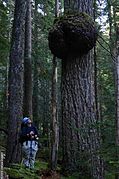
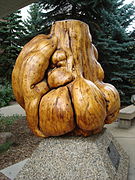
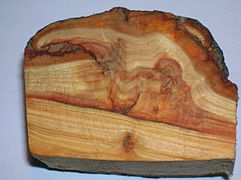
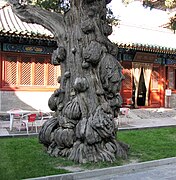
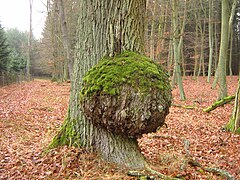
A burl (American English) or burr (British English) is a tree growth in which the grain has grown in a deformed manner. It is commonly found in the form of a rounded outgrowth on a tree trunk or branch that is filled with small knots from dormant buds. Burl formation is typically a result of some form of stress such as an injury or a viral or fungal infection.
Burls yield a very peculiar and highly figured wood sought after in woodworking, and some items may reach high prices on the wood market. Poaching of burl specimens and damaging the trees in the process poses a problem in some areas.
A burl results from a tree undergoing some form of stress. It may be caused by an injury, virus or fungus.[1] Most burls grow beneath the ground, attached to the roots as a type of malignancy that is generally not discovered until the tree dies or falls over. Such burls sometimes appear as groups of bulbous protrusions connected by a system of rope-like roots. Almost all burl wood is covered by bark, even if it is underground. Insect infestation and certain types of mold infestation are the most common causes of this condition.
In some tree species, burls can grow to great size. The largest, at 26 ft (8 m), occur in coast redwoods (Sequoia sempervirens) and can engirdle the entire trunk; when moisture is present, these burls can grow new redwood trees. The world's second-largest burls can be found in Port McNeill, British Columbia. One of the largest burls known was found around 1984 in the small town of Tamworth, New South Wales. It stands 6.4 ft (2.0 m) tall, with an odd shape resembling a trombone. In January 2009, this burl was controversially removed from its original location, and relocated to a public school in the central New South Wales city of Dubbo.
A burled spruce log carved for use as a railing with built-in seats on a log cabin
Burls yield a very peculiar and highly figured wood, prized for its beauty and rarity. It is sought after by furniture makers, artists, and wood sculptors. There are a number of well-known types of burls (each from a particular species); these are highly valued and sliced into veneers for furniture, inlay in doors, picture frames, household objects, automobile interior paneling and trim, musical instruments, and woodturning. It is also used for car dashboards.
The prized "burr maple" is not a species of a maple, but wood from a maple's burl (burr).
The famous birdseye maple of the sugar maple (Acer saccharum) superficially resembles burr maple, but it is something else entirely.
Burl wood is very hard to work with hand tools or on a lathe, because its grain is twisted and interlocked, causing it to chip and shatter unpredictably. This "wild grain" makes burl wood extremely dense and resistant to splitting, which made it valued for bowls, mallets, mauls and "beetles" or "beadles" for hammering chisels and driving wooden pegs.[2]
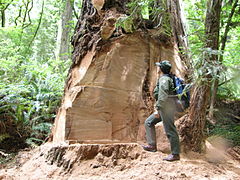
Because of the value of burls, ancient redwoods in national parks in the Western United States have recently been poached by thieves for their burls, including at Redwood National and State Parks.[3] Poachers often cut off the burls from the sides of the trunks using chainsaws, which exposes the tree to infection and disease, or fell the entire tree to steal burls higher up.[3] Because of the risk of poaching, Jeff Denny, the state park's redwood coast sector supervisor, encourages those buying burl to inquire where it came from and to ensure it was obtained legally. Legal acquisition methods for burl include trees from private land cleared for new development and from lumber companies with salvage permits.[3]
Zalasky, Harry (1975). "Low-temperature-induced cankers and burls in test conifers and hardwoods". Canadian Journal of Botany. 53 (21): 2526–35. doi:10.1139/b75-277.


![[icon]](https://en.wikipedia.org/wiki/File:Wiki_letter_w_cropped.svg)


.JPG)