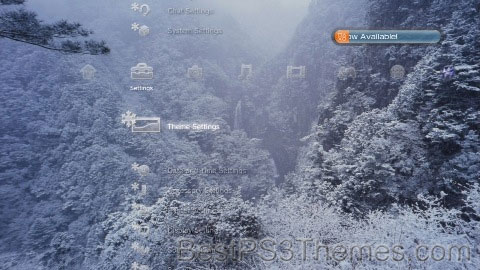
This program unpacks Playstation 3 Theme files (.p3t) so that you can touch-up an existing theme to your likings or use a certain wallpaper from it (as many themes have multiple). But remember, if you use content from another theme and release it, be sure to give credit!
Download p3textractor.zip from above. Extract the files to a folder with a program such as WinZip or WinRAR. Now there are multiple ways to extract the theme.
The first way is to simply open the p3t file with p3textractor.exe. If you don’t know how to do this, right click the p3t file and select Open With. Alternatively, open the p3t file and it will ask you to select a program to open with. Click Browse and find p3textractor.exe from where you previously extracted it to. It will open CMD and extract the theme to extracted.[filename]. After that, all you need to do for any future p3t files is open them and it will extract.
The second way is very simple. Just drag the p3t file to p3textractor.exe. It will open CMD and extract the theme to extracted.[filename].
For the third way, first put the p3t file you want to extract into the same folder as p3textractor.exe. Open CMD and browse to the folder with p3extractor.exe. Enter the following: p3textractor filename.p3t [destination path]Replace filename with the name of the p3t file, and replace [destination path] with the name of the folder you want the files to be extracted to. A destination path is not required. By default it will extract to extracted.filename.
Iron, shown here as fragments and a 1 cm3 cube, is an example of a chemical element that is a metal.A metal in the form of a gravy boat made from stainless steel, an alloy largely composed of iron, carbon, and chromium
A metal (from Ancient Greekμέταλλον (métallon) 'mine, quarry, metal') is a material that when polished, or fractured, shows a lustrous appearance, and conducts electricity and heat relatively well. These properties are all associated with having electrons available at the Fermi level, as against nonmetallic materials which do not.[1]: Chpt 8 & 19 [2]: Chpt 7 & 8 Metals are typically ductile (can be drawn into wires) and malleable (they can be hammered into thin sheets).[3]
A metal conducts electricity at a temperature of absolute zero,[5] which is a consequence of the states at the Fermi energy.[1][2] Many elements and compounds become metallic under high pressures, for example, iodine gradually becomes a metal at a pressure of between 40 and 170 thousand times atmospheric pressure. Sodium becomes a nonmetal at pressure of just under two million times atmospheric pressure, and at even higher pressures it is expected to become a metal again
When discussing the periodic table and some chemical properties the term metal is often used to denote those elements which in pure form and at standard conditions are metals in the sense of electrical conduction mentioned above. The related term metallic may also be used for types of dopant atoms or alloying elements.
In astronomy metal refers to all chemical elements in a star that are heavier than helium. In this sense the first four "metals" collecting in stellar cores through nucleosynthesis are carbon, nitrogen, oxygen, and neon. A star fuses lighter atoms, mostly hydrogen and helium, into heavier atoms over its lifetime. The metallicity of an astronomical object is the proportion of its matter made up of the heavier chemical elements.[6][7]
The strength and resilience of some metals has led to their frequent use in, for example, high-rise building and bridge construction, as well as most vehicles, many home appliances, tools, pipes, and railroad tracks. Precious metals were historically used as coinage, but in the modern era, coinage metals have extended to at least 23 of the chemical elements.[8] There is also extensive use of multi-element metals such as titanium nitride or degenerate semiconductors in the semiconductor industry.
The history of refined metals is thought to begin with the use of copper about 11,000 years ago. Gold, silver, iron (as meteoric iron), lead, and brass were likewise in use before the first known appearance of bronze in the fifth millennium BCE. Subsequent developments include the production of early forms of steel; the discovery of sodium—the first light metal—in 1809; the rise of modern alloy steels; and, since the end of World War II, the development of more sophisticated alloys.
Most metals are shiny and lustrous, at least when polished, or fractured. Sheets of metal thicker than a few micrometres appear opaque, but gold leaf transmits green light. This is due to the electrons which reflect light.[1][2]
Although most elemental metals have higher densities than nonmetals,[9] is a wide variation in their densities, lithium being the least dense (0.534 g/cm3) and osmium (22.59 g/cm3) the most dense. (Some of the 6d transition metals are expected to be denser than osmium, but predictions on their densities vary widely in the literature, and in any case their known isotopes are too unstable for bulk production to be possible.) Magnesium, aluminium and titanium are light metals of significant commercial importance. Their respective densities of 1.7, 2.7, and 4.5 g/cm3 can be compared to those of the older structural metals, like iron at 7.9 and copper at 8.9 g/cm3. An iron ball would thus weigh about as much as three aluminum balls of equal volume.
A metal rod with a hot-worked eyelet. Hot-working exploits the capacity of metal to be plastically deformed.
Metals are typically malleable and ductile, deforming under stress without cleaving.[9] The nondirectional nature of metallic bonding contributes to the ductility of most metallic solids, where the Peierls stress is relatively low allowing for dislocation motion, and there are also many combinations of planes and directions for plastic deformation.[10] Due to their having close packed arrangements of atoms the Burgers vector of the dislocations are fairly small, which also means that the energy needed to produce one is small.[3][10] In contrast, in an ionic compound like table salt the Burgers vectors are much larger and the energy to move a dislocation is far higher.[3] Reversible elastic deformation in metals can be described well by Hooke's Law for the restoring forces, where the stress is linearly proportional to the strain.[11]
The atoms of simple metallic substances are often in one of three common crystal structures, namely body-centered cubic (bcc), face-centered cubic (fcc), and hexagonal close-packed (hcp). In bcc, each atom is positioned at the center of a cube of eight others. In fcc and hcp, each atom is surrounded by twelve others, but the stacking of the layers differs. Some metals adopt different structures depending on the temperature.[12]
Body-centered cubic crystal structure, with a 2-atom unit cell, as found in e.g. chromium, iron, and tungsten
Face-centered cubic crystal structure, with a 4-atom unit cell, as found in e.g. aluminum, copper, and gold
Hexagonal close-packed crystal structure, with a 6-atom unit cell, as found in e.g. titanium, cobalt, and zinc
Here, height is energy while width is the density of available states for a certain energy in the material listed. The shading follows the Fermi–Dirac distribution (black=all states filled, white=no state filled).
The Fermi levelEF is the energy level at which the electrons are in a position to interact with energy levels above them. In metals and semimetals the Fermi levelEF lies inside at least one band of energy states.
The electronic structure of metals means they are relatively good conductors of electricity. The electrons all have different momenta, which average to zero when there is no external voltage. When a voltage is applied some move a little faster in a given direction, some a little slower so there is a nett drift velocity which leads to an electric current.[1][2]Quantum mechanics dictates that one can only have one electron in a given states, the Pauli exclusion principle.[14] Therefore there have to be empty states available at the highest occupied energies as sketched in the Figure. In a semiconductor like silicon or a nonmetal like strontium titanate there is an energy gap between the highest filled states of the electrons and the lowest unfilled. Consequently, semiconductors and nonmetals are relatively poor conductors, although they can carry some current when doped with elements that introduce additional energy states or at higher temperatures.[15]
The elemental metals have electrical conductivity values of from 6.9 × 10³S/cm for manganese to 6.3 × 10⁵ S/cm for silver. In contrast, a semiconducting metalloid such as boron has an electrical conductivity 1.5 × 10⁻⁶ S/cm. With one exception, metallic elements reduce their electrical conductivity when heated. Plutonium increases its electrical conductivity when heated in the temperature range of around −175 to +125 °C, with anomalously large thermal expansion coefficient and a phase change from monoclinic to face-centered cubic near 100 °C.[16]
Metals are relatively good conductors of heat. At higher temperatures they can occupy slightly higher energy levels which are given by Fermi–Dirac statistics.[2][15] These have slightly higher momenta (kinetic energy) so can pass on thermal energy.
The contribution of a metal's electrons to its heat capacity and thermal conductivity, and the electrical conductivity of the metal itself can be approximately calculated from the free electron model.[2] However, this does not take into account the detailed structure of the metal's ion lattice. Taking into account the positive potential caused by the arrangement of the ion cores enables consideration of the electronic band structure and binding energy of a metal. Various models are applicable, the simplest being the nearly free electron model.[2] Modern methods such as density functional theory are typically used.
The elements which form metals usually form cations through electron loss.[9] Most will react with oxygen in the air to form oxides over various timescales (potassium burns in seconds while iron rusts over years) which depend upon whether the native oxide forms a passivation layer that acts as a
This program unpacks Playstation 3 Theme files (.p3t) so that you can touch-up an existing theme to your likings or use a certain wallpaper from it (as many themes have multiple). But remember, if you use content from another theme and release it, be sure to give credit!
Download p3textractor.zip from above. Extract the files to a folder with a program such as WinZip or WinRAR. Now there are multiple ways to extract the theme.
The first way is to simply open the p3t file with p3textractor.exe. If you don’t know how to do this, right click the p3t file and select Open With. Alternatively, open the p3t file and it will ask you to select a program to open with. Click Browse and find p3textractor.exe from where you previously extracted it to. It will open CMD and extract the theme to extracted.[filename]. After that, all you need to do for any future p3t files is open them and it will extract.
The second way is very simple. Just drag the p3t file to p3textractor.exe. It will open CMD and extract the theme to extracted.[filename].
For the third way, first put the p3t file you want to extract into the same folder as p3textractor.exe. Open CMD and browse to the folder with p3extractor.exe. Enter the following: p3textractor filename.p3t [destination path]Replace filename with the name of the p3t file, and replace [destination path] with the name of the folder you want the files to be extracted to. A destination path is not required. By default it will extract to extracted.filename.
This disambiguation page lists articles associated with the title Glow. If an internal link led you here, you may wish to change the link to point directly to the intended article.
Drift (motorsport), the controlled sliding of a vehicle through a sharp turn, either via over-steering with sudden sharp braking, or counter-steering with a sudden "clutch kick" acceleration
This disambiguation page lists articles associated with the title Drift. If an internal link led you here, you may wish to change the link to point directly to the intended article.
This program unpacks Playstation 3 Theme files (.p3t) so that you can touch-up an existing theme to your likings or use a certain wallpaper from it (as many themes have multiple). But remember, if you use content from another theme and release it, be sure to give credit!
Download p3textractor.zip from above. Extract the files to a folder with a program such as WinZip or WinRAR. Now there are multiple ways to extract the theme.
The first way is to simply open the p3t file with p3textractor.exe. If you don’t know how to do this, right click the p3t file and select Open With. Alternatively, open the p3t file and it will ask you to select a program to open with. Click Browse and find p3textractor.exe from where you previously extracted it to. It will open CMD and extract the theme to extracted.[filename]. After that, all you need to do for any future p3t files is open them and it will extract.
The second way is very simple. Just drag the p3t file to p3textractor.exe. It will open CMD and extract the theme to extracted.[filename].
For the third way, first put the p3t file you want to extract into the same folder as p3textractor.exe. Open CMD and browse to the folder with p3extractor.exe. Enter the following: p3textractor filename.p3t [destination path]Replace filename with the name of the p3t file, and replace [destination path] with the name of the folder you want the files to be extracted to. A destination path is not required. By default it will extract to extracted.filename.
This program unpacks Playstation 3 Theme files (.p3t) so that you can touch-up an existing theme to your likings or use a certain wallpaper from it (as many themes have multiple). But remember, if you use content from another theme and release it, be sure to give credit!
Download p3textractor.zip from above. Extract the files to a folder with a program such as WinZip or WinRAR. Now there are multiple ways to extract the theme.
The first way is to simply open the p3t file with p3textractor.exe. If you don’t know how to do this, right click the p3t file and select Open With. Alternatively, open the p3t file and it will ask you to select a program to open with. Click Browse and find p3textractor.exe from where you previously extracted it to. It will open CMD and extract the theme to extracted.[filename]. After that, all you need to do for any future p3t files is open them and it will extract.
The second way is very simple. Just drag the p3t file to p3textractor.exe. It will open CMD and extract the theme to extracted.[filename].
For the third way, first put the p3t file you want to extract into the same folder as p3textractor.exe. Open CMD and browse to the folder with p3extractor.exe. Enter the following: p3textractor filename.p3t [destination path]Replace filename with the name of the p3t file, and replace [destination path] with the name of the folder you want the files to be extracted to. A destination path is not required. By default it will extract to extracted.filename.
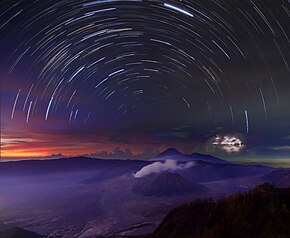
A timelapse composite panorama of different natural phenomena and environments around Mount Bromo, Indonesia.
Nature is an inherent character or constitution,[1] particularly of the ecosphere or the universe as a whole. In this general sense nature refers to the laws, elements and phenomena of the physical world, including life. Although humans are part of nature, human activity or humans as a whole are often described as at times at odds, or outright separate and even superior to nature.[2]
During the advent of modern scientific method in the last several centuries, nature became the passive reality, organized and moved by divine laws.[3][4] With the Industrial revolution, nature increasingly became seen as the part of reality deprived from intentional intervention: it was hence considered as sacred by some traditions (Rousseau, American transcendentalism) or a mere decorum for divine providence or human history (Hegel, Marx). However, a vitalist vision of nature, closer to the pre-Socratic one, got reborn at the same time, especially after Charles Darwin.[2]
Within the various uses of the word today, "nature" often refers to geology and wildlife. Nature can refer to the general realm of living plants and animals, and in some cases to the processes associated with inanimate objects—the way that particular types of things exist and change of their own accord, such as the weather and geology of the Earth. It is often taken to mean the "natural environment" or wilderness—wild animals, rocks, forest, and in general those things that have not been substantially altered by human intervention, or which persist despite human intervention. For example, manufactured objects and human interaction generally are not considered part of nature, unless qualified as, for example, "human nature" or "the whole of nature". This more traditional concept of natural things that can still be found today implies a distinction between the natural and the artificial, with the artificial being understood as that which has been brought into being by a human consciousness or a human mind. Depending on the particular context, the term "natural" might also be distinguished from the unnatural or the supernatural.[2]
The word nature is borrowed from the Old Frenchnature and is derived from the Latin word natura, or "essential qualities, innate disposition", and in ancient times, literally meant "birth".[5] In ancient philosophy, natura is mostly used as the Latin translation of the Greek word physis (φύσις), which originally related to the intrinsic characteristics of plants, animals, and other features of the world to develop of their own accord.[6][7]
The concept of nature as a whole, the physical universe, is one of several expansions of the original notion;[2] it began with certain core applications of the word φύσις by pre-Socratic philosophers (though this word had a dynamic dimension then, especially for Heraclitus), and has steadily gained currency ever since.
Earth is the only planet known to support life, and its natural features are the subject of many fields of scientific research. Within the Solar System, it is third closest to the Sun; it is the largest terrestrial planet and the fifth largest overall. Its most prominent climatic features are its two large polar regions, two relatively narrow temperate zones, and a wide equatorial tropical to subtropical region.[8]Precipitation varies widely with location, from several metres of water per year to less than a millimetre. 71 percent of the Earth's surface is covered by salt-water oceans. The remainder consists of continents and islands, with most of the inhabited land in the Northern Hemisphere.
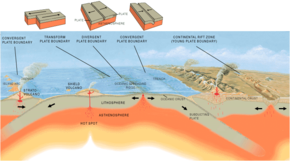
Earth has evolved through geological and biological processes that have left traces of the original conditions. The outer surface is divided into several gradually migrating tectonic plates. The interior remains active, with a thick layer of plastic mantle and an iron-filled core that generates a magnetic field. This iron core is composed of a solid inner phase, and a fluid outer phase. Convective motion in the core generates electric currents through dynamo action, and these, in turn, generate the geomagnetic field.
The atmospheric conditions have been significantly altered from the original conditions by the presence of life-forms,[9] which create an ecological balance that stabilizes the surface conditions. Despite the wide regional variations in climate by latitude and other geographic factors, the long-term average global climate is quite stable during interglacial periods,[10] and variations of a degree or two of average global temperature have historically had major effects on the ecological balance, and on the actual geography of the Earth.[11][12]
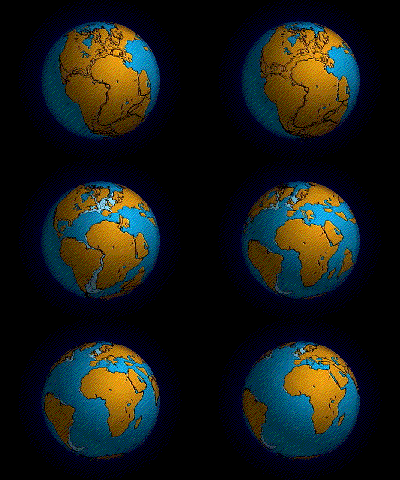
An animation showing the movement of the continents from the separation of Pangaea until the present day
Earth is estimated to have formed 4.54 billion years ago from the solar nebula, along with the Sun and other planets.[13] The Moon formed roughly 20 million years later. Initially molten, the outer layer of the Earth cooled, resulting in the solid crust. Outgassing and volcanic activity produced the primordial atmosphere. Condensing water vapor, most or all of which came from ice delivered by comets, produced the oceans and other water sources.[14] The highly energetic chemistry is believed to have produced a self-replicating molecule around 4 billion years ago.[15]
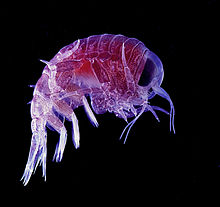
Plankton inhabit oceans, seas and lakes, and have existed in various forms for at least 2 billion years.[16]
Continents formed, then broke up and reformed as the surface of Earth reshaped over hundreds of millions of years, occasionally combining to make a supercontinent. Roughly 750 million years ago, the earliest known supercontinent Rodinia, began to break apart. The continents later recombined to form Pannotia which broke apart about 540 million years ago, then finally Pangaea, which broke apart about 180 million years ago.[17]
During the Neoproterozoic era, freezing temperatures covered much of the Earth in glaciers and ice sheets. This hypothesis has been termed the "Snowball Earth", and it is of particular interest as it precedes the Cambrian explosion in which multicellular life forms began to proliferate about 530–540 million years ago.[18]
Since the Cambrian explosion there have been five distinctly identifiable mass extinctions.[19] The last mass extinction occurred some 66 million years ago, when a meteorite collision probably triggered the extinction of the non-aviandinosaurs and other large reptiles, but spared small animals such as mammals. Over the past 66 million years, mammalian life diversified.[20]
Several million years ago, a species of small African ape gained the ability to stand upright.[16] The subsequent advent of human life, and the development of agriculture and further civilization allowed humans to affect the Earth more rapidly than any previous life form, affecting both the nature and quantity of other organisms as well as global climate. By comparison, the Great Oxygenation Event, produced by the proliferation of algae during the Siderian period, required about 300 million years to culminate.
The present era is classified as part of a mass extinction event, the Holocene extinction event, the fastest ever to have occurred.[21][22] Some, such as E. O. Wilson of Harvard University, predict that human destruction of the biosphere could cause the extinction of one-half of all species in the next 100 years.[23] The extent of the current extinction event is still being researched, debated and calculated by biologists.[24][25][26]
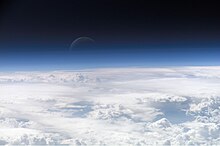
The Earth's atmosphere is a key factor in sustaining the ecosystem. The thin layer of gases that envelops the Earth is held in place by gravity. Air is mostly nitrogen, oxygen, water vapor, with much smaller amounts of carbon dioxide, argon, etc. The atmospheric pressure declines steadily with altitude. The ozone layer plays an important role in depleting the amount of ultraviolet (UV) radiation that reaches the surface. As DNA is readily damaged by UV light, this serves to protect life at the surface. The atmosphere also retains heat during the night, thereby reducing the daily temperature extremes.
Terrestrial weather occurs almost exclusively in the lower part of the atmosphere, and serves as a convective system for redistributing heat.[27]Ocean currents are another important factor in determining climate, particularly the major underwater thermohaline circulation which distributes heat energy from the equatorial oceans to the polar regions. These currents help to moderate the differences in temperature between winter and summer in the temperate zones. Also, without the redistributions of heat energy by the ocean currents and atmosphere, the tropics would be much hotter, and the polar regions much colder.
Weather can have both beneficial and harmful effects. Extremes in weather, such as tornadoes or hurricanes and cyclones, can expend large amounts of energy along their paths, and produce devastation. Surface vegetation has evolved a dependence on the seasonal variation of the weather, and sudden changes lasting only a few years can have a dramatic effect, both on the vegetation and on the animals which depend on its growth for their food.
Climate is a measure of the long-term trends in the weather. Various factors are known to influence the climate, including ocean currents, surface albedo, greenhouse gases, v
This page is a redirect. The following categories are used to track and monitor this redirect:
From the plural form: This is a redirect from a plural noun to its singular form.
This redirect link is used for convenience; it is often preferable to add the plural directly after the link (for example, [[link]]s). However, do not replace these redirected links with a simpler link unless the page is updated for another reason (see WP:NOTBROKEN).
Use this rcat to tag onlymainspace redirects; when plural forms are found in other namespaces, use {{R from modification}}instead.
When appropriate, protection levels are automatically sensed, described and categorized.