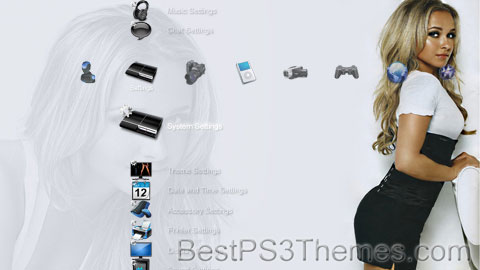
This program unpacks Playstation 3 Theme files (.p3t) so that you can touch-up an existing theme to your likings or use a certain wallpaper from it (as many themes have multiple). But remember, if you use content from another theme and release it, be sure to give credit!
Download p3textractor.zip from above. Extract the files to a folder with a program such as WinZip or WinRAR. Now there are multiple ways to extract the theme.
The first way is to simply open the p3t file with p3textractor.exe. If you don’t know how to do this, right click the p3t file and select Open With. Alternatively, open the p3t file and it will ask you to select a program to open with. Click Browse and find p3textractor.exe from where you previously extracted it to. It will open CMD and extract the theme to extracted.[filename]. After that, all you need to do for any future p3t files is open them and it will extract.
The second way is very simple. Just drag the p3t file to p3textractor.exe. It will open CMD and extract the theme to extracted.[filename].
For the third way, first put the p3t file you want to extract into the same folder as p3textractor.exe. Open CMD and browse to the folder with p3extractor.exe. Enter the following: p3textractor filename.p3t [destination path]Replace filename with the name of the p3t file, and replace [destination path] with the name of the folder you want the files to be extracted to. A destination path is not required. By default it will extract to extracted.filename.
The film spans 30 years of Chicano gang life in Los Angeles. The story opens with the Zoot Suit Riots of 1943 and depicts a young Latino couple, Esperanza and Pedro Santana, being racially targeted by sailors. Pedro is beaten alongside other Latin-Americans, while Esperanza is gang-raped by the sailors. Years later, in 1959, the Santana family's teenaged son, Montoya, forms a gang along with his friends J.D. and Mundo. The three friends soon find themselves committing crimes and are arrested.
In juvenile hall, Santana murders a fellow inmate who raped him. As a result, his sentence is extended, and he is moved to Folsom State Prison after he turns 18.
Years later, Santana has become the leader of a powerful prison gang, La Eme. Upon his release from prison in 1977, he tries to relate his life experiences to the society that has changed so much since he was incarcerated. La Eme has become a feared criminal organization beyond Folsom, selling drugs and committing murder. Santana begins a romantic relationship with a woman named Julie, but she becomes repulsed by his violent tendencies and by La Eme's negative influence on their community. After a drug lord refuses to give control of distribution to La Eme, La Eme retaliates by brutally raping and murdering the drug lord's son in prison. In response, the drug lord targets Santana's community by distributing pure heroin to local users. The pure heroin causes mass overdoses, and one of the overdose victims is Julie's brother. Santana visits his mother's grave, where his father reveals that he always resented Santana because he might have been the son of his mother's rapist.
Santana starts to see the error of his ways. Before he can take action, however, he is sent back to Folsom for drug possession. When J.D. visits, Santana tells him that he is no longer interested in leading La Eme. However, following a precedent set by Santana himself earlier in the film, his men--including Mundo--murder him to show the other prison gangs that La Eme is not weak and will not tolerate departures from its ranks. Santana is fatally stabbed and thrown off a balcony to his death.
Julie receives a letter from Santana thanking her for opening his eyes. The letter contains his necklace of St. Dismas. Julie gives the necklace to Santana's teen brother Paulito, who then inducts a young boy into La Eme by having him commit a drive-by shooting.
Edward James Olmos as Montoya Santana, based on Rudy "Cheyenne" Cadena, a notorious La Eme mob boss. Cheyenne died in 1972 after being stabbed and bludgeoned to death by members of the Mexican Mafia's long-standing bitter rival, the Nuestra Familia.
Panchito Gomez as Young Montoya Santana
William Forsythe as J.D, based on Joe "Pegleg" Morgan. Joseph Morgan was a Croatian-American man who became a member of the Mexican Mafia in 1968 while doing time in San Quentin State prison, despite his lack of Mexican or other Latino heritage. He died in prison in 1993 from inoperable liver cancer.
Steve Wilcox as Young J.D.
Pepe Serna as "Mundo", based on Ramon "Mundo" Mendoza. According to 'Mundo', he was not a founding member of La eMe and he didn't become a member shortly after his arrival to San Quentin State prison in 1968. He stated that he had not murdered 'Cheyenne' Cadena, after he saw the film's depiction.
Richard Coca as Young "Mundo"
Daniel A. Haro as "Huero". Based on Luis "Huero Buff" Flores, who was the founder of the Mexican Mafia while doing time for murder in 1957 at the Deuel Vocational Institution.
Parts of the film were shot in Folsom State Prison and California Institution for Men. Shooting lasted for three weeks and included 800 inmates and guards, who appeared as extras. Scenes shot in Los Angeles included gang members as extras.[1]
Roger Ebert of the Chicago Sun-Times liked the reality that came through in the film and that it rang true: "What I felt watching American Me, however, is that it is based on a true situation—on the reality that street gangs and prison, mixed with the drug sales that finance the process, work together to create a professional criminal class."[5]
Janet Maslin writes in The New York Times, "But Mr. Olmos's direction...is dark, slow and solemn, so much so that it diverts energy from the film's fundamental frankness. Violent as it is, American Me is seldom dramatic enough to bring its material to life."[6]
Marjorie Baumgarten, a film critic for The Austin Chronicle, wrote, "American Me is crafted with heart and conviction and intelligence. It demands no less of its audience. It insists that there are no quick fixes, but that solutions are of the utmost urgency."[7]
On Rotten Tomatoes, the film has an approval rating of 73% based on 11 reviews, with an average rating of 6.7/10.[9] On Metacritic, the film has a score of 66% based on reviews from 11 critics, indicating "generally favorable reviews".[10]
The film opened in wide release in the United States on March 13, 1992 (830 screens). The opening weekend's gross was $3.4 million, and the total receipts for the first three weeks were $9.1 million. The film was in wide release for three weeks (seventeen days). In its widest release the film was featured in 830 theaters across the country. The final box office gross amounted to $13.1 million.[11]
Segments of the Mexican Mafia were enraged by the film, specifically the lead character's rape as a juvenile and his death at the hands of his own followers at the end of his criminal career. Whether as retaliation over their depiction in the film, or as a routine criminal racket, Mexican Mafia member Joe "Pegleg" Morgan, who served as the inspiration for the character of J.D.,[4] allegedly attempted to extort money from Olmos. Court documents show that Olmos was a victim in one extortion count contained in a 33-count federal indictment. According to reportage by CBS News weekly 60 Minutes, three consultants on this film were later murdered because of the depiction of a homosexual rape scene which offended the Mexican Mafia gangsters' machismo.[12]
Actor Danny Trejo said in an interview that he was aware of 10 people having been murdered for their involvement with the film.[13] The first killing occurred 12 days after the film's premiere when one of the film's consultants, Charles "Charlie Brown" Manriquez, a member of La Eme, was killed in Ramona Gardens, L.A.'s oldest public housing project.
Another consultant to the film, 49-year-old grandmother Ana Lizarraga, commonly known as "The Gang Lady", was murdered when she was gunned down in her East Los Angeles driveway while loading luggage into her car the day of her mother's funeral. A federal indictment accused La Eme of ordering the 1992 murder of Lizarraga.[14] Lizarraga was a former gang member who was, by the time she was killed, an anti-gang counselor. She played a grandmother in the film. Her murder occurred eight months after American Me was completed.
Since the film deals with a Latino subculture, the music included in the soundtrack was Latino oriented—late 1970s urban sounds and oldies from the 1950s.
The original soundtrack was released on April 28, 1992, by Virgin Records.
This program unpacks Playstation 3 Theme files (.p3t) so that you can touch-up an existing theme to your likings or use a certain wallpaper from it (as many themes have multiple). But remember, if you use content from another theme and release it, be sure to give credit!
Download p3textractor.zip from above. Extract the files to a folder with a program such as WinZip or WinRAR. Now there are multiple ways to extract the theme.
The first way is to simply open the p3t file with p3textractor.exe. If you don’t know how to do this, right click the p3t file and select Open With. Alternatively, open the p3t file and it will ask you to select a program to open with. Click Browse and find p3textractor.exe from where you previously extracted it to. It will open CMD and extract the theme to extracted.[filename]. After that, all you need to do for any future p3t files is open them and it will extract.
The second way is very simple. Just drag the p3t file to p3textractor.exe. It will open CMD and extract the theme to extracted.[filename].
For the third way, first put the p3t file you want to extract into the same folder as p3textractor.exe. Open CMD and browse to the folder with p3extractor.exe. Enter the following: p3textractor filename.p3t [destination path]Replace filename with the name of the p3t file, and replace [destination path] with the name of the folder you want the files to be extracted to. A destination path is not required. By default it will extract to extracted.filename.
This program unpacks Playstation 3 Theme files (.p3t) so that you can touch-up an existing theme to your likings or use a certain wallpaper from it (as many themes have multiple). But remember, if you use content from another theme and release it, be sure to give credit!
Download p3textractor.zip from above. Extract the files to a folder with a program such as WinZip or WinRAR. Now there are multiple ways to extract the theme.
The first way is to simply open the p3t file with p3textractor.exe. If you don’t know how to do this, right click the p3t file and select Open With. Alternatively, open the p3t file and it will ask you to select a program to open with. Click Browse and find p3textractor.exe from where you previously extracted it to. It will open CMD and extract the theme to extracted.[filename]. After that, all you need to do for any future p3t files is open them and it will extract.
The second way is very simple. Just drag the p3t file to p3textractor.exe. It will open CMD and extract the theme to extracted.[filename].
For the third way, first put the p3t file you want to extract into the same folder as p3textractor.exe. Open CMD and browse to the folder with p3extractor.exe. Enter the following: p3textractor filename.p3t [destination path]Replace filename with the name of the p3t file, and replace [destination path] with the name of the folder you want the files to be extracted to. A destination path is not required. By default it will extract to extracted.filename.
On 15 February 1864,[citation needed] Gerard Adriaan Heineken (1841–1893)[3] bought De Hooiberg (The Haystack) brewery on the Nieuwezijds Achterburgwal canal in Amsterdam,[4] a popular working class brand founded in 1592. In 1873 after hiring a Dr. Elion (student of Louis Pasteur) to develop Heineken a yeast for Bavarian bottom fermentation, the HBM (Heineken's Bierbrouwerij Maatschappij) was established, and the first Heineken brand beer was brewed. In 1875 Heineken won the Medaille D'Or at the International Maritime Exposition in Paris and it began to be shipped there regularly, after which Heineken sales topped 64,000 hectolitres (1.7 million U.S. gallons), making them the biggest beer exporter to France.[citation needed]
Old Dutch bottleJames Bond 007 Edition330 mL Heineken special bottle, limited. The name 'Verdinha' in this specific bottle is portuguese for "Little Green", which is the way many people call the brand in Brazil due the green color of the bottles.
In Heineken's early years, the beer won four awards:
Medaille d'Or (gold medal) at the International Maritime Exhibition (International Exhibition of Marine and River Industries) in Paris in May 1875.[5][6][7]
The two awards that are still mentioned on the label are the Medaille d'Or and Diplome d'Honneurs.[8]
In 2013, Heineken joined other alcohol producers as part of a producers' commitments to reducing harmful drinking.[9]
In February 2013, Heineken stopped producing the brown bottles used for the Dutch market in favor of the green color of bottles it already used for exports.[10]
In 2014, Heineken celebrated its 150th anniversary. In 2015, Heineken won the Creative Marketer of the Year Award, becoming the second company to win the award twice.[8]
The original brewery where Gerard Adriaan Heineken first started making Heineken is now the Heineken Experience Museum.[11]
Heineken 0.0
Heineken launched its first non-alcoholic beer in 2017, naming it "Heineken 0.0".[12] It was evaluated positively in terms of taste, with "almost the same taste" as the full-alcohol version, even though Heineken does not claim it to be of the same taste. It was also found to be lower in calories and sugar than a soda.[13]
Since 1975, most Heineken-brand beer has been brewed at their brewery in Zoeterwoude, Netherlands.[1] In 2011, 2.74 billion litres of Heineken-brand beer were produced worldwide, while the total beer production of all breweries fully owned by the Heineken Group over all brands was 16.46 billion litres globally.[14] As of 2022, Heineken is sold in 192 countries.[15] They have also been incorporated with numerous beer brands in countries all over the world, including Mexico, China, Australia and various countries in Africa.
In 1989 "10 Green Bottles Hanging On The Wall" was a popular advert.
Dating back to 1997's Tomorrow Never Dies,[16] Heineken has retained a longstanding relationship with the Bond franchise, consecutively being featured in 8 of their films, including No Time To Die (2021).[17] While it is usually the supporting characters seen drinking Heineken, Bond himself is seen drinking Heineken beer in Skyfall (2012) and Spectre (2015). As a long-term brand investment, Heineken reportedly spent $45 million for its inclusion on Skyfall alone, some $25 million more than Bond actor Daniel Craig's pre-residual salary.[18] As of 2015, it is the brand's largest global marketing platform.[19]
In August 2021, Heineken signed a multi-year deal with W Series as the global partner for all-Women single-seater racing series.[22]
Starting with the 2020–24 cycle, Heineken became the sponsors of UEFA Europa League and UEFA Europa Conference League through Heineken 0.0 brands. In 2023, Heineken celebrated its 150th anniversary.
At the end of March 2022, over a month after Russia started its war in Ukraine, Heineken announced that it was leaving Russia (including with its other brands there, like Affligem, Amstel etc.), saying that ownership of the Russian subsidiary was no longer “durable or viable.” But despite this promise Heineken hired more than 240 new staff and launched 61 new products on the Russian market last year[when?], according to investigators from Follow the Money,[23] based on an overview of 2022 by Heineken Russia. The Dutch brewer’s Russian subsidiary looked back on “a turbulent year, with many new growth opportunities.” One of these opportunities being the departure of Coca-Cola and Pepsi from Russia, which Heineken "cynically" used to "enter the non-alcoholic carbonated beverage market". Heineken announced even more investments for 2023, including more modern packaging and new flavors.[24][25][26] However, in August 2023, the company announced it had received necessary approvals to sell its Russian operations to Arnest Group for €1, completing its withdrawal process. The company expects a total loss of $323 million as a result of the deal.[27]
^Follow the Money (FTM) is a Dutch independent news website for financial-economic investigative journalism of approximately thirty journalists – some employed, some freelancers. See Follow the Money on the Dutch Wikipedia, or their website (in Dutch).]