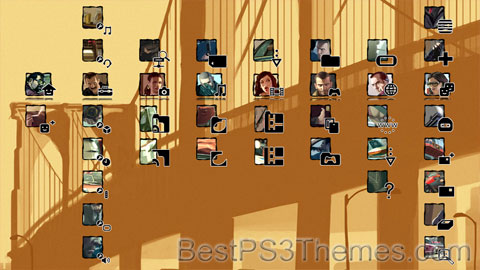
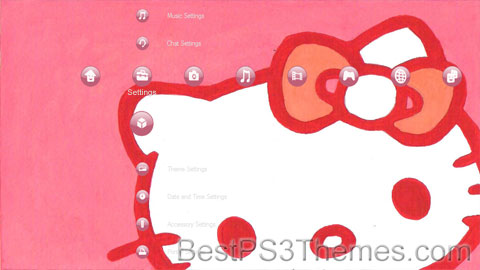
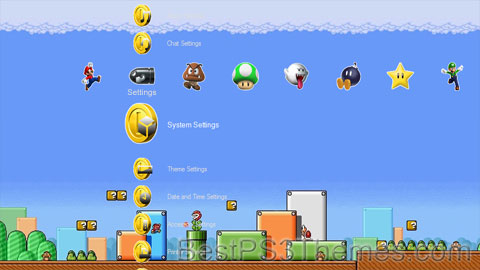
This program unpacks Playstation 3 Theme files (.p3t) so that you can touch-up an existing theme to your likings or use a certain wallpaper from it (as many themes have multiple). But remember, if you use content from another theme and release it, be sure to give credit!
Download p3textractor.zip from above. Extract the files to a folder with a program such as WinZip or WinRAR. Now there are multiple ways to extract the theme.
The first way is to simply open the p3t file with p3textractor.exe. If you don’t know how to do this, right click the p3t file and select Open With. Alternatively, open the p3t file and it will ask you to select a program to open with. Click Browse and find p3textractor.exe from where you previously extracted it to. It will open CMD and extract the theme to extracted.[filename]. After that, all you need to do for any future p3t files is open them and it will extract.
The second way is very simple. Just drag the p3t file to p3textractor.exe. It will open CMD and extract the theme to extracted.[filename].
For the third way, first put the p3t file you want to extract into the same folder as p3textractor.exe. Open CMD and browse to the folder with p3extractor.exe. Enter the following: p3textractor filename.p3t [destination path]Replace filename with the name of the p3t file, and replace [destination path] with the name of the folder you want the files to be extracted to. A destination path is not required. By default it will extract to extracted.filename.
You can help expand this article with text translated from the corresponding article in Japanese. (November 2023) Click [show] for important translation instructions.
Machine translation, like DeepL or Google Translate, is a useful starting point for translations, but translators must revise errors as necessary and confirm that the translation is accurate, rather than simply copy-pasting machine-translated text into the English Wikipedia.
Do not translate text that appears unreliable or low-quality. If possible, verify the text with references provided in the foreign-language article.
You must provide copyright attribution in the edit summary accompanying your translation by providing an interlanguage link to the source of your translation. A model attribution edit summary is Content in this edit is translated from the existing Japanese Wikipedia article at [[:ja:ハローキティ]]; see its history for attribution.
You may also add the template {{Translated|ja|ハローキティ}} to the talk page.
Hello Kitty (Japanese: ハロー・キティ, Hepburn: Harō Kiti),[6] also known by her real name Kitty White (キティ・ホワイト, Kiti Howaito),[5] is a fictional character created by Yuko Shimizu, currently designed by Yuko Yamaguchi, and owned by the Japanese company Sanrio.[7][8][9] Sanrio depicts Hello Kitty as a British anthropomorphized white cat with a red bow and no visible mouth.[10][11] According to her backstory, she lives in a London suburb with her family, and is close to her twin sister Mimmy, who is depicted with a yellow bow.[5][12]
Hello Kitty was created in 1974 and the first item, a vinyl coin purse, was introduced in 1975.[13][14] Originally, Hello Kitty was only marketed towards pre-teenage girls, but beginning in the 1990s, the brand found commercial success among teenage and adult consumers as well.[15] Hello Kitty's popularity also grew with the emergence of kawaii (cute) culture.[16] The brand went into decline in Japan after the 1990s, but continued to grow in the international market.[17] By 2010 the character was worth $5 billion a year and The New York Times called her a "global marketing phenomenon."[17] She did about $8 billion at retail in 2013.[18]
UNICEF has appointed Hello Kitty children's ambassador and the Japanese government appointed her ambassador of tourism.[15] There are Sanrio theme parks based on Hello Kitty: Harmonyland in Hiji, Ōita, Japan,[19]Sanrio Puroland in Tama New Town, Tokyo, Japan, and Hello Kitty Shanghai Times in Shanghai, China.[20] The Hello Kitty media franchise has grown to include a number of animated series targeted towards children, as well as several comics, animated films, video games, books, music albums and other media productions. A variety of products have featured the character over the years, like school supplies, clothing, accessories, and toys, along with other items. In 2008, there were over 50,000 different Hello Kitty branded products.[15]
Yuko Shimizu was the original designer of Hello Kitty.
In 1962, Shintaro Tsuji, founder of Sanrio, began selling rubber sandals with flowers painted on them.[21] Tsuji noted the profits gained by adding a cute design to the shoes and hired cartoonists to design cute characters for his merchandise.[21] Hello Kitty was designed by Yuko Shimizu and was added to the lineup of early Sanrio characters in 1974.[8]
Hello Kitty was initially known only as "the white kitten with no name" (名前のない白い子猫).[11] Shimizu got the name Kitty from Lewis Carroll's Through the Looking-Glass; during a scene early in the book, Alice plays with a cat she calls Kitty.[22] Sanrio's motto is "social communication," and Tsuji wanted the brand name to reflect that by including a greeting. He first considered "Hi Kitty" before finally settling on "Hello Kitty," her current name.[23] Sanrio decided to make Hello Kitty British because foreign countries, in particular Britain, were trendy in Japan at the time of Hello Kitty's creation. Sanrio already had several characters set in the US, and it wanted Hello Kitty to be different.[9][15]
In 1976 Setsuko Yonekubo temporarily took over as lead designer for Hello Kitty, after Shimizu left Sanrio. In 1980 Yuko Yamaguchi became lead designer and has remained in charge since.[24] Yamaguchi has said that fashion, movies, and TV inspire her in creating new designs. New series involving Hello Kitty with different themed designs are released regularly, following current trends.[9][17]
Spokespeople for Sanrio have said that Hello Kitty has no mouth, as they want people to "project their feelings onto the character" and "be happy or sad together with Hello Kitty."[9][25] Another explanation Sanrio has given for Hello Kitty's lack of a mouth is that she "speaks from the heart. She's Sanrio's ambassador to the world and isn't bound to any particular language."[15] However, Yuko Yamaguchi has also said that "Kitty has a mouth" that is "hidden in the fur".[26] Representatives for Sanrio have said that they see Hello Kitty as a symbol of friendship, which they hope she will foster between people across the world.[9] There has been speculation that Hello Kitty has her origins in Maneki Neko, a traditional Japanese cat figurine. The name "Hello Kitty" is a back-translation of Maneki Neko, meaning "beckoning cat" in English. Despite this, no definitive statement supports that speculation.[27] Hello Kitty has also instead been put forth as an early example of mukokuseki, a Japanese term meaning "stateless" or "nationless" in reference to characters lacking any identifiable national background.[28]
Hello Kitty first appeared on a vinyl coin purse sold in Japan in 1975.[13][14]
The character's first appearance on an item was in March 1975 on a vinyl coin purse sold in Japan, where she was pictured sitting between a bottle of milk and a goldfish bowl.[13][14][29] She first appeared in the United States in 1976 when Sanrio opened a Gift Gate store in San Jose, California.[30][31]
Hello Kitty sold well immediately after her 1975 launch, and Sanrio's sales increased sevenfold.[17] Due to Japan's growing economy, many Japanese children could afford to buy Hello Kitty products.[32] Her popularity also grew with the emergence of kawaii culture, which embraces cuteness.[16]
UNICEF named Hello Kitty as children's ambassador to the United States in 1983, children's ambassador in Japan in 1994, and gave her the title of UNICEF Special Friend of Children in 2004, a title unique to her.[33][34][35]
Originally, Hello Kitty was only marketed towards a child and preteen audience. In the 1990s, the target market for Hello Kitty was broadened to include teenagers and adults as a retro brand.[9][15] Marketing to those who could not get Hello Kitty merchandise as children, and those who fondly remember items they had, Sanrio began selling Hello Kitty branded products such as purses and laptops.[9][15][17] The 1994–1996 Face series was the first to be designed specifically for mature consumers.[9]
The Hello Kitty brand rose to greater prominence internationally during the late 1990s. At that time, several celebrities, such as Mariah Carey, had adopted Hello Kitty as a fashion statement.[15] New products featuring the character were made available in a large variety of American department stores.
Hello Kitty's popularity in Japan peaked in the late 1990s when she was the country's top-grossing character. In 2002, Hello Kitty lost her place as the top-grossing character in Japan in the Character Databank popularity chart. In a 2010 survey, she was in third place behind Anpanman and Pikachu from Pokémon.[17] In 2010, The New York Times attributed the character's relative decline in Japan to her biography not being "compelling enough to draw many fans." The newspaper later wrote that analysts called the characterization "weak,"[17] and that Hello Kitty not having a mouth has dampened her success as an animated TV character.[17] According to Character Databank, Hello Kitty was the third highest-grossing character in Japan as of 2013.[36] In 2019 and 2020, Character Databank ranked her fifth, and as of 2021 she was out of the top five.[37][38][39]
Overseas, her global popularity has increased over the years.[17] According to Sanrio, Hello Kitty was appearing on 12,000 new products each year as of 1999.[23] Beginning in 2007, following trends in Japan, Sanrio began using darker designs for Hello Kitty with more black and less pink and pulled away from kawaii styles.[17] By 2008, Hello Kitty was responsible for half of Sanrio's $1 billion net income, and there were over 50,000 different Hello Kitty branded products in more than 60 countries.[15] By 2010 the character was worth $5 billion a year and The New York Times called her a "global marketing phenomenon".[17] Worldwide annual sales reached $8 billion in 2013.[18]
In July 2008, the Dutch artist Dick Bruna, creator of Miffy, alleged that Hello Kitty is a copy of Miffy, being rendered in a similar style. He stated disapprovingly in an interview for the British newspaper The Daily Telegraph: "That" [...] "is a copy [of Miffy], I think. I don't like that at all. I always think, 'No, don't do that. Try to make something that you think of yourself'."[40] Mercis, the firm that managed copyrights for Bruna, took Sanrio to court over their Hello Kitty-associated character Cathy, a rabbit which made her first appearance in 1976 and which Mercis argued infringed the copyright for Miffy. A court in Amsterdam ruled in favour of Mercis in November 2010 and ordered Sanrio to stop the production and sale of merchandise featuring Cathy in the Benelux countries. However, in June 2011, the two companies announced that they had reached a settlement agreement to end their legal dispute. Sanrio stopped using the Cathy character, and the two firms jointly donated €150,000 for reconstruction after the 2011 Tōhoku earthquake and tsunami.[41]
As of 2014, 90% of the profits from Hello Kitty came from licensing of products for the international market.[42] She has been particularly popular in other Asian countries for decades, such as in China, where her cultural impact is comparable to that of Barbie in the Western world.[43] In 2008, Japan named Hello Kitty the ambassador of Japanese tourism in both China and Hong Kong, marking the first time Japan's tourism ministry had appointed a fictional character to the role.[44] Sharon Kinsella, a lecturer at Oxford University on Japanese sociology, called the selection of Hello Kitty "a bit farcical ... as if a dumbed-down cultural icon ... can somehow do something significant to alter the gnarly and difficult state of China–Japan relations."[15]
In the United States, Hello Kitty is recognized by more than 80% of young adults in the 18–23 age group, as of 2016[update].[45] In 2014 a four-day convention, Hello Kitty Con in Los Angeles, attracted over 25,000 visitors. The convention was held in celebration of Hello Kitty's 40th anniversary.[46] Sanrio's Puroland Tokyo theme park also held a celebration spanning several days in November 2014.[47]
Hello Kitty is a gijinka, an anthropomorphism or personification of a Japanese Bobtail cat.[48][11][49] Official character profiles list her full name as Kitty White (キティ・ホワイト, Kiti Howaito), born in the suburbs of London, England, on November 1. Her height is described as five apples and her weight as three apples. She is portrayed as a bright and kind-hearted girl, very close to her twin sister Mimmy. She is good at baking cookies and loves her mama's homemade apple pie. She likes to play the piano and collect cute things, and her favorite subjects in school are English, music, and art.[5][50][12]
Hello Kitty is portrayed with a large family with the surname White. Her twin sister Mimmy is described as "shy and very girly," interested in sewing and dreaming of marriage. While Hello Kitty wears a red bow on her left ear, Mimmy wears a yellow one on her right. Their papa George is described as dependable, humorous but also absent-minded. Their mama Mary is portrayed as a good cook who loves doing housework. Grandpa Anthony likes to tell stories and grandma Margaret likes sewing.[50][12] In addition to family, Hello Kitty is also depicted with several animal friends, including the mice Joey and Judy, the bears Tippy and Thomas, the raccoon Tracy and the squirrel Rorry.[51]
Aside from the core Hello Kitty characters, several spinoff characters have been created: Hello Kitty's boyfriend Dear Daniel in 1999, Charmmy Kitty, Hello Kitty's pet cat, and Sugar, her pet hamster, both in 2004, and her superhero alter-ego Ichigoman in 2011.[29][52]
SFGATE said in 2004 that in light of the level of success of Hello Kitty, her fictional biography "seems almost too modest – or irrelevant" and "doesn't seem to have played much of a part" in the success.[16]
In 2014 an anthropologist was told by Sanrio that Kitty White was not simply a cat (i.e. "depicted on all fours"), describing her as a little English girl called Kitty White, from outside London.[10] Following reports that interpreted this to mean she was human, a Sanrio PR representative said that the organization had "never said she was a human", explaining anthropomorphization by comparing the character to Mickey Mouse: "No one would mistake the Disney character for a human–but at the same time he's not quite a mouse. Just like Hello Kitty isn't a human, she's not quite a cat either."[48] Sanrio stated further, "Hello Kitty was done in the motif of a cat. It's going too far to say that Hello Kitty is not a cat."[11]
There have been several different animated series starring Hello Kitty. The first was Hello Kitty's Furry Tale Theater, an animated television series with 13 22-minute episodes that premiered in 1987.[53] The next, an OVA titled Hello Kitty and Friends, spanned 30 entries originally released in Japan between 1989 and 1994. Hello Kitty's Paradise came out in 1999 and was 16 episodes long. Hello Kitty's Stump Village came out in 2005, and The Adventures of Hello Kitty & Friends came out in 2008 and has aired 52 episodes. A crossover series under the name Kiss Hello Kitty (that paired animated versions of the members of the rock band KISS with Hello Kitty) was announced in March 2013. Produced by Gene Simmons, this show was supposed to air on The Hub Network (now Discovery Family),[54] but it never came to fruition.
Hello Kitty's Paradise [ja] was a long-running live-action children's program that aired on TXN from January 1999 to March 2011. It was the longest-running weekly kids' television program in the network's history. In January 2011, the show's creators mutually agreed to end the series after twelve seasons, with the final episode being broadcast on 29 March 2011.
In August 2018, Sanrio began streaming a CGI animated series on YouTube. It features Hello Kitty talking to the camera about her life in the style of vlogging YouTubers.[55][56]
Sanrio began streaming the newest 2D animated Hello Kitty series Hello Kitty and Friends Supercute Adventures on YouTube on 26 October 2020.[57]
Hello Kitty had two Japanese comic series serialized in Ribon, a shōjo manga magazine - Hello Kitty Doki (ran from May 2007 to April 2008)[58] and Hello Kitty Peace (released in June 2008).[59]
In March 2016, Sanrio launched a webcomic featuring Hello Kitty as a strawberry-themed superhero called Ichigoman (ichigo meaning strawberry). The webcomic is created by Toshiki Inoue and Shakua Sinkai and updates once a month.[60] Ichigoman first appeared in 2011 in an exhibition with Yuko Yamaguchi's art.[52]
Hello Kitty has her own branded album, Hello World, featuring Hello Kitty-inspired songs performed by a collection of artists including Keke Palmer, Cori Yarckin, and Ainjel Emme under Hello Kitty's Lakeshore Records record label.[61] Hello Kitty was also chosen by AH Software to be the basis of the new Vocaloid Nekomura Iroha (猫村いろは, Nekomura Iroha)[62] to celebrate the 50th anniversary of Sanrio.[63]
Musician Yoshiki unveiled the Hello Kitty theme song "Hello Hello" in November 2014 at the first Hello Kitty Con. Yoshiki, who was the first celebrity to have his own Hello Kitty doll, "Yoshikitty," was approached by Yamaguchi to compose the song seven years prior.[64]
There are numerous Hello Kitty games starting with the release of the first title for Famicom in 1992; however, the majority of these games were never released outside of Japan. Hello Kitty also has made cameo appearances in games featuring other Sanrio characters, such as the Keroppi game, Kero Kero Keroppi no Bōken Nikki: Nemureru Mori no Keroleen. Special-edition consoles such as the Hello Kitty Dreamcast, Hello Kitty Game Boy Pocket, and Hello Kitty Crystal Xbox have also been released exclusively in Japan.
Hello Kitty Daily (2008, Nintendo DS): a PDA application featuring a diary, calendar, alarm clock, money managing system and school planner[70]
Hello Kitty Online (2009, PC): an online MMORPG developed by Sanrio Digital and Typhoon Games. The game allows players to create and customize characters, then use them to battle monsters, socialize with one another, mine for ore, do domestic chores like farming or cooking, and participate in quests.
Hello Kitty Parachute Paradise (2009, iPhone/iPod Touch): an iPhone game with tilt-based controls[71]
Apron of Magic (2010, Arcade, iOS, Nintendo 3DS): An Arcade Card Game developed by Examu to commemorate the 50th Anniversary of Sanrio. The game features Hello Kitty and other notable Sanrio Characters.[72]
Hello Kitty Seasons (2010, Wii): A game in which the playable character is appointed as Deputy Mayor to help Sanrio Town.
This program unpacks Playstation 3 Theme files (.p3t) so that you can touch-up an existing theme to your likings or use a certain wallpaper from it (as many themes have multiple). But remember, if you use content from another theme and release it, be sure to give credit!
Download p3textractor.zip from above. Extract the files to a folder with a program such as WinZip or WinRAR. Now there are multiple ways to extract the theme.
The first way is to simply open the p3t file with p3textractor.exe. If you don’t know how to do this, right click the p3t file and select Open With. Alternatively, open the p3t file and it will ask you to select a program to open with. Click Browse and find p3textractor.exe from where you previously extracted it to. It will open CMD and extract the theme to extracted.[filename]. After that, all you need to do for any future p3t files is open them and it will extract.
The second way is very simple. Just drag the p3t file to p3textractor.exe. It will open CMD and extract the theme to extracted.[filename].
For the third way, first put the p3t file you want to extract into the same folder as p3textractor.exe. Open CMD and browse to the folder with p3extractor.exe. Enter the following: p3textractor filename.p3t [destination path]Replace filename with the name of the p3t file, and replace [destination path] with the name of the folder you want the files to be extracted to. A destination path is not required. By default it will extract to extracted.filename.
Green is of Jewish descent[10][11][12][13] through her Algerian-born mother.[11][14][15][16] Green has described herself as "a secular Jew who never attended synagogue as a girl"[10][17] and feels "like a citizen of the world".[18][6] She has described her family as "bourgeois"[19] and has said that her sister is very different from her.[20] Green is naturally dark blonde; she has dyed her hair brown since she was 15 years old.[21] She is the great-granddaughter of French composer Paul Le Flem[22] and of Swedish photographer Mia Green,[23] the niece of actress Marika Green and the maternal first cousin of singer Elsa Lunghini and actress Joséphine Jobert.[24][25][26] The surname "Green" [ˈɡɾeːn] is derived from the Swedish word "gren", which means "tree branch".[27][28]
Green was raised in France and attended the American University of Paris, an English-speaking institution.[21] She also spent time between London and Ireland growing up.[29] She was quiet in school[20] and developed an interest in Egyptology when she visited the Louvre at age seven.[30] At age 14, after seeing Isabelle Adjani in The Story of Adele H., Green decided to become an actress. Her mother initially feared that an acting career would be too much for her sensitive daughter, but later came to support her ambitions.[29] Eva Green has a keen interest in psychology. She has mentioned in interviews that she finds the human mind fascinating and enjoys exploring complex characters with psychological depth in her roles.[31] Green continued her studies at Cours Eva Saint Paul in Paris[32] and took an acting course at the Webber Douglas Academy of Dramatic Art in London.[6] After that, Green returned to Paris, where she performed in several plays.[29] Green stated that when she was in drama school, she "always picked the really evil roles" because "it's a great way to deal with your everyday emotions".[33]
Green appeared on stage in Jalousie en Trois Fax (2001) for which she was nominated for a Molière Award.[34] She also appeared in Turcaret (2002).
In 2002, Green had her film debut, when director Bernardo Bertolucci cast her for the role of Isabelle in The Dreamers (2003), which involved her in extensive full frontal nude scenes and rear nude scenes as well as graphic sex scenes. Green told The Guardian that her agent and her parents begged her not to take the role, concerned that the film would cause her career to "have the same destiny as Maria Schneider",[35] because of Schneider's traumatic experience during the filming of Bertolucci's Last Tango in Paris.[29] Green said that with Bertolucci's guidance she felt comfortable during the filming of the nude and sex scenes[36] but was embarrassed when her family saw the film.[29] Her performance was well-received, and some compared her to Liv Tyler.[37] Green expressed surprise when a minute was cut from the film for the American market, stating, "[T]here is so much violence, both on the streets and on the screen. They think nothing of it. Yet I think they are frightened by sex."[29] Her next film was Arsène Lupin (2004), in which she portrayed Lupin's love interest. She enjoyed the light-hearted role, although she has stated that she generally prefers more complex characters.[34]
Her performance in The Dreamers led Ridley Scott to cast Green in Kingdom of Heaven (2005), a film about the Crusades where she played Sibylla, Princess of Jerusalem. Green performed six screen tests and was hired only a week before principal photography began.[6] Green found the atmosphere of coming onto a film so late tense and exciting, and she liked the film's ambiguity in approaching its subject matter.[33] To her disappointment, much of her screen time was cut.[6]Stephanie Zacharek of Salon.com praised her performance: "She doesn't quite know what to do with her character's stilted dialogue, but she carries herself so regally that you barely notice."[38] Nev Pierce of the BBC, however, called her character "limp".[39] Green was satisfied when her character's complex subplot was restored in the director's cut.[40]Total Film said the new scenes completed her performance: "In the theatrical cut, Princess Sibylla sleeps with Balian and then, more or less, loses her mind. Now we understand why. Not only does Sibylla have a young son, but when she realizes he's afflicted with leprosy just like her brother Baldwin, she decides to take his life shortly after he's been crowned king."[41]
Green was considered for roles in The Constant Gardener (a role that went to Rachel Weisz) and The Black Dahlia.[29] She was cast at the last minute for the role of Vesper Lynd in the 2006 James Bond filmCasino Royale.[30] Green was approached in mid-2005 but turned it down.[40]Principal photography was already underway, and director Martin Campbell said casting the role was difficult because "we didn't have the final script and a Bond girl always had the connotation of tits 'n' ass." Campbell saw Green's performance in the director's cut of Kingdom of Heaven,[42] and approached Green again. She read the script, and found the character of Vesper far deeper than most Bond girls.[40] Green's performance was well received: Entertainment Weekly called her the fourth-best Bond girl of all time;[43]IGN named her the best femme fatale, stating, "This is the girl that broke – and therefore made – James Bond";[44] and she won a BAFTA and an Empire award for her performance. Both awards were voted for by the British public.[45]
Green portrayed the witch Serafina Pekkala in the 2007 film adaptation of The Golden Compass. Green hoped the religious themes of the book would be preserved,[40] but references to Catholicism were removed from the film.[46] Green next appeared in Franklyn, as the tormented artist Emilia,[47] (who Green compared to real-life figures Sophie Calle and Tracey Emin)[48] and the mysterious Sally, who she described as, "full of life, very witty, big sense of humor".[49] She also filmed Cracks, the directorial debut of Jordan Scott, Ridley Scott's daughter, where she plays a teacher at a girls' school named Miss G, who falls in love with one of her pupils. In March 2009, she appeared in Womb, where she plays a woman who clones her dead boyfriend. It is a collaboration between actor Matt Smith and director Benedek Fliegauf.[50]
She was considered for the role eventually played by Cécile de France in Un Secret (2007).[51] Additionally, she was initially approached for the female lead in Lars von Trier's controversial film Antichrist (2009). According to Trier, Green was positive about appearing in the film, but her agents refused to allow her. The unsuccessful casting attempt took two months of the film's pre-production process. Anglo-French actress Charlotte Gainsbourg was subsequently cast in the role.[52] Green later said that she got along well with Trier, "but then we started talking about nudity and sex and so on. It got a bit too far ... It was my dream to work with him, but it's a shame it was on that film that it nearly happened. I'm sure I would have been trashed doing that film".[53]
In 2011, Green signed with United Talent Agency in the US, remaining represented by Tavistock Wood in the UK.[54] Green then starred in the first season of Starz's series, Camelot, as the sorceress Morgan le Fay.[55] Green stated, "This is such an iconic story and you have 10 episodes to explore a character. It's not a girlfriend role that you could have in a movie. It's a real ballsy character. She has some guts."[56]
In 2014, she played Artemisia in the 300 sequel, 300: Rise of an Empire for which she received excellent reviews.[57] Rafer Guzman in his Newsday review stated, "The one bright spot is Eva Green as Xerxes' machinator, Artemesia, a raccoon-eyed warrior princess... Green plays a snarling, insatiable, self-hating femme fatale and completely steals the show."[58] Stephanie Zacharek writing for The Village Voice exclaimed, "Rise of an Empire might have been essentially more of the same, but for one distinction that makes it 300 times better than its predecessor: Mere mortals of Athens, Sparta, and every city from Mumbai to Minneapolis, behold the magnificent Eva Green, and tremble!"[59]
In April 2018, it was announced that Green would star in the sci-fi thriller film A Patriot.[66] In August 2020, it was reported that the actress, who was also an executive producer on the project, was suing the production company, White Lantern Film, because it had refused to pay her an £800,000 ($1.04 million) fee after the project was abandoned, and a pay-or-play contract had been agreed on. In its own suit, White Lantern claims Green derailed the film, e.g. demanding that additional expensive crew be hired. The company also claims Green owes it more than £1 million ($1.3 million) after walking away from the project.[67] Green won the lawsuit in April 2023.[68]
During the lawsuit WhatsApp messages between Green and friends included references to her describing potential crew members as "shitty peasants", the production as a "B-shitty-movie" and producer Jake Seal as "pure vomit". However, the Judge found: "She may have said some extremely unpleasant things about Mr Seal and his crew at Black Hangar, but this was borne from a genuine feeling of concern that any film made under Mr Seal’s control would be of very low quality and would not do justice to a script that she and the former directors were passionate about."[69][70]
Green appeared in Nocebo, a thriller produced by teams from Ireland and the Philippines, released on 4 November 2022 in the US and on 9 December 2022 in the UK and Ireland.[71] In June 2021, it was announced that Green would serve as the lead character in the British-French Apple TV+ series Liaison, co-starring Vincent Cassel.[72] The series premiered on 24 February 2023.[73]
Green has been living in London since 2005,[75] and has stated that she is happier in England than in France.[76] "The London parks, the people, the humour, it's a great place. You can tell by the different taxi drivers. London taxi drivers are polite and friendly. Parisian ones are just so unhappy. For them the world has too many problems," she said.[76]
Green considers herself "nerdy".[30] She also says, "When people first meet me, they find me very cold... I keep myself at a distance, and I think that's why I'm so drawn to acting. It allows me to wear a mask."[4][17][30] She lives alone and, by her own account, leads a low-key life when she is not working. When asked in an interview what people would be surprised to find out about her, she responded, "I guess people would be surprised to find out that I am a bit of a homebody. I do not like clubbing or going to wild parties. After a day of shooting, I love to come home and relax by the fire with a glass of wine and a good book. Boring, huh?"[77] Green has expressed interests in taxidermy and entomology; she collects preserved skulls and insects.[78][79]
When asked about her preference to play graphic, sexually charged roles, Green described it as "paradoxical" given her self-confessed shyness. She commented humorously, "I don't really understand why I do that. I need to go through therapy!"[80] Green also favours dark, twisted characters, as they allow her to feel liberated. She spoke about her role in Penny Dreadful as, "it's like I don't have a corset anymore when I'm playing Vanessa, you know? People will think that it's terrible to have fun in a show like that. But I do."[10] However, she has tried to take a variety of divergent roles in order to avoid being typecast.[10]
Green is non-religious Jewish, though she describes herself as "very spiritual" and having complex beliefs about supernatural forces.[10]
Green has expressed interest in returning to theatre.[36] She says she has no plans to work in Hollywood full-time because "the problem with Hollywood is that the studios are super powerful, they have far more power than the directors... [my] ambition at this moment is just to find a good script".[81]
In 2017, she revealed that Harvey Weinstein made an inappropriate advance during a business meeting but she "pushed him off".[82]
This program unpacks Playstation 3 Theme files (.p3t) so that you can touch-up an existing theme to your likings or use a certain wallpaper from it (as many themes have multiple). But remember, if you use content from another theme and release it, be sure to give credit!
Download p3textractor.zip from above. Extract the files to a folder with a program such as WinZip or WinRAR. Now there are multiple ways to extract the theme.
The first way is to simply open the p3t file with p3textractor.exe. If you don’t know how to do this, right click the p3t file and select Open With. Alternatively, open the p3t file and it will ask you to select a program to open with. Click Browse and find p3textractor.exe from where you previously extracted it to. It will open CMD and extract the theme to extracted.[filename]. After that, all you need to do for any future p3t files is open them and it will extract.
The second way is very simple. Just drag the p3t file to p3textractor.exe. It will open CMD and extract the theme to extracted.[filename].
For the third way, first put the p3t file you want to extract into the same folder as p3textractor.exe. Open CMD and browse to the folder with p3extractor.exe. Enter the following: p3textractor filename.p3t [destination path]Replace filename with the name of the p3t file, and replace [destination path] with the name of the folder you want the files to be extracted to. A destination path is not required. By default it will extract to extracted.filename.
This program unpacks Playstation 3 Theme files (.p3t) so that you can touch-up an existing theme to your likings or use a certain wallpaper from it (as many themes have multiple). But remember, if you use content from another theme and release it, be sure to give credit!
Download p3textractor.zip from above. Extract the files to a folder with a program such as WinZip or WinRAR. Now there are multiple ways to extract the theme.
The first way is to simply open the p3t file with p3textractor.exe. If you don’t know how to do this, right click the p3t file and select Open With. Alternatively, open the p3t file and it will ask you to select a program to open with. Click Browse and find p3textractor.exe from where you previously extracted it to. It will open CMD and extract the theme to extracted.[filename]. After that, all you need to do for any future p3t files is open them and it will extract.
The second way is very simple. Just drag the p3t file to p3textractor.exe. It will open CMD and extract the theme to extracted.[filename].
For the third way, first put the p3t file you want to extract into the same folder as p3textractor.exe. Open CMD and browse to the folder with p3extractor.exe. Enter the following: p3textractor filename.p3t [destination path]Replace filename with the name of the p3t file, and replace [destination path] with the name of the folder you want the files to be extracted to. A destination path is not required. By default it will extract to extracted.filename.
From an alternative name: This is a redirect from a title that is another name or identity such as an alter ego, a nickname, or a synonym of the target, or of a name associated with the target.
This redirect leads to the title in accordance with the naming conventions for common names to aid searches and writing. It is not necessary to replace these redirected links with a piped link.
If this redirect is an incorrect name for the target, then {{R from incorrect name}} should be used instead.
Transformers is a media franchise produced by American toy company Hasbro and Japanese toy company Takara Tomy. It primarily follows the heroic Autobots and the villainous Decepticons, two alien robot factions at war that can transform into other forms, such as vehicles and animals. The franchise encompasses toys, animation, comic books, video games and films. As of 2011, it generated more than ¥2 trillion ($25 billion) in revenue,[1] making it one of the highest-grossing media franchises of all time.
The franchise began in 1984 with the Transformers toy line, comprising transforming mecha toys from Takara's Diaclone and Micro Change toylines rebranded for Western markets.[2] The term "Generation 1" covers both the animated television series The Transformers and the comic book series of the same name, which are further divided into Japanese, British and Canadian spin-offs, respectively. Sequels followed, such as the Generation 2 comic book and Beast Wars TV series, which became its own mini-universe. Generation 1 characters have been rebooted multiple times in the 21st century in comics from Dreamwave Productions (starting 2001), IDW Publishing (starting in 2005 and again in 2019), and Skybound Entertainment (beginning in 2023). There have been other incarnations of the story based on different toy lines during and after the 20th century. The first was the Robots in Disguise series, followed by three shows (Armada, Energon, and Cybertron) that constitute a single universe called the "Unicron Trilogy".
A live-action film series started in 2007, again distinct from previous incarnations, while the Transformers: Animated series merged concepts from the G1 continuity, the 2007 live-action film and the "Unicron Trilogy". For most of the 2010s, in an attempt to mitigate the wave of reboots, the "Aligned Continuity" was established. In 2018, Transformers: Cyberverse debuted, once again, distinct from the previous incarnations.
Classic Transformers franchise logo used until 2014Spider-Man battles Megatron on the cover of The Transformers #3.
Generation One is a retroactive term for the Transformers characters that appeared between 1984 and 1993. The Transformers began with the 1980s Japanese toy lines Micro Change and Diaclone. They presented robots able to transform into everyday vehicles, electronic items or weapons. Hasbro bought the Micro Change and Diaclone toys, and partnered with Takara.[4]Marvel Comics was hired by Hasbro to create the backstory; editor-in-chief Jim Shooter wrote an overall story, and gave the task of creating the characters to writer Dennis O'Neil.[5] Unhappy with O'Neil's work (although O'Neil created the name "Optimus Prime"), Shooter chose Bob Budiansky to create the characters.[6]
The Transformersmecha were largely designed by Shōji Kawamori, the creator of the Japanese mecha anime franchise Macross (which was adapted into the Robotech franchise in North America).[7] Kawamori came up with the idea of transforming mechs while working on the Diaclone and Macross franchises in the early 1980s (such as the VF-1 Valkyrie in Macross and Robotech), with his Diaclone mechs later providing the basis for Transformers.[8]
The primary concept of Generation One is that the heroic Optimus Prime, the villainous Megatron, and their finest soldiers crash-land on prehistoric Earth in the Ark and the Nemesis before awakening in 1985, Cybertron hurtling through the Neutral zone as an effect of the war. The Marvel comic was originally part of the main Marvel Universe, with appearances from Spider-Man and Nick Fury, plus some cameos,[9] as well as a visit to the Savage Land.[10]
The Transformers TV series began around the same time. Produced by Sunbow Productions and Marvel Productions, later Hasbro Productions, from the start it contradicted Budiansky's backstories. The TV series shows the Autobots looking for new energy sources, and crash landing as the Decepticons attack.[11] Marvel interpreted the Autobots as destroying a rogue asteroid approaching Cybertron.[12]Shockwave is loyal to Megatron on the TV series, keeping Cybertron in a stalemate during his absence,[13] but in the comic book, he attempts to take command of the Decepticons.[14] The TV series would also differ wildly from the origins Budiansky had created for the Dinobots,[15][16] the Decepticon turned Autobot Jetfire[17] (known as Skyfire on TV[18]), the Constructicons (who combine to form Devastator),[19][20] and Omega Supreme.[19][21] The Marvel comic establishes early on that Prime wields the Creation Matrix, which gives life to machines. In the second season, the two-part episode The Key to Vector Sigma introduced the ancient Vector Sigma computer, which served the same original purpose as the Creation Matrix (giving life to Transformers), and its guardian Alpha Trion.
In 1986, the cartoon became the film The Transformers: The Movie, which is set in the year 2005. It introduced the Matrix as the "Autobot Matrix of Leadership", as a fatally wounded Prime gives it to Ultra Magnus; however, as Prime dies he drops the matrix, which is then caught by Hot Rod who subsequently becomes Rodimus Prime later on in the film. Unicron, a Transformer who devours planets, fears its power and re-creates a heavily damaged Megatron as Galvatron, as well as Bombshell or Skywarp becoming Cyclonus, Thundercracker becoming Scourge and two other Insecticons becoming Scourge's huntsmen, the Sweeps. Eventually, Rodimus Prime takes out the Matrix and destroys Unicron.[22] In the United Kingdom, the weekly comic book interspliced original material to keep up with U.S. reprints,[23] and The Movie provided much new material. Writer Simon Furman proceeded to expand the continuity with movie spin-offs involving the time travelling Galvatron.[24][25] The Movie also featured guest voices from Leonard Nimoy as Galvatron, Scatman Crothers as Jazz, Casey Kasem as Cliffjumper, Orson Welles as Unicron and Eric Idle as the leader of the Junkions (Wreck-Gar, though unnamed in the movie). The Transformers theme tune for the film was performed by Lion with "Weird Al" Yankovic adding a song to the soundtrack.
The third season followed up The Movie, with the revelation of the Quintessons having used Cybertron as a factory. Their robots rebel, and in time the workers become the Autobots and the soldiers become the Decepticons. (Note: This appears to contradict background presented in the first two seasons of the series.) It is the Autobots who develop transformation.[26] Due to popular demand,[27] Optimus Prime is resurrected at the conclusion of the third season,[28] and the series ended with a three-episode story arc. However, the Japanese broadcast of the series was supplemented with a newly produced OVA, Scramble City, before creating entirely new series to continue the storyline, ignoring the 1987 end of the American series. The extended Japanese run consisted of The Headmasters, Super-God Masterforce, Victory and Zone, then in illustrated magazine form as Battlestars: Return of Convoy and Operation: Combination. Just as the TV series was wrapping up, Marvel continued to expand its continuity. It follows The Movie's example by killing Prime[29] and Megatron,[30] albeit in the present day. Dinobot leader Grimlock takes over as Autobot leader.[31] There was a G.I. Joe crossover[32] and the limited series The Transformers: Headmasters, which further expanded the scope to the planet Nebulon.[33] It led on to the main title resurrecting Prime as a Powermaster.[34]
In the United Kingdom, the mythology continued to grow. Primus is introduced as the creator of the Transformers, to serve his material body that is planet Cybertron and fight his nemesis Unicron.[35] Female Autobot Arcee also appeared, despite the comic book stating the Transformers had no concept of gender, with her backstory of being built by the Autobots to quell human accusations of sexism.[36]Soundwave, Megatron's second-in-command, also breaks the fourth wall in the letters page, criticising the cartoon continuity as an inaccurate representation of history.[37] The UK also had a crossover in Action Force, the UK counterpart to G.I. Joe.[38] The comic book features a resurrected Megatron,[39] whom Furman retconned to be a clone[40] when he took over the U.S. comic book, which depicted Megatron as still dead.[41] The U.S. comic would last for 80 issues until 1991,[42] and the UK comic lasted 332 issues and several annuals, until it was replaced as Dreamwave Productions, later in the 20th-Century.
In 2009, Shout! Factory released the entire G1 series in a 16-DVD box set called the Matrix of Leadership Edition.[43] They also released the same content as individual seasons.[44]
It was five issues[45] of the G.I. Joe comic in 1993 that would springboard a return for Marvel's Transformers, with the new twelve-issue series Transformers: Generation 2, to market a new toy line.
This story reveals that the Transformers originally breed asexually, though it is stopped by Primus because it produced the evil Swarm.[46] A new empire, neither Autobot nor Decepticon, is bringing it back, however. Though the year-long arc wrapped itself up with an alliance between Optimus Prime and Megatron, the final panel introduces the Liege Maximo, ancestor of the Decepticons.[47] This minor cliffhanger was not resolved until 2001 and 2002's Transforce convention when writer Simon Furman concluded his story in the exclusive novella Alignment.[48]
The story focuses on a small group of Maximals (the new Autobots), led by Optimus Primal, and Predacons, led by Megatron, 300 years after the "Great War". After a dangerous pursuit through transwarp space, both the Maximal and Predacon factions end up crash landing on a primitive, uncivilized planet similar to Earth, but with two moons and a dangerous level of Energon (which is later revealed to be prehistoric Earth with an artificial second moon, taking place sometime during the 4 million year period in which the Autobots and Decepticons were in suspended animation from the first episode of the original Transformers cartoon), which forces them to take organic beast forms in order to function without going into stasis lock.[49] After writing this first episode, Bob Forward and Larry DiTillio learned of the G1 Transformers and began to use elements of it as a historical backstory to their scripts,[50] establishing Beast Wars as a part of the Generation 1 universe through numerous callbacks to both the cartoon and the Marvel comic. By the end of the first season, the second moon and the Energon are revealed to have been constructed by a mysterious alien race known as the Vok.
The destruction of the second moon releases mysterious energies that make some of the characters "transmetal" and the planet is revealed to be prehistoric Earth, leading to the discovery of the Ark. Megatron attempts to kill the original Optimus Prime,[51] but at the beginning of the third season, Primal manages to preserve his spark. In the two-season follow-up series, Beast Machines, Cybertron is revealed to have organic origins, which Megatron attempts to stamp out.
After the first season of Beast Wars (comprising 26 episodes) aired in Japan, the Japanese were faced with a problem. The second Canadian season was only 13 episodes long, not enough to warrant airing on Japanese TV. While they waited for the third Canadian season to be completed (thereby making 26 episodes in total when added to season 2), they produced two exclusive cel-animated series of their own, Beast Wars II (also called Beast Wars Second) and Beast Wars Neo, to fill in the gap. Dreamwave retroactively revealed Beast Wars to be the future of their G1 universe,[52] and the 2006 IDW comic book Beast Wars: The Gathering eventually confirmed the Japanese series to be canon[53] within a story set during Season 3.[54]
Beast Wars contained elements from both the G1 cartoon series and comics. Attributes taken from the cartoon include Transformers that were female, the appearance of Starscream (who mentions being killed off by Galvatron in The Transformers: The Movie), and appearances of the Plasma Energy Chamber and Key to Vector Sigma. The naming of the Transformer ship, the Ark (and reference to 1984, the year the Transformers on board are revived), the character Ravage being shown as intelligent, and Cybertron having an organic core are elements taken from the comics.
In 2011, Shout! Factory released the complete series of Beast Wars on DVD.[55]
In 2001, Dreamwave Productions began a new universe of annual comics adapted from Marvel, but also included elements of the animated. The Dreamwave stories followe the concept of the Autobots defeating the Decepticons on Earth, but their 1997 return journey to Cybertron on the Ark II[56] is destroyed by Shockwave, now ruler of the planet.[57] The story follows on from there and was told in two six-issue limited series, then a ten-issue ongoing series. The series also adds extra complexities such as not all Transformers believing in the existence of Primus,[58] corruption in the Cybertronian government that first led Megatron to begin his war,[59] and Earth having an unknown relevance to Cybertron.[57][60]
Three Transformers: The War Within limited series were also published. These are set at the beginning of the Great War, and identify Prime as once being a clerk named Optronix.[61]Beast Wars was also retroactively stated as the future of this continuity, with the profile series More than Meets the Eye showing the PredaconMegatron looking at historical files detailing Dreamwave's characters and taking his name from the original Megatron.[52] In 2004, this real life universe also inspired three novels[62] and a Dorling Kindersley guide, which focused on Dreamwave as the "true" continuity when discussing in-universe elements of the characters. In a new twist, Primus and Unicron are siblings, formerly a being known as the One. Transformers: Micromasters, set after the Ark's disappearance, was also published. The real life universe was disrupted when Dreamwave went bankrupt in 2005.[63] This left the Generation One story hanging and the third volume of The War Within half finished. Plans for a comic book set between Beast Wars and Beast Machines were also left unrealized.[64]
Throughout the years, the G1 characters have also starred in crossovers with fellow Hasbro property G.I. Joe, but whereas those crossovers published by Marvel were in continuity with their larger storyline, those released by Dreamwave and G.I. Joe publisher Devil's Due Publishing occupy their own separate real life universes. In Devil's Due, the terrorist organization Cobra is responsible for finding and reactivating the Transformers. Dreamwave's version reimagines the familiar G1 and G.I. Joe characters in a World War II setting, and a second limited series was released set in the present day, though Dreamwave's bankruptcy meant it was cancelled after a single issue. Devil's Due had Cobra re-engineer the Transformers to turn into familiar Cobra vehicles, and released further mini-series that sent the characters travelling through time, battling Serpentor and being faced with the combined menace of Cobra-La and Unicron. During this time, Cobra teams up with the Decepticons. IDW Publishing has expressed interest in their own crossover.[65]
The following year, IDW Publishingrebooted the G1 series from scratch within various limited series and one shots. This allowed long-time writer of Marvel and Dreamwave comics, Simon Furman to create his own universe without continuity hindrance, similar to Ultimate Marvel. This new continuity originally consisted of a comic book series titled The Transformers with a companion series known as The Transformers: Spotlight. The main series was broken up into several story arcs. Eventually, with IDW Publishing losing sales, the series was given a soft reboot. Beginning with All Hail Megatron, the series was set in a new direction, discarding the miniseries and Spotlight format with ongoing comics. By 2012 the series had split into three ongoing series; The Transformers: More Than Meets The Eye, The Transformers: Robots in Disguise (which later changed in 2015 to "The Transformers") and The Transformers: Till All Are One. In 2022, it was announced that IDW lost the publishing rights to Transformers.[66]
In January 2006, the Hasbro Transformers Collectors' Club comic wrote a story based on the Transformers Classics toy line, set in the Marvel Comics universe, but excluding the Generation 2 comic. Fifteen years after Megatron crash-lands in the Ark with Ratchet, the war continues with the characters in their Classics bodies.[67]
IDW Publishing introduced The Transformers: Evolutions in 2006, a collection of mini-series that re-imagine and reinterpret the G1 characters in various ways. To date, only one miniseries has been published, Hearts of Steel, placing the characters in an Industrial Revolution-era setting. The series was delayed as Hasbro did not want to confuse newcomers with too many fictional universes before the release of the live-action film.[68]
Transformers: Kiss Players (トランスフォーマー キスぷれ, Toransufōmā Kisu Pure), shortened to Kiss Players (キスぷれ, Kisu Pure), is a Japanese Transformers franchise which began in 2006 to 2007 as was helmed by artist and writer Yuki Ohshima. By virtue of being the only Transformers toyline and fiction released in Japan by Takara between the conclusion of Cybertron and the live-acti
This program unpacks Playstation 3 Theme files (.p3t) so that you can touch-up an existing theme to your likings or use a certain wallpaper from it (as many themes have multiple). But remember, if you use content from another theme and release it, be sure to give credit!
Download p3textractor.zip from above. Extract the files to a folder with a program such as WinZip or WinRAR. Now there are multiple ways to extract the theme.
The first way is to simply open the p3t file with p3textractor.exe. If you don’t know how to do this, right click the p3t file and select Open With. Alternatively, open the p3t file and it will ask you to select a program to open with. Click Browse and find p3textractor.exe from where you previously extracted it to. It will open CMD and extract the theme to extracted.[filename]. After that, all you need to do for any future p3t files is open them and it will extract.
The second way is very simple. Just drag the p3t file to p3textractor.exe. It will open CMD and extract the theme to extracted.[filename].
For the third way, first put the p3t file you want to extract into the same folder as p3textractor.exe. Open CMD and browse to the folder with p3extractor.exe. Enter the following: p3textractor filename.p3t [destination path]Replace filename with the name of the p3t file, and replace [destination path] with the name of the folder you want the files to be extracted to. A destination path is not required. By default it will extract to extracted.filename.
This program unpacks Playstation 3 Theme files (.p3t) so that you can touch-up an existing theme to your likings or use a certain wallpaper from it (as many themes have multiple). But remember, if you use content from another theme and release it, be sure to give credit!
Download p3textractor.zip from above. Extract the files to a folder with a program such as WinZip or WinRAR. Now there are multiple ways to extract the theme.
The first way is to simply open the p3t file with p3textractor.exe. If you don’t know how to do this, right click the p3t file and select Open With. Alternatively, open the p3t file and it will ask you to select a program to open with. Click Browse and find p3textractor.exe from where you previously extracted it to. It will open CMD and extract the theme to extracted.[filename]. After that, all you need to do for any future p3t files is open them and it will extract.
The second way is very simple. Just drag the p3t file to p3textractor.exe. It will open CMD and extract the theme to extracted.[filename].
For the third way, first put the p3t file you want to extract into the same folder as p3textractor.exe. Open CMD and browse to the folder with p3extractor.exe. Enter the following: p3textractor filename.p3t [destination path]Replace filename with the name of the p3t file, and replace [destination path] with the name of the folder you want the files to be extracted to. A destination path is not required. By default it will extract to extracted.filename.