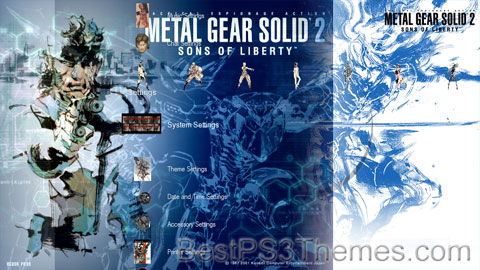
Hellsing theme by Tony (gaara1978)
Download: Hellsing_3.p3t

(4 backgrounds, HD only)
| Hellsing | |
| Genre | |
|---|---|
| Manga | |
| Written by | Kouta Hirano |
| Published by | Shōnen Gahōsha |
| English publisher | |
| Imprint | Young King Comics |
| Magazine | Young King OURs |
| Demographic | Seinen |
| Original run | April 30, 1997 – September 30, 2008 |
| Volumes | 10 |
| Anime television series | |
| Directed by |
|
| Written by | Chiaki J. Konaka |
| Music by | Yasushi Ishii |
| Studio | Gonzo |
| Licensed by | |
| Original network | Fuji TV |
| English network | |
| Original run | October 11, 2001 – January 17, 2002 |
| Episodes | 13 |
| Manga | |
| Hellsing: The Dawn | |
| Written by | Kouta Hirano |
| Published by | Shōnen Gahosha |
| Magazine | Young King OURs Zōkan |
| Demographic | Seinen |
| Original run | March 2002 – March 2006 |
| Original video animation | |
| Hellsing Ultimate | |
| Directed by |
|
| Produced by |
|
| Written by | |
| Music by | Hayato Matsuo |
| Studio |
|
| Licensed by | |
| Released | February 10, 2006 – December 26, 2012 |
| Runtime | 42–68 minutes |
| Episodes | 10 |
| Original video animation | |
| Hellsing: The Dawn | |
| Produced by | Hiroki Yoshioka |
| Music by | Hayato Matsuo |
| Studio | Graphinica |
| Released | July 27, 2011 – December 26, 2012 |
| Runtime | 6–9 minutes |
| Episodes | 3 |
Hellsing (stylized in all caps) is a Japanese manga series written and illustrated by Kouta Hirano. It was serialized in Shōnen Gahōsha's seinen manga magazine Young King OURs from April 1997 to September 2008, with its chapters collected in ten tankōbon volumes. The series chronicles the efforts of the mysterious and secret Hellsing Organization as it combats vampires, ghouls, and other supernatural foes who threaten England. The series was licensed for English language release in North America by Dark Horse Comics. From 2002 to 2006, Hirano released a six-chapter prequel series, Hellsing: The Dawn, in Young King OURs Zōkan (later Young King OURs+ before ceasing publication).
A thirteen-episode anime television series adaptation by Gonzo, directed by Umanosuke Iida and Yasunori Urata, with screenplay by Chiaki J. Konaka, was broadcast on Fuji TV from October 2001 to January 2002. A ten-episode original video animation (OVA), titled Hellsing Ultimate, was produced by Geneon. It followed the manga storyline more closely than the anime series.[5] It was released between February 2006 and December 2012. In North America, both the TV series and the OVA were first licensed by Geneon Entertainment and later by Funimation. Following the announcement that Funimation would be unified under the Crunchyroll brand, both Hellsing and Hellsing Ultimate were moved to the platform in 2022.
Plot[edit]
Hellsing is named after and centered around the Royal Order of Protestant Knights originally led by Abraham Van Helsing. The mission of Hellsing is to search for and destroy the undead and other supernatural forces of evil that threaten the queen and the country. This organization is currently led by Sir Integra Fairbrook Wingates Hellsing, who inherited the leadership of Hellsing as a child after the death of her father. She witnessed his death which turned her from a once innocent and shy little girl to a tough and deadly force. She is protected by the faithful Hellsing family butler Walter C. Dornez, a deadly foe in his own right, and Alucard, the original and most powerful vampire, who swore loyalty to the Hellsing family after being defeated by Van Helsing one hundred years before the story takes place. These formidable guardians are joined early on in the storyline by former police officer Seras Victoria, whom Alucard turned into a vampire.
As the scale and frequency of incidents involving the undead escalate in England and all around the world, Sir Integra discovers that the remnants of a Nazi group called Millennium still exist and are intent on reviving Nazi Germany by creating a battalion of vampires. Millennium, Hellsing, and the Vatican section XIII Iscariot clash in an apocalyptic three-sided war in London, and Millennium reveals its true objective: to destroy the vampire lord Alucard, ending a feud begun during World War II.
Production[edit]
In 1996, manga author Kouta Hirano published a one-shot, titled Hellsing: The Legends of Vampire Hunter, in Wanimagazine's hentai magazine Comic Kairakuten.[6][7] Hirano commented that it was not his intention to create a story of this genre, and that he only wanted to create a "somewhat daring" action story.[8] Hirano said that the original story did not take him long to create, and that the fact that he was drawing hentai at the time afforded him the opportunity to have it published.[9] Afterwards, Hirano considered to create another story, using the same setting, removing the erotic side and focusing more on the action, explaining that this was the origin of Hellsing. Given its "atypical" universe, Hirano and the publisher Shōnen Gahōsha decided to test the reception with readers, explaining that that was the reason why the start of the series may seem "a little disjointed", and that after the reception turned out to be positive, it was decided to make it a serialized work.[8]
Hirano stated that he wanted to make a story with gunplay, but that a story of vampires with guns would not work with Alucard being portrayed as a "formulaic vampire", so Hirano added him a hat and a long coat, stating: "[i]t's still dark and ominous, but just more suited to his behavior. I always come up with the characters before the story."[9] Hirano said that he received various comments comparing Alucard's design to Vash the Stampede from Trigun (whose continuation, Trigun Maximum, was also published in Young King OURs), expressing that he "shouldn't have given him the sunglasses".[10] Hirano said that, due to the "dark, desolate story", he wanted to create someone who made the series "a bit warmer" and a female character involved as well, so he created the character of Seras Victoria, who offered the opportunity "for both of those at the same time", adding that she is "the only one who stands out from the darkness."[9] Hirano commented that for the references to historical characters, mythology, and pop culture featured in the series, he did not do specific research, stating that he is not "someone with a lot of culture", but "just an otaku", and that all the references came from what he had seen and read out of "otaku passion".[8]
The anime producer, Yasuyuki Ueda, commented that for Hellsing Ultimate he wanted to make it as an original video animation (OVA) instead of a television series due to the time limit that implies the former, and since he was a fan of the series, he wanted to take more time to "get more out of my system from the manga", adding that the OVA allowed him to do much more than the TV series. He discussed it with writer Yōsuke Kuroda and he agreed to write the script. Ueda commented, at the time, that various series were using CG animation, which he said that was "very time-consuming", especially when incorporating it to traditional animation, but that since the project would be an OVA, they did have the "luxury" to work with it, and that he wanted to use it for the weaponry and bullets to make them look realistic.[9]
Media[edit]
Manga[edit]
Written and illustrated by Kouta Hirano, Hellsing was serialized for eleven years in Shōnen Gahōsha's seinen manga magazine Young King OURs from April 30, 1997,[a] to September 30, 2008.[13] Its 89 individual chapters were collected by Shōnen Gahōsha in ten tankōbon volumes, released from September 24, 1998,[14] to March 27, 2009.[15]
In North America, the series was licensed for English release by Dark Horse Comics in 2003.[16] The ten volumes were released from December 1, 2003,[17] to May 19, 2010.[18] In January 2020, Dark Horse Comics announced that they would re-release the series in a three-volume deluxe edition, with over 600 pages each.[19] The volumes were released from July 15, 2020, to June 16, 2021.[20][21][22]
Chuang Yi licensed the series in English in Singapore.[23] Madman Entertainment released the series in Australia and New Zealand.[24]
Crossfire[edit]
Crossfire is a three-chapter one-shot story, which was published in the defunct Hobby Japan's magazine Comic Master.[10] It follows Heinkel Wolfe and Yumie Takagi, a Catholic nun and an assassin who work for the Iscariot organization. They call themselves "earthly agents of divine punishment". Crossfire also has cameos by Alexander Anderson and Enrico Maxwell, the head of Iscariot. Across the three chapters, Heinkel and Yumie face a variety of opposition, including Islamic terrorists, communist revolutionaries, and finally, an obscure pagan cult. Crossfire as a side work was discontinued by Kouta Hirano, but it was republished in the first three volumes of Hellsing as an extra. Crossfire was adapted into a drama CD and included in Hellsing Ultimate OVA 6 and 7.
Hellsing: The Dawn[edit]
A prequel series, titled Hellsing: The Dawn, was published Young King OURs Zōkan (later Young King OURs+ before being discontinued),[25] with six chapters released from the March 2002 to the March 2006 issues;[26] the series remains incomplete.[6] The Dawn features a fourteen-year-old Walter C. Dornez and Alucard, in the form of a young girl, attacking Millennium's base of operations in Nazi-controlled Poland in September 1944, during the Warsaw Uprising.
Anime[edit]
The manga was adapted into a thirteen-episode anime television series by Gonzo. The series was directed by Yasunori Urata, under the chief direction of Umanosuke Iida, and written by Chiaki J. Konaka.[27] The series uses the same characters and settings, but narrates a different story from its source manga.[28] It was broadcast on Fuji TV from October 11, 2001, to January 17, 2002.[27] The series opening theme is "Logos Naki World" (ロゴスなきワールド, Rogosu Naki Wārudo, "A World Without Logos") by Yasushi Ishii and the ending theme is "Shine" by Mr. Big.[27]
In North America, the series was first licensed by Pioneer Entertainment (later Geneon USA).[29] Four DVD sets were released between July 23, 2002,[30] and January 21, 2003.[31] The series was broadcast in the United States on Starz!'s Encore Action channel, as part of its Animidnight late night programming block, starting in October 2003.[32][33] The series was later acquired by Funimation in 2010;[34] they released the series on a complete DVD set on November 13, 2012.[35] Following the announcement that Funimation would be unified under the Crunchyroll brand, the series was moved to the platform in 2022.[36]
In the United Kingdom, the series was first licensed by ADV Films, who released four DVDs from July 21, 2003,[37] to January 19, 2004.[38] The series was later licensed by Manga Entertainment and released on a four-disc box set on August 12, 2013.[39] In Australia and New Zealand, the series was licensed by Madman Entertainment, who released four DVDs from November 13, 2002, and February 11, 2003.[40]
Original video animation[edit]

In April 2005, it was announced that a new original video animation (OVA) adaptation, titled Hellsing Ultimate (still known simply as Hellsing in Japan), more faithful to the original manga than the TV series, would be released by Geneon Entertainment in Japan and North America.[41] The first four episodes of the OVA were animated by Satelight, directed by Tomokazu Tokoro, and written by Yōsuke Kuroda;[42] they were released from February 10, 2006,[43] to February 22, 2008.[44] The three following episodes (5–7) were animated by Madhouse, directed by Hiroyuki Tanaka and written by Kuroda; they were released from November 21, 2008,[45] to December 23, 2009.[46] The three last episodes (8–10) were animated by Graphinica,[47] directed by Yasuhiro Matsumura (8, 10) and Kenichi Suzuki (9 and 10), and written by Kuroda;[48][49][50] they were released from July 27, 2011,[51] to December 26, 2012.[52] Each limited edition of the last three episodes' home video release included an episode of Hellsing: The Dawn.[53][54][55]
In North America, Geneon Entertainment released the first three episodes from December 5, 2006,[56] to October 16, 2007.[57] Geneon announced that they would stop self-distribution of its titles in 2007.[58] The first two episodes were broadcast on Starz Edge's Animidnight programming block on February 12, 2008;[59][60] episodes 3 and 4 were also announced to air,[61] however, the fourth episode was not ready with an English-language track at the time and they were not broadcast.[62] In 2008, Funimation announced that they would distribute "select" Geneon titles,[63] and re-released the first three episodes of Hellsing Ultimate on September 16 of the same year,[64] along with the fourth episode on September 23.[65] In 2010, Funimation announced that they had licensed episodes 5–7;[66] in 2011, they announced that they had licensed the 8th episode as well.[67] Funimation re-released the first four episodes on DVD/Blu-ray Disc sets on October 30, 2012,[68] while episodes 5–8 were released on the same formats on November 13 of the same year.[35] Episodes 9–10 were released on October 28, 2014.[69][70][71] The series was broadcast on Adult Swim's Toonami programming block from September 13 to December 13, 2014.[72][73] Funimation released all the episodes on a Blu-ray Disc set on June 4, 2019.[74][75] Following the announcement that Funimation would be unified under the Crunchyroll brand, Hellsing Ultimate was moved to the platform in 2022.[36]
Soundtracks[edit]
The music of the Hellsing anime television series was composed by Yasushi Ishii. Two soundtrack CDs were released: Raid was released on November 22, 2001;[76] and Ruins was released on February 22, 2002.[77] In North America, both CDs were released on July 1 and September 2, 2003, respectively.[78][79]
The music of Hellsing Ultimate was composed by Hayato Matsuo. An extra CD, titled Warsaw Recording Selection, was released with the limited edition of the fourth episode on February 22, 2008.[80] The original, Black Dog, was released on March 21, 2008;[81] An extra CD, titled Nazi CD, was released with the limited edition of the first Blu-ray box set on October 22, 2010.[82] An extra CD, titled Somehow, Iscariote, was released with the limited edition of the second Blu-ray box set on April 1, 2015.[83]
Live-action film[edit]
In March 2021, it was announced that Amazon Studios is developing a live-action film adaptation of Hellsing with scripts by Derek Kolstad. It will be produced by Kolstad, Automatik's Brian Kavanaugh-Jones and Fred Berger, Ranger 7 Films's Mike Callaghan and Reuben Liber, and Soluble Fish Productions' Jason Lust.[84]
Reception[edit]
The ten volumes of the Hellsing manga have sold 4 million copies worldwide.[85] In 2005, the sixth and seventh volumes ranked among Diamond Comics Distributors' list of the top 48 manga volumes sold in the United States for the year.[86] In November 2007, the ninth volume was among the top 10 volumes sold according to Japan's monthly sales rankings.[87][88]
In a review of the first volume, Winnie Chow of Animerica commented that the English translation "works to enhance the locations and people of the story", and noted that the original manga contains more comedy elements than its anime adaptation. Chow said that the series' violence is "everywhere, which is only to be expected when one is in the occupation of undead extermination", and that the characters are "magnificent to behold in action when they get into a frenzy, from crushing heads beneath their boot heels to impaling an enemy with an untold number of blessed blades", ultimately stating that Hirano "does violence right".[89] Reviewing the first volume, Publishers Weekly called the series "mostly a fun, violent romp", stating that the "rather awkward" religious sparring between the Catholic Church and Hellsing, are "goofy details" that give it "some charm and energy". They concluded: "Hirano's storytelling is easy to follow, as stylish close-ups of the "we're-groovy-and-we-know-it" characters explode into violent full-page illustrations of all-out mayhem."[90] In a review of the first volume, Barb Lien-Cooper of Sequential Tart gave it a 7 out of 10, commending the series for its worldbuilding and pacing, but criticizing the "repetitive violence", stating: "[y]ou've seen one blown off head, you've seen 'em all."[91] Reviewing the first volume, Justin Rich of AnimeOnDVD gave it a B− grade. Rich commented that the series is consistent with the action, and while he stated that the first volume does not have a "real sense of a continuing arc", "orders here are very enjoyable", and concluded: "[s]itting down and spending some time with the blasé Alucard makes me look forward to the next volume."[92] Connie C. of Slightly Biased Manga, in her review of the first volume, said: "[i]t's got just the right amount of blood and violence, great art, and I like everything about this series", concluding: "[r]ead it if you're in to this sort of thing, I promise you'll love it if you're not offended."[93]
Reviewing the fourth volume, Liann Cooper of Anime News Network (ANN) said that one its "greatest strengths" is the impeccable storytelling of Hirano, calling the story "dark and gory", but also "incredibly amusing". Cooper concluded: "[c]ombined with highly detailed artwork and near flawless character designs, every action-packed, blood-spewing battle to each eerie character expression completes one of the most well-rounded manga series I've had the pleasure of reading. This is one horrifically enticing vampire series that you can't afford to miss."[94] Hilary Goldstein of IGN, in a review of the sixth volume, called it "the best vampire manga around", and that it "clamors forward with a seething wit and a frantic pace, and style that passes beyond gothic grace."[95] Reviewing the first volume, Ryan Huston of Manga Life gave the first volume a C− grade. Huston wrote that the series "borrow heavily" from the stylistic elements of Blade, Castlevania, The Crow, and BloodRayne,[b] also calling it "very contrived", stating that "there's nary of whiff of originality", and criticizing the "inconsistent" artwork.[96] In a more positive review of the eighth volume, Lori Henderson of the same website gave it an A grade. Henderson wrote: "I generally don't read blood-spilling horror manga, but for Hellsing, I make an exception", stating that she was "instantly hooked" by the series, concluding: "Hellsing is a title that totally lives up to its hype. The art is fantastic, and the story strings you along just enough to keep you coming back for more."[97] Also reviewing the eighth volume, Katherine Dacey of PopCultureShock gave it a B+ grade. Dacey said that the plot of the volume is "absurd", but that "Hirano's bold visuals, insane plot twists, and extended action sequences make for an entertaining read, even when the plot makes absolutely no sense at all."[98]
Reviewing the tenth and final volume, Davey C. Jones of Active Anime commented that it "doesn't disappoint but it is always sad to see such a great series come to an end", also expressing that the series has a "unique style and an awesome, mind bending anti-hero in Alucard", concluding that it is "hard not to keep from wanting more."[99] Reviewing the same volume, Connie C., writing for PopCultureShock, gave it a B grade. She commented that the series is "ridiculous, violent, over-the-top, and absolutely revels in its debauchery", and called the epilogue "a little underwhelming", but stated, however, concludedt: "[i]t was violent and action-packed in the most extreme way possible all the way through and quiet moments feel out of place. It revels in depravity and does it better and marginally more coherently than most other series that try it. It's a true legend to the end."[100] Carl Kimlinger of ANN gave the final volume a B grade. Kimlinger criticized its ending, stating that the final arc "finishes it in an undignified rush", and that it "falls back on some insultingly overused anime cheese to expedite its finish." Kimlinger, however, wrote that "a tired, rushed Hellsing is still Hellsing", adding that "[t]here's still enough demented ultraviolence and bizarre indulgences on display to shame all but the most transgressive of other manga."[101]
Courtney Kraft of Graphic Novel Reporter said that one of the series' appeal is that "every cast member is very one-dimensional, and yet each is unique, interesting, and memorable", not only commending the main cast
Tomb Raider Anniversary HD
Tomb Raider Anniversary HD theme by Tutu
Download: TombRaiderAnniversaryHD.p3t
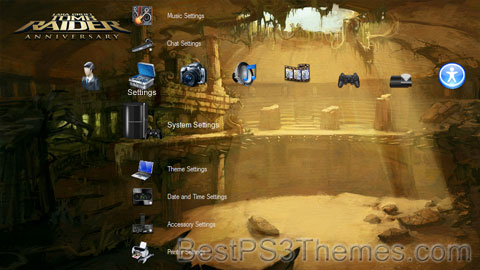
(4 backgrounds, HD only)
P3T Unpacker v0.12
Copyright (c) 2007. Anoop Menon
This program unpacks Playstation 3 Theme files (.p3t) so that you can touch-up an existing theme to your likings or use a certain wallpaper from it (as many themes have multiple). But remember, if you use content from another theme and release it, be sure to give credit!
Download for Windows: p3textractor.zip
Instructions:
Download p3textractor.zip from above. Extract the files to a folder with a program such as WinZip or WinRAR. Now there are multiple ways to extract the theme.
The first way is to simply open the p3t file with p3textractor.exe. If you don’t know how to do this, right click the p3t file and select Open With. Alternatively, open the p3t file and it will ask you to select a program to open with. Click Browse and find p3textractor.exe from where you previously extracted it to. It will open CMD and extract the theme to extracted.[filename]. After that, all you need to do for any future p3t files is open them and it will extract.
The second way is very simple. Just drag the p3t file to p3textractor.exe. It will open CMD and extract the theme to extracted.[filename].
For the third way, first put the p3t file you want to extract into the same folder as p3textractor.exe. Open CMD and browse to the folder with p3extractor.exe. Enter the following:
p3textractor filename.p3t [destination path]Replace filename with the name of the p3t file, and replace [destination path] with the name of the folder you want the files to be extracted to. A destination path is not required. By default it will extract to extracted.filename.
GTA4 CoD4
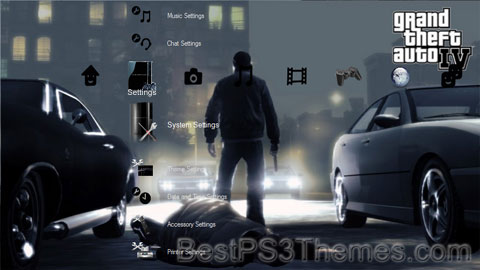
GTA4 CoD4 theme by loann44
Download: GTA4CoD4.p3t

(14 backgrounds)
P3T Unpacker v0.12
Copyright (c) 2007. Anoop Menon
This program unpacks Playstation 3 Theme files (.p3t) so that you can touch-up an existing theme to your likings or use a certain wallpaper from it (as many themes have multiple). But remember, if you use content from another theme and release it, be sure to give credit!
Download for Windows: p3textractor.zip
Instructions:
Download p3textractor.zip from above. Extract the files to a folder with a program such as WinZip or WinRAR. Now there are multiple ways to extract the theme.
The first way is to simply open the p3t file with p3textractor.exe. If you don’t know how to do this, right click the p3t file and select Open With. Alternatively, open the p3t file and it will ask you to select a program to open with. Click Browse and find p3textractor.exe from where you previously extracted it to. It will open CMD and extract the theme to extracted.[filename]. After that, all you need to do for any future p3t files is open them and it will extract.
The second way is very simple. Just drag the p3t file to p3textractor.exe. It will open CMD and extract the theme to extracted.[filename].
For the third way, first put the p3t file you want to extract into the same folder as p3textractor.exe. Open CMD and browse to the folder with p3extractor.exe. Enter the following:
p3textractor filename.p3t [destination path]Replace filename with the name of the p3t file, and replace [destination path] with the name of the folder you want the files to be extracted to. A destination path is not required. By default it will extract to extracted.filename.
Haze and Company
Haze and Company theme by Louxx
Download: HazeandCompany.p3t
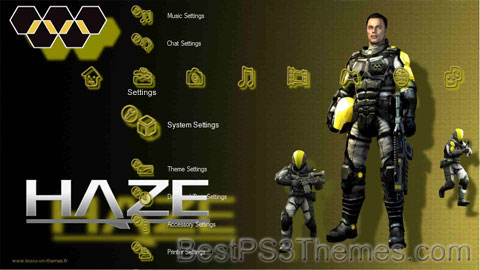
(5 backgrounds)
P3T Unpacker v0.12
Copyright (c) 2007. Anoop Menon
This program unpacks Playstation 3 Theme files (.p3t) so that you can touch-up an existing theme to your likings or use a certain wallpaper from it (as many themes have multiple). But remember, if you use content from another theme and release it, be sure to give credit!
Download for Windows: p3textractor.zip
Instructions:
Download p3textractor.zip from above. Extract the files to a folder with a program such as WinZip or WinRAR. Now there are multiple ways to extract the theme.
The first way is to simply open the p3t file with p3textractor.exe. If you don’t know how to do this, right click the p3t file and select Open With. Alternatively, open the p3t file and it will ask you to select a program to open with. Click Browse and find p3textractor.exe from where you previously extracted it to. It will open CMD and extract the theme to extracted.[filename]. After that, all you need to do for any future p3t files is open them and it will extract.
The second way is very simple. Just drag the p3t file to p3textractor.exe. It will open CMD and extract the theme to extracted.[filename].
For the third way, first put the p3t file you want to extract into the same folder as p3textractor.exe. Open CMD and browse to the folder with p3extractor.exe. Enter the following:
p3textractor filename.p3t [destination path]Replace filename with the name of the p3t file, and replace [destination path] with the name of the folder you want the files to be extracted to. A destination path is not required. By default it will extract to extracted.filename.
Metal Gear Solid 2
Cincinatti Bengals
Cincinatti Bengals theme by Godfather1
Download: CincinattiBengals.p3t

(7 backgrounds)
Redirect to:
- From a misspelling: This is a redirect from a misspelling or typographical error. The correct form is given by the target of the redirect.
- This redirect is made available to aid searches. Pages that use this link should be updated to link directly to the target without the use of a piped link that hides the correct details.
- This template tags redirects with a subcategory of the Redirects from incorrect names category, so template {{R from incorrect name}} should not be used with this template.
University of Hawaii Warriors
University of Hawaii Warriors theme by chawan
Download: UniversityofHawaiiWarriors.p3t
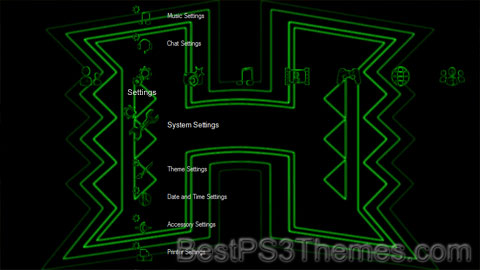
(7 backgrounds)
P3T Unpacker v0.12
Copyright (c) 2007. Anoop Menon
This program unpacks Playstation 3 Theme files (.p3t) so that you can touch-up an existing theme to your likings or use a certain wallpaper from it (as many themes have multiple). But remember, if you use content from another theme and release it, be sure to give credit!
Download for Windows: p3textractor.zip
Instructions:
Download p3textractor.zip from above. Extract the files to a folder with a program such as WinZip or WinRAR. Now there are multiple ways to extract the theme.
The first way is to simply open the p3t file with p3textractor.exe. If you don’t know how to do this, right click the p3t file and select Open With. Alternatively, open the p3t file and it will ask you to select a program to open with. Click Browse and find p3textractor.exe from where you previously extracted it to. It will open CMD and extract the theme to extracted.[filename]. After that, all you need to do for any future p3t files is open them and it will extract.
The second way is very simple. Just drag the p3t file to p3textractor.exe. It will open CMD and extract the theme to extracted.[filename].
For the third way, first put the p3t file you want to extract into the same folder as p3textractor.exe. Open CMD and browse to the folder with p3extractor.exe. Enter the following:
p3textractor filename.p3t [destination path]Replace filename with the name of the p3t file, and replace [destination path] with the name of the folder you want the files to be extracted to. A destination path is not required. By default it will extract to extracted.filename.
Bleach versionD 02
Bleach versionD 02 theme by Deemy
Download: Bleach_versionD02.p3t
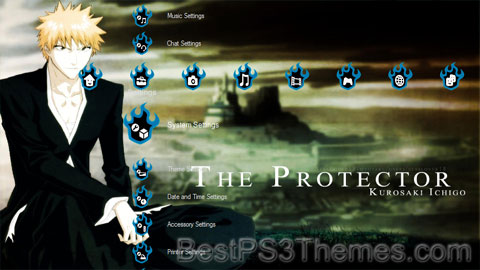
(16 backgrounds)
P3T Unpacker v0.12
Copyright (c) 2007. Anoop Menon
This program unpacks Playstation 3 Theme files (.p3t) so that you can touch-up an existing theme to your likings or use a certain wallpaper from it (as many themes have multiple). But remember, if you use content from another theme and release it, be sure to give credit!
Download for Windows: p3textractor.zip
Instructions:
Download p3textractor.zip from above. Extract the files to a folder with a program such as WinZip or WinRAR. Now there are multiple ways to extract the theme.
The first way is to simply open the p3t file with p3textractor.exe. If you don’t know how to do this, right click the p3t file and select Open With. Alternatively, open the p3t file and it will ask you to select a program to open with. Click Browse and find p3textractor.exe from where you previously extracted it to. It will open CMD and extract the theme to extracted.[filename]. After that, all you need to do for any future p3t files is open them and it will extract.
The second way is very simple. Just drag the p3t file to p3textractor.exe. It will open CMD and extract the theme to extracted.[filename].
For the third way, first put the p3t file you want to extract into the same folder as p3textractor.exe. Open CMD and browse to the folder with p3extractor.exe. Enter the following:
p3textractor filename.p3t [destination path]Replace filename with the name of the p3t file, and replace [destination path] with the name of the folder you want the files to be extracted to. A destination path is not required. By default it will extract to extracted.filename.
Christina Aguilera #3
Christina Aguilera theme by Tony (gaara1978)
Download: ChristinaAguilera_3.p3t
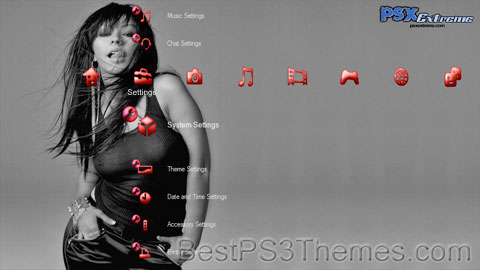
(3 backgrounds, HD only)
Christina Aguilera | |
|---|---|
Aguilera in 2023 | |
| Born | Christina María Aguilera December 18, 1980 New York City, US |
| Other names |
|
| Occupations |
|
| Years active | 1993–present |
| Organization | |
| Works | |
| Spouse |
Jordan Bratman
(m. 2005; div. 2011) |
| Partner | Matthew Rutler (eng. 2014) |
| Children | 2 |
| Awards | Full list |
| Musical career | |
| Genres | |
| Instruments | Vocals |
| Labels | |
| Website | christinaaguilera |
| Signature | |
Christina María Aguilera (/ˌæɡɪˈlɛərə/ AG-il-AIR-ə, Spanish: [kɾisˈtina maˈɾi.a aɣiˈleɾa];[1] born December 18, 1980) is an American singer, songwriter, actress, and television personality. Referred to as the "Voice of a Generation", she is noted for her four-octave vocal range, musical reinventions, sustaining high notes including use of the whistle register, and a signature use of melisma throughout her music. Recognized as an influential figure in popular music, she also became known for incorporating controversial themes such as feminism, sexuality, LGBT culture and the sex-positive movement into her work. Aguilera was also honoured as a Disney Legend, for her contributions to The Walt Disney Company.
After appearing on The All-New Mickey Mouse Club (1993–1994) as a child, Aguilera recorded "Reflection", the theme for the 1998 animated film Mulan and signed a record deal with RCA Records. She rose to fame in 1999 with her self-titled debut album and the US Billboard Hot 100 number-one singles, "Genie in a Bottle", "What a Girl Wants" and "Come On Over Baby (All I Want Is You)". Aguilera also won the Grammy Award for Best New Artist and followed with Mi Reflejo (2000) and My Kind of Christmas (2000); with the former becoming the best-selling Latin pop album of 2000. After gaining more control over her career, Aguilera sought a departure from her teen idol image and released Stripped (2002), which initially had a mixed response. The album later became one of the best-selling albums of the 21st century. Aguilera underwent another reinvention with the release of the critically praised old-school-music inspired Back to Basics (2006). Throughout these periods, she amassed numerous international successes, including the number-one single "Lady Marmalade", alongside "Beautiful", "Dirrty", "Can't Hold Us Down", "Fighter", "Ain't No Other Man" and "Hurt".
Throughout the early 2010s, Aguilera had a moderately successful period with the albums Bionic (2010) and Lotus (2012), with their respective lead singles, "Not Myself Tonight" and "Your Body", topping the US Dance Club Songs chart. She also starred in the 2010 film Burlesque and contributed to its soundtrack, earning a Golden Globe Award nomination. Aguilera returned to the top of the charts with a string of collaborations, including "Feel This Moment", "Say Something", and "Moves like Jagger"; with the latter reaching number-one on the Hot 100, making Aguilera one of the few artists to reach the top spot over three decades. She found critical success with her follow-up albums Liberation (2018) and Aguilera (2022). Her concurrent ventures included a role in the series Nashville (2015), roles in the films The Emoji Movie (2017) and Zoe (2018), becoming an ambassador for the World Food Programme (WFP), performing two concert residencies, co-founding the company Playground, and serving as a coach on the reality competition show The Voice (2011–2016).
Aguilera is one of the best-selling music artists of all time, with estimated sales of over 90 million records sold worldwide.[2] Considered a pop culture icon and a triple threat entertainer, she has been named one of the greatest vocalists of all time by publications such as Rolling Stone and Consequence of Sound and has been hailed as one of the most successful artists to come out of the 2000s. In 2009, Billboard named her the twentieth most successful artist of the decade, and was ranked eighth on VH1's list of greatest women in music. Aguilera has since been regarded as one of the most influential Latin artists in the entertainment industry, having helped shape the "Latin explosion" in the music industry. Her accolades include five Grammy Awards, two Latin Grammy Awards, six ALMA Awards, two MTV Video Music Awards (VMA), one Billboard Music Award, one Guinness World Record, and a star on the Hollywood Walk of Fame.
Early life and education[edit]
Christina María Aguilera was born on December 18, 1980, in New York City, to Shelly Loraine (née Fidler) and Fausto Wagner Xavier Aguilera.[3] Her father is an Ecuadorian emigrant from Guayaquil while her mother has German, Irish, Welsh, and Dutch ancestry.[4][5] Fausto Aguilera was a United States Army sergeant, and Shelly Loraine was a violinist in the American Youth Symphony before becoming a Spanish translator.[6][7]
Due to Fausto's military service, Aguilera's family moved frequently, living in New Jersey and Texas.[8] In 1983, they moved to Japan and lived in Sagamihara for at least two years.[9] During her youth in Pittsburgh metropolitan area, Aguilera attended North Allegheny Intermediate High School before leaving there to be homeschooled to avoid bullying she experienced at school.[10][11]
In 1986, the family returned to the United States, and settled in Pennsylvania, where they welcomed her younger sister, Rachel, in 1986.[12] Aguilera has spoken out about her father's physically and emotionally abusive behavior.[13] She noted that this is what made her turn to music, noting that, "growing up in an unstable environment and whatnot, music was my only real escape".[14] In 1987, Shelly filed to divorce Fausto and moved with Aguilera and Rachel to her mother's home in Rochester, a suburb of Pittsburgh.[15] She later married James Kearns with whom she had a son named Michael.[16] In 2012, following decades of estrangement, Aguilera expressed interest in reconciling with her biological father.[17]
Aguilera moving to her grandmother's home allowed her to explore her grandmother's records, which featured mostly soul and blues singers and increased her interest in music.[18] She also began to practice singing in public and competing in talent contests.[19] Following numerous contests, she earned reputation in her neighborhood as the "little girl with a big voice" and received widespread attention from local television and radio programs.[20][21]
In 1990, she performed the popular song "A Sunday Kind of Love" on the reality competition show Star Search, but was eliminated during the semi-final round.[22] Aguilera was eventually invited to sing "The Star-Spangled Banner" before Pittsburgh Penguins hockey, Pittsburgh Steelers football, and Pittsburgh Pirates baseball games, and at the 1992 Stanley Cup Finals.[23][24]
Career[edit]
1993–1998: Career beginnings[edit]
In 1991, Aguilera auditioned for a position on The All-New Mickey Mouse Club (MMC), aired on the Disney Channel. She ran against 400 candidates, and while she made the shortlist she was ultimately rejected for not meeting the minimum age requirement.[25] One year later, in 1992, Aguilera received a call from one of the show's producers asking if she was still interested in becoming a "Mouseketeer". She once again competed for a spot (this time, against 15,000 candidates) and was selected to join the variety program the following year.[26] Her fellow cast members included Ryan Gosling, Keri Russell, Britney Spears, and Justin Timberlake.[27] During the show recordings—which included Aguilera performing musical numbers and comedy sketches—she moved with her family to Orlando, Florida.[28] In 1994, it was reported the series would not return for a new season.[29]
Aiming to begin a music career, Aguilera moved to Japan in 1997. She was selected to record a duet with Japanese singer Keizo Nakanishi, with whom she performed in concert shows around the country.[30] Their song, "All I Wanna Do", was released as a single but failed to reach commercial success.[20] In June 1997, Aguilera went on to Romania to represent the United States in a singers contest during the Golden Stag Festival, but she failed to win over the audience.[31]
Seeking a recording contract, Aguilera recorded numerous demo tapes directed to record labels, including Walt Disney Records, for which she sent a cover of "Run to You" by Whitney Houston.[32] She eventually was chosen to record "Reflection", the theme song from the animated film Mulan (1998), which reached number 15 on the Billboard Adult Contemporary chart.[33] Following the attention she received with "Reflection", Aguilera caught the ear of Ron Fair, the A&R executive from RCA Records, who consequently signed Aguilera to the label.[8] In late 1998, she began to record her debut studio album into which producers reportedly invested over $1 million worth of writers, producers and vocal lessons.[8]
1999–2001: Breakthrough with debut album[edit]
In May 1999, Aguilera released "Genie in a Bottle", the lead single off her long-awaited debut album, which topped the Billboard Hot 100 for five consecutive weeks and became the second best-selling single of 1999.[34] The song became an international success, increasing Aguilera's popularity worldwide, topping the charts in over 20 countries.[35] The single also attracted the attention of conservatives including celebrities such as Debbie Gibson that spoke out against its lyrical content, and was eventually considered "too provocative" to be sung by a teen idol.[36][37] Due to the criticism, Radio Disney replaced the song with a censored version.[38] The song was nominated for a Grammy Award for Best Female Pop Vocal Performance.[39]
Aguilera's self-titled debut album, Christina Aguilera, was released on August 24, 1999, to critical praise, debuting at number one on the Billboard 200.[40] It catapulted Aguilera into fame globally and sold over ten million copies in its first year.[41] It was later certified eight times platinum by the Recording Industry Association of America (RIAA),[42] and it has sold over 17 million copies worldwide.[43][44] Originally, Aguilera's desire was to create material directly inspired by R&B and soul, but the label opted for a more teen pop production due the genre's high financial return in the late 1990s.[45] At the 42nd Annual Grammy Awards, Aguilera won the Best New Artist category for which Time credited the award for "[helping] certify her credentials as a real singer".[46]
I was completely blown away, shocked, overwhelmed and thrilled. I didn't expect it. I've dreamed of that since I was eight years old. I was rambling off the top of my head, my knees were shaking and I'm still floating on air because of it!
—Aguilera on winning Best New Artist at the 42nd Annual Grammy Awards.[47]
After the album's release, "What a Girl Wants", topped the Hot 100 and is recognised as the first new number one entry on the chart for the 2000's decade.[48] The song was also nominated for Best Female Pop Vocal Performance at the 43rd Annual Grammy Awards.[48] This was followed with "I Turn to You" which reached number three there,[40] and "Come On Over Baby (All I Want Is You)" which became Aguilera's third number one song and achieved worldwide success.[49] She also released a cover of "The Christmas Song" in November 1999 which peaked at number 18 and became the second highest charting position of the song after the original in 1944.[50]
In May 2000, Aguilera embarked on her debut concert tour, Christina Aguilera in Concert, which toured North America, Latin America, Europe, and Japan until February 2001.[51][52] Her success continued to rise with the release of her second studio album, Mi Reflejo, in September 2000 which topped both the Billboard Top Latin Albums and Latin Pop Albums for nineteen consecutive weeks.[53] The album featured Spanish-language versions of several songs from her debut album along with new songs, and had Latin pop themes.[54] Three singles were release for the album including the Spanish version of "Come On Over Baby (All I Want Is You)" titled "Ven Conmigo (Solamente Tú)", "Pero Me Acuerdo de Ti" and "Falsas Esperanzas".[55] The latter two were performed at the 43rd Annual Grammy Awards.[56] The album went on to be the best-selling Latin pop album of 2000 and was later certified six times Latin platinum by the RIAA.[28][57] Mi Reflejo also reached the platinum stats in Argentina, Mexico, and Spain.[58] At the 2nd Annual Latin Grammy Awards, the album won Best Female Pop Vocal Album.[59]
In October 2000, Aguilera also released her third studio album, My Kind of Christmas, her first Christmas album, which reached number one on the US Top Holiday Albums chart.[60][61] The album received generally polarized reviews at the time but has since gone on to retrospectively receive praise.[62] Aguilera starred in a holiday special, My Reflection, which aired on December 3, 2000, on ABC.[63] Aguilera's commercial success saw her being named the 2000 Top Female Pop Act by Billboard.[64] The same year, she also filed a fiduciary duty against manager Steve Kurtz for "improper, undue, and inappropriate influence over her professional activities".[65] She eventually hired Irving Azoff to manage her career, aiming for control of her career and image.[65]
On January 16, 2001, Aguilera featured on Ricky Martin's "Nobody Wants to Be Lonely", which topped charts internationally and peaked at number 13 on the Hot 100, becoming her fifth top-20 hit in the US.[66][67] The song was ranked at number 65 on VH1's "100 Greatest Love Songs",[68] and was nominated for Best Pop Collaboration with Vocals at the 44th Annual Grammy Awards.[69] In April of that year, Aguilera featured alongside Lil' Kim, Mýa, and Pink on "Lady Marmalade" from the soundtrack for the film, Moulin Rouge! (2001).[70] The song received positive reviews and topped the Hot 100 for five consecutive weeks, becoming Aguilera's fourth number one.[71][72] The song also won the Grammy Award for Best Pop Collaboration with Vocals and the MTV Video Music Award for Video of the Year.[73]
In August 2001, Warlock Records released Just Be Free, a demo album recorded by Aguilera between 1994 and 1995 while she was looking for a recording deal following the end of The All-New Mickey Mouse Club (MMC).[74] She filed a suit against the label and the album's producers aiming to stop the release of the album; however, both parties came to a confidential settlement to release the album, in which Aguilera lent out her name, likeness, and image for an unspecified amount of damages.[75]
2002–2004: New image with Stripped[edit]
With a new management, Aguilera started moving away from her teen pop niche and began working on a new project.[76] She cultivated a new image by adopting the alter ego Xtina, dyeing her hair black, and sporting several tattoos and body piercings.[77] Aguilera's new persona was widely criticized by media outlets.[78][79][80] In September 2002, she released the controversial song, "Dirrty", which garnered mixed reviews and peaked as number 48 on Billboard Hot 100.[45] The song's accompanying music video generated controversy for depicting overtly sexual fetishes,[81] and attracted the attention of conservative organizations and moralists who sought to have the video banned on MTV.[82] The video also sparked protests in Thailand and was eventually banned on the country's local television.[83][84] "Dirrty" topped the charts in the UK and Ireland,[85] and has gone on to become a cult classic.[86]

Eureka Seven War
Eureka Seven War theme by Octupus8
Download: EurekaSevenWar.p3t
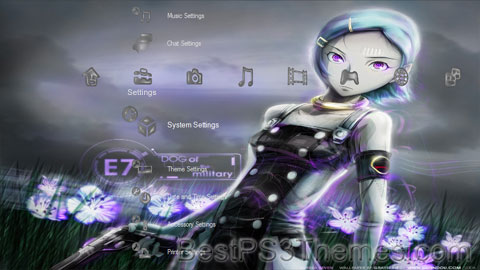
(3 backgrounds)
P3T Unpacker v0.12
Copyright (c) 2007. Anoop Menon
This program unpacks Playstation 3 Theme files (.p3t) so that you can touch-up an existing theme to your likings or use a certain wallpaper from it (as many themes have multiple). But remember, if you use content from another theme and release it, be sure to give credit!
Download for Windows: p3textractor.zip
Instructions:
Download p3textractor.zip from above. Extract the files to a folder with a program such as WinZip or WinRAR. Now there are multiple ways to extract the theme.
The first way is to simply open the p3t file with p3textractor.exe. If you don’t know how to do this, right click the p3t file and select Open With. Alternatively, open the p3t file and it will ask you to select a program to open with. Click Browse and find p3textractor.exe from where you previously extracted it to. It will open CMD and extract the theme to extracted.[filename]. After that, all you need to do for any future p3t files is open them and it will extract.
The second way is very simple. Just drag the p3t file to p3textractor.exe. It will open CMD and extract the theme to extracted.[filename].
For the third way, first put the p3t file you want to extract into the same folder as p3textractor.exe. Open CMD and browse to the folder with p3extractor.exe. Enter the following:
p3textractor filename.p3t [destination path]Replace filename with the name of the p3t file, and replace [destination path] with the name of the folder you want the files to be extracted to. A destination path is not required. By default it will extract to extracted.filename.