Metal Gear Solid #6

Metal Gear Solid theme by DecipleofSnake

Download: MGS_6.p3t
Metal Gear Solid Theme 6
(1 background)

Redirect to:

  • With possibilities: This is a redirect from a title that potentially could be expanded into a new article or other type of associated page such as a new template. The topic described by this title may be more detailed than is currently provided on the target page or in a section of that page.
    • When the target page becomes too large, or for any reason a new page would be an improvement, this redirect may be replaced with an article, template or other project page that is carved out of the target page. See also {{R to section}} and use together with this rcat when appropriate.
    • If the topic of the redirect is not susceptible to expansion, then use other rcats such as {{R to section}} or {{R to list entry}} when appropriate.
    • Since a new page may be created, links to this redirect should not be replaced with a direct link to the target page. To make redirects to this page, use {{R avoided double redirect}}.
    • {{R printworthy}} should be used together with this template when applied to a redirect in mainspace.
    • When used on a template redirect, it will automatically populate Category:Template redirects with possibilities.

Christina Aguilera #2

Christina Aguilera theme by Jana

Download: ChristinaAguilera_2.p3t
Christina Aguilera Theme 2
(9 backgrounds)

Christina Aguilera
Aguilera in 2023
Born
Christina María Aguilera

(1980-12-18) December 18, 1980 (age 43)
New York City, US
Other names
  • Xtina
Occupations
  • Singer
  • songwriter
  • actress
  • television personality
Years active1993–present
Organization
Works
Spouse
Jordan Bratman
(m. 2005; div. 2011)
PartnerMatthew Rutler (eng. 2014)
Children2
AwardsFull list
Musical career
Genres
InstrumentsVocals
Labels
Websitechristinaaguilera.com
Signature

Christina María Aguilera (/ˌæɡɪˈlɛərə/ AG-il-AIR, Spanish: [kɾisˈtina maˈɾi.a aɣiˈleɾa];[1] born December 18, 1980) is an American singer, songwriter, actress, and television personality. Referred to as the "Voice of a Generation", she is noted for her four-octave vocal range, musical reinventions, sustaining high notes including use of the whistle register, and a signature use of melisma throughout her music. Recognized as an influential figure in popular music, she also became known for incorporating controversial themes such as feminism, sexuality, LGBT culture and the sex-positive movement into her work. Aguilera was also honoured as a Disney Legend, for her contributions to The Walt Disney Company.

After appearing on The All-New Mickey Mouse Club (1993–1994) as a child, Aguilera recorded "Reflection", the theme for the 1998 animated film Mulan and signed a record deal with RCA Records. She rose to fame in 1999 with her self-titled debut album and the US Billboard Hot 100 number-one singles, "Genie in a Bottle", "What a Girl Wants" and "Come On Over Baby (All I Want Is You)". Aguilera also won the Grammy Award for Best New Artist and followed with Mi Reflejo (2000) and My Kind of Christmas (2000); with the former becoming the best-selling Latin pop album of 2000. After gaining more control over her career, Aguilera sought a departure from her teen idol image and released Stripped (2002), which initially had a mixed response. The album later became one of the best-selling albums of the 21st century. Aguilera underwent another reinvention with the release of the critically praised old-school-music inspired Back to Basics (2006). Throughout these periods, she amassed numerous international successes, including the number-one single "Lady Marmalade", alongside "Beautiful", "Dirrty", "Can't Hold Us Down", "Fighter", "Ain't No Other Man" and "Hurt".

Throughout the early 2010s, Aguilera had a moderately successful period with the albums Bionic (2010) and Lotus (2012), with their respective lead singles, "Not Myself Tonight" and "Your Body", topping the US Dance Club Songs chart. She also starred in the 2010 film Burlesque and contributed to its soundtrack, earning a Golden Globe Award nomination. Aguilera returned to the top of the charts with a string of collaborations, including "Feel This Moment", "Say Something", and "Moves like Jagger"; with the latter reaching number-one on the Hot 100, making Aguilera one of the few artists to reach the top spot over three decades. She found critical success with her follow-up albums Liberation (2018) and Aguilera (2022). Her concurrent ventures included a role in the series Nashville (2015), roles in the films The Emoji Movie (2017) and Zoe (2018), becoming an ambassador for the World Food Programme (WFP), performing two concert residencies, co-founding the company Playground, and serving as a coach on the reality competition show The Voice (2011–2016).

Aguilera is one of the best-selling music artists of all time, with estimated sales of over 90 million records sold worldwide.[2] Considered a pop culture icon and a triple threat entertainer, she has been named one of the greatest vocalists of all time by publications such as Rolling Stone and Consequence of Sound and has been hailed as one of the most successful artists to come out of the 2000s. In 2009, Billboard named her the twentieth most successful artist of the decade, and was ranked eighth on VH1's list of greatest women in music. Aguilera has since been regarded as one of the most influential Latin artists in the entertainment industry, having helped shape the "Latin explosion" in the music industry. Her accolades include five Grammy Awards, two Latin Grammy Awards, six ALMA Awards, two MTV Video Music Awards (VMA), one Billboard Music Award, one Guinness World Record, and a star on the Hollywood Walk of Fame.

Early life and education[edit]

Christina María Aguilera was born on December 18, 1980, in New York City, to Shelly Loraine (née Fidler) and Fausto Wagner Xavier Aguilera.[3] Her father is an Ecuadorian emigrant from Guayaquil while her mother has German, Irish, Welsh, and Dutch ancestry.[4][5] Fausto Aguilera was a United States Army sergeant, and Shelly Loraine was a violinist in the American Youth Symphony before becoming a Spanish translator.[6][7]

Due to Fausto's military service, Aguilera's family moved frequently, living in New Jersey and Texas.[8] In 1983, they moved to Japan and lived in Sagamihara for at least two years.[9] During her youth in Pittsburgh metropolitan area, Aguilera attended North Allegheny Intermediate High School before leaving there to be homeschooled to avoid bullying she experienced at school.[10][11]

In 1986, the family returned to the United States, and settled in Pennsylvania, where they welcomed her younger sister, Rachel, in 1986.[12] Aguilera has spoken out about her father's physically and emotionally abusive behavior.[13] She noted that this is what made her turn to music, noting that, "growing up in an unstable environment and whatnot, music was my only real escape".[14] In 1987, Shelly filed to divorce Fausto and moved with Aguilera and Rachel to her mother's home in Rochester, a suburb of Pittsburgh.[15] She later married James Kearns with whom she had a son named Michael.[16] In 2012, following decades of estrangement, Aguilera expressed interest in reconciling with her biological father.[17]

Aguilera moving to her grandmother's home allowed her to explore her grandmother's records, which featured mostly soul and blues singers and increased her interest in music.[18] She also began to practice singing in public and competing in talent contests.[19] Following numerous contests, she earned reputation in her neighborhood as the "little girl with a big voice" and received widespread attention from local television and radio programs.[20][21]

In 1990, she performed the popular song "A Sunday Kind of Love" on the reality competition show Star Search, but was eliminated during the semi-final round.[22] Aguilera was eventually invited to sing "The Star-Spangled Banner" before Pittsburgh Penguins hockey, Pittsburgh Steelers football, and Pittsburgh Pirates baseball games, and at the 1992 Stanley Cup Finals.[23][24]

Career[edit]

1993–1998: Career beginnings[edit]

In 1991, Aguilera auditioned for a position on The All-New Mickey Mouse Club (MMC), aired on the Disney Channel. She ran against 400 candidates, and while she made the shortlist she was ultimately rejected for not meeting the minimum age requirement.[25] One year later, in 1992, Aguilera received a call from one of the show's producers asking if she was still interested in becoming a "Mouseketeer". She once again competed for a spot (this time, against 15,000 candidates) and was selected to join the variety program the following year.[26] Her fellow cast members included Ryan Gosling, Keri Russell, Britney Spears, and Justin Timberlake.[27] During the show recordings—which included Aguilera performing musical numbers and comedy sketches—she moved with her family to Orlando, Florida.[28] In 1994, it was reported the series would not return for a new season.[29]

Aiming to begin a music career, Aguilera moved to Japan in 1997. She was selected to record a duet with Japanese singer Keizo Nakanishi, with whom she performed in concert shows around the country.[30] Their song, "All I Wanna Do", was released as a single but failed to reach commercial success.[20] In June 1997, Aguilera went on to Romania to represent the United States in a singers contest during the Golden Stag Festival, but she failed to win over the audience.[31]

Seeking a recording contract, Aguilera recorded numerous demo tapes directed to record labels, including Walt Disney Records, for which she sent a cover of "Run to You" by Whitney Houston.[32] She eventually was chosen to record "Reflection", the theme song from the animated film Mulan (1998), which reached number 15 on the Billboard Adult Contemporary chart.[33] Following the attention she received with "Reflection", Aguilera caught the ear of Ron Fair, the A&R executive from RCA Records, who consequently signed Aguilera to the label.[8] In late 1998, she began to record her debut studio album into which producers reportedly invested over $1 million worth of writers, producers and vocal lessons.[8]

1999–2001: Breakthrough with debut album[edit]

In May 1999, Aguilera released "Genie in a Bottle", the lead single off her long-awaited debut album, which topped the Billboard Hot 100 for five consecutive weeks and became the second best-selling single of 1999.[34] The song became an international success, increasing Aguilera's popularity worldwide, topping the charts in over 20 countries.[35] The single also attracted the attention of conservatives including celebrities such as Debbie Gibson that spoke out against its lyrical content, and was eventually considered "too provocative" to be sung by a teen idol.[36][37] Due to the criticism, Radio Disney replaced the song with a censored version.[38] The song was nominated for a Grammy Award for Best Female Pop Vocal Performance.[39]

Aguilera's self-titled debut album, Christina Aguilera, was released on August 24, 1999, to critical praise, debuting at number one on the Billboard 200.[40] It catapulted Aguilera into fame globally and sold over ten million copies in its first year.[41] It was later certified eight times platinum by the Recording Industry Association of America (RIAA),[42] and it has sold over 17 million copies worldwide.[43][44] Originally, Aguilera's desire was to create material directly inspired by R&B and soul, but the label opted for a more teen pop production due the genre's high financial return in the late 1990s.[45] At the 42nd Annual Grammy Awards, Aguilera won the Best New Artist category for which Time credited the award for "[helping] certify her credentials as a real singer".[46]

I was completely blown away, shocked, overwhelmed and thrilled. I didn't expect it. I've dreamed of that since I was eight years old. I was rambling off the top of my head, my knees were shaking and I'm still floating on air because of it!

—Aguilera on winning Best New Artist at the 42nd Annual Grammy Awards.[47]

After the album's release, "What a Girl Wants", topped the Hot 100 and is recognised as the first new number one entry on the chart for the 2000's decade.[48] The song was also nominated for Best Female Pop Vocal Performance at the 43rd Annual Grammy Awards.[48] This was followed with "I Turn to You" which reached number three there,[40] and "Come On Over Baby (All I Want Is You)" which became Aguilera's third number one song and achieved worldwide success.[49] She also released a cover of "The Christmas Song" in November 1999 which peaked at number 18 and became the second highest charting position of the song after the original in 1944.[50]

In May 2000, Aguilera embarked on her debut concert tour, Christina Aguilera in Concert, which toured North America, Latin America, Europe, and Japan until February 2001.[51][52] Her success continued to rise with the release of her second studio album, Mi Reflejo, in September 2000 which topped both the Billboard Top Latin Albums and Latin Pop Albums for nineteen consecutive weeks.[53] The album featured Spanish-language versions of several songs from her debut album along with new songs, and had Latin pop themes.[54] Three singles were release for the album including the Spanish version of "Come On Over Baby (All I Want Is You)" titled "Ven Conmigo (Solamente Tú)", "Pero Me Acuerdo de Ti" and "Falsas Esperanzas".[55] The latter two were performed at the 43rd Annual Grammy Awards.[56] The album went on to be the best-selling Latin pop album of 2000 and was later certified six times Latin platinum by the RIAA.[28][57] Mi Reflejo also reached the platinum stats in Argentina, Mexico, and Spain.[58] At the 2nd Annual Latin Grammy Awards, the album won Best Female Pop Vocal Album.[59]

In October 2000, Aguilera also released her third studio album, My Kind of Christmas, her first Christmas album, which reached number one on the US Top Holiday Albums chart.[60][61] The album received generally polarized reviews at the time but has since gone on to retrospectively receive praise.[62] Aguilera starred in a holiday special, My Reflection, which aired on December 3, 2000, on ABC.[63] Aguilera's commercial success saw her being named the 2000 Top Female Pop Act by Billboard.[64] The same year, she also filed a fiduciary duty against manager Steve Kurtz for "improper, undue, and inappropriate influence over her professional activities".[65] She eventually hired Irving Azoff to manage her career, aiming for control of her career and image.[65]

On January 16, 2001, Aguilera featured on Ricky Martin's "Nobody Wants to Be Lonely", which topped charts internationally and peaked at number 13 on the Hot 100, becoming her fifth top-20 hit in the US.[66][67] The song was ranked at number 65 on VH1's "100 Greatest Love Songs",[68] and was nominated for Best Pop Collaboration with Vocals at the 44th Annual Grammy Awards.[69] In April of that year, Aguilera featured alongside Lil' Kim, Mýa, and Pink on "Lady Marmalade" from the soundtrack for the film, Moulin Rouge! (2001).[70] The song received positive reviews and topped the Hot 100 for five consecutive weeks, becoming Aguilera's fourth number one.[71][72] The song also won the Grammy Award for Best Pop Collaboration with Vocals and the MTV Video Music Award for Video of the Year.[73]

In August 2001, Warlock Records released Just Be Free, a demo album recorded by Aguilera between 1994 and 1995 while she was looking for a recording deal following the end of The All-New Mickey Mouse Club (MMC).[74] She filed a suit against the label and the album's producers aiming to stop the release of the album; however, both parties came to a confidential settlement to release the album, in which Aguilera lent out her name, likeness, and image for an unspecified amount of damages.[75]

2002–2004: New image with Stripped[edit]

With a new management, Aguilera started moving away from her teen pop niche and began working on a new project.[76] She cultivated a new image by adopting the alter ego Xtina, dyeing her hair black, and sporting several tattoos and body piercings.[77] Aguilera's new persona was widely criticized by media outlets.[78][79][80] In September 2002, she released the controversial song, "Dirrty", which garnered mixed reviews and peaked as number 48 on Billboard Hot 100.[45] The song's accompanying music video generated controversy for depicting overtly sexual fetishes,[81] and attracted the attention of conservative organizations and moralists who sought to have the video banned on MTV.[82] The video also sparked protests in Thailand and was eventually banned on the country's local television.[83][84] "Dirrty" topped the charts in the UK and Ireland,[85] and has gone on to become a cult classic.[86]

Aguilera performing on The Stripped Tour in 2003

Aguilera's fourth studio album,

Shotgun

Shotgun theme by Chewy

Download: Shotgun.p3t
Shotgun Theme
(3 backgrounds, HD only)

Silhouettes of several shotguns of different types and configurations:
Break action: double-barreled shotgun
Lever action: Winchester Model 1887
Pump action: Winchester Model 1897
Semi-automatic: SRM Arms 1200
Automatic: Atchisson AA-12

A shotgun (also known as a scattergun, peppergun,[1] or historically as a fowling piece) is a long-barreled firearm designed to shoot a straight-walled cartridge known as a shotshell, which discharges numerous small spherical projectiles called shot, or a single solid projectile called a slug. Shotguns are most commonly used as smoothbore firearms, meaning that their gun barrels have no rifling on the inner wall, but rifled barrels for shooting sabot slugs (slug barrels) are also available.

Shotguns come in a wide variety of calibers and gauges ranging from 5.5 mm (.22 inch) to up to 5 cm (2.0 in), though the 12-gauge (18.53 mm or 0.729 in) and 20-gauge (15.63 mm or 0.615 in) bores are by far the most common. Almost all are breechloading, and can be single barreled, double barreled, or in the form of a combination gun. Like rifles, shotguns also come in a range of different action types, both single-shot and repeating. For non-repeating designs, over-and-under and side-by-side break action shotguns are by far the most common variants. Although revolving shotguns do exist, most modern repeating shotguns are either pump action or semi automatic, and also fully automatic, lever-action, or bolt-action to a lesser extent.

Preceding smoothbore firearms (such as the musket) were widely used by European militaries from the 17th until the mid-19th century.[2] The muzzleloading blunderbuss, the direct ancestor of the shotgun, was also used in similar roles from self-defense to riot control. Shotguns were often favored by cavalry troops in the early to mid-19th century because of its ease of use and generally good effectiveness on the move, as well as by coachmen for its substantial power. But by the late 19th century, these weapons became largely replaced on the battlefield by breechloading rifled firearms shooting spin-stabilized cylindro-conoidal bullets, which were far more accurate with longer effective ranges. The military value of shotguns was rediscovered in the First World War, when American forces used the pump-action Winchester Model 1897 shotgun in trench fighting to great effect. Since then, shotguns have been used in a variety of close quarters combat roles in civilian, law enforcement, and military applications.

The smoothbore shotgun barrel generates less resistance and thus allows greater propellant loads for heavier projectiles without as much risk of overpressure or a squib load, and are also easier to clean. The shot pellets from a shotshell are propelled indirectly through a wadding inside the shell and scatter upon leaving the barrel, which is usually choked at the muzzle end to control the projectile scatter. This means each shotgun discharge will produce a cluster of impact points instead of a single point of impact like other firearms. Having multiple projectiles also means the muzzle energy is divided among the pellets, leaving each individual projectile with less penetrative kinetic energy. The lack of spin stabilization and the generally suboptimal aerodynamic shape of the shot pellets also make them less accurate and decelerate quite quickly in flight due to drag, giving shotguns short effective ranges. In a hunting context, this makes shotguns useful primarily for hunting fast-flying birds and other agile small/medium-sized game without risking overpenetration and stray shots to distant bystander and objects. However, in a military or law enforcement context, the high short-range blunt knockback force and large number of projectiles makes the shotgun useful as a door breaching tool, a crowd control or close-quarters defensive weapon. Militants or insurgents may use shotguns in asymmetric engagements, as shotguns are commonly owned civilian weapons in many countries. Shotguns are also used for target-shooting sports such as skeet, trap, and sporting clays, which involve flying clay disks, known as "clay pigeons", thrown in various ways by a dedicated launching device called a "trap".

Design factors[edit]

Action[edit]

The action is the operating mechanism of a gun. There are many types of shotguns, typically categorized by the number of barrels or the way the gun is reloaded.

Break-action[edit]

A view of the break-action of a side-by-side, and an over-and-under double-barrelled shotgun, both shown with the action open

For most of the history of the shotgun, the breechloading break-action shotgun was the most common type, and double-barreled variants are by far the most commonly seen in modern days. These are typically divided into two subtypes: the traditional "side-by-side" shotgun features two barrels mounted horizontally beside each other (as the name suggests), whereas the "over-and-under" shotgun has the two barrels mounted vertically one on top of the other. Side-by-side shotguns were traditionally used for hunting and other sporting pursuits (early long-barreled side-by-side shotguns were known as "fowling pieces" for their use hunting ducks and other waterbirds as well as some landfowls), whereas over-and-under shotguns are more commonly associated with recreational use (such as clay pigeon shooting). Both types of double-barrel shotgun are used for hunting and sporting use, with the individual configuration largely being a matter of personal preference.

Another, less commonly encountered type of break-action shotgun is the combination gun, which is an over-and-under design with one smoothbore barrel and one rifle barrel (more often with a rifle barrel on top, but a rifle barrel on bottom was not uncommon). There is also a class of break-action guns called drillings, which contain three barrels, usually two smoothbore barrels of the same gauge and a rifled barrel, though the only common theme is that at least one barrel be smoothbore. The most common arrangement was essentially a side-by-side shotgun with the rifled barrel below and centered. Usually a drilling containing more than one rifled barrel would have both rifled barrels in the same caliber, but examples do exist with different caliber barrels, usually a .22 long rifle and a centerfire cartridge. Although very rare, drillings with three and even four (a vierling) shotgun barrels were made.

Pump-action[edit]

A Winchester M1897, one of the first successful pump-action shotgun designs

In pump-action shotguns, a linearly sliding fore-end handguard (i.e. pump) is manually moved back-and-forth like a hand pump to work the action, extracting the spent shell and inserting a new round, while cocking the hammer or striker. A pump-action shotgun is typically fed from a tubular magazine underneath the barrel, which also serves as a guide rail for the pump. The rounds are fed in one by one through a port in the receiver, where they are lifted by a lever called the elevator and pushed forward into the chamber by the bolt. A pair of latches at the rear of the magazine hold the rounds in place and facilitate feeding of one shell at a time. If it is desired to load the gun fully, a round may be loaded through the ejection port directly into the chamber, or cycled from the magazine, which is then topped off with another round. Well-known examples include the Winchester Model 1897, Remington 870, and Mossberg 500/590.

Pump-action shotguns are common hunting, fowling and sporting shotguns. Hunting models generally have a barrel between 600 and 700 mm (24"-28"). Tube-fed models designed for hunting often come with a dowel rod or other stop that is inserted into the magazine and reduces the capacity of the gun to three shells (two in the magazine and one chambered) as is mandated by U.S. federal law when hunting migratory birds. They can also easily be used with an empty magazine as a single-shot weapon, by simply dropping the next round to be fired into the open ejection port after the spent round is ejected. For this reason, pump-actions are commonly used to teach novice shooters under supervision, as the trainer can load each round more quickly than with a break-action, while unlike a break-action the student can maintain his grip on the gun and concentrate on proper handling and firing of the weapon.

Pump-action shotguns with shorter barrels and little or no barrel choke are highly popular for use in home defense, military and law enforcement, and are commonly known as riot guns. The minimum barrel length for shotguns in most of the U.S. is 18 inches (460 mm), and this barrel length (sometimes 18.5–20 in (470–510 mm) to increase magazine capacity and/or ensure the gun is legal regardless of measuring differences[3]) is the primary choice for riot shotguns. The shorter barrel makes the weapon easier to maneuver around corners and in tight spaces, though slightly longer barrels are sometimes used outdoors for a tighter spread pattern or increased accuracy of slug projectiles. Home-defense and law enforcement shotguns are usually chambered for 12-gauge shells, providing maximum shot power and the use of a variety of projectiles such as buckshot, rubber, sandbag and slug shells, but 20-gauge (common in bird-hunting shotguns) or .410 (common in youth-size shotguns) are also available in defense-type shotgun models allowing easier use by novice shooters.

A riot shotgun has many advantages over a handgun or rifle. Compared to "defense-caliber" handguns (chambered for 9mm Parabellum, .38 Special, .357 Magnum, .40 S&W, .45 ACP and similar), a shotgun has far more power and damage potential (up to 10 times the muzzle energy of a .45 ACP cartridge), allowing a "one-shot stop" that is more difficult to achieve with typical handgun loads. Compared to a rifle, riot shotguns are easier to maneuver due to the shorter barrel, still provide better damage potential at indoor distances (generally 3–5 meters/yards), and reduce the risk of "overpenetration"; that is, the bullet or shot passing completely through the target and continuing beyond, which poses a risk to those behind the target through walls. The wide spread of the shot reduces the importance of shot placement compared to a single projectile, which increases the effectiveness of "point shooting" – rapidly aiming simply by pointing the weapon in the direction of the target. This allows easy, fast use by novices.

Lever-action[edit]

A modern reproduction of the Winchester M1887 lever-action shotgun

Early attempts at repeating shotguns invariably centred around either bolt-or lever-action designs, drawing inspiration from contemporary repeating rifles, with the earliest successful repeating shotgun being the lever-action Winchester M1887, designed by John Browning at the behest of the Winchester Repeating Arms Company.

Lever shotguns, while less common, were popular in the late 19th century with the Winchester Model 1887 and Model 1901 being prime examples. Initially very popular, demand waned after the introduction of pump-action shotguns around the start of the 20th century, and production was eventually discontinued in 1920.

One major issue with lever-actions (and to a lesser extent pump-actions) was that early shotgun shells were often made of paper or similar fragile materials (modern hulls are plastic or metal). As a result, the loading of shells, or working of the action of the shotgun, could often result in cartridges getting crushed and becoming unusable, or even damaging the gun.

Lever shotguns have seen a return to the gun market in recent years, however, with Winchester producing the Model 9410 (chambering the .410 gauge shotgun shell and using the action of the Winchester Model 94 series lever-action rifle, hence the name), and a handful of other firearm manufacturers (primarily Norinco of China and ADI Ltd. of Australia) producing versions of the Winchester Model 1887/1901 designed for modern 12-gauge smokeless shotshells with more durable plastic casings. There has been a notable uptick in lever-action shotgun sales in Australia since 1997, when pump-actions were effectively outlawed.

Bolt-action[edit]

Bolt-action shotguns, while uncommon, do exist. One of the best-known examples is a 12-gauge manufactured by Mossberg featuring a 3-round magazine, marketed in Australia just after changes to the gun laws in 1997 heavily restricted the ownership and use of pump-action and semi-automatic shotguns. They were not a huge success, as they were somewhat slow and awkward to operate, and the rate of fire was noticeably slower (on average) than a double-barrelled gun. The Rifle Factory Ishapore in India also manufactured a single-shot .410 bore shotgun based on the SMLE Mk III* rifle. The Russian Berdana shotgun was effectively a single-shot bolt-action rifle that became obsolete, and was subsequently modified to chamber 16-gauge shotgun shells for civilian sale. The U.S. military M26 is also a bolt-action weapon. Bolt-action shotguns have also been used in the "goose gun" application, intended to kill birds such as geese at greater range. Typically, goose guns have long barrels (up to 36 inches), and small bolt-fed magazines. Bolt-action shotguns are also used in conjunction with slug shells for the maximum possible accuracy from a shotgun.[4]

In Australia, some straight-pull bolt-action shotguns, such as the Turkish-made Pardus BA12 and Dickinson T1000, the American C-More Competition M26, as well as the indigenous-designed SHS STP 12, have become increasingly popular alternatives to lever-action shotguns, largely due to the better ergonomics with less stress on the shooter's trigger hand and fingers when cycling the action.

Revolver[edit]

Closeup of MTs255

Colt briefly manufactured several revolving shotguns that were met with mixed success. The Colt Model 1839 Shotgun was manufactured between 1839 and 1841. Later, the Colt Model 1855 Shotgun, based on the Model 1855 revolving rifle, was manufactured between 1860 and 1863. Because of their low production numbers and age they are among the rarest of all Colt firearms.[5]

The Armsel Striker was a modern take on the revolving shotgun that held 10 rounds of 12-gauge ammunition in its cylinder. It was copied by Cobray as the Streetsweeper.[6][7]

Taurus manufactures a carbine variant of the Taurus Judge revolver along with its Australian partner company, Rossi known as the Taurus/Rossi Circuit Judge. It comes in the original combination chambering of .410 bore and .45 Long Colt, as well as the .44 Remington Magnum chambering. The rifle has small blast shields attached to the cylinder to protect the shooter from hot gases escaping between the cylinder and barrel.[8]

The MTs255 (Russian: МЦ255) is a shotgun fed by a 5-round internal revolving cylinder. It is produced by the TsKIB SOO, Central Design and Research Bureau of Sporting and Hunting Arms. They are available in 12, 20, 28 and 32 gauges, and .410 bore.

Semi-automatic[edit]

A Browning A-5 semi-automatic shotgun

Recoil/inertia-driven or gas-operated actions are other popular methods of increasing the rate of fire of a shotgun; these self-loading shotguns are generally referred to as autoloaders. Instead of having the action manually operated by a pump or lever, the action automatically cycles each time the shotgun is fired, ejecting the spent shell and reloading a fresh one into the chamber. The first successful semi-automatic shotgun was John Browning's Auto-5, first produced by Fabrique Nationale beginning in 1902. Other well-known examples include the Remington 1100, Benelli M1, and Saiga-12.

Some, such as the Franchi SPAS-12 and Benelli M3, are capable of switching between semi-automatic and pump action. These are popular for two reasons; first, some jurisdictions forbid the use of semi-automatic actions for hunting, and second, lower-powered rounds, like "reduced-recoil" buckshot shells and many less-lethal cartridges, have insufficient power to reliably cycle a semi-automatic shotgun.

Automatic[edit]

Fully automatic shotguns, such as the 1960's (appeared in 1967) Vietnam War era Remington Model 7188 (designed for and used by US Navy SEALs in Vietnam), the Auto Assault-12 (AA-12) or the USAS-12 also exist, but they are still rare.

Other[edit]

In addition to the commonly encountered shotgun actions already listed, there are also shotguns based on the Martini-Henry rifle design, originally designed by British arms maker W.W. Greener.

Some of the more interesting advances in shotgun technology include the versatile NeoStead 2000 and fully automatics such as the Pancor Jackhammer or Auto-Assault 12.

In 1925, Rodolfo Cosmi produced the first working prototype hybrid semi-automatic shotgun, which had an 8-round magazine located in the stock. While it reloaded automatically after each shot like a semi-automatic, it had a break-action to load the first shell. This design has only been repeated once, by Beretta with their UGB25 automatic shotgun. The user loads the first shell by breaking the gun in the manner of a break-action shotgun, then closes it and inserts the second shell into a clip on the gun's right side. The spent hulls are ejected downwards. The guns combine the advantages of the break action (they can be proven to be safe by breaking open, there are no flying hulls) with those of the semi-automatic (low recoil, low barrel axis position hence low muzzle flip).

The Italian firearms manufacturer Benelli Armi SpA also makes the Benelli M3, a dual-mode hybrid shotgun that allows the user the choice of semi-automatic or pump-action operation. Pump-action operation is employed when shooting less energetic shells (such as baton rounds) that do not generate enough recoil to operate the semi-automatic mechanism. Conversely, the semi-automatic mode can be employed with more powerful shells, absorbing some of the recoil. Switching between the two modes is done by manipulating the ring located at the front of the foregrip.

The French firearm manufacturer Verney-Carron produces the Véloce shotgun, a "lever-release blowback firearm" using bolt catch mechanism like its similarly designed SpeedLine rifle. The Véloce is in essence a modified inertia-driven semi-automatic shotgun, but after blowback the bolt is trapped by a bolt stop and cannot return to battery unless it is manually released by depressing a thumb lever near the tang of the grip. Because the gun will not chamber a new round without manual actuation, the design is technically not really a self-loading, and Verney-Carron described it as a "manual repeating shotgun". When Australian firearm dealers tried to import the Véloce shotgun in 2018, Greens' David Shoebridge and anti-gun groups such as Gun Control Australia caused a moral panic on the mainstream media, calling it "semi-semi-automatic" that needed to be prohibited as a "rapid-fire weapon".[9][10][11][12]

Gauge[edit]

A United States Army soldier armed with a Mossberg 500 shotgun

The gauge number is determined by the weight, in fractions of a pound, of a solid sphere of lead with a diameter equal to the inside diameter of the barrel. So, a 10-gauge shotgun nominally should have an inside diameter equal to that of a sphere made from one-tenth of a pound of lead. Each gauge has a set caliber. By far the most common gauges are 12 (0.729 in, 18.5mm diameter) and 20 (0.614 in, 15.6mm), this includes other more or less common gauges, such as the 10, 16, 24, 28, 32, and 67 (.410 bore) gauge.

Different gauges have different typical applications. 12-gauge shotguns are common for hunting geese, large ducks, or other big larger gamebirds; professional skeet and trap shooting; military applications; and home-defense applications. 16-gauge shotguns were once common for hunters who wanted to use only a single shotgun for gamebirds normally pursued with 12 or 20-gauge shotguns, but have become rarer in recent years. 20-gauge shotguns are often used for gamebirds such as doves, smaller ducks, and quail. 28-gauge shotguns are not as common, but are classic quail-hunting guns. .410 gauge shotguns are typically used for squirrel hunting or for sportsmen seeking the challenge of killing game with a smaller load.

Other, less common shotgun cartridges have their own unique uses. Ammunition manufacturer CCI produces 9mm Parabellum (.355 in.) and several other popular pistol calibers up to .45 ACP (11.43mm), as well as smaller calibers such as .22 Long Rifle (5.5mm) and .22 Magnum (5.5mm). These are commonly called snake shot cartridges.[13] Larger gauges, up to 4 bore, too powerful to shoulder, have been built, but were generally affixed to small boats and referred to as punt guns. These were used for commercial waterfowl hunting, to kill large numbers of birds resting on the water.

Bond Arms Cowboy Defender .45 Colt/.410 Shotshell Derringer

Handguns have also been produced that are capable of firing either .45 (Long) Colt or .410 shotgun shells from the same chamber; they are commonly known as "snake guns". Derringers such as the "Snake Slayer and Cowboy Defender" are popular among some outdoors-men in the South and Southwest regions of the United States. There are also some revolvers, such as the Taurus Judge and Smith & Wesson Governor, that are capable of shooting the .45LC/.410 rounds; but as with derringers they are not considered shotguns.

The .410 bore (10.4 mm) is unusual, being measured in inches, and would be approximately 67 "real" gauge, though its short hull versions are nominally called 36-gauge in Europe. It uses a relatively small charge of shot. It is used for hunting and for skeet. Because of its very light recoil (approx 10 N), it is often used as a beginner's gun. However, the small charge and typically tight choke make it more difficult to hit targets. It is also frequently used by expert shooters because of the difficulty, especially in expensive side by side and over/under models for hunting small bird game such as quail and doves.[14] Inexpensive bolt-action .410 shotguns are a very common first hunting shotgun among young pre-teen hunters, as they are used mostly for hunting squirrels, while additionally teaching bolt-action manipulation skills that will transfer easily later to adult-sized hunting rifles. Most of these young hunters move up to a 20-gauge within a few years, and to 12-gauge shotguns and full-size hunting rifles by their late teens. Still, many who are particularly recoil-averse choose to stay with 20-gauge shotguns all their adult life, as it is a suitable gauge for many popular hunting uses.

A recent innovation is the back-boring of barrels, in which the barrels are bored out slightly larger than their actual gauge. This reduces the compression forces on the shot when it transitions from the chamber to the barrel. This leads to a slight reduction in perceived recoil, and an improvement in shot pattern due to reduced deformation of the shot.

Shot[edit]

U.S. Marines fire their shotguns

Most shotguns are used to fire "a number of ball shot", in addition to slugs and sabots. The ball shot or pellets is for the most part made of lead but this has been partially replaced by bismuth, steel, tungsten-iron, tungsten-nickel-iron and even tungsten polymer loads. Non-toxic loads are required by Federal law for waterfowl hunting in the US, as the shot may be ingested by the waterfowl, which some authorities believe can lead to health problems due to the lead exposure. Shot is termed either birdshot or buckshot depending on the shot size. Informally, birdshot pellets have a diameter smaller than 5 mm (0.20 in) and buckshot are larger than that. Pellet size is indicated by a number; for bird shot this ranges from the smallest 12 (1.2 mm, 0.05 in) to 2 (3.8 mm, 0.15 in) and then BB (4.6 mm, 0.18 in).[15]

For buckshot, the numbers start and end with 4, 3, 2, 1, 0 ("single-aught"), 00 ("double-aught"), 000 ("triple-aught"), and 0000 ("quadruple-aught"). A different informal distinction is that "bird shot" pellets are small enough that they can be measured into the cartridge by weight, and simply poured in, whereas "buckshot" pellets are so large they must be stacked inside the cartridge in a fixed geometric arrangement to fit. The diameter in hundredths of an inch of bird shot sizes from No. 9 to No. 1 can be obtained by subtracting the shot size from 17. Thus, No. 4 bird shot is 17 – 4 = 13 = 0.13 inches (3.3 mm) in diameter. Different terminology is used outside the United States. In England and Australia, for example, 00 buckshot cartridges are commonly referred to as "S.G." (Swanshot gauge) cartridges.

Table of American standard birdshot size
Size Caliber Pellets/10 g lead Pellets/10 g steel
FF 5.84 mm (.230") 8 12
F 5.59 mm (.220") 10 14
TT 5.33 mm (.210") 11 16
T 5.08 mm (.200") 13 19
BBB 4.83 mm (.190") 15 22
BB 4.57 mm (.180") 18 25
B 4.32 mm (.170") 21 30
1 4.06 mm (.160") 25 36
2 3.81 mm (.150") 30 44
3 3.56 mm (.140") 37 54
4 3.30 mm (.130") 47 68
5 3.05 mm (.120") 59 86
6 2.79 mm (.110") 78 112
7 2.41 mm (.100") 120 174
8 2.29 mm (.090") 140 202
9 2.03 mm (.080") 201 290

High Five

High Five theme by Tom O’Dea

Download: HighFive.p3t

High Five Theme
(1 background)

Table of buckshot size
Size Caliber Pellets/10 g lead
000 or LG ("triple-aught") 9.1 mm (.36") 2.2
00 or SG ("double-aught") 8.4 mm (.33") 2.9
0 ("one-aught") 8.1 mm (.32") 3.1

Superman #3

Superman theme by Tez

Download: Superman_3.p3t

Superman Theme 3
(11 backgrounds)

Clark Kent / Kal-El
Superman
Superman with his cape billowing
Superman appearing on a variant cover of Action Comics #1000 (April 2018)
Art by Jason Fabok.
Publication information
PublisherDC Comics
First appearanceAction Comics #1
(cover-dated June 1938; published April 18, 1938)
Created byJerry Siegel (writer)
Joe Shuster (artist)
In-story information
Alter egoKal-El (birth name)
Clark J. Kent (adopted name)
SpeciesKryptonian
Place of originKrypton
Team affiliations
Partnerships
Notable aliases
  • Superboy
  • The Man of Steel
  • The Last Son of Krypton
  • The Man of Tomorrow
  • The Big Blue Boy Scout
Abilities
  • Superhuman strength, speed, stamina, agility, reflexes, senses, and durability
  • Heat vision
  • Wind and freeze breath
  • Solar energy absorption
  • X-ray vision
  • Flight
  • Invulnerability
  • Skilled hand-to-hand combatant
  • Genius-level intellect

Superman is a superhero who appears in American comic books published by DC Comics. The character was created by writer Jerry Siegel and artist Joe Shuster, and debuted in the comic book Action Comics #1 (cover-dated June 1938 and published April 18, 1938).[1] Superman has been adapted to a number of other media, which includes radio serials, novels, films, television shows, theater, and video games.

Superman was born on the fictional planet Krypton with the birth name of Kal-El. As a baby, his parents sent him to Earth in a small spaceship shortly before Krypton was destroyed in a natural cataclysm. His ship landed in the American countryside near the fictional town of Smallville, Kansas. He was found and adopted by farmers Jonathan and Martha Kent, who named him Clark Kent. Clark began developing various superhuman abilities, such as incredible strength and impervious skin. His adoptive parents advised him to use his powers for the benefit of humanity, and he decided to fight crime as a vigilante. To protect his personal life, he changes into a colorful costume and uses the alias "Superman" when fighting crime. Clark resides in the fictional American city of Metropolis, where he works as a journalist for the Daily Planet. Superman's supporting characters include his love interest and fellow journalist Lois Lane, Daily Planet photographer Jimmy Olsen, and editor-in-chief Perry White, and his enemies include Brainiac, General Zod, and archenemy Lex Luthor.

Superman is the archetype of the superhero: he wears an outlandish costume, uses a codename, and fights evil with the aid of extraordinary abilities. Although there are earlier characters who arguably fit this definition, it was Superman who popularized the superhero genre and established its conventions. He was the best-selling superhero in American comic books up until the 1980s.[2]

Development[edit]

Jerry Siegel, writer
Joe Shuster, illustrator
"The Reign of the Superman", a short story by Jerry Siegel (January 1933)

Jerry Siegel and Joe Shuster met in 1932 while attending Glenville High School in Cleveland and bonded over their admiration of fiction. Siegel aspired to become a writer and Shuster aspired to become an illustrator. Siegel wrote amateur science fiction stories, which he self-published as a magazine called Science Fiction: The Advance Guard of Future Civilization. His friend Shuster often provided illustrations for his work.[3] In January 1933, Siegel published a short story in his magazine titled "The Reign of the Superman". The titular character is a homeless man named Bill Dunn who is tricked by an evil scientist into consuming an experimental drug. The drug gives Dunn the powers of mind-reading, mind-control, and clairvoyance. He uses these powers maliciously for profit and amusement, but then the drug wears off, leaving him a powerless vagrant again. Shuster provided illustrations, depicting Dunn as a bald man.[4]

Siegel and Shuster shifted to making comic strips, with a focus on adventure and comedy. They wanted to become syndicated newspaper strip authors, so they showed their ideas to various newspaper editors. However, the newspaper editors told them that their ideas were insufficiently sensational. If they wanted to make a successful comic strip, it had to be something more sensational than anything else on the market. This prompted Siegel to revisit Superman as a comic strip character.[5][6] Siegel modified Superman's powers to make him even more sensational: Like Bill Dunn, the second prototype of Superman is given powers against his will by an unscrupulous scientist, but instead of psychic abilities, he acquires superhuman strength and bullet-proof skin.[7][8] Additionally, this new Superman was a crime-fighting hero instead of a villain, because Siegel noted that comic strips with heroic protagonists tended to be more successful.[9] In later years, Siegel once recalled that this Superman wore a "bat-like" cape in some panels, but typically he and Shuster agreed there was no costume yet, and there is none apparent in the surviving artwork.[10][11]

Siegel and Shuster showed this second concept of Superman to Consolidated Book Publishers, based in Chicago.[12][a] In May 1933, Consolidated had published a proto-comic book titled Detective Dan: Secret Operative 48.[13] It contained all-original stories as opposed to reprints of newspaper strips, which was a novelty at the time.[14] Siegel and Shuster put together a comic book in a similar format called The Superman. A delegation from Consolidated visited Cleveland that summer on a business trip and Siegel and Shuster took the opportunity to present their work in person.[15][16] Although Consolidated expressed interest, they later pulled out of the comics business without ever offering a book deal because the sales of Detective Dan were disappointing.[17][18]

Cover of an unpublished comic book, 1933

Siegel believed publishers kept rejecting them because he and Shuster were young and unknown, so he looked for an established artist to replace Shuster.[19] When Siegel told Shuster what he was doing, Shuster reacted by burning their rejected Superman comic, sparing only the cover. They continued collaborating on other projects, but for the time being Shuster was through with Superman.[20]

Siegel wrote to numerous artists.[19] The first response came in July 1933 from Leo O'Mealia, who drew the Fu Manchu strip for the Bell Syndicate.[21][22] In the script that Siegel sent to O'Mealia, Superman's origin story changes: He is a "scientist-adventurer" from the far future when humanity has naturally evolved "superpowers". Just before the Earth explodes, he escapes in a time-machine to the modern era, whereupon he immediately begins using his superpowers to fight crime.[23] O'Mealia produced a few strips and showed them to his newspaper syndicate, but they were rejected. O'Mealia did not send to Siegel any copies of his strips, and they have been lost.[24]

In June 1934, Siegel found another partner: an artist in Chicago named Russell Keaton.[25][26] Keaton drew the Buck Rogers and Skyroads comic strips. In the script that Siegel sent Keaton in June, Superman's origin story further evolved: In the distant future, when Earth is on the verge of exploding due to "giant cataclysms", the last surviving man sends his three-year-old son back in time to the year 1935. The time-machine appears on a road where it is discovered by motorists Sam and Molly Kent. They leave the boy in an orphanage, but the staff struggle to control him because he has superhuman strength and impenetrable skin. The Kents adopt the boy and name him Clark, and teach him that he must use his fantastic natural gifts for the benefit of humanity. In November, Siegel sent Keaton an extension of his script: an adventure where Superman foils a conspiracy to kidnap a star football player. The extended script mentions that Clark puts on a special "uniform" when assuming the identity of Superman, but it is not described.[27] Keaton produced two weeks' worth of strips based on Siegel's script. In November, Keaton showed his strips to a newspaper syndicate, but they too were rejected, and he abandoned the project.[28][29]

Siegel and Shuster reconciled and resumed developing Superman together. The character became an alien from the planet Krypton. Shuster designed the now-familiar costume: tights with an "S" on the chest, over-shorts, and a cape.[30][31][32] They made Clark Kent a journalist who pretends to be timid, and conceived his colleague Lois Lane, who is attracted to the bold and mighty Superman but does not realize that he and Kent are the same person.[33]

Concept art c. 1934/1935. Note the laced sandals, based on those of strongmen and classical heroes.[34]

In June 1935 Siegel and Shuster finally found work with National Allied Publications, a comic magazine publishing company in New York owned by Malcolm Wheeler-Nicholson.[35] Wheeler-Nicholson published two of their strips in New Fun Comics #6 (1935): "Henri Duval" and "Doctor Occult".[36] Siegel and Shuster also showed him Superman and asked him to market Superman to the newspapers on their behalf.[37] In October, Wheeler-Nicholson offered to publish Superman in one of his own magazines.[38] Siegel and Shuster refused his offer because Wheeler-Nicholson had demonstrated himself to be an irresponsible businessman. He had been slow to respond to their letters and had not paid them for their work in New Fun Comics #6. They chose to keep marketing Superman to newspaper syndicates themselves.[39][40] Despite the erratic pay, Siegel and Shuster kept working for Wheeler-Nicholson because he was the only publisher who was buying their work, and over the years they produced other adventure strips for his magazines.[41]

Wheeler-Nicholson's financial difficulties continued to mount. In 1936, he formed a joint corporation with Harry Donenfeld and Jack Liebowitz called Detective Comics, Inc. in order to release his third magazine, which was titled Detective Comics. Siegel and Shuster produced stories for Detective Comics too, such as "Slam Bradley". Wheeler-Nicholson fell into deep debt to Donenfeld and Liebowitz, and in early January 1938, Donenfeld and Liebowitz petitioned Wheeler-Nicholson's company into bankruptcy and seized it.[3][42]

In early December 1937, Siegel visited Liebowitz in New York, and Liebowitz asked Siegel to produce some comics for an upcoming comic anthology magazine called Action Comics.[43][44] Siegel proposed some new stories, but not Superman. Siegel and Shuster were, at the time, negotiating a deal with the McClure Newspaper Syndicate for Superman. In early January 1938, Siegel had a three-way telephone conversation with Liebowitz and an employee of McClure named Max Gaines. Gaines informed Siegel that McClure had rejected Superman, and asked if he could forward their Superman strips to Liebowitz so that Liebowitz could consider them for Action Comics. Siegel agreed.[45] Liebowitz and his colleagues were impressed by the strips, and they asked Siegel and Shuster to develop the strips into 13 pages for Action Comics.[46] Having grown tired of rejections, Siegel and Shuster accepted the offer. At least now they would see Superman published.[47][48] Siegel and Shuster submitted their work in late February and were paid $130 (equivalent to $2,814 in 2023) for their work ($10 per page).[49] In early March they signed a contract at Liebowitz's request in which they gave away the copyright for Superman to Detective Comics, Inc. This was normal practice in the business, and Siegel and Shuster had given away the copyrights to their previous works as well.[50]

Superman's debut

The duo's revised version of Superman appeared in the first issue of Action Comics, which was published on April 18, 1938. The issue was a huge success thanks to Superman's feature.[1][51][52]

Influences[edit]

Siegel and Shuster read pulp science-fiction and adventure magazines, and many stories featured characters with fantastical abilities such as telepathy, clairvoyance, and superhuman strength. One character in particular was John Carter of Mars from the novels by Edgar Rice Burroughs. John Carter is a human who is transported to Mars, where the lower gravity makes him stronger than the natives and allows him to leap great distances.[53][54] Another influence was Philip Wylie's 1930 novel Gladiator, featuring a protagonist named Hugo Danner who had similar powers.[55][56]

Superman's stance and devil-may-care attitude were influenced by the characters of Douglas Fairbanks, who starred in adventure films such as The Mark of Zorro and Robin Hood.[57] The name of Superman's home city, Metropolis, was taken from the 1927 film of the same name.[58] Popeye cartoons were also an influence.[58]

Douglas Fairbanks (left) and Harold Lloyd (right) influenced the look of Superman and Clark Kent, respectively.

Clark Kent's harmless facade and dual identity were inspired by the protagonists of such movies as Don Diego de la Vega in The Mark of Zorro and Sir Percy Blakeney in The Scarlet Pimpernel. Siegel thought this would make for interesting dramatic contrast and good humor.[59][60] Another inspiration was slapstick comedian Harold Lloyd. The archetypal Lloyd character was a mild-mannered man who finds himself abused by bullies but later in the story snaps and fights back furiously.[61]

Kent is a journalist because Siegel often imagined himself becoming one after leaving school. The love triangle between Lois Lane, Clark, and Superman was inspired by Siegel's own awkwardness with girls.[62]

The pair collected comic strips in their youth, with a favorite being Winsor McCay's fantastical Little Nemo.[58] Shuster remarked on the artists who played an important part in the development of his own style: "Alex Raymond and Burne Hogarth were my idols – also Milt Caniff, Hal Foster, and Roy Crane."[58] Shuster taught himself to draw by tracing over the art in the strips and magazines they collected.[3]

As a boy, Shuster was interested in fitness culture[63] and a fan of strongmen such as Siegmund Breitbart and Joseph Greenstein. He collected fitness magazines and manuals and used their photographs as visual references for his art.[3]

The visual design of Superman came from multiple influences. The tight-fitting suit and shorts were inspired by the costumes of wrestlers, boxers, and strongmen. In early concept art, Shuster gave Superman laced sandals like those of strongmen and classical heroes, but these were eventually changed to red boots.[34] The costumes of Douglas Fairbanks were also an influence.[64] The emblem on his chest was inspired by heraldic crests.[65] Many pulp action heroes such as swashbucklers wore capes. Superman's face was based on Johnny Weissmuller with touches derived from the comic-strip character Dick Tracy and from the work of cartoonist Roy Crane.[66]

The word "superman" was commonly used in the 1920s and 1930s to describe men of great ability, most often athletes and politicians.[67] It occasionally appeared in pulp fiction stories as well, such as "The Superman of Dr. Jukes".[68] It is unclear whether Siegel and Shuster were influenced by Friedrich Nietzsche's concept of the Übermensch; they never acknowledged as much.[69]

Comics[edit]

Comic books[edit]

The cover of Superman #6 (Sept. 1940) by Joe Shuster, the original artist and co-creator

Since 1938, Superman stories have been regularly published in periodical comic books published by DC Comics. The first and oldest of these is Action Comics, which began in April 1938.[1] Action Comics was initially an anthology magazine, but it eventually became dedicated to Superman stories. The second oldest periodical is Superman, which began in June 1939. Action Comics and Superman have been published without interruption (ignoring changes to the title and numbering scheme).[71][72] A number of other shorter-lived Superman periodicals have been published over the years.[73] Superman is part of the DC Universe, which is a shared setting of superhero characters owned by DC Comics, and consequently he frequently appears in stories alongside the likes of Batman, Wonder Woman, and others.

Superman has sold more comic books over his publication history than any other American superhero character.[74] Exact sales figures for the early decades of Superman comic books are hard to find because, like most publishers at the time, DC Comics concealed this data from its competitors and thereby the general public as well, but given the general market trends at the time, sales of Action Comics and Superman probably peaked in the mid-1940s and thereafter steadily declined.[75] Sales data first became public in 1960, and showed that Superman was the best-selling comic book character of the 1960s and 1970s.[2][76][77] Sales rose again starting in 1987. Superman #75 (Nov 1992) sold over 23 million copies,[78] making it the best-selling issue of a comic book of all time, thanks to a media sensation over the supposedly permanent death of the character in that issue.[79] Sales declined from that point on. In March 2018, Action Comics sold just 51,534 copies, although such low figures are normal for superhero comic books in general (for comparison, Amazing Spider-Man #797 sold only 128,189 copies).[80] The comic books are today considered a niche aspect of the Superman franchise due to low readership,[81] though they remain influential as creative engines for the movies and television shows. Comic book stories can be produced quickly and cheaply, and are thus an ideal medium for experimentation.[82]

Whereas comic books in the 1950s were read by children, since the 1990s the average reader has been an adult.[83] A major reason for this shift was DC Comics' decision in the 1970s to sell its comic books to specialty stores instead of traditional magazine retailers (supermarkets, newsstands, etc.) — a model called "direct distribution". This made comic books less accessible to children.[84]

Newspaper strips[edit]

Beginning in January 1939, a Superman daily comic strip appeared in newspapers, syndicated through the McClure Syndicate. A color Sunday version was added that November. Jerry Siegel wrote most of the strips until he was conscripted in 1943. The Sunday strips had a narrative continuity separate from the daily strips, possibly because Siegel had to delegate the Sunday strips to ghostwriters.[85] By 1941, the newspaper strips had an estimated readership of 20 million.[86] Joe Shuster drew the early strips, then passed the job to Wayne Boring.[87] From 1949 to 1956, the newspaper strips were drawn by Win Mortimer.[88] The strip ended in May 1966, but was revived from 1977 to 1983 to coincide with a series of movies released by Warner Bros.[89]

Editors[edit]

Initially, Siegel was allowed to write Superman more or less as he saw fit because nobody had anticipated the success and rapid expansion of the franchise.[90][91] But soon Siegel and Shuster's work was put under careful oversight for fear of trouble with censors.[92] Siegel was forced to tone down the violence and social crusading that characterized his early stories.[93] Editor Whitney Ellsworth, hired in 1940, dictated that Superman not kill.[94] Sexuality was banned, and colorfully outlandish villains such as Ultra-Humanite and Toyman were thought to be less nightmarish for young readers.[95]

Mort Weisinger was the editor on Superman comics from 1941 to 1970, his tenure briefly interrupted by military service. Siegel and his fellow writers had developed the character with little thought of building a coherent mythology, but as the number of Superman titles and the pool of writers grew, Weisinger demanded a more disciplined approach.[96] Weisinger assigned story ideas, and the logic of Superman's powers, his origin, the locales, and his relationships with his growing cast of supporting characters were carefully planned. Elements such as Bizarro, his cousin Supergirl, the Phantom Zone, the Fortress of Solitude, alternate varieties of kryptonite, robot doppelgangers, and Krypto were introduced during this era. The complicated universe built under Weisinger was beguiling to devoted readers but alienating to casuals.[97] Weisinger favored lighthearted stories over serious drama, and avoided sensitive subjects such as the Vietnam War and the American civil rights movement because he feared his right-wing views would alienate his left-leaning writers and readers.[98] Weisinger also introduced letters columns in 1958 to encourage feedback and build intimacy with readers.[99]

Weisinger retired in 1970 and Julius Schwartz took over. By his own admission, Weisinger had grown out of touch with newer readers.[100] Starting with The Sandman Saga, Schwartz updated Superman by making Clark Kent a television anchor, and he retired overused plot elements such as kryptonite and robot doppelgangers.[101] Schwartz also scaled Superman's powers down to a level closer to Siegel's original. These changes would eventually be reversed by later writers. Schwartz allowed stories with serious drama such as "For the Man Who Has Everything" (Superman Annual #11), in which the villain Mongul torments Superman with an illusion of happy family life on a living Krypton.

Schwartz retired from DC Comics in 1986 and was succeeded by Mike Carlin as an editor on Superman comics. His retirement coincided with DC Comics' decision to reboot the DC Universe with the companywide-crossover storyline "Crisis on Infinite Earths". In The Man of Steel writer John Byrne rewrote the Superman mythos, again reducing Superman's powers, which writers had slowly re-strengthened, and revised many supporting characters, such as making Lex Luthor a billionaire industrialist rather than a mad scientist, and making Supergirl an artificial shapeshifting organism because DC wanted Superman to be the sole surviving Kryptonian.

Carlin was promoted to Executive Editor for the DC Universe books in 1996, a position he held until 2002. K.C. Carlson took his place as editor of the Superman comics.

Aesthetic style[edit]

In the earlier decades of Superman comics, artists were expected to conform to a certain "house style".[102] Joe Shuster defined the

Soccer

Soccer theme by Raymond Regina

Download: Soccer.p3t

Soccer Theme
(3 backgrounds)

South Park Unlimited! V2

South Park Unlimited! version 2 theme by Jeffrey Schipper a.k.a Ubiytsa

Download: SouthParkUnlimitedV2.p3t
South Park Unlimited! V2 Theme
(13 backgrounds)

P3T Unpacker v0.12
Copyright (c) 2007. Anoop Menon

This program unpacks Playstation 3 Theme files (.p3t) so that you can touch-up an existing theme to your likings or use a certain wallpaper from it (as many themes have multiple). But remember, if you use content from another theme and release it, be sure to give credit!

Download for Windows: p3textractor.zip

Instructions:

Download p3textractor.zip from above. Extract the files to a folder with a program such as WinZip or WinRAR. Now there are multiple ways to extract the theme.

The first way is to simply open the p3t file with p3textractor.exe. If you don’t know how to do this, right click the p3t file and select Open With. Alternatively, open the p3t file and it will ask you to select a program to open with. Click Browse and find p3textractor.exe from where you previously extracted it to. It will open CMD and extract the theme to extracted.[filename]. After that, all you need to do for any future p3t files is open them and it will extract.

The second way is very simple. Just drag the p3t file to p3textractor.exe. It will open CMD and extract the theme to extracted.[filename].

For the third way, first put the p3t file you want to extract into the same folder as p3textractor.exe. Open CMD and browse to the folder with p3extractor.exe. Enter the following:
p3textractor filename.p3t [destination path]Replace filename with the name of the p3t file, and replace [destination path] with the name of the folder you want the files to be extracted to. A destination path is not required. By default it will extract to extracted.filename.

Byakuya Kuchiki

Byakuya Kuchiki theme by –Voldo–

Download: ByakuyaKuchiki.p3t
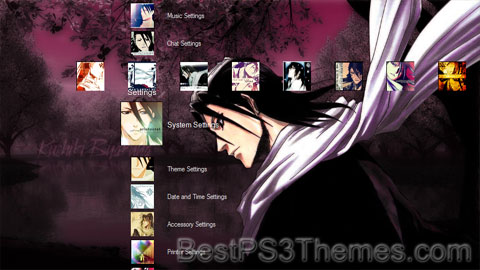
Byakuya Kuchiki Theme
(7 backgrounds HD, 9 SD)

Byakuya Kuchiki
Bleach character
Byakuya Kuchiki as depicted on the cover for Volume 7
First appearanceBleach manga chapter 51
Created byTite Kubo
Portrayed byMiyavi
Voiced byJapanese
Ryōtarō Okiayu
English
Dan Woren
Greg Chun (live-action film)
In-universe information
FamilySoujun Kuchiki (father, deceased)
Unnamed mother (deceased)
Rukia Kuchiki (sister-in-law, adoptive sister)
SpouseHisana Kuchiki (wife, deceased)
RelativesGinrei Kuchiki (grandfather)
Renji Abarai (brother-in-law)
Ichika Abarai (niece)

Byakuya Kuchiki (朽木 白哉, Kuchiki Byakuya) is a fictional character in the anime and manga series Bleach created by Tite Kubo. He is a captain of the Sixth Division for Gotei 13 and Rukia's brother. His vice-captain is Renji Abarai.

Character outline[edit]

Byakuya is the 28th head of the noble Kuchiki clan, one of the four great noble families in Soul Society.[1] As such, he acts in an aristocratic manner — he seems always serene and apathetic towards other people, even when he is actually deeply conflicted. He is also extremely calm, even in battle, and is rarely surprised by even the most drastic of actions. At a young age, he is a little joyful, as noted by his grandfather, Ginrei.

He believes in law and order. As the head of one of the great noble families and as a captain in the Gotei 13, he always works hard for a peaceful society. He thinks that if someone in his position does not follow the rules as a good example, then no one will follow them.[2] He believes that to maintain order, all law-breakers must be punished, even if that goes against his own wishes. Despite his icy and regal manner, Byakuya cares for and protects those important to him, even referring to Rukia, his adopted younger sister, as his "pride".

Byakuya is popular among female Soul Reapers and was voted number one in the "captain we desire to release a photo book for" poll taken by the Soul Reaper Women's Association. He likes Japanese cherry blossoms, night-time walks, spicy food, and bananas, but he dislikes sweets.

He wears the standard captain uniform along with a white headpiece called a kenseikan (symbolizing his noble rank as the head of the Kuchiki family) and a white scarf made by the master weaver, Tsujishirō Kuroemon III.[3] The scarf is made from silver-white windflower light silk (ginpaku kazahana no uzuginu) and is a family heirloom handed down through the generations to the head of the Kuchiki family. Forty five houses can be built for the cost of just one such scarf.[1]

Despite his extremely serious personality, Byakuya seems to have a funny side to himself. He not only attends the lieutenants' meeting when Renji is absent, but it is also implied that he attends the meetings of the Soul Reaper Women's Association when Rukia is absent. In the former's case, he reasons that "part of a captain's responsibilities is to make sure the lieutenant's responsibilities are taken care of;"[4] When Renji asks him if he also goes to Rukia's meetings, Byakuya responds only by smiling. On other occasions, Byakuya has jokingly remarked that he uses Senbonzakura to cut his hair[5] and has claimed that life in general is not supposed to be entertaining, and even makes up an idea for a game that is not meant to be amusing.[6] His artistic talent is similar to Rukia's (that is, non-existent); it appears that only Rukia is impressed with his abilities and deeply admires his style.[7] Byakuya prefers formality when he is addressed. He is referred to by title or his full name by everyone except family, his seniors on rare occasions and Ichigo. He initially protested Ichigo calling him by only his first name and has continued to pointedly refer to Ichigo formally as "Kurosaki Ichigo" since instead of reciprocating the casual first-name address.

History[edit]

Little is known about his early history. When his grandfather, Ginrei, was still the captain of the 6th Division, Byakuya plans to take over leadership of the clan, although Ginrei was worried about his rash and hotheaded attitude.[8] During this time Yoruichi Shihouin would play pranks on him and goad him into games of tag using flash steps,[9] which she won every time. Byakuya at this time would very easily lose his temper, and his grandfather believed he would become much stronger if he would learn to control himself. This aspect of his personality is reflected in Senbonzakura when he manifests in the Zanpakutou rebellion arc.

Over fifty years before the main storyline,[10] Byakuya married Hisana, a commoner from Inuzuri, one of the poorest districts of Rukongai; in doing so, he broke the rules by accepting her into the noble Kuchiki family. Shortly before her death from illness, Hisana asked Byakuya to find, adopt, and protect her biological sister, Rukia, whom she had abandoned as a baby. She also made him promise that he would not tell Rukia about her real family. She believed that as she abandoned Rukia when she was younger she was not worthy to be called Rukia's sister, but asked Byakuya to allow her to call him 'brother'.

A year later, during Rukia's time at the academy, Byakuya found her and immediately adopted her into the Kuchiki clan. By adopting her, Byakuya respected his wife's last wish, but had broken the rules of his clan again. He later swore upon his parents' graves that he would never break the rules again, no matter what. As a result, he, though entirely apathetic on the surface, is actually deeply conflicted with the matter of Rukia's execution. Should he intervene, it would require breaking the promise to his parents and the rules again; but should he do nothing he would fail to fulfill the last promise he made to his dying wife to protect Rukia as his own sister.

It is implied that Byakuya became a captain of the 6th division about 50 years before the main Bleach storyline (shortly before Rukia had entered the Gotei 13).[11] Gin Ichimaru became captain of the 3rd Division at the same time, and Gin would commonly start pointless conversations with Byakuya during times they crossed paths.

Synopsis[edit]

Byakuya first appears on a mission with his lieutenant, Renji Abarai, to capture Rukia Kuchiki and kill Ichigo Kurosaki. They succeeded in retrieving Rukia, and spared Ichigo, if not for Rukia's intervention, pleading for Byakuya not to give the finishing blow. Byakuya later interrupts Ganju Shiba and Hanatarō Yamada's attempt to rescue Rukia and, later on, Renji's attempt to do the same. he then fights Ichigo for the third time. Following Ichigo's inner hollow's forced submission, both focus their remaining power into one final attack, resulting in a tie. At the end of the battle, Byakuya, through their conversation, realizes that what Ichigo has fought against is the law of Soul Society instead of Byakuya himself, after which he gives his word to protect Rukia.[12] When Sōsuke Aizen orders Gin Ichimaru to kill Rukia, Byakuya intervenes and is overwhelmed by Gin. While being treated, Byakuya tells Rukia why she was adopted, apologizes to her, and thanks Ichigo. Afterwards, Byakuya's attitude toward Rukia changes significantly. He is seen to care for Rukia in an indirect manner and displays a new view on the idea that the law is never perfect.

When the Bounts threatened to harm the Soul Society it becomes serious. He uses the Kuchiki Clan's records to gain information on the Bounts for head captain Yamamoto. Byakuya, aiding Rukia in her battle with Yoshi, attempts to seek out the Bount leader Jin Kariya. The two meet and engage in a battle that is interrupted by Ichigo and later Rantao. In the anime-exclusive Zanpakutō Unknown Tales arc, Byakuya betrays the Soul Society and sides with the rogue Zanpakutō Muramasa, who had set the Soul Reapers' Zanpakutō, including Byakuya's own Senbonzakura, free from their control and was influencing them. He states his reasons for doing so were to maintain his pride; however, it is later revealed that Byakuya's true intentions were to stay close to Muramasa so that he could locate and kill Muramasa's Soul Reaper Kōga Kuchiki for dishonoring the Kuchiki clan.

Byakuya reappears to retrieve Tōshirō Hitsugaya's team on General Yamamoto's order near the end of the Arrancar Arc, but he secretly assigns Rukia and Renji to rescue Orihime. He reasons that he was only ordered to bring them back to Soul Society and that what they chose to do afterwards was none of his concern, though Ichigo and Rukia suspect otherwise. Byakuya appears later in Hueco Mundo to save Rukia from the 7th Espada, Zommari Leroux. Afterwards, he appears with Kenpachi Zaraki to save Ichigo in his fight against the Cero Espada Yammy.

Seventeen months later, Byakuya and several other high-ranking Soul Reapers appear before Ichigo in the human world after Ichigo is robbed of his Fullbring. It is revealed that he and the accompanying Soul Reapers channeled their power into the blade that stabbed Ichigo to restore his lost Soul Reaper powers. Byakuya subsequently fights Shūkurō Tsukishima.

When the Wandenreich invades the Soul Society, Byakuya mourns Lieutenant Chōjirō Sasakibe. Byakuya assists Renji on fighting Stern Ritter F, Äs Nödt. Byakuya activates his Bankai, tells Renji to observe Äs and finds out a way to unseal it after it is sealed. However, Byakuya learns that his Bankai was not sealed, but stolen by the Quincy. Byakuya clashes with Äs, but is easily overwhelmed. Äs Nödt finishes Byakuya off by using his own Bankai against him and smashing him into a nearby wall. When Ichigo breaks free of his imprisonment in the Dangai and arrives at the spot where Byakuya lays wounded, Byakuya asks Ichigo to forgive him for his failure to defeat his enemy and begs him to protect the Soul Society as his dying wish. After the Wandenreich leave, the Royal Guard arrives in the Soul Society, bringing Byakuya with them so that he can be healed. He later returns to the Soul Society sufficiently healed with his strength increased, arriving during Rukia's battle with Äs Nödt. Acknowledging Rukia's growth, he dismisses Äs Nödt's assumption that Byakuya will fight him and instead encourages Rukia to finish Äs Nödt with her own new abilities. After defeating Äs Nödt with her Bankai, Byakuya praises her Bankai but warns her to return to her normal state slowly, commenting on the dangerous nature of her Bankai requiring her to turn her entire body into ice in the process. He subsequently joins Renji, Rukia, and other Soul Reapers to fight against the Wandenreich, tasked with preventing Ichigo from reaching the Soul King's palace. However, the Soul Reapers are overwhelmed by Wandenreich Schutzstaffel Gerard Valkyrie, who grows in size each time he is cut down by the power of "miracles." He orders Rukia and Renji to go join Ichigo at the Soul King's palace, while Byakuya, Toshiro Hitsugaya, and Kenpachi Zaraki continue to try and subdue Gerard Valkyrie.

Ten years later, Byakuya remains the captain of the Sixth Division ten years after Yhwach's apparent destruction and is present during Rukia's promotion as the new captain of the Thirteenth Division. Upon realizing that Yhwach's presence is still lingering in the Soul Society, he elects not to tell Rukia and Renji so that they can visit Ichigo in the human world, and decides to join Mayuri Kurotsuchi and Soifon in disposing of Yhwach's presence. However, they witness the presence abruptly disappear, unaware that Yhwach was dispelled when Yhwach's presence also appeared in the living world and came into contact with Kazui Kurosaki, the son of Ichigo and Orihime Inoue.

Abilities[edit]

As a captain of the Gotei 13, Byakuya is extremely skilled in all forms of Soul Reaper combat. In keeping with his rank, Byakuya's abilities allow him to defeat opponents of captain-level ability without much effort. He holds the Advanced-Captain class within the Gotei 13.

Of particular note is Byakuya's speed: he is skilled in the use of shunpo (Flash steps), having trained with (but never surpassed) Yoruichi Shihōin.[13] Yoruichi also taught Byakuya some techniques of her own creation that involved flash steps, including one called utsusemi (空蝉, lit. Cast-Off Cicada Shell, in reference to their molting), which allows Byakuya to move out of harm's way while leaving an after-image behind. One of Byakuya's favorite techniques, as described by Renji, is Senka (闪花, lit. Flash Blossom), a flash step combined with a spin to quickly move behind the enemy, followed by a combination of two quick thrusts to destroy the opponent's soul chain and soul sleep in one move, destroying the opponent's source of spiritual power.[14] He manages to quickly dispatch Ichigo in their first encounter with this technique. In his battle with Zommari Leroux, he is able to maintain his composure and fight at full speed, despite being forced to cut the tendons in his left leg and arm to prevent Zommari from gaining control of them.

As Byakuya has displayed knowledge of high level kidō spells, and can cast spells up to number 81 without the incantation.[15] He is adept at using them tactically, such as disrupting the movement of Renji's Bankai with a well-timed fire spell and damaging Ichigo's right arm by using a low-level lightning spell at point-blank range to burn a hole through his shoulder.[16]

Scatter Senbon Zakura Kageyoshi[edit]

Byakuya's zanpakutō' is Senbonzakura (千本桜, literally "Thousand cherry blossoms"). Its Shikai is triggered by the command "scatter" (散れ, chire). In the English manga the phrase is translated inconsistently; at the start of volume fourteen it is translated as "die", though later in the same volume "scatter" is used instead. When manifested in the anime Zanpakutō Unknown Tales arc, Senbonzakura resembles a masked man in samurai armor with a half-cherry blossom decoration on his helmet.

In its Shikai, Senbonzakura's blade separates into thousands of slender, petal-like blades. The release may be negated before it is complete, such as when Yoruichi Shihōin wrapped the blade in cloth during Byakuya's short battle with Ichigo. While the blades are too small to be seen by the naked eye, they reflect light in such a way as to appear as cherry blossom petals. he can control the blades at will, thereby allowing him to shred opponents at a distance and break through almost any defense. While Byakuya can control the blades with his mind alone, using his hands allows him to do so more effectively, making the blades move twice as fast.

The inside view (the upper image) and the outside view (the lower image) of Senbonzakura's Bankai, Senkei form

Byakuya's Bankai, named Senbonzakura Kageyoshi (千本桜景厳, literally "Vibrant Scape of a Thousand Cherry Blossoms"), is essentially a much larger version of Senbonzakura's Shikai. To activate it, Byakuya drops his sword. The sword passes through the ground and two rows of giant blades rise up from the ground. These then scatter into millions of tiny blades. The number of blades is great enough that Byakuya can use them for defense and offense at the same time. He commonly forms them into large masses of blades to crush opponents.[17][18] As with his Shikai, its attack is triggered with the phrase "scatter".

His Bankai has several forms, achieved by arranging the blades in different patterns. They are activated by saying the name of the technique followed by the name of his Bankai. Each form presents a different advantage, such as increasing offense at the expense of defense.

To overwhelm the defense of an opponent, Byakuya can use lit."Pivotal Scape" (吭景, gōkei). This aligns every blade in a spherical formation around his opponent, which then collapses into them from every possible angle, leaving no blind spots and no chance to escape.[19]

His attack form is "Annihilation Scape" (殲景, Senkei), which unites the scattered petals into complete swords that form rows of swords around Byakuya and his opponent. In this form, Byakuya abandons the defense potential of his many blades and concentrates on killing the enemy. While Byakuya can control these swords as he does his regular blades, he usually attacks with just one in hand. He remarks in his battle with Ichigo that he normally only shows Senkei to those he has sworn to "kill by his own hand", Ichigo being the second to see this.[20] After immobilizing an opponent, he can call in the other blades to hit them while they are trapped. He can also use all the blades at once for one immensely powerful strike. He demonstrates that Senkei can also be used as a barrier to protect those inside from a barrage of Cero blasts. He also displays the ability to activate Kageyoshi from inside Senkei, shattering all rows of swords at once.[21]

He also possesses a secret move known as "Annihilation Scape" (一咬千刃花, Ikka Senjinka) which sends all the blades of Senkei towards his enemy at once.

As a final attack he can use "Final Scape" (終景, Shūkei). This condenses every one of his blades into a single sword, drastically increasing its cutting power. The blade appears bright white, and its aura takes the form of a dragon, earning it the name lit."Sword of the White Emperor" (白帝剣, Hakuteiken). Byakuya also grows pure white wings and a halo-like circle in the back, both made of spiritual power.[22]

Reception[edit]

Ryōtarō Okiayu in 2016
Miyavi performing at A38 in Budapest, 2017
Ryōtarō Okiayu (left) voiced Byakuya in the Japanese version of the anime and Miyavi (right) portrays the character in the live-action film.

He was ranked 7th in the most recent popularity poll with 4,010 votes, edging out Orihime Inoue by 35 votes.[23] In 2007, he was one of 4 Bleach characters to place in Newtype's top 100 anime character listing.[citation needed] Dan Woren, Byakuya's English voice actor, liked how his character is able to deal with anything while staying cool. He also noted his need to stick to the rules but found it tragic due to the fact he becomes determined to execute Rukia Kuchiki, his sister.[24]

IGN praises his character's faults and contrasts with Ichigo shown during their climactic battle, stating that "his problem...is that he's arrogant." The battle was "made better by the fact that these two characters have such different personalities, and they really seem to be bringing the best out of each other." His lack of truly villainous characteristics as an antagonistic role was also praised; in the same review, IGN notes that Ichigo and Byakuya are both "just two people fighting for what they think is right. Ichigo for friendship, and Byakuya for honor and Soul Society pride. Instead of the usual evil vs. good battle, it becomes more about whether honor and rules should come first before saving a friend."[25] At the end of the Soul Society arc, moments showing Byakuya's changes in character were heralded as being some of "the best in the episode"; IGN writes "while Byakuya has changed, he still enjoys some of the traditions of the Soul Society."[26]

References[edit]

  1. ^ a b Bleach Bleach souls Book.
  2. ^ Bleach manga; chapter 167, page 08.
  3. ^ Note: In the anime, the scarf is an extremely light green (episode 52 and 53)
  4. ^ Soul Reaper's Illustrated Picture Book, anime episode 118
  5. ^ Soul Reaper's Illustrated Picture Book, anime episode 113
  6. ^ Bleach manga omake chapters
  7. ^ Bleach at the Beach omake chapter
  8. ^ Bleach manga; Chapter -105, page 14
  9. ^ Bleach manga; Chapter -105, page 11-12
  10. ^ Bleach manga; chapter 179, page 8.
  11. ^ Bleach manga; chapter 145, page 5.
  12. ^ Kubo, Tite (2005). "Chapter 167". Bleach, Volume 19. Shueisha. ISBN 4-08-873862-4.
  13. ^ Bleach manga; chapter 118, page 14.
  14. ^ Bleach manga; chapter 140, page 15.
  15. ^ Bleach manga; chapter 302
  16. ^ Bleach manga; chapter 165, pages 10-11.
  17. ^ Bleach manga; chapter 142.
  18. ^ Bleach manga, chapter 161.
  19. ^ Bleach manga; chapter 301, page 22.
  20. ^ Bleach manga; chapter 164, page 11.
  21. ^ Kubo, Tite (2007). BLEACH The DiamondDust Rebellion もう一つの氷輪丸. Shueisha. ISBN 978-4-08-703189-8.
  22. ^ Bleach manga; chapter 166, page 16.
  23. ^ Bleach manga; chapter 307, pages 1 and 2
  24. ^ Bleach Uncut Season 2 Box Set; Behind the scenes of Bleach (DVD). Viz Media. August 19, 2008.
  25. ^ IGN: Unseal! The Black Blade, The Miraculous Power Review
  26. ^ IGN: Rukia's Resolution, Ichigo's Feelings Review