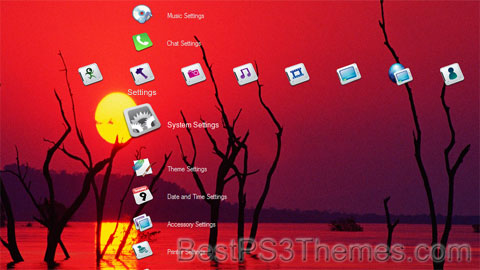
Angel Lola Luv theme by Lil Booey
Download: AngelLolaLuv.p3t

(2 backgrounds)
Redirect to:

The #1 spot for Playstation themes!
Real version 1.01 theme by Hasenhirn
Download: RealV1.01.p3t
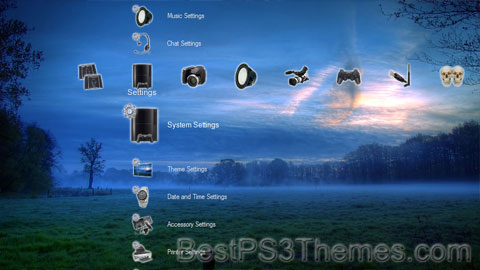
(1 background)
P3T Unpacker v0.12
Copyright (c) 2007. Anoop Menon
This program unpacks Playstation 3 Theme files (.p3t) so that you can touch-up an existing theme to your likings or use a certain wallpaper from it (as many themes have multiple). But remember, if you use content from another theme and release it, be sure to give credit!
Download for Windows: p3textractor.zip
Instructions:
Download p3textractor.zip from above. Extract the files to a folder with a program such as WinZip or WinRAR. Now there are multiple ways to extract the theme.
The first way is to simply open the p3t file with p3textractor.exe. If you don’t know how to do this, right click the p3t file and select Open With. Alternatively, open the p3t file and it will ask you to select a program to open with. Click Browse and find p3textractor.exe from where you previously extracted it to. It will open CMD and extract the theme to extracted.[filename]. After that, all you need to do for any future p3t files is open them and it will extract.
The second way is very simple. Just drag the p3t file to p3textractor.exe. It will open CMD and extract the theme to extracted.[filename].
For the third way, first put the p3t file you want to extract into the same folder as p3textractor.exe. Open CMD and browse to the folder with p3extractor.exe. Enter the following:
p3textractor filename.p3t [destination path]Replace filename with the name of the p3t file, and replace [destination path] with the name of the folder you want the files to be extracted to. A destination path is not required. By default it will extract to extracted.filename.
Bleach Grand Theft Auto versionD theme by Deemy
Download: BleachGTA_versionD.p3t

(1 background)
P3T Unpacker v0.12
Copyright (c) 2007. Anoop Menon
This program unpacks Playstation 3 Theme files (.p3t) so that you can touch-up an existing theme to your likings or use a certain wallpaper from it (as many themes have multiple). But remember, if you use content from another theme and release it, be sure to give credit!
Download for Windows: p3textractor.zip
Instructions:
Download p3textractor.zip from above. Extract the files to a folder with a program such as WinZip or WinRAR. Now there are multiple ways to extract the theme.
The first way is to simply open the p3t file with p3textractor.exe. If you don’t know how to do this, right click the p3t file and select Open With. Alternatively, open the p3t file and it will ask you to select a program to open with. Click Browse and find p3textractor.exe from where you previously extracted it to. It will open CMD and extract the theme to extracted.[filename]. After that, all you need to do for any future p3t files is open them and it will extract.
The second way is very simple. Just drag the p3t file to p3textractor.exe. It will open CMD and extract the theme to extracted.[filename].
For the third way, first put the p3t file you want to extract into the same folder as p3textractor.exe. Open CMD and browse to the folder with p3extractor.exe. Enter the following:
p3textractor filename.p3t [destination path]Replace filename with the name of the p3t file, and replace [destination path] with the name of the folder you want the files to be extracted to. A destination path is not required. By default it will extract to extracted.filename.
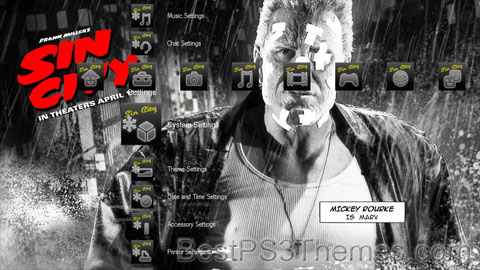
Sin City theme by Paja
Download: SinCity.p3t

(6 backgrounds)
Sin City is a series of neo-noir comics by American comic book writer-artist Frank Miller. The first story originally appeared in Dark Horse Presents Fifth Anniversary Special (April 1991), and continued in Dark Horse Presents #51–62 from May 1991 to June 1992, under the title of Sin City, serialized in thirteen parts. Several other stories of variable lengths have followed. The intertwining stories, with frequently recurring characters, take place in Basin City.
A film adaptation of Sin City, co-directed by Robert Rodriguez and Frank Miller, was released on April 1, 2005. A sequel, Sin City: A Dame to Kill For, was released on August 22, 2014.
Writer-artist Frank Miller rose to fame within the American comics industry with his 1981–1983 work on Marvel Comics' Daredevil, and the 1986 DC Comics miniseries The Dark Knight Returns, both of which exhibited subtle elements of film noir.[1] Miller's venture into the film noir genre deepened with his creator-owned series Sin City, which began publishing in serialized form in the Dark Horse Comics anthology series Dark Horse Presents #51–62. The story was released in a trade paperback and later re-released in 1995 under the name Sin City: The Hard Goodbye.
In a 2016 interview with the Kubert School, Miller explained his inspiration for Sin City thus:
I've been a fanatic for a long time for old crime movies and old crime novels. But it started with the movies. And the old Cagney movies. Bogart and all that. I loved just how the morals of the stories are. They're all about right and wrong. But in Sin City in particular I wanted them all to happen to in a world where virtuous behavior was rare, which greatly resembled the world I lived in. It's kinda like the old Rolling Stones song, where every cop's a criminal, and all the sinners are saints, where the lowlifes would often be heroic, and the most stridently beautiful and sweet women would be prostitutes. I wanted it to be a world out of balance, where virtue is defined by individuals in difficult situations, not by an overwhelming sense of goodness that was somehow governed by this godlike Comics Code.[2]
The film noir influence on the series' artwork[1][3][4][5] is seen in its use of shadow and stark backgrounds. Black and white are the sole colors most of the time, with exception of red, yellow, blue, and pink, of which limited use is made in some stories to draw attention to particular characters.[1][6]
The writing style also draws heavily on detective and crime pulp fiction.[3][7][8]
Miller's Sin City work challenges some conventions of comic book form. The letters of onomatopoeic words like "blam" are often incorporated into scenes via lighting effects, or are suggested by the negative space between panels, or are created by the outline of the panels themselves. This is especially evident in early "yarns," such as The Hard Goodbye, which were more experimental.[9]
On April 28, 2022, it was officially announced that Miller was launching the comic book publishing company Frank Miller Presents (FMP), with one of his initial contributions being a Western tale set in Sin City's past, titled Sin City 1858.[10]

Basin City, almost universally referred to by the nickname "Sin City", is a fictional town in the Western United States. The climate is hot and arid, although Sacred Oaks[clarification needed] is characterized as being heavily wooded. A major river runs through the city, which has an extensive waterfront. Usually twice a year, a major downpour comes, and the city is prone to heavy snowfall in the winter. Desert lizards and palm trees are common, while tar pits, desert areas, mountain ranges and flat farmland make up the landscape around the city.[citation needed]
The Basin City Police Department are more or less along the lines of paramilitary or SWAT, as they have to deal with incredibly high crime rates among criminals and civilians alike, which is why they have access to what most would consider "heavy weaponry" and full body armor. Those who make up the force have been described as commonly being lazy, cowardly and/or corrupt. Only a handful of the cops are honest, though frequently the wealthy of the city bribe the corrupt members of the police into performing their duty (usually as a result of some crime being committed or threatened against a member of their family).[citation needed]
During the California Gold Rush, the Roark family "imported" a large number of attractive women to keep the miners happy, making a fortune and turning a struggling mining camp into a thriving, bustling city. Over the years, as the Roark family migrated into other areas of business and power, these women ended up forming the district of Old Town, the prostitute quarter of the city where they rule with absolute authority. In addition, the people charged with governing the city, most of them from the Roark line, remained in power for generations, running it as they saw fit.[citation needed]
As the various yarns progress, the audience gradually becomes familiar with key locations in and around Basin City:
Because a large majority of the residents of Basin City are criminals, there are several organizations and cartels central to the stories who are vying for monopoly over the various criminal enterprises in the city. Listed below are crime syndicates, gangs and other low-lifes who figure heavily in the Sin City mythos.
The Basin City Police Department: So deep does corruption and criminality run in Basin City that even their police officers qualify as a gang of paid thugs, turning a blind eye to the affairs of those too poor to pay them off. Few among them are considered incorruptible; even the honest officers are unable (or unwilling) to curtail the criminal actions of the dishonest ones. Notable characters in the series who are police include Detective John Hartigan, his partner Bob, Lieutenants Jack Rafferty and Mort, Commissioner Liebowitz, and Officers Manson and Bundy from Hell and Back.
Roark family: A dynasty of corrupt landowners and politicians whose influence over Basin City has stretched as far back as the days of the Old West. Famous Roarks of this generation include a senator, a cardinal, an attorney general, and Roark Junior, 'That Yellow Bastard'.
The Girls of Old Town: Populating the region of Basin City known as Old Town is a group of women in the world's oldest profession, having made a truce with the cops to allow them to govern and police themselves. As of A Dame to Kill For, they were led by the twins, Goldie and Wendy.
Wallenquist Organization: A powerful crime syndicate led by Herr Wallenquist, a mysterious crime lord with a broad range of criminal enterprises to his name. Although they are one of the city's two "normal" criminal organizations, the Wallenquist management seems to be the most peaceful and forgiving of the various leaders. It is unknown which crime rings they hold.
Magliozzi Crime Family: The undisputed heads of the local Cosa Nostra, the Magliozzi family seems to be the purest example of "true" Mafia lifestyle. While they appear in only one story, it is hinted that the Mafia influence in Basin City's underworld is a lot larger than just their family and that there are more families.
Other groups that have been seen or mentioned in the comics include:
Tong gangsters: Mentioned, but not seen as of A Dame to Kill For. Miho's life was saved by Dwight when he secretly protected her during a fight with several Tong gangsters in a dark alleyway.
White slavers: Mentioned, but not seen as of A Dame to Kill For. Led by a man named Manuel, whose brothers were also involved. Were "taken care of" by Dwight prior to the events of A Dame to Kill For.
Irish mercenaries: Seen during The Big Fat Kill, most of them are evidently former IRA members, as implied by one of the mercenaries referring to his glee at blowing up a public house (British pubs were targeted by the IRA). All are killed by Dwight and Miho.
These are the individual stories, usually referred to as "yarns," set in Frank Miller's Sin City universe.
The stories have been collected into a number of trade paperbacks and hardcover editions. There is also a collection of art, The Art of Sin City.
In 2016, Dark Horse Comics released an ambitious, oversized edition titled Frank Miller’s Sin City The Hard Goodbye Curator’s Collection.[11] This 15 x 21 inch book reprints the entire first storyline, scanned and reproduced exactly from the original art at 1:1 size. When referencing the production process in an interview with Michael Dooley for Print Magazine, editor/designer John Lind gave the anecdote “When Frank and I first reviewed some of the scanned pages from Sin City, he pulled one aside and said, ‘You can see details in some of the scans where you can tell what the humidity was like when I was lettering because you can see the smudging from my hand.’ That type of reaction represents the level of detail I'm working hard to achieve with the production.[12]
| Name | Contents | ISBN |
|---|---|---|
| The Hard Goodbye | Episodes #1–13 of 13 from Dark Horse 5th Anniversary Special and Dark Horse Presents issues #51–62 | ISBN 1-59307-293-7 |
| A Dame to Kill For | Issues #1–6 of 6 | ISBN 1-59307-294-5 |
| The Big Fat Kill | Issues #1–5 of 5 | ISBN 1-59307-295-3 |
| That Yellow Bastard | Issues #1–6 of 6 | ISBN 1-59307-296-1 |
| Family Values | 128-page original graphic novel | ISBN 1-59307-297-X |
| Booze, Broads, & Bullets | A number of one-shots | ISBN 1-59307-298-8 |
| Hell and Back | Issues #1–9 of 9 | ISBN 1-59307-299-6 |
| Name | Contents | Release Date | ISBN |
|---|---|---|---|
| Frank Miller's Sin City Library Set Vol. 1 | The Hard Goodbye, A Dame to Kill For, The Big Fat Kill and That Yellow Bastard | December 2005 | 978-1-59307-421-0 |
| Frank Miller's Sin City Library Set Vol. 2 | Family Values, Booze, Broads and Bullets, Hell and Back, and The Art of Sin City | June 2006 | 978-1-59307-422-7 |
| Big Damn Sin City | The Hard Goodbye, A Dame to Kill For, The Big Fat Kill, That Yellow Bastard, Family Values, Booze, Broads and Bullets, Hell and Back, and The Art of Sin City | June 2014 | 978-1-61655-237-4 |
| Frank Miller's Sin City Vol.1: The Hard Goodbye Curator's Edition | The Hard Goodbye scanned from the original artwork in Frank Miller's archives and reproduced at full size. Introduction by Robert Rodriguez, with an afterword by Mike Richardson and an interview about the artistic process with Frank Miller. | August 2016 | 978-1-50670-070-0 |
| Frank Miller's Sin City Vol.1: The Hard Goodbye Deluxe Edition | Episodes #1–13 of 13 from Dark Horse 5th Anniversary Special and Dark Horse Presents issues #51–62 | November 2021 | 978-1-50672-837-7 |
| Frank Miller's Sin City Vol.2: A Dame to Kill For Deluxe Edition | Issues #1–6 of 6 | December 2021 | 978-1-50672-838-4 |
| Frank Miller's Sin City Vol.3: The Big Fat Kill Deluxe Edition | Issues #1–5 of 5 | February 2022 | 978-1-50672-839-1 |
| Frank Miller's Sin City Vol.4: That Yellow Bastard Deluxe Edition | Issues #1–6 of 6 | May 2022 | 978-1-50672-840-7 |
| Frank Miller's Sin City Vol.5: Family Values Deluxe Edition | 128-page original graphic novel | June 2022 | 978-1-50672-841-4 |
A film adaptation of Sin City, co-directed by Robert Rodriguez and Frank Miller, was released on April 1, 2005. A sequel, Sin City: A Dame to Kill For, was released on August 22, 2014.
Dimension Films planned to develop a soft reboot of the series for television; Stephen L’Heureux who produced the second film was to oversee the series with Sin City creator Frank Miller.[13] The new TV series would feature new characters and timelines and be more like the comics rather than the films.[14] On November 15, 2019, Legendary Pictures bought the rights for the television series.[15]
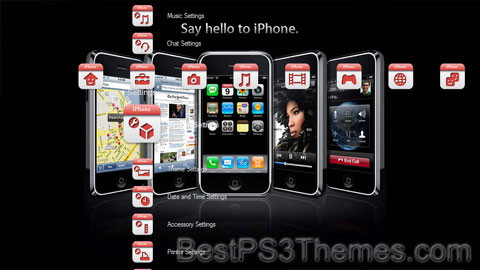
iPhone theme by Paja
Download: iPhone_4.p3t

(1 background)
Front face of the latest model, the iPhone 15 Pro | |
| Developer | Apple |
|---|---|
| Manufacturer | Contract manufacturers: |
| Type | Smartphone |
| Units sold | 2.3 billion (as of January 1, 2024[update])[1] |
| Operating system | iOS |
| Storage | 64, 128, 256, 512 GB or 1 TB[note 1] flash memory[2] (current models) |
| Sound | |
| Power | Built-in rechargeable lithium-ion battery |
| Online services | |
| Related | |
| Website | apple |
| This article is part of a series on the |
| iPhone |
|---|
|
|
The iPhone is a line of smartphones produced by Apple that use Apple's own iOS mobile operating system. The first-generation iPhone was announced by then–Apple CEO Steve Jobs on January 9, 2007. Since then, Apple has annually released new iPhone models and iOS updates. As of November 1, 2018, more than 2.2 billion iPhones had been sold.
The iPhone was the first mobile phone to use multi-touch technology.[3] Since the iPhone's launch, it has gained larger screen sizes, video-recording, waterproofing, and many accessibility features. Up to the iPhone 8 and 8 Plus, iPhones had a single button on the front panel, with the iPhone 5s and later integrating a Touch ID fingerprint sensor.[4] Since the iPhone X, iPhone models have switched to a nearly bezel-less front screen design with Face ID facial recognition, and app switching activated by gestures. Touch ID is still used for the budget iPhone SE series.
The iPhone is one of the two largest smartphone platforms in the world alongside Android, and is a large part of the luxury market. The iPhone has generated large profits for Apple, making it one of the world's most valuable publicly traded companies. The first-generation iPhone was described as a "revolution" for the mobile phone industry and subsequent models have also garnered praise.[5] The iPhone has been credited with popularizing the smartphone and slate form factor, and with creating a large market for smartphone apps, or "app economy". As of January 2017[update], Apple's App Store contained more than 2.2 million applications for the iPhone.
Development of an Apple smartphone began in 2004, when Apple started to gather a team of 1,000 employees led by hardware engineer Tony Fadell, software engineer Scott Forstall, and design officer Jony Ive,[6] to work on the highly confidential "Project Purple".[7][8]
Then-Apple CEO Steve Jobs steered the original focus away from a tablet (which was later revisited in the form of the iPad) towards a phone.[9] Apple created the device during a secretive collaboration with Cingular Wireless (later renamed AT&T Mobility) at an estimated development cost of US$150 million over thirty months.[10] According to Jobs in 1998, the "i" word in "iMac" (and thereafter "iPod", "iPhone" and "iPad") stands for internet, individual, instruct, inform, and inspire.[11][12]
Apple rejected the "design by committee" approach that had yielded the Motorola ROKR E1, a largely unsuccessful "iTunes phone" made in collaboration with Motorola. Among other deficiencies, the ROKR E1's firmware limited storage to only 100 iTunes songs to avoid competing with Apple's iPod nano.[13][14] Cingular gave Apple the liberty to develop the iPhone's hardware and software in-house, a rare practice at the time,[15][16] and paid Apple a fraction of its monthly service revenue (until the iPhone 3G),[17] in exchange for four years of exclusive U.S. sales, until 2011.[18]
Jobs unveiled the first-generation iPhone to the public on January 9, 2007, at the Macworld 2007 convention at the Moscone Center in San Francisco.[19] The iPhone incorporated a 3.5-inch multi-touch display with few hardware buttons, and ran the iPhone OS operating system with a touch-friendly interface, then marketed as a version of Mac OS X.[20] It launched on June 29, 2007, at a starting price of US$499 in the United States, and required a two-year contract with AT&T.[21] The price was reduced by a third after two months. The resulting complaints forced Jobs to issue an apology and offer a partial rebate to early purchasers of the phone.[22]

On July 11, 2008, at Apple's Worldwide Developers Conference (WWDC) 2008, Apple announced the iPhone 3G, and expanded its launch-day availability to twenty-two countries, and it was eventually released in 70 countries and territories.[23][24] The iPhone 3G introduced faster 3G connectivity, and a lower starting price of US$199 (with a two-year AT&T contract).[25] It proved commercially popular, overtaking Motorola RAZR V3 as the best selling cell phone in the US by the end of 2008.[26] Its successor, the iPhone 3GS, was announced on June 8, 2009, at WWDC 2009, and introduced video recording functionality.[27]

The iPhone 4 was announced on June 7, 2010, at WWDC 2010, and introduced a redesigned body incorporating a stainless steel frame and a rear glass panel.[28] At release, the iPhone 4 was marketed as the "world's thinnest smartphone";[28] it uses the Apple A4 processor, being the first iPhone to use an Apple custom-designed chip. It introduced the Retina display, having four-times the display resolution of preceding iPhones, and was the highest-resolution smartphone screen at release;[28] a front-facing camera was also introduced, enabling video calling functionality via FaceTime.
Users of the iPhone 4 reported dropped/disconnected telephone calls when holding their phones in a certain way, and this issue was nicknamed "antennagate".[29] In January 2011, as Apple's exclusivity agreement with AT&T was expiring, Verizon announced that they would be carrying the iPhone 4, with a model compatible with Verizon's CDMA network releasing on February 10.[30][31]
The iPhone 4s was announced on October 4, 2011, and introduced the Siri virtual assistant, a dual-core A5 processor, and an 8 megapixel camera with 1080p video recording functionality. The iPhone 5 was announced on September 12, 2012, and introduced a larger 4-inch screen, up from the 3.5-inch screen of all previous iPhone models, as well as faster 4G LTE connectivity.[32] It also introduced a thinner and lighter body made of aluminum alloy, and the 30-pin dock connector of previous iPhones was replaced with the new, reversible Lightning connector.[32]

The iPhone 5s and iPhone 5c were announced on September 10, 2013. The iPhone 5s included a 64-bit A7 processor, becoming the first ever 64-bit smartphone;[33] it also introduced the Touch ID fingerprint authentication sensor. The iPhone 5c was a lower-cost device that incorporated hardware from the iPhone 5, into a series of colorful plastic frames.[34]
On September 9, 2014, Apple introduced the iPhone 6 and iPhone 6 Plus, and included significantly larger screens than the iPhone 5s, at 4.7-inch and 5.5-inch respectively; both models also introduced mobile payment technology via Apple Pay.[35] Optical image stabilization was introduced to the 6 Plus' camera. The Apple Watch was also introduced on the same day, and is a smartwatch that operates in conjunction with a connected iPhone. Some users experienced bending issues from normal use with the iPhone 6 and 6 Plus, particularly on the latter model, and this issue was nicknamed "bendgate".[36]
The iPhone 6s and 6s Plus were introduced on September 9, 2015, and included a more bend-resistant frame made of a stronger aluminum alloy, as well as a higher resolution 12 megapixel main camera capable of 4K video recording.[37] The first-generation iPhone SE was introduced on March 21, 2016, and was a low-cost device that incorporated newer hardware from the iPhone 6s, in the frame of the older iPhone 5s.[38]
The iPhone 7 and 7 Plus were announced on September 7, 2016, which introduced larger camera sensors, IP67-certified water and dust resistance, and a quad-core A10 Fusion processor utilizing big.LITTLE technology;[39] the 3.5 mm headphone jack was removed, and was followed by the introduction of the AirPods wireless earbuds.[40] Optical image stabilization was added to the 7's camera. A second telephoto camera lens was added on the 7 Plus, enabling two-times optical zoom, and "Portrait" photography mode which simulates bokeh in photos.[41]
The iPhone 8, 8 Plus, and iPhone X were announced on September 12, 2017, in Apple's first event held at the Steve Jobs Theater in Apple Park. All models featured rear glass panel designs akin to the iPhone 4, wireless charging, and a hexa-core A11 Bionic chip with "Neural Engine" AI accelerator hardware. The iPhone X additionally introduced a 5.8-inch OLED "Super Retina" display with a "bezel-less" design, with a higher pixel density and contrast ratio than previous iPhones with LCD displays, and introduced a stronger frame made of stainless steel. It also introduced Face ID facial recognition authentication hardware, in a "notch" screen cutout, in place of Touch ID;[42][43] the home button was removed to achieve the “bezel-less” design, replacing it with a gesture-based navigation system.[44] At its US$999 starting price, the iPhone X was the most expensive iPhone at launch.[45]

The iPhone XR, iPhone XS, and XS Max were announced on September 12, 2018. All models featured the "Smart HDR" computational photography system, and a significantly more powerful "Neural Engine".[46] The XS Max introduced a larger 6.5-inch screen. The iPhone XR included a 6.1-inch LCD "Liquid Retina" display, with a "bezel-less" design similar to the iPhone X, but does not include a second telephoto lens; it was made available in a series of vibrant colors, akin to the iPhone 5c, and was a lower-cost device compared to the iPhone X and XS.[47]
The iPhone 11, 11 Pro, and 11 Pro Max were announced on September 10, 2019. The iPhone 11 was the successor to the iPhone XR, while the iPhone 11 Pro and 11 Pro Max succeeded the iPhone XS and XS Max. All models gained an ultra-wide lens, enabling two-times optical zoom out, as well as larger batteries for longer battery life.[48][49] The second-generation iPhone SE was introduced on April 17, 2020, and was a low-cost device that incorporated newer hardware from the iPhone 11, in the frame of the older iPhone 8, while retaining the home button and the Touch ID sensor.[50]
The iPhone 12, 12 Mini, 12 Pro, and 12 Pro Max were announced via a livestream event on October 13, 2020. All models featured OLED "Super Retina XDR" displays, introduced faster 5G connectivity, and the MagSafe magnetic charging and accessory system; a slimmer flat-edged design was also introduced, which combined with stronger glass-ceramic front glass, added better drop protection compared to previous iPhones.[51][52] The iPhone 12 Mini introduced a smaller 5.4-inch screen, while the 12 Pro and 12 Pro Max had larger screens of 6.1-inch and 6.7-inch respectively. The iPhone 12 Pro and 12 Pro Max additionally added a Lidar sensor for better accuracy in augumented reality (AR) applications.
The iPhone 13, 13 Mini, 13 Pro, and 13 Pro Max were announced via a livestream event on September 14, 2021. All models featured larger camera sensors, larger batteries for longer battery life, and a narrower "notch" screen cutout.[53] The iPhone 13 Pro and 13 Pro Max additionally introduced smoother adaptive 120 Hz refresh rate "ProMotion" technology in its OLED display, and three-times optical zoom in the telephoto lens.[54] The low-cost third-generation iPhone SE was introduced on March 8, 2022, and incorporated the A15 Bionic chip from the iPhone 13, but otherwise retained similar hardware to the second-generation iPhone SE.
The iPhone 14, 14 Plus, 14 Pro, and 14 Pro Max were announced on September 7, 2022. All models introduced satellite phone emergency calling functionality. The iPhone 14 Plus introduced the large 6.7-inch screen size, first seen on the iPhone 12 Pro Max, into a lower-cost device.[55] The iPhone 14 Pro and 14 Pro Max additionally introduced a higher-resolution 48-megapixel main camera, the first increase in megapixel count since the iPhone 6s; it also introduced always-on display technology to the lock screen, and an interactive status bar interface integrated in a redesigned screen cutout, entitled "Dynamic Island".[56]
The iPhone 15, 15 Plus, 15 Pro, and 15 Pro Max were announced on September 12, 2023. Starting with this group of devices, all models switch to using USB-C as their power connector to comply with European Commission regulations, replacing Apple's proprietary Lightning connector after eleven years of use in previous models.[57] All models feature the Dynamic Island, which debuted with the iPhone 14 Pro (effectively retiring the "notch" display cutout), slightly curved edges, and a frosted glass back.[58][59][60] The iPhone 15 Pro and 15 Pro Max also replace the mute switch and stainless-steel edges with the "Action" button and titanium, respectively.[60]
42 iPhone models have been produced. The models in bold are devices of the latest generation:
| Release date | Model | System-on-a-chip |
|---|---|---|
| September 24, 2021 | iPhone 13 | Apple A15 |
| March 18, 2022 | iPhone SE (3rd generation) | |
| September 16, 2022 | iPhone 14 | |
| October 7, 2022 | iPhone 14 Plus | |
| September 22, 2023 | iPhone 15 | Apple A16 |
| iPhone 15 Plus | ||
| iPhone 15 Pro | Apple A17 | |
| iPhone 15 Pro Max |
| Model | Release(d) | Discontinued | Support | ||||
|---|---|---|---|---|---|---|---|
| With OS | Date | Ended | Final OS[a] | Lifespan[b] | |||
| Max[c] | Min[d] | ||||||
| iPhone | iPhone OS 1.0 | June 29, 2007 | June 9, 2008 | June 20, 2010 | iPhone OS 3.1.3 | 2 years, 11 months | 2 years |
| iPhone 3G | iPhone OS 2.0 | July 11, 2008 | August 9, 2010 | March 3, 2011 | iOS 4.2.1 | 2 years, 7 months | 6 months |
| iPhone 3GS | iPhone OS 3.0 | June 19, 2009 | September 12, 2012 | September 18, 2013 (late, single update: February 21, 2014) |
iOS 6.1.3 (6.1.6) |
4 years, 2 months | 1 year |
| iPhone 4 | iOS 4.0 | June 24, 2010 | September 10, 2013 | September 17, 2014 | iOS 7.1.2 | 4 years, 2 months | 1 year |
| iPhone 4s | iOS 5.0 | October 14, 2011 | September 9, 2014 | September 12, 2016 (late, single update: July 22, 2019) |
iOS 9.3.5 (9.3.6) |
4 years, 10 months | 2 years |
| iPhone 5 | iOS 6.0 | September 21, 2012 | September 10, 2013 | ||||