LittleBigPlanet #11

LittleBigPlanet theme by m0dus

Download: LittleBigPlanet_11.p3t
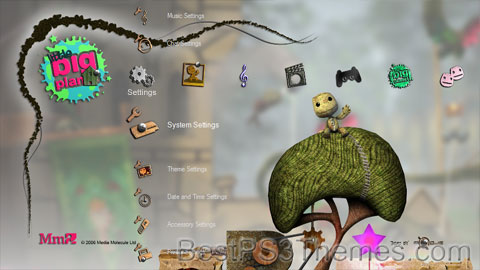
LittleBigPlanet Theme 11
(1 background)

LittleBigPlanet
Genre(s)Platform, endless running
Developer(s)Media Molecule (2008-2014)
SCE Studio Cambridge (2009)
Supermassive Games (2010)
XDev (2010-2012)
Double Eleven (2012)
Tarsier Studios (2012)
United Front Games (2012)
San Diego Studio (2012)
Firesprite (2014)
Sumo Digital (2014-2020)
Exient Entertainment (2023)
Publisher(s)Sony Interactive Entertainment
PlayStation Mobile (2014)
Platform(s)PlayStation 3
PlayStation Portable
PlayStation Vita
PlayStation 4
PlayStation 5
Windows
First releaseLittleBigPlanet
27 October 2008
Latest releaseUltimate Sackboy
March 3, 2023

LittleBigPlanet (LBP - stylised as LittleBIGPlanet) is a puzzle platform video game series created and produced by British developer Media Molecule and published by Sony Interactive Entertainment. Most games in the series put a strong emphasis on user-generated content and are based on the series' tagline "Play, Create, Share". The tagline represents the three core elements of the series: playing alone or with others locally (on the same console) or online, creating new content using the in-game creation tools, and sharing creations and discoveries online with other players.

Tarsier Studios, Fireproof Games and Supermassive Games also contribute to the development of the PlayStation 3 games, creating in-game assets (downloadable content) including costumes, backgrounds, objects, and stickers. Some of these assets will also provide the player more tools and gadgets to use in the level editor.[1]

The series comprises six games across five gaming platforms. The series was launched in 2008 with the PlayStation 3 game LittleBigPlanet, which was followed in 2009 by a PlayStation Portable version of the same name, initially developed by Studio Liverpool[2] and later handed to SCE Studio Cambridge. The sequel to the PlayStation 3 version, LittleBigPlanet 2, was released in January 2011 alongside a smaller spin-off title called Sackboy's Prehistoric Moves. LittleBigPlanet PS Vita was developed by Tarsier Studios and Double Eleven, released in September 2012 for the PlayStation Vita. At E3 2014, Sony announced LittleBigPlanet 3, a PlayStation 4 instalment that was developed by Sumo Digital and released in November 2014.[3] The games are all published by Sony Computer Entertainment. The latest instalment for the LittleBigPlanet franchise titled Sackboy: A Big Adventure was revealed during the PS5 live event and released on the PlayStation 4 and PlayStation 5 in November 2020. A Windows version was released on 27 October 2022.[4]

On 17 January 2015, it was announced that all LittleBigPlanet servers in Japan would shut down on 31 July, along with the PlayStation Portable version and LittleBigPlanet Karting in late August in all regions. Due to attacks on the online servers, all LittleBigPlanet servers were taken down in May 2021 (the Vita version had remained closed since March).[5] The servers for the PS4 version of LittleBigPlanet 3 were brought back up on 13 September 2021, however, in the same announcement, it mentioned that the servers for LittleBigPlanet, LittleBigPlanet 2, LittleBigPlanet PS Vita and the PS3 version of LittleBigPlanet 3 will remain closed permanently.[6] On 8 January, 2024, it was announced that, presumably due to more attacks on the online servers, the servers for the PS4 version of LittleBigPlanet 3 were being temporarily closed while they investigate them.[7][8][9]

On 19 April 2024, the servers for the PlayStation 4 version of LittleBigPlanet 3 were permanently shut down due to ongoing technical issues.[10]

Gameplay[edit]

The core mechanics of the series revolve around its tagline, "Play, Create, Share".[11]

Play[edit]

In the first two instalments of the series, gameplay consist primarily of traditional two-dimensional look in a three-dimensional style platforming like jumping and avoiding obstacles to successfully navigate to the end of a level to win.[12] Since LittleBigPlanet 2, the series has included mini-games, including ones that do not follow the platformer genre. Most LittleBigPlanet games involve a player playing solo or co-operatively with friends to navigate through a level whilst collecting various "bubbles" along the way, which can take the form of either points or collectibles. In-game collectibles can be used in level creation or to customize Sackboy, the player character. There are also numerous co-operative parts of levels whereby certain prize bubbles can be earned. In LittleBigPlanet 3 and Sackboy: A Big Adventure, Collectables are also present, being used in various shops to purchase more costumes.

Create[edit]

The Create component primarily refers to level creation in the game, along with other features like character customisation. Players can create their own levels with the built-in level creator. Many items that are collected while playing through the story mode and from LittleBigPlanet's community can be used to help with level creation.[13] These levels can remain as the original LittleBigPlanet platforming gameplay, or they can include other game types, such as racing, fighting, shooting and sports.[12] The player can also make non-gaming creations such as music and films (commonly known in-game as cut-scenes).[14] In LittleBigPlanet 2, Sackbots were introduced to give players more control over non-player characters in their levels as well as make the levels in their entirety more intelligent. The creation technique introduced on the game gave the possibility for logic, and it gave the ability to build sets of machines and complex contraptions.[14]

Share[edit]

Lastly, the Share component relates to sharing creations with the game's community by uploading levels to the PlayStation Network. To-date there were an excess of ten million user-created levels available to play on the LittleBigPlanet server in the PlayStation 3 games.[15] After the release of LittleBigPlanet 2 and the LBP.me community website, the Share component also had a strong emphasis sharing discoveries. Players were encouraged to share levels they found with other players by writing reviews and comments in-game and by sharing links to creations' LBP.me pages via social networks.

Overview[edit]

The series takes place in a world known as LittleBigPlanet. Each curator is in charge of a part of LittleBigPlanet and they govern them independently. LittleBigPlanet has geography inspired by the real-life Earth. All games in the series follow the main protagonist Sackboy, a small anthropomorphic creature made of brown fabric with a zip fastener and button eyes. He can be customized to the player's liking using costumes that are either unlocked in the game or bought as downloadable content from the PlayStation Store. The player can control Sackboy's four emotions; happiness, sadness, worry and anger, each of which has three levels of intensity. The English language version of each game is narrated by Stephen Fry and in all formats Fry's scripts are written by Dean Wilkinson.

Games[edit]

Release timeline
2008LittleBigPlanet
2009LittleBigPlanet (PSP)
2010Sackboy's Prehistoric Moves
2011LittleBigPlanet 2
2012LittleBigPlanet PS Vita
LittleBigPlanet Karting
2013
2014Run Sackboy! Run!
LittleBigPlanet 3
2015
2016
2017
2018
2019
2020Sackboy: A Big Adventure
2021
2022
2023Ultimate Sackboy

Main series[edit]

LittleBigPlanet[edit]

The first game in the series was released on the PlayStation 3 platform in 2008 and was the first title developed by Media Molecule, under the name The Next Big Thing. The player controls Sackboy as he travels around the titular LittleBigPlanet, helping the eight creator curators of LittleBigPlanet with their problems in their own respective realms. Throughout the story, Sackboy tries to stop The Collector, one of the eight creator curators who has gone rogue, kidnapping the creations of LittleBigPlanet.[16] The game received widespread acclaim for its design, gameplay, and customization afforded to the player, particularly the built-in level editor. After its release, it received numerous industry awards.[17]

LittleBigPlanet 2[edit]

The second game in the series is a direct sequel to the first LittleBigPlanet and was developed by Media Molecule for the PlayStation 3 for a release in 2011. The sequel saw a major shift in the direction of the series, going from a primarily traditional platform game in the first two entries to a more varied style of gameplay called a "platform for games". The second game gave players a wider variety of options when it came to level design, which saw the creation of levels other than platforming such as racing, puzzles, and fighting games.[18] Following the events of the first two entries in the series, the game takes place when an antagonist known as the Negativitron invades LittleBigPlanet and begins to suck up all its inhabitants. Sackboy must team up with a secret organization known as "The Alliance", led by Larry Da Vinci, to save LittleBigPlanet from the Negativitron.[19] The game also supported the PlayStation Move, with an update post-launch.

LittleBigPlanet 3[edit]

LittleBigPlanet 3 is a game for the PlayStation 3[20][21][22] and PlayStation 4. Announced at E3 2014, it was developed by Sumo Digital and was released in November 2014. In the game, Sackboy is transported to another world, Bunkum, where he has to awaken its three missing heroes, OddSock, Toggle and Swoop, who are new playable characters. Sackboy travels through different worlds in order to free the 3 new characters and stop Newton.[23]

Handheld[edit]

LittleBigPlanet (PlayStation Portable)[edit]

A portable entry of the series was developed primarily by SCE Studio Cambridge in association with Media Molecule for the PlayStation Portable. The game, released in 2009, shared the same name as the original game; however, it was not a port of the PlayStation 3 game, but rather a new entry in the series. It has a story-mode with levels and features many of the same mechanics of its PlayStation 3 counterpart, such as customizations, albeit without the multiplayer component of the game. The game takes place after the events of the PlayStation 3 version of LittleBigPlanet, in which The Collector has been defeated. A carnival is being held and Sackboy decides to go around the world to invite the eight curators of LittleBigPlanet to the carnival whilst finding materials for his own carnival float.[24]

LittleBigPlanet PS Vita[edit]

The fourth game in the series was developed by Tarsier Studios, Double Eleven, and XDev for the PlayStation Vita handheld and had a 2012 release.[25] The game features the same core mechanics from LittleBigPlanet 2, with the focus being on a "platform for games" rather than a platformer like previous entries in the series before LittleBigPlanet 2. The game utilizes the unique controls of the PlayStation Vita by using its multi-touch touchscreen and its rear touchpad to navigate through various obstacles in stages as well as for level creation by users.[26] The game supports cross-buy of DLC costume packs between LittleBigPlanet 2, as well as LittleBigPlanet Karting.

Spinoff games[edit]

LittleBigPlanet Karting[edit]

LittleBigPlanet Karting is a kart racing game developed by United Front and San Diego Studio in conjunction with series creator Media Molecule for the PlayStation 3.[27] In its story mode, the player ventures through worlds including: LittleBigPlanet, Monster Islands, Victoria's Laboratory, The Progress Emporium, Eve's Asylum, The Space Bass, and Hoard, Sweet Hoard, to put an end to the Hoard racers, who snatch many pieces of the different planets to stash them in the Garage at the End of the Universe. Sony Entertainment America shut down the North American LittleBigPlanet Karting online servers on 31 August 2016.[28]

Sackboy's Prehistoric Moves[edit]

The game was developed by XDev as a spin-off from the LittleBigPlanet series utilizing the PlayStation Move on the PlayStation 3. It was released in December 2010, as a downloadable title from the PlayStation Store and was later bundled with LittleBigPlanet 2. The game was described as a "demo" and featured 10 prehistoric inspired story levels. In the game, Sackboy must save Little Big Planet from the T-Rex. Unlike the main games, which can be played as a single-player experience, the game required a minimum of two players to work.[29] This was due to the main mechanics of the spin-off whereby one player would control Sackboy traditionally using the gamepad for platforming while a second player had to use a PlayStation Move similar to a pointer to move obstacles and objects out of the way in order to successfully navigate a level.[30]

Run Sackboy! Run![edit]

Run Sackboy! Run! is a free-to-play endless running game developed by Firesprite and published by PlayStation Mobile that was released on iOS on 30 October 2014,[31] Android on 17 December 2014[32] and PlayStation Vita on 31 March 2015.[33] The game has no real plot, except for Sackboy running through Craftworld from the Negativitron. The game awarded players with exclusive costumes for LittleBigPlanet 3 (which was released at a similar time) by reaching point goals and collecting stickers.[34]

LittleBigPlanet Hub[edit]

LittleBigPlanet Hub is an unreleased free-to-play game for the PlayStation 3.[35] It was planned to be a downloadable title from the PlayStation Store which would have allowed players to create levels and play a curated selection of community levels from LittleBigPlanet and LittleBigPlanet 2 as well as 16 levels from the games' story modes. LittleBigPlanet Hub would also have contained weekly challenges, not found in other LittleBigPlanet games. Downloadable content purchased in other games were to be compatible with LittleBigPlanet Hub, and users were rumoured to be also able to access additional content from the PlayStation Store.[citation needed]

Since its announcement in August 2013, no further details about LittleBigPlanet Hub were revealed.[36] In February 2024, a beta tester posted a video showing gameplay from a beta build onto YouTube, and shortly afterwards, with assistance, dumped it online for download. This makes the build playable through unofficial means, such as emulations like RPCS3 or PlayStation 3 homebrew.[37]

Sackboy: A Big Adventure[edit]

Sackboy: A Big Adventure is a 2020 platform game developed by Sumo Digital and published by Sony Interactive Entertainment for the PlayStation 5 and the PlayStation 4. It was announced at the PlayStation 5 reveal event on June 11, 2020, and was released on November 12, 2020; a version for Windows was released on October 27, 2022, marking the series's first release on PCs. Unlike previous LittleBigPlanet entries with 2.5D platforming, A Big Adventure features a range of perspectives and 3D movement.

Ultimate Sackboy[edit]

Ultimate Sackboy is a free-to-play endless running game developed by Exient Entertainment and released on mobile on 21 February 2023. It is the first LittleBigPlanet game to feature limited-time paid subscriptions known as "Marathons." In contrast to Run Sackboy! Run!, it adopts the style from Sackboy: A Big Adventure and is played in 3D.

Reception[edit]

Aggregate review scores
Game Metacritic
LittleBigPlanet (PlayStation 3) 95/100[38]
LittleBigPlanet (PlayStation Portable) 87/100[39]
Sackboy's Prehistoric Moves 66/100[40]
LittleBigPlanet 2 91/100[41]
LittleBigPlanet PS Vita 88/100[42]
LittleBigPlanet Karting 74/100[43]
LittleBigPlanet 3 79/100[44]
Run Sackboy! Run! 65/100[45]
Sackboy: A Big Adventure 80/100[46]
Ultimate Sackboy 57/100[47]

Most of the games in the series have been well received by critics with the LittleBigPlanet on PlayStation 3 and PlayStation Portable gaining Metacritic scores of 95/100[38] and 87/100[39] respectively. LittleBigPlanet 2 garnered nearly as much acclaim as the first game, with an average score of 91/100.[48] LittleBigPlanet PS Vita also received very positive reviews and was the highest-ranked PS Vita game at the time of its release with an average score of 88/100.[49] However, the release of LittleBigPlanet 3 did not receive critical acclaim, garnering a mostly positive average of 79/100.[50] Critically, LittleBigPlanet Karting is the worst-performing major game in the series so far but still gained a "mixed or average" Metacritic score of 74/100.[51] However, the mobile game Run Sackboy! Run! performed worse, with a Metacritic score of 65/100.[52] Additionally, the character of Sackboy is often seen as a PlayStation mascot.[53] In 2011, readers of Guinness World Records Gamer's Edition voted Sackboy as the 50th-top video game character of all time.[54]

References[edit]

  1. ^ "Introducing the Extended LittleBigPlanet Family - Media Molecule - We make games". Media Molecule. Archived from the original on 21 February 2016. Retrieved 6 December 2010.
  2. ^ "LittleBigPlanet coming to PSP - CVG". Computerandvideogames.com. 8 April 2008. Archived from the original on 15 April 2014. Retrieved 14 June 2014.
  3. ^ "LittleBigPlanet 3 coming to PS4 this November". 10 June 2014. Archived from the original on 14 July 2014. Retrieved 10 June 2014.
  4. ^ "Sackboy: A Big Adventure coming to PC on October 27". Gematsu. 29 September 2022. Retrieved 29 September 2022.
  5. ^ "LittleBigPlanet Servers Taken Down After Hackers Post Hate Speech". PlayStation LifeStyle. 24 May 2021. Archived from the original on 13 September 2021. Retrieved 13 September 2021.
  6. ^ Yin-Poole, Wesley (13 September 2021). "Sony shuts down online for older LittleBigPlanet games "to protect the community"". Eurogamer. Archived from the original on 2 April 2022. Retrieved 13 September 2021.

    Maple Story

    Maple Story theme by bestps3themes.com

    Download: MapleStory.p3t
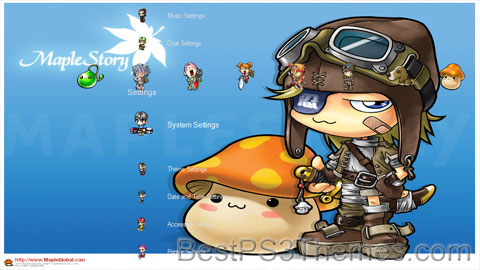
    Maple Story Theme
    (5 backgrounds)

    Redirect to:

Terminator

Terminator theme by Nigel Mansell

Download: Terminator.p3t
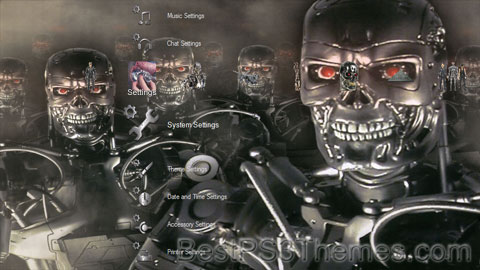
Terminator Theme
(6 backgrounds)

Terminator may refer to:

Science and technology[edit]

Genetics[edit]

Astronomy[edit]

Electronics and computers[edit]

Military[edit]

  • BMPT Ob'yekt 199 Ramka, armoured tracked vehicle, designed for tanks support, often nicknamed "Terminator"
  • Sukhoi Su-37 Air Superiority Fighter, also called the "Terminator".

Entertainment[edit]

Films and television[edit]

Literature[edit]

Music[edit]

Games[edit]

Comics[edit]

Other entertainment[edit]

  • Nikki Terminator, robot assistant of magician Rudy Coby
  • Terminator, a moving city at the edge of light and dark in the planet Mercury, in Kim Stanley Robinson's novels and short stories

People[edit]

Other uses[edit]

See also[edit]

Prince of Persia: Warrior Within versionD

Prince of Persia: Warrior Within versionD theme by Deemy

Download: POPWarriorWithin_verD.p3t
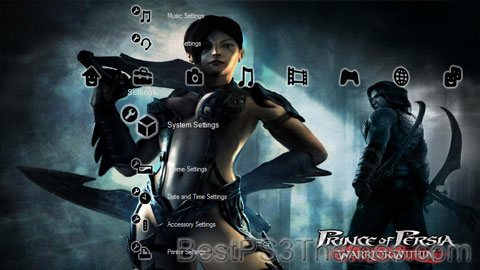
Prince of Persia: Warrior Within versionD Theme
(7 backgrounds)

P3T Unpacker v0.12
Copyright (c) 2007. Anoop Menon

This program unpacks Playstation 3 Theme files (.p3t) so that you can touch-up an existing theme to your likings or use a certain wallpaper from it (as many themes have multiple). But remember, if you use content from another theme and release it, be sure to give credit!

Download for Windows: p3textractor.zip

Instructions:

Download p3textractor.zip from above. Extract the files to a folder with a program such as WinZip or WinRAR. Now there are multiple ways to extract the theme.

The first way is to simply open the p3t file with p3textractor.exe. If you don’t know how to do this, right click the p3t file and select Open With. Alternatively, open the p3t file and it will ask you to select a program to open with. Click Browse and find p3textractor.exe from where you previously extracted it to. It will open CMD and extract the theme to extracted.[filename]. After that, all you need to do for any future p3t files is open them and it will extract.

The second way is very simple. Just drag the p3t file to p3textractor.exe. It will open CMD and extract the theme to extracted.[filename].

For the third way, first put the p3t file you want to extract into the same folder as p3textractor.exe. Open CMD and browse to the folder with p3extractor.exe. Enter the following:
p3textractor filename.p3t [destination path]Replace filename with the name of the p3t file, and replace [destination path] with the name of the folder you want the files to be extracted to. A destination path is not required. By default it will extract to extracted.filename.

Prince of Persia: The Sands of Time versionD

Prince of Persia: The Sands of Time versionD theme by Deemy

Download: POPSandsOfTime_verD.p3t
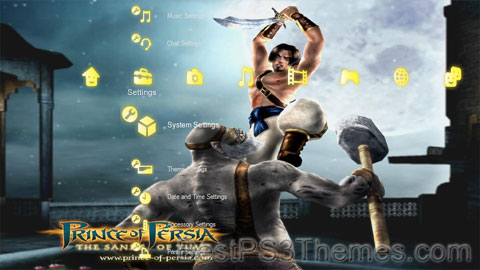
Prince of Persia: The Sands of Time versionD Theme
(11 backgrounds)

P3T Unpacker v0.12
Copyright (c) 2007. Anoop Menon

This program unpacks Playstation 3 Theme files (.p3t) so that you can touch-up an existing theme to your likings or use a certain wallpaper from it (as many themes have multiple). But remember, if you use content from another theme and release it, be sure to give credit!

Download for Windows: p3textractor.zip

Instructions:

Download p3textractor.zip from above. Extract the files to a folder with a program such as WinZip or WinRAR. Now there are multiple ways to extract the theme.

The first way is to simply open the p3t file with p3textractor.exe. If you don’t know how to do this, right click the p3t file and select Open With. Alternatively, open the p3t file and it will ask you to select a program to open with. Click Browse and find p3textractor.exe from where you previously extracted it to. It will open CMD and extract the theme to extracted.[filename]. After that, all you need to do for any future p3t files is open them and it will extract.

The second way is very simple. Just drag the p3t file to p3textractor.exe. It will open CMD and extract the theme to extracted.[filename].

For the third way, first put the p3t file you want to extract into the same folder as p3textractor.exe. Open CMD and browse to the folder with p3extractor.exe. Enter the following:
p3textractor filename.p3t [destination path]Replace filename with the name of the p3t file, and replace [destination path] with the name of the folder you want the files to be extracted to. A destination path is not required. By default it will extract to extracted.filename.

Wizzin’ on the 360

Wizzin’ on the 360 theme by S

Download: WizzinOnThe360.p3t
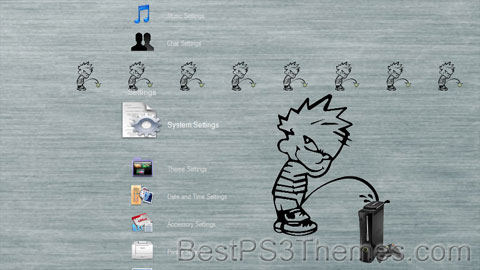
Wizzin’ on the 360 Theme
(1 background)

P3T Unpacker v0.12
Copyright (c) 2007. Anoop Menon

This program unpacks Playstation 3 Theme files (.p3t) so that you can touch-up an existing theme to your likings or use a certain wallpaper from it (as many themes have multiple). But remember, if you use content from another theme and release it, be sure to give credit!

Download for Windows: p3textractor.zip

Instructions:

Download p3textractor.zip from above. Extract the files to a folder with a program such as WinZip or WinRAR. Now there are multiple ways to extract the theme.

The first way is to simply open the p3t file with p3textractor.exe. If you don’t know how to do this, right click the p3t file and select Open With. Alternatively, open the p3t file and it will ask you to select a program to open with. Click Browse and find p3textractor.exe from where you previously extracted it to. It will open CMD and extract the theme to extracted.[filename]. After that, all you need to do for any future p3t files is open them and it will extract.

The second way is very simple. Just drag the p3t file to p3textractor.exe. It will open CMD and extract the theme to extracted.[filename].

For the third way, first put the p3t file you want to extract into the same folder as p3textractor.exe. Open CMD and browse to the folder with p3extractor.exe. Enter the following:
p3textractor filename.p3t [destination path]Replace filename with the name of the p3t file, and replace [destination path] with the name of the folder you want the files to be extracted to. A destination path is not required. By default it will extract to extracted.filename.

Metal #2

Metal theme by Jabyaeye

Download: Metal_2.p3t

Metal Theme 2
(5 backgrounds)

refer to caption
Iron, shown here as fragments and a 1 cm3 cube, is an example of a chemical element that is a metal.
A metal gravy boat
A metal in the form of a gravy boat made from stainless steel, an alloy largely composed of iron, carbon, and chromium

A metal (from Ancient Greek μέταλλον (métallon) 'mine, quarry, metal') is a material that when polished, or fractured, shows a lustrous appearance, and conducts electricity and heat relatively well. These properties are all associated with having electrons available at the Fermi level, as against nonmetallic materials which do not.[1]: Chpt 8 & 19 [2]: Chpt 7 & 8  Metals are typically ductile (can be drawn into wires) and malleable (they can be hammered into thin sheets).[3]

A metal may be a chemical element such as iron; an alloy such as stainless steel; or a molecular compound such as polymeric sulfur nitride.[4] The general science of metals is called metallurgy, a subtopic of materials science; aspects of the electronic and thermal properties are also within the scope of condensed matter physics and solid-state chemistry, it is a multidisciplinary topic.

A metal conducts electricity at a temperature of absolute zero,[5] which is a consequence of the states at the Fermi energy.[1][2] Many elements and compounds become metallic under high pressures, for example, iodine gradually becomes a metal at a pressure of between 40 and 170 thousand times atmospheric pressure. Sodium becomes a nonmetal at pressure of just under two million times atmospheric pressure, and at even higher pressures it is expected to become a metal again

When discussing the periodic table and some chemical properties the term metal is often used to denote those elements which in pure form and at standard conditions are metals in the sense of electrical conduction mentioned above. The related term metallic may also be used for types of dopant atoms or alloying elements.

In astronomy metal refers to all chemical elements in a star that are heavier than helium. In this sense the first four "metals" collecting in stellar cores through nucleosynthesis are carbon, nitrogen, oxygen, and neon. A star fuses lighter atoms, mostly hydrogen and helium, into heavier atoms over its lifetime. The metallicity of an astronomical object is the proportion of its matter made up of the heavier chemical elements.[6][7]

The strength and resilience of some metals has led to their frequent use in, for example, high-rise building and bridge construction, as well as most vehicles, many home appliances, tools, pipes, and railroad tracks. Precious metals were historically used as coinage, but in the modern era, coinage metals have extended to at least 23 of the chemical elements.[8] There is also extensive use of multi-element metals such as titanium nitride or degenerate semiconductors in the semiconductor industry.

The history of refined metals is thought to begin with the use of copper about 11,000 years ago. Gold, silver, iron (as meteoric iron), lead, and brass were likewise in use before the first known appearance of bronze in the fifth millennium BCE. Subsequent developments include the production of early forms of steel; the discovery of sodium—the first light metal—in 1809; the rise of modern alloy steels; and, since the end of World War II, the development of more sophisticated alloys.

Properties[edit]

Form and structure[edit]

Gallium crystals on a table
Gallium crystals

Most metals are shiny and lustrous, at least when polished, or fractured. Sheets of metal thicker than a few micrometres appear opaque, but gold leaf transmits green light. This is due to the electrons which reflect light.[1][2]

Although most elemental metals have higher densities than nonmetals,[9] is a wide variation in their densities, lithium being the least dense (0.534 g/cm3) and osmium (22.59 g/cm3) the most dense. (Some of the 6d transition metals are expected to be denser than osmium, but predictions on their densities vary widely in the literature, and in any case their known isotopes are too unstable for bulk production to be possible.) Magnesium, aluminium and titanium are light metals of significant commercial importance. Their respective densities of 1.7, 2.7, and 4.5 g/cm3 can be compared to those of the older structural metals, like iron at 7.9 and copper at 8.9 g/cm3. An iron ball would thus weigh about as much as three aluminum balls of equal volume.

Multiple metal rods, one of which has a glowing hot eyelet
A metal rod with a hot-worked eyelet. Hot-working exploits the capacity of metal to be plastically deformed.

Metals are typically malleable and ductile, deforming under stress without cleaving.[9] The nondirectional nature of metallic bonding contributes to the ductility of most metallic solids, where the Peierls stress is relatively low allowing for dislocation motion, and there are also many combinations of planes and directions for plastic deformation.[10] Due to their having close packed arrangements of atoms the Burgers vector of the dislocations are fairly small, which also means that the energy needed to produce one is small.[3][10] In contrast, in an ionic compound like table salt the Burgers vectors are much larger and the energy to move a dislocation is far higher.[3] Reversible elastic deformation in metals can be described well by Hooke's Law for the restoring forces, where the stress is linearly proportional to the strain.[11]

A temperature change may lead to the movement of structural defects in the metal such as grain boundaries, point vacancies, line and screw dislocations, stacking faults and twins in both crystalline and non-crystalline metals. Internal slip, creep, and metal fatigue may also ensue.[3][10]

The atoms of simple metallic substances are often in one of three common crystal structures, namely body-centered cubic (bcc), face-centered cubic (fcc), and hexagonal close-packed (hcp). In bcc, each atom is positioned at the center of a cube of eight others. In fcc and hcp, each atom is surrounded by twelve others, but the stacking of the layers differs. Some metals adopt different structures depending on the temperature.[12]

Many other metals with different elements have more complicated structures, such as rock-salt structure in titanium nitride or perovskite (structure) in some nickelates.[13]


Electrical and thermal[edit]

The energy states available to electrons in different kinds of solids at thermodynamic equilibrium.
 
Here, height is energy while width is the density of available states for a certain energy in the material listed. The shading follows the Fermi–Dirac distribution (black=all states filled, white=no state filled).
 
The Fermi level EF is the energy level at which the electrons are in a position to interact with energy levels above them. In metals and semimetals the Fermi level EF lies inside at least one band of energy states.
 
In insulators and semiconductors the Fermi level is inside a band gap; however, in semiconductors the bands are near enough to the Fermi level to be thermally populated with electrons or holes.

The electronic structure of metals means they are relatively good conductors of electricity. The electrons all have different momenta, which average to zero when there is no external voltage. When a voltage is applied some move a little faster in a given direction, some a little slower so there is a nett drift velocity which leads to an electric current.[1][2] Quantum mechanics dictates that one can only have one electron in a given states, the Pauli exclusion principle.[14] Therefore there have to be empty states available at the highest occupied energies as sketched in the Figure. In a semiconductor like silicon or a nonmetal like strontium titanate there is an energy gap between the highest filled states of the electrons and the lowest unfilled. Consequently, semiconductors and nonmetals are relatively poor conductors, although they can carry some current when doped with elements that introduce additional energy states or at higher temperatures.[15]

The elemental metals have electrical conductivity values of from 6.9 × 10³ S/cm for manganese to 6.3 × 10⁵ S/cm for silver. In contrast, a semiconducting metalloid such as boron has an electrical conductivity 1.5 × 10⁻⁶ S/cm. With one exception, metallic elements reduce their electrical conductivity when heated. Plutonium increases its electrical conductivity when heated in the temperature range of around −175 to +125 °C, with anomalously large thermal expansion coefficient and a phase change from monoclinic to face-centered cubic near 100  °C.[16]

Metals are relatively good conductors of heat. At higher temperatures they can occupy slightly higher energy levels which are given by Fermi–Dirac statistics.[2][15] These have slightly higher momenta (kinetic energy) so can pass on thermal energy.

The contribution of a metal's electrons to its heat capacity and thermal conductivity, and the electrical conductivity of the metal itself can be approximately calculated from the free electron model.[2] However, this does not take into account the detailed structure of the metal's ion lattice. Taking into account the positive potential caused by the arrangement of the ion cores enables consideration of the electronic band structure and binding energy of a metal. Various models are applicable, the simplest being the nearly free electron model.[2] Modern methods such as density functional theory are typically used.

Chemical[edit]

The elements which form metals usually form cations through electron loss.[9] Most will react with oxygen in the air to form oxides over various timescales (potassium burns in seconds while iron rusts over years) which depend upon whether the native oxide forms a passivation layer that acts as a

Space #2

Space theme by Jabyaeye

Download: Space_2.p3t

Space Theme 2
(1 background)

A right-handed three-dimensional Cartesian coordinate system used to indicate positions in space

Space is a three-dimensional continuum containing positions and directions.[1] In classical physics, physical space is often conceived in three linear dimensions. Modern physicists usually consider it, with time, to be part of a boundless four-dimensional continuum known as spacetime.[2] The concept of space is considered to be of fundamental importance to an understanding of the physical universe. However, disagreement continues between philosophers over whether it is itself an entity, a relationship between entities, or part of a conceptual framework.

In the 19th and 20th centuries mathematicians began to examine geometries that are non-Euclidean, in which space is conceived as curved, rather than flat, as in the Euclidean space. According to Albert Einstein's theory of general relativity, space around gravitational fields deviates from Euclidean space.[3] Experimental tests of general relativity have confirmed that non-Euclidean geometries provide a better model for the shape of space.

Philosophy of space[edit]

Debates concerning the nature, essence and the mode of existence of space date back to antiquity; namely, to treatises like the Timaeus of Plato, or Socrates in his reflections on what the Greeks called khôra (i.e. "space"), or in the Physics of Aristotle (Book IV, Delta) in the definition of topos (i.e. place), or in the later "geometrical conception of place" as "space qua extension" in the Discourse on Place (Qawl fi al-Makan) of the 11th-century Arab polymath Alhazen.[4] Many of these classical philosophical questions were discussed in the Renaissance and then reformulated in the 17th century, particularly during the early development of classical mechanics.

Isaac Newton viewed space as absolute, existing permanently and independently of whether there was any matter in the.[5] In contrast, other natural philosophers, notably Gottfried Leibniz, thought that space was in fact a collection of relations between objects, given by their distance and direction from one another. In the 18th century, the philosopher and theologian George Berkeley attempted to refute the "visibility of spatial depth" in his Essay Towards a New Theory of Vision. Later, the metaphysician Immanuel Kant said that the concepts of space and time are not empirical ones derived from experiences of the outside world—they are elements of an already given systematic framework that humans possess and use to structure all experiences. Kant referred to the experience of "space" in his Critique of Pure Reason as being a subjective "pure a priori form of intuition".

Galileo[edit]

Galilean and Cartesian theories about space, matter, and motion are at the foundation of the Scientific Revolution, which is understood to have culminated with the publication of Newton's Principia Mathematica in 1687.[6] Newton's theories about space and time helped him explain the movement of objects. While his theory of space is considered the most influential in physics, it emerged from his predecessors' ideas about the same.[7]

As one of the pioneers of modern science, Galileo revised the established Aristotelian and Ptolemaic ideas about a geocentric cosmos. He backed the Copernican theory that the universe was heliocentric, with a stationary Sun at the center and the planets—including the Earth—revolving around the Sun. If the Earth moved, the Aristotelian belief that its natural tendency was to remain at rest was in question. Galileo wanted to prove instead that the Sun moved around its axis, that motion was as natural to an object as the state of rest. In other words, for Galileo, celestial bodies, including the Earth, were naturally inclined to move in circles. This view displaced another Aristotelian idea—that all objects gravitated towards their designated natural place-of-belonging.[8]

René Descartes[edit]

Descartes set out to replace the Aristotelian worldview with a theory about space and motion as determined by natural laws. In other words, he sought a metaphysical foundation or a mechanical explanation for his theories about matter and motion. Cartesian space was Euclidean in structure—infinite, uniform and flat.[9] It was defined as that which contained matter; conversely, matter by definition had a spatial extension so that there was no such thing as empty space.[6]

The Cartesian notion of space is closely linked to his theories about the nature of the body, mind and matter. He is famously known for his "cogito ergo sum" (I think therefore I am), or the idea that we can only be certain of the fact that we can doubt, and therefore think and therefore exist. His theories belong to the rationalist tradition, which attributes knowledge about the world to our ability to think rather than to our experiences, as the empiricists believe.[10] He posited a clear distinction between the body and mind, which is referred to as the Cartesian dualism.

Leibniz and Newton[edit]

Gottfried Leibniz

Following Galileo and Descartes, during the seventeenth century the philosophy of space and time revolved around the ideas of Gottfried Leibniz, a German philosopher–mathematician, and Isaac Newton, who set out two opposing theories of what space is. Rather than being an entity that independently exists over and above other matter, Leibniz held that space is no more than the collection of spatial relations between objects in the world: "space is that which results from places taken together".[11] Unoccupied regions are those that could have objects in them, and thus spatial relations with other places. For Leibniz, then, space was an idealised abstraction from the relations between individual entities or their possible locations and therefore could not be continuous but must be discrete.[12] Space could be thought of in a similar way to the relations between family members. Although people in the family are related to one another, the relations do not exist independently of the people.[13] Leibniz argued that space could not exist independently of objects in the world because that implies a difference between two universes exactly alike except for the location of the material world in each universe. But since there would be no observational way of telling these universes apart then, according to the identity of indiscernibles, there would be no real difference between them. According to the principle of sufficient reason, any theory of space that implied that there could be these two possible universes must therefore be wrong.[14]

Isaac Newton

Newton took space to be more than relations between material objects and based his position on observation and experimentation. For a relationist there can be no real difference between inertial motion, in which the object travels with constant velocity, and non-inertial motion, in which the velocity changes with time, since all spatial measurements are relative to other objects and their motions. But Newton argued that since non-inertial motion generates forces, it must be absolute.[15] He used the example of water in a spinning bucket to demonstrate his argument. Water in a bucket is hung from a rope and set to spin, starts with a flat surface. After a while, as the bucket continues to spin, the surface of the water becomes concave. If the bucket's spinning is stopped then the surface of the water remains concave as it continues to spin. The concave surface is therefore apparently not the result of relative motion between the bucket and the water.[16] Instead, Newton argued, it must be a result of non-inertial motion relative to space itself. For several centuries the bucket argument was considered decisive in showing that space must exist independently of matter.

Kant[edit]

Immanuel Kant

In the eighteenth century the German philosopher Immanuel Kant published his theory of space as "a property of our mind" by which "we represent to ourselves objects as outside us, and all as in space" in the Critique of Pure Reason[17] On his view the nature of spatial predicates are "relations that only attach to the form of intuition alone, and thus to the subjective constitution of our mind, without which these predicates could not be attached to anything at all."[18] This develops his theory of knowledge in which knowledge about space itself can be both a priori and synthetic.[19] According to Kant, knowledge about space is synthetic because any proposition about space cannot be true merely in virtue of the meaning of the terms contained in the proposition. In the counter-example, the proposition "all unmarried men are bachelors" is true by virtue of each term's meaning. Further, space is a priori because it is the form of our receptive abilities to receive information about the external world. For example, someone without sight can still perceive spatial attributes via touch, hearing, and smell. Knowledge of space itself is a priori because it belongs to the subjective constitution of our mind as the form or manner of our intuition of external objects.

Non-Euclidean geometry[edit]

Spherical geometry is similar to elliptical geometry. On a sphere (the surface of a ball) there are no parallel lines.

Euclid's Elements contained five postulates that form the basis for Euclidean geometry. One of these, the parallel postulate, has been the subject of debate among mathematicians for many centuries. It states that on any plane on which there is a straight line L1 and a point P not on L1, there is exactly one straight line L2 on the plane that passes through the point P and is parallel to the straight line L1. Until the 19th century, few doubted the truth of the postulate; instead debate centered over whether it was necessary as an axiom, or whether it was a theory that could be derived from the other axioms.[20] Around 1830 though, the Hungarian János Bolyai and the Russian Nikolai Ivanovich Lobachevsky separately published treatises on a type of geometry that does not include the parallel postulate, called hyperbolic geometry. In this geometry, an infinite number of parallel lines pass through the point P. Consequently, the sum of angles in a triangle is less than 180° and the ratio of a circle's circumference to its diameter is greater than pi. In the 1850s, Bernhard Riemann developed an equivalent theory of elliptical geometry, in which no parallel lines pass through P. In this geometry, triangles have more than 180° and circles have a ratio of circumference-to-diameter that is less than pi.

Type of geometry Number of parallels Sum of angles in a triangle Ratio of circumference to diameter of circle Measure of curvature
Hyperbolic Infinite < 180° > π < 0
Euclidean 1 180° π 0
Elliptical 0 > 180° < π > 0

Gauss and Poincaré[edit]

Carl Friedrich Gauss
Henri Poincaré

Although there was a prevailing Kantian consensus at the time, once non-Euclidean geometries had been formalised, some began to wonder whether or not physical space is curved. Carl Friedrich Gauss, a German mathematician, was the first to consider an empirical investigation of the geometrical structure of space. He thought of making a test of the sum of the angles of an enormous stellar triangle, and there are reports that he actually carried out a test, on a small scale, by triangulating mountain tops in Germany.[21]

Henri Poincaré, a French mathematician and physicist of the late 19th century, introduced an important insight in which he attempted to demonstrate the futility of any attempt to discover which geometry applies to space by experiment.[22] He considered the predicament that would face scientists if they were confined to the surface of an imaginary large sphere with particular properties, known as a sphere-world. In this world, the temperature is taken to vary in such a way that all objects expand and contract in similar proportions in different places on the sphere. With a suitable falloff in temperature, if the scientists try to use measuring rods to determine the sum of the angles in a triangle, they can be deceived into thinking that they inhabit a plane, rather than a spherical surface.[23] In fact, the scientists cannot in principle determine whether they inhabit a plane or sphere and, Poincaré argued, the same is true for the debate over whether real space is Euclidean or not. For him, which geometry was used to describe space was a matter of convention.[24] Since Euclidean geometry is simpler than non-Euclidean geometry, he assumed the former would always be used to describe the 'true' geometry of the world.[25]

Einstein[edit]

Albert Einstein

In 1905, Albert Einstein published his special theory of relativity, which led to the concept that space and time can be viewed as a single construct known as spacetime. In this theory, the speed of light in vacuum is the same for all observers—which has the result that two events that appear simultaneous to one particular observer will not be simultaneous to another observer if the observers are moving with respect to one another. Moreover, an observer will measure a moving clock to tick more slowly than one that is stationary with respect to them; and objects are measured to be shortened in the direction that they are moving with respect to the observer.

Subsequently, Einstein worked on a general theory of relativity, which is a theory of how gravity interacts with spacetime. Instead of viewing gravity as a force field acting in spacetime, Einstein suggested that it modifies the geometric structure of spacetime itself.[26] According to the general theory, time goes more slowly at places with lower gravitational potentials and rays of light bend in the presence of a gravitational field. Scientists have studied the behaviour of binary pulsars, confirming the predictions of Einstein's theories, and non-Euclidean geometry is usually used to describe spacetime.

Mathematics[edit]

In modern mathematics spaces are defined as sets with some added structure. They are typically topological spaces, in which a concept of neighbourhood is defined, frequently by means of a distance (metric spaces). The elements of a space are often called points, but they can have other names such as vectors in vector spaces and functions in function spaces.

Physics[edit]