This program unpacks Playstation 3 Theme files (.p3t) so that you can touch-up an existing theme to your likings or use a certain wallpaper from it (as many themes have multiple). But remember, if you use content from another theme and release it, be sure to give credit!
Download p3textractor.zip from above. Extract the files to a folder with a program such as WinZip or WinRAR. Now there are multiple ways to extract the theme.
The first way is to simply open the p3t file with p3textractor.exe. If you don’t know how to do this, right click the p3t file and select Open With. Alternatively, open the p3t file and it will ask you to select a program to open with. Click Browse and find p3textractor.exe from where you previously extracted it to. It will open CMD and extract the theme to extracted.[filename]. After that, all you need to do for any future p3t files is open them and it will extract.
The second way is very simple. Just drag the p3t file to p3textractor.exe. It will open CMD and extract the theme to extracted.[filename].
For the third way, first put the p3t file you want to extract into the same folder as p3textractor.exe. Open CMD and browse to the folder with p3extractor.exe. Enter the following: p3textractor filename.p3t [destination path]Replace filename with the name of the p3t file, and replace [destination path] with the name of the folder you want the files to be extracted to. A destination path is not required. By default it will extract to extracted.filename.
The game follows an unnamed Prince whose father sacks an ancient city at the instigation of a traitorous Vizier. During the attack, the Prince obtains an artifact called the Dagger of Time, while his father's army captures an hourglass containing the mysterious Sands of Time. Visiting the palace of the Sultan of Azad to present the Sands as a gift, the Vizier tricks the Prince into releasing the Sands, transforming the people of Azad into savage monsters under his control. Together with Farah, a young Princess who knows the power of the Sands, the Prince works to correct his mistake and foil the Vizier's evil plans. The gameplay revolves around the Prince's platforming abilities, broken up by fights with the creatures created by the Sands. A key mechanic in the game is using the Dagger to rewind time if the Prince makes a mistake while platforming and use it to kill and freeze enemies.
Concept work began in spring of 2001, after Ubisoft acquired the Prince of Persia catalog. After Mechner was brought on board, production began in June of that year. After the initial story draft was scrapped as it was too complex, the team began with four guiding concepts, including the ability to rewind time: this idea grew into the Dagger, the Sands, and the various powers related to them. Mechner's script drew inspiration from the Shahnameh, with the main focus on creating a simple narrative that worked with the pace of gameplay. The game used Ubisoft's Jade engine, originally designed for Beyond Good & Evil, another game published by the company. Production was troubled, with the team facing problems with the engine structure and delays with environment assets, while also managing to create an effective tester network to seek out the game's bugs. In 2004, a version for mobile phones was developed and published in North America by Gameloft.
Upon release, it received critical acclaim, being nominated for and winning numerous awards and has been recognized by many as one of the greatest video games ever made. Sales of the title were initially slow, but it eventually became a commercial success. Its success prompted the development of a sequel, Prince of Persia: Warrior Within, which was released in November 2004. Further games set in the Sands of Time continuity have been developed, and is generally cited as the reason for the Prince of Persia series' return to fame. As of 2014, the game has sold over 14 million copies worldwide, across all platforms. A remake is currently in development.
On Monday 10 June 2024, during its Ubisoft Forward event in Los Angeles, Ubisoft revealed a short cinematic confirming that the Prince of Persia: The Sands of Time remake project was still in active development, with a new release window of 2026.[1]
The Prince in combat with Sands Monsters. Shown are the battle interface and the Dagger's available Sand chambers.
Prince of Persia: The Sands of Time is an action-adventurepuzzle-platformer. The player controls the main protagonist, an unnamed Prince from a kingdom in Persia. Environments are seen through a controllable third-person view. The camera's view changes to different positions triggered by entering certain areas or performing actions.[2][3] The Prince can be moved in all directions, and he is able to manipulate large objects such as blocks and levers connected to mechanisms. His health and power meter are represented in the top left-hand corner of the screen. The Prince restores health by drinking water from pools and fountains; total loss of health from injuries by traps or enemies results in a game over. Collecting Sands increases the Prince's power, and drinking from hidden magic fountains increases the Prince's maximum health.[2][4] During several points in the game, the Prince is assisted by his companion Farah, controlled by artificial intelligence, who fires a bow at enemies, though her arrows can also hit the Prince if he strays into her line of fire. Monsters will attack her, and if she is killed, the game also ends.[2][5]
During exploration, the Prince navigates areas filled with traps: these traps include spike pits, arrow traps, wall-mounted blades and saws, and spinning spiked stakes. The Prince's main contextual move is wall-running, an action where he runs up onto and along a wall for a set distance, either to land on or jump off to a platform. The Prince's other acrobatic abilities include climbing along and across ledges, walking along beams, swinging on and jumping from poles, jumping onto and between pillars, and swinging on ropes.[2][4][6] Large environmental puzzles are encountered during the Prince's journey, extending across multiple areas in large rooms. Many puzzles are cooperative, requiring Farah's help to complete them.[6] In combat, the Prince fights monsters created by the Sands infecting the Palace's inhabitants with dual wielded melee weapons, his sword and Dagger of Time, each controlled by a single button. With the sword, a single command contextually triggers different moves depending on position and directional movement, while other special moves such as a somersault attack and bouncing off walls into enemies require additional commands. After being damaged by the sword, enemies can only be killed by stabbing them with the Dagger of Time, which gathers up the Sands inside them.[2][7]
The Sands the Prince collects from enemies and the environment are tied to his magical abilities, themselves connected with the Dagger. The most basic (and defensive) power is Rewind, the ability for the Prince to rewind time by up to ten seconds to reverse fatal game-ending mistakes such as missteps in platforming, getting overwhelmed by enemies or losing Farah. In combat, once the Dagger develops special power "tanks", the Prince can also use any of three more offensive Sand Powers that can slow time immediately around him, freeze time for a single enemy, or freeze time completely so that he can attack his enemies at great speed while they are unable to move. Each use of power uses up one Sand Tank, and when empty, all powers become inaccessible until more Sand is collected. More powerful abilities, such as freezing time, are powered by Power Tanks. Increasing their number unlocks new Sand-based powers. Starting out with a small amount of Sand available to him, its capacity can be increased by collecting Sand from enemies, along with Sand Clouds scattered around the palace. Large columns of Sand within the Palace grant visions of future areas and act as save points.[2]
The Game Boy Advance version shares basic elements with its console counterparts. Displayed from a side-scrolling view, the Prince navigates the palace of Azad using his acrobatic skills. The Rewind ability is still present to save the Prince's life, and is also involved in solving some puzzles and fighting bosses. New moves and abilities are gained by the Prince by performing moves and solving puzzles. Farah is featured as a second playable character in some sections, with switching between the two being key to some puzzles.[8] There are also light role-playing gameplay elements, such as debuff-inducing attacks, as well as combat statistics that can be enhanced by leveling up from saving citizens from the Sands' influence.[9] The mobile version is similarly a side-scroller, featuring simple puzzles and traps. The powers linked to the Sands are absent, but enemies must still be killed by stabbing them with the Dagger. There are three enemy types: archers, flying enemies, and foot soldiers.[10]
The game is set in Persia during the 9th century AD, and begins with the Prince narrating to an unseen listener about his adventures.[5][11] The Prince and the army of his father Shahraman are passing through India to visit the Sultan of Azad. The Vizier of a local Maharaja, wanting to prevent his death using a substance known as the Sands of Time, entices them into attacking the Maharaja's palace, where the Sands are stored. During the fight, the Prince loots an artifact called the Dagger of Time, and the Maharaja's daughter Farah is taken as a gift for the Sultan of Azad. Visiting Azad, the Vizier tricks the Prince into releasing the Sands, turning everyone but the Prince, the Vizier and Farah (protected by the Dagger, a staff and a medallion respectively) into monsters.[12] The Vizier attempts to seize the Dagger from the Prince, but he escapes and eventually allies with Farah to undo the damage he has caused and prevent the Sands from covering the world, even though he has doubts about her loyalties and motives.[12][13]
Despite mistrusting each other, the Prince and Farah gradually fall in love. After navigating the palace of Azad and reaching the hourglass of the Sands in the Tower of Dawn, the Prince hesitates when following Farah's instructions on containing the Sands, unsure of whether to trust her as he has reoccurring visions of her stealing the Dagger from him.[14] The Vizier ambushes them and they barely escape with the Dagger, ending up in a tomb beneath the city. As they try to find their way out of the tomb, Farah recounts a childhood story to the Prince that she has never told anyone else. Eventually finding shelter in a mysterious bathhouse, Farah seduces the Prince into the bath and they spend the night together. When the Prince wakes back in the palace, he realizes that Farah stole the Dagger while he was asleep and left the Prince her medallion to protect himself. He follows her and only just manages to catch her as she is driven over a ledge above the hourglass by monsters by grabbing the blade of the Dagger she holds, cutting his hand. To save the Prince, Farah releases the Dagger and allows herself to fall to her death. As the Prince mourns over her with the Dagger back in his wounded hands, the Vizier offers him eternal life in exchange for the weapon. The Prince refuses and stabs the hourglass with the Dagger.[15]
Time rewinds to before the attack on the Maharaja's palace, and the Prince, still in possession of the Dagger and his memories, runs ahead to warn Farah of the Vizier's treachery. It is now revealed that the Prince has been recounting his tale to Farah, and as he finishes, the Vizier enters to kill him. The Prince kills the Vizier and returns the Dagger to Farah, who believes his narrative was just a story. The Prince passionately kisses Farah but she rebukes him because she no longer has any memory of ever having fallen in love with him. The Prince promptly rewinds time to undo his kiss. In parting, the Prince mentions a private word Farah told him during their time in the tomb, leaving her amazed and proving to her that what he had told her was indeed real.[16]
The development of the initial concept work for The Sands of Time began in the second quarter of 2001, after Ubisoft had bought the Prince of Persia license. While Ubisoft held the Prince of Persia catalog, the actual IP still belonged to the series original creator Jordan Mechner, but he was initially unwilling to return to the series after poor experiences with Prince of Persia 3D. The game was developed by Ubisoft Montreal, which was also a year into developing Tom Clancy's Splinter Cell.[17][18] After some mock assets had been created, Ubisoft asked Mechner to come and help develop the game, showing them their concepts and the assets as AVIs. Mechner was impressed by Ubisoft's work and came on board as a creative consultant. He soon became more involved with the project, becoming the game's designer and writer. Full production began in June 2001, and at its peak was worked on by a staff of 65 people, internally known as "PoP Team".[17][19] Development ran parallel to that of Splinter Cell, and as part of their research, the development team read One Thousand and One Nights, a collection of stories originating from the Middle East that Mechner had previously used as inspiration when designing the original Prince of Persia.[5][17][18][20] Over the course of production, the team ran through over 150 different versions before the retail version.[19]
The Sands of Time was announced in March 2003.[21] It was released for the PlayStation 2, Xbox, GameCube, Game Boy Advance and Windows. The versions were released gradually between October and November the same year. The Game Boy Advance version of the game was released in North America on October 28 and in Europe on November 14.[22][23] Scheduled for release in North America on November 11,[24][25][26] the PlayStation 2 and Xbox versions were shipped to stores on November 6 and November 10, respectively.[27][28] The PlayStation 2 version was released in Europe on November 21.[29] The GameCube and Windows versions were released on November 18 and December 2, with the Windows version releasing three days later in Europe.[30][31][32] The GameCube and Xbox versions were released in Europe the following year on February 20, 2004.[33] The various versions had multiple differences in both graphics and control options. The GameCube and Xbox versions included a documentary about the making of the game. The PC port came with support for EAX, EAX2, and EAX3 Advanced HD. Gameloft developed a version of the game for mobile phones, which was released in April 2004. Two versions were developed for higher and lower-spec mobile phones.[34][35] Connecting the GameCube and Game Boy Advance versions of the game gave access to a port of the original Prince of Persia with the GameCube version, along with the ability for the Prince to automatically regenerate health.[36] The PS2 version was released in Japan on September 2, 2004. The game was published in the region by Sony Computer Entertainment Japan, who were impressed by both the quality and the praise it earned in the west.[37][38]
The game's title was thought up by the production team, but the original story built around the title proved impossible to work. The original draft had nine characters (including the Prince, two love interests, two villains, and two helper characters) representing different political factions, and the setting of the Prince's own palace home instead of in another kingdom. This storyline ultimately impeded other aspects of development, and so was scrapped. In starting over, the team returned to "The Sands of Time" title and concept. They decided upon four key elements for the game: "Unity of time and place", with the game taking place over twenty-four hours within the palace of Azad; "Acrobatics", referring to the gameplay and how the setting was constructed around this concept; "Combat", with the palace being filled with monsters to give the game and story a fast-paced feeling; and "Rewind", the ability to turn back and manipulate time.[12] One of the early decisions made by the production team was not to refer to Prince of Persia 3D in any degree in designing the gameplay, instead looking to the 1989 original for reference. They intended to capture the original feeling of platforming an adventure in a 3D environment. The Rewind mechanic began as a gameplay wish for the title, surviving the initial rewrite of the story and becoming key to both story and gameplay. The Dagger of Time and the Sands were both born from the need to explain this mechanic in-game. The initial concept was simply using the Dagger to rewind time and dispatch enemies, but its powers were gradually expanded into its current roster.[20] The main character's acrobatics were designed to be novel to the video game medium, inspired by similar stunts performed in Crouching Tiger, Hidden Dragon and The Matrix. A video game which provided inspiration for the acrobatic feats of the Prince was Tony Hawk's Pro Skater. Elements such as using ladders as part of combat, and riding on a magic carpet or a horse were axed early in development. The Rewind function was suggested by the game's director Patrice Désilets based on experiences playing Donald Duck: Goin' Quackers, where he had wished to rewind after making a mistake rather than restarting the entire level.[19]
The game design was also influenced by Ico. According to Désilets, they "spent an entire day going through [Ico], the entire team together sitting down, looking at it, playing it, discussing it, brainstorming" and they particularly liked "how the castle in Ico seems real and you always know where you are, so we tried to have this a little bit also in the second palace". It also influenced the interaction between the player and the lead female character, but with some changes. According to Désilets, Farah "has some behaviors to help you out, but we didn't want for her to become a key just like in Ico, a key to a door all the time".[39][40]
Pre-production was originally estimated at ten months, but ultimately extended to fourteen months. Each time a new movement or ability was created for the Prince, it required adjustments to multiple other systems, as leaving them alone would have damaged the game. They also needed to make adjustments to the enemy and partner artificial intelligence, and they did not have time to polish those systems. All this meant that the debugging started much later than originally scheduled. The Prince had over 780 scripted movements, far more than any other character in the game. This caused problems with creating the movements for other characters.[17] To make the character movements realistic, the team used motion capture to animate their movements.[41] Art director Raphael Lacoste did not join the team until July 2002, well into the game's production, resulting in multiple delays in creating the game's environments. This issue was compounded by the need to produce a demo for the 2003 Electronic Entertainment Expo, then to deliver an entire game at the same if not a higher quality than the demo.[17] Each environment needed to work for the Prince's set of movements and abilities: the work needed involved checking each rewind sequence, and each of the Prince's movement in and effect on the environment worked. These issues were compounded by the late delivery of environmental maps. In hindsight, producer Yannis Mallat lamented the fact that they did not have enough time to work out the problems caused by these issues. Despite these problems, other parts of production including play-testing, management of creative tools, and the integrated testing system worked smoothly. A cited example was the team discovering a tester that was good at finding severe bugs, so they included her in one of their testing groups, giving her a development kit she could use to sort out those bugs. This was replicated, and managed to greatly increase the amount of bugs that could be found and fixed. The development team's enthusiasm was also high, which enabled the problems during development to be overcome.[17] During the aftermath of E3, the team considered release The Sands of Time as two games so they could include all the desired content, but the idea was dropped. Another element that needed to be cut after the demo was a griffin boss that would appear three times during the Prince's journey;[19] such boss would appear in the Game Boy Advance version instead.
The game used an updated version of the company's Jade engine, designed for Beyond Good & Evil. When the team saw the capacities of the Jade engine, they decided to use it for The Sands of Time. For The Sands of Time, the team made improvements to the engine by adding additional walking and running animations, enabling smoother character movement. They also made custom animations for the character. The engine made editing and fine-tuning the game very easy due to its easy-to-use tools. Using this as a base, they were able to focus on rapid integration of new elements into the game, and were also able to do quick testing and adjustments. The team developed "substance" and "glow" systems, which respectively enabled natural movements of cloth and gave the lightning effects a "magical" feel.[42] The way the engine was structured, with all assets in a single accessible folder, proved problematic when alterations needed to be made or new features added, as the team size meant too many people were accessing the engine and were causing data to be overwritten, files to be corrupted, and the whole system to crash. They attempted to solve the problem using a "data monkey" solution which would allow for simultaneous access, but it came late in development and they did not risk making such a radical change to the system. Instead, they set up a file server to manage check-in times, which could allow for management of access and prioritisation of critical work.[17]
Jordan Mechner, scenario writer and game designer for The Sands of Time, at WonderCon 2010
Mechner created the scenario and wrote the game's script.[12] While doing his research for the script, Mechner read a translation of the Shahnameh, an epic poem written by Ferdowsi between the 10th and 11th century. Reading it through helped Mechner visualise the new Prince as a more mature character than the original. Despite this, Mechner felt that the character could not fully shed the "happy-go-lucky" elements of One Thousand and One Nights. In retrospect, Mechner also felt that this inability to resolve this inherent conflict gave the character his charm. Mechner also included specific references in the Prince's dialogue to stories from the Shahnameh.[5] The story and the Prince were created for newcomers to the series. The main scenario was based around second chances, while an unstated anti-war theme was also included by Mechner and showcased in the game's opening level.[5][12] Mechner created the Dagger of Time as a combined gameplay and narrative device within the four core concepts created by the team. Its acquisition by the Prince was directly inspired by the opening of Raiders of the Lost Ark, which had previously inspired his portrayal of the Prince in the original Prince of Persia. The palace of Azad was crafted to be the Prince's "playground", while some scenes which developed the Prince's portrayal (the opening attack on the Maharaja's palace, activating Azad's traps on the instructions of a deranged guard) were deliberately meant to be morally dubious to the player while increasing empathy with the character.[12]
Mechner's main preoccupation for this new storyline was keeping the narrative simple and engaging, using his preferred writing style of keeping cutscenes short and working as much of the story as possible into the gameplay. He also aimed to mix narrative and gameplay genres that might normally clash with one-another. The three main characters he created were the hero (the Prince), the villain (the Vizier) and the love interest and sidekick (Farah). Two non-playable authority figures (the Prince's father Shahraman and the Sultan of Azad) were included to add weight to the Prince's burden as they were transformed into monsters by the Sands. The three artefacts each character used (the Dagger, Farah's medallion and the Vizier's staff) were created to explain their survival of the Sands' release, with the Dagger also becoming integral to gameplay. The Prince's narration was both difficult and satisfying for Mechner. It needed to be written to work on two levels: first to be understandable for first-time players, and to gain greater significance upon future playthroughs. The narration also served to give gentle hints to the player, and expand upon the setting and add depth to the experience. Among his cited reference points for the narration were the 1940s version of The Thief of Bagdad, the works of Edgar Allan Poe, and films such as Double Indemnity and Sunset Boulevard. The Prince's interactions with Farah were also an important factor. As part of the character interaction, Farah was deliberately designed not to be a perfect archer, sometimes hitting the Prince if he strayed into her line of fire. Despite this, unspecified features planned for her needed to be cut.[12]
Yuri Lowenthal voiced the Prince in The Sands of Time, returning for subsequent games set within the continuity.
The music for The Sands of Time was composed by Stuart Chatwood of the Canadian rock band The Tea Party.[3][43] Chatwood was chosen for the role as Ubisoft wanted music that had Persian elements in it to fit the setting, while not being pure Persian music. When he was approached, Chatwood expanded his music library as part of his research. To achieve the desired effect, rock elements were mixed with Middle Eastern music and melodies, along with Indian elements. Chatwood used different instruments, including an Indian tabla and strings, along with vocal tracks by Cindy Gomez and Maryem Tollar.[3][43] A soundtrack album for the game, Prince of Persia: The Sands of Time Original Soundtrack, was released in Japan on 20 October 2004 by Scitron Digital Content.[44] Tracks from the game were included in an album featuring music from both The Sands of Time and its two sequels Warrior Within and The Two Thrones. The album was released on 1 December 2005 as a pre-order bonus for the PS2 and Xbox versions of The Two Thrones.[45] A larger compilation album featuring music from the three games was released digitally by Ubisoft on January 3, 2011.[46]
For the sound effects, the team worked with sound company Dane Tracks to create most of the game's sound effects, with the rest being done by Ubisoft Montreal. To make the enemies in the game stand out, the sound team mixed "organic and evil" sound effects with whispering sounds, rather than using sound effects associated with the undead.[3] Mechner supervised the game's voice recording.[18] The recording took place at L. A. Vox and Ubisoft Montreal's sound studios.[47] One of the unconventional choices made by the team was not to halt gameplay during in-game dialogue, meaning players could miss large portions of character interaction. In addition to story-based dialogue and banter, context-specific dialogue was written for certain situations. Over one thousand lines of dialogue were written, though over half of them were cut. To help with voice recording, the recording team created a graph to help the actors playing the Prince and Farah time their exchanges correctly. Aside from some exceptions which played in sequence, all comments made by Farah when the Prince did a specific thing were stand-alone responses.[12]
The actors were chosen for their roles based on how well their voices matched the characters.[47] The Prince was voiced by Yuri Lowenthal, whose performance was proven popular and would return to voice the character in future games set after The Sands of Time. Speaking in a 2008 interview, Lowenthal felt "that [he] in a way originated that role".[48] Farah was voiced by Joanna Wasick.[47] Lowenthal and Wasick recorded their dialogue in separate studios.[49]
By the end of 2003, sales of Prince of Persia: The Sands of Time had reached 2 million copies, and Ubisoft highlighted the game's success in Europe in a quarterly business report.[50] Europe accounted for 1.1 million sales by February 2004;[51] worldwide sales rose to 2.4 million units by the end of March.[52] During its North American debut, the game suffered from poor sales: by December, the PS2 version had sold 218,000 copies, the Xbox version 128,000 copies, and the GameCube version 85,000 copies. Its combined sales since release at that time totaled 272,000 (PS2), 172,000 (Xbox), and 100,000 copies (GameCube). It was speculated that its sales were negatively affected by the concurrent release of Beyond Good & Evil, alongside other prominent releases at the time. In response to this, Ubisoft offered copies of their other games free with purchases of The Sands of Time, providing a boost to sales.[53] By July 2006, the game's PlayStation 2 version alone had sold 700,000 copies in North America, bringing an estimated revenue of $24 million.[54] During its week of release in Japan, the game reached seventh place in the charts, selling 14,000 copies. This was noted as being high for a western game released in Japan. By the end of 2004, it had sold 26,116 copies.[38][55] It received a "Gold" sales award from the Entertainment and Leisure Software Publishers Association (ELSPA),[56] indicating sales of at least 200,000 copies in the United Kingdom.[57] As of 2014, the game has sold over 14 million copies worldwide, across all platforms.[58]
This disambiguation page lists articles associated with the title Westcoast. If an internal link led you here, you may wish to change the link to point directly to the intended article.
This program unpacks Playstation 3 Theme files (.p3t) so that you can touch-up an existing theme to your likings or use a certain wallpaper from it (as many themes have multiple). But remember, if you use content from another theme and release it, be sure to give credit!
Download p3textractor.zip from above. Extract the files to a folder with a program such as WinZip or WinRAR. Now there are multiple ways to extract the theme.
The first way is to simply open the p3t file with p3textractor.exe. If you don’t know how to do this, right click the p3t file and select Open With. Alternatively, open the p3t file and it will ask you to select a program to open with. Click Browse and find p3textractor.exe from where you previously extracted it to. It will open CMD and extract the theme to extracted.[filename]. After that, all you need to do for any future p3t files is open them and it will extract.
The second way is very simple. Just drag the p3t file to p3textractor.exe. It will open CMD and extract the theme to extracted.[filename].
For the third way, first put the p3t file you want to extract into the same folder as p3textractor.exe. Open CMD and browse to the folder with p3extractor.exe. Enter the following: p3textractor filename.p3t [destination path]Replace filename with the name of the p3t file, and replace [destination path] with the name of the folder you want the files to be extracted to. A destination path is not required. By default it will extract to extracted.filename.
This program unpacks Playstation 3 Theme files (.p3t) so that you can touch-up an existing theme to your likings or use a certain wallpaper from it (as many themes have multiple). But remember, if you use content from another theme and release it, be sure to give credit!
Download p3textractor.zip from above. Extract the files to a folder with a program such as WinZip or WinRAR. Now there are multiple ways to extract the theme.
The first way is to simply open the p3t file with p3textractor.exe. If you don’t know how to do this, right click the p3t file and select Open With. Alternatively, open the p3t file and it will ask you to select a program to open with. Click Browse and find p3textractor.exe from where you previously extracted it to. It will open CMD and extract the theme to extracted.[filename]. After that, all you need to do for any future p3t files is open them and it will extract.
The second way is very simple. Just drag the p3t file to p3textractor.exe. It will open CMD and extract the theme to extracted.[filename].
For the third way, first put the p3t file you want to extract into the same folder as p3textractor.exe. Open CMD and browse to the folder with p3extractor.exe. Enter the following: p3textractor filename.p3t [destination path]Replace filename with the name of the p3t file, and replace [destination path] with the name of the folder you want the files to be extracted to. A destination path is not required. By default it will extract to extracted.filename.
This program unpacks Playstation 3 Theme files (.p3t) so that you can touch-up an existing theme to your likings or use a certain wallpaper from it (as many themes have multiple). But remember, if you use content from another theme and release it, be sure to give credit!
Download p3textractor.zip from above. Extract the files to a folder with a program such as WinZip or WinRAR. Now there are multiple ways to extract the theme.
The first way is to simply open the p3t file with p3textractor.exe. If you don’t know how to do this, right click the p3t file and select Open With. Alternatively, open the p3t file and it will ask you to select a program to open with. Click Browse and find p3textractor.exe from where you previously extracted it to. It will open CMD and extract the theme to extracted.[filename]. After that, all you need to do for any future p3t files is open them and it will extract.
The second way is very simple. Just drag the p3t file to p3textractor.exe. It will open CMD and extract the theme to extracted.[filename].
For the third way, first put the p3t file you want to extract into the same folder as p3textractor.exe. Open CMD and browse to the folder with p3extractor.exe. Enter the following: p3textractor filename.p3t [destination path]Replace filename with the name of the p3t file, and replace [destination path] with the name of the folder you want the files to be extracted to. A destination path is not required. By default it will extract to extracted.filename.
With possibilities: This is a redirect from a title that potentially could be expanded into a new article or other type of associated page such as a new template. The topic described by this title may be more detailed than is currently provided on the target page or in a section of that page.
When the target page becomes too large, or for any reason a new page would be an improvement, this redirect may be replaced with an article, template or other project page that is carved out of the target page. See also {{R to section}} and use together with this rcat when appropriate.
If the topic of the redirect is not susceptible to expansion, then use other rcats such as {{R to section}} or {{R to list entry}}when appropriate.
Since a new page may be created, links to this redirect should not be replaced with a direct link to the target page. To make redirects to this page, use {{R avoided double redirect}}.
{{R printworthy}} should be used together with this template when applied to a redirect in mainspace.
Liliane Rudabet Gloria Elsveta "Leelee" Sobieski (born June 10, 1983)[1][2][3] is an American artist and retired actress. She achieved fame in her teens with roles in films such as Deep Impact (1998), Never Been Kissed, Eyes Wide Shut (both 1999), Here on Earth (2000), Joy Ride and The Glass House (both 2001). She received Emmy and Golden Globe Award nominations for her portrayal of the title character in the television film Joan of Arc (1999), and a further Golden Globe nomination for her performance in the NBC miniseries Uprising (2001). Sobieski continued to work in films and on television until retiring in 2012, after which she focused on her children and art career.[4][5]
Sobieski pregnant at the opening night of the Metropolitan Opera in 2009
Sobieski was born in New York City.[6] Her mother, Elizabeth Sobieski (née Salomon), is an American film producer and screenwriter who also worked as Sobieski's manager, and her father, Jean Sobieski, is a French-born painter and former actor of Polish and Swiss descent.[7][8][9] Her maternal grandfather, United States Navy Captain Robert Salomon, was Jewish. Her maternal grandmother was of Ashkenazi Jewish and one quarter Dutch descent. Sobieski grew up in a "pan-religious" family; she has said that she is "proud of [her] melting pot roots".[10][7] Her younger brother is Robert "Roby" Sobieski.[8]
Sobieski's first name, Liliane, was the name of her paternal grandmother. One of her middle names, Elsveta, is derived from her mother's name, Elizabeth.[11]
Sobieski was first noticed by a talent scout in the cafeteria of a New York City private school.[citation needed] That encounter led to her audition for the role of Claudia in Interview with the Vampire (1994), a role that ultimately went to Kirsten Dunst. Sobieski portrayed the character of Anna Yates in the 1994 TV movie Reunion starring Marlo Thomas. Next, she played a lead role in A Horse for Danny, a 1995 made-for-television film. In 1997, she snagged her first role in a studio film playing the daughter of Martin Short's character in the Tim Allen comedy Jungle 2 Jungle.
While still in her mid-teens, Sobieski rose to fame with her appearance in the movie Deep Impact (1998).[14] The film was a major financial success, grossing over $349 million worldwide on a $75 million production budget. Deep Impact brought her to the attention of many casting directors. That same year Sobieski appeared in the Merchant Ivory filmA Soldier's Daughter Never Cries. Sobieski's performance received praise from critics; Emanuel Levy of Variety wrote that "the graceful Sobieski registers strongly as a potential star, combining physical charm with technical skill."[15] The film garnered her a Young Artist Award nomination, as well as a nomination by the Chicago Film Critics Association.
In 1999, Sobieski appeared in Stanley Kubrick's Eyes Wide Shut. Recalling acting alongside Tom Cruise, Sobieski stated he was "very kind and considerate with me," and says her most vivid recollection of Kubrick, who died soon after filming finished, was that he "genuinely seemed to hold something magic".[16]
Also in 1999, Sobieski was cast in a supporting role in the teen comedy feature Never Been Kissed starring Drew Barrymore. Her next performance in the title role of the TV movie Joan of Arc (1999) earned her an Emmy nomination and a Golden Globe nomination, and she became the youngest actress ever to portray Joan of Arc on screen.
In 2001, Sobieski played the lead role in the road horror film Joy Ride with Paul Walker and Steve Zahn. The film received generally favorable reviews.[17] Garth Franklin of Dark Horizons stated that Sobieski "does a better job than usual."[18] That same year, she starred in the thriller The Glass House, alongside Diane Lane. The film was panned by critics[19] and, with little promotion, had a disappointing opening weekend gross of just under $6 million.[20] Sobieski's performance in the 2001 low-budget drama My First Mister was praised by critics, with Pete Croatto of Filmcritic.com writing that, "As for Sobieski, who I've always liked, she does another fine job. This time it's with a shaky character – the troubled Goth chick... [but] Sobieski finds her character's human touch and runs with it."[21]
The experimental-indie film Lying, starring Sobieski alongside Chloë Sevigny and Jena Malone, debuted at the 2006 Cannes Film Festival, followed by a limited release in the United States in 2008.[23] She next starred in the American drama Heavens Fall as one of several young women who accuse nine black youths of rape in the segregated South.[24] That same year, she appeared in the horror film In a Dark Place as well as the remake of The Wicker Man starring Nicolas Cage.[25]
The independent comedy film Walk All over Me, in which Sobieski plays a woman who becomes a dominatrix, premiered at the 2007 Toronto International Film Festival and was later screened at several other film festivals. Her next major motion picture, the thriller 88 Minutes co-starring Al Pacino and Alicia Witt, opened on April 18, 2008, in the United States, after a release in various other countries the previous year. Though panned by critics,[26] the film was a minor success at the box office, earning more than $32 million worldwide.[27]
In January 2008, Sobieski appeared in In the Name of the King: A Dungeon Siege Tale, a fantasy film inspired by the Dungeon Siege video game series. For her performances in both 88 Minutes and A Dungeon Siege Tale, she received a Razzie Award nomination for Worst Supporting Actress. Sobieski next reteamed with her Joy Ride co-star Steve Zahn in the direct-to-video film Night Train. In the film, Sobieski plays Chloe, a potentially lethal medical student who has a fateful encounter with two other strangers aboard a Polar Express-like train.[28]
In 2009, Sobieski had a small role in the biographical crime drama Public Enemies. In June 2010, she starred alongside Denise Richards and Jamie Kennedy in the film Finding Bliss, a romantic comedy about a straitlaced aspiring filmmaker who is forced to go to work for a producer of adult films.[29] She made a guest appearance in the television series Drop Dead Diva in the episode "A Mother's Secret".[30] Sobieski also played a lead role in the 2010 drama thriller Acts of Violence, the story of a man on a mission of vengeance after his wife is raped. Also in 2010, Sobieski filmed a supporting role in the indie comedy-drama The Last Film Festival, which would not be released until 2016.
Sobieski guest-starred on a January 2011 episode of The Good Wife, playing the girlfriend of one of Lockhart/Gardner & Bond's most influential clients, who is accused of using prescription stimulants.[31]
From April 2012 to August 2012, Sobieski starred in the lead role of Officer Jennifer "White House" Perry, a rookie New York City police officer, on the CBS drama series NYC 22, which was created by Richard Price and produced by Robert De Niro.[32][33][34] She also played the lead role of Abby Gibbons in the movie Branded, which was released on September 7th, 2012.
She began her art career using her married surname Leelee Kimmel. She paints and sculpts abstract work,[13][35] and works in VR, using Google Tilt Brush.[13] She uses bright colors, abstracted and textured shapes floating on either a large black or white background.
Her 2018 solo exhibit debut, “Channels,” opened at the Journal Gallery in Williamsburg, Brooklyn, and garnered positive reviews.[13][36]Vogue said the exhibit and her work "warrants serious merit".[37] She then debuted her first UK exhibit titled “Wormhole” at the Simon Lee Gallery in London. In this latest installment, she presents large-scale abstract paintings that are confrontational in both colour and dimension, exploring themes of creation and destruction.[38] “Kimmel’s world is very much her own – a heady mix of daftness and profundity – and a space that’s potentially fascinating, yet disorientating for those unfamiliar with it. Such are the worlds she builds in her paintings, too, and which expand beyond the canvas into gloriously gelatinous sculptures and a pioneering VR piece.”[39] Interview Magazine says, "Leelee Kimmel has always been an artist."[40]
In January 2009, Sobieski began dating fashion designer Adam John Kimmel, the son of American real estate developer Martin Kimmel and grandson of American boat racer and designer Donald Aronow. They were engaged on May 28, 2009, and it was made public on June 23, 2009, when fans at the premiere of Public Enemies spotted Sobieski wearing an engagement ring. The couple officially announced their engagement on July 17, 2009.[41][42][43] Their daughter was born in December 2009, and their son in August 2014.[44][45] They reside in Red Hook, Brooklyn.[46]
Sobieski speaks fluent French, which she learned from her French-born father.[47][48]
Sobieski, in a 2001 interview with IGN, expressed her thoughts about whether the movies she was making were escapist fare, or that they had a deeper message for society,
Joy Ride isn't a film you would make a statement with. It's a fun, jump out of life film. That's great. I love those films. Those films are great in times like these too. You can make a point with a film and help society or not. Take a film like Bulworth, a fantastic film. There are certain films like that, that can appeal to everybody and have a message in it and that's really great.[49]
In 2016, Sobieski confirmed "I don't do movie stuff anymore." Commenting on the reasons for her early retirement to Us Weekly, Sobieski said, "I am just focused on my kids. I think that's mainly why I stopped ... Also, ninety percent of acting roles involve so much sexual stuff with other people, and I don't want to do that."[50]
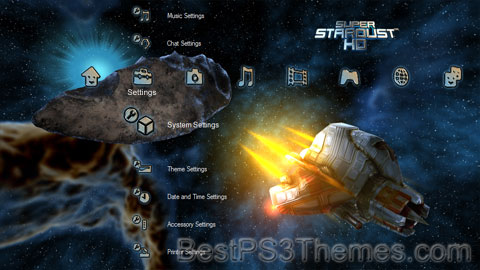
The game combines the mechanics of Asteroids and Robotron: 2084 with a level of action found typically in modern games such as Geometry Wars. The game is an enhanced version of Super Stardust for the Amiga. Super Stardust HD was one of the games given for free by Sony as part of their 'Welcome Back' package due to the PlayStation Network outage in 2011. Super Stardust HD was the first title with trophy support on the PlayStation 3.[1]
A version for PlayStation Portable titled Super Stardust Portable (Star Strike Portable in Asia) was released in November 2008, and a PlayStation Vita game building on Super Stardust HD, called Super Stardust Delta(Star Strike Delta in Asia) was released in 2012.
In Super Stardust HD, the player controls a space fighter craft that can move in any direction on a spherical shield surrounding a planet, while simultaneously firing in any direction independent of its movement. The primary threats against the player are three types of asteroids and various enemy spacecraft, which appear on the playfield at certain time intervals. The ship is equipped with three upgradeable weapons, a limited arsenal of bombs, and a boost capability that grants temporary invincibility and recharges after use. Each weapon is more effective against certain types of asteroid and enemies than others. Items include weapon upgrades and a shield that absorbs one fatal hit against the player's ship.
Super Stardust HD provides several modes of play, each with their own online leaderboards. The default game mode, Arcade, takes the player through a series of five planets, each consisting of five main phases, the last of which is a boss battle. Planet Mode allows the player to play any one of five planets in the same way, ending the game after the planet is complete. Both of these modes support both single-player and two-player cooperative play.
The Solo add-on pack (released in April 2008 and available for download via the PlayStation Store) adds several extra gameplay modes. Endless Mode pits the player against a continuous onslaught of rocks and enemies, gradually speeding up the action over time. Survival Mode challenges the player to last as long as possible while the playfield is filled with indestructible objects. Bomber Mode challenges players to score as many points as they can using only bombs and a single life – primary weapons and the boost ability are disabled. Time Attack mode challenges the player to complete a planet's worth of rocks and enemies in the shortest time possible – losing a life in this mode incurs a 3-minute penalty. The PSP version also received its own version of the Solo add-on pack, with only the Endless, Survival and Bomber modes, along with two new soundtracks. The Japanese version of the PSP game already comes with this pack.
With the release of game update version 2.40 on July 2, 2008, PlayStation trophy support was added to the title. This made Super Stardust HD the first title with trophy support on the PlayStation 3. A total of 17 trophies are available for the game.[1]
The Team Pack was also released the same day, which includes split-screen co-op and player versus player modes. The pack also offers an additional orchestral soundtrack in 5.1 surround and the ability to customize the player ship's appearance. The Team Pack was available for purchase from within the game and via the PlayStation Store before being removed with the 2.40 firmware. It was soon reinstated on July 15, in a store update after Sony's E3 press conference.
Stereoscopic 3D support was demonstrated at the 2010 Consumer Electronics Show and released in June in the same year. Super Stardust HD is the first 3D game for the PS3 that runs at 720p resolution at 60 frames per second for each eye (120 frames per second).[2] The original 2D version supports full 1080p resolution at 60 frames per second.[3]
Impact Mode, released in April 2011 on the PlayStation Store,[4] introduces much higher score multipliers. With weapons disabled in Impact Mode, the primary mode of attack is a modified version of the ship's boost capability, which remains active as long as there are targets to attack nearby.
The HD edition of Super Stardust received "favorable" reviews, while the Portable, Ultra, and its VR version received "average" reviews, according to the review aggregation website Metacritic.[24][25][26][27] In Japan, where the Ultra version was ported for release on March 12, 2015, Famitsu gave it a score of one eight, one seven, one nine, and one eight for a total of 32 out of 40.[9]
In 2013, the game entered IGN's Top 25 PlayStation Network Games list in the 4th position.[28]
Super Stardust HD has sold approximately 400,000 units for the PS3 as of September 2010.[29]
A follow-up, Super Stardust Ultra (known in Asia as Star Strike Ultra), was released in North America and the PAL region in February 2015 for PlayStation 4.[30] It was essentially an enhanced version of Super Stardust HD, without being a direct port.[31] It adds an exclusive mode called Interactive Streaming, which is an endless mode where the game is streamed live over the Internet, and viewers are allowed to help or hinder the player. A port of Super Stardust Ultra titled Super Stardust Ultra VR, offering a unique perspective from within the cockpit, was released as a launch title for the PlayStation VR.[32] The title was developed by UK based company D3T Ltd.[33]
In 2022, Super Stardust Portable was added to the premium collection of PlayStation Plus.
^Croft, Liam (February 27, 2015). "Super Stardust Ultra Review". The Digital Fix. Poisonous Monkey. Archived from the original on March 17, 2015. Retrieved December 5, 2018.
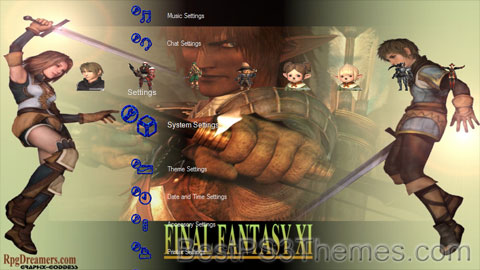
The story is set in the fantasy world of Vana'diel, where player-created avatars can both compete and cooperate in a variety of objectives to develop an assortment of jobs, skills, and earn in-game item rewards. Players can undertake an array of quests and progress through the in-game hierarchy and through the major plot of the game. Since its debut in 2002, five expansion packs have been released[4] along with six add-on scenarios. Each expansion pack and add-on brings a new major storyline to the Final Fantasy XI world, along with numerous areas, quests, events and item rewards.
In 2015, Square Enix released the final main scenario for Final Fantasy XI titled Rhapsodies of Vana'diel.[5]Final Fantasy XI became the final active server on the PlayStation 2 online service. Support for the PlayStation 2 and Xbox 360 versions was ultimately ended on March 31, 2016,[6] leaving only the PC platform playable. A mobile client for the game was under development by Square Enix in collaboration with Korean developer Nexon, using Unreal Engine 4, but was cancelled in late 2020.[7] A spin-off mobile game, Final Fantasy Grandmasters was released on September 30, 2015. A new, episodic story series titled The Voracious Resurgence was added to the game in 2020,[8] concluding in June 2023.[citation needed] In May 2022 rumors had circulated that FFXI may soon be shutting down. Yoji Fujito released a statement noting that this was not the case and users should not worry about the services being shut down any time soon.[9]
Final Fantasy XI is a massively multiplayer online role-playing game (MMORPG), and differs from previous titles in the series in several ways. Unlike the predefined main characters of previous Final Fantasy titles, players are able to customize their characters in limited ways, including selecting from one of five races and choosing their gender, facial style, hair color, body size, job, and nation allegiance. Also diverging from previous games in the series, the game takes place in a fully three-dimensional landscape with enemies freely roaming in it, allowing battles to occur in real time as opposed to the random encounters used in previous games - a trend continued in every numbered Final Fantasy title since.[10]
There are currently 16 public game worlds available for play, down from 32 at the game's height, with approximately 15,000 to 20,000 players in each.[11] A private Test Server was opened to eligible players to aid in feedback of updates in development for the game in mid-2011. The servers are named after summoned monsters from previous Final Fantasy titles, such as Ifrit and Diabolos. Players have the ability to move between servers, though Square Enix charges a "world transfer" fee to do so.[12][13] There are no region-specific or system-specific servers, and unlike most online games, players of different languages play in the same world and can interact through automatic language translation from a library of translated phrases.[14] The game servers are run by Square Enix as part of their PlayOnline network.
A player engages in a dialog sequence to advance the story.
Players have the option of using any combination of a keyboard, mouse, and controller to play Final Fantasy XI. While by default, a player using a PlayStation 2 or an Xbox 360 uses a virtual/in-game keyboard option, the player is able to use an external keyboard that is USB compatible for communication within the game. The head-up display in Final Fantasy XI consists of a log window, menus, and several game information elements. The log window at the bottom of the screen displays system messages, battle messages, and text input by other players. Players may choose to filter what appears in the log window. "Menus" allow the player to access different commands, status windows, and configuration options. The "action command menu" appears just above the log window and gives the player several options to interact with the game world. Several menu options are available through the use of keyboard shortcuts, as well.[15]
Story related gameplay in Final Fantasy XI consists of two major components: missions, through which the main storyline of the game is told, and quests, which do not advance the main storyline, but fill out the game's fantasy world.[16] Completing missions allows a player to advance in rank, which grants access to new areas, several privileges, and various other storylines. At first, a player may only complete missions for their home nation, though they are able to change allegiances later on, allowing access to other nations' storylines. Quests may be undertaken for their various rewards, or to acquire "fame", which allows a character to become well-known and respected by NPCs; a higher fame rating will open up new interactions and quests with NPCs. At release, over one hundred quests were available to play and each expansion pack has added its own set of missions and quests.[17] Players obtain in-game money known as gil by completing missions, quests and defeating Beastmen, though unlike previous Final Fantasy games, these monsters drop only small amounts. Gil can then be exchanged amongst players for goods through the Auction House, or be used to purchase items and rewards from NPCs.
Unlike some MMORPGs, there is very little focus on player versus player (PvP) combat, instead the game revolves around player versus environment (PvE). There are numerous PvE activities and events for players to partake in, including instanced activities and shared spaces activities. Some instanced events include Dynamis, Salvage, Assault and Nyzul Isle, which involve anywhere between 6 and 64 players.[18] These battle grounds give players a series of objectives to overcome or complete and enemies to defeat, generally within a certain time frame. Popular shared spaces activities include hunting Notorious Monsters, fiends that rarely appear and drop precious loot.
The only way to attack other players in PvP is to enter one on one competition activities known as "Conflict".[19] The first form of competition, called Ballista, involves players competing to score points by throwing petras into a castle-like structure known as a Rook.[20][21] The second form is known as "Brenner", and features a capture the flag type system.
From time to time special seasonal festivals and events are held. They last only for a set period of time and offer a variety of fun or useful rewards. Many events have changed over time, adding new features and eliminating old ones. These events are geared towards any level, often restricting players to level 1, so that veterans and novice players alike can join in together. Events celebrated are often thematically based on real life equivalents, for example: Valentione's Day in place of Valentine's Day, the Egg Hunt Egg-stravaganza in place of Easter, and the Starlight Celebration in place of Christmas.
Battles in Final Fantasy XI take place in the world in which players move around, a first in the series, where battle had previously taken place in a separate screen via random encounters. The surprise of the random encounter system is achieved via aggressive monsters, who will attack players based on different factors such as sight and sound. This format would continue in future Final Fantasy games. Monsters within the game operate under a system of "claim" and "enmity". A monster is claimed the moment a player performs any offensive action upon it, whether physical, magical or ability related. With some exceptions, once a monster is claimed it can only be attacked by players in the party or alliance of the player that claimed it. A monster will focus its attention on whoever has built up the most enmity. Players have several means at their disposal, including spells, abilities and items, to build up enmity or shed it to their advantage in battle - a factor that features heavily in group, or "party" play.
To defeat more powerful monsters and gain experience points efficiently, players can join a party. A regular party has room for six members. Like in many other games, a well-balanced party will consist of several archetypes- namely a healer, a tank (the party member with high defense that will be the main target of the monster), and the damage dealer. The enmity system comes into play heavily in parties, as players try to keep the monsters attention off fragile jobs and on the tanks. One of the key aspects of the battle system lies in the extreme flexibility of the party composition: unlike many other games, there are no constraints on the role (or "job" class) of the party members. This feature allows to tackle every fight with a wide array of different strategies, while encouraging the community to share new, creative ways of handling a certain type of enemy.
A party can expand into an alliance, with up to three parties combined, with a total of 18 players. Alliances are necessary to complete more difficult challenges: including missions, quests, nation or territory driven events, and defeating notorious monsters. Much of end-game play consists of alliance forces overcoming these higher level challenges and can even allow several alliances to enter into specific instances owned by a group of players (e.g. Dynamis instances entry is controlled by an hourglass item).
Final Fantasy XI's incarnation of Limit Breaks are "Weapon Skills". Physical damage given and received fills a Tactical Points (TP) bar, to a maximum of 3000. Any amount above 1000 is able to be used up by being channelled into a weapon skill. These skills vary in effect depending on job class, what weapon is equipped, how full the TP bar is, and how proficient the player is with the weapon. If partying with other players, one may use these weapon skills in succession in order to create a "Skillchain". A skillchain creates additional damage after a series of weapon skills are used. Building on this even further, magic used on a skillchain at the right time will receive a boost to its damage; this is called a "Magic Burst". In order to create the best possible skillchains and magic bursts, players must work together, focusing on each other's actions and timing.
Final Fantasy XI uses the concept of changing Jobs in a similar fashion to Final Fantasy III,[22] and currently has twenty-two Jobs as of the latest expansion pack in 2013. There are six "standard Jobs" available to choose from at the start of the game. After one standard Job has reached Level 30, the "extra Jobs" are accessible upon completing certain quests. Players are able to change their jobs any time from inside their house or by speaking with a Nomad Moogle. In June 2010, the long-standing level limit of 75 was incrementally increased to the higher level cap of 99, finishing in the December 2011 version update.
Jobs have a combination of unique "job traits", "job abilities", and magic spells, giving them a specific role within group play due to their area of expertise. Job traits are passive abilities that are always in effect, while job abilities must be activated by the player in order to come into effect. They last a limited time and have a "cooldown" period before they can be used again. Magic spells are available to certain jobs, and in addition to a cooldown period, they often consume MP or some form of item in order to be cast, while at the same time requiring the user to stand still. Additionally, each job has a special one-hour ability that performs an extraordinary function.
The unique system of Final Fantasy XI's job system is the "Support Job".[23] This system allows a player to augment their character with abilities, traits, and spells from another chosen job, at half the level of their current job. For instance, a Level 20 Warrior setting Ninja as their support job would allow them to use all Ninja abilities, traits, and spells up to that of a level 10 Ninja, while still primarily being a Level 20 Warrior. The support job system allows for job-merges never before seen in the Final Fantasy series. However, there are some exceptions to the system. One-hour abilities and other abilities deemed signature to a particular job (such as Call Wyvern for Dragoons) are restricted to being used only on the main job.
The raising, breeding, and racing of Chocobos was a much requested addition to the game.
In addition to completing quests and missions, players can participate in several side-minigames and other activities.[10] One such minigame is fishing, where players can measure their strength against the fish they attempt to catch. Another is clamming, where players collect as many fish or sea creatures as possible without going over their bucket's size limit. Gardening allows players to raise plants in their residence, or "Mog House" as it is known in the game.[24] The raising and breeding of Chocobos was a long-requested activity enabled in the summer 2006 update.[25] Chocobo racing began in March 2007, which allowed for the racing of player-raised Chocobos against non-player characters (NPCs). Winning racers can earn "Chocobucks", which can be used to buy, for example, items that assist Chocobo breeding.[26]
An important part of the game is the accumulation of items, especially rare ones, which allow players to create powerful weapons, armour and food. There are many ways to obtain items, such as harvesting, excavating, logging, mining, defeating monsters, and digging by using Chocobos. Square Enix attempted to increase the opportunity for players to find rare items in order to equalize the game and stop the practice of "gil selling", or exchanging real money for in-game items.[27] The item auction system was shut down temporarily once due to some players exploiting the system.[28] Items can be created by consuming elemental crystals (obtained by fighting monsters) with other ingredients in a process called "synthesis".[29] Recipe results can vary widely based on the player's skill, the quality of the player's equipment worn, and the ingredients used. There is large speculation (though nothing evidently documented yet) about the moon phase, direction the player is facing, in-game day (every day of the week is assigned an element), and even time of day the synthesis is performed to either increase or reduce the results of the recipe.
Final Fantasy XI has a largely player-based economy, with a heavy reliance on auction houses in each of the major cities of Vana'diel. There are certain economic controls in place mainly in the form of fees for putting items up for auction. Transportation, auction house, item storage, and fees do not go to players; these gil sinks effectively remove money from the economy to prevent inflation. The city of Jeuno used to levy a tax on bazaar purchases inside the city, but was removed in a patch in the December 2008 version update.[30]
Square Enix has stated that the trade of items for real currency is officially a violation of the Terms of Service for Final Fantasy XI.[31] In early 2006, Square Enix discovered that a group of players had found a way to generate game currency and exchange it for real currency, which, in turn, drove up prices for all items across the game. In response, 700 accounts were permanently banned and 300 billion gil was removed from circulation.[32] That July, Square Enix banned or suspended over 8,000 other accounts for similar manipulation and commerce.[33] Since 2006, Square Enix has regularly banned accounts found to be in violation of the terms, some of them using third-party tools, effectively removing billions of gil from the in-game economy.
The setting of Final Fantasy XI is the world of Vana'diel, a rich world with diverse climates, ranging from northern glaciers and southern deserts, to ethereal realms and sky landmasses.[34] Vana'diel is divided into a number of regions, which are subdivided into areas known as "zones". These zones are available for exploration and consist of outdoor areas, dungeons, cities, and towns. Players are able to explore a portion of Vana'diel, including the Middle Lands, Near East, and with the release of Seekers of Adoulin, the near west.[35] Six city states exist in the available lands, The Republic of Bastok, The Kingdom of San d'Oria, The Federation of Windurst, The Grand Duchy of Jeuno, The Empire of Aht Urhgan and the Sacred City of Adoulin. While most areas are accessible by walking, various modes of transportation, ranging from the classic Final FantasyChocobo and airships to special spells, facilitate movement across the game world.
Ancient lore states that Vana'diel was created as a playground for the Gods and their children, who themselves were spawned from an enormous and sentient Crystal. Eventually wishing to be one with the Gods, the children constructed a pathway to paradise. They were smote down for their insolence and their cities cast to the bottom of the sea. After seeing the destruction of her children and filled with sadness, the Goddess Altana wept five tears that gave life to the five Enlightened Races of Vana'diel. The God of Twilight, Promathia, condemned her weakness and the life that arose from it. Promathia cursed the five races with eternal conflict amongst themselves by bringing forth their darkest attributes: the apathy of the Humes, the arrogance of the Elvaan, the rage of the Galka, the cowardice of the Tarutaru, and the envy of the Mithra. He created the Beastmen, commanding them to forever fight the people of Vana'diel and occupy their minds, so these children would never have time to group together and construct a pathway like the ones before them.[34] The creation lore's sentient Crystal, Gods, Children, and the truths behind them feature as major plot points in several Final Fantasy XI expansion packs, while the Beastmen are some of the game's main antagonists.
The events of the game are set 20 years after the Crystal War, a devastating war where the Middle Land nations of Bastok, San d'Oria and Windurst fought and defeated the Shadow Lord and his army of Beastmen. Players deal with the aftermath of this conflict in the original story, and may travel back in time to aid in the war effort with the expansion pack Wings of the Goddess. Several parallel worlds are available, such as Dynamis and Abyssea, in which the beastmen won the Crystal War and conquered the land.
Final Fantasy XI features five playable races known as the "Enlightened Races":
The playable races in Final Fantasy XI. From left to right: Galka, Mithra, Hume, Elvaan, and Tarutaru.
Elvaan
A race of proud warriors, the Elvaan's home city is the Kingdom of San d'Oria. Elvaan have an unshakable pride and faith in their beliefs, and many eschew the business world, preferring an austere lifestyle as skilled sword fighters. The Elvaan race possesses high strength and mind, but low MP and intelligence. Elvaan are said to be cursed with the sin of arrogance.
Hume
Originating from the city of Bastok, Humes are the most common race in Vana'diel and are known for their intelligence and high level of skill in numerous areas. Humes have equally balanced abilities, and are said to be cursed with the sin of apathy. They serve as the game's human race.
Galka
A hulking race of powerful warriors, the Galka's capital city was destroyed by war 600 years ago. Many of the surviving Galka settled in Bastok, and are currently used by the city as cheap underclass labour. The Galka do not have a female counterpart, but reproduce through reincarnation. They possess the highest HP and vitality in the game, but also the lowest MP. The Galka are cursed with rage.
Mithra
The Mithra are a race of hunters who live alongside the Tarutaru in Windurst. They are known for their energy, curiosity, and their penchant for causing playful mischief. Due to a gender imbalance in their race males are a rarity, and so only female mithra leave the home, making females the only playable gender. Mithra possess high dexterity and agility, but lower HP and charisma. Mithra are cursed with envy.
Tarutaru
A race of skilled magic users from the Federation of Windurst, the Tarutaru physically resemble children, however their size does not reflect their age. Tarutaru are playful yet cunning. They possess the highest MP and intelligence of all the races, but the lowest HP and strength. Tarutaru are said to be cursed with cowardice.[10]
In addition to the playable races, there are two other non-playable Enlightened Races, known as the Zilart and the Kuluu. These ancient races were thought to be extinct, and are the focus of the first two-game expansions. There is also a large supporting cast of NPCs involved in quests, missions and the game's storylines. The game features several typical Final Fantasy fiends, including Goblins, Sahagins and Tonberries. Several of these races are known as Beastmen, a distinction made between fiends who possess higher than average intelligence, exhibiting self-awareness, emotions, culture, and religion. The complex relationship, bigoted views, and reasons of conflict between the Enlightened Races and Beastmen is a plot point throughout the game.[36]
Final Fantasy XI is represented in the Dissidia game series by Shantotto, a female Tarutaru Black Mage from the Windurst storyline, voiced by famed voice actress Megumi Hayashibara in the Japanese version and Candi Milo in the English version.[37][38] The game's prequel adds Prishe, a female Elvaan from Tavnazia, who is the main character in the Chains of Promathia expansion pack.
The storyline is primarily followed with missions through the governing nations that exist in the base game as well as each expansion that the player is affiliated with. Nation or governing body affiliation is relatively simple, sometimes requiring prerequisite quests being completed and have several stages of progression to achieve higher recognition and reward throughout each story. Some missions are even required to be completed to further progress into the start of the additional storylines of each expansion or specific areas.
Players begin the game as residents of one of the three main countries: San d'Oria, Bastok, and Windurst, and must help band the nations together against the resurrected Shadow Lord.
The expansion Rise of the Zilart reveals that the Crystal War and the resurrection of the Shadow Lord had been masterminded by the Zilart princes Eald'Narche and Kam'lanaut, who survived the extinction of their race. The two Zilarts plan to become Gods by opening the path to paradise, and the player is charged with thwarting their plans.
Chains of Promathia revolves around an Elvaan girl named Prishe and the dead Twilight God Promathia, who had originally cursed the Zilart race, and the attempts of various factions to either complete or stop his resurrection. The wyrmking Bahamut is involved in these events, and intends to destroy Vana'diel to prevent Promathia from absorbing the life of the world.
Treasures of Aht Urhgan concerns the Empire of Aht Urhgan which opens up to the nations of midlands after years of self-imposed isolation. As a new and powerful nation, it is of concern to the nation of the player, who is sent as a representative. The player then becomes embroiled in the intrigues of the Empress's court and the growing fears of war and darkness coming to Aht Urhgan.
Wings of the Goddess primarily occurs in the era of the Crystal War, 20 years in the past from the main Final Fantasy XI setting. The player discovers and crosses mysterious time portals alongside the Hume/Elvaan mix Lilisette, and are led to help the Regal Feline Cait Sith reduce the suffering of the era. However, Lilisette and her partner encounter Lilith, an alternate timeline version of herself who wishes to keep the war going to maintain her time while negating Lilisette's.
Seekers of Adoulin concerns the western continent archipelago of Adoulin, and the Sacred City of Adoulin. The city was a focal point for colonization 200 years before the present game, but when colonization efforts failed in the main continent of Ulbuka, the nation fell in population and shifted to trade as a focus. Now colonization has begun once again, and players are free to explore the region.
Rhapsodies of Vana'diel concerns the conclusion of the previous Final Fantasy XI storylines with the threat posed by the Cloud of Darkness and an alternate timeline version of the player.
The Voracious Resurgence, the follow-up story to Rhapsodies of Vana'diel, concerns the mysterious "world eater eggs" appearing all throughout the land of Vana'diel.
Final Fantasy XI is the most representative title of the Final Fantasy series, according to producer Hiromichi Tanaka.[39]
The idea to develop Final Fantasy XI as an online game was conceived by Hironobu Sakaguchi when establishing Square Pictures headquarters in Hawaii. Impressed by western MMORPGs that he discovered there, such as EverQuest, Sakaguchi convinced Square to begin the development of their own MMORPG and suggested that it be based on the Final Fantasy series.[39] Since MMORPG creation was seen as a "greater cause", Final Fantasy XI was made by a merger of four crews: the Parasite Eve II and Brave Fencer Musashi teams from Osaka, and the Mana and Chrono Cross teams from Tokyo.[40][41] Development began in November 1999. The game was the first developed under Square's new philosophy to develop for "all platforms and media".[42]Hiromichi Tanaka, the producer of the game, said that the title is heavily influenced by Final Fantasy III, especially in its battle and magic systems.[22] According to Tanaka, Square put in Final Fantasy XI what they could not put in the first Final Fantasy titles due to technical limitations, thus making XI the "most [representative] Final Fantasy of all the episodes".[39] The game was developed and ran on the NvidiaGeForce 4 TiGPU, which the President of Square Yoichi Wada described as the most powerful graphics processor available at the time.[43] The game cost two to three billion yen (~$17–25 million) to create along with the PlayOnline Network Service and was assumed to become profitable over a five-year timespan.[44] By creating a unified game world instead of different ones balkanized by language, development costs were cut 66%.[45][46] Since recurring monsters of the series are known by different names in the Japanese and English versions of the other installments, it was decided for Final Fantasy XI to use both Japanese and English names for different varieties of the same monsters.[45]
The PlayStation 2 version of the game came with a 40GB hard drive that required the Network Adaptor to connect to the system.
A simultaneous release on the PlayStation 2 and Microsoft Windows as well as concurrent Japanese and American release was originally considered, but this was later changed.[47] There was also discussion of an Xbox release, but was abandoned mainly because of its small 8 GB hard drive.[11] Originally announced in January 2000 at the Yokohama Millennium Conference, there was a great deal of negative press.[48] There were questions raised about naming the game the eleventh in the series, since it was not clear whether the game would have a structured story, which it ended up having, and the title of Final Fantasy Online was suggested.[49] Following an August 2001 beta test in Japan, a public Japanese beta test was done four months later in December.[50]
Following its PC release, Final Fantasy XI was listed as one of IGN's most anticipated PlayStation 2 games of 2004.[51]Sony launched a multimillion-dollar ad campaign to promote the game along with the PlayStation 2 hard drive add-on which the game required.[52] Having been released on the PlayStation 2 as well as the personal computer, it became the first cross-platform MMORPG ever created.[1] On June 14, 2002, the game server was down for four hours for maintenance to the database servers, bug fixes on the text interface, and a new patch for the game client.[53] This is thought to be the first patch ever released for a console game.[54] Other early issues included complaints by American players that experienced Japanese players had already completed all the quests. Square Enix responded by adding new servers in order to have game worlds with fewer expert players.[17]
Final Fantasy XI is one of the first cross-console video games, and has continued to update its software to allow the game to run on new consoles. In March 2007, a patch was released to enable gameplay in French and German. Square Enix noted that Nintendo's use of "