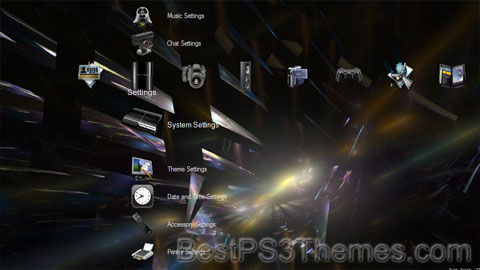
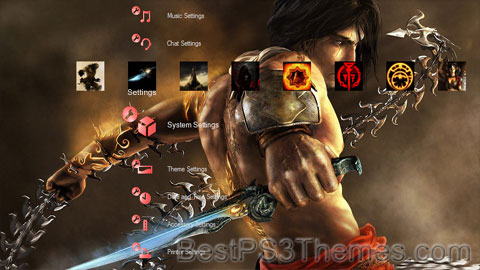
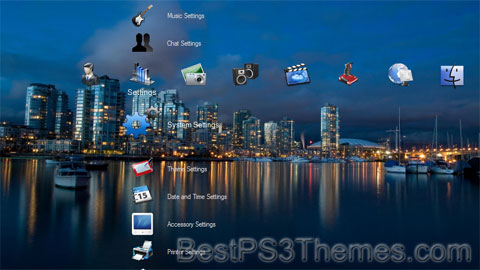
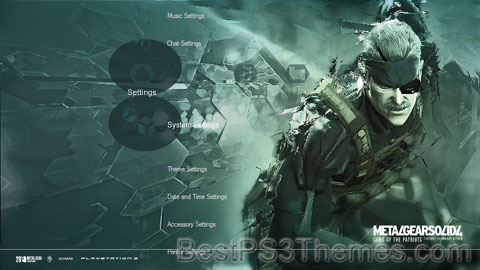
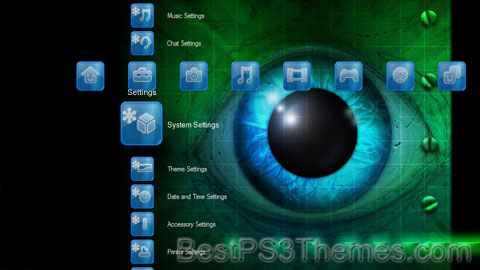
This program unpacks Playstation 3 Theme files (.p3t) so that you can touch-up an existing theme to your likings or use a certain wallpaper from it (as many themes have multiple). But remember, if you use content from another theme and release it, be sure to give credit!
Download p3textractor.zip from above. Extract the files to a folder with a program such as WinZip or WinRAR. Now there are multiple ways to extract the theme.
The first way is to simply open the p3t file with p3textractor.exe. If you don’t know how to do this, right click the p3t file and select Open With. Alternatively, open the p3t file and it will ask you to select a program to open with. Click Browse and find p3textractor.exe from where you previously extracted it to. It will open CMD and extract the theme to extracted.[filename]. After that, all you need to do for any future p3t files is open them and it will extract.
The second way is very simple. Just drag the p3t file to p3textractor.exe. It will open CMD and extract the theme to extracted.[filename].
For the third way, first put the p3t file you want to extract into the same folder as p3textractor.exe. Open CMD and browse to the folder with p3extractor.exe. Enter the following: p3textractor filename.p3t [destination path]Replace filename with the name of the p3t file, and replace [destination path] with the name of the folder you want the files to be extracted to. A destination path is not required. By default it will extract to extracted.filename.
The first game in the series was created by Jordan Mechner after the success of Karateka. Drawing from multiple general sources of inspiration, including the One Thousand and One Nights stories,[4] and films like Raiders of the Lost Ark[5] and The Adventures of Robin Hood,[6] the protagonist's character animation was created using a technique called rotoscoping, with Mechner using his brother as the model for the titular prince.[7] The original Prince of Persia, with its more than 20 platform ports, is one of the most ported games in video game history.[8][9]
Mechner enrolled in New York University's film department, producing an award-winning short film during his time there, before returning to design and direct a sequel to the original game.[10] The sequel, Prince of Persia 2: The Shadow and the Flame, was developed internally at Broderbund with Mechner's supervision. The game, like its predecessor, received critical acclaim and high sales. Broderbund was subsequently purchased by The Learning Company,[11] which was later acquired by US game company Mattel Interactive.[12] In 1999, Prince of Persia 3D was developed and released under Broderbund's Red Orb label.[10] Released for PC and the Dreamcast only,[13] it was criticized by many users as being buggy, and was a commercial disappointment.[10] The Broderbund/Learning Company's games division, the assets of which included the Prince of Persia franchise, was subsequently sold to Ubisoft.[14]
Mechner, who owned the Prince of Persiaintellectual property, was brought in to work with Ubisoft on a reboot of the franchise, titled The Sands of Time, although he was originally wary after the failure of Prince of Persia 3D.[15] The team they worked with was also working on Tom Clancy's Splinter Cell: their aim with the game was to "breathe new life into the action-adventure genre".[16][17]
Mechner did not take part in the production of the next game, Prince of Persia: Warrior Within, and he commented on finding the dark atmosphere and heightened level of violence unappealing.[18] The changes also provoked mixed reactions from critics, but sales were strong and a third game, eventually titled Prince of Persia: The Two Thrones, went into production.[19] For The Two Thrones, the developers and artists tried to strike a balance between the light, cartoon-like tones of The Sands of Time, and the grittier mediums of Warrior Within.[20]
A fourth installment in The Sands of Time series, Prince of Persia: The Forgotten Sands, was released in May 2010.[21] The Windows, Xbox 360 and PlayStation 3 versions of the game filled in some of the narrative gap between The Sands of Time and Warrior Within, whereas the PSP, Wii, and the DS versions each feature their own alternative storylines. The game was released as a tie in to The Sands of Time film adaptation.[22]
The Prince of Persia Trilogy (known as Prince of Persia Trilogy 3D on the remastered collection's title screen) is a collection of The Sands of Time trilogy released on the PlayStation 2 and subsequently on the PlayStation 3 as part of the Classics HD range.[23] The collection includes The Sands of Time, Warrior Within and The Two Thrones, all previously released on the PlayStation 2, Xbox and Microsoft Windows. The games were remastered in high-definition for the PlayStation 3 with 3D and PlayStation Network Trophy support on one Blu-ray Disc. The PlayStation 2 collection was released on October 27, 2006, in Europe,[citation needed] while the remastered collection was released on November 19, 2010, on Blu-ray in PAL regions. The release marks the first Classics HD title to not be published by Sony Computer Entertainment.
In North America, the three games were originally released separately as downloadable-only titles on the PlayStation Store. The first, The Sands of Time, was released on November 16, 2010, while the other two games followed in December.[24] The Blu-ray version was to be released in North America on March 22, 2011[25] but the collection ended up being delayed until April 19.
In 2006, concept designs surfaced hinting at another entry in the franchise.[26] The game, titled simply Prince of Persia, is a second reboot of the franchise, with its level and combat design harking back to the original 1989 game.[27] The game was released in December 2008, receiving positive reviews from most video game outlets and decent sales.[28] Alongside the main game, Ubisoft's Casablanca branch developed a direct sequel and spin-off for the Nintendo DS, titled Prince of Persia: The Fallen King,[29] which received fair reviews.[30][31][32][19]
The first spin-off of the series was developed alongside and released in the same year as The Two Thrones for the Nintendo DS. Battles of Prince of Persia is a turn-based strategy game set between The Sands of Time and Warrior Within.[33] It received mediocre reviews from critics.[34][35]
In 2007, Gameloft and Ubisoft released Prince of Persia Classic, an enhanced remake of the original Prince of Persia for Java ME, Android, iOS, Xbox 360 (XBLA), and PlayStation 3 (PSN).[36] The visual style was upgraded to resemble Prince of Persia: The Sands of Time, and the Prince himself was given some additional moves, such as the ability to roll, backflip, wall jump and stop time briefly during combat. However, the core gameplay remains the same as the original – the player must defeat Jaffar within one hour while watching out for the many traps and defeating the guards they encounter.
There have been a number of mobile games for Java ME-based phones developed by Gameloft, some based on older PC or console titles with 2D graphics and others loosely based on contemporary games but with 2D graphics and different gameplay due to technology constraints. Gameloft has also developed some ports for both the iPhone and the iPad.[37] The first spin-off by Gameloft was titled Prince of Persia: Harem Adventures, released for Java phones in 2003.[38] Specifically, the company has developed HD remakes of the original Prince of Persia in 2007,[39] and its sequel The Shadow and the Flame in July 2013.[40][41]
In 2018, Ubisoft under the banner of its entity Ketchapp released Prince of Persia: Escape,[42] a mobile game for Android and iOS. It is a runner game made up of different levels,[43] and the player can customize the protagonist with outfits from past games. Reviewing for Pocket Gamer, Cameron Bald called Prince of Persia: Escape a "mundane game crushed under the weight of excessive greed".[44] In August 2022, a follow-up, Prince of Persia: Escape 2, was released.[45]
A remake of the Sands of Time, formally announced at Ubisoft Forward 2020, was originally scheduled for release on January 21, 2021, for Microsoft Windows, PlayStation 4 and Xbox One, but Ubisoft delayed the remake indefinitely.[47] In its quarterly financial report, Ubisoft stated that the remake was expected to be out sometime during its 2022–23 fiscal year.[48] The remake's development was moved to Ubisoft Montréal, a change from Ubisoft Mumbai and Ubisoft Pune. The company said the 2023 fiscal year release target was no longer being targeted.[49] A new release window of 2026 was announced at Ubisoft Forward 2024.[50]
The Rogue Prince of Persia is an upcoming 2.5D roguelike title developed by Evil Empire and set to release in Early Access on May 14, 2024. The game entered development around 2019, after a discussion between Evil Empire and Ubisoft at GDC, and its art direction is heavily inspired by Franco-Belgian comics. The game will be Ubisoft's first day-one Steam release in five years, as well as their first title to be released in Early Access before a full release.[51]
In 2012, leaked images from a project entitled Osiris were assumed to be the next Prince of Persia title.[52] Jordan Mechner even commented on his Twitter account that the images were not from a Prince of Persia game.[53] A year later, Yannis Mallat, CEO of Ubisoft Montreal, said that the franchise was being "paused", saying that "as soon as we have something to show, we will".[54] In the following months, Ubisoft confirmed that it was either planning or considering next-generation entries in multiple franchises, including Prince of Persia.[55] A video uploaded by a Ubisoft Montreal artist in 2012 but only discovered in 2020 showed a gameplay trailer for Prince of Persia Redemption which would have been released for Windows, Xbox 360, and PlayStation 3.[56][57][58] According to Jonathan Cooper, a former Ubisoft animator at the time, the trailer was a mockup of the planned gameplay for the title created by Khai Nguyen, used to pitch the game concept. The game never developed beyond that point, though the work on the pitch trailer was used to prepare a similar trailer for Assassin's Creed III.[59]
Jordan Mechner finished writing the story for a graphic novel in 2007. The novel was written by A.B. Sina, and illustrated by Alex Puvilland and LeUyen Pham. It was released by First Second Books in autumn 2008.[60][61] The story follows two Princes, jumping between the 9th and 13th centuries. Although it belongs to the franchise the plot is not related to any of the game continuities or that of the 2010 film.[62]
In 2010, a film adaptation of The Sands of Time was released by Walt Disney Pictures. Starring Jake Gyllenhaal as Prince Dastan, it would go on to receive mixed reception, but still gross $336 million in theaters.[63] Besides The Sands of Time, the film also incorporated elements from Warrior Within and The Two Thrones, the two other titles from the Sands of Time trilogy of the Prince of Persia video game franchise.
Upon the film's release, it was accompanied by Before the Sandstorm, a 2010 one-shot comic book published by Disney Publishing Worldwide. This comic serves as both a direct prequel and sequel to the feature film, and explains the motives and backgrounds of some characters. It was written by Jordan Mechner and featured illustrations by Todd McFarlane, Niko Henrichon, David Lopez and Bernard Chang.
Lego Prince of Persia was released by The Lego Group in 2010, as part of the company's strategy to produce sets based on Disney properties.[64] Based on the feature film, Lego released six sets within the theme, as well as a short animated film, before discontinuing it.[65][66]
The success of the Prince of Persia series resulted in Guinness World Records awarding the series 6 world records in the Guinness World Records: Gamer's Edition 2008. These records include First Motion-Capture Animation in a Video Game and Highest Rated Platformer on PS2 and Xbox.
South Korean singer-songwriter Kim Kwang-Jin released the song 'Magic Castle', with lyrics inspired from the storyline of the original Prince of Persia.[67]
In 1992, Russian author Victor Pelevin wrote a book called A Werewolf Problem in Central Russia and Other Stories, in which there is a short story called "Prince of Gosplan". The story is greatly influenced by the game; the main hero of the story lives in a mixed reality of the real world and video games and identifies himself as Prince of Persia. He tries to understand if his life is real or if he is just seeing it on a computer display.[68]
The feel of the gameplay in Tomb Raider was intended to evoke that of the original Prince of Persia.[69]
The Assassin's Creed series originated out of ideas for a sequel for Prince of Persia: The Sands of Time. Its critical and financial success led Ubisoft to request Ubisoft Montreal to develop a sequel, aiming for the Xbox 360 and PlayStation 3. The Ubisoft Montreal team decided on taking the gameplay from The Sands of Time into an open world approach, taking advantage of the improved processing power to render larger spaces and crowds. Narratively, the team wanted to move away from the Prince being someone next in line for the throne but to have to work for it; combined with research into secret societies led them to focus on the Assassins, heavily borrowing from the novel Alamut.[70] They developed a narrative where the player would control an Assassin that served as a bodyguard for a non-playable Prince, leading them to call this game Prince of Persia: Assassin. The "Animus" device allowed them to explain certain facets of gameplay, such as accounting when the player fails a mission, in the same way they had done in The Sands of Time.[70]
Ferruccio Lamborghini (1916–1993), an Italian manufacturing magnate, founded Automobili Ferruccio Lamborghini S.p.A. in 1963 to compete with Ferrari. The company was noted for using a rear mid-engine, rear-wheel drive layout. Lamborghini grew rapidly during its first decade, but sales plunged in the wake of the 1973 worldwide financial downturn and the oil crisis. The firm's ownership changed three times after 1973, including a bankruptcy in 1978. American Chrysler Corporation took control of Lamborghini in 1987 and sold it to Malaysian investment group Mycom Setdco and Indonesian group V'Power Corporation in 1994. In 1998, Mycom Setdco and V'Power sold Lamborghini to the Volkswagen Group where it was placed under the control of the group's Audi division.
New products and model lines were introduced to the brand's portfolio and brought to the market and saw an increased productivity for the brand. In the late 2000s, during the worldwide financial crisis and the subsequent economic crisis, Lamborghini's sales saw a drop of nearly 50 per cent.
Lamborghini Trattori, founded in 1948 by Ferruccio Lamborghini, is headquartered in Pieve di Cento, Italy, and continues to produce tractors. Since 1973, Lamborghini Trattori has been a separate entity from the automobile manufacturer.
Manufacturing magnate Italian Ferruccio Lamborghini founded the company in 1963 with the objective of producing a refined grand touring car to compete with offerings from established marques such as Ferrari. The company's first models, such as the 350 GT, were released in the mid-1960s. Lamborghini was noted for the 1966 Miura sports coupé, which used a rear mid-engine, rear-wheel drive layout.
Lamborghini grew rapidly during its first ten years, but sales fell in the wake of the 1973 worldwide financial downturn and the oil crisis. Ferruccio Lamborghini sold the company to Georges-Henri Rossetti and René Leimer and retired in 1974. The company went bankrupt in 1978, and was placed in the receivership of brothers Jean-Claude and Patrick Mimran in 1980. The Mimrans purchased the company out of receivership by 1984 and invested heavily in its expansion. Under the Mimrans' management, Lamborghini's model line was expanded from the Countach to include the Jalpa sports car and the LM002 high-performance off-road vehicle.
The Mimrans sold Lamborghini to the Chrysler Corporation in 1987. After replacing the Countach with the Diablo and discontinuing the Jalpa and the LM002, Chrysler sold Lamborghini to Malaysian investment group Mycom Setdco and Indonesian group V'Power Corporation in 1994. In 1998, Mycom Setdco and V'Power sold Lamborghini to the Volkswagen Group where it was placed under the control of the group's Audi division. New products and model lines were introduced to the brand's portfolio and brought to the market and saw an increased productivity for the brand Lamborghini. In the late 2000s, during the worldwide financial crisis and the subsequent economic crisis, Lamborghini's sales saw a drop of nearly 50 per cent.
In 2021, the CEO of Lamborghini said that by 2024 all its models will be hybrid.[5]
As of the 2018 model year, Lamborghini's automobile product range consists of three model lines, two of which are mid-engine two-seat sports cars while the third one is a front engined, all-wheel drive SUV.[6]
Production of the new Revuelto began in mid-2023 and it will be delivered in late 2023 as a 2024 model. The car will be powered by a 6.5L naturally aspirated V12 and three magnetic motors for a combined power output of 1,001 hp (1,015 PS).[7][8]
The V10-powered Huracán line currently includes the all-wheel-drive LP 610-4, the low cost rear-wheel-drive LP 580-2 and the powerful track oriented LP 640-4 Performante, each in coupé and Spyder (convertible) versions.[9]
With the intention of doubling its sales volume by 2019, Lamborghini also added an SUV named Urus in its line-up which is powered by a twin-turboV8 engine and utilises a front engine, all-wheel drive layout.[10][11]
Motori Marini Lamborghini produces a large V12 marine engine block for use in World Offshore Series Class 1 powerboats. A Lamborghini branded marine engine displaces approximately 8,171 cc (8.2 L) and outputs approximately 940 hp (700 kW).[12]
In the mid-1980s, Lamborghini produced a limited-production run of a 1,000 cc (61.0 cu in) sports motorcycle. UK weekly newspaper Motor Cycle News reported in 1994—when featuring an example available through an Essex motorcycle retailer—that 24 examples were produced with a Lamborghini alloy frame having adjustable steering head angle, Kawasaki GPz1000RX engine/transmission unit, Cerianifront forks and Marvic wheels. The bodywork was plastic and fully integrated with front fairing merged into fuel tank and seat cover ending in a rear tail-fairing. The motorcycles were designed by Lamborghini stylists and produced by French business Boxer Bikes.[13]
Lamborghini licenses its brand to manufacturers that produce a variety of Lamborghini-branded consumer goods including scale models, clothing, accessories, bags, electronics[14] and laptop computers.[15]
Lamborghini Motorsport Division Squadra Corse produces GT3 cars and cars for their Super Trofeo events based on the Gallardo and Huracán. Apart from them, the Squadra Corse builds cars upon customer request.
The Super Trofeo is a series of Motorsport events held by Squadra corse using their Super Trofeo model vehicles (currently the Huracán Super Trofeo EVO) which are racing versions of the road-approved models (Huracán and Gallardo models).
The Super Trofeo events are held in three different series, in three continents: America, Asia and Europe. Many private race team participate each of these events.
Every series consists of six rounds, each of which feature free practice sessions, qualifying and two races lasting 50 minutes each. There are four categories of drivers: Pro, Pro-Am, Am and Lamborghini Cup. The season ends in the Lamborghini Super Trofeo World Final.[16]
The Lamborghini GT3 is a series of Motorsport events held by The Squadra Corse using Huracán GT3 cars that comply with the FIA GT3 regulations. The racing event is open to any Huracán GT3 customer.
Lamborghini currently uses Huracán GT3 Evo cars for these events and more than 60 private race teams participate these events.[17]
The first Resident Evil game was created by Shinji Mikami and Tokuro Fujiwara for PlayStation, and released in 1996.[1][2] It is credited for defining the survival horror genre and returning zombies to popular culture. By the time of Resident Evil 4 (2005), the franchise shifted to more dynamic shooting action, achieved critical acclaim, and influenced the evolution of the survival horror and third-person genres, popularizing the "over-the-shoulder" third-person view.[3]
The first Resident Evil action film was released in 2002, starring Milla Jovovich, followed by five further sequels and a reboot, Welcome to Raccoon City (2021). The films have received mostly negative critical reviews, including on Rotten Tomatoes and some on Metacritic; however, some of the films have received mixed reviews on Metacritic. Nevertheless, the films have grossed more than $1.2 billion, making Resident Evil the third-highest-grossing video game film series.
The development of the first Resident Evil, released as Biohazard in Japan, began in 1993 when Capcom's Tokuro Fujiwara told Shinji Mikami and other co-workers to create a game using elements from Fujiwara's 1989 game Sweet Home on the Family Computer (Famicom) in Japan.[5][6] When in late 1994 marketing executives were setting up to release Biohazard in the United States, it was pointed out that securing the rights to the name Biohazard would be very difficult as a DOS game had been registered under that name, as well as a New York hardcore punk band called Biohazard. A contest was held among company personnel to choose a new name; this competition turned up Resident Evil, the name under which it was released in the west.[7]Resident Evil made its debut on the PlayStation in 1996 and was later ported to the Sega Saturn.
The first entry in the series was the first game to be dubbed a "survival horror", a term coined for the new genre it initiated,[8] and its critical and commercial success[9] led to the production of two sequels, Resident Evil 2 in 1998 and Resident Evil 3: Nemesis in 1999, both for the PlayStation. A port of Resident Evil 2 was released for the Nintendo 64. In addition, ports of all three were released for Windows. The fourth game in the series, Resident Evil – Code: Veronica, was developed for the Dreamcast and released in 2000, followed by ports of Resident Evil 2 and Resident Evil 3: Nemesis. Resident Evil – Code: Veronica was later re-released for Dreamcast in Japan in an updated form as Code: Veronica Complete, which included slight changes, many of which revolved around story cutscenes. This updated version was later ported to the PlayStation 2 and GameCube under the title Code: Veronica X.
Despite earlier announcements that the next game in the series would be released for the PlayStation 2, which resulted in the creation of an unrelated game titled Devil May Cry, series' creator and producer Shinji Mikami decided to make the series exclusively for the GameCube.[10] The next three games in the series—a remake of the original Resident Evil and the prequel Resident Evil Zero, both released in 2002, as well as Resident Evil 4 (2005)—were all released initially as GameCube exclusives. Resident Evil 4 was later released for Windows, PlayStation 2, and Wii.
Resident Evil Outbreak is an online game for the PlayStation 2, released in 2003, depicting a series of episodic storylines in Raccoon City set during the same period as Resident Evil 2 and Resident Evil 3: Nemesis. It was the first in the series and the first survival horror title to feature cooperative gameplay.[14] It was followed by a sequel, Resident Evil Outbreak: File #2. Raccoon City is a metropolis located in the Arklay Mountains of the Midwestern United States that succumbed to the deadly T-virus outbreak and was consequently destroyed via a nuclear missile attack issued by the United States government. The town served as a critical junction for the series' progression as one of the main catalysts to Umbrella's downfall and the entry point for some of the series' most notable characters.
Resident Evil Gaiden is an action-adventure game for the Game Boy Color featuring a role-playing-style combat system. There have been several downloadable mobile games based on the Resident Evil series in Japan. Some of these mobile games have been released in North America and Europe through T-Mobile. At the Sony press conference during E3 2009, Resident Evil Portable was announced for the PlayStation Portable,[15][16][17] described as an all-new title being developed with "the PSP Go in mind" and "totally different for a Resident Evil game". No further announcements have been made, and the game is considered to have been canceled.[18][19]
In 2013, producer Masachika Kawata said the Resident Evil franchise would return to focus on elements of horror and suspense over action, adding that "survival horror as a genre is never going to be on the same level, financially, as shooters and much more popular, mainstream games. At the same time, I think we need to have the confidence to put money behind these projects, and it doesn't mean we can't focus on what we need to do as a survival horror game to meet fan's needs."[23]Resident Evil: Revelations 2, an episodic game set between Resident Evil 5 and Resident Evil 6, was released in March 2015. A series of team-based multiplayer games were developed beginning with the poorly receivedUmbrella Corps, which was released in June 2016.[24]Resident Evil: Resistance was released in April 2020, followed by Resident Evil Re:Verse in October 2022, with both being available for free to those who bought Resident Evil 3 and Village respectively.[25][26]
Using the new RE Engine, which would develop the next generation of Resident Evil games, the series continued to shift back towards more horror elements. The next mainline game, Resident Evil 7: Biohazard was released for Windows, PlayStation 4 and Xbox One in January 2017.[27][28] Set in a dilapidated mansion in Louisiana, the game uses a first-person perspective and emphasizes horror and exploration over action, unlike previous installments.[29][30][31][32] The first-person perspective continued in the eighth mainline game Resident Evil Village. Released in May 2021, the game, set in a mysterious European village, is a direct sequel to Resident Evil 7: Biohazard although it incorporates more action elements inspired from Resident Evil 4.[33][34] The game also marked the franchise's debut on PlayStation 5 and Xbox Series X/S[35]
A new generation of remakes of older entries began in 2019 with a remake of Resident Evil 2, being released for the PlayStation 4, Windows, and Xbox One. The remake outsold the original game within a year, selling over five million copies.[36] Following in the success of the Resident Evil 2 remake, Capcom revealed a remake of Resident Evil 3: Nemesis in December 2019, known as Resident Evil 3. It was released in April 2020.[37] In June 2022, a remake of Resident Evil 4 was announced and released on March 24, 2023 for PlayStation 4, PlayStation 5, Xbox Series X/S, and PC.[38]
Logo for Umbrella Corporation, a prominent antagonistic faction in the franchise
The early Resident Evil games focused on the Umbrella Corporation, an international pharmaceutical company that secretly develops mutagenic viruses to further their "bio-organic weapons" (BOW) research. The company's viruses can transform humans into mindless zombies while also mutating plants and animals into horrifying monstrosities. The Umbrella Corporation uses its vast resources to effectively control Raccoon City, a fictional midwestern American city. In the original Resident Evil, members of an elite police task force, Special Tactics and Rescue Service (STARS), are lured to a derelict mansion on the outskirts of Raccoon City. The STARS team is mostly decimated by zombies and other BOWs, leaving only a handful of survivors, including Chris Redfield, Jill Valentine, and Albert Wesker. Chris and Jill explore the zombie-infested mansion and uncover a secret underground Umbrella research facility. Wesker reveals himself to be a double agent for Umbrella and betrays his comrades. However, Wesker is seemingly murdered by a Tyrant, a special BOW that is the culmination of the Umbrella Corporation's research.[39][40]
Chris and Jill escape the mansion, but their testimony is ridiculed by Raccoon City's officials due to Umbrella's influence. Meanwhile, a separate viral outbreak occurs in another Umbrella research facility underneath Raccoon City. Most of the city's residents are infected and become zombies. Resident Evil 2 introduces two new protagonists, Leon S. Kennedy, a rookie police officer and Claire Redfield, the younger sister of Chris. Leon and Claire arrive in Raccoon City amidst the chaos of the viral outbreak. Leon is aided by Ada Wong, a corporate spy posing as an FBI agent, while Claire rescues Sherry Birkin, the daughter of two prominent Umbrella researchers. At the same time, Jill makes her escape from the city in Resident Evil 3: Nemesis. She is relentlessly pursued by a new Tyrant, Nemesis, who is deployed by Umbrella to eliminate all surviving STARS members. The U.S. Government destroys Raccoon City with a missile strike to sterilize the viral outbreak.[41] Leon, Claire, Sherry, Ada, and Jill escape the city before its eradication. Claire continues to look for Chris, whereas Leon is recruited to work for the U.S. Government. Resident Evil – Code: Veronica follows Claire as she escapes from a prison camp in the Southern Ocean and later reunites with Chris at an Umbrella research facility in Antarctica. Resident Evil 4 is set six years after the Raccoon City incident and focuses on Leon as he tries to rescue the U.S. President's daughter from a cult in Spain.[39][40]
A government investigation into the Umbrella Corporation reveals its involvement in the Raccoon City disaster and leads to the company's dissolution. Despite the downfall of the Umbrella Corporation, the company's research and BOWs proliferate across the black market and lead to the rise of bioterrorism. Chris and Jill establish the Bioterrorism Security Assessment Alliance (BSAA) to combat these ever-growing threats on a global scale. Wesker is revealed to be alive and involved in the development of new potent viral agents and BOWs. In Resident Evil 5, Wesker seeks to unleash a highly mutagenic virus that will infect all of humanity. Chris and the BSAA confront and kill Wesker in Africa before he can fulfill his mission.[42]Resident Evil 6 features Leon and Chris meeting for the first time in the video game series.[43] The two work separately to triage bioterrorist attacks in the United States, Eastern Europe, and China. They are assisted by Sherry, Wesker's illegitimate son Jake Muller, Ada, and many members of the BSAA and U.S. government.
Resident Evil 7: Biohazard and Resident Evil Village introduce a new protagonist, Ethan Winters, who becomes entangled in a bioterrorism incident while searching for his missing wife. He encounters Chris and the BSAA, who help him rescue his wife and defeat Eveline, a powerful BOW. Ethan, Mia, and their newborn daughter, Rosemary, are relocated to Eastern Europe but are abducted by a cult. Ethan ultimately sacrifices himself to destroy a fungal colony being weaponized by bioterrorists and save his family.[39][40][44]
The Resident Evil franchise has had a variety of control schemes and gameplay mechanics throughout its history. Puzzle-solving has figured prominently throughout the series.[45]
The first game introduced a control scheme that the player community has come to refer to as "tank controls" to the series. In a game with tank controls, players control movement relative to the position of the player character, rather than relative to the fixed virtual camera from which the player views the current scene.[46] Pressing up (for example on a D-pad, analog stick, or cursor movement keys) on the game controller moves the character in the direction being faced, pressing down backpedals, and left and right rotates the character.[46] This can feel counter-intuitive when the character is facing the camera, as the controls are essentially reversed in this state. This differs from many 3D games, in which characters move in the direction the player pushes the controls from the perspective of the camera.[46] Some critics have posited that the control scheme is intentionally clumsy, meant to enhance stress and exacerbate difficulty.[47]
While the first three entries in the series featured this control scheme, the third, Resident Evil 3: Nemesis, saw some action-oriented additions. These included a 180 degree turn and dodge command that, according to GameSpot, "hinted at a new direction that the series would go in." Later games in the series, like Resident Evil 4, would feature a more fluid over-the-shoulder third-person camera instead of a fixed camera for each room, while Resident Evil 7 and Resident Evil Village are played from the first-person perspective.
Resident Evil 4 saw significant changes to the established gameplay, including switching from fixed camera perspectives to a tracking camera, and more action-oriented gameplay and mechanics. This was complemented by an abundance of ammunition and revised aiming and melee mechanics. Some critics claimed that this overhauled control scheme "made the game less scary."[47] The next two games in the franchise furthered the action-oriented mechanics: Resident Evil 5 featured cooperative play and added strafing, while Resident Evil 6 allowed players to move while aiming and shooting for the first time, fully abandoning the series' signature tank controls.[47]
Resident Evil 7 is the first main Resident Evil game to use the first-person perspective and to use virtual reality. It drew comparisons to modern survival horror games such as Outlast and PT.[47] The eighth main-series game, Resident Evil Village, also features a first-person perspective.[48] A VR version of Resident Evil 4 was released on the Oculus Quest 2 on October 21, 2021.[49]
The Resident Evil franchise features video games and tie-in merchandise and products, including various live-action and animated films, comic books, and novels.
From 2002 to 2016, six live-action Resident Evil films were produced, all written and produced by Paul W. S. Anderson. The films do not follow the games' premise but feature some game characters. The series' protagonist is Alice, an original character created for the films portrayed by Milla Jovovich. Despite a negative reaction from critics, the live-action film series has made over $1 billion worldwide.[50] They are, to date, the only video game adaptations to increase the amount of money made with each successive film.[51] The series holds the record for the "Most Live-Action Film Adaptations of a Video Game" in the 2012 Guinness World Records Gamer's Edition, which also described it as "the most successful movie series to be based on a video game."[14]
The first computer animated film for the franchise was Biohazard 4D-Executer. It was a short 3D film produced for Japanese theme parks and did not feature any characters from the game.[53]
Starting in 2008, a series of feature-length computer-animated films have been released. These films take place in the same continuity with the games of the series, and feature characters such as Leon Kennedy, Claire Redfield, Ada Wong, Chris Redfield,
Pogled (mountain), a mountain peak in Kosovo, Serbia, and Montenegro
In Serbia:
Pogled, Arilje, a settlement in the Municipality of Arilje
In Slovenia:
Pogled, Moravče, a settlement in the Municipality of Moravče
Pogled, Apače, a settlement in the Municipality of Apače
Topics referred to by the same term
This disambiguation page lists articles about distinct geographical locations with the same name. If an internal link led you here, you may wish to change the link to point directly to the intended article.
This program unpacks Playstation 3 Theme files (.p3t) so that you can touch-up an existing theme to your likings or use a certain wallpaper from it (as many themes have multiple). But remember, if you use content from another theme and release it, be sure to give credit!
Download p3textractor.zip from above. Extract the files to a folder with a program such as WinZip or WinRAR. Now there are multiple ways to extract the theme.
The first way is to simply open the p3t file with p3textractor.exe. If you don’t know how to do this, right click the p3t file and select Open With. Alternatively, open the p3t file and it will ask you to select a program to open with. Click Browse and find p3textractor.exe from where you previously extracted it to. It will open CMD and extract the theme to extracted.[filename]. After that, all you need to do for any future p3t files is open them and it will extract.
The second way is very simple. Just drag the p3t file to p3textractor.exe. It will open CMD and extract the theme to extracted.[filename].
For the third way, first put the p3t file you want to extract into the same folder as p3textractor.exe. Open CMD and browse to the folder with p3extractor.exe. Enter the following: p3textractor filename.p3t [destination path]Replace filename with the name of the p3t file, and replace [destination path] with the name of the folder you want the files to be extracted to. A destination path is not required. By default it will extract to extracted.filename.