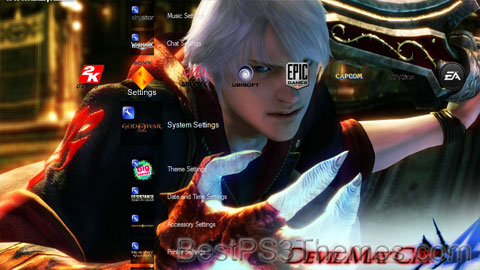
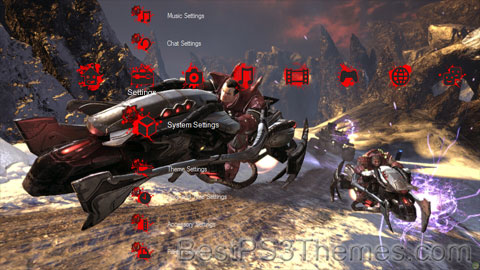
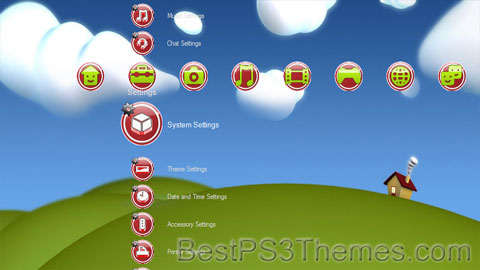
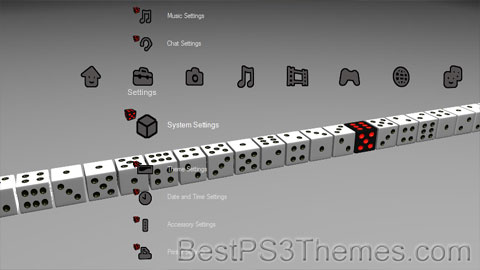
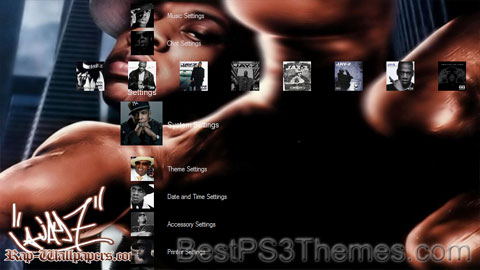
This program unpacks Playstation 3 Theme files (.p3t) so that you can touch-up an existing theme to your likings or use a certain wallpaper from it (as many themes have multiple). But remember, if you use content from another theme and release it, be sure to give credit!
Download p3textractor.zip from above. Extract the files to a folder with a program such as WinZip or WinRAR. Now there are multiple ways to extract the theme.
The first way is to simply open the p3t file with p3textractor.exe. If you don’t know how to do this, right click the p3t file and select Open With. Alternatively, open the p3t file and it will ask you to select a program to open with. Click Browse and find p3textractor.exe from where you previously extracted it to. It will open CMD and extract the theme to extracted.[filename]. After that, all you need to do for any future p3t files is open them and it will extract.
The second way is very simple. Just drag the p3t file to p3textractor.exe. It will open CMD and extract the theme to extracted.[filename].
For the third way, first put the p3t file you want to extract into the same folder as p3textractor.exe. Open CMD and browse to the folder with p3extractor.exe. Enter the following: p3textractor filename.p3t [destination path]Replace filename with the name of the p3t file, and replace [destination path] with the name of the folder you want the files to be extracted to. A destination path is not required. By default it will extract to extracted.filename.
This program unpacks Playstation 3 Theme files (.p3t) so that you can touch-up an existing theme to your likings or use a certain wallpaper from it (as many themes have multiple). But remember, if you use content from another theme and release it, be sure to give credit!
Download p3textractor.zip from above. Extract the files to a folder with a program such as WinZip or WinRAR. Now there are multiple ways to extract the theme.
The first way is to simply open the p3t file with p3textractor.exe. If you don’t know how to do this, right click the p3t file and select Open With. Alternatively, open the p3t file and it will ask you to select a program to open with. Click Browse and find p3textractor.exe from where you previously extracted it to. It will open CMD and extract the theme to extracted.[filename]. After that, all you need to do for any future p3t files is open them and it will extract.
The second way is very simple. Just drag the p3t file to p3textractor.exe. It will open CMD and extract the theme to extracted.[filename].
For the third way, first put the p3t file you want to extract into the same folder as p3textractor.exe. Open CMD and browse to the folder with p3extractor.exe. Enter the following: p3textractor filename.p3t [destination path]Replace filename with the name of the p3t file, and replace [destination path] with the name of the folder you want the files to be extracted to. A destination path is not required. By default it will extract to extracted.filename.
This program unpacks Playstation 3 Theme files (.p3t) so that you can touch-up an existing theme to your likings or use a certain wallpaper from it (as many themes have multiple). But remember, if you use content from another theme and release it, be sure to give credit!
Download p3textractor.zip from above. Extract the files to a folder with a program such as WinZip or WinRAR. Now there are multiple ways to extract the theme.
The first way is to simply open the p3t file with p3textractor.exe. If you don’t know how to do this, right click the p3t file and select Open With. Alternatively, open the p3t file and it will ask you to select a program to open with. Click Browse and find p3textractor.exe from where you previously extracted it to. It will open CMD and extract the theme to extracted.[filename]. After that, all you need to do for any future p3t files is open them and it will extract.
The second way is very simple. Just drag the p3t file to p3textractor.exe. It will open CMD and extract the theme to extracted.[filename].
For the third way, first put the p3t file you want to extract into the same folder as p3textractor.exe. Open CMD and browse to the folder with p3extractor.exe. Enter the following: p3textractor filename.p3t [destination path]Replace filename with the name of the p3t file, and replace [destination path] with the name of the folder you want the files to be extracted to. A destination path is not required. By default it will extract to extracted.filename.
The game is played from a third-person perspective and its world is navigated on foot and by vehicle. Throughout the single-player mode, players control Niko Bellic. An online multiplayer mode is also included with the game, allowing up to 32 players to engage in both cooperative and competitive gameplay in a recreation of the single-player setting.[b] Two expansion packs were later released for the game, The Lost and Damned and The Ballad of Gay Tony, which both feature new plots that are interconnected with the main Grand Theft Auto IV storyline, and follow new protagonists.
Development of Grand Theft Auto IV began soon after the release of San Andreas and was shared between many of Rockstar's studios worldwide. The game introduced a shift to a more realistic and detailed style and tone for the series. Unlike previous entries, Grand Theft Auto IV lacked a strong cinematic influence, as the team attempted an original approach to the story. As part of their research for the open world, the development team conducted extensive field research in New York, capturing over 100,000 photographs and several hours of video. The developers considered the world to be the most important element of the game; though not the largest map in the series, they considered it comparable in scope due to its verticality and level of detail. The budget climbed to over US$100 million, making it one of the most expensive video games to develop.
Grand Theft Auto IV was released for the PlayStation 3 and Xbox 360 consoles in April 2008, and for Windows in December. Upon release, the game received critical acclaim, with praise particularly directed at the narrative and open-world design. Grand Theft Auto IV broke industry sales records and became the fastest-selling entertainment product in history at the time, earning US$310 million in its first day and US$500 million in its first week. Considered one of the most significant titles of the seventh generation of video games, and by many critics as one of the greatest video games of all time, it won year-end accolades, including Game of the Year awards from several gaming publications. It is among the best-selling video games with over 25 million copies sold by 2013. The game generated controversy, with criticism directed at the game's depiction of violence and players' ability to drink-drive. Its successor, Grand Theft Auto V, was released in September 2013.
Grand Theft Auto IV is an action-adventure game played from a third-person perspective.[2] Players complete missions—linear scenarios with set objectives—to progress through the story. It is possible to have several active missions running at one time, as some require players to wait for further instructions or events. Outside of missions, players can freely roam the game's open world and complete optional side missions.[3] Composed of the fictional city of Liberty City, the world is larger in area than most earlier Grand Theft Auto series entries.[4] At the beginning of the game, players can only explore the first island—composed of Dukes and Broker—with all other islands unlocking as the story progresses.[5]
Players use melee attacks, firearms and explosives to fight enemies, and may run, jump, swim or use vehicles to navigate the game's world. There is a first-person perspective option when using vehicles. In combat, auto-aim and a cover system can be used as assistance against enemies. Should players take damage, their health meter can be fully regenerated by consuming food or drinks, using medical kits, or calling for paramedics.[6] If players commit crimes, the game's law enforcement agencies may respond as indicated by a "wanted" meter in the head-up display (HUD). On the meter, the displayed stars indicate the current wanted level (for example, at the maximum six-star level, efforts by law enforcement to incapacitate players become very aggressive). Law enforcement officers will search for players who leave the wanted vicinity. The wanted meter enters a cool-down mode and eventually recedes when players are hidden from the officers' line of sight.[7]
Combat in Grand Theft Auto IV was reworked to include a cover system.[6]
The game's cover system allows players to move between cover, to fire blindly, aim freely, and target a specific enemy. Individual body parts can also be targeted.[8] Melee attacks include additional moves, such as dodging, blocking, disarming an opponent and counter-attacking. Body armour can be used to absorb gunshots and explosive damage, but is used up in the process. When health is entirely depleted, gameplay stops, and players respawn at the nearest hospital.[6]
The single-player mode lets players control an Eastern European war veteran, Niko Bellic. During the story, Niko meets and befriends various new characters. They can then perform favours for Niko whenever he asks; for example, his cousin Roman, who owns a taxi service, can send one of his cabs to take Niko to any destination around the city. Cabs are always available during gameplay for quick travel to a destination. Throughout the course of the game, players are also faced with morality choices, which alter the storyline appropriately depending on the player's choice. While free roaming the game world, players may engage in context-specific activities such as bowling or darts. Other available activities include a vigilante mini-game, and in-game television programming.[9][10][11] Niko has a cell phone for contacting friends and starting activities.[12] The cell phone is also used to access the game's online multiplayer mode, and to enter cheat codes.[13] To access the in-game Internet, which allows Niko to send and receive emails and set up prospective dates with potential girlfriends, Niko can use Internet cafés located around the city.[14] The game also features a subway system, allowing players to quickly traverse through the game's world.[15]
The online multiplayer mode for Grand Theft Auto IV allows up to 32 players[b] to freely roam across the map. Players decide which game mode they wish to play, including deathmatches and street races. Both cooperative and competitive game modes are available, split into ranked and unranked matches.[16] For players to level up through ranks, in-game money has to be earned. The game also features a Free Mode, in which players have the entire map open to explore, with no end goal or mission to complete. Hosts of the game can control many variables, such as police presence, traffic, and weapons.[17] The multiplayer mode was discontinued on Windows in 2020.[18]
Grand Theft Auto IV takes place in 2008, within a redesigned version of Liberty City. The design of the city focuses on a recreation of four of the boroughs of New York City: Broker (based on Brooklyn), Dukes (Queens), Bohan (The Bronx), and Algonquin (Manhattan). The setting also includes the neighbouring state of Alderney (based on New Jersey).[19] Initially, bridges are locked down due to a terrorist threat, and police constantly pursue players if the bridges are crossed. The blockades are lifted as the story progresses, allowing the player to traverse between islands safely.
Grand Theft Auto IV is set in the fictional "HD Universe", which mirrors and parodies the real world. The previous games formed fictional universes of their own,[c] which despite having many similarities with the HD Universe, are considered to be different continuities. Hence, the Liberty City depicted in Grand Theft Auto IV is different from its previous renditions, and the game itself serves as a reboot for the series. The new timeline established by Grand Theft Auto IV would continue with two expansion packs, The Lost and Damned and The Ballad of Gay Tony, and a sequel, Grand Theft Auto V, as well as its online component, Grand Theft Auto Online.[21][22][23] The handheld game Grand Theft Auto: Chinatown Wars is also considered part of the HD Universe, because it features the same map as Grand Theft Auto IV, except for Alderney.[24]
Niko Bellic, an Eastern European ex-soldier,[25] arrives in Liberty City aboard a cargo ship, the Platypus, to escape his criminal past, pursue the American Dream, and search for the man who betrayed his unit to an ambush during a war ten years prior. Reuniting with his cousin Roman, he discovers that his tales of riches were lies concealing his small, dirty apartment, unprofitable taxi company, gambling debts, and disputes with loan sharks. Niko begins assisting Roman with his problems, which leads him to make his first criminal contacts in the city. He befriends Yardies second-in-command Little Jacob and is forced to work for Vlad Glebov, Roman's Russian loan shark, whom Niko eventually kills upon learning he had slept with Roman's girlfriend, Mallorie.
In retaliation, Niko and Roman are kidnapped by Russian mobsters on orders of their boss Mikhail Faustin and his lieutenant, Dimitri Rascalov. Indifferent to Vlad's murder, Faustin releases them and employs Niko as a hitman, eventually ordering him to kill the son of Russian crime lord Kenny Petrović. When Petrović threatens retaliation, Dimitri convinces Niko to assassinate Faustin. However, he then betrays and brings Niko to his former employer, Ray Bulgarin, who accuses Niko of stealing from him during a botched human trafficking job years earlier. Niko denies the allegation and a firefight ensues, allowing Dimitri and Bulgarin to escape.
Dimitri's men burn down Niko and Roman's apartment and taxi company, forcing them to flee to Bohan. While Niko finds work with several local drug lords, Dimitri kidnaps Roman in a failed attempt to lure Niko into a trap. Later, Niko discovers that his romantic interest, a woman named Michelle, is a government agent, who then entraps him into working for her agency. In exchange for the murders of several known or suspected terrorists, the agency clears Niko's criminal record and assists him in searching for the traitor he seeks. Niko and Roman's fortunes improve when the latter receives a large amount of insurance money from his destroyed business, which he uses to rebuild it and buy an apartment in Algonquin. Roman also proposes to Mallorie, who accepts.
While working for the Irish Mob, Niko befriends gangster Patrick "Packie" McReary and helps him and his brothers carry out various jobs, including a major bank robbery. Niko is later hired by Ray Boccino, a caporegime in the Pegorino crime family, to oversee a diamond deal, which goes awry. Boccino repays Niko by helping him find his ex-comrade Florian Cravic, now known as Bernie Crane, who claims he was not the one to betray their unit. Niko concludes that the traitor was Darko Brevic, the only other survivor. Niko continues working for the Mafia in Liberty City and eventually earns the trust of Don Jimmy Pegorino, who orders Niko to kill Boccino after suspecting him of being a police informant. Niko also helps Packie kidnap Don Giovanni Ancelotti's daughter to ransom her for the diamonds, but Bulgarin intercepts the exchange. In the ensuing firefight, the diamonds are lost.
Eventually, the government agents find Darko in Romania and bring him to Liberty City for Niko to decide his fate. Afterwards, Niko is summoned by Pegorino for one final favour: to help with a highly lucrative heroin deal in collusion with Dimitri. Niko must either agree to work with Dimitri or exact revenge on him.[26] If Niko goes through with the deal, Dimitri betrays him again,[27] kills Pegorino,[28] and attempts to kill Niko via an assassin at Roman's wedding, but accidentally kills Roman;[29] Niko retaliates by tracking and murdering Dimitri.[28] If Niko chooses to exact revenge, he kills Dimitri aboard the Platypus,[30] prompting a furious Pegorino to target Niko but accidentally kill Packie's sister Kate, whom Niko had been dating, at Roman's wedding;[29] Niko retaliates by tracking and murdering Pegorino.[31] Later, either Mallorie or Roman tells Niko that Mallorie is pregnant.
Rockstar North's former studio in Edinburgh, Scotland, where Grand Theft Auto IV's development was overseen
Preliminary work on Grand Theft Auto IV began in November 2004,[32] a month after the release of Grand Theft Auto: San Andreas.[33] Rockstar president Sam Houser felt that following up San Andreas was "a nightmare".[34]Rockstar North, the core 220-person team behind the game, co-opted studios owned by parent company Rockstar Games to facilitate development between a full team of over 1,000,[35] including 50 employees at Rockstar NYC, 40 at Rockstar Lincoln, 10 at Rockstar San Diego, and around 600–700 working part-time internally and externally.[36] Some key members of the development team worked 12-hour days during production, often without holidays.[35] The team decided to continue the numbering scheme absent from the previous two main games to represent the same leap in production as Grand Theft Auto 2 (1999) to Grand Theft Auto III (2001).[33] Development of Grand Theft Auto IV ceased by 21 April 2008 when the game was submitted for manufacturing.[37] Producer Leslie Benzies estimated that the budget of the development efforts exceeded US$100 million, making Grand Theft Auto IV one of the most expensive video games ever made.[35]
The game's setting, Liberty City, is based on New York City. The team did not look at the previous renditions of Liberty City as inspiration, wanting it to retain the "general feel" but nothing else.[38] The map is roughly three times the size of Grand Theft Auto III's.[38] The developers originally considered using the entire state of New York, before restricting it to Manhattan, and then expanding it out again. They considered including more suburbs with woods, and would regularly vote on which areas to include.[39] Art director Aaron Garbut said that the team chose the setting because of the detail and variety it provided, describing New York as "an amazing, diverse, vibrant, cinematic city".[40] Writer Dan Houser added that the team "wanted to be somewhere where we had a foothold" due to the amount of research required for the world; Rockstar Games's main headquarters are located in New York.[41] The team consciously avoided a precise recreation of New York City to allow for more enjoyable game design,[32] selecting the areas that they felt "characterised it the best".[40] Garbut wanted to capture a caricature of the city as he felt that most people were familiar with "the highlights" from film or literature but did not need to know the areas precisely.[40] The city was not built with specific missions in mind; the area was created first, and missions implemented later.[42]
To achieve a realistic environment, 60–70 employees from Rockstar North travelled to New York for research: first at the beginning of the project in March or April 2005 for a week and a half,[39] and a smaller trip in 2007.[38] Police officers who previously worked the beat drove the team around Washington Heights.[39] A full-time research team based in New York handled further requests for information, such as the ethnic minority of a neighbourhood or videos of traffic patterns. Videos shot in New York were played on televisions at the Rockstar North offices "so while they worked they could look up and there was New York".[39] Benzies claimed that the team took over 100,000 photographs on location in New York,[35] though Garbut estimates that they took around 250,000.[38] They also studied architectural plans for apartments, used satellite images to determine city block layout, researched sales figures for models of cars, and read books that detailed the city's infrastructure, including its subways, sewers, and garbage disposal.[43] Hove Beach is based on Brighton Beach, which Sam Houser found "pretty incredible" and unusual; the name is based on the English city Brighton and Hove, made up of the former neighbouring towns Brighton and Hove.[44] Houser appreciated that Brighton Beach was home to several Eastern Europeans due to the nature of the game's characters.[44]
Dan Houser described Liberty City as "the biggest character" of the game.[40] The Grand Theft Auto IV rendition of Liberty City is more detailed and larger in size than most earlier entries in the series; although smaller than San Andreas, the setting of the previous main game, the developers considered it comparable in scope due to city's verticality, number of buildings, and level of detail.[45] The team wanted less dead spots and irrelevant spaces, such as the wide open deserts in San Andreas.[32] They wanted the game to be "a more focused experience" than San Andreas, and Dan Houser felt that the limited activities of New York allowed this.[33] The team felt that the addition of Niko's mobile phone added to the immersion of the world and represented society's shifted focus on phones.[33] The in-game brands and products are designed over several years; the billboards were implemented in the game around six months prior to release.[38]
Benzies produced the game. Dan Houser co-wrote the story,[35] while his brother Sam executive-produced the game.[34]
The game's script, written by Dan Houser and Rupert Humphries, is about 1,000 pages.[35] Approximately 660 actors provided voices for the game over 80,000 lines of dialogue.[39] After conceiving the character and setting, Dan Houser spoke with his brother Sam Houser and Leslie Benzies to bounce story ideas before writing a rough synopsis, a six-paged, detailed document. Once the synopsis was reworked, the designers broke it into missions, represented by a large flow document demonstrating each section. The writers then work on the introductions to the missions; the gameplay dialogue comes much later.[41] Unlike previous Grand Theft Auto games, Grand Theft Auto IV does not have cinematic influences. "We were consciously trying to go, well, if video games are going to develop into the next stage, then the thing isn't to try and do a loving tribute or reference other stuff," said Dan Houser.[41] He said that the writers wanted something "fresh and new and not something that was obviously derived from [a] movie".[41] Dan Houser felt that the quality of the writing had to improve alongside the advancements in graphics and technology. He noted that the improvements in facial animation allowed for slower-paced cutscenes.[40] The unique dialogue that plays when a mission is retried was to ensure that the gameplay felt "less canned and less like Groundhog Day".[40]
Dan Houser described Niko Bellic as "a more rounded character" than those in previous games.[40] He felt that his dual personality—often saving innocent people, while also being a "cold-hearted killer"—made him more relatable.[40] He also felt that Niko's unfamiliarity with Liberty City allowed for the player to relate to him more, only driven by his vague past and relationship with Roman. When deciding on Niko's background, the writers felt that being an immigrant could lead to more dangerous situations, and therefore more enjoyable missions; after discussions with criminal experts, Dan Houser found that "the real scary characters are not born in America anymore".[40] He felt that Niko's outsider view of American culture was "fun".[40] The team wanted Niko to be "more of an anti hero than a hero, capable of making positive actions within his criminal world".[46] They wanted his demeanour to reflect the weight of his past and choices.[46]
Niko's design underwent a few changes, but was finalised early in development.[47] His outfit underwent several changes based on Eastern Europeans, particularly photographs of men fighting in winter wars in Yugoslavia and Chechnya. The primary motivation for the design was a face to convey the appropriate emotions and a body that could move nicely with the new animations.[40] The in-game purchasable outfits were also designed to fit with the character.[33] The team ensured that the gameplay choices presented to the player were not too extensive, as they still had to make sense to the character, who is driven by the people around him. Dan Houser felt that the missions in San Andreas had become too linear, and wanted to present choices to the player in Grand Theft Auto IV.[40]
The writers found that Niko needed a motivation to come to America, so they created his cousin, Roman. Dan Houser felt that the two could not be brothers as there would be a deeper level of familiarity than necessary. He described the two as a double act, with Roman's fantasist charm playing off Niko's tough cynicism. The team gave other non-playable characters (NPCs) more definable behaviours and dialogue to make them feel more alive. The writers initially considered having a smaller group of characters, but found that the story became boring and that players were less likely to explore the world. The stranger characters found in the game world were based on the "crazy people" that populate New York, according to Dan Houser, which in previous games were only able to be captured through radio stations or mild pedestrian behaviours.[38] The team based the ethnicities, clothing, and behaviours of the NPCs on the photographs and videos that they captured around New York, divided into different areas;[40] they created mood boards for each location.[38] The NPCs also converse in different languages.[39]
Grand Theft Auto IV sees a shift in the series to a more realistic and detailed style and tone, partly a result of the transition to consoles which offered high-definition graphics and the new and improved capabilities of such consoles. The development team worked to represent the upgrade in quality across all design aspects while maintaining the coherence of the previous games.[32] The team took the game's development as an opportunity to "strip things back and start again", refining the art style without losing the style of the series;[40] they distanced the game from the "cartoon-like style" of its predecessors while creating a new style that was consistent across all aspects of the game.[48] Garbut found the increased demand of detail brought on by the advanced technology daunting.[49] A technique used to make the visuals look real was to avoid harsh edges, instead blending surfaces together to make the world look dirty and lived-in.[50] The props department created multiple variations of different objects to make the world more interesting and unique.[40]G
This program unpacks Playstation 3 Theme files (.p3t) so that you can touch-up an existing theme to your likings or use a certain wallpaper from it (as many themes have multiple). But remember, if you use content from another theme and release it, be sure to give credit!
Download p3textractor.zip from above. Extract the files to a folder with a program such as WinZip or WinRAR. Now there are multiple ways to extract the theme.
The first way is to simply open the p3t file with p3textractor.exe. If you don’t know how to do this, right click the p3t file and select Open With. Alternatively, open the p3t file and it will ask you to select a program to open with. Click Browse and find p3textractor.exe from where you previously extracted it to. It will open CMD and extract the theme to extracted.[filename]. After that, all you need to do for any future p3t files is open them and it will extract.
The second way is very simple. Just drag the p3t file to p3textractor.exe. It will open CMD and extract the theme to extracted.[filename].
For the third way, first put the p3t file you want to extract into the same folder as p3textractor.exe. Open CMD and browse to the folder with p3extractor.exe. Enter the following: p3textractor filename.p3t [destination path]Replace filename with the name of the p3t file, and replace [destination path] with the name of the folder you want the files to be extracted to. A destination path is not required. By default it will extract to extracted.filename.
This disambiguation page lists articles associated with the title Bliss. If an internal link led you here, you may wish to change the link to point directly to the intended article.
A traditional die is a cube with each of its six faces marked with a different number of dots (pips) from one to six. When thrown or rolled, the die comes to rest showing a random integer from one to six on its upper surface, with each value being equally likely. Dice may also have polyhedral or irregular shapes, may have faces marked with numerals or symbols instead of pips and may have their numbers carved out from the material of the dice instead of marked on it. Loaded dice are specifically designed or modified to favor some results over others for cheating or entertainment.
Composite image of all sides of a 12 mm (1⁄2 in) Roman die, found in Leicestershire, England
Dice have been used since before recorded history, and it is uncertain where they originated. It is theorized that dice developed from the practice of fortune-telling with the talus of hoofed animals, colloquially known as knucklebones.[2] The Egyptian game of senet (played before 3000 BCE and up to the 2nd century CE) was played with flat two-sided throwsticks which indicated the number of squares a player could move, and thus functioned as a form of dice.[3] Perhaps the oldest known dice were excavated as part of a backgammon-like game set at the Burnt City, an archeological site in south-eastern Iran, estimated to be from between 2800 and 2500 BCE.[4][5] Bone dice from Skara Brae, Scotland have been dated to 3100–2400 BCE.[6] Excavations from graves at Mohenjo-daro, an Indus Valley civilization settlement, unearthed terracotta dice dating to 2500–1900 BCE,[7] including at least one die whose opposite sides all add up to seven, as in modern dice.[8]
Games involving dice are mentioned in the ancient IndianRigveda, Atharvaveda,Mahabharata and Buddhist games list.[9] There are several biblical references to "casting lots" (Hebrew: יפילו גורלyappîlū ḡōrāl), as in Psalm 22, indicating that dicing (or a related activity) was commonplace when the psalm was composed. Knucklebones was a game of skill played in ancient Greece; a derivative form had the four sides of bones receive different values like modern dice.[10]
Roman wall painting showing two dice-players, Pompeii, 1st century
Although gambling was illegal, many Romans were passionate gamblers who enjoyed dicing, which was known as aleam ludere ("to play at dice"). There were two sizes of Roman dice. Tali were large dice inscribed with one, three, four, and six on four sides. Tesserae were smaller dice with sides numbered from one to six.[11] Twenty-sided dice date back to the 2nd century CE[12] and from Ptolemaic Egypt as early as the 2nd century BCE.[13]
Dominoes and playing cards originated in China as developments from dice.[14] The transition from dice to playing cards occurred in China around the Tang dynasty (618–907 CE), and coincides with the technological transition from rolls of manuscripts to block printed books.[15] In Japan, dice were used to play a popular game called sugoroku. There are two types of sugoroku. Ban-sugoroku is similar to backgammon and dates to the Heian period (794–1185 CE), while e-sugoroku is a racing game.[16]
Dice are thrown onto a surface either from the hand or from a container designed for this (such as a cup, tray, or tower). The face (or corner, in cases such as tetrahedral dice, or edge, for odd-numbered long dice) of the die that is uppermost when it comes to rest provides the value of the throw.
The result of a die roll is determined by the way it is thrown, according to the laws of classical mechanics (although luck is often credited for the results of a roll). A die roll is made random by uncertainty in minor factors such as tiny movements in the thrower's hand; they are thus a crude form of hardware random number generator.
One typical contemporary dice game is craps, where two dice are thrown simultaneously and wagers are made on the total value of the two dice. Dice are frequently used to introduce randomness into board games, where they are often used to decide the distance through which a piece will move along the board (as in backgammon and Monopoly).
Common dice are small cubes, most often 1.6 cm (0.63 in) across, whose faces are numbered from one to six, usually by patterns of round dots called pips. (While the use of Arabic numerals is occasionally seen, such dice are less common.)
Opposite sides of a modern die traditionally add up to seven, requiring the 1, 2, and 3 faces to share a vertex.[17] The faces of a die may be placed clockwise or counterclockwise about this vertex. If the 1, 2, and 3 faces run counterclockwise, the die is called "right-handed". If those faces run clockwise, the die is called "left-handed". Western dice are normally right-handed, and Chinese dice are normally left-handed.[18]
The pips on standard six-sided dice are arranged in specific patterns as shown. Asian style dice bear similar patterns to Western ones, but the pips are closer to the center of the face; in addition, the pips are differently sized on Asian style dice, and the pips are colored red on the 1 and 4 sides. Red fours may be of Indian origin.[18][19]
Typical facets showing the more compact pip arrangement of an Asian-style die (top) vs. a Western-style die (bottom)
Non-precision dice are manufactured via the plastic injection molding process, often made of polymethyl methacrylate (PMMA). The pips or numbers on the die are a part of the mold. Different pigments can be added to the dice to make them opaque or transparent, or multiple pigments may be added to make the dice speckled or marbled.[20]
The coloring for numbering is achieved by submerging the die entirely in paint, which is allowed to dry. The die is then polished via a tumble finishing process similar to rock polishing. The abrasive agent scrapes off all of the paint except for the indents of the numbering. A finer abrasive is then used to polish the die. This process also produces the smoother, rounded edges on the dice.
Precision casino dice may have a polished or sand finish, making them transparent or translucent respectively. Casino dice have their pips drilled, then filled flush with a paint of the same density as the material used for the dice, such that the center of gravity of the dice is as close to the geometric center as possible. This mitigates concerns that the pips will cause a small bias.[21] All such dice are stamped with a serial number to prevent potential cheaters from substituting a die. Precision backgammon dice are made the same way; they tend to be slightly smaller and have rounded corners and edges, to allow better movement inside the dice cup and stop forceful rolls from damaging the playing surface.
While the terms ace, deuce, trey, cater, cinque and sice are generally obsolete, with the names of the numbers preferred, they are still used by some professional gamblers to designate different sides of the dice. Ace is from the Latin as, meaning "a unit";[23] the others are 2 to 6 in Old French.[24]
When rolling two dice, certain combinations have slang names. The term snake eyes is a roll of one pip on each die. The Online Etymology Dictionary traces use of the term as far back as 1919.[25]
The US term boxcars, also known as midnight, is a roll of six pips on each die. The pair of six pips resembles a pair of boxcars on a freight train. Many rolls have names in the game of craps.
Through his business ventures, Jay-Z became the first hip-hop billionaire in 2019.[19][20] In 1999, he co-founded the clothing retailer Rocawear[21] and later founded the 40/40 Club, a luxury bar chain, in 2003. As both grew into multi-million-dollar businesses, he launched Roc Nation, a multi-disciplinary entertainment agency in 2008. In 2015, he acquired the technology company Aspiro and led the expansion of Tidal, the company's media streaming service.[22][23][24] As of 2024, he is the wealthiest musical artist in the world with a net worth of US$2.5 billion.[25]
Shawn Corey Carter was born on December 4, 1969, in Brooklyn, New York City.[30] He was raised in Marcy Houses, a public housing project in Brooklyn's Bedford–Stuyvesant neighborhood.[31] His father, Adnis Reeves,[32] abandoned the family, and Jay-Z and his three older siblings were raised by his mother, Gloria Carter. Reeves later met and reconciled with Jay-Z prior to his death in 2003. Jay-Z claims in his lyrics that in 1982, at age 12, he shot his older brother in the shoulder for stealing his jewelry.[33][34]
Jay-Z can be briefly heard on several of Jaz-O's early recordings in the late 1980s and early 1990s, including "H. P. Gets Busy", "The Originators" and "Hawaiian Sophie".[39][40] Jay-Z became embroiled in several battles with rapper LL Cool J in the early 1990s.[41] He first became known to a wide audience on the posse cut "Show and Prove" on the 1994 Big Daddy Kane album Daddy's Home. Jay-Z has been referred to as Big Daddy Kane's hype man during this period,[42] although Kane explains that he did not fill the traditional hype man role, and was instead basically making cameo appearances on stage. "When I would leave the stage to go change outfits, I would bring out Jay-Z and Positive K and let them freestyle until I came back to the stage."[43][44]
According to his second verse on "99 Problems", released in 2003, Jay-Z was allegedly stopped by an NYPD detective in 1994 while en route to I-95, possibly for a search of drugs in his car. Detection dogs were called, but another police car had passed; Jay-Z was let go soon after.[45] Jay-Z appeared on a popular song by Big L, "Da Graveyard", and on Mic Geronimo's "Time to Build", which also featured early appearances by his former Murder Inc. colleagues Ja Rule and DMX in 1995. His first official rap single was "In My Lifetime", which was released with an accompanying music video in 1995. An unreleased music video was also produced for the B-side "I Can't Get with That."[46]
1995–2000: Reasonable Doubt, In My Lifetime, Vol. 1, Vol. 2..., Vol. 3..., and The Dynasty[edit]
In 1998, Jay-Z released Vol. 2... Hard Knock Life which spawned the biggest hit of his career at the time, "Hard Knock Life (Ghetto Anthem)". He relied more on flow and wordplay, and he continued with his penchant for mining beats from the popular producers of the day such as Swizz Beatz, an upstart in-house producer for Ruff Ryders, and Timbaland.[48] Other producers included DJ Premier, Erick Sermon, The 45 King, and Kid Capri. Charting hits from this album included "Can I Get A...", featuring Ja Rule and Amil, and "Nigga What, Nigga Who", featuring Amil and Jaz-O. Vol. 2 would eventually become Jay-Z's most commercially successful album; it was certified 5× Platinum in the United States and has to date sold over five million copies.[47] The album went on to win a Grammy Award, although Jay-Z boycotted the ceremony protesting DMX's failure to garner a Grammy nomination and the academy's decision to not broadcast urban music categories.[49]
In 1999, Jay-Z collaborated with Mariah Carey on "Heartbreaker", a song from her seventh album, Rainbow. The song became Jay-Z's first chart-topper in the US, spending two weeks atop the BillboardHot 100.[50] In that same year, Jay-Z released Vol. 3... Life and Times of S. Carter. The album proved successful and sold over 3 million copies.[47]Vol. 3's most successful single was "Big Pimpin", featuring UGK.
In 2000, Jay-Z released The Dynasty: Roc La Familia, which was originally intended to become a compilation album for Roc-A-Fella artists but Def Jam turned into a Jay-Z album.[51] The album helped to introduce newcomer producers The Neptunes, Just Blaze, Kanye West, and Bink, which have all gone on to achieve notable success. This is also the first album where Jay-Z utilizes a more soulful sound than his previous albums. The Dynasty sold over two million units in the U.S. alone.[47]
2001–2002: Feud with Nas, The Blueprint and The Blueprint2[edit]
In 2001, Jay-Z spoke out against Prodigy after he took an issue with a Jay-Z line from "Money, Cash, Hoes" that he felt alluded disparagingly to Mobb Deep and Prodigy's dispute with Tupac Shakur, Snoop Dogg, and Death Row Records. He later performed the song "Takeover", at Summer Jam 2001, which initially attacked Prodigy and revealed photos of Prodigy dressed like Michael Jackson.[52] A line at the end of "Takeover" referred to Nas, who criticized him on "We Will Survive".[53] Nas responded with a diss track called "Ether" and Jay-Z straightaway added a verse to "Takeover" which dissed Nas and would start a feud between the two rappers. The feud had ended by 2005; Jay-Z stated that record producer Mark Pitts had helped them settle their differences.[54]
In October 2001, Jay-Z pleaded guilty to aggravated assault for stabbing record producer Lance Rivera at the Kit Kat Klub in New York City in 1999.[59] Despite Jay-Z's sentence of three years probation for the crime, Rivera later recanted the allegations in 2023.[60][61]
Jay-Z then collaborated with Chicago singer R. Kelly to release collaborative studio album, The Best of Both Worlds in March 2002. In November of that year, Jay-Z released his seventh studio album The Blueprint2: The Gift & The Curse—a double album. The album debuted on the Billboard 200 at number one, selling over 3 million units solely in the U.S.[47] and surpassing The Blueprint.[62] It yielded a single-disc re-issue, The Blueprint 2.1, which retained half of the songs from the original. Its original release spawned two hit singles, "Excuse Me Miss" and "'03 Bonnie & Clyde", which features Jay-Z's then-girlfriend, Beyoncé, and contained the track "A Dream", featuring Faith Evans and the late Notorious B.I.G.; the re-issue spawned the single "La-La-La", which was a sequel to "Excuse Me Miss" and failed to match its commercial success.
2003–2005: The Black Album and initial retirement[edit]
Later in 2004, Jay-Z was named president of Def Jam Records, which led to Jay-Z, Dash and Biggs selling their remaining interests in Roc-A-Fella Records and Jay-Z taking control of both of the companies.[67] Reportedly this major industry move was prompted by disagreements between Jay-Z and Dash as to what direction Roc-A-Fella could undertake.[68]
2005–2007: Kingdom Come and American Gangster[edit]
Jay-Z performing in 2006
On October 27, 2005, Jay-Z headlined New York's Power 105.1 annual concert, Powerhouse. The concert was entitled the "I Declare War" concert leading to intense speculation in the weeks preceding the event on whom exactly Jay-Z would declare war. As he had previously "declared war" on other artists taking lyrical shots at him at other events, many believed that the Powerhouse show would represent an all-out assault by Jay-Z upon his rivals.[69] The theme of the concert was Jay-Z's position as president and CEO of Def Jam, complete with an on-stage mock-up of the Oval Office. Many artists made appearances such as the old roster of Roc-A-Fella records artists, as well as Ne-Yo, Teairra Marí, T.I., Young Jeezy, Akon, Kanye West, Paul Wall, The LOX, and Diddy.[70]
At the conclusion of the concert, Jay-Z put many arguments to rest to the surprise of hip hop fans. The most significant development in this show was closure to the infamous hip hop rivalry between Jay-Z and Nas. The two former rivals shook hands and shared the stage together to perform Jay-Z's "Dead Presidents" blended with Nas's song "The World is Yours".[71]
Jay-Z returned with his comeback album on November 21, 2006, titled Kingdom Come.[72] Jay-Z's comeback single, "Show Me What You Got", was leaked on the Internet in early October 2006, scheduled to be released later on that month, received heavy air-play after its leak, causing the FBI to step in and investigate.[73] Jay-Z worked with video director Hype Williams, and the single's video was directed by F. Gary Gray. The album features production from Just Blaze, Pharrell, Kanye West, Dr. Dre and Coldplay's Chris Martin (single entitled "Beach Chair").[74][75] The first week saw 680,000 sales of the CD, enough to be his "biggest sales week ever" as Billboard reported.[76] This album has sold 2 million copies in the U.S.[47]
Jay-Z released his tenth album entitled American Gangster on November 6, 2007. After viewing the Ridley Scott film of the same name, Jay-Z was heavily inspired to create a new "concept" album that depicts his experiences as a street-hustler.
This program unpacks Playstation 3 Theme files (.p3t) so that you can touch-up an existing theme to your likings or use a certain wallpaper from it (as many themes have multiple). But remember, if you use content from another theme and release it, be sure to give credit!
Download p3textractor.zip from above. Extract the files to a folder with a program such as WinZip or WinRAR. Now there are multiple ways to extract the theme.
The first way is to simply open the p3t file with p3textractor.exe. If you don’t know how to do this, right click the p3t file and select Open With. Alternatively, open the p3t file and it will ask you to select a program to open with. Click Browse and find p3textractor.exe from where you previously extracted it to. It will open CMD and extract the theme to extracted.[filename]. After that, all you need to do for any future p3t files is open them and it will extract.
The second way is very simple. Just drag the p3t file to p3textractor.exe. It will open CMD and extract the theme to extracted.[filename].
For the third way, first put the p3t file you want to extract into the same folder as p3textractor.exe. Open CMD and browse to the folder with p3extractor.exe. Enter the following: p3textractor filename.p3t [destination path]Replace filename with the name of the p3t file, and replace [destination path] with the name of the folder you want the files to be extracted to. A destination path is not required. By default it will extract to extracted.filename.
This page is a redirect. The following categories are used to track and monitor this redirect:
From a page move: This is a redirect from a page that has been moved (renamed). This page was kept as a redirect to avoid breaking links, both internal and external, that may have been made to the old page name.
From a stylization: This is a redirect from a stylized article title. It leads to the target in accordance with Wikipedia naming conventions for symbols and stylizations. This may help writing, searching, and international language issues.
Use this rcat to tag onlymainspace redirects; when stylized titles are in other namespaces, use {{R from modification}}instead.
From other capitalisation: This is a redirect from a title with another method of capitalisation. It leads to the title in accordance with the Wikipedia naming conventions for capitalisation, or it leads to a title that is associated in some way with the conventional capitalisation of this redirect title. This may help writing, searching and international language issues.
If this redirect is an incorrect capitalisation, then {{R from miscapitalisation}} should be used instead, and pages that use this link should be updated to link directly to the target. Miscapitalisations can be tagged in any namespace.
Use this rcat to tag onlymainspace redirects; when other capitalisations are in other namespaces, use {{R from modification}}instead.