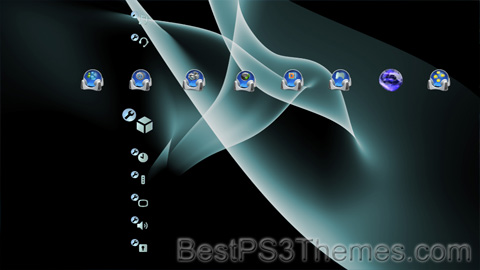
This program unpacks Playstation 3 Theme files (.p3t) so that you can touch-up an existing theme to your likings or use a certain wallpaper from it (as many themes have multiple). But remember, if you use content from another theme and release it, be sure to give credit!
Download p3textractor.zip from above. Extract the files to a folder with a program such as WinZip or WinRAR. Now there are multiple ways to extract the theme.
The first way is to simply open the p3t file with p3textractor.exe. If you don’t know how to do this, right click the p3t file and select Open With. Alternatively, open the p3t file and it will ask you to select a program to open with. Click Browse and find p3textractor.exe from where you previously extracted it to. It will open CMD and extract the theme to extracted.[filename]. After that, all you need to do for any future p3t files is open them and it will extract.
The second way is very simple. Just drag the p3t file to p3textractor.exe. It will open CMD and extract the theme to extracted.[filename].
For the third way, first put the p3t file you want to extract into the same folder as p3textractor.exe. Open CMD and browse to the folder with p3extractor.exe. Enter the following: p3textractor filename.p3t [destination path]Replace filename with the name of the p3t file, and replace [destination path] with the name of the folder you want the files to be extracted to. A destination path is not required. By default it will extract to extracted.filename.
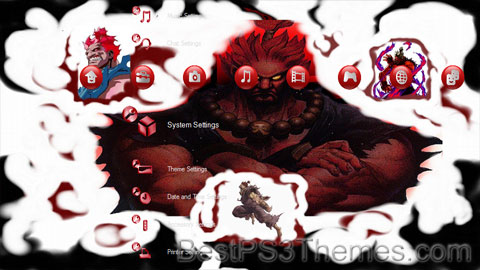
This disambiguation page lists articles associated with the title Akuma. If an internal link led you here, you may wish to change the link to point directly to the intended article.
This program unpacks Playstation 3 Theme files (.p3t) so that you can touch-up an existing theme to your likings or use a certain wallpaper from it (as many themes have multiple). But remember, if you use content from another theme and release it, be sure to give credit!
Download p3textractor.zip from above. Extract the files to a folder with a program such as WinZip or WinRAR. Now there are multiple ways to extract the theme.
The first way is to simply open the p3t file with p3textractor.exe. If you don’t know how to do this, right click the p3t file and select Open With. Alternatively, open the p3t file and it will ask you to select a program to open with. Click Browse and find p3textractor.exe from where you previously extracted it to. It will open CMD and extract the theme to extracted.[filename]. After that, all you need to do for any future p3t files is open them and it will extract.
The second way is very simple. Just drag the p3t file to p3textractor.exe. It will open CMD and extract the theme to extracted.[filename].
For the third way, first put the p3t file you want to extract into the same folder as p3textractor.exe. Open CMD and browse to the folder with p3extractor.exe. Enter the following: p3textractor filename.p3t [destination path]Replace filename with the name of the p3t file, and replace [destination path] with the name of the folder you want the files to be extracted to. A destination path is not required. By default it will extract to extracted.filename.
Shadows of visitors to the Eiffel Tower, viewed from the first platformPark fence shadow is distorted by an uneven snow surface.Shadows from cumulus clouds thick enough to block sunlight
A shadow is a dark area where light from a light source is blocked by an object. It occupies all of the three-dimensional volume behind an object with light in front of it. The cross section of a shadow is a two-dimensionalsilhouette, or a reverse projection of the object blocking the light.
A point source of light casts only a simple shadow, called an "umbra". For a non-point or "extended" source of light, the shadow is divided into the umbra, penumbra, and antumbra. The wider the light source, the more blurred the shadow becomes. If two penumbras overlap, the shadows appear to attract and merge. This is known as the shadow blister effect.
The outlines of the shadow zones can be found by tracing the rays of light emitted by the outermost regions of the extended light source. The umbra region does not receive any direct light from any part of the light source and is the darkest. A viewer located in the umbra region cannot directly see any part of the light source.
By contrast, the penumbra is illuminated by some parts of the light source, giving it an intermediate level of light intensity. A viewer located in the penumbra region will see the light source, but it is partially blocked by the object casting the shadow.
If there is more than one light source, there will be several shadows, with the overlapping parts darker, and various combinations of brightnesses or even colors. The more diffuse the lighting is, the softer and more indistinct the shadow outlines become until they disappear. The lighting of an overcast sky produces few visible shadows.
The absence of diffusing atmospheric effects in the vacuum of outer space produces shadows that are stark and sharply delineated by high-contrast boundaries between light and dark.
For a person or object touching the surface where the shadow is projected (e.g. a person standing on the ground, or a pole in the ground) the shadows converge at the point of contact.
A shadow shows, apart from distortion, the same image as the silhouette when looking at the object from the sun-side, hence the mirror image of the silhouette seen from the other side.
The names umbra, penumbra and antumbra are often used for the shadows cast by astronomical objects, though they are sometimes used to describe levels of darkness, such as in sunspots. An astronomical object casts human-visible shadows when its apparent magnitude is equal or lower than -4.[2] The only astronomical objects able to project visible shadows onto Earth are the Sun, the Moon, and in the right conditions, Venus or Jupiter.[3][4]Night is caused by the hemisphere of a planet facing its orbital star blocking its sunlight.
A shadow cast by the Earth onto the Moon is a lunar eclipse. Conversely, a shadow cast by the Moon onto the Earth is a solar eclipse.[5]
The sun casts shadows that change dramatically through the day. The length of a shadow cast on the ground is proportional to the cotangent of the sun's elevation angle—its angle θ relative to the horizon. Near sunrise and sunset, when θ = 0° and cot(θ) = ∞, shadows can be extremely long. If the sun passes directly overhead (only possible in locations between the Tropics of Cancer and Capricorn), then θ = 90°, cot(θ) = 0, and shadows are cast directly underneath objects.
Such variations have long aided travellers during their travels, especially in barren regions such as the Arabian Desert.[6]
The farther the distance from the object blocking the light to the surface of projection, the larger the silhouette (they are considered proportional). Also, if the object is moving, the shadow cast by the object will project an image with dimensions (length) expanding proportionally faster than the object's own rate of movement. The increase of size and movement is also true if the distance between the object of interference and the light source are closer. This, however, does not mean the shadow may move faster than light, even when projected at vast distances, such as light years. The loss of light, which projects the shadow, will move towards the surface of projection at light speed.
Although the edge of a shadow appears to "move" along a wall, in actuality the increase of a shadow's length is part of a new projection that propagates at the speed of light from the object of interference. Since there is no actual communication between points in a shadow (except for reflection or interference of light, at the speed of light), a shadow that projects over a surface of large distances (light years) cannot convey information between those distances with the shadow's edge.[7]
Visual artists are usually very aware of colored light emitted or reflected from several sources, which can generate complex multicolored shadows. Chiaroscuro, sfumato, and silhouette are examples of artistic techniques which make deliberate use of shadow effects.[8]
During the daytime, a shadow cast by an opaque object illuminated by sunlight has a bluish tinge. This happens because of Rayleigh scattering, the same property that causes the sky to appear blue. The opaque object is able to block the light of the sun, but not the ambient light of the sky which is blue as the atmosphere molecules scatter blue light more effectively. As a result, the shadow appears bluish.[9]
A shadow occupies a three-dimensional volume of space, but this is usually not visible until it projects onto a reflective surface. A light fog, mist, or dust cloud can reveal the 3D presence of volumetric patterns in light and shadow.
Fog shadows may look odd to viewers who are not used to seeing shadows in three dimensions. A thin fog is just dense enough to be illuminated by the light that passes through the gaps in a structure or in a tree. As a result, the path of an object's shadow through the fog becomes visible as a darkened volume. In a sense, these shadow lanes are the inverse of crepuscular rays caused by beams of light, they're caused by the shadows of solid objects.
Theatrical fog and strong beams of light are sometimes used by lighting designers and visual artists who seek to highlight three-dimensional aspects of their work.
Oftentimes shadows of chain-linked fences and other such objects become inverted (light and dark areas are swapped) as they get farther from the object. A chain-link fence shadow will start with light diamonds and shadow outlines when it is touching the fence, but it will gradually blur. Eventually, if the fence is tall enough, the light pattern will go to shadow diamonds and light outlines.
In photography, which is essentially recording patterns of light, shade, and color, "highlights" and "shadows" are the brightest and darkest parts, respectively, of a scene or image. Photographic exposure must be adjusted (unless special effects are wanted) to allow the film or sensor, which has limited dynamic range, to record detail in the highlights without them being washed out, and in the shadows without their becoming undifferentiated black areas.
On satellite imagery and aerial photographs, taken vertically, tall buildings can be recognized as such by their long shadows (if the photographs are not taken in the tropics around noon), while these also show more of the shape of these buildings.
Shadow as a term is often used for any occlusion or blockage, not just those with respect to light. For example, a rain shadow is a dry area, which with respect to the prevailing wind direction, is beyond a mountain range; the elevated terrain impedes rainclouds from entering the dry zone. An acoustic shadow occurs when a direct sound has been blocked or diverted around a given area.
Shadows often appear in mythical or cultural contexts. Sometimes in a malevolent light, other times not.
An unattended shade was thought by some cultures to be similar to that of a ghost. The name for the fear of shadows is "sciophobia" or "sciaphobia".
In heraldry, when a charge is supposedly shown "in the shadow" (the appearance is of the charge merely being outlined in a neutral tint rather than being of one or more tinctures different from the field on which it is placed), it is technically described as "umbrated". Supposedly, only a limited number of specific charges can be so depicted.[citation needed]
Shadows are often linked with darkness and evil; in common folklore, like shadows who come to life, are often evil beings trying to control the people they reflect. The film Upside-Down Magic features an antagonistic shadow spirit who possesses people.
Ancient Egyptians surmised that a shadow, which they called šwt (shut), contains something of the person it represents because it is always present. Through this association, statues of people and deities were sometimes referred to as shadows.
In a commentary to The Egyptian Book of the Dead (BD), Egyptologist Ogden Goelet, Jr. discusses the forms of the shadow: "In many BD papyri and tombs the deceased is depicted emerging from the tomb by day in shadow form, a thin, black, featureless silhouette of a person. The person in this form is, as we would put it, a mere shadow of his former existence, yet nonetheless still existing. Another form the shadow assumes in the BD, especially in connection with gods, is an ostrich-feather sun-shade, an object which would create a shadow."[10]
Scientists from the National University of Singapore presented a shadow-effect energy generator (SEG), which consists of cells of gold deposited on a silicon wafer attached on a plastic film. The generator has a power density of 0.14 μW cm−2 under indoor conditions (0.001 sun).[11]
^Goelet, Ogden Jr. (1994). The Egyptian Book of the dead: the Book of going forth by day: being the Papyrus of Ani (royal scribe of the divine offerings), written and illustrated circa 1250 B.C.E., by scribes and artists unknown, including the balance of chapters of the books of the dead known as the Theban recension, compiled from ancient texts, dating back to the roots of Egyptian civilization (1st ed.). Chronicle Books. p. 152. ISBN0811807673.
^Qian Zhang; et al. (2020). "Energy harvesting from shadow-effect". Energy & Environmental Science. doi:10.1039/D0EE00825G.
Prison Break is an American drama television series created by Paul Scheuring for Fox. The series revolves around two brothers, Lincoln Burrows (Dominic Purcell) and Michael Scofield (Wentworth Miller); Burrows has been sentenced to death for a crime he did not commit, while Scofield devises an elaborate plan to help his brother escape prison and clear his name. Along with creator Paul Scheuring, the series is executive-produced by Matt Olmstead, Kevin Hooks, Marty Adelstein, Dawn Parouse, Neal H. Moritz, and Brett Ratner who directed the pilot episode. The series' theme music, composed by Ramin Djawadi, was nominated for a Primetime Emmy Award in 2006.[1]Prison Break is a joint production between Original Film, Adelstein/Parouse Productions (seasons 1–4), Dawn Olmstead Productions (season 5), Adelstein Productions (season 5), One Light Road Productions (season 5) and 20th Century Fox Television, and is syndicated by 20th Television.
The series was originally turned down by Fox in 2003, which was concerned about the long-term prospects of such a series. Following the popularity of serialized prime time television series Lost and 24, Fox decided to back production in 2004. The first season received mostly positive reviews from critics with universal acclaim from audiences.[2] Furthermore, it performed exceptionally in the ratings and was originally planned for a 13-episode run, but was extended to include an extra nine episodes due to its popularity. The subsequent seasons continued to receive strong ratings, however some critics claimed the show had overstayed its welcome.[3]Prison Break was nominated for several industry awards, including the 2005 Golden Globe Award for Best Television Series Drama and the 2006 People's Choice Award for Favorite New TV Drama, which it won. In the United States, all five seasons have been released on DVD and released on Blu-ray internationally.
The success of the series has spawned several official tie-ins: a video game, the spin-off series Prison Break: Proof of Innocence for mobile phones, online webisodes, an official magazine, and a novel. The fourth season of Prison Break returned from its mid-season break in a new timeslot on April 17, 2009, for the series' last six episodes.[4] Two additional episodes, titled "The Old Ball and Chain" and "Free" were produced, and were later transformed into a standalone feature, titled The Final Break. Its events take place before the last scene of the series finale, and conclude the plotlines. The feature was released on DVD and Blu-ray July 21, 2009.[5]
A nine-episode fifth season was announced by Fox in January 2016. The revival series premiered on April 4, 2017, and concluded on May 30.[6] In January 2018, Fox confirmed that season 6 was in early development;[7] however, in August 2019, Fox announced that it had no current plans to revive Prison Break,[8] with Miller stating in late 2020 that he had no plan to return to the series.[9]
The first season follows the rescue of Lincoln Burrows, who is accused of murdering Terrence Steadman, the brother of Vice President of the United States, Caroline Reynolds. Lincoln is sentenced to death and is incarcerated in Fox River State Penitentiary where he awaits his execution. Lincoln's brother, brilliant structural engineer Michael Scofield, is convinced of Lincoln's innocence and formulates an elaborate escape plan. In order to gain access to Fox River, Michael commits an armed robbery which results in him being sentenced to Fox River. In prison, Michael befriends the prison doctor Sara Tancredi when he pretends to suffer from Type 1 diabetes, in order to gain daily access to the prison's infirmary, where he receives his daily insulin shots. The brothers' fight to ward off the execution is aided by their lifelong friend Veronica Donovan, who begins to investigate the conspiracy that put Lincoln in jail. However, they are hindered by covert agents, members of an organization called "The Company". The Company was responsible for framing Lincoln, and they did so because of Lincoln's father Aldo Burrows, and his former connections with The Company. The brothers, along with six inmates, Fernando Sucre, Theodore "T-Bag" Bagwell, Benjamin Miles "C-Note" Franklin, David "Tweener" Apolskis, John Abruzzi, and Charles "Haywire" Patoshik, who come to be known as the Fox River Eight, escape in the season's penultimate episode by using their prison privileges to dig an escape tunnel underneath the prison.
The second season begins eight hours after the escape, focusing mainly on the eight escapees. Series creator Paul Scheuring describes the second season as "The Fugitive times eight" and likens it to the "second half of The Great Escape."[10] The fugitives split up and journey to locations across the country with the authorities close behind them as they each pursue their individual goals. Brad Bellick gets fired from the prison where he worked as the main guard and chases after the inmates himself for the reward money. Several of the escapees reunite in search of a large cache of money buried long ago by another Fox River inmate, Charles Westmoreland. Federal agent Alexander Mahone is assigned to track down and capture the eight fugitives, but is revealed to be working for The Company, which wants all eight men dead. When Sara discovers her father, Governor Frank Tancredi, has been killed, she meets with Michael, remaining with him as the brothers try to bring down now-President Reynolds, a Company member. To ensure the brothers' safety, Sara allows herself to be arrested and faces trial. During the trial, the testimony of former Secret Service agent Paul Kellerman, who used to work for The Company-controlled President, exonerates Lincoln and Sara. Half of the escapees are killed or recaptured, but the brothers make it to Panama. Michael, T-Bag, Mahone, and Bellick are arrested by the Panamanian authorities and imprisoned at the Penitenciaría Federal de Sona.
The third season follows Michael inside Sona and Lincoln on the outside in Panama. Sona is a prison run by the inmates and guarded only from the outside, due to a riot the year before. Inmates are only supplied with food and water and are expected to distribute and serve fellow inmates independently. The surrounding landscape is monitored by armed guards, who shoot at the sight of inmates escaping. Burrows is quickly contacted by Gretchen Morgan (a Company's operative who was in charge of operations in Panama) who kidnapped his son LJ and Sara, the woman Michael loves. He is told that The Company wants Scofield to break James Whistler out of Sona. The season follows Michael and Whistler's trials in formulating an escape plan, as Michael has to deal with extreme tension and as Lincoln deals with The Company's operative Gretchen Morgan. Sucre gets a job at the prison to aid Michael in his escape plan. When Lincoln attempts to rescue Sara and LJ following a clue provided by Sara, Gretchen claims to have beheaded Sara and sends Lincoln a head in a box as a warning. As the season ends, the pair manage to escape along with Mahone, and another inmate, Luis, leaving behind several accomplices including T-Bag and Bellick. Sucre's identity is discovered by a prison guard and he is thrown into Sona just after the escape. LJ and Sofia (who was captured for a guarantee that Whistler would go with her) are traded for Whistler, and Michael seeks revenge against Gretchen for Sara's death.
The major storyline for the fourth season is about a team recruited by Homeland Security agent Don Self to obtain Scylla. Although the team initially believes it to be The Company's "black book," it is later revealed to contain information on an advanced renewable power cell. Over the course of the first half of the season, the team obtains cards to access Scylla and breaks into The Company's headquarters to steal it, Sara is discovered to be alive, Bellick dies when he sacrifices himself, and Self is revealed to be a double agent intent on selling Scylla to the highest bidder. Reluctantly, Lincoln decides to join The Company to get it back, while Michael suffers from a hypothalamic hamartoma. He is treated and operated on by The Company. Michael later learns that his mother, Christina is still alive and was an agent of The Company, who is revealed to acquire Scylla to sell to the highest bidder. Eventually, the series' main storyline of the past 4 seasons ends in Miami, where Scylla is recovered by Michael and the team, the General and The Company are taken down, and Sara kills Christina.
The last two episodes of the season represent the series finale. In the penultimate episode, Sara is seen buying flowers in Panama with her toddler son, Michael, before visiting Michael's grave with Lincoln, Sucre and Mahone. The final episode and television movie Prison Break: The Final Break show what happened between the takedown of The Company and Michael's death. This story involves the incarceration of Sara in Miami-Dade county penitentiary for Christina's murder. The General and T-Bag are in the adjacent men's facility. The General wants Sara dead and has put a $100,000 bounty on her. Michael hears of the bounty and devises a plan to break Sara out. In the end, knowing that he is dying from a brain tumor, Michael sacrifices himself for Sara to escape.
In June 2015, it was reported that a revival was in development at Fox.[11] The limited series is a sequel to the original series, taking place several years later and features Wentworth Miller and Dominic Purcell reprising their roles as well as the return of series creator Paul Scheuring. Despite Michael being killed in the series finale, Fox CEO Dana Walden said that the series will provide "a logical and believable explanation to why the characters are alive and still moving around the world".[12] In January 2016, Fox officially ordered the revival to series, with the episode order revised to nine episodes.[13] In March 2016, it was confirmed that Sarah Wayne Callies, Amaury Nolasco, Robert Knepper, Rockmond Dunbar and Paul Adelstein would reprise their roles.[14][15][16] Filming began in April 2016 in Vancouver, and several Moroccan cities including Rabat, Casablanca, and Ouarzazate.[14][17] It debuted on April 4, 2017, and aired on Tuesdays at 9:00 pm.[6]
Prison Break maintains an ensemble cast for each season along with many recurring guest stars. The first season features a cast of ten actors who receive star billing, who were based in Chicago or at Fox River State Penitentiary.[18] The second season features a cast of nine actors who receive billing; three characters are downgraded from series regular to recurring status, another is upgraded, and a new character is introduced.[19] The third season introduces four new characters; two of whom are prisoners at Penitenciaría Federal de Sona.[20]
Most of the changes in the cast have been due to character deaths. Series creator, Paul Scheuring, explains that killing off major characters "makes the audience that much more fearful for our protagonists" and that "it actually does help us in terms of reducing story lines".[21] The two protagonists of the series, Michael Scofield and Lincoln Burrows, are the only characters to have appeared in every episode of the series.
Dominic Purcell as Lincoln Burrows: Lincoln is a high school drop-out and a convicted felon, who is wrongfully convicted of the murder of Terence Steadman, the brother of the Vice President of the United States. Purcell was cast three days before the start of production and consequently, he was the last actor to join the original cast.[22] He auditioned for the role while he had a recurring role as Tommy Ravetto on North Shore. Since working on John Doe, Purcell has had an amiable relationship with Fox. Hence, he was sent the pilot script of Prison Break.[23] Scheuring's first impression of Purcell did not convince him as a fit for the role since the actor went to the audition with his hair styled and a tan. However, Purcell's acting won the role. He arrived on the set on the first day of filming with a shaved head, which amazed Scheuring with the physical likeness of the series' two leading actors.[24]
Wentworth Miller as Michael Scofield: Michael is Lincoln's brother (his last name is his mother's maiden name), and worked as a structural engineer before devoting full-time to his brother's case. In order to save his brother's life, Michael creates an elaborate plan to help his brother escape from prison. In an interview, Paul Scheuring recalled that most of the actors who tested for the role "would come in playing mysterious, but it was so cheesy and false."[24] A week before the start of production, Miller auditioned for the role and impressed Scheuring with his performance; he was cast the following day.[22]
Amaury Nolasco as Fernando Sucre: Sucre develops a friendship with Michael during time at Fox River State Penitentiary, where he was his cell-mate. Initially, his character's story focuses on his wish to reunite with his fiancée. Upon receiving the pilot script, Nolasco's first thought was that it was "one of those failed pilots that the network did not really want" since most of the series' pilots would have started production by that time. Admitting that he does not like to read, Nolasco was amazed that the script was a "huge page-turner". Prior to his last audition for the role, Nolasco recalled his nervousness, which grew when Paul Scheuring told him that he was their favorite choice. Subsequently, he was cast in the role.[25]
Robert Knepper as Theodore "T-Bag" Bagwell: T-Bag appears in all five seasons of the series as a cunning, violent, and manipulative psychopath, consistently underestimated by those around him. T-Bag will stop at nothing to get what he wants and lets nothing stand in his way.
Robin Tunney as Veronica Donovan (seasons 1–2): Veronica is Michael and Lincoln's childhood friend who decides to review Lincoln's case at Michael's insistence. She becomes Lincoln's lawyer and appears as a major character in the first season. She also stars in the first episode of the second season.
Peter Stormare as John Abruzzi (seasons 1–2): Due to his role as the leader of a Chicago mafia, Abruzzi became a prominent figure at Fox River State Penitentiary. He agrees to provide an escape jet plane for Michael in exchange for the location of the eyewitness to his crimes, Otto Fibonacci. He appears regularly in the first half of the first season and makes selected appearances towards the end of the first season and the beginning of the second season.
Marshall Allman as Lincoln "L. J." Burrows Jr. (seasons 1–4): L. J. is the teenage son of Lincoln Burrows and is greatly affected by his father's death sentence. He is forced into hiding after he becomes the target of the people who want Lincoln dead.
Wade Williams as Brad Bellick (seasons 1–4): Bellick is introduced as the captain of Fox River's correctional officers. After reading the pilot script, Williams initially did not want to portray the role of Bellick because the character was "horrible and despicable". His reluctance stemmed from being the father of a four-year-old daughter. However, his manager persuaded him to audition and Williams landed the role.[25]
Sarah Wayne Callies as Sara Tancredi (seasons 1–2, 4–5): Sara is the prison doctor at Fox River and the daughter of Governor Frank Tancredi, who is linked into the plot that brings Lincoln to Fox River. She takes a liking to Michael and eventually aids his escape. She ultimately joins them on the run. Callies was the first actress the producers saw at the audition for the role of Sara Tancredi and was also the first to become a principal cast member.[22][26]
Paul Adelstein as Paul Kellerman (seasons 1–2, 4–5): Kellerman was introduced as a Secret Service agent working for the Vice President to make sure that the execution of Lincoln Burrows goes smoothly. He appears as a major character in the first and second seasons.
Rockmond Dunbar as Benjamin Miles "C-Note" Franklin (seasons 1–2, 4–5): Desperate for his family, C-Note blackmails Michael at Fox River to join his escape team. He appears in the series as a major character in the first and second seasons.
William Fichtner as Alexander Mahone (seasons 2–4): Introduced as an FBI agent in the second season, Mahone's assignment was to locate the fugitives. Mahone is intellectually matched with Michael and his background unfolds as the series progresses. In the third season he finds himself incarcerated with Michael in Sona and is eventually forced to become his ally through the fourth season.
Chris Vance as James Whistler (seasons 3–4): Whistler is incarcerated in Sona for the murder of the Mayor's son and appears as a major character in the third season. He also stars in the first episode of the fourth season.
Robert Wisdom as Norman "Lechero" St. John (season 3): Appearing as a major character in the third season, Lechero is a prisoner at Sona who rules the prison as a dictator and a Panamanian drug kingpin.
Danay Garcia as Sofia Lugo (seasons 3–4): Sofia was introduced in the third season as Whistler's girlfriend. At the beginning of the fourth season, she begins dating Lincoln Burrows.
Jodi Lyn O'Keefe as Gretchen Morgan (seasons 3–4): Introduced as "Susan B. Anthony", Gretchen is an operative for The Company who is in charge of ensuring the escape of James Whistler.
Mark Feuerstein as Jacob Anton Ness (season 5): Introduced in the fifth season, Jacob is Sara's new husband and an economics professor who is later revealed to be a rogue CIA operative who is responsible for Michael's disappearance.
Inbar Lavi as Sheba (season 5): The leader of a resistance against ISIL in Yemen, Sheba appears as C-Note's friend and Lincoln's love interest.
Augustus Prew as David "Whip" Martin (season 5): Michael's cellmate and partner in the fifth season, as well as T-Bag's illegitimate son. He is the muscle to back up Michael, often called Michael's whip hand.
The original concept of Prison Break—a man deliberately getting himself sent to prison in order to help someone escape—was suggested to Paul Scheuring by producer Dawn Parouse, who wanted to produce an action-oriented series. Although Scheuring thought it was a good idea, he was initially stumped as to why someone would embark on such a mission or how he could develop it into a viable television show. He came up with the story of the wrongfully accused brother, and began working on the plot outline and devising the characters. In 2003, he pitched the idea to the Fox Broadcasting Company but was turned down as Fox felt nervous about the long-term possibilities of such a series. He subsequently showed the concept to other channels but was also turned down as it was thought to be more suited for a film project than a television series.[23]Prison Break was later considered as a possible 14-part miniseries, which drew the interest of Steven Spielberg before his departure due to his involvement with War of the Worlds. Thus, the miniseries never materialized. Following the huge popularity of serialized prime time television series such as Lost and 24, Fox backed the production in 2004. The pilot episode was filmed one year after Scheuring wrote the script.[27]
This program unpacks Playstation 3 Theme files (.p3t) so that you can touch-up an existing theme to your likings or use a certain wallpaper from it (as many themes have multiple). But remember, if you use content from another theme and release it, be sure to give credit!
Download p3textractor.zip from above. Extract the files to a folder with a program such as WinZip or WinRAR. Now there are multiple ways to extract the theme.
The first way is to simply open the p3t file with p3textractor.exe. If you don’t know how to do this, right click the p3t file and select Open With. Alternatively, open the p3t file and it will ask you to select a program to open with. Click Browse and find p3textractor.exe from where you previously extracted it to. It will open CMD and extract the theme to extracted.[filename]. After that, all you need to do for any future p3t files is open them and it will extract.
The second way is very simple. Just drag the p3t file to p3textractor.exe. It will open CMD and extract the theme to extracted.[filename].
For the third way, first put the p3t file you want to extract into the same folder as p3textractor.exe. Open CMD and browse to the folder with p3extractor.exe. Enter the following: p3textractor filename.p3t [destination path]Replace filename with the name of the p3t file, and replace [destination path] with the name of the folder you want the files to be extracted to. A destination path is not required. By default it will extract to extracted.filename.
This program unpacks Playstation 3 Theme files (.p3t) so that you can touch-up an existing theme to your likings or use a certain wallpaper from it (as many themes have multiple). But remember, if you use content from another theme and release it, be sure to give credit!
Download p3textractor.zip from above. Extract the files to a folder with a program such as WinZip or WinRAR. Now there are multiple ways to extract the theme.
The first way is to simply open the p3t file with p3textractor.exe. If you don’t know how to do this, right click the p3t file and select Open With. Alternatively, open the p3t file and it will ask you to select a program to open with. Click Browse and find p3textractor.exe from where you previously extracted it to. It will open CMD and extract the theme to extracted.[filename]. After that, all you need to do for any future p3t files is open them and it will extract.
The second way is very simple. Just drag the p3t file to p3textractor.exe. It will open CMD and extract the theme to extracted.[filename].
For the third way, first put the p3t file you want to extract into the same folder as p3textractor.exe. Open CMD and browse to the folder with p3extractor.exe. Enter the following: p3textractor filename.p3t [destination path]Replace filename with the name of the p3t file, and replace [destination path] with the name of the folder you want the files to be extracted to. A destination path is not required. By default it will extract to extracted.filename.
This program unpacks Playstation 3 Theme files (.p3t) so that you can touch-up an existing theme to your likings or use a certain wallpaper from it (as many themes have multiple). But remember, if you use content from another theme and release it, be sure to give credit!
Download p3textractor.zip from above. Extract the files to a folder with a program such as WinZip or WinRAR. Now there are multiple ways to extract the theme.
The first way is to simply open the p3t file with p3textractor.exe. If you don’t know how to do this, right click the p3t file and select Open With. Alternatively, open the p3t file and it will ask you to select a program to open with. Click Browse and find p3textractor.exe from where you previously extracted it to. It will open CMD and extract the theme to extracted.[filename]. After that, all you need to do for any future p3t files is open them and it will extract.
The second way is very simple. Just drag the p3t file to p3textractor.exe. It will open CMD and extract the theme to extracted.[filename].
For the third way, first put the p3t file you want to extract into the same folder as p3textractor.exe. Open CMD and browse to the folder with p3extractor.exe. Enter the following: p3textractor filename.p3t [destination path]Replace filename with the name of the p3t file, and replace [destination path] with the name of the folder you want the files to be extracted to. A destination path is not required. By default it will extract to extracted.filename.








.jpg)