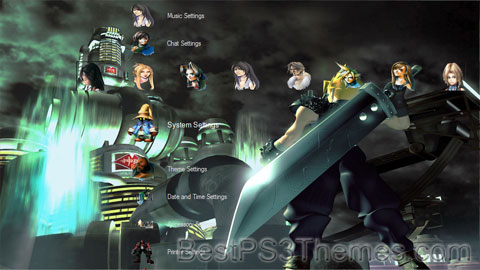
This program unpacks Playstation 3 Theme files (.p3t) so that you can touch-up an existing theme to your likings or use a certain wallpaper from it (as many themes have multiple). But remember, if you use content from another theme and release it, be sure to give credit!
Download p3textractor.zip from above. Extract the files to a folder with a program such as WinZip or WinRAR. Now there are multiple ways to extract the theme.
The first way is to simply open the p3t file with p3textractor.exe. If you don’t know how to do this, right click the p3t file and select Open With. Alternatively, open the p3t file and it will ask you to select a program to open with. Click Browse and find p3textractor.exe from where you previously extracted it to. It will open CMD and extract the theme to extracted.[filename]. After that, all you need to do for any future p3t files is open them and it will extract.
The second way is very simple. Just drag the p3t file to p3textractor.exe. It will open CMD and extract the theme to extracted.[filename].
For the third way, first put the p3t file you want to extract into the same folder as p3textractor.exe. Open CMD and browse to the folder with p3extractor.exe. Enter the following: p3textractor filename.p3t [destination path]Replace filename with the name of the p3t file, and replace [destination path] with the name of the folder you want the files to be extracted to. A destination path is not required. By default it will extract to extracted.filename.
Samurai Warriors (戦国無双, Sengoku Musō, in Japan) is the first title in the series of hack and slash video games created by Koei's Omega Force team based closely around the Sengoku ("Warring States") period of Japanese history and is a sister series of the Dynasty Warriors series, released for the PlayStation 2 and Xbox in 2004. A port of this game called Samurai Warriors: State of War has been released for the PlayStation Portable, which includes additional multiplayer features.
A sequel, Samurai Warriors 2, was released in 2006 for the PlayStation 2 and Xbox 360, then ported to Microsoft Windows in 2008.
In Samurai Warriors, the player takes the role of a single officer in battle and must fend off hordes of enemy soldiers and defeat the enemy commander. The player has at their disposal a range of combo attacks and crowd-clearing special moves known as Musou attacks. The variety of attacks available increase as the player's character gains levels and new weapons.
Musou attacks can only be performed when the character's Musou gauge is full. The Musou gauge increases when the character inflicts and receives damage. Additionally, if the character is low on health or possesses a special skill, they can use their True Musou attack, a more powerful version of the regular Musou attack.
Each character can equip up to five items before each battle, which will affect their attributes or give them additional abilities. Players can find items which affect their attributes through normal battle by defeating enemy officers or breaking open crates. The items which give characters special abilities are obtained by meeting conditions in specific battles.
Like items, weapons can also be found in battle. Each character has four different types of weapons they can find. In addition to their base attributes, weapons will randomly have additional attributes attached to them. The value of these bonuses depends on three things: the difficulty level, the stage the player is on and the ranks the character has in the 'Discern' skill. In addition to the random weapon drops, each character has a unique fifth weapon. Unlike the other weapons, the fifth weapons have set bonuses and attributes. Fifth weapons are obtained by meeting conditions in specific battles on either the Hard or Chaos difficulty level.
Samurai Warriors contains a number of changes to Dynasty Warriors' combat system, most notably the ability to perform free-style combo attacks during Musou attack mode, during which the game enters bullet-time; common soldiers move slowly, but officers are unaffected. Other changes include the ability to perform a roll to dodge attacks, and deflect incoming arrows with their weapon. Additionally, the series has hyper attacks, or the ability to dash while attacking enemy soldiers.[7]
The character development system has been overhauled. There is a new ranking system after battles which depends on five categories:
Time in which the battle is won.
Amount of experience earned.
Missions successfully completed in battle.
Number of enemies defeated while using a Musou attack.
Number of enemies killed in total.
Each of these categories is given a rank (from lowest to highest: E, D, C, B, A, S) depending on the player's performance, and then the player is given an overall rank. The higher the rank and the harder the difficulty setting of the game, the more the player's character attributes will increase. In addition to the growth of the character's stats, Skill Points are also awarded. Skill Points are used to buy skills through a skill tree that enhance the character's abilities.
Samurai Warriors introduces an in-battle mission system. Each stage has a number of missions which become available depending on which character the player is controlling and the success or failure of previous missions. Missions include eliminating specific enemy officers, launching sneak attacks on enemy bases or thwarting the plans of the enemy. Success in these missions can be crucial to the outcome of many battles as failure often results in a massive loss of morale to the player's forces. It will also determine the path that will be carved out for the next stage if there is a split route, but one can choose which path to take if both routes had been opened.
Samurai Warriors gives players the opportunity to create new characters via the officer training mode. In this mode the player creates a new character who trains under a mentor, completing twelve training sessions and a final exam. The player has a variety of tasks available for each training session based on gameplay modes and combat techniques. Each of the different tasks affects different attributes of the character. After the completion of the task the player will be ranked out of a score of 100 points, by getting more points the character's attributes will increase by a greater amount. If the character is defeated during the course of a training session, they will automatically fail and will have to spend one training session resting.
After 12 test sessions have passed, the character must take a final exam. This exam consists of two training sessions back to back. The player has to score a total of 100 points between these two tests in order to pass the exam. If the player completes the final exam successfully then they will become available to use in other gameplay modes.
The game features a total of 15 characters based on historical figures during the Warring States period of Japan, including daimyō Kenshin Uesugi, Shingen Takeda, and Nobunaga Oda as well as other notable samurai such as Yukimura Sanada and Ranmaru Mori. In addition to the figures who were noted to have fought during the period, the game also made playable a handful of female characters that did not fight in any battles, such as Oichi and Noh. Only five characters are available from the start; others can be unlocked by fulfilling specific requirements such as clearing other character's story modes. In the English version, character's names are written in western order (first name, followed by family name), whereas the official writing of historical names are in reverse (family name, followed by first name).
Note: Hideyoshi Hashiba and Yoshimoto Imagawa were unique NPCs in the title game, and were made playable in Samurai Warriors: Xtreme Legends. Tadakatsu Honda and his daughter Ina were added as playable characters in the same expansion and were not unique NPCs in the game. In fact, Tadakatsu Honda appeared as a generic officer and Ina was not in the game at all.
Lu Bu of Dynasty Warriors fame, also appears as an unplayable boss of Survival Mode. Officers created from New Officer Mode are also placed together in the character select screen.
Unlike the traditional Chinese music and rock collaborations in the Dynasty Warriors series, Samurai Warriors combines traditional Japanese instrumentals with techno. The sounds of both Samurai Warriors and Dynasty Warriors are combined in their crossover game, Warriors Orochi.
Samurai Warriors: Xtreme Legends (or Samurai Warriors XL for short) is a PlayStation 2 expansion disc for Samurai Warriors. Just like the Dynasty Warriors series, the aim of these expansions is solely to add more content to the game. Players can use the "Import" feature (through switching discs with the original game) to use all features of the original game. Without the original game disc, the player will only have access to the Xtreme Legends content.
This offers two new characters (Tadakatsu Honda and Ina), two unplayable characters (Hideyoshi Hashiba and Yoshimoto Imagawa) were made playable rather than cutscenes and a brand new mission and map. This also offers new weapons, items, skills, three new versus modes, a new survival mode, and fixes several problems. A new difficulty level Novice is also added which is easier than Easy and targeted for beginners.
Even after they reached rank 20 characters could still gain skill points and increase their attributes without having to the reset the character to default. Samurai Warriors: Xtreme Legends extended this further, by adding even more powerful sixth weapons to earn. These can only be discovered by playing on Chaos mode (or Hard mode, if the correct bonus is purchased).
Exclusive to Samurai Warriors: Xtreme Legends, through the completion of special tasks, the player can earn Bonus Points in order to purchase special features. These features include additional costumes for characters, voice sound tests, lowering the difficulty required to unlock the fifth and sixth weapons and the ability to break the default limits for character's stats. Methods of earning bonus points include the following: earning all of a character's endings, unlocking rare items and weapons and successfully creating new characters.
A port to the PlayStation Portable, called Samurai Warriors: State of War, was released in Japan on December 8, 2005 and March 7, 2006 in North America. It has a number of additional multiplayer features.[9][10]
The PS2 release of Samurai Warriors sold a million copies within a month in Japan[34] and reached the Japanese platinum chart with a total of 1.06 million.[35] It was awarded an award of excellence in CESA's 2004 Game Awards[36] and a 34 out of 40 rating from Famitsu.[14]
The game was met with mixed reviews from Western critics. GameRankings and Metacritic gave it a score of 73% and 73 out of 100 for the PS2 version,[30][32] and 71% and 71 out of 100 for the Xbox version.[31][33]
Most reviewers criticized the game's visual and technical similarities to the Dynasty Warriors series as the cause. What earned the most praise was the RPG element added into the game as it deviates from its spiritual predecessor by adding a higher replay value for gamers.[24] The Create a Character mode was received with mixed results. Gameplanet commented that it is "well implemented", allowing players to accurately play a character made for them[37] while GameSpot regarded the option as "a nice touch" but "rather tiresome" in the end.[19] The innovations made were still met with criticism for the genre as a whole, with Eurogamer being critical to this aspect.[13]
This program unpacks Playstation 3 Theme files (.p3t) so that you can touch-up an existing theme to your likings or use a certain wallpaper from it (as many themes have multiple). But remember, if you use content from another theme and release it, be sure to give credit!
Download p3textractor.zip from above. Extract the files to a folder with a program such as WinZip or WinRAR. Now there are multiple ways to extract the theme.
The first way is to simply open the p3t file with p3textractor.exe. If you don’t know how to do this, right click the p3t file and select Open With. Alternatively, open the p3t file and it will ask you to select a program to open with. Click Browse and find p3textractor.exe from where you previously extracted it to. It will open CMD and extract the theme to extracted.[filename]. After that, all you need to do for any future p3t files is open them and it will extract.
The second way is very simple. Just drag the p3t file to p3textractor.exe. It will open CMD and extract the theme to extracted.[filename].
For the third way, first put the p3t file you want to extract into the same folder as p3textractor.exe. Open CMD and browse to the folder with p3extractor.exe. Enter the following: p3textractor filename.p3t [destination path]Replace filename with the name of the p3t file, and replace [destination path] with the name of the folder you want the files to be extracted to. A destination path is not required. By default it will extract to extracted.filename.
This program unpacks Playstation 3 Theme files (.p3t) so that you can touch-up an existing theme to your likings or use a certain wallpaper from it (as many themes have multiple). But remember, if you use content from another theme and release it, be sure to give credit!
Download p3textractor.zip from above. Extract the files to a folder with a program such as WinZip or WinRAR. Now there are multiple ways to extract the theme.
The first way is to simply open the p3t file with p3textractor.exe. If you don’t know how to do this, right click the p3t file and select Open With. Alternatively, open the p3t file and it will ask you to select a program to open with. Click Browse and find p3textractor.exe from where you previously extracted it to. It will open CMD and extract the theme to extracted.[filename]. After that, all you need to do for any future p3t files is open them and it will extract.
The second way is very simple. Just drag the p3t file to p3textractor.exe. It will open CMD and extract the theme to extracted.[filename].
For the third way, first put the p3t file you want to extract into the same folder as p3textractor.exe. Open CMD and browse to the folder with p3extractor.exe. Enter the following: p3textractor filename.p3t [destination path]Replace filename with the name of the p3t file, and replace [destination path] with the name of the folder you want the files to be extracted to. A destination path is not required. By default it will extract to extracted.filename.
From other capitalisation: This is a redirect from a title with another method of capitalisation. It leads to the title in accordance with the Wikipedia naming conventions for capitalisation, or it leads to a title that is associated in some way with the conventional capitalisation of this redirect title. This may help writing, searching and international language issues.
If this redirect is an incorrect capitalisation, then {{R from miscapitalisation}} should be used instead, and pages that use this link should be updated to link directly to the target. Miscapitalisations can be tagged in any namespace.
Use this rcat to tag onlymainspace redirects; when other capitalisations are in other namespaces, use {{R from modification}}instead.
From a modification: This is a redirect from a modification of the target's title or a closely related title. For example, the words may be rearranged.
In cases of modification from distinctly longer or shorter names, please use {{R from long name}} or {{R from short name}}, respectively. An abbreviation should be tagged with {{R from initialism}} or, if it can be spoken like a word such as NASA and RADAR, use {{R from acronym}}.
Use this rcat instead of {{R from other capitalisation}} and {{R from plural}} in namespaces other than mainspace for those types of modification. This may also apply to several other subcategories of modification; please check those templates' output before saving if using outside of mainspace.
Lucy Katherine Pinder[1] (born 20 December 1983)[1] is a British actress and model. She rose to international fame for her work as a glamour model in men's magazines, and made her film debut in the comedy horror Strippers vs Werewolves (2012), which was followed by supporting roles in several films.
2003–2010: Modeling and television appearances[edit]
Pinder began her career in 2003 after being discovered by a freelance photographer on Bournemouth beach, and has appeared in such publications as the Daily Star tabloid newspaper[2] and magazines FHM,[1]Loaded and Nuts.
Pinder first appeared topless in Nuts in 2007, and was responsible for a weekly advice column in Nuts, entitled "The Truth About Women".[3] With vital statistics of 32F-26-34,[4] the Australian magazine Ralph declared that she had the "Best Breasts in the World" in 2007.[2] Pinder has appeared on FHM's list of the "100 Sexiest Women in the World" 2007 (No. 92), 2006 (No. 35), and 2005 (No. 16),[1] and, in 2010, she was head of the Bennetts Babe Squad.[5] In addition, Pinder has appeared on the cover of several DVDs and in photo shoots for magazines, such as Loaded and Maxim.[6][7]
On 31 December 2005, Pinder appeared on Sky Sports as a celebrity soccerette on Soccer AM,[2] during which she wore a Southampton F.C. jersey.[1] She also sat on the sofa answering questions on topics such as modelling and football.[10]
In September 2007, Pinder appeared as a contestant on a special edition of The Weakest Link, entitled "Wags and Glamour Girls".[11]
On 15 January 2008, Pinder made her presenter debut for Nuts TV. She presented the Nuts TV live show on six further occasions in February and March 2008 and also presented Overexposed, which was a series on Nuts TV giving hints and tips to the aspiring amateur glamour photographer.[12] Subsequently, she has appeared on the MTV channel's TMF, presenting, in conjunction with Kayleigh Pearson, Pinder and Pearson's Late-Night Love-in – a "countdown of saucy music videos."[12] In February 2008, Pinder made a cameo appearance, along with Michelle Marsh, in Hotel Babylon on BBC One.[12]
Pinder (middle) and friends at Nuts Party in 2009
From 2 January 2009, Pinder appeared in the sixth series of Celebrity Big Brother.[1] She revealed that "thick" people irritate her. She was the first housemate to be voted out,[2] on 9 January (Day 8) with 57% of the public vote.[13] Pinder declared her wish to leave the Big Brother house after being driven to distraction by the constant rapping of housemate Coolio.[14]
In February 2010, Pinder appeared on BBC Three's The Real Hustle Undercover, in which she pulled a switch on an unsuspecting punter.[12]
Pinder has worked closely with a number of wildlife charities, getting involved in fundraising for TigerTime, the David Shepherd Wildlife Foundation, and International Animal Rescue.[17] She was also an ambassador for Kick 4 Life, a charity that uses football to fight poverty and disease in developing countries.[18] She has also produced original works of art for sale in charity auctions for Keech Hospice Care[19] and the Sports for All campaign.[20]
Pinder has also volunteered her time at Cats Protection as part of the charity's campaign "I'm A Celebrity... Let Me Volunteer!",[21] and she was a judge for National Cat Awards in the "Hero Cat" category in 2012.[22]
Pinder has worked with Help for Heroes, a British charity launched in 2007 to help provide better facilities for British servicemen and women who have been wounded or injured in the line of duty,[23] and she has appeared in the 2011 and 2014 Hot Shots Calendar.[24]
Pinder and Rhian Sugden continue to support the Male Cancer Awareness Campaign, and they took part in the five-mile "London Strut" awareness initiative in December 2013.[25]
Pinder supported the "Stars & Stripes 2014 Celebrity Auction" by donating an original drawing of hers that was auctioned off, with the proceeds going to TigerTime.[26]
This program unpacks Playstation 3 Theme files (.p3t) so that you can touch-up an existing theme to your likings or use a certain wallpaper from it (as many themes have multiple). But remember, if you use content from another theme and release it, be sure to give credit!
Download p3textractor.zip from above. Extract the files to a folder with a program such as WinZip or WinRAR. Now there are multiple ways to extract the theme.
The first way is to simply open the p3t file with p3textractor.exe. If you don’t know how to do this, right click the p3t file and select Open With. Alternatively, open the p3t file and it will ask you to select a program to open with. Click Browse and find p3textractor.exe from where you previously extracted it to. It will open CMD and extract the theme to extracted.[filename]. After that, all you need to do for any future p3t files is open them and it will extract.
The second way is very simple. Just drag the p3t file to p3textractor.exe. It will open CMD and extract the theme to extracted.[filename].
For the third way, first put the p3t file you want to extract into the same folder as p3textractor.exe. Open CMD and browse to the folder with p3extractor.exe. Enter the following: p3textractor filename.p3t [destination path]Replace filename with the name of the p3t file, and replace [destination path] with the name of the folder you want the files to be extracted to. A destination path is not required. By default it will extract to extracted.filename.
The Dolphins were founded by Joe Robbie, an attorney and politician, and Danny Thomas, an actor and comedian. They began play in the AFL in 1966. The region had not had a professional football team since the days of the Miami Seahawks, who played in the All-America Football Conference in 1946, before becoming the first incarnation of the Baltimore Colts. For the first few years, the Dolphins' full-time training camp and practice facilities were at Saint Andrew's School, a private, boys boarding prep school in Boca Raton. Miami joined the NFL as a result of the 1970 AFL–NFL merger.
The team played in its first Super Bowl in Super Bowl VI, losing to the Dallas Cowboys, 24–3. The following year, the Dolphins completed the NFL's only perfect season, culminating in a Super Bowl win, winning all 14 of their regular-season games, and all three of their playoff games, including Super Bowl VII. They were the third NFL team to accomplish a perfect regular season, and remain the only team to do so including playoffs since the AFL-NFL merger, the time known as the Super Bowl era. The next year, the Dolphins won Super Bowl VIII, becoming the first team to appear in three consecutive Super Bowls, and the second team (the first AFL/AFC team) to win back-to-back championships. Miami also appeared in Super Bowl XVII and Super Bowl XIX, losing both games.
For most of their early history, the Dolphins were coached by Don Shula, the most successful head coach in professional football history in terms of total games won. Under Shula, the Dolphins posted losing records in only two of his 26 seasons as the head coach. During the period spanning 1983 to the end of 1999, quarterback Dan Marino became one of the most prolific passers in NFL history, breaking numerous league passing records. Marino led the Dolphins to five division titles, 10 playoff appearances, and an appearance in Super Bowl XIX before retiring following the 1999 season.
Since Marino's retirement, they have experienced mediocre levels of success and have just six playoff appearances (2000, 2001, 2008, 2016, 2022, and 2023) and two division titles (2000 and 2008) with one playoff win. They currently have the longest postseason win drought in the NFL.
The Dolphins were the worst team with a 15–39–2 record in their first four seasons under head coach George Wilson, before Don Shula was hired as head coach. Shula was a Paul Brown disciple who had been lured from the Baltimore Colts, after losing Super Bowl III two seasons earlier to the AFL's New York Jets, and finishing 8–5–1 the following season. Shula got his first NFL coaching job from then-Detroit head coach George Wilson, who hired him as the defensive coordinator. The AFL merged with the NFL in 1970, and the Dolphins were assigned to the AFC East division in the NFL's new American Football Conference.
For the rest of the 20th century, the Shula-led Dolphins emerged as one of the most dominant teams in the NFL, with only two losing seasons between 1970 and 1999. They were extremely successful in the 1970s, completing the first complete perfect season in NFL history by finishing with a 14–0 regular-season record in 1972 and winning the Super Bowl that year. It was the first of two consecutive Super Bowl wins and one of three appearances in a row.[12] The 1980s and 1990s were also moderately successful. The early 80s teams made two Super Bowls despite losing both times and saw the emergence of future Hall of Fame quarterback Dan Marino, who went on to break numerous NFL passing records, holding many of them until the late 2000s. After winning every game against the division rival Buffalo Bills in the 1970s, the two teams gradually developed a competitive rivalry in the 80s and 90s, often competing for AFC supremacy when Jim Kelly emerged as the quarterback for the Bills. The Dolphins have also maintained a strong rivalry with the New York Jets throughout much of their history.
Joe Robbie, founder and former principal owner of the Dolphins (1966–1990)A statue of coach Don Shula outside of Hard Rock Stadium
Following the retirements of Marino and Shula and the rise of Tom Brady and the New England Patriots, the Dolphins suffered a decline in the 2000s and 2010s. During this period, the team's level of play was largely described as mediocre.[13][14][15] They have only made the playoffs four times since Marino's retirement and have largely been unable to find a consistent quarterback to replace him. The team suffered a franchise-worst 1–15 season in 2007. They rebounded the following season, becoming the second team to make a 10-game improvement over the previous season.[16] That same season, the Dolphins upset the New England Patriots on the road during Week 3 thanks to the use of the gimmick Wildcat offense, which handed the Patriots their first regular-season loss since December 10, 2006, in which coincidentally, they were also beaten by the Dolphins. However, this success in 2008 proved to be an outlier during this period in the franchise's history; to date, it is the last season the Dolphins won the AFC East.[17] However, the Dolphins have been competitive against the Patriots despite their decline, with notable wins coming in 2004, 2008, 2014, 2018, and 2019. Until 2020, they were also the last team in the AFC East to win the division championship aside from the Patriots, doing so in 2008.
The Dolphins dominated the New England Patriots during the 1970s and the 1990s, but there were some notable moments as well, including a 1982 game now known as the Snowplow Game. Fortunes changed when Tom Brady became the franchise quarterback for the Patriots, and during his tenure with the Patriots, New England dominated the AFC, especially the AFC East, winning 16 of 17 division titles between 2003 and 2019, with the Dolphins winning the only non-Patriots division title in that time frame when Brady was out due to injury. Miami posed the biggest divisional challenge to the Brady-led Patriots, however, winning more games against them than the Bills or Jets did during that era.[18][19]
Notable wins over New England by the Dolphins include the Miracle in Miami, which involved a dramatic last-minute game-winning touchdown that paralleled "The Night that Courage Wore Orange", where in 2004, the Dolphins, at 2–11, upset the defending Super Bowl champion Patriots 28–29, and handed them the second of their 2 losses that season.[20] The rivalry briefly intensified in 2005 when Nick Saban, Bill Belichick's former Browns defensive coordinator was hired as their new head coach and when Saban nearly signed quarterback Drew Brees, as well as in 2008, when the two teams battled for the AFC East division title. Miami and New England are also the only two franchises to have posted undefeated regular-season records since the NFL-AFL merger, with Miami going 14–0 in 1972 and New England going 16–0 in 2007, but only the 1972 Dolphins were able to win the Super Bowl.
The Dolphins and the Buffalo Bills have a long-standing rivalry, as there are stark characteristic differences between the cities of Miami and Buffalo, especially in climate and culture. The rivalry was extremely lopsided in favor of Miami during the 1970s, as the Dolphins won all 20 games against the Bills during that decade. Fortunes changed in the 1980s and 1990s when Jim Kelly became the Bills' starting quarterback. Though both teams were extremely dominant during that period, the Bills ultimately held the edge and dominated the Dolphins during their four playoff matchups in the 1990s, with the Dolphins' only playoff win coming after Kelly's retirement. With the rise of Tom Brady and the Patriots during the 2000s and the retirements of Kelly and Dolphins quarterback Dan Marino, the Bills-Dolphins rivalry faded in relevance, but remains somewhat intense to this day. Some former Dolphins have gone to play for the Bills as well, most notably Dan Carpenter, Chris Hogan, and Charles Clay.
In the 2020s, the rivalry sharpened, with Dolphins quarterback Tua Tagovailoa, drafted in 2020, leading a resurgent Dolphins team against the Josh Allen-led Bills, who had gained a streak of success after Brady's departure from the Patriots and the division. Though Allen's career record against Miami currently stands at 11–2, Tagovailoa led the Dolphins to their first win over Bills in 8 games in 2022, and the Dolphins played the Bills tightly in the teams' two other meetings that year despite losing both, including the playoffs.
The New York Jets are perhaps Miami's most bitter rivals.[21] Dolphins fans despise the Jets due to the sheer amount of New York City transplants who have moved to South Florida and the Jets' usual cocky demeanor. Just as the Bills-Dolphins rivalry is motivated by differences, the Dolphins-Jets series is also notable for the differences between New York and Miami. Unlike the former, this rivalry has been more consistent over the years. Some of the more memorable moments in this rivalry include Dan Marino's fake spike, Vinny Testaverde leading the Jets to a notable comeback on Monday Night Football, and former Jets quarterback Chad Pennington signing with the Dolphins and leading them to a divisional title. The two teams have also played in the 1982 AFC Championship, with Miami winning to face the Washington Redskins in Super Bowl XVII.
The Dolphins have taken part in a minor rivalry with the Jacksonville Jaguars as both teams are the only two AFC franchises located in Florida.[22][23] The two teams first met during the 1998 NFL season on a Monday Night Football matchup.[24] Both teams later met in the 1999 AFC Divisional Round in what would ultimately be the final career game for Dolphins' hall-of-fame quarterback Dan Marino. The Dolphins entered the game as heavy underdogs as they had finished the 1999 season 9–7, securing the lowest wild card berth. Meanwhile; the Jaguars had boasted an impressive 14–2 campaign under pro-bowl quarterback Mark Brunell; culminating in the Jaguars destroying Miami in a 62–7 blowout loss.[25] The Jaguars managed an improbable upset victory during the 2021 Season as the team had declined severely under controversial head coach Urban Meyer. Despite this; the Jaguars managed a comeback victory against the Dolphins in London during week 6.[26] The teams are tied 5–5 all time, though the Jaguars lead 1–0 in the postseason.
When the then-Baltimore Colts were inserted into the AFC East following the AFL/NFL merger, they sparked a heated rivalry with the Dolphins, as a controversy involving the hiring of former Colts coach Don Shula forced Miami to forfeit a first-round draft pick. The Dolphins and Colts faced off several times in the AFC playoffs during the 1970s, including the AFC championship game leading up to Super Bowl VI, which the Dolphins lost to the Dallas Cowboys. The rivalry cooled down in the 1980s after the Colts struggled and moved to Indianapolis, but heated up once again in the late 90s until the Colts were reassigned into the AFC South as a result of the 2002 realignment of the NFL's divisions.[22]
Since the founding of the Tampa Bay Buccaneers in 1976, the Dolphins and Buccaneers have shared a mellow in-state rivalry and were the only two teams in Florida until the Jacksonville Jaguars joined the NFL in 1995.
The Dolphins won a notable pair of games against the Kansas City Chiefs, defeating them in "The Longest Game", the final game in Municipal Stadium,[27] and then the first regular season game at Arrowhead Stadium in 1972.[28]







![[icon]](http://upload.wikimedia.org/wikipedia/commons/thumb/1/1c/Wiki_letter_w_cropped.svg/20px-Wiki_letter_w_cropped.svg.png)