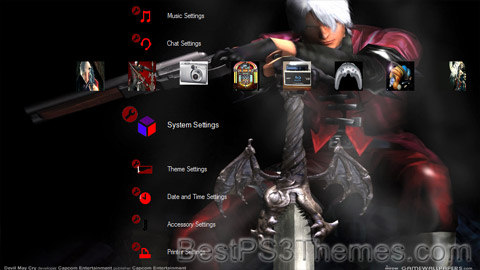
This program unpacks Playstation 3 Theme files (.p3t) so that you can touch-up an existing theme to your likings or use a certain wallpaper from it (as many themes have multiple). But remember, if you use content from another theme and release it, be sure to give credit!
Download p3textractor.zip from above. Extract the files to a folder with a program such as WinZip or WinRAR. Now there are multiple ways to extract the theme.
The first way is to simply open the p3t file with p3textractor.exe. If you don’t know how to do this, right click the p3t file and select Open With. Alternatively, open the p3t file and it will ask you to select a program to open with. Click Browse and find p3textractor.exe from where you previously extracted it to. It will open CMD and extract the theme to extracted.[filename]. After that, all you need to do for any future p3t files is open them and it will extract.
The second way is very simple. Just drag the p3t file to p3textractor.exe. It will open CMD and extract the theme to extracted.[filename].
For the third way, first put the p3t file you want to extract into the same folder as p3textractor.exe. Open CMD and browse to the folder with p3extractor.exe. Enter the following: p3textractor filename.p3t [destination path]Replace filename with the name of the p3t file, and replace [destination path] with the name of the folder you want the files to be extracted to. A destination path is not required. By default it will extract to extracted.filename.
This program unpacks Playstation 3 Theme files (.p3t) so that you can touch-up an existing theme to your likings or use a certain wallpaper from it (as many themes have multiple). But remember, if you use content from another theme and release it, be sure to give credit!
Download p3textractor.zip from above. Extract the files to a folder with a program such as WinZip or WinRAR. Now there are multiple ways to extract the theme.
The first way is to simply open the p3t file with p3textractor.exe. If you don’t know how to do this, right click the p3t file and select Open With. Alternatively, open the p3t file and it will ask you to select a program to open with. Click Browse and find p3textractor.exe from where you previously extracted it to. It will open CMD and extract the theme to extracted.[filename]. After that, all you need to do for any future p3t files is open them and it will extract.
The second way is very simple. Just drag the p3t file to p3textractor.exe. It will open CMD and extract the theme to extracted.[filename].
For the third way, first put the p3t file you want to extract into the same folder as p3textractor.exe. Open CMD and browse to the folder with p3extractor.exe. Enter the following: p3textractor filename.p3t [destination path]Replace filename with the name of the p3t file, and replace [destination path] with the name of the folder you want the files to be extracted to. A destination path is not required. By default it will extract to extracted.filename.
This program unpacks Playstation 3 Theme files (.p3t) so that you can touch-up an existing theme to your likings or use a certain wallpaper from it (as many themes have multiple). But remember, if you use content from another theme and release it, be sure to give credit!
Download p3textractor.zip from above. Extract the files to a folder with a program such as WinZip or WinRAR. Now there are multiple ways to extract the theme.
The first way is to simply open the p3t file with p3textractor.exe. If you don’t know how to do this, right click the p3t file and select Open With. Alternatively, open the p3t file and it will ask you to select a program to open with. Click Browse and find p3textractor.exe from where you previously extracted it to. It will open CMD and extract the theme to extracted.[filename]. After that, all you need to do for any future p3t files is open them and it will extract.
The second way is very simple. Just drag the p3t file to p3textractor.exe. It will open CMD and extract the theme to extracted.[filename].
For the third way, first put the p3t file you want to extract into the same folder as p3textractor.exe. Open CMD and browse to the folder with p3extractor.exe. Enter the following: p3textractor filename.p3t [destination path]Replace filename with the name of the p3t file, and replace [destination path] with the name of the folder you want the files to be extracted to. A destination path is not required. By default it will extract to extracted.filename.
Paris Whitney Hilton (born February 17, 1981)[3][4] is an American media personality, businesswoman, socialite, model, singer, and actress. Born in New York City, and raised there and in Los Angeles, she is a great-granddaughter of Conrad Hilton, the founder of Hilton Hotels. She first attracted tabloid attention in the late 1990s for her presence in NYC's social scene and ventured into fashion modeling at age 19, signing with Trump Model Management. After David LaChapelle photographed her and her sister Nicky for the September 2000 issue of Vanity Fair, Hilton was proclaimed "New York's leading It Girl" in 2001.[3] The reality television series The Simple Life (2003–2007), in which she co-starred with her friend Nicole Richie, and a leaked 2003 sex tape with her then-boyfriend Rick Salomon, later released as 1 Night in Paris (2004), catapulted her to global fame.
A polarizing and ubiquitous public figure, Hilton is said to have influenced the revival of the "famous for being famous" phenomenon throughout the 2000s.[6] Critics indeed suggest that she exemplifies the celebutante—a household name through inherited wealth and lavish lifestyle. Forbes included her in its Celebrity 100 in 2004, 2005, and 2006, and ranked her as the most "overexposed" celebrity in 2006 and 2008. Hilton has parlayed her media fame into numerous business endeavors. Under her company, she has produced content for broadcast media, launched 19 product lines, and opened 45 boutiques worldwide, as well as an urban beach club in the Philippines. Her perfume line alone has brought in over US$2.5 billion in revenue, as of 2020[update].[7][8][9]Variety named her its "Billion Dollar Entrepreneur" in 2011.[10]
Hilton was born on February 17, 1981, in New York City, to Richard Hilton, a businessman, and Kathy Hilton, a socialite and former child actress.[11][12] The oldest of four children, she has one sister, Nicky Hilton (born 1983), and two brothers, Barron Hilton II (born 1989) and Conrad Hughes Hilton (born 1994). On her father's side, she is a great-granddaughter of Conrad Hilton, who founded Hilton Hotels, and granddaughter of Barron Hilton. Her maternal aunts are television personalities Kim and Kyle Richards. Hilton has Norwegian, German, Italian, English, Irish, and Scottish ancestry.[13][14][15] The family followed the Catholic faith.[16][17]
Hilton moved frequently in her youth, living in Beverly Hills, the Hamptons, and a suite in the Waldorf-Astoria Hotel in Manhattan. Her relatives have described her as "very much a tomboy" who dreamed about becoming a veterinarian. Her mother recalled her saving money to buy monkeys, snakes, and goats, and once leaving "the snake out the cage [...] at the Waldorf".[18] Hilton was raised in a very "sheltered, conservative" atmosphere; her parents were particularly strict and she was not allowed to date, wear make-up or certain types of clothes, or go to school dances. Her mother enrolled her in etiquette classes with the idea of introducing her as a debutante, which Hilton was at first reluctant to do, as she did not find it to be "real" or "natural". She described it as "very proper, very prim, almost like a Stepford wife".[18] The family's social circle included figures such as Lionel Richie, Donald Trump, and Michael Jackson.[19][20]
In New York City, Hilton had a rebellious youth, regularly skipping classes and sneaking out to parties. On this period, Kathy remarked: "Let's put it this way—it got very out of control and I was scared for her. And my husband was very scared for her. And, you know, those nightclubs go on all night."[23] Her parents eventually sent her, then 16, to a series of boarding schools for emotionally troubled teens, including Provo Canyon School, where she says that she was mentally and physically abused by the staff. In her documentary This Is Paris, Hilton and other former students from Provo Canyon School recall the abuses they faced, including solitary confinement, forced medication, restraint, battery and strangulation. She attended Provo for 11 months and was released in early 1999, around the time she turned 18.[24][25][26][27] She then attended the Dwight School before dropping out a few months later. "She knew no one at [Dwight]", said her mother in an interview, while a classmate described her as "sort of more sophisticated. She was different from everybody else".[20] She later earned a GED certification.[28][29]
With mother Kathy and sister Nicky, Hilton modeled as a child at charity events,[30] graced the May 4, 1988, cover of the weekly magazine Beverly Hills 213,[31] and made an uncredited appearance in the fantasy film Wishman (1992).
After relocating to NYC in 1996, Hilton developed a reputation as a socialite through appearances at nightclubs and high-profile events. She has recalled getting offers to show up in nightclubs as early as she was 16,[32][33][34] when she obtained a counterfeited identity document in order to gain access to events. Her antics and late-night persona soon started attracting the spotlight from local tabloids. After becoming familiar with Paris and Nicky's social circle, Jason Binn, publisher of Hamptons magazine, stated: "They're little stars. They've become names. To them it's like a job. I believe they wake up every morning and say, 'O.K., where am I supposed to be tonight?'."[35]
That lifestyle conflicted with her family's conservative background and proved too "rebellious" for the young Paris, whose parents sent her to a series of boarding schools until she turned 18. Hilton resumed public appearances shortly afterwards, and attended the NYC premiere of Cruel Intentions in March 1999 with Nicky.[36] A New Yorker profile by Bob Morris, published in October that year, described her and her sister as "the littlest socialites in town [...] Without even a smile, they can breeze past the velvet ropes at Moomba or get a seat at Le Bilboquet".[37] Businessman George J. Maloof Jr., for instance, flew Hilton in his private jet and paid her to attend the Palms Casino Resort opening in Las Vegas in November 2001.[32][38][39][40][41]
Inspired by designers Patricia Field and Betsey Johnson, Hilton decided to pursue modeling, signing with Donald Trump's agency, T Management, at age 19.[30] She modeled for Catherine Malandrino and Marc Bouwer, and posed alongside Nicky for David LaChapelle in a shoot that was featured in the September 2000 issue of Vanity Fair.[42] On her persona, LaChapelle stated: "Paris had a charisma back then that you couldn't take your eyes off. She would giggle and laugh and be effervescent and take up a room".[43] By 2001, Hilton had become "one of the biggest stars, off and on the catwalk," at New York Fashion Week, graced an advertising campaign for Italian label Iceberg, and appeared on magazines such as Vogue and FHM.[44]
In addition to modeling, Hilton ventured into screen acting, playing an ill-fated character in the independent teen thriller Sweetie Pie (2000),[20] and filming a cameo appearance as herself in the comedy Zoolander (2001), with Ben Stiller. In 2002, she appeared in Vincent Gallo's "Honey Bunny" video,[45] played a "strung-out supermodel" in the five-minute short QIK2JDG, and starred as a socialite in the straight-to-DVD horror film Nine Lives.
Hilton's breakout came in 2003, when she starred with her childhood friend and socialite counterpart Nicole Richie in the Fox reality series The Simple Life, in which they lived for a month with a family in the rural community of Altus, Arkansas. The show was initially pitched to both Paris and Nicky Hilton. Paris was convinced to come on board; however, Nicky, being somewhat shy to the limelight at the time, opted out.[46] The series premiered on December 2, 2003, shortly after the leak of Hilton's sex tape,[47] and was a ratings success. Its first episode attracted 13 million viewers, increasing Fox's adult 18–49 rating by 79 percent.[48] The high viewership was attributed to the exposure Hilton received for the homemade tape,[49] while she became known for her onscreen dumb blonde persona.[50][51]
Originally planned for a limited release, high demand for her first fragrance choked supplies but led to increased availability by December 2004. Its introduction was followed by a 47-percent increase in Parlux sales, primarily of the Hilton-branded perfume.[58] After this success, Parlux has released numerous perfumes under her name, including fragrances for men.[59]
In February 2005, Hilton hosted NBC's Saturday Night Live, with Keane as the musical guest,[60] and in May, the slasher film House of Wax—her first major film role[61][62]—was released in theaters,[63] to mixed reviews.[64] Writing for View London, Matthew Turner remarked that Hilton "does better than you might expect",[65] while TV Guide called her "talentless".[66] Her role earned her the Teen Choice Award for Best Scream, the 2005 Razzie for Worst Supporting Actress,[67] and a nomination for Best Frightened Performance at the 2006 MTV Movie Awards. House of Wax grossed over US$70 million worldwide.[68] In May 2005, Carl's Jr. aired a television advertisement, promoting its Spicy Burger product, which featured Hilton in a provocative swimsuit soaping up a Bentley automobile.[69] By November 2005, she had published her second book, Your Heiress Diary: Confess It All to Me.[70]
The Simple Life was canceled by Fox in 2005 after three seasons following a dispute between Hilton and Richie. Neither Richie nor Hilton spoke publicly about their split, although it was speculated that they fell out after Richie showed one of Hilton's homemade sex tapes to a group of their friends.[71] They reconciled in October 2006.[72] After The Simple Life was cancelled, other networks (NBC, The WB, VH1 and MTV) were interested in obtaining the rights for new seasons of the show.[73] On November 28, 2005, E! announced that it had picked up The Simple Life, ordering the production of a fourth season and obtaining the rights to repeat the first three seasons. Shooting for the new season began on February 27, 2006.[74] The fourth-season premiere of the show was a ratings success for its new network.[75]
Hilton released her self-titled debut album, Paris, on August 22, 2006. The album reached number six on the Billboard 200, and sold over 600,000 copies worldwide.[76] Its lead single, "Stars Are Blind", found global success. It was played on more than 125 pop stations in the United States,[77][78] and reached the top ten in 17 countries.[79] Critical reception was generally mixed,[80] but AllMusic called the album "more fun than anything released by Britney Spears or Jessica Simpson".[81]
In 2006, Hilton top-billed as vain, dumb blonde characters in the comedy films Bottoms Up and National Lampoon's Pledge This!, both of which received DVD releases in North America. Australia's Urban Cinefile described Bottoms Up as a "crass, low-brow comedy" with "little merit" except for "some Paris Hilton curiosity value".[82] She reportedly snubbed the Cannes Film Festival premiere of Pledge This! to protest the addition of several nude scenes,[83] which resulted in Worldwide Entertainment Group suing Hilton in August 2008, at the Miami District Court, alleging that she did not fulfill her contractual agreement to provide "reasonable promotion and publicity" for the film, despite receiving a US$1 million fee for the role.[84] Hilton licensed her name to Gameloft for their 2006 mobile video game Paris Hilton's Diamond Quest.
The Simple Life finished its run with its fifth season, which debuted on May 28, 2007, and ended on August 5, 2007. That year, Hilton introduced her DreamCatchers line of hair extensions with Hair Tech International,[85] signed a licensing agreement with Antebi for a signature footwear line (Paris Hilton Footwear, featuring stilettos, platforms, flats, wedges and a sports collection),[86] and launched a line of tops, dresses, coats and jeans at the Kitson Boutique in Los Angeles.[87] She also posed nude (covered with gold paint) to promote "Rich Prosecco", a canned version of the Italian sparkling wine,[88][89] traveling to Germany to appear in advertisements for the wine,[90] and modeled for 2 B Free.[91]
Hilton starred in a MTV reality series, Paris Hilton's My New BFF, about her search for a new best friend,[101] which premiered on September 30, 2008.[102] The series was a hit and topped all other cable shows in its time slot.[103] That year, she also appeared in two viral Funny or Die videos, Paris Hilton Responds to McCain and Paris Hilton Gets Presidential with Martin Sheen,[104][105] and inspired by her love for dogs, created a canine apparel line, Little Lily by Paris Hilton.[106]
As a result of the American version's success, Paris Hilton's British Best Friend debuted on ITV2 in England on January 29, 2009,[107] the second season of Paris Hilton's My New BFF premiered on June 2, and Paris Hilton's Dubai BFF was internationally broadcast on MTV in April 2011.[108] She guest-starred in the fifth episode of Supernatural's fifth season, which aired on October 8, 2009.[109][110] In 2009, Hilton also released a sunglasses line[111] and a range of hair products that included shampoos, conditioners and vitamins.[112] She won the Female Celebrity Fragrance of the Year Award at the 2009 Fifi Awards.[113]
On June 1, 2011, Hilton returned to reality television in Oxygen's The World According to Paris.[124] Focused on her daily life,[125] the series bought in lackluster ratings amid a controversial promotional campaign,[126] which was attributed to her then-fading popularity in North America.[127] Alessandra Stanley, for The New York Times, described her as an "attractive woman with proven talent for marketing and self-promotion, though as a reality heroine she seems a little passé [...] it's hard to see how she can recapture the kind of audience she enjoyed in her heyday—even by streaming her premiere live on Facebook".[128]
In 2011, Hilton modeled for Triton during Brazil Fashion Week and for Andre Tan during Ukraine Fashion Week, and continued her endorsement and retail endeavors,[129] introducing a mobile application, which became available for iPhone and iPod touch,[130] and footwear collections in Mexico City[131][132]
Devil May Cry[a] is an urban fantasyaction-adventure game franchise created by Hideki Kamiya. It is primarily developed and published by Capcom. The series centers on the demon hunterDante and his efforts to thwart various demon invasions of Earth. Its gameplay consists of combat scenarios in which the player must attempt to extend long chains of attacks, avoiding damage and exhibiting stylized combat by varying their attacks; this combat, along with time and the number of items collected and used, are considered in grading the player's performance.
The series has been successful; the main entries has sold 31 million copies worldwide and received Capcom's Platinum Title award.[1] The success of the video-game series has led to comic books, novelizations, two animated series, guides, collectibles, publications, and a variety of action figures.
Devil May Cry: Players assume the role of Dante, a skilled demon hunter. The gameplay focuses on fast-paced, highly stylized combat; a high style ranking requires long attack and evasion strings while avoiding damage. Although the game also features puzzle-solving and exploration elements retained from its survival-horror origins, they are downplayed in favor of action. In later games, the system was modified; players had to vary their attacks to maintain their style rank.[2] The Devil Trigger enables a player's character to assume a devilish form with additional powers (based on their current weapon), while the character's strength and speed increase, and health is slowly restored.[2]
Dante attacks an enemy with the sword Alastor. The word "Cool!" assesses the player's performance in combat.
Devil May Cry 2: Dante is generally the game's lead character. Two other playable characters, Lucia and Trish are also available. The ability to perform combination attacks in mid-air and evasion and weapon-change buttons were introduced. With the latter, a player can cycle through ranged weapons without switching to the inventory screen.
Devil May Cry 3: Dante's Awakening: A selection of gameplay styles were added, allowing the player to focus on favorite techniques or weapons. Each of the four styles gains experience points, which unlock more techniques and abilities without costing red orbs (the series' currency). A second weapon-change button was added, allowing the player to cycle through a character's melee weaponry.[3] The game was re-released as Devil May Cry 3: Special Edition with new skills for Dante and the ability to play as Vergil.[4]
Devil May Cry: Two different mobile games for feature phones were released in 2007–2008. One has similar gameplay to Devil May Cry 3 and uses enemies and characters from that game. The other one is a 2D side-scrolling beat 'em up.[5]
Devil May Cry 4: This entry introduces a new protagonist, Nero, who is playable alongside the returning Dante. Nero's Devil Bringer arm gives players the ability to pull distant enemies in to be attacked or destroyed. Nero is also armed with a sword which can be throttled up, allowing players to pre-charge it for extra damage on the next hit; with precise timing, it can be charged after each attack for extra damage and style. As Dante, players can switch fighting styles in mid-combat, allowing more varied and unique combos.[6] The game was re-released as Devil May Cry 4: Special Edition, featuring the ability to play as Vergil as well as returning characters Lady and Trish.
Devil May Cry HD Collection: A collection of the series' first three games for the PlayStation 3 and Xbox 360, ported by Pipeworks Software and Double Helix Games, eventually released on March 22, 2012, in Japan and March 29, 2012, in the US.[7] It was later ported to the PlayStation 4, Windows, and Xbox One on March 13, 2018.[8][9]
DmC: Devil May Cry: This reboot of the series introduced a new continuity. Players could reach hidden areas with the Ophion whip and grappling hook. The environment often "attacks" Dante by changing its architecture and infrastructure to a more-hostile form, prompting fast-paced chase sequences and platforming scenarios.[10][11]
Devil May Cry 5: This game continues the original continuity from Devil May Cry 4. It again features Nero and Dante as playable characters, as well as a new character named V. Nero's Devil Bringer arm is replaced with a selection of swappable cybernetic arms dubbed Devil Breakers, each one featuring distinct gameplay mechanics. V remotely commands three demons in battle due to his weak physical state.[12] The game was re-released as Devil May Cry 5: Special Edition, featuring the ability to play as Vergil.
Devil May Cry: Peak of Combat: A mobile-phone game by Yunchang Games, based on Devil May Cry 3. Its rendition of Dante's appearance was criticized, and the developers promised to fix it when the game left the beta period for release in 2020.[13]
The series begins two millennia before the first game with the demon Sparda, the Black Knight, defeating Demon World ruler Mundus. Sparda stops Mundus from conquering the human world by sealing several Hellgates and Temen-Ni-Gru (the last portal) with a ritual requiring his blood and the aid of a human priestess. Sparda meets Eva, who gives birth to his twin sons Dante and Vergil.
The plot begins with Devil May Cry 3, a year after Dante has a falling-out with Vergil.[14] A large tower erupts from the ground near the shop, and Dante interprets it as a challenge from Vergil.[15] Dante is defeated in Temen-Ni-Gru by Vergil, who takes his locket and leaves with Arkham. Dante's dormant devil power revives him, and he resumes pursuing his brother. Vergil wants to use the pendants their mother gave them in a ritual to create a portal to the Demon World. The battle is joined by Lady, who wants to avenge her mother's death by Arkham; Arkham manipulated the three into completing the ritual, which would allow him to acquire Sparda's sword: the Force Edge.[16][17] Dante and Vergil defeat him, and resume battling each other. The portal begins to close, and Vergil approaches it. Dante pleads with his brother not to go, but Vergil leaps into the Demon World before the portal closes. Vergil is tested and encounters Mundus, his mother's killer. When Lady returns to the human world, she coins the phrase "devil may cry"; Dante uses it for the shop.[18][19]
Dante is confronted in Devil May Cry by Trish, who reveals that Mundus is planning to return and only a descendant of Sparda can defeat him.[20] He explores Mallet Island (where Mundus is set to return), encountering demons which include Mundus' general:[21] the undead Vergil, Nelo Angelo.[22] As Dante approaches Mundus, he falls into a trap which reveals that Trish is the demon's agent; he saves her, however, because she resembles his mother. Trish saves Dante from Mundus, and Dante realizes his father's power.[23] Dante defeats Mundus when Trish helps him return Mundus to the Demon World.[24] Dante and Trish escape as the island collapses and work together in the Devil Never Cry shop.
In the Devil May Cry: The Animated Series anime, Trish is a demon hunter; Dante is the bodyguard of Patty, a young heiress who becomes obsessed with him. Patty's mother is descended from a sorcerer who sealed the power of Abigail, an ancient devil lord. Patty is targeted by Sid, a demon seeking Abigail's power. Lady and Trish fight demons summoned by Sid, and Dante kills him.
Dante is invited by Lucia in Devil May Cry 2 to meet her mother, Matier. Dante learns that Arius is collecting artifacts (Arcana) to summon the demon lord Argosax.[25] Dante flips a coin, and decides to help.[26] Lucia confronts Arius, who reveals that he created her.[27] Lucia gives Dante the last of the Arcana before facing Arius alone.[28] Dante encounters Matier, who asks him to take the Arcana to save Lucia from Arius.[29] Lucia attacks Arius, but he captures her. Dante arrives, trades the Arcana for Lucia, and attacks Arius (who escapes).[30] A stream of energy strikes the Ouroboros tower, and a portal to the demon world opens. Dante and Lucia argue about who will enter, and Dante determines that he will go.[31] After Dante leaves, Arius returns to the human world and Lucia defeats him.[32]
In Devil May Cry 4, Dante and Trish discover foul play within the Order of the Sword and investigate while learning its religious leader's scheme to conquer the world using demonic power. Dante seemingly assassinates the Sanctus, only to face a young holy knight named Nero, who awakened his demonic forces as a descendant of Sparda. Nero quests to capture Dante while gaining Yamato, only to learn the Order's dark secrets before being captured by Sanctus through his girlfriend. Dante manages to cripple Sanctus's plans before freeing Nero to finish the job. The two part ways on good terms with Nero allowed keeping Yamato.
In Devil May Cry 5, set several years after Devil May Cry 4, Nero runs a mobile branch of Dante's Devil May Cry business.[33] He befriends Nico, a weapons artist and descendant of the gunsmith who crafted Dante's Ebony and Ivory handguns.[34] Nero's Devil Bringer arm from Devil May Cry 4 is stolen; armed with a prosthetic Devil Breaker created by Nico, he leaves with Dante and the demon hunter V to face their "strongest foe yet".[35][36]
Although the series' timeline had placed Devil May Cry 4 before Devil May Cry 2, it was retconned with the release of Devil May Cry 5.[37][38]DmC: Devil May Cry, developed by Ninja Theory, is not part of the timeline and takes place in an alternate universe from the main series. Along with a very different looking Dante, it moves away from the gothic look of the previous games to a more contemporary setting with some social commentary on mass media and culture.[39]
After the completion of Resident Evil 2 in 1998, preliminary work on a PlayStation 2 installment of the Resident Evil series began by Team Little Devil under the direction of Hideki Kamiya.[40] Early research and development included a trip to Spain to examine castles as a basis for the game's environments. Its prototype, however, was a radical departure from the Resident Evil formula and the survival horror genre. Kamiya rewrote the story and changed its premise, drawing from Italian poet Dante Alighieri's Divine Comedy[41][42] for Devil May Cry.[43]
Strider, another Capcom franchise, is cited as a vital influence on the Devil May Cry games and their action, particularly in their inclusion of the "boss rush".[44][45]
Despite the success of the original game, its sequel was not created by Kamiya or Team Little Devils.[46][47] Although an unidentified director was placed in charge of the project, Capcom was dissatisfied with their work and assigned Hideaki Itsuno "with only 4 to 5 months remaining in development" to steer the project back on course.[48] Despite Itsuno's limited time on the project, he is the only person credited as director in the final version of the game.[49] According to producer Tsuyoshi Tanaka, the design aim was to make Devil May Cry 2 bigger than its predecessor; Tanaka estimated that the game's environments were about nine times larger than the first.[50]
After Devil May Cry 2's mixed reception, Capcom decided to develop the next game like the more critically successful Devil May Cry. Gameplay elements, such as environment size and battle engine, were reconsidered.[51] In the original game, Vergil was killed by demons early and his soul was controlled by Mundus; Bingo Morihashi wanted to create an alternate universe in which Vergil was alive. However, Kamiya gave Morihashi the freedom to rework Vergil's backstory and make him a living teenager for Devil May Cry 3.[52] As a result, the game was designed as a prequel to the series, set several years before the events of the first game.
Development of Devil May Cry 4 began shortly after its predecessor's success.[53] The development team had 80 members.[54] A new protagonist was discussed many times at Capcom, but was not approved until producer Hiroyuki Kobayashi said that Dante had to be in the game.[55] Kobashi said before the game's release that they wanted to make Dante seem significantly more powerful than Nero, to create an obvious difference between the strength of a "veteran" compared to a "rookie".[56] Writer Morihashi collaborated with film director Yuji Shimomura, who worked on the earlier games. Morihashi left Capcom at one point, but returned at Itsuno's request. It took him a year to finish writing the game; he had difficulty with the characterization of Nero, the new protagonist. Dante returned as a supporting character.[57]
Although the fourth game was a commercial and critical success, the staff considered rebooting the series because other game series had better sales.[58] They chose Ninja Theory, impressed with their work on Heavenly Sword (which the staff thought would work with a Devil May Cry game).[59] However, in 2013 Itsuno expressed interest in developing a fifth installment.[60] It was originally thought that Itsuno intended for the series to go on hiatus or end if Devil May Cry 4: Special Edition was not a commercial success,[61] but he said in a GameSpot interview that the series' future did not depend on Devil May Cry 4: Special Edition's sales. He alleviated fears that DmC: Devil May Cry's sales would kill the series, confirming that Capcom was satisfied with them.[62] In mid-January 2016, Itsuno tweeted that he had begun work on a new project.[63] Reuben Langdon and Johnny Yong Bosch, who had done voice acting and motion capture for Dante and Nero in Devil May Cry 4, took pictures of themselves in motion-capture gear in March 2016; this led to speculation that a new Devil May Cry game was in development.[64] According to Capcom Vancouver, "It's not a game that [they] announced that [they are] working on at [their] studio".[65] On May 17, 2018, the domain name "DevilMayCry5.com" was registered under Capcom's Onamae domain register.[66]
Devil May Cry 5, featuring the return of Dante and Nero, was confirmed at E3 2018 for release the following year.[67] Most of the team had worked on the recently released Resident Evil 7, and were experienced with the game engine; Itsuno was influenced by his work in Monster Hunter: World to provide content appealing to new gamers but also felt that making the game challenging would appeal to long-time fans.[68] Other members of the staff had worked on the reboot game DmC: Devil May Cry, but the Osaka team was more willing to make a sequel to the fourth installment of the main series. The team listened to fan opinions about previous games to ensure that the new game appealed to them; an "auto" mode facilitated combos.[69] Itsuno was moved to tears by a film in which three robots combined into a giant robot to overcome their foe, and wanted to create similar moments.[70] He wanted to convey the style of a Hollywood movie such as Marvel's Avengers series.[71] In November 2017, Kamiya expressed interest in making a remake of the first installment and a crossover game with Dante and Bayonetta.[72]
The series has several print adaptations. Two Devil May Cry light novels, written by Shinya Goikeda and illustrated by Shirow Miwa, were published in Japan in 2002 and translated and published in the United States in 2006. The first, Devil May Cry Volume 1, was published in Japan in conjunction with the release of the first game and explored Dante in an adventure set before the game's events. The second, entitled Devil May Cry Volume 2 in the US, was published in Japan to coincide with the second game's release and is set after the first game's events. Tokyopop published the books in the United States in June and November 2006, respectively.[73][74]
Bingo Morihashi wrote a Devil May Cry 4 novel entitled Devil May Cry 4 Deadly Fortune. The two-volume novel, published in Japan in 2009, has a number of scenes which were not included in the original game due to time constraints.[75][76] A prequel novel by Morihashi titled Before the Nightmare, set before Devil May Cry 5 and leading to the beginning of the game, was published on March 1, 2019.[77]
Three issues of a comic adaptation of the first game were published by the Canadian Dreamwave Productions in 2004, but the series was left unfinished when the company went bankrupt the following year.[78] On July 25, 2008, WildStorm (a DC Comicsimprint) and Capcom announced that they would collaborate on a Devil May Crycomic-book series. Details about the series were planned to be announced at a later date,[79] but no new information has been provided.
Two volumes of a planned three-part Devil May Cry 3 manga series have been published in Japan and the United States. Set a year before the events of Devil May Cry 3, the manga describes how the characters come to be at the beginning of the game.
On March 7, 2019, Capcom announced that a tie-in manga entitled Devil May Cry 5 Visions of V would be serialized on the Japanese manga-hosting site Line Manga (LINE マンガ).[80] The manga's prologue was published before the serialization began. Illustrated by Tomio Ogata, the manga (only available in Japan) would update every other Sunday beginning on April 27.[81][82][83]
An anime series, Devil May Cry: The Animated Series, premiered on Japan's Wowow TV network on June 12, 2007. The 12-episode series,[84][85] produced by Madhouse, was directed by Shin Itagaki. Bingo Morihashi, a writer of the third and fourth games, was one of its writers.
In November 2021, Shankar revealed that the show's first season will have 8 episodes.[88] He also have plans for a connected "multi-season arc", like what he did with Castlevania, and that fan-favorite characters will make their debut throughout the series.[88] In November 2023, Netflix announced that the series will premiere in 2024.[89]
On February 28, 2011, Screen Gems (which made Resident Evil into a film series) had purchased feature-film rights to the Devil May Cry series.[90] Kyle Ward was hired to write the screenplay for the film (based on DmC: Devil May Cry), which would be Dante's origin story.[91][92][93] No news has emerged about the project's status.
Capcom produced Sengoku Basara vs. Devil May Cry a staged amalgam of the Devil May Cry and Sengoku Basara series, in August 2015. In the play, Dante, Lady, Trish, and Vergil encounter mysterious historical ruins while chasing a devil and are sent back in time to Japan's Warring States period; there, they meet Date Masamune, Sanada Yukimura, and other characters from the Sengoku Basara franchise. The play ran at the AiiA 2.5 Theater in Tokyo for 18 performances. Masanari Ujigawa wrote and directed the play, and Hideaki Itsuno and Izaki Matsuno collaborated on the scenery. Kazushi Miyakoda and Tetsuya Yamaura were the producers, supervised by Hiroyuki Kobayashi and Makoto Yamamoto.[94]
Devil May Cry: The Live Hacker, a musical, ran for 13 performances in March 2019 at Zepp DiverCity in Tokyo. Jun Yoriko wrote and directed the musical and its video,[95] and a DVD was released in late August of that year.[96]
The Devil May Cry series has seen the release of seven separate soundtracks. Initially, Capcom was very reluctant to release an officially sanctioned soundtrack for the Devil May Cry series, due to worries that the products would sell poorly. As a means of testing the market, Capcom decided to ask for pre-release sales.[97]
Devil May Cry characters appear in the PlayStation versions of the Viewtiful Joe games, another Capcom series created by Hideki Kamiya; Dante is a playable character in the PlayStation 2 port of the first Viewtiful Joe. The PSP version of Viewtiful Joe: Red Hot Rumble also includes Dante and costumes based on Vergil, Trish, Sparda, Marionette, and Plasma.
In a deal between Capcom and Atlus, Megami Tensei character designer Kazuma Kaneko created Dante and Vergil's demonic forms in Devil May Cry 3. In return, Atlus included Dante in his Devil May Cry 2 costume as a character in an enhanced release of Shin Megami Tensei: Nocturne (Maniax in Japan). The English localization of Nocturne was based on the game's Maniax edition.[98]
Dante and Trish are playable characters in Marvel vs. Capcom 3: Fate of Two Worlds, and Vergil, Dante, and Trish are playable characters in its Ultimate Marvel vs. Capcom 3 update. Dante and Vergil retain their Kazuma Kaneko-designed Devil Trigger forms since they are based on the third game of the Devil May Cry series. Dante is also a playable character in Marvel vs. Capcom: Infinite.
The DmC: Devil May Cry version of Dante is a playable character in PlayStation All-Stars Battle Royale, and he is a playable character in Project X Zone for the Nintendo 3DS as half of a pair with Darkstalkers'Demitri Maximoff; Lady is a separate character. Dante returns in its sequel, Project X Zone 2, with Vergil; Vergil's future self, Nelo Angelo, is a rival character.
On June 28, 2021, it was announced that a Mii costume based on Dante would appear in the crossover fighting game
This program unpacks Playstation 3 Theme files (.p3t) so that you can touch-up an existing theme to your likings or use a certain wallpaper from it (as many themes have multiple). But remember, if you use content from another theme and release it, be sure to give credit!
Download p3textractor.zip from above. Extract the files to a folder with a program such as WinZip or WinRAR. Now there are multiple ways to extract the theme.
The first way is to simply open the p3t file with p3textractor.exe. If you don’t know how to do this, right click the p3t file and select Open With. Alternatively, open the p3t file and it will ask you to select a program to open with. Click Browse and find p3textractor.exe from where you previously extracted it to. It will open CMD and extract the theme to extracted.[filename]. After that, all you need to do for any future p3t files is open them and it will extract.
The second way is very simple. Just drag the p3t file to p3textractor.exe. It will open CMD and extract the theme to extracted.[filename].
For the third way, first put the p3t file you want to extract into the same folder as p3textractor.exe. Open CMD and browse to the folder with p3extractor.exe. Enter the following: p3textractor filename.p3t [destination path]Replace filename with the name of the p3t file, and replace [destination path] with the name of the folder you want the files to be extracted to. A destination path is not required. By default it will extract to extracted.filename.
The first game in the series, titled Dynasty Warriors in English and Sangokumusō in Japanese, was a fighting game, a separate genre from the rest of the games in the series. Koei later created a new game as a spin-off and added the word shin (真, true, genuine) to the beginning of the title to differentiate it from its predecessor. When the game was localized for the North American market, the name became Dynasty Warriors 2. Since then, all English titles have been numbered one larger than their Japanese counterparts. Because the original Dynasty Warriors game belongs to a separate genre and has a different series title in Japan, Koei Tecmo does not consider it a formal entry in the Dynasty Warriors series.[Note 1] This is evidenced by Koei-Tecmo's celebration of the series' 20th anniversary in 2020, two decades after the release of Dynasty Warriors 2.[1]
In 2008, it was Koei's most successful franchise,[2] and as of February 2020, the series has sold more than 21 million copies worldwide.[3]
The next game was released in Japan as Shin Sangokumusou. This game was released in other countries as Dynasty Warriors 2, leading to the discrepancy in title numbers. From this game onwards, the player chooses a playable character and plays a number of levels representing particular battles in the Three Kingdoms period, eventually defeating all other rival kingdoms and uniting China under a common ruler. In this game mode, known as "Musou Mode", the generals are usually chosen from one of the three kingdoms (Wu, Shu or Wei; however, from Dynasty Warriors 3: Xtreme Legends onwards, independent generals were given full stories as well). Dynasty Warriors 3 has two secret characters, Nü Wa and Fu Xi, that are not playable in Musou Mode.
Dynasty Warriors 2, Dynasty Warriors 3, Dynasty Warriors 5 and Dynasty Warriors 6 have individual Musou Modes for each character. In Dynasty Warriors 4, Dynasty Warriors 7, and Dynasty Warriors 8, each of the Three Kingdoms has its own Musou Mode, which all characters from a particular kingdom would play. The stages are presented in a third-person view, with the camera set behind the player as they engage the enemy forces. Each scenario can have different win/lose conditions, but the common losing conditions (defeat of the commander-in-chief, health bar reaching zero and maximum time limit reached) still hold. As for the other characters not from either of the Three Kingdoms, their Musou story modes are purely fictional since in Romance of the Three Kingdoms, most or all of them were eliminated until only the Three Kingdoms were left.
In Dynasty Warriors 5, a relatively more realistic Musou Mode is introduced for each character. Instead of participating in the entire set of their kingdoms' events, the characters appear only in certain battles that they had fought in, as according to the novel or factual history. Therefore, characters will start at different points in time and they may never have opportunities to encounter some of the other characters (e.g. Zhuge Liang will never meet Lü Bu or Dong Zhuo in his Musou Mode). In between stages there are some dramatic cutscenes, in which the character will express their thoughts on the situation, adding a more personal touch and keeping the player updated on the events. Besides, a character's Musou Mode may end before the unification of China at any point of time, stopping for most at their historical point of death. However, some characters such as the three founders may continue to participate in battles that occurred after their deaths (e.g. Cao Cao appearing in Battle of Wuzhang Plains), representing an extended leadership under more successful circumstances.
In Dynasty Warriors 8, an "if" route is added for each country. By fulfilling conditions in previous battles, the player can unlock a hypothetical route for each country where it manages to achieve what it failed to do in actual history. For example, the player can help Wei avoid defeat in the battle of Chibi and unite China with all Wei characters alive.
Dynasty Warriors 9 sought to introduce an "open world" style of gameplay.
In 2002, an Xtreme Legends (猛将伝, Mōshōden) expansion was first released for the main games, beginning with Dynasty Warriors 3. This expansion features new Musou Modes for the characters in the Other category as well as new stages, weapons, items, and modes. The Xtreme Legends expansion only have the new content, and so players would require the original game disc and use the "Mixjoy" option to access all features. The following games would continue the tradition by having Xtreme Legends expansion, save for Dynasty Warriors 6. New characters were also added through the Xtreme Legends starting with Dynasty Warriors 7.
Beginning in 2004, another expansion line, titled Empires was first released for Dynasty Warriors 4. In Empires, the game would combine the action gameplay of the regular series with strategical and tactical elements from Koei's earlier series Romance of the Three Kingdoms. Unlike the Xtreme Legends, Empires did not require the original game disc to access all of its features as it is considered a unique game of its own. Again, the following games would continue having the Empires expansion, including Dynasty Warriors 6, which did not receive an Xtreme Legends expansion.
Other than titles specifically made for handhelds, select main Dynasty Warriors titles have also been ported to handhelds, all of which are only available in Japan. The PS2 version of Dynasty Warriors 6, Dynasty Warriors 6: Special was also ported to the PSP, which was soon followed by the Empires expansion in 2010. A port of Dynasty Warriors 7, Shin Sangokumusou 6: Special was released in 2011 for PSP, based on the Xtreme Legends expansion but without including the three new characters added for the expansion. A PS Vita port of Dynasty Warriors 8 was released in 2013, which includes features from the Xtreme Legends expansion for that game. Later, in 2015, the Empires expansion of Dynasty Warriors 8 was also released on the PS Vita, notably also compatible with the PlayStation TV.
Dynasty Warriors 4: Hyper in 2005 is marked as the first DW game for the PC. Hyper was a port of Dynasty Warriors 4 for the PS2, and had harder AI, more enemies on screen and smoother textures.
In 2006, Dynasty Warriors BB (renamed Dynasty Warriors Online in 2007) was released as an online game. As of January 10, 2014 Aeria Games shut down the servers for Dynasty Warriors Online in America.[5] Next to Dynasty Warriors 4: Hyper, Dynasty Warriors 5 Special was released for PC in 2006, Dynasty Warriors 6 was released for PC in 2008. Also Samurai Warriors 2 released in 2009. The PC port of Dynasty Warriors 7 with Extreme Legends was released on March 9, 2012.
Dynasty Warriors 9: Empires was announced on September 27, 2020, and was released in Japan in December 2021 and the rest of the world in February 2022.[10]
The Dynasty Warriors game series, although referenced to factual people, is known for changing the traditional ways of how some of the historical characters were depicted in Romance of the Three Kingdoms or in historical records. For example, Zhang He appears to be more feminine while Wei Yan becomes a bestial tribal warrior, while historical accounts depict both to be relatively normal generals with no outstanding characteristics such as these. Some of them also wield weapons that are anachronistic, such as Ling Tong's nunchaku and Sun Ce's tonfas. A touch of mysticism is also added, as some characters such as Zhuge Liang, Sima Yi and Zuo Ci have the ability to use magic in their attacks. Female characters (except Zhurong and Wang Yi) who did not participate in any battles in the novel or in history are depicted as fearsome female warriors with exceptional fighting skills and weapons.
A total of 96 characters have been made playable at some point in the series (not counting spin-offs); however, only 94 currently make mainstay appearances as of Dynasty Warriors 9. Each of these characters is armed with a weapon that may be a conventional historical one, an exotic martial arts weapon or a magical weapon that enhances their mystical powers. From Dynasty Warriors 3 onward, each character can choose from a range of weapons with their own power-ups and ability enhancements, as well as higher-level weapons that extend their attack chain.
Following the success of Dynasty Warriors, Koei released Dynasty Tactics in 2002 and its sequel, Dynasty Tactics 2 in the following year, focusing on strategy and tactics in the same Three Kingdoms setting.
Probably the third most recognized franchise of Koei, Samurai Warriors (Sengoku Musou in Japan) series, was introduced in 2004. Instead of the Three Kingdoms era, the series uses Japan's Sengoku period. As a result, the game's roster consists of characters from that era, while having gameplay similar to that of Dynasty Warriors. The game would be followed by Samurai Warriors 2 in 2006, Samurai Warriors 3 in 2009, Samurai Warriors 4 in 2014, and Samurai Warriors 5 in 2021.[11] as well as numerous other spin-off titles. As with the original series, Samurai Warriors also has the Xtreme Legends and Empires expansions, with the former beginning on the first game and the latter on the second game.
A tactical role-playing game, Dynasty Warriors: Godseekers was announced on April 5, 2016, with a Japanese release date in 2016 for the PlayStation 3, PlayStation 4, and PlayStation Vita. It will be the series' first strategy RPG, featuring a turn-based system and a world map. The game will also completely deviate from history by introducing a completely new story line involving fictitious mystical elements, with Zhao Yun as the main protagonist.
Other related titles include:
Dynasty Warriors Mahjong (Jan Sangoku Musou in Japan), which is completely different from the rest of the series, as it has the same characters play the game of mahjong, rather than having the gameplay of the original games.
Dynasty Warriors: Gundam (Gundam Musou in Japan) was released in 2007, combining the popular Gundam franchise with Dynasty Warriors gameplay. The game would be followed by three more sequels: Dynasty Warriors: Gundam 2 released in 2008, Dynasty Warriors: Gundam 3 in 2010, and Dynasty Warriors: Gundam Reborn in 2013,[12] which also serves as a remake of the entire series.
Warriors Orochi (Musou Orochi in Japan), released in 2007 crosses the Dynasty Warriors and Samurai Warriors series to create a fictional crossover. The game introduces the three-man team and have a modified gameplay from both series. The game was followed by a direct sequel Warriors Orochi 2 (called Musou Orochi: Mao Sairin in Japan) which reuses the same gameplay of the original game with the focus on adding new stories. A compilation of the two games, Musou Orochi Z was released in 2009, thus far has not been brought overseas. The third game, Warriors Orochi 3, was released in 2011. The game had a different engine and gameplay than the first two games, and noticeably titled Musou Orochi 2 in Japan (as the second game is considered as an expansion to the first game). The third game would have several ports and updates that would expand on the content, including a port for PlayStation Portable and Wii U in 2012, and an Ultimate update in 2013, which was re-released as a definitive edition including all downloadable content for the game in July 12, 2022 on PC. A fourth game titled Warriors Orochi 4 (released in Japan as Musou Orochi 3) was released September 27, 2018.
Bladestorm: The Hundred Years' War, a historical real-time tactics spinoff, released in 2007. The game is loosely based on the Hundred Years' War between the Kingdoms of England and France in the 14th and 15th centuries.
Fist of the North Star: Ken's Rage (Hokuto Musou in Japan), a spin-off based on the manga and anime series Fist of the North Star,[13] was released in 2010. It is the first game in the Warriors series to receive an M rating by the ESRB, due to its faithful depiction of the manga's highly graphic and violent fight scenes. It was followed by a sequel, Fist of the North Star: Ken's Rage 2 (Shin Hokuto Musou in Japan) in 2012, which other than featuring a continuation of the first game's story with revamped gameplay, also serves as a remake of the first game. The sequel was made to celebrate the manga series' 30th anniversary.
Warriors: Legends of Troy (Troy Musou in Japan), the second game in the Warriors series to receive an M rating by the ESRB, released for the PlayStation 3 and Xbox 360 in 2011.
Hyrule Warriors (Zelda Musou in Japan), a game inspired by The Legend of Zelda video game franchise owned by Nintendo. The game was originally released in 2014 exclusively for the Wii U.[14] An enhanced port for Nintendo 3DS featuring additional characters and story content, Hyrule Warriors Legends, was released in 2016, with the additional characters and future downloadable content also releasing on the Wii U version.[15][16] A third version for the Nintendo Switch, Hyrule Warriors: Definitive Edition, was announced and released in 2018, with all the features and downloadable content from previous versions of the game.[17]
Arslan: The Warriors of Legend (Arslan Senki x Musou in Japan), a game inspired by The Heroic Legend of Arslan fantasy novel series by Yoshiki Tanaka. It was based on the 2015 anime television adaptation sponsored by Koei Tecmo, which in turn is based on the 2013 manga adaptation by Hiromu Arakawa. It was released on October 1, 2015, for the PlayStation 3 and PlayStation 4. An Xbox One version was released as well, but only in Europe and North America. Arslan was released February 10, 2016 on Steam for PC.
Berserk and the Band of the Hawk (Berserk Musou in Japan), a game inspired by the Berserk manga series. It was released for PlayStation 4, PlayStation 3 and PlayStation Vita in Japan on October 27, 2016. The game is confirmed for a western release, which was revealed at Tokyo Game Show 2016 as February 21, 2017. A European release date for February 24, 2017 was also announced. The PlayStation 3 version will not release outside Japan and a PC version is in development for a simultaneous release with the PlayStation 4 and PlayStation Vita versions on the western markets. It is the fourth Warriors title to be rated M.
Warriors All-Stars, a game based similar to the Warriors Orochi series featuring characters from various Koei Tecmo franchises such as Ninja Gaiden, Dead or Alive, Toukiden and Atelier. The game was released in Japan on PlayStation 4 and PlayStation Vita on March 30, 2017; an English release was released on August 29, 2017.
Dynasty Warriors: Godseekers, is a tactical game with new and old characters, that was released on February 1, 2017.
Fire Emblem Warriors (Fire Emblem Musou in Japan), a crossover between the Warriors franchise and Nintendo's Fire Emblem series of tactical role-playing games, was released for the Nintendo Switch and New Nintendo 3DS on September 27, 2017.
Persona 5 Strikers (Persona 5 Scramble: The Phantom Strikers in Japan), a crossover between the series and Atlus's 2016 role-playing game Persona 5, takes place six months after the events of the original game. It was released in Japan for the PlayStation 4 and Nintendo Switch on February 20, 2020, with a worldwide release on February 23, 2021. It is the fifth M-rated Warriors title.
Hyrule Warriors: Age of Calamity (Zelda Musou: Calamity Apocalypse in Japan), a successor to Hyrule Warriors and an alternate-universe prequel to the events of the 2017 game The Legend of Zelda: Breath of the Wild, was released exclusively for the Nintendo Switch on November 20, 2020. Within its first four days, the game shipped over 3 million copies worldwide, making it the single best-selling game in the entire Warriors franchise.
Fire Emblem Warriors: Three Hopes, a successor to Fire Emblem Warriors, was released exclusively for the Nintendo Switch on June 24, 2022. The game features an alternate story set in the universe of the 2019 game Fire Emblem: Three Houses and is likewise split amongst three different routes, each with their own unique playable characters, scenarios, and outcomes.
This section needs to be updated. The reason given is: The "future" section mentions events between 2018 and 2021. Please help update this article to reflect recent events or newly available information.(June 2024)
In January 2018, the president of Koei Tecmo, Hisashi Koinuma, said tha
This program unpacks Playstation 3 Theme files (.p3t) so that you can touch-up an existing theme to your likings or use a certain wallpaper from it (as many themes have multiple). But remember, if you use content from another theme and release it, be sure to give credit!
Download p3textractor.zip from above. Extract the files to a folder with a program such as WinZip or WinRAR. Now there are multiple ways to extract the theme.
The first way is to simply open the p3t file with p3textractor.exe. If you don’t know how to do this, right click the p3t file and select Open With. Alternatively, open the p3t file and it will ask you to select a program to open with. Click Browse and find p3textractor.exe from where you previously extracted it to. It will open CMD and extract the theme to extracted.[filename]. After that, all you need to do for any future p3t files is open them and it will extract.
The second way is very simple. Just drag the p3t file to p3textractor.exe. It will open CMD and extract the theme to extracted.[filename].
For the third way, first put the p3t file you want to extract into the same folder as p3textractor.exe. Open CMD and browse to the folder with p3extractor.exe. Enter the following: p3textractor filename.p3t [destination path]Replace filename with the name of the p3t file, and replace [destination path] with the name of the folder you want the files to be extracted to. A destination path is not required. By default it will extract to extracted.filename.
This page is a redirect. The following categories are used to track and monitor this redirect:
From a merge: This is a redirect from a page that was merged into another page. This redirect was kept in order to preserve the edit history of this page after its content was merged into the content of the target page. Please do not remove the tag that generates this text (unless the need to recreate content on this page has been demonstrated) or delete this page.
For redirects with substantive page histories that did not result from page merges use {{R with history}} instead.
From a related word or phrase: This is a redirect from a word or phrase (term) to a page title that is related in some way. This redirect might be a good search term, or it could be a candidate for a Wiktionary link.
Redirects from related words are not properly redirects from alternative spellings of the same word. They are also different from redirects that are subtopics or related topics, because unlike those, a related word or phrase probably does not warrant its own subtopic section in the target page or possess the possibility of ever becoming an article, template, project page, and so forth.
When appropriate, protection levels are automatically sensed, described and categorized.
Dude is American slang for an individual, typically male.[1] From the 1870s to the 1960s, dude primarily meant a male person who dressed in an extremely fashionable manner (a dandy) or a conspicuous citified person who was visiting a rural location, a "city slicker". In the 1960s, dude evolved to mean any male person, a meaning that slipped into mainstream American slang in the 1970s. Current slang retains at least some use of all three of these common meanings.[2]
Evander Berry Wall, a New York socialite, was dubbed "King of the Dudes". He is pictured (1888) in the New York American newspaper at the time of the "battle of the Dudes".[3][4]
The term "dude" may have derived from the 18th-century word "doodle", as in "Yankee Doodle Dandy".[5]
In the popular press of the 1880s and 1890s, "dude" was a new word for "dandy"—an "extremely well-dressed male", a man who assigned particular importance to his appearance. The café society and Bright Young Things of the late 1800s and early 1900s were populated with dudes. Young men of leisure vied to display their wardrobes. The best known of this type is probably Evander Berry Wall, who was dubbed "King of the Dudes" in 1880s New York and maintained a reputation for sartorial splendor all his life. This meaning of the word, though rarely consciously known today, remains occasionally in some American slang, as in the phrase "all duded up" for getting dressed in fancy clothes.[6]
Among the first published descriptions defining "dude"; Chicago Tribune, 25 February 1883
The word was used to refer to American Easterners, specifically referring to a man with "store-bought clothes".[7] The word was used by cowboys to unfavorably refer to the city dwellers.[8]
A variation of this was a "well-dressed man who is unfamiliar with life outside a large city". In The Home and Farm Manual (1883), author Jonathan Periam used the term "dude" several times to denote an ill-bred and ignorant but ostentatious man from the city.[citation needed]
The implication of an individual who is unfamiliar with the demands of life outside of urban settings gave rise to the definition of dude as a "city slicker", or "an Easterner in the [American] West".[1] Thus "dude" was used to describe the wealthy men of the expansion of the United States during the 19th century by ranch-and-homestead-bound settlers of the American Old West. This use is reflected in the dude ranch, a guest ranch catering to urbanites seeking more rural experiences. Dude ranches began to appear in the American West in the early 20th century, for wealthy Easterners who came to experience the "cowboy life". The implicit contrast is with those persons accustomed to a given frontier, agricultural, mining, or other rural setting. This usage of "dude" was still in use in the 1950s in America, as a word for a tourist—of either sex—who attempts to dress like the local culture but fails.[9] An inverse of these uses of "dude" would be the term "redneck," a contemporary American colloquialism referring to poor farmers and uneducated persons, which itself became pejorative, and is also still in use.[10][11][12]
As the word gained popularity and reached the coasts of the U.S. and traveled between borders, variations of the slang began to pop up such as the female versions of dudette and dudines; however, they were short lived due to dude also gaining a neutral gender connotation and some linguists see the female versions as more artificial slang. The slang eventually had gradual decline in usage until the early to mid 20th century when other subcultures of the U.S. began using it more frequently while again deriving it from the type of dress and eventually using it as a descriptor for common male and sometimes female companions. Eventually, lower class schools with a greater mix of subcultures allowed the word to spread to almost all cultures and eventually up the class ladders to become common use in the U.S. By the late 20th to early 21st century, dude had gained the ability to be used in the form of expression, whether that be disappointment, excitement, or loving and it also widened to be able to refer to any general person no matter race, sex, or culture.[13]
The term was also used as a "job description", such as "bush hook dude" as a position on a railroad in the 1880s. For an example, see the Stampede Tunnel.[citation needed]
In the early 1960s, dude became prominent in surfer culture as a synonym of guy or fella. The female equivalent was "dudette" or "dudess", but these have both fallen into disuse and "dude" is now also used as a unisex term. This more general meaning of "dude" started creeping into the mainstream in the mid-1970s. "Dude", particularly in surfer and "bro" culture,[citation needed] is[when?] generally used informally to address someone ("Dude, I'm glad you finally called") or refer to another person ("I've seen that dude around here before").[14]
The 1998 film The Big Lebowski featured Jeff Bridges as "The Dude", described as a "lazy deadbeat". The character was largely inspired by activist and producer Jeff Dowd who has been called "Dude" since childhood.[17] The film's central character inspired the creation of Dudeism, a neoreligion.[18]
In 2008, Bud Light aired an advertising campaign in which the dialogue consists entirely of different inflections of "Dude!" and does not mention the product by name. It was a followup to their near-identical and more widely noted "Whassup?" campaign.[19][16]
^ abPeters, Mark (April 25, 2010). "The History of the "Dude"". GOOD Worldwide, Inc. Archived from the original on February 2, 2017. Retrieved January 27, 2017.
Material for the Study of Dude – The etymological origin of the word "dude" by Barry Popik, David Shulman, and Gerald Cohen. Originally published in Comments on Etymology, October 1993, Vol. 23, No. 1


.jpg)