Litho theme by dragonkiss
Download: Litho.p3t

(4 backgrounds)
Redirect to:

The #1 spot for Playstation themes!
Hitman theme by Jonathan Benitez
Download: Hitman_2.p3t

(1 background)
Redirect to:
This page is a redirect. The following categories are used to track and monitor this redirect:
|
Zero Punctuation theme by gtrunner
Download: ZeroPunctuation.p3t

(1 background)
 |
| Zero Punctuation | |
|---|---|
 Logo featuring Yahtzee's cartoon avatar | |
| Genre | Video game reviews, black comedy, insult comedy, satire |
| Created by | Ben "Yahtzee" Croshaw |
| Theme music composer | Ian Dorsch |
| Country of origin | Australia United States |
| Original language | English |
| No. of episodes | 836 |
| Original release | |
| Network | The Escapist |
| Release | July 24, 2007 – November 21, 2023 |
Zero Punctuation is a series of video game reviews created by English comedy writer and video game journalist Ben "Yahtzee" Croshaw. From its inception in 2007, episodes were published weekly by internet magazine The Escapist. Episodes typically range from five to six minutes in length. Videos provide caustic humour, rapid-fire delivery, visual gags and critical insight into recently released video games, with occasional reviews of older games and retrospectives of the industry itself. In 2023, Zero Punctuation was discontinued following Croshaw's resignation from The Escapist and the formation of Second Wind, with new reviews being published by him under the rebranded series Fully Ramblomatic.
Prior to Zero Punctuation, Croshaw primarily authored content for his blog, Fully Ramblomatic, and would occasionally review video games, often with an emphasis on humor and criticism.[1] In July 2007, Croshaw uploaded two game reviews in video format to YouTube in the same style that would eventually be used for Zero Punctuation: one of the demo of The Darkness for the PlayStation 3, and the other of Fable: The Lost Chapters for the PC. Both were well-received and The Escapist was one of several publishers to offer Croshaw a contract.[2]
The name "Zero Punctuation" refers to the speed of Croshaw's narration. Since its creation, the series has become popular in the gaming community.[2] Video game developers and publishers have occasionally acknowledged Croshaw's reviews of their games, and at least one internet meme has resulted from Zero Punctuation.[3][4] At the end of each year, starting in 2008, Croshaw created special episodes of Zero Punctuation discussing what he believes were the best and worst games of the year. He occasionally dedicated episodes to new technologies or milestones in video gaming, such as E3 and the coming of the eighth generation of consoles.[5][6] Croshaw also dedicated certain episodes to covering events or periods in gaming history that he considered to have disparaged the industry or its reputation. These include the video game industry crash of 1983, and the controversial Hot Coffee mod for Grand Theft Auto: San Andreas.[7][8]
From 2009 to 2017, Croshaw authored a column on The Escapist known as Extra Punctuation. These articles were originally published every Tuesday and often supplemented the previous week's review by discussing a certain topic or trend exhibited by that game. Croshaw resumed the series in 2021 in video format.[9]
On November 6, 2023, Croshaw announced he had resigned from The Escapist with other colleagues out of solidarity following the firing of editor-in-chief Nick Calandra that same day. He also confirmed that he did not own the rights to Zero Punctuation, leaving the future of the series in doubt.[10][11] Two days later, on November 8, Calandra and Croshaw announced that Croshaw would continue making weekly short-form reviews under the title of Fully Ramblomatic. This show is hosted on Second Wind, a new outlet formed by the staff who left The Escapist.[12][13] The Escapist's parent company Gamurs published the final two episodes of Zero Punctuation—reviews of Sonic Superstars and Marvel's Spider-Man 2—on November 21.[14][15][16]

In Zero Punctuation, Croshaw usually reviews a game in a highly critical manner using rapid-fire speech delivery accompanied by minimalistic cartoon imagery and animation on a distinctive yellow background, which illustrates what is being said or provides an ironic counterpoint to it. Subtle references or jokes may be inserted to the visuals for comic effect or to add additional context to the narration. His reviews are intended to be humorous with constant usage of puns, analogies, metaphors, and dark humour accompanied by frequent use of profanity.[17][18][19] Croshaw usually substitutes the main character or himself with his own avatar, a cartoon man distinguished by a trilby, with other cartoon people in the same style representing the main characters in a video game, celebrities, video game programmers, or friends of Croshaw. Another character used often is an imp-like creature (originally meant to resemble a "darkling" from The Darkness) which represents antagonists, animals, children, or less important characters from a game. Video games, developers, countries, and other entities are often anthropomorphized as box arts, logos, or flags, respectively, with arms and legs. Croshaw often allegorizes jokes, game details, or video game industry activities with references to, or commentaries on popular culture, politics, and history.
Zero Punctuation opens and closes with a theme song, a rock track composed and performed by Ian Dorsch.[20] The ending credits usually feature humorous notes or other information relating to the review, as well as imagery of characters from the review engaging in slapstick. Prior to mid-2008, Zero Punctuation featured commercial songs at the beginning and end of each episode, which were usually related to the context of, or at odds with the game in question, such as the Ramones' "I Wanna Be Sedated" and Eric Johnson's "Cliffs of Dover" at the beginning and end, respectively, of his review of Guitar Hero III: Legends of Rock.
The series' format has proved inspirational for several other web series, such as the critical and educational series Extra Credits[21] and CGP Grey.[22][23]
Croshaw provides highly critical reviews of games, usually pointing out the faults that he implies other professional reviewers ignore in high-profile releases.[4][24] He tends to disdain certain tropes and conventions in video games he feels have been overused, such as quick time events, highly common uses of motion controls, cover-based shooting, crafting systems,[25][26][27][28][29][30] and an unbalanced emphasis on graphics over story or gameplay.[5][31][32] Similarly, he has expressed cynicism of the prevalence of specific game designs, including military-themed first-person shooters for being very similar in gameplay, poor in ethics, and contrived in story;[33][34][35] open-world games including crafting, collectibles, and stealth mechanics that he feels bloats a game's content;[36] cinematic games that consist of linear, uneventful sections separated by action sequences and brief exploration;[37] and live service games with repetitive gameplay that incorporates grinding to unlock new content.[38][39] He also disapproves of game franchises that release sequels in rapid succession, such as Final Fantasy, Assassin's Creed, and Call of Duty.[40] Croshaw generally does not review certain genres of games, such as sports and racing games, and has openly admitted to not liking most JRPGs, real-time strategy games, fighting games, or simulation games.[citation needed]
Certainly I focus on the bad, because I reckon plenty of sources focus on the good already. Happily, the bad is also easier to make funny.
Croshaw on a Reddit "Ask me Anything" thread in 2011[41]
Although Zero Punctuation episodes are usually intended to highlight Croshaw's criticisms of video games, his opinions are not universally negative, and any positive feelings towards the aspects of a game will usually be explicitly stated.[42] During his review of Portal, he admitted to being unable to find any faults with the game.[43] He opened his review of BioShock by saying "nobody likes it when I'm being nice to a game," referring to the negative reception of his favorable review of Psychonauts.[44]
Croshaw cites the work of British television critic and PC Zone journalist Charlie Brooker as the "main inspiration" for his own reviewing style, as well as the writings of Douglas Adams, Sean "Seanbaby" Riley, Victor Lewis-Smith, and Old Man Murray's Chet Faliszek and Erik Wolpaw.[42][45][46] He expressed respect towards the late Roger Ebert, noting that he "might one day aspire to being his videogaming equivalent".[47]
From 2008, Croshaw created annual, year-end episodes of Zero Punctuation which enumerate his favorite and least favorite games from that year. For 2008 and 2009, mock "awards" were given for games based on arbitrarily defined categories. Starting in 2010, the "awards" format was replaced with ordered lists of his five favorite and least favorite games of the year. For 2015, he added a new category for his choices of the blandest and least innovative games of the year.[48] To commemorate the end of the 2010s, Croshaw ranked in order of preference the best and worst games he had awarded during the decade.[49]
In his 2013 lists, he awarded the "Lifetime Achievement Award for Total Abhorrence" to Ride to Hell: Retribution, expressing that it was so poor in quality that he hardly considered it a game but rather saw it as "congealed failure."[40]
| Year | Game | Notes |
|---|---|---|
| 2008 | Saints Row 2 | |
| 2009 | Batman: Arkham Asylum | |
| 2010 | Just Cause 2 | 9th Best of the 2010s |
| 2011 | Portal 2 | 2nd Best of the 2010s |
| 2012 | Spec Ops: The Line | 7th Best of the 2010s |
| 2013 | BioShock Infinite | 8th Best of the 2010s |
| 2014 | Middle-earth: Shadow of Mordor | 10th Best of the 2010s |
| 2015 | Undertale | Best Game of the 2010s |
| 2016 | Doom | 4th Best of the 2010s |
| 2017 | Resident Evil 7: Biohazard | 5th Best of the 2010s |
| 2018 | Return of the Obra Dinn | 3rd Best of the 2010s |
| 2019 | Disco Elysium | 6th Best of the 2010s |
| 2020 | Spiritfarer | |
| 2021 | Psychonauts 2 | |
| 2022 | Neon White | |
| 2023 | Hi-Fi Rush | Ranking published under Fully Ramblomatic |
| Year | Game(s) | Notes |
|---|---|---|
| 2009 | Wet | |
| 2010 | Kane & Lynch 2: Dog Days | 6th Worst of the 2010s |
| 2011 | Battlefield 3 and Call of Duty: Modern Warfare 3 (tie) | 10th Worst of the 2010s |
| 2012 | Amy | 2nd Worst of the 2010s |
| 2013 | Call of Duty: Ghosts | 8th Worst of the 2010s |
| 2014 | Thief | 9th Worst of the 2010s |
| 2015 | The Order: 1886 | 5th Worst of the 2010s |
| 2016 | Homefront: The Revolution | 4th Worst of the 2010s |
| 2017 | Sniper Ghost Warrior 3 | 7th Worst of the 2010s |
| 2018 | Hunt Down the Freeman | Worst Game of the 2010s |
| 2019 | Contra: Rogue Corps | 3rd Worst of the 2010s |
| 2020 | The Last of Us Part II | |
| 2021 | Balan Wonderworld | |
| 2022 | Five Nights at Freddy's: Security Breach | |
| 2023 | The Lord of the Rings: Gollum | Ranking published under Fully Ramblomatic |
| Year | Game(s) | Notes |
|---|---|---|
| 2015 | Halo 5: Guardians | |
| 2016 | No Man's Sky | |
| 2017 | Star Wars Battlefront II | |
| 2018 | Conan Exiles | |
| 2019 | Anthem | |
| 2020 | Marvel's Avengers | |
| 2021 | Medal of Honor: Above and Beyond | |
| 2022 | Saints Row | |
| 2023 | Starfield | Ranking published under Fully Ramblomatic |
In his 2008 review of The Witcher, Croshaw sarcastically referred to the PC gaming community as "the glorious PC gaming master race", intending to criticize the perceived elitist attitudes in that community. The phrase has since become an internet meme, and has been appropriated and championed by that community.[50] In a 2018 review of Kingdom Come: Deliverance, Croshaw explained that he regretted calling the community "PC master race" instead of "dick-slurp all-stars," citing a continuation of the behavior that originally prompted the term.[51]
Croshaw's negative review of Super Smash Bros. Brawl in 2008 was poorly received by fans of the game.[52] He claimed to have received a disproportionate amount of hate mail following the review, and dedicated an episode to highlight and respond to various e-mails that he had allegedly received in response to it.
In 2009, Croshaw reviewed Prototype by comparing it to InFamous, attempting to decide which game was better. Unable to determine a victor, he jokingly suggested that the developers of each game send him artwork of the opposing game's main character wearing lingerie in order to claim the award. Radical Entertainment and Sucker Punch – the respective developers – unexpectedly complied with the challenge, prompting Croshaw to declare InFamous the winner after judging the quality of the images.[3]
In 2013, Croshaw came under fire after an episode of Zero Punctuation on Papers, Please contained a metaphor that was viewed as transphobic. Croshaw agreed with the criticism and apologized, expressing regret towards making the statement.[53] The offending remark was retroactively omitted from the video.
Croshaw was one of the founders of the Mana Bar, a video gaming lounge in Brisbane that operated from 2010 until 2015. Croshaw's popularity through Zero Punctuation has been credited with the initial success of the establishment.[54]
Faust Theme One (Clean) by Daniel Keen
Download: FaustThemeOneClean.p3t

(1 background)
P3T Unpacker v0.12
Copyright (c) 2007. Anoop Menon
This program unpacks Playstation 3 Theme files (.p3t) so that you can touch-up an existing theme to your likings or use a certain wallpaper from it (as many themes have multiple). But remember, if you use content from another theme and release it, be sure to give credit!
Download for Windows: p3textractor.zip
Instructions:
Download p3textractor.zip from above. Extract the files to a folder with a program such as WinZip or WinRAR. Now there are multiple ways to extract the theme.
The first way is to simply open the p3t file with p3textractor.exe. If you don’t know how to do this, right click the p3t file and select Open With. Alternatively, open the p3t file and it will ask you to select a program to open with. Click Browse and find p3textractor.exe from where you previously extracted it to. It will open CMD and extract the theme to extracted.[filename]. After that, all you need to do for any future p3t files is open them and it will extract.
The second way is very simple. Just drag the p3t file to p3textractor.exe. It will open CMD and extract the theme to extracted.[filename].
For the third way, first put the p3t file you want to extract into the same folder as p3textractor.exe. Open CMD and browse to the folder with p3extractor.exe. Enter the following:
p3textractor filename.p3t [destination path]Replace filename with the name of the p3t file, and replace [destination path] with the name of the folder you want the files to be extracted to. A destination path is not required. By default it will extract to extracted.filename.
Glasgow Rangers FC theme by Richard Harrison
Download: GlasgowRangers_2.p3t

(4 backgrounds)
Redirect to:
Air Gear theme by Kiri (Disband)
Download: AirGear_2.p3t
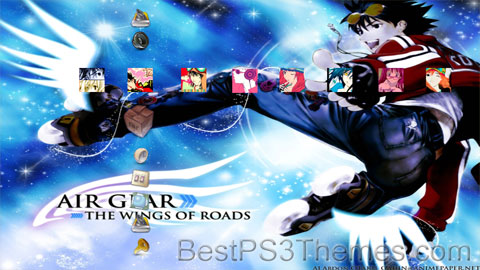
(7 backgrounds)
| Air Gear | |
 First tankōbon volume cover cover, featuring Ikki Minami with his pet crow, Kuu | |
| エア・ギア (Ea Gia) | |
|---|---|
| Genre | Action,[1] sports[2] |
| Manga | |
| Written by | Oh! great |
| Published by | Kodansha |
| English publisher | |
| Imprint | Shōnen Magazine Comics |
| Magazine | Weekly Shōnen Magazine |
| Demographic | Shōnen |
| Original run | November 6, 2002 – May 23, 2012 |
| Volumes | 37 |
| Anime television series | |
| Directed by | Hajime Kamegaki |
| Produced by |
|
| Written by | Chiaki J. Konaka |
| Music by |
|
| Studio | Toei Animation |
| Licensed by | Crunchyroll |
| Original network | TV Tokyo |
| English network |
|
| Original run | April 4, 2006 – September 26, 2006 |
| Episodes | 25 |
| Original animation DVD | |
| Break on the Sky | |
| Directed by | Shinji Ishihira |
| Produced by |
|
| Written by | Atsushi Maekawa |
| Music by | Shigerō Yoshida |
| Studio | Satelight |
| Released | November 17, 2010 – June 17, 2011 |
| Runtime | 28 minutes |
| Episodes | 3 |
Air Gear (Japanese: エア・ギア, Hepburn: Ea Gia) is a Japanese manga series written and illustrated by Oh! great, serialized in Kodansha's shōnen manga magazine Weekly Shōnen Magazine from November 2002 to May 2012, with its chapters collected in 37 tankōbon volumes. Air Gear revolves around the life of Itsuki Minami "Ikki or Crow", also known as "Baby Face", "Lil (and Little) Crow", and his friends. The story follows their use of Air Gear, an in-universe invention derived from inline skates. Initial sections of the plot carries out the introduction of characters that eventually join Ikki. As the story progresses, it focuses on their roles as Storm Riders and their quest to be on the top of the Trophaeum Tower, the pinnacle that all Storm Riders hope to reach.
Air Gear was adapted into a 25-episode anime television series by Toei Animation, which aired on TV Tokyo from April to September 2006. A three-episode original video animation (OVA), titled Air Gear: Break on the Sky, produced by Satelight, was released from November 2010 to June 2011.
Air Gear had over 18 million copies in circulation by August 2020. It won the 31st Kodansha Manga Award for the shōnen category in 2006.
A new fad by the name of "Air Treks" (a futuristic evolution of aggressive skating) has swept the nation's youth and all over gangs are being formed that compete in various events using their A-Ts. Ikki is a middle-school boy who is the toughest street-fighting punk on the east side of town and part of the gang "The East-Side Gunz". He lives with four adopted gorgeous sisters who took him in when he was a kid. But what Ikki does not know is that the girls are part of one of the most infamous A-T gangs, "Sleeping Forest". It does not take long before Ikki finds out about the world of Air Treks and is propelled into a fate he had not foreseen, learning about his past and making a number of storm riding allies on the way.
Written and illustrated by Oh! Great, Air Gear was serialized in Kodansha's shōnen manga magazine Weekly Shōnen Magazine from November 6, 2002,[3] to May 23, 2012.[4][5] Kodansha collected its 357 individual chapters into 37 tankōbon volumes, published under its Shōnen Magazine Comics imprint, from May 16, 2003,[6] to July 17, 2012.[7] A one-shot chapter was published in the magazine on December 22, 2015.[8]
The manga was licensed for release in North America by Del Rey Manga and the first volume was released on July 25, 2006.[9] Kodansha USA published the series under the Kodansha Comics imprint after Del Rey's shut down.[10]
An anime adaptation covering 12 volumes of the manga was produced by Toei Animation, Marvelous and Avex Entertainment and directed by Hajime Kamegaki, with Chiaki J. Konaka handling series composition and writing episode scripts, Masayuki Satō designing the characters and skankfunk, Wall5 Project and Masaki Sakamoto composing the music. ADV Films announced over the October 20, 2006 weekend at Oni-Con that they had licensed the anime for release in the United States;[11] the anime in its entirety reportedly cost $780,000.[12] Though few of the actual artists and inside creators of Air Gear were actually there. The few that were there included Loa Mitsoyagi (Ikki), Ian Miller (Agito), Jason Remmings (Kazuma), and the ADV representing team. The first volume was released on February 6, 2007.[13] ADV released the uncensored Japanese home video version, rather than the broadcast version. On January 3, 2007, IGN released a special sneak peek of Episode 1 of the English dub.[14] In 2008, Air Gear became one of over 30 ADV titles transferred to Funimation.[15] In Australia and New Zealand, the series is licensed by Madman Entertainment.[16]
Avex released one single and two albums covering all the songs and themes used for the anime adaptation. The opening theme single "Chain" performed by Back-on was released on June 7, 2006 and peak ranked 139th on Oricon singles chart.[17][18] The two albums Air Gear original soundtrack: What a Groovy Tricks!! and Air Gear original soundtrack 2: Who wants more Groovy Trick!!?? were released on August 23, 2006 and February 28, 2007, respectively.[19][20]
In July 2010, it was announced that a new Air Gear original video animation (OVA) would be released alongside the limited edition of the manga's 30th volume.[21] Animation studio Satelight animated the OVA instead of Toei with Shinji Ishihira as director, Atsushi Maekawa as script writer, Osamu Horiuchi as character designer and Stanislas Brunet as mechanical design. Nobuhiko Okamoto plays Ikki, Haruka Tomatsu plays Ringo, and Yukari Fukui plays Kururu.
The first OVA was released on November 17, 2010 and adapted the confrontation between Ikki and Ringo from volume 16 of the manga. The second OVA was released on March 17 and the final third OVA was released on June 17, 2011. The latter two OVAs adapt the legendary battle between Kogarasumaru and Sleeping Forest from volumes 24 and 25 of the manga.
Air Gear was adapted into a musical called Musical Air Gear,[22] which made its debut on January 7, 2007 and ran until January 21, 2007. The musical is loosely adapted from the manga and all female roles are eliminated from the plot. The cast featured Kenta Kamakari, KENN, and Kenjiro Tsuda reprising their roles from the anime respectively as Ikki, Kazu, and Spitfire with Masaki Kaji (who had also starred with Kenta and KENN in the Prince of Tennis musicals), Run&Gun, etc. as their co-stars.[23] In the musical, team Kogarasumaru opposes team Bacchus, whose names all come from works of Shakespeare. (Romeo, Juliet, Hamlet, Macbeth and Puck).
Due to the success and popularity of the musical's first run, the musical had a rerun in May, 2007 titled, Musical Air Gear vs. Bacchus Super Range Remix (ミュージカル「エア·ギア」vs.バッカス Super Range Remix, Myūjikaru "Ea Gia" tai Bakkasu Sūpā Renji Rimikkusu) with the entire cast, except for Kenta Kamakari due to illness, reprising their roles. Ryuji Kamiyama (originally Romeo) replaced Kamakari, subsequently Kosuke Yonehara (originally Hamlet) took over the role of Romeo and a new actor was brought in to play Hamlet.
In April, 2010 there was a third run of the musical, It was titled 'Musical Air Gear vs. Bacchus Top Gear Remix.' Many cast members reprise their roles, Kenta Kamakari returning as Ikki. Remarkably, Agito's actor was replaced by a younger actor and the original actor now played the part of Juliet. The role of Spitfire was replaced by Aeon Clock.
By August 2020, Air Gear had over 18 million copies in circulation.[24] It won the 2006 Kodansha Manga Award in the shōnen category.[25]
Both the manga and anime have gained a lot of popularity, both in the east and the west and now has quite a large fan base.[26] BlogCritics said "It mixes this action and comedy quite well with a storyline that doesn't fail to leave a reader wanting more."[27] The anime has often been criticized for not remaining true to the manga, story and skipping parts, but is praised for its soundtrack. The English dub has received positive reviews since its release.[28] AnimeOnDVD said "The concept of the show is one that is pure anime though and something that visually can be done very well".[13] The anime's ending was cited as underwhelming despite its mostly positive reviews.
Frazetta theme by bracomadar
Download: Frazetta.p3t
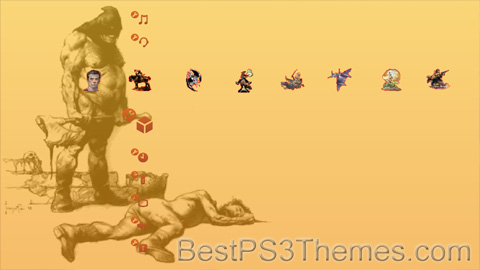
(5 backgrounds)
Redirect to:
This page is a redirect. The following categories are used to track and monitor this redirect:
|
Jimi Hendrix theme by 1_BAD_SOLDIER
Download: JimiHendrix.p3t
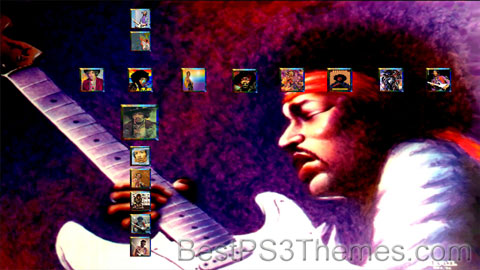
(3 backgrounds)
Jimi Hendrix | |
|---|---|
 Hendrix performing on Hoepla in 1967 | |
| Background information | |
| Birth name | Johnny Allen Hendrix |
| Also known as | James Marshall Hendrix |
| Born | November 27, 1942 Seattle, Washington, US |
| Died | September 18, 1970 (aged 27) London, England |
| Genres | |
| Occupations |
|
| Instruments |
|
| Years active | 1962–1970 |
| Labels | |
| Formerly of |
|
| Website | jimihendrix |
| Signature | |
 | |
James Marshall "Jimi" Hendrix (born Johnny Allen Hendrix; November 27, 1942 – September 18, 1970) was an American guitarist, songwriter and singer. Although his mainstream career spanned only four years, he is widely regarded as the greatest and one of the most influential electric guitarists in the history of popular music, and one of the most celebrated musicians of the 20th century. The Rock and Roll Hall of Fame describes him as "arguably the greatest instrumentalist in the history of rock music."[1]
Born in Seattle, Washington, Hendrix began playing guitar at age 15. In 1961, he enlisted in the US Army, but was discharged the following year. Soon afterward, he moved to Clarksville, then Nashville, Tennessee, and began playing gigs on the chitlin' circuit, earning a place in the Isley Brothers' backing band and later with Little Richard, with whom he continued to work through mid-1965. He then played with Curtis Knight and the Squires before moving to England in late 1966 after bassist Chas Chandler of the Animals became his manager. Within months, Hendrix had earned three UK top ten hits with his band, the Jimi Hendrix Experience (consisting of bassist Noel Redding, drummer Mitch Mitchell, and Hendrix himself): "Hey Joe", "Purple Haze", and "The Wind Cries Mary". He achieved fame in the US after his performance at the Monterey Pop Festival in 1967, and in 1968 his third and final studio album, Electric Ladyland, reached number one in the US. The double LP was Hendrix's most commercially successful release and his only number one album. The world's highest-paid rock musician,[2] he headlined the Woodstock Festival in 1969 and the Isle of Wight Festival in 1970 before his accidental death in London from barbiturate-related asphyxia in September 1970.
Hendrix was inspired by American rock and roll and electric blues. He favored overdriven amplifiers with high volume and gain, and was instrumental in popularizing the previously undesirable sounds caused by guitar amplifier feedback. He was also one of the first guitarists to make extensive use of tone-altering effects units in mainstream rock, such as fuzz distortion, Octavia, wah-wah, and Uni-Vibe. He was the first musician to use stereophonic phasing effects in recordings. Holly George-Warren of Rolling Stone commented: "Hendrix pioneered the use of the instrument as an electronic sound source. Players before him had experimented with feedback and distortion, but Hendrix turned those effects and others into a controlled, fluid vocabulary every bit as personal as the blues with which he began."[3]
Hendrix was the recipient of several music awards during his lifetime and posthumously. In 1967, readers of Melody Maker voted him the Pop Musician of the Year and in 1968, Billboard named him the Artist of the Year and Rolling Stone declared him the Performer of the Year. Disc and Music Echo honored him with the World Top Musician of 1969 and in 1970, Guitar Player named him the Rock Guitarist of the Year. The Jimi Hendrix Experience was inducted into the Rock and Roll Hall of Fame in 1992 and the UK Music Hall of Fame in 2005. Rolling Stone ranked the band's three studio albums, Are You Experienced (1967), Axis: Bold as Love (1967), and Electric Ladyland (1968), among the "500 Greatest Albums of All Time", and they ranked Hendrix as the greatest guitarist and the sixth-greatest artist of all time. Hendrix was named the greatest guitarist of all time by Rolling Stone in 2023.[4]

Hendrix was of African American and alleged Cherokee descent.[nb 1] His paternal grandfather, Bertran Philander Ross Hendrix, was born in 1866 from an extramarital affair between a woman named Fanny and a grain merchant from Urbana, Ohio, or Illinois, one of the wealthiest men in the area at that time.[11][nb 2] Hendrix's paternal grandmother, Zenora "Nora" Rose Moore, was a former dancer and vaudeville performer who co-founded Fountain Chapel in Hogan's Alley.[13] Hendrix and Moore relocated to Vancouver, Canada, where they had a son they named James Allen Hendrix on June 10, 1919; the family called him "Al".[14]
In 1941, after moving to Seattle, Washington, Al met Lucille Jeter (1925–1958) at a dance; they married on March 31, 1942.[15] Lucille's father (Jimi's maternal grandfather) was Preston Jeter (born 1875), whose mother was born in similar circumstances as Bertran Philander Ross Hendrix.[16] Lucille's mother, Clarice (née Lawson), had African American ancestors who had been enslaved people.[17] Al, who had been drafted by the US Army to serve in World War II, left to begin his basic training three days after the wedding.[18] Johnny Allen Hendrix was born on November 27, 1942, in Seattle; he was the first of Lucille's five children. In 1946, Johnny's parents changed his name to James Marshall Hendrix, in honor of Al and his late brother Leon Marshall.[19][nb 3]
Stationed in Alabama at the time of Hendrix's birth, Al was denied the standard military furlough afforded servicemen for childbirth; his commanding officer placed him in the stockade to prevent him from going AWOL to see his infant son in Seattle. He spent two months locked up without trial, and, while in the stockade, received a telegram announcing his son's birth.[13][nb 4] During Al's three-year absence, Lucille struggled to raise their son.[23] When Al was away, Hendrix was mostly cared for by family members and friends, especially Lucille's sister Delores Hall and her friend Dorothy Harding.[24] Al received an honorable discharge from the US Army on September 1, 1945. Two months later, unable to find Lucille, Al went to the Berkeley, California, home of a family friend named Mrs. Champ, who had taken care of and attempted to adopt Hendrix; this is where Al saw his son for the first time.[25]
After returning from service, Al reunited with Lucille, but his inability to find steady work left the family impoverished. They both struggled with alcohol, and often fought when intoxicated. The violence sometimes drove Hendrix to withdraw and hide in a closet in their home.[26] His relationship with his brother Leon (born 1948) was close but precarious; with Leon in and out of foster care, they lived with an almost constant threat of fraternal separation.[27] In addition to Leon, Hendrix had three younger siblings: Joseph, born in 1949, Kathy in 1950, and Pamela in 1951, all of whom Al and Lucille gave up to foster care and adoption.[28] The family frequently moved, staying in cheap hotels and apartments around Seattle. On occasion, family members would take Hendrix to Vancouver to stay at his grandmother's. A shy and sensitive boy, he was deeply affected by his life experiences.[29] In later years, he confided to a girlfriend that he had been the victim of sexual abuse by a man in uniform.[30] On December 17, 1951, when Hendrix was nine years old, his parents divorced; the court granted Al custody of him and Leon.[31]
At Horace Mann Elementary School in Seattle during the mid-1950s, Hendrix's habit of carrying a broom with him to emulate a guitar gained the attention of the school's social worker. After more than a year of his clinging to a broom like a security blanket, she wrote a letter requesting school funding intended for underprivileged children, insisting that leaving him without a guitar might result in psychological damage.[32] Her efforts failed, and Al refused to buy him a guitar.[32][nb 5]
In 1957, while helping his father with a side-job, Hendrix found a ukulele among the garbage they were removing from an older woman's home. She told him that he could keep the instrument, which had only one string.[34] Learning by ear, he played single notes, following along to Elvis Presley songs, particularly "Hound Dog".[35][nb 6] By the age of 33, Hendrix's mother Lucille had developed cirrhosis of the liver, and on February 2, 1958, she died when her spleen ruptured.[37] Al refused to take James and Leon to attend their mother's funeral; he instead gave them shots of whiskey and told them that was how men should deal with loss.[37][nb 7] In 1958, Hendrix completed his studies at Washington Junior High School and began attending, but did not graduate from, Garfield High School.[38][nb 8]
In mid-1958, at age 15, Hendrix acquired his first acoustic guitar, for $5[41] (equivalent to $53 in 2023). He played for hours daily, watching others and learning from more experienced guitarists, and listening to blues artists such as Muddy Waters, B.B. King, Howlin' Wolf, and Robert Johnson.[42] The first tune Hendrix learned to play was the television theme "Peter Gunn".[43] Around that time, Hendrix jammed with boyhood friend Sammy Drain and his keyboard-playing brother.[44] In 1959, attending a concert by Hank Ballard & The Midnighters in Seattle, Hendrix met the group's guitarist Billy Davis.[45] Davis showed him some guitar licks and got him a short gig with the Midnighters.[46] The two remained friends until Hendrix's death in 1970.[47]
Soon after he acquired the acoustic guitar, Hendrix formed his first band, the Velvetones. Without an electric guitar, he could barely be heard over the sound of the group. After about three months, he realized that he needed an electric guitar.[48] In mid-1959, his father relented and bought him a white Supro Ozark.[48] Hendrix's first gig was with an unnamed band in the Jaffe Room of Seattle's Temple De Hirsch, but they fired him between sets for showing off.[49] He joined the Rocking Kings, which played professionally at venues such as the Birdland club. When his guitar was stolen after he left it backstage overnight, Al bought him a red Silvertone Danelectro.[50]

Before Hendrix was 19 years old, law authorities had twice caught him riding in stolen cars. Given a choice between prison or joining the Army, he chose the latter and enlisted on May 31, 1961.[51] After completing eight weeks of basic training at Fort Ord, California, he was assigned to the 101st Airborne Division and stationed at Fort Campbell, Kentucky.[52] He arrived on November 8, and soon afterward he wrote to his father: "There's nothing but physical training and harassment here for two weeks, then when you go to jump school ... you get hell. They work you to death, fussing and fighting."[53] In his next letter home, Hendrix, who had left his guitar in Seattle at the home of his girlfriend Betty Jean Morgan, asked his father to send it to him as soon as possible, stating: "I really need it now."[53] His father obliged and sent the red Silvertone Danelectro on which Hendrix had hand-painted the words "Betty Jean" to Fort Campbell.[54] His apparent obsession with the instrument contributed to his neglect of his duties, which led to taunting and physical abuse from his peers, who at least once hid the guitar from him until he had begged for its return.[55] In November 1961, fellow serviceman Billy Cox walked past an army club and heard Hendrix playing.[56] Impressed by Hendrix's technique, which Cox described as a combination of "John Lee Hooker and Beethoven", Cox borrowed a bass guitar and the two jammed.[57] Within weeks, they began performing at base clubs on the weekends with other musicians in a loosely organized band, the Casuals.[58]
Hendrix completed his paratrooper training and, on January 11, 1962, Major General Charles W. G. Rich awarded him the prestigious Screaming Eagles patch.[53] By February, his personal conduct had begun to draw criticism from his superiors. They labeled him an unqualified marksman and often caught him napping while on duty and failing to report for bed checks.[59] On May 24, Hendrix's platoon sergeant, James C. Spears, filed a report in which he stated: "He has no interest whatsoever in the Army ... It is my opinion that Private Hendrix will never come up to the standards required of a soldier. I feel that the military service will benefit if he is discharged as soon as possible."[60] On June 29, 1962, Hendrix was granted a general discharge under honorable conditions.[61] Hendrix later spoke of his dislike of the army and that he had received a medical discharge after breaking his ankle during his 26th parachute jump,[62][nb 9] but no Army records have been produced that indicate that he received or was discharged for any injuries.[64]
In September 1962, after Cox was discharged from the Army, he and Hendrix moved about 20 miles (32 km) across the state line from Fort Campbell to Clarksville, Tennessee, and formed a band, the King Kasuals.[65] In Seattle, Hendrix saw Butch Snipes play with his teeth and now the Kasuals' second guitarist, Alphonso "Baby Boo" Young, was performing this guitar gimmick.[66] Not to be upstaged, Hendrix also learned to play in this way. He later explained: "The idea of doing that came to me ... in Tennessee. Down there you have to play with your teeth or else you get shot. There's a trail of broken teeth all over the stage."[67]
Although they began playing low-paying gigs at obscure venues, the band eventually moved to Nashville's Jefferson Street, which was the traditional heart of the city's black community and home to a thriving rhythm and blues music scene.[68] They earned a brief residency playing at a popular venue in town, the Club del Morocco, and for the next two years Hendrix made a living performing at a circuit of venues throughout the South that were affiliated with the Theater Owners Booking Association (TOBA), widely known as the chitlin' circuit.[69] In addition to playing in his own band, Hendrix performed as a backing musician for various soul, R&B, and blues musicians, including Wilson Pickett, Slim Harpo, Sam Cooke, Ike & Tina Turner[70] and Jackie Wilson.[71]
In January 1964, feeling he had outgrown the circuit artistically, and frustrated by having to follow the rules of bandleaders, Hendrix decided to venture out on his own. He moved into the Hotel Theresa in Harlem, where he befriended Lithofayne Pridgon, known as "Faye", who became his girlfriend.[72] A Harlem native with connections throughout the area's music scene, Pridgon provided him with shelter, support, and encouragement.[73] Hendrix also met the Allen twins, Arthur and Albert.[74][nb 10] In February 1964, Hendrix won first prize in the Apollo Theater amateur contest.[76] Hoping to secure a career opportunity, he played the Harlem club circuit and sat in with various bands. At the recommendation of a former associate of Joe Tex, Ronnie Isley granted Hendrix an audition that led to an offer to become the guitarist with the Isley Brothers' backing band, the I.B. Specials, which he readily accepted.[77]
In March 1964, Hendrix recorded the two-part single "Testify" with the Isley Brothers. Released in June, it failed to chart.[78] In May, he provided guitar instrumentation for the Don Covay song, "Mercy Mercy". Issued in August by Rosemart Records and distributed by Atlantic, the track reached number 35 on the Billboard chart.[79]
Hendrix toured with the Isleys during much of 1964, but near the end of October, after growing tired of playing the same set every night, he left the band.[80][nb 11] Soon afterward, Hendrix joined Little Richard's touring band, the Upsetters.[82] During a stop in Los Angeles in February 1965, he recorded his first and only single with Richard, "I Don't Know What You Got (But It's Got Me)", written by Don Covay and released by Vee-Jay Records.[83] Richard's popularity was waning at the time, and the single peaked at number 92, where it remained for one week before dropping off the chart.[84][nb 12] Hendrix met singer Rosa Lee Brooks while staying at the Wilcox Hotel in Hollywood, and she invited him to participate in a recording session for her single, which included the Arthur Lee penned "My Diary" as the A-side, and "Utee" as the B-side.[86] Hendrix played guitar on both tracks, which also included background vocals by Lee. The single failed to chart, but Hendrix and Lee began a friendship that lasted several years; Hendrix later became an ardent supporter of Lee's band, Love.[86]
In July 1965, Hendrix made his first television appearance on Nashville's Channel 5 Night Train. Performing in Little Richard's ensemble band, he backed up vocalists Buddy and Stacy on "Shotgun". The video recording of the show marks the earliest known footage of Hendrix performing.[82] Richard and Hendrix often clashed over tardiness, wardrobe, and Hendrix's stage antics, and in late July, Richard's brother Robert fired him.[87]
On July 27, Hendrix signed his first recording contract with Juggy Murray at Sue Records and Copa Management.[88][89] He then briefly rejoined the Isley Brothers, and recorded a second single with them, "Move Over and Let Me Dance" backed with "Have You Ever Been Disappointed".[90] Later that year, he joined a New York-based R&B band, Curtis Knight and the Squires, after meeting Knight in the lobby of a hotel where both men were staying.[91] Hendrix performed with them for eight months.[92]
In October 1965, he and Knight recorded the single, "How Would You Feel" backed with "Welcome Home". Despite his two-year contract with Sue,[93] Hendrix signed a three-year recording contract with entrepreneur Ed Chalpin on October 15.[94] While the relationship with Chalpin was short-lived, his contract remained in force, which later caused legal and career problems for Hendrix.[95][nb 13] During his time with Knight, Hendrix briefly toured with Joey Dee and the Starliters, and worked with King Curtis on several recordings including Ray Sharpe's two-part single, "Help Me".[97] Hendrix earned his first composer credits for two instrumentals, "Hornets Nest" and "Knock Yourself Out", released as a Curtis Knight and the Squires single in 1966.[98][nb 14]
Feeling restricted by his experiences as an R&B sideman, Hendrix moved in 1966 to New York City's Greenwich Village, which had a vibrant and diverse music scene.[103] There, he was offered a residency at the Cafe Wha? on MacDougal Street and formed his own band that June, Jimmy James and the Blue Flames, which included future Spirit guitarist Randy California.[104][nb 15] The Blue Flames played at several clubs in New York and Hendrix began developing his guitar style and material that he would soon use with the Experience.[106][107] In September, they gave some of their last concerts at the Cafe Au Go Go in Manhattan, as the backing group for a singer and guitarist then billed as John Hammond.[108][nb 16]

By May 1966, Hendrix was struggling to earn a living wage playing the R&B circuit, so he briefly rejoined Curtis Knight and the Squires for an engagement at one of New York City's most popular nightspots, the Cheetah Club.[109] During a performance, Linda Keith, the girlfriend of Rolling Stones guitarist Keith Richards, noticed Hendrix and was "mesmerised" by his playing.[109] She invited him to join her for a drink, and the two became friends.[109]
While Hendrix was playing as Jimmy James and the Blue Flames, Keith recommended him to Stones manager Andrew Loog Oldham and producer Seymour Stein. They failed to see Hendrix's musical potential and rejected him.[110] Keith referred him to Chas Chandler, who was leaving the Animals and was interested in managing and producing artists.[111] Chandler saw Hendrix play in
Samurai X theme by sisiri Download: SamuraiX.p3t Samurai X may refer to:
Mega Man 20th Anniversary theme by MechanizedDemon Download: MegaMan20th.p3t P3T Unpacker v0.12 This program unpacks Playstation 3 Theme files (.p3t) so that you can touch-up an existing theme to your likings or use a certain wallpaper from it (as many themes have multiple). But remember, if you use content from another theme and release it, be sure to give credit! Download for Windows: p3textractor.zip Instructions: Download p3textractor.zip from above. Extract the files to a folder with a program such as WinZip or WinRAR. Now there are multiple ways to extract the theme. The first way is to simply open the p3t file with p3textractor.exe. If you don’t know how to do this, right click the p3t file and select Open With. Alternatively, open the p3t file and it will ask you to select a program to open with. Click Browse and find p3textractor.exe from where you previously extracted it to. It will open CMD and extract the theme to extracted.[filename]. After that, all you need to do for any future p3t files is open them and it will extract. The second way is very simple. Just drag the p3t file to p3textractor.exe. It will open CMD and extract the theme to extracted.[filename]. For the third way, first put the p3t file you want to extract into the same folder as p3textractor.exe. Open CMD and browse to the folder with p3extractor.exe. Enter the following:Samurai X
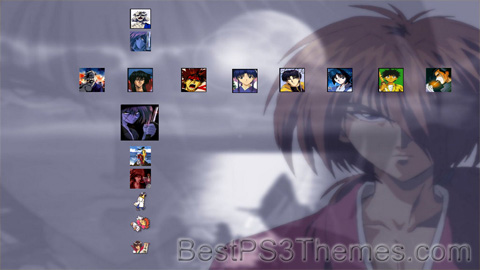
(3 backgrounds)
 This disambiguation page lists articles associated with the title Samurai X.
If an internal link led you here, you may wish to change the link to point directly to the intended article.Mega Man 20th Anniversary

(3 backgrounds)
Copyright (c) 2007. Anoop Menon
p3textractor filename.p3t [destination path]Replace filename with the name of the p3t file, and replace [destination path] with the name of the folder you want the files to be extracted to. A destination path is not required. By default it will extract to extracted.filename.