Hip Hop theme by André Mello
Download: HipHop.p3t

(4 backgrounds)
Redirect to:
This page is a redirect. The following categories are used to track and monitor this redirect:
|

The #1 spot for Playstation themes!
Hip Hop theme by André Mello
Download: HipHop.p3t
(4 backgrounds)
Redirect to:
This page is a redirect. The following categories are used to track and monitor this redirect:
|
Beautiful Space theme by Jewad Alnabi
Download: BeautifulSpace.p3t
Home theme by Jchia
Download: Home_2.p3t
(1 background)
 | The examples and perspective in this article may not represent a worldwide view of the subject. (December 2021) |

A home, or domicile, is a space used as a permanent or semi-permanent residence for one or more human occupants, and sometimes various companion animals. It is a fully- or semi-sheltered space and can have both interior and exterior aspects to it.[vague] Homes provide sheltered spaces, for instance rooms, where domestic activity can be performed such as sleeping, preparing food, eating and hygiene as well as providing spaces for work and leisure such as remote working, studying and playing.
Physical forms of homes can be static such as a house or an apartment, mobile such as a houseboat, trailer or yurt or digital such as virtual space.[1] The aspect of 'home' can be considered across scales; from the micro scale showcasing the most intimate spaces of the individual dwelling and direct surrounding area to the macro scale of the geographic area such as town, village, city, country or planet.
The concept of 'home' has been researched and theorized across disciplines – topics ranging from the idea of home, the interior, the psyche, liminal space, contested space to gender and politics.[2] The home as a concept expands beyond residence as contemporary lifestyles and technological advances redefine the way the global population lives and works.[citation needed] The concept and experience encompasses the likes of exile, yearning, belonging, homesickness and homelessness.[3]

The earliest homes that humans inhabited were likely naturally occurring features such as caves. The earliest human fossils found in caves come from a series of caves near Krugersdorp and Mokopane in South Africa. The cave sites of Sterkfontein, Swartkrans, Kromdraai B, Drimolen, Malapa, Cooper's D, Gladysvale, Gondolin and Makapansgat have yielded a range of early human species dating back to between three and one million years ago, including Australopithecus africanus, Australopithecus sediba and Paranthropus robustus. However, it is not generally thought that these early humans were living in the caves, but that they were brought into the caves by carnivores that had killed them.[citation needed]
The first early hominid ever found in Africa, the Taung Child in 1924, was also thought for many years to come from a cave, where it had been deposited after being preyed upon by an eagle. However, this is now debated.[4] Caves do form in the dolomite of the Ghaap Plateau, including the Early, Middle and Later Stone Age site of Wonderwerk Cave; however, the caves that form along the escarpment's edge, like that hypothesized for the Taung Child, are formed within a secondary limestone deposit called tufa. There is numerous evidence for other early human species inhabiting caves from at least one million years ago in different parts of the world, including Homo erectus in China at Zhoukoudian, Homo rhodesiensis in South Africa at the Cave of Hearths (Makapansgat), Homo neanderthalensis and Homo heidelbergensis in Europe at Archaeological Site of Atapuerca, Homo floresiensis in Indonesia, and the Denisovans in southern Siberia.
In southern Africa, early modern humans regularly used sea caves as shelter starting about 180,000 years ago when they learned to exploit the sea for the first time.[5] The oldest known site is PP13B at Pinnacle Point. This may have allowed rapid expansion of humans out of Africa and colonization of areas of the world such as Australia by 60–50,000 years ago. Throughout southern Africa, Australia, and Europe, early modern humans used caves and rock shelters as sites for rock art, such as those at Giants Castle. Caves such as the yaodong in China were used for shelter; other caves were used for burials (such as rock-cut tombs), or as religious sites (such as Buddhist caves). Among the known sacred caves are China's Cave of a Thousand Buddhas[6] and the sacred caves of Crete. As technology progressed, humans and other hominids began constructing their own dwellings. Buildings such as huts and longhouses have been used for living since the late Neolithic.[7]
![[icon]](https://en.wikipedia.org/wiki/File:Wiki_letter_w_cropped.svg) | This section is empty. You can help by adding to it. (December 2021) |
From the 14th to the 16th century, homelessness was perceived of as a "vagrancy problem" and legislative responses to the problem were predicated upon the threat it may pose to the state.[8]

According to Kirsten Gram-Hanssen, "It can be argued that historically and cross-culturally there is not always [a] strong relation between the concept of home and the physical building, and that this mode of thinking is rooted in the Enlightenment of the seventeenth century".[10] Before, one's home was more public than private; traits such as privacy, intimacy and familiarity would proceed to achieve greater prominence, aligning the concept with the bourgeoisie.[11][12] The connection between home and house was reinforced by a case law declaration from Edward Coke: "The house of everyman is to him as his castle and fortress, as well as his defense against injury and violence, as for his repose". Colloquially, this was adapted into the phrase "The Englishman's home is his castle" which popularised the notion of home as house.[13]
A result of the longstanding association between home and women, 18th century English women, of upper-class status, were scorned for pursuing activities outside of the home, thus seen to be of undesirable character.[14] The concept of home took on unprecedent prominence by the 18th century, reified by cultural practice.[15]
The concept of a smart home arose in the 19th century in turn with electricity having been introduced to homes in a limited capacity.[10] The distinction between home and work formulated in the 20th century, with home acting as sanctuary.[16] Modern definitions portray home as a site of supreme comfort and familial intimacy, operating as a buffer to the greater world.[14]
The concept of home is one with multiple interpretations, influenced by one's history and identity.[17] People of differing ages, genders, ethnicities and classes may have resultingly different meanings of home.[18] Commonly, it is associated with various forms of abodes such as wagons, cars, boats or tents although it is equally considered to extend beyond the space, in mind and emotion.[8][19][20] The space of a home need not be significant or fixed though the boundaries of home are often tied to the space.[19][20] There have been multiple theories regarding one's choice of home with the residential conditions of their childhood often reflected in their later choice of home.[11] According to Paul Oliver, the vast majority of abodes are vernacular, constructed in accordance with the residents' needs.[21]
.jpg)
A house is a single-unit residential building. It may range in complexity from a rudimentary hut to a complex structure of wood, masonry, concrete or other material, outfitted with plumbing, electrical, and heating, ventilation, and air conditioning systems.[22][23]
The social unit that lives in a house is known as a household. Most commonly, a household is a family unit of some kind, although households may also be other social groups, such as roommates or, in a rooming house, unconnected individuals. Some houses only have a dwelling space for one family or similar-sized group; larger houses called townhouses or row houses may contain numerous family dwellings in the same structure. A house may be accompanied by outbuildings, such as a garage for vehicles or a shed for gardening equipment and tools. A house may have a backyard or a front yard or both, which serve as additional areas where inhabitants can relax or eat. [citation needed] Houses may provide "certain activities, which gradually accumulate meaning until they become homes".[20]
Joseph Rykwert distinguished between home and house in their physicality; a house requires a building whereas a home does not.[24] Home and house are often used interchangeably, although their connotations may differ: house being "emotionally neutral" and home evoking "personal, cognitive aspects".[20][25] By the mid-18th century, the definition of home had extended beyond a house.[15] "Few English words are filled with the emotional meaning of the word home".[14]


Home as constitutionally mobile and transient has been contended by anthropologists and sociologist.[26] A mobile home (also known as a house trailer, park home, trailer, or trailer home) is a prefabricated structure, built in a factory on a permanently attached chassis before being transported to site (either by being towed or on a trailer). Used as permanent homes, or for holiday or temporary accommodation, they are often left permanently or semi-permanently in one place, but can be moved, and may be required to move from time to time for legal reasons.
A houseboat is a boat that has been designed or modified to be used primarily as a home. Some houseboats are not motorized, because they are usually moored, kept stationary at a fixed point and often tethered to land to provide utilities. However, many are capable of operation under their own power. Float house is a Canadian and American term for a house on a float (raft); a rough house may be called a shanty boat.[27] In Western countries, houseboats tend to be either owned privately or rented out to holiday-goers, and on some canals in Europe, people dwell in houseboats all year round. Examples of this include, but are not limited to, Amsterdam, London, and Paris.[28]
A traditional yurt or ger is a portable round tent covered with skins or felt and used as a dwelling by several distinct nomadic groups in the steppes of Central Asia. The structure consists of an angled assembly or latticework of wood or bamboo for walls, a door frame, ribs (poles, rafters), and a wheel (crown, compression ring) possibly steam-bent. The roof structure is often self-supporting, but large yurts may have interior posts supporting the crown. The top of the wall of self-supporting yurts is prevented from spreading by means of a tension band which opposes the force of the roof ribs. Modern yurts may be permanently built on a wooden platform; they may use modern materials such as steam-bent wooden framing or metal framing, canvas or tarpaulin, plexiglass dome, wire rope, or radiant insulation.

A housing cooperative, or housing co-op, is a legal entity, usually a cooperative or a corporation, which owns real estate, consisting of one or more residential buildings; it is one type of housing tenure. Typically housing cooperatives are owned by shareholders but in some cases they can be owned by a non-profit organization. They are a distinctive form of home ownership that have many characteristics that differ from other residential arrangements such as single family home ownership, condominiums and renting.[29]
The cooperative is membership based, with membership granted by way of a share purchase in the cooperative. Each shareholder in the legal entity is granted the right to occupy one housing unit. A primary advantage of the housing cooperative is the pooling of the members' resources so that their buying power is leveraged; thus lowering the cost per member in all the services and products associated with home ownership.
Home repair involves the diagnosis and resolution of problems in a home, and is related to home maintenance to avoid such problems. Many types of repairs are "do it yourself" (DIY) projects, while others may be so complicated, time-consuming or risky as to require the assistance of a qualified handyperson, property manager, contractor/builder, or other
Metal Gear Solid 4 theme by GhostViperGTX Download: MetalGearSolid4_3.p3t Redirect to: Avril Lavigne theme by RamMan Download: AvrilLavigne.p3t
Avril Ramona Lavigne CM[1] (/ˈævrɪl ləˈviːn/ AV-ril lə-VEEN, French: [avʁil ʁamɔna laviɲ]; born September 27, 1984) is a Canadian singer-songwriter. She is considered a key musician in the development of pop-punk music, as she paved the way for female-driven, punk-influenced pop music in the early 2000s.[2][3] Her accolades include eight Grammy Award nominations.
At age 16, Lavigne signed a two-album recording contract with Arista Records. Her debut studio album, Let Go (2002), is the best-selling album of the 21st century by a Canadian artist. It yielded the successful singles "Complicated" and "Sk8er Boi", which emphasized a skate punk persona and earned her the title "Pop-Punk Queen" from music publications.[4][5] Her second studio album, Under My Skin (2004), became Lavigne's first album to reach the top of the Billboard 200 chart in the United States, going on to sell 10 million copies worldwide.
Lavigne's third studio album, The Best Damn Thing (2007), reached number one in seven countries worldwide and saw the international success of its lead single "Girlfriend", which became her first single to reach the top of the Billboard Hot 100 in the United States. Her next two studio albums, Goodbye Lullaby (2011) and Avril Lavigne (2013), saw continued commercial success and were both certified gold in Canada, the United States, and other territories.[6][7][8] After releasing her sixth studio album, Head Above Water (2019), she returned to her punk roots with her seventh studio album, Love Sux (2022).[9]
Avril Ramona Lavigne was born on September 27, 1984, in Belleville, Ontario. She was named Avril (the French word for April) by her father.[10] He and Lavigne's mother recognized their child's vocal abilities when she was two years old and sang "Jesus Loves Me" on the way home from church.[11] Lavigne has an older brother named Matthew and a younger sister named Michelle,[12] both of whom teased her when she sang. "My brother used to knock on the wall because I used to sing myself to sleep and he thought it was really annoying."[11] She is the sister-in-law of Japanese band One OK Rock bassist Ryota Kohama.[13] Lavigne's paternal grandfather Maurice Yves Lavigne was born in Saint-Jérôme, Quebec.[14] A member of the Royal Canadian Air Force, he married Lucie Dzierzbicki, a French native of Morhange in 1953. Their son, Jean-Claude Lavigne, was born in 1954 at RCAF Station Grostenquin near Grostenquin, Lorraine.[15] When Jean-Claude was a child, the family moved to Ontario, and in 1975, he married Judith-Rosanne "Judy" Loshaw.[16][17]
When Lavigne was 5, the family moved to Napanee (now incorporated as Greater Napanee),[18] a town with a population of approximately 5,000 at the time.[19][20][21] Also when she was 5, she was diagnosed with ADHD, which caused her problems during her school years.[22]
To support her musical interests, her father bought her a microphone, a drum kit, a keyboard, and several guitars, and converted their basement into a studio. Her father often played bass at the church the family attended, the Third Day Worship Centre in Kingston. When Lavigne was 14 years old, her parents took her to karaoke sessions.[23]
Lavigne performed at country fairs, singing songs by Garth Brooks, the Chicks, and Shania Twain, and began writing her own songs. Her first song was called "Can't Stop Thinking About You", about a teenage crush, which she described as "cheesy cute".[24]
Lavigne also played hockey during high school and won MVP twice as a right winger in a boys league.[25]
In 1999, Lavigne won a radio contest to perform with Canadian singer Shania Twain at the Corel Centre in Ottawa, before an audience of 20,000 people.[26][18][19] Twain and Lavigne sang Twain's song, "What Made You Say That",[18] and Lavigne told Twain that she aspired to be "a famous singer".[19] During a performance with the Lennox Community Theatre, Lavigne was spotted by local folksinger Stephen Medd. He invited her to contribute vocals on his song, "Touch the Sky", for his 1999 album, Quinte Spirit. She later sang on "Temple of Life" and "Two Rivers" for his follow-up album, My Window to You, in 2000.
In December 1999, Lavigne was discovered by her first professional manager, Cliff Fabri, while singing country covers at a Chapters bookstore in Kingston.[18][19] Fabri sent out VHS tapes of Lavigne's home performances to several industry prospects, and Lavigne was visited by several executives.[27] Mark Jowett, co-founder of a Canadian management firm, Nettwerk, received a copy of Lavigne's karaoke performances recorded in her parents' basement.[28] Jowett arranged for Lavigne to work with producer Peter Zizzo during the summer of 2000 in New York, where she wrote the song "Why". Lavigne was noticed by Arista Records during a trip to New York.[27]
In November 2000,[20] Ken Krongard, an A&R representative, invited Antonio "L.A." Reid, then head of Arista Records, to Zizzo's Manhattan studio to hear Lavigne sing. Her 15-minute audition "so impressed" Reid that he immediately signed her to Arista with a deal worth $1.25 million for two albums and an extra $900,000 for a publishing advance.[21][18] By this time, Lavigne had found that she fit in naturally with her hometown high school's skater clique, an image that carried through to her first album, but although she enjoyed skateboarding, school left her feeling insecure. Having signed a record deal, and with support from her parents, she left school to focus on her music career.[20][29][24] Lavigne's band, which were mostly the members of Closet Monster, was chosen by Nettwerk, as they wanted young performers who were up and coming from the Canadian punk rock scene who would fit with Lavigne's personality.[30]
Reid gave A&R Joshua Sarubin the responsibility of overseeing Lavigne's development and the recording of her debut album. They spent several months in New York working with different co-writers, trying to forge an individual sound for her. Sarubin told HitQuarters that they initially struggled; although early collaborations with songwriter-producers including Sabelle Breer, Curt Frasca and Peter Zizzo resulted in some good songs, they did not match her or her voice. It was only when Lavigne went to Los Angeles in May 2001 and created two songs with the Matrix production team—including "Complicated", later released as her debut single—that the record company felt she had made a major breakthrough. Lavigne worked further with the Matrix and also with singer-songwriter Clif Magness. Recording of Lavigne's debut album, Let Go, finished in January 2002.[31]
Lavigne released Let Go in June 2002 in the US, where it reached number two on the Billboard 200 albums chart. It peaked at number one in Australia, Canada, and the UK—this made Lavigne, at 17 years old, the youngest female soloist to have a number-one album on the UK Albums Chart at that time.[32] By the end of 2002, the album was certified four-times Platinum by the RIAA, making her the bestselling female artist of 2002 and Let Go the top-selling debut of the year.[33] By May 2003, Let Go had accumulated over 1 million sales in Canada, receiving a diamond certification from the Canadian Recording Industry Association.[34] By 2009, the album had sold over 16 million units worldwide.[35] By March 2018, the RIAA certified the album seven-times Platinum, denoting shipments of over seven million units in the US.[36]
Lavigne's debut single, "Complicated", peaked at number one in Australia and number two in the US. "Complicated" was one of the bestselling Canadian singles of 2002, and one of the decade's biggest hits in the US,[37] where subsequent singles "Sk8er Boi" and "I'm with You" reached the top ten.[38] With these three singles, Lavigne became the second artist in history to have three top-ten songs from a debut album on Billboard's Mainstream Top 40 chart.[39] Lavigne was named Best New Artist (for "Complicated") at the 2002 MTV Video Music Awards,[40] won four Juno Awards in 2003 out of six nominations,[41] received a World Music Award for "World's Bestselling Canadian Singer", and was nominated for eight Grammy Awards, including Best New Artist and Song of the Year for "Complicated".[42]
In 2002, Lavigne made a cameo appearance in the music video for "Hundred Million" by the pop punk band Treble Charger.[43] In March 2003, Lavigne posed for the cover of Rolling Stone magazine,[16] and in May she performed "Fuel" during MTV's Icon tribute to Metallica.[44][45] During her first headlining tour, the Try to Shut Me Up Tour, Lavigne covered Green Day's "Basket Case".[46]
Lavigne's second studio album, Under My Skin, was released in May 2004 and debuted at number one in Australia, Canada, Japan, the UK, and the US.[47] The album was certified five-times Platinum in Canada[48] and has sold 10 million copies,[49] including 3.2 million in the US.[50] Lavigne wrote most of the album's tracks with Canadian singer-songwriter Chantal Kreviazuk, and Kreviazuk's husband, Our Lady Peace front man Raine Maida, co-produced the album with Butch Walker and Don Gilmore. Lavigne said that Under My Skin proved her credentials as a songwriter, saying that "each song comes from a personal experience of mine, and there are so much [sic] emotions in those songs".[51] "Don't Tell Me", the lead single off the album, reached the top five in the UK and Canada and the top ten in Australia. "My Happy Ending", the album's second single, was a top five hit in the UK and Australia. In the US, it was a top ten entry on the Billboard Hot 100 and became a number-one pop radio hit. The third single, "Nobody's Home", did not manage to make the top 40 in the US and performed moderately elsewhere.
During early 2004 Lavigne went on the 'Live and By Surprise' acoustic mall tour in the US and Canada to promote Under My Skin, accompanied by her guitarist Evan Taubenfeld. In September 2004, Lavigne embarked on her first world tour, the year-long Bonez Tour. Lavigne won two World Music Awards in 2004, for 'World's Best Pop/Rock Artist' and 'World's Bestselling Canadian Artist' and won three Juno Awards from five nominations in 2005, including 'Artist of the Year'.[52] She also won in the category of 'Favorite Female Singer' at the eighteenth annual Nickelodeon Kids' Choice Awards.[53]
Lavigne co-wrote the song "Breakaway", which was recorded by Kelly Clarkson for the soundtrack to the 2004 film The Princess Diaries 2: Royal Engagement.[54] "Breakaway" was released as a single in mid 2004 and subsequently included as the title track on Clarkson's second album, Breakaway. Lavigne performed the Goo Goo Dolls song "Iris" with the band's lead singer John Rzeznik at Fashion Rocks in September 2004,[55] and she posed for the cover of Maxim in October 2004.[56] She recorded the theme song for The SpongeBob SquarePants Movie (released in November 2004) with producer Butch Walker.[57]
In February 2006, Lavigne represented Canada at the closing ceremony of the 2006 Winter Olympics.[58] Fox Entertainment Group approached Lavigne to write a song for the soundtrack to the 2006 fantasy-adventure film Eragon; her contribution, "Keep Holding On", was released as a single to promote the film and its soundtrack.[59][60][61]
Lavigne's third album, The Best Damn Thing, was released in April 2007 and debuted at number one on the U.S. Billboard 200,[62] and subsequently achieved Platinum status in Canada.[48] The album sold more than 2 million copies in the US.[36] Its lead single, "Girlfriend", became Lavigne's first number-one single on the U.S. Billboard Hot 100 and one of the decade's biggest singles.[62][63] The single also peaked at number one in Australia, Canada, and Japan, and reached number two in the UK and France. As well as English, "Girlfriend" was recorded in Spanish, French, Italian, Portuguese, German, Japanese, and Mandarin. The International Federation of the Phonographic Industry ranked "Girlfriend" as the most-downloaded track worldwide in 2007, selling 7.3 million copies, including the versions recorded in eight different languages.[64][65] "When You're Gone", the album's second single, reached the top five in Australia and the United Kingdom, the top ten in Canada, and the top forty in the US. "Hot" was the third single and charted only at number 95 in the US, although it reached the top 10 in Canada and the top 20 in Australia.
Lavigne won two World Music Awards in 2007, for 'World's Bestselling Canadian Artist' and 'World's Best Pop/Rock Female Artist'. She won her first two MTV Europe Music Awards, received a Teen Choice Award for 'Best Summer Single', and was nominated for five Juno Awards.[52] In December 2007, Lavigne was ranked number eight in Forbes magazine's list of 'Top 20 Earners Under 25', with annual earnings of $12 million.[66] In March 2008, Lavigne undertook a world tour, The Best Damn World Tour, and appeared on the cover of Maxim for the second time.[67] In mid-August, Malaysia's Islamic opposition party, the Pan-Malaysian Islamic Party, attempted to ban Lavigne's tour show in Kuala Lumpur, judging her stage moves "too sexy". It was thought that her concert on August 29 would promote wrong values ahead of Malaysia's Independence Day on August 31.[68] On August 21, 2008, MTV reported that the concert had been approved by the Malaysian government.[69]
In January 2010, Lavigne worked with Disney to create clothing designs inspired by Tim Burton's feature film Alice in Wonderland. She recorded a song for its soundtrack, "Alice", which was played over the end credits and included on the soundtrack album Almost Alice.[70][71][72] In February, Lavigne performed at the Vancouver 2010 Winter Olympics closing ceremony.[73] Lavigne's song "I'm with You" was sampled by Rihanna on the track "Cheers (Drink to That)", which is featured on Rihanna's fifth studio album, Loud (2010).[74][75] "Cheers (Drink to That)" was released as a single the following year, and Lavigne appeared in its music video.[76] In December 2010, American singer Miranda Cosgrove released "Dancing Crazy", a song written by Lavigne, Max Martin and Shellback. It was also produced by Martin.[77]
Lavigne began recording for her fourth studio album, Goodbye Lullaby, in her home studio in November 2008. Its opening track, "Black Star", was written to help promote her first fragrance of the same name.[78][79] Lavigne described the album as being about her life experiences rather than focusing on relationships, and its style as less pop rock than her previous material, reflecting her age.[79][80] The release date for Goodbye Lullaby was delayed several times, which Lavigne said was because of her label.[81][82] Goodbye Lullaby was released in March 2011,[83][80] and its lead single, "What the Hell", premiered in December 2010, ahead of the album's release.[83] Goodbye Lullaby received Juno Award nominations for Album of the Year and Pop Album of the Year.[52] By March 2018, Goodbye Lullaby sold more than 500,000 copies in the US, and it was certified Gold by the RIAA.[36]
Three months after the release of Goodbye Lullaby, Lavigne announced that work on her fifth studio album had already begun, describing it as the musical opposite of Goodbye Lullaby[84] and "pop and more fun again". Armored Core theme by Wicketnezz and BlackGhost8942 Download: ArmoredCore.p3t Armored Core[a] is a third-person shooter mecha video game series developed by FromSoftware. The series centers on a silent protagonist who takes on work as a mercenary pilot in the far future, operating large robot combat units known as Armored Cores at the behest of corporate and private clients. As the player completes missions for these clients, they gain credits to improve their Armored Core and unlock further opportunities to make money. Some games include an "Arena" mode in which the player fights other Armored Core pilots in head-to-head battles, which can reward the player with further income or prestige.
Several story continuities exist, spread across 13 main games, seven spin-offs, and three remastered re-releases, with different releases divided by a different set of "generations" of sequels that starts with every numbered entry. The first game in the series, Armored Core, was released in 1997, while the most recent, Armored Core VI: Fires of Rubicon, was released in 2023.[1][2] The series has been released on the PlayStation, PlayStation 2, mobile phones, PlayStation Portable, PlayStation 3, Xbox 360, PlayStation 4, PlayStation 5, Windows, Xbox One, and Xbox Series X/S.
In the original continuity established by 1997's Armored Core through 2001's Armored Core 2: Another Age, Earth experienced a cataclysm known as the "Great Destruction" and humanity has been forced underground. Corporations begin fighting for dominance, leading to the increasing reliance on Armored Core pilots called Ravens.[3] Following the events of 1999's Armored Core: Master of Arena, humanity rebuilds and colonizes Mars. Through 2000's Armored Core 2 and its expansion, Another Age, the fledgling Earth government struggles to maintain power as opportunistic corporations exploit the power gap and rebel groups resist against the hegemony of government and business interests.[4][5]
The series was rebooted with 2002's Armored Core 3, beginning a new story arc that concluded with Armored Core: Last Raven in 2005. Following a global nuclear war, humanity has retreated underground. Following centuries of rule by an artificial intelligence called The Controller, its decay leads to the destruction of much of humanity's underground network, causing them to look toward the surface for safety.[6] By the end of 2003's Silent Line: Armored Core, humanity has fully returned to the surface of Earth.[7] The final two games of this continuity, 2004's Armored Core: Nexus and 2005's Armored Core: Last Raven involve the end of the existing power dynamic of corporations and Ravens fighting over the surface.[8][9]
2006's Armored Core 4 rebooted the series yet again. Here, corporations have seized control of Earth governments and are waging war across the surface for dominance. A war waged over the course of the game pollutes the environment, leading to the creation of floating cities in 2008's Armored Core: For Answer. Depending on the player's choices, humanity either barely survives the fallout of For Answer's conflict or is completely eradicated.[10][11]
The third continuity of the series continued with 2012's Armored Core V. A single corporation has dominance over a contaminated Earth and is being opposed by a resistance faction that seeks to overthrow them. 2013's Armored Core: Verdict Day details the outbreak of another war 100 years later following an apocalyptic event.[12][13]
Another continuity has begun with 2023's Armored Core VI: Fires of Rubicon. For the first time in the series, it takes place far away from Earth in a human-colonized solar system on the planet Rubicon 3. Decades prior to the game's start, a powerful resource called Coral was discovered, leading to significant technological advancements, but a disaster called the Fires of Ibis scorched the entire Rubicon system and left it highly contaminated. However, the Coral, thought to have all burned, has begun to reappear, bringing multiple corporations into conflict for control of it which, in turn, has brought the attention of mercenaries. Added into the conflict are the Planetary Closure Administration, an organization tasked with quarantining Rubicon, and the Rubicon Liberation Front, a resistance group who venerate the Coral, wishing to end its exploitation and free the planet.
Within the core games of the franchise, the gameplay is generally focused on the player taking the role of a mech-piloting mercenary, taking on missions for various clients and gaining currency from completing them.[14] Missions can involve multiple objectives and pit the player against computer controlled opponents, some of which pilot mechs as well.[15] Upon completion of a mission, the operating costs of the mech, such as repairs and ammunition, are deducted from the total earnings of the player, as well as compensation for destroying valuable objects within the mission area. Likewise, if the player loses a mission, those same deductions occur from the player's direct balance.[16]
The game's mechs, called Armored Cores (or ACs for short), are highly customizable with hundreds of parts and weapons that can be purchased from an in-game shop or by fulfilling certain requirements.[17] Different parts can provide gameplay advantages in certain terrains or against certain enemies, which forces the player to put thought into how to approach the construction of their mech as each sortie often has different obstacles and hazards to overcome.[14] The customization of Armored Cores is strictly limited by multiple factors such as the maximum weight load of their leg parts, or the energy output of their generators supplying power to all equipped parts of the AC. As such, an Armored Core's performance varies depending on the parts which compose it.
Many of the franchise's games feature a branching storyline where taking on certain missions can block off others, with consequences of a player's decision in mission being relayed to them at the end of a mission. Certain games require multiple playthroughs to access additional contents, such as missions inaccessible during initial playthrough, and even different endings that adds additional lore and context to the games.[18]
An Arena mode introduced in Armored Core: Project Phantasma gave players the opportunity to fight opponents outside of missions for additional rewards. Project Phantasma also introduced the import feature, allowing players to retain their progress from a previous entry when starting a new one.[19] This import feature would become a mainstay of the franchise, with "expansion" titles like Silent Line: Armored Core allowing for importing save data.[20]
Since its first release, the Armored Core games have featured multiplayer options in some form. In the original PlayStation era, local split-screen multiplayer modes were the primary method, generally featuring head-to-head battles.[21] A PlayStation Link Cable feature, allowing for the connection of two PlayStation consoles, was included in all three original Armored Core titles.[22]
With the PlayStation 2, split-screen and console linking continue to be the primary source of multiplayer. 2004's Armored Core: Nexus introduced the LAN multiplayer mode, in addition to connecting through their internet service and allowed up to 4 players to fight in matches together.[23]
Online multiplayer was first introduced in the Japanese release of Armored Core 2: Another Age, but was removed in other regions due to the PlayStation Network Adapter not being ready in time.[24] No PlayStation 2-era game after this release would include online play either, with the first game to do so being Armored Core 4.[10]
The original trilogy of Armored Core games were developed for the original PlayStation by FromSoftware and established many of the core themes and mechanics that would be found in the rest of the series. The debut title, Armored Core, was released on July 10, 1997, in Japan.[25] Story elements like corporate-funded conflicts, post-apocalyptic settings, and silent protagonists were introduced in the first game. The game's mechanics revolve around taking on missions from various clients for pay, using earned money to customize the player's Armored Core unit.[14]
Armored Core: Project Phantasma was released as a stand-alone expansion to the original game, released on December 4, 1997.[26] Project Phantasma introduced an Arena mechanic that would be expanded on in later titles, as well as an import mechanic that would become an important feature through the franchise. Players were able to import save data from earlier Armored Core games and bring their existing Armored Core units into the expansions.[19]
A second stand-alone expansion, Armored Core: Master of Arena, was released on February 4, 1999, and was the final game released for the original PlayStation.[27] It concluded the core arc of the original Armored Core and greatly expanded on the Arena mechanic introduced in Project Phantasma.[28] Like its predecessor, Master of Arena allowed players to import save files from both the original Armored Core and Project Phantasma to continue their progress.[29]
All three games from the original PlayStation era were re-released on the PlayStation Network in 2007 for the tenth anniversary of the original title.[30][31][32] The original Armored Core was also released on the Japanese PlayStation Classic in 2018.[33]
With the transition to the PlayStation 2, FromSoftware released Armored Core 2 as a launch title in Japan on August 3, 2000.[34] As a narrative sequel to the original trilogy, Armored Core 2 transitioned the series away from the post-apocalyptic setting and added more science fiction elements, such as Mars colonization. Much of the gameplay remained the same, including the mission structure, customization, and Arena modes.[35][4] The title did overhaul the visuals from the original game, taking advantage of the added power of the new console, but overall designs stayed similar.[36] Unlike Project Phantasma and Master of Arena, players could not import their saves to the new game.
Armored Core 2: Another Age was released on April 12, 2001, as a stand-alone expansion.[37] It allowed players to import their save files from Armored Core 2 and continue with their existing Armored Core units.[38] The game introduced movement controls using the DualShock analog sticks and cooperative mission mode.[39] The Japanese version of Armored Core 2 was the first title to include online broadband play, allowing players to fight each other over the internet.[24]
Armored Core 3 was released on April 4, 2002, and served as a reboot for the franchise.[40] The story returned to a post-apocalyptic setting and retained the core concept of corporate warfare and mercenary mission structure. Very little gameplay was changed from the earlier PlayStation 2 titles, instead focusing on incremental improvements and minor features like USB mice, computer-controlled allies, and surround sound.[6][41][42] Due to its nature as a reboot, players could not import save data from Armored Core 2 or Another Age.
A stand-alone expansion, Silent Line: Armored Core, was released on January 23, 2003, and was a direct sequel to Armored Core 3.[43] Like other expansions in the franchise, players could import their progress from Armored Core 3 into Silent Line, retaining their parts and credits from the earlier game.[20] Silent Line introduced new gameplay mechanics, including computer-controlled companions and a first person mode.[44][45]
Armored Core: Nexus was released on March 18, 2004, as a direct sequel to Silent Line.[46] Unlike its predecessor, Nexus was treated as a core entry rather than an expansion and did not allow for save data import.[47] While carrying over parts from 3 and Silent Line, mechanics changed significantly compared to past expansions. The heat mechanic introduced in Armored Core 2 was made much more influential, especially with the introduction of booster heat. All part stats were also totally redistributed. The game was the first in the franchise to include support for dual analog sticks. It also introduced a new LAN multiplayer mode that allowed up to 4 players to participate in matches against each other.[23]
Armored Core: Last Raven was released on August 4, 2005, and served as the conclusion to Armored Core 3's story arc.[48] The game is structured around a 24-hour clock that moves forward as missions progress. At the end of the 24-hour period, choices made by the player can alter the outcome of the plot.[49] The game introduced a component damage system, allowing for individual parts to be broken in combat.[50]
Armored Core 4 was released on December 21, 2006, for the PlayStation 3, serving as another reboot for the franchise. An Xbox 360 version, the first instance of a main title in the franchise being released outside of the PlayStation ecosystem, was released on March 22, 2007.[51] Gameplay in Armored Core 4 has been sped up and streamlined from its predecessors in an attempt to make the game more accessible to new players.[52] The game marks the first instance of online multiplayer outside of the Japanese release of Armored Core 2: Another Age.[53]
Armored Core: For Answer was released on March 19, 2008, as a standalone expansion to Armored Core 4.[54] It incorporates an online co-operative mode and a branching storyline.[55] The game was noted for its technical problems on the PlayStation 3 version.[56] Like Nexus, this game did not simply add content to its predecessor and changed gameplay by greatly increasing booster speeds and increasing generator performance.
Armored Core V was released on January 26, 2012, for the PlayStation 3 and Xbox 360 and acts as indirect sequel to Armored Core 4 and Armored Core: For Answer.[57] The game focuses on the online multiplayer component and includes far fewer offline story missions than its predecessors.[12] In the game's online mode, players battle for territory in teams of up to 20 players. A co-operative mode is included for players to fight NPCs alongside other players for various rewards.[58]
Armored Core: Verdict Day was released on September 24, 2013, as a standalone expansion to Armored Core V.[59] The game retains its predecessor's multiplayer focus, though it allows players to create teams of AI companions instead of requiring teams composed entirely of players.[60] A full-length story mode returns alongside a newly implemented "hardcore mode", and players can import their saved games from Armored Core V to retain their personalized mechs.[61]
Armored Core VI: Fires of Rubicon was announced at The Game Awards 2022 on December 8. It is another reboot of the series, unrelated to any past games, set in an alternate future where humanity has developed an interstellar civilization. The player character, codenamed "C4-621" is an augmented Armored Core pilot sent to the distant planet Rubicon 3 to fight in a war between corporations, the government and the local inhabitants for the control of a highly valuable resource called "Coral" which only exists there. The game was released on PlayStation 4, PlayStation 5, Windows, Xbox One, and Xbox Series X/S on August 25, 2023.[62][63]
In 2004, FromSoftware released two spin-offs from the main Armored Core series. The first, Armored Core: Nine Breaker was released on October 28, 2004, for the PlayStation 2.[64] Removing the focus from story-based missions, the game is instead built around an Arena mode where the player must compete with computer-controlled opponents to increase their rank.[65] Minigames designed as training exercises were included to allow players to practice specific skills.[66]
Armored Core: Formula Front was released on December 12, 2004, for the PlayStation Portable.[67] Like Nine Breaker, its focus was on Arena-style gameplay, though a new mechanic put a focus on building an artificial intelligence strategy for the Armored Core units to execute.[68] Formula Front was later released for the PlayStation 2 in Japan.[69]
Several mobile games were released in the Armored Core franchise from 2004 to 2008, but they were never released outside of Japan.[70] An American version of these mobile games was in development around 2005, but the title was never released.[71]
Armored Core: Tower City Blade is a manga by Fujimi Shobo based on the game. It was serialized in Dragon Age Pure between March 14 and April 14, 2007. A project called Armored Core: Fort Tower Song was to consist of a book and an anime also released in 2007. The book was completed but the anime was not.[72] From Software announced in 2011 that the anime had been canceled due to View Works shutting down.[73]
The making of Armored Core solidified FromSoftware's development skills, and in July 1999, they released the multiplayer action game Frame Gride for the Sega Dreamcast.[74] The company's focus would shift from RPGs to mech games due in part to the success of the Armored Core series. In 2002, FromSoftware released the mech action game Murakumo: Renegade Mech Pursuit for the Xbox.[74] In 2004, they released another Xbox title, Metal Wolf Chaos. In 2005, FromSoftware would start to produce a series of licensed games based on the various anime properties under the banner Another Century's Episode.[75] Kenichiro Tsukuda, the producer of the Armored Core series produced a very similar video game called Daemon X Machina that was released for the Nintendo Switch and Microsoft Windows.[76]
Aperture Green theme by hobix Download: ApertureGreen.p3t P3T Unpacker v0.12 This program unpacks Playstation 3 Theme files (.p3t) so that you can touch-up an existing theme to your likings or use a certain wallpaper from it (as many themes have multiple). But remember, if you use content from another theme and release it, be sure to give credit! Download for Windows: p3textractor.zip Instructions: Download p3textractor.zip from above. Extract the files to a folder with a program such as WinZip or WinRAR. Now there are multiple ways to extract the theme. The first way is to simply open the p3t file with p3textractor.exe. If you don’t know how to do this, right click the p3t file and select Open With. Alternatively, open the p3t file and it will ask you to select a program to open with. Click Browse and find p3textractor.exe from where you previously extracted it to. It will open CMD and extract the theme to extracted.[filename]. After that, all you need to do for any future p3t files is open them and it will extract. The second way is very simple. Just drag the p3t file to p3textractor.exe. It will open CMD and extract the theme to extracted.[filename]. For the third way, first put the p3t file you want to extract into the same folder as p3textractor.exe. Open CMD and browse to the folder with p3extractor.exe. Enter the following: Venom theme by blindedcoon Download: Venom.p3t
Venom or zootoxin is a type of toxin produced by an animal that is actively delivered through a wound by means of a bite, sting, or similar action.[1][2][3] The toxin is delivered through a specially evolved venom apparatus, such as fangs or a stinger, in a process called envenomation.[2] Venom is often distinguished from poison, which is a toxin that is passively delivered by being ingested, inhaled, or absorbed through the skin,[4] and toxungen, which is actively transferred to the external surface of another animal via a physical delivery mechanism.[5]
Venom has evolved in terrestrial and marine environments and in a wide variety of animals: both predators and prey, and both vertebrates and invertebrates. Venoms kill through the action of at least four major classes of toxin, namely necrotoxins and cytotoxins, which kill cells; neurotoxins, which affect nervous systems; myotoxins, which damage muscles; and haemotoxins, which disrupt blood clotting. Venomous animals cause tens of thousands of human deaths per year.
Venoms are often complex mixtures of toxins of differing types. Toxins from venom are used to treat a wide range of medical conditions including thrombosis, arthritis, and some cancers. Studies in venomics are investigating the potential use of venom toxins for many other conditions.
The use of venom across a wide variety of taxa is an example of convergent evolution. It is difficult to conclude exactly how this trait came to be so intensely widespread and diversified. The multigene families that encode the toxins of venomous animals are actively selected, creating more diverse toxins with specific functions. Venoms adapt to their environment and victims, evolving to become maximally efficient on a predator's particular prey (particularly the precise ion channels within the prey). Consequently, venoms become specialized to an animal's standard diet.[6]
Venoms cause their biological effects via the many toxins that they contain; some venoms are complex mixtures of toxins of differing types. Major classes of toxin in venoms include:[7]
Venom is widely distributed taxonomically, being found in both invertebrates and vertebrates, in aquatic and terrestrial animals, and among both predators and prey. The major groups of venomous animals are described below.
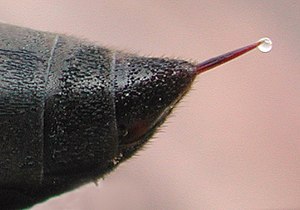
Venomous arthropods include spiders, which use fangs on their chelicerae to inject venom, and centipedes, which use forcipules — modified legs — to deliver venom, while scorpions and stinging insects inject venom with a sting. In bees and wasps, the stinger is a modified ovipositor (egg-laying device). In Polistes fuscatus, the female continuously releases a venom that contains a sex pheromone that induces copulatory behavior in males.[16] In wasps such as Polistes exclamans, venom is used as an alarm pheromone, coordinating a response from the nest and attracting nearby wasps to attack the predator.[17] In some species, such as Parischnogaster striatula, venom is applied all over the body as an antimicrobial protection.[18]
Many caterpillars have defensive venom glands associated with specialized bristles on the body called urticating hairs. These are usually merely irritating, but those of the Lonomia moth can be fatal to humans.[19]
Bees synthesize and employ an acidic venom (apitoxin) to defend their hives and food stores, whereas wasps use a chemically different venom to paralyse prey, so their prey remains alive to provision the food chambers of their young. The use of venom is much more widespread than just these examples; many other insects, such as true bugs and many ants, also produce venom.[20] The ant species Polyrhachis dives uses venom topically for the sterilisation of pathogens.[21]
There are venomous invertebrates in several phyla, including jellyfish such as the dangerous box jellyfish,[22] the Portuguese man-of-war (a siphonophore) and sea anemones among the Cnidaria,[23] sea urchins among the Echinodermata,[24] and cone snails[25] and cephalopods, including octopuses, among the Molluscs.[26]
Venom is found in some 200 cartilaginous fishes, including stingrays, sharks, and chimaeras; the catfishes (about 1000 venomous species); and 11 clades of spiny-rayed fishes (Acanthomorpha), containing the scorpionfishes (over 300 species), stonefishes (over 80 species), gurnard perches, blennies, rabbitfishes, surgeonfishes, some velvetfishes, some toadfishes, coral crouchers, red velvetfishes, scats, rockfishes, deepwater scorpionfishes, waspfishes, weevers, and stargazers.[27]
Some salamanders can extrude sharp venom-tipped ribs.[28][29] Two frog species in Brazil have tiny spines around the crown of their skulls which, on impact, deliver venom into their targets.[30]
Some 450 species of snake are venomous.[27] Snake venom is produced by glands below the eye (the mandibular glands) and delivered to the target through tubular or channeled fangs. Snake venoms contain a variety of peptide toxins, including proteases, which hydrolyze protein peptide bonds; nucleases, which hydrolyze the phosphodiester bonds of DNA; and neurotoxins, which disrupt signalling in the nervous system.[31] Snake venom causes symptoms including pain, swelling, tissue necrosis, low blood pressure, convulsions, haemorrhage (varying by species of snake), respiratory paralysis, kidney failure, coma, and death.[32] Snake venom may have originated with duplication of genes that had been expressed in the salivary glands of ancestors.[33][34]
Venom is found in a few other reptiles such as the Mexican beaded lizard,[35] the gila monster,[36] and some monitor lizards, including the Komodo dragon.[37] Mass spectrometry showed that the mixture of proteins present in their venom is as complex as the mixture of proteins found in snake venom.[37][38]
Some lizards possess a venom gland; they form a hypothetical clade, Toxicofera, containing the suborders Serpentes and Iguania and the families Varanidae, Anguidae, and Helodermatidae.[39]
Euchambersia, an extinct genus of therocephalians, is hypothesized to have had venom glands attached to its canine teeth.[40]
A few species of living mammals are venomous, including solenodons, shrews, vampire bats, male platypuses, and slow lorises.[27][41] Shrews have venomous saliva and most likely evolved their trait similarly to snakes.[42] The presence of tarsal spurs akin to those of the platypus in many non-therian Mammaliaformes groups suggests that venom was an ancestral characteristic among mammals.[43]
Extensive research on platypuses shows that their toxin was initially formed from gene duplication, but data provides evidence that the further evolution of platypus venom does not rely as much on gene duplication as was once thought.[44] Modified sweat glands are what evolved into platypus venom glands. Although it is proven that reptile and platypus venom have independently evolved, it is thought that there are certain protein structures that are favored to evolve into toxic molecules. This provides more evidence of why venom has become a homoplastic trait and why very different animals have convergently evolved.[13]
Envenomation resulted in 57,000 human deaths in 2013, down from 76,000 deaths in 1990.[45] Venoms, found in over 173,000 species, have potential to treat a wide range of diseases, explored in over 5,000 scientific papers.[36]
In medicine, snake venom proteins are used to treat conditions including thrombosis, arthritis, and some cancers.[46][47] Gila monster venom contains exenatide, used to treat type 2 diabetes.[36] Solenopsins extracted from fire ant venom has demonstrated biomedical applications, ranging from cancer treatment to psoriasis.[48][49] A branch of science, venomics, has been established to study the proteins associated with venom and how individual components of venom can be used for pharmaceutical means.[50]
Venom is used as a trophic weapon by many predator species. The coevolution between predators and prey is the driving force of venom resistance, which has evolved multiple times throughout the animal kingdom.[51] The coevolution between venomous predators and venom-resistant prey has been described as a chemical arms race.[52] Predator/prey pairs are expected to coevolve over long periods of time.[53] As the predator capitalizes on susceptible individuals, the surviving individuals are limited to those able to evade predation.[54] Resistance typically increases over time as the predator becomes increasingly unable to subdue resistant prey.[55] The cost of developing venom resistance is high for both predator and prey.[56] The payoff for the cost of physiological resistance is an increased chance of survival for prey, but it allows predators to expand into underutilised trophic niches.[57]
The California ground squirrel has varying degrees of resistance to the venom of the Northern Pacific rattlesnake.[58] The resistance involves toxin scavenging and depends on the population. Where rattlesnake populations are denser, squirrel resistance is higher.[59] Rattlesnakes have responded locally by increasing the effectiveness of their venom.[60]
The kingsnakes of the Americas are constrictors that prey on many venomous snakes.[61] They have evolved resistance which does not vary with age or exposure.[55] They are immune to the venom of snakes in their immediate environment, like copperheads, cottonmouths, and North American rattlesnakes, but not to the venom of, for example, king cobras or black mambas.[62]
Among marine animals, eels are resistant to sea snake venoms, which contain complex mixtures of neurotoxins, myotoxins, and nephrotoxins, varying according to species.[63][64] Eels are especially resistant to the venom of sea snakes that specialise in feeding on them, implying coevolution; non-prey fishes have little resistance to sea snake venom.[65]
Clownfish always live among the tentacles of venomous sea anemones (an obligatory symbiosis for the fish),[66] and are resistant to their venom.[67][68] Only 10 known species of anemones are hosts to clownfish and only certain pairs of anemones and clownfish are compatible.[69][70] All sea anemones produce venoms delivered through discharging nematocysts and mucous secretions. The toxins are composed of peptides and proteins. They are used to acquire prey and to deter predators by causing pain, loss of muscular coordination, and tissue damage. Clownfish have a protective mucus that acts as a chemical camouflage or macromolecular mimicry preventing "not self" recognition by the sea anemone and nematocyst discharge.[71][72][73] Clownfish may acclimate their mucus to resemble that of a specific species of sea anemone.[73]
Metal Gear Solid 4 #3

(3 backgrounds)
Call of Duty 4 #7
PSN at Home
Avril Lavigne

(3 backgrounds)
Avril Lavigne Lavigne in 2019
Born Avril Ramona Lavigne
September 27, 1984Belleville, Ontario, CanadaCitizenship
Occupations
Years active 1999–present Works Spouses Relatives Ryota Kohama (brother-in-law) Awards Full list Musical career Genres Instruments
Labels
TikTok informationPage Followers 5.7 million Likes 39.2 million
Last updated: June 28, 2024Website avrillavigne Signature 
Early life[edit]
Career[edit]
1999–2001: Career beginnings[edit]
2002–2003: Let Go[edit]

2004–2005: Under My Skin[edit]

2006–2011: The Best Damn Thing and Goodbye Lullaby[edit]

2012–2017: Self-titled album[edit]

Armored Core
(5 backgrounds)
Armored Core 
Genre(s) Third-person shooter Developer(s) FromSoftware Publisher(s)
Platform(s) First release Armored Core
July 10, 1997Latest release Armored Core VI: Fires of Rubicon
August 25, 2023Premise[edit]
Gameplay[edit]

Multiplayer[edit]
Games[edit]
1997 Armored Core Project Phantasma 1998 1999 Master of Arena 2000 Armored Core 2 2001 2: Another Age 2002 Armored Core 3 2003 Silent Line 2004 Nexus Nine Breaker Formula Front 2005 Last Raven 2006 Armored Core 4 2007 2008 For Answer 2009–2011 2012 Armored Core V 2013 Verdict Day 2014–2022 2023 Armored Core VI: Fires of Rubicon Armored Core[edit]
Armored Core 2[edit]
Armored Core 3[edit]
Armored Core 4[edit]
Armored Core V[edit]
Armored Core VI: Fires of Rubicon[edit]
Spin-offs[edit]
Other media[edit]
Legacy[edit]
Footnotes[edit]
Notes[edit]
References[edit]
Aperture Green
(1 background)
Copyright (c) 2007. Anoop Menon
p3textractor filename.p3t [destination path]Replace filename with the name of the p3t file, and replace [destination path] with the name of the folder you want the files to be extracted to. A destination path is not required. By default it will extract to extracted.filename.Venom

(2 backgrounds)
Evolution[edit]
Mechanisms[edit]

Taxonomic range[edit]
Arthropods[edit]
Other invertebrates[edit]

Vertebrates[edit]
Fish[edit]
Amphibians[edit]
Reptiles[edit]

 The venom of the prairie rattlesnake, Crotalus viridis (left), includes metalloproteinases (example on the right) which help digest prey before eating.
Mammals[edit]
Venom and humans[edit]
Resistance[edit]
The California ground squirrel is resistant to the Northern Pacific rattlesnake's powerful venom.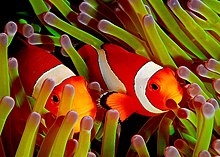
See also[edit]
References[edit]
{{cite book}}: CS1 maint: location missing publisher (link)
Posts pagination