Battle Angel theme by Rbirth
Download: BattleAngel.p3t

(3 backgrounds)
Redirect to:

The #1 spot for Playstation themes!
FLCL (Fooly Cooly) Ver. 2 theme by Rbirth
Download: FLCLv2.p3t

(3 backgrounds)
P3T Unpacker v0.12
Copyright (c) 2007. Anoop Menon
This program unpacks Playstation 3 Theme files (.p3t) so that you can touch-up an existing theme to your likings or use a certain wallpaper from it (as many themes have multiple). But remember, if you use content from another theme and release it, be sure to give credit!
Download for Windows: p3textractor.zip
Instructions:
Download p3textractor.zip from above. Extract the files to a folder with a program such as WinZip or WinRAR. Now there are multiple ways to extract the theme.
The first way is to simply open the p3t file with p3textractor.exe. If you don’t know how to do this, right click the p3t file and select Open With. Alternatively, open the p3t file and it will ask you to select a program to open with. Click Browse and find p3textractor.exe from where you previously extracted it to. It will open CMD and extract the theme to extracted.[filename]. After that, all you need to do for any future p3t files is open them and it will extract.
The second way is very simple. Just drag the p3t file to p3textractor.exe. It will open CMD and extract the theme to extracted.[filename].
For the third way, first put the p3t file you want to extract into the same folder as p3textractor.exe. Open CMD and browse to the folder with p3extractor.exe. Enter the following:
p3textractor filename.p3t [destination path]Replace filename with the name of the p3t file, and replace [destination path] with the name of the folder you want the files to be extracted to. A destination path is not required. By default it will extract to extracted.filename.
Team Fortress 2 theme by Deathvein
Download: TeamFortress2.p3t
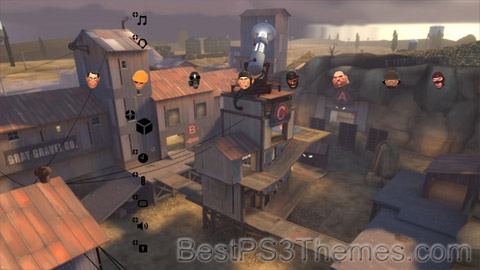
(6 backgrounds)
| Team Fortress 2 | |
|---|---|
 Promotional art depicting the nine playable classes | |
| Developer(s) | Valve |
| Publisher(s) | Valve |
| Designer(s) |
|
| Composer(s) | Mike Morasky |
| Engine | Source |
| Platform(s) | |
| Release | October 10, 2007
|
| Genre(s) | First-person shooter |
| Mode(s) | Single-player, multiplayer |
Team Fortress 2 (TF2) is a 2007 multiplayer first-person shooter game developed and published by Valve Corporation. It is the sequel to the 1996 Team Fortress mod for Quake and its 1999 remake, Team Fortress Classic. The game was released in October 2007 as part of The Orange Box for Microsoft Windows and the Xbox 360, and ported to the PlayStation 3 in December 2007.[2][3] It was released as a standalone game for Windows in April 2008, and updated to support macOS in June 2010 and Linux in February 2013. It is distributed online through Valve's digital retailer Steam, with Electronic Arts managing retail and console editions.
Players join one of two teams—RED (Reliable Excavation Demolition) and BLU (Builders League United)—and choose one of nine character classes to play as, with game modes including capture the flag and king of the hill. Development was led by John Cook and Robin Walker, the developers of the original Team Fortress mod. Team Fortress 2 was announced in 1998 under the name Team Fortress 2: Brotherhood of Arms. Initially, the game had more realistic, militaristic visuals and gameplay, but this changed over the protracted nine years of development. After Valve released no information for six years, Team Fortress 2 regularly featured in Wired News's annual vaporware list among other entries. Finally released on the Source game engine in 2007, Team Fortress 2 preserved much of the core class-based gameplay of its predecessors while featuring an overhauled, cartoon-like visual style influenced by the works of J. C. Leyendecker, Dean Cornwell, and Norman Rockwell, alongside an increased focus on the visual and verbal characterization of its playable classes and what the developers have described as a 1960s spy movie aesthetic.
Team Fortress 2 has received critical acclaim for its art direction, gameplay, humor, and use of character in a wholly multiplayer game,[4][5][6][7] and since its release has been referred to as one of the greatest video games ever created.[8][9][10] The game continues to receive official Valve server support as of January 2024,[11] in addition to new content being released on a seasonal basis in the form of submissions made through the Steam Workshop. In June 2011, the game became free-to-play, with revenue derived from microtransactions for in-game cosmetics. A 'drop system' was also added and refined, allowing free-to-play users to periodically receive in-game equipment and items. Though the game has had an unofficial competitive scene since its release, both support for official competitive play through ranked matchmaking and an overhauled casual experience were added in July 2016.[12] Since early 2020, the official Valve servers have seen an influx of bot accounts using cheat software, often inhibiting legitimate gameplay, which led to multiple online protests to call for actions against the bots and their hosts.[13]

In most game modes, two teams, RED and BLU, compete for a combat-based objective.[5] Players can choose to play as one of nine character classes in these teams, each with their own unique strengths, weaknesses, and weapon sets. In order to accomplish objectives efficiently, a balance of these classes is required due to how these strengths and weaknesses interact with each other in a team-based environment. Although the abilities of a number of classes have changed from earlier Team Fortress incarnations, the basic elements of each class have remained, them being one primary weapon, one secondary weapon, and one melee weapon.[14][15] The game was released with six official maps, although over one hundred maps have since been included in subsequent updates, including community-created maps.[16][17] When players choose a gamemode for the first time, an introductory video is played, showing how to complete its objectives. During matches, the Administrator,[18] voiced by Ellen McLain, announces the teams' current objectives over loudspeakers.[19] The player limit for one match is 16 on the Xbox 360 and PlayStation 3, and 24 on the Windows edition.[20] However, in 2008, the Windows edition was updated to include a server variable that allows for up to 32 players.[21] Furthermore, in 2023, the Windows edition was updated to have unrestricted player counts for up to 100 players in a single server.[22]
Team Fortress 2 is the first of Valve's multiplayer games to provide detailed statistics for individual players, such as the total amount of time spent playing as each class, most points obtained, and most objectives completed in a single life. Persistent statistics tell the player how they are performing in relation to these statistics, such as if a player comes close to their record for the damage inflicted in a round.[16] Team Fortress 2 also features numerous achievements for carrying out certain tasks, such as achieving a certain number of kills or completing a specific objective. Sets of class-specific achievements have been added in updates, which can award weapons to the player upon completion. This unlockable system has since been expanded into a random drop system, with which players can also obtain items simply by playing the game.[23]
Team Fortress 2 contains five core game modes.
There are several alternative game modes in Team Fortress 2. These modes consist of a small number of maps and detach from the core game modes in some way.
These modes are not categorized with the other modes, and instead have their own separate sections in the game.
Team Fortress 2 is played competitively, through multiple leagues. The North American league, ESEA, supports a paid Team Fortress 2 league, with $42,000 in prizes for the top teams in 2017.[44][45][46] While formalized competitive gameplay is very different from normal Team Fortress 2, it offers an environment with a much higher level of teamwork than in public servers. Most teams use voice chat to communicate, and use a combination of strategy, communication, and mechanical skill to win against other teams. Community-run competitive leagues also tend to feature restrictions such as item bans and class limits. These leagues are often supported by Valve via in-game medals (which are submitted via the Steam Workshop) and announcements on the official blog.[47][48][49]
In April 2015, Valve announced that a dedicated competitive mode would be added to Team Fortress 2, utilizing skill-based matchmaking;[50] closed beta testing began in the following year.[51] The competitive mode was added in the "Meet Your Match" update, released on July 7, 2016.[52] Ranked matches are played six-vs-six, with players ranked in thirteen tiers based on win/losses and an assessment of their skills.[53] Ranked matchmaking will balance players based on their tiers and rating. A similar matchmaking approach has been added for casual games for matches of 12-vs-12 players. In order to join competitive matchmaking, players must have associated their Steam account with the Steam Guard Mobile Authenticator, as well as having a Team Fortress 2 "premium account", which is unlocked by either having bought the game before it went free-to-play or by having made an in-game item purchase since.[54]
Team Fortress 2 is played in a variety of different formats, which dictate the maximum size and composition of a team and can drastically change the impact of a single player's gameplay or choice of class. The two most basic formats consist of 12v12 and 6v6 ("Sixes"), the two being used on official Valve servers for casual and competitive modes respectively with no additional limitations. Most competitive leagues host Sixes but include limits on certain classes and weapons to preserve traditional, skill-based playstyles, for example limiting the allowed amount of Medics or Demomen to one on either team or banning certain movement-enhancing weapons from use. Other popular formats include "Highlander", a 9v9 format with a limit of one player per each of the nine classes, as well as a Sixes-inspired 7v7 variant thereof known as "Prolander" to allow for strategically switching classes during a competitive game.[47][48][55]
 | This section needs additional citations for verification. (July 2022) |

Team Fortress 2 features nine playable classes, which are evenly split and categorized into "Offense", "Defense", and "Support".[16] Each class has strengths and weaknesses and must work with other classes to be efficient, encouraging strategy and teamwork.[56] Each class has at least three default weapons: a primary weapon, secondary weapon, and melee weapon. Engineers have two additional slots for their PDAs, and Spies have an additional slot for their disguise kit. An additional character, Saxton Hale, is playable in the "Versus Saxton Hale" game mode.[57]
Colours theme by Ali4Chris
Download: Colours.p3t

(4 backgrounds)
Redirect to:
This page is a redirect. The following categories are used to track and monitor this redirect:
|
Aperture theme by hobix
Download: Aperture.p3t

(5 backgrounds)
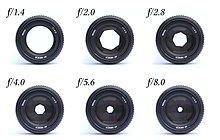



In optics, the aperture of an optical system (including a system consisted of a single lens) is a hole or an opening that primarily limits light propagated through the system. More specifically, the entrance pupil as the front side image of the aperture and focal length of an optical system determine the cone angle of a bundle of rays that comes to a focus in the image plane.
An optical system typically has many openings or structures that limit ray bundles (ray bundles are also known as pencils of light). These structures may be the edge of a lens or mirror, or a ring or other fixture that holds an optical element in place or may be a special element such as a diaphragm placed in the optical path to limit the light admitted by the system. In general, these structures are called stops,[2] and the aperture stop is the stop that primarily determines the cone of rays that an optical system accepts (see entrance pupil). As a result, it also determines the ray cone angle and brightness at the image point (see exit pupil). The aperture stop generally depends on the object point location; on-axis object points at different object planes may have different aperture stops, and even object points at different lateral locations at the same object plane may have different aperture stops (vignetted).[3] In practice, many object systems are designed to have a single aperture stop at designed working distance and field of view.
In some contexts, especially in photography and astronomy, aperture refers to the opening diameter of the aperture stop through which light can pass. For example, in a telescope, the aperture stop is typically the edges of the objective lens or mirror (or of the mount that holds it). One then speaks of a telescope as having, for example, a 100-centimetre (39 in) aperture. The aperture stop is not necessarily the smallest stop in the system. Magnification and demagnification by lenses and other elements can cause a relatively large stop to be the aperture stop for the system. In astrophotography, the aperture may be given as a linear measure (for example, in inches or millimetres) or as the dimensionless ratio between that measure and the focal length. In other photography, it is usually given as a ratio.
A usual expectation is that the term aperture refers to the opening of the aperture stop, but in reality, the term aperture and the aperture stop are mixed in use. Sometimes even stops that are not the aperture stop of an optical system are also called apertures. Contexts need to clarify these terms.
The word aperture is also used in other contexts to indicate a system which blocks off light outside a certain region. In astronomy, for example, a photometric aperture around a star usually corresponds to a circular window around the image of a star within which the light intensity is assumed.[4]

The aperture stop is an important element in most optical designs. Its most obvious feature is that it limits the amount of light that can reach the image/film plane. This can be either unavoidable due to the practical limit of the aperture stop size, or deliberate to prevent saturation of a detector or overexposure of film. In both cases, the size of the aperture stop determines the amount of light admitted by an optical system. The aperture stop also affects other optical system properties:
In addition to an aperture stop, a photographic lens may have one or more field stops, which limit the system's field of view. When the field of view is limited by a field stop in the lens (rather than at the film or sensor) vignetting results; this is only a problem if the resulting field of view is less than was desired.
In astronomy, the opening diameter of the aperture stop (called the aperture) is a critical parameter in the design of a telescope. Generally, one would want the aperture to be as large as possible, to collect the maximum amount of light from the distant objects being imaged. The size of the aperture is limited, however, in practice by considerations of its manufacturing cost and time and its weight, as well as prevention of aberrations (as mentioned above).
Apertures are also used in laser energy control, close aperture z-scan technique, diffractions/patterns, and beam cleaning.[5] Laser applications include spatial filters, Q-switching, high intensity x-ray control.
In light microscopy, the word aperture may be used with reference to either the condenser (that changes the angle of light onto the specimen field), field iris (that changes the area of illumination on specimens) or possibly objective lens (forms primary images). See Optical microscope.
The aperture stop of a photographic lens can be adjusted to control the amount of light reaching the film or image sensor. In combination with variation of shutter speed, the aperture size will regulate the film's or image sensor's degree of exposure to light. Typically, a fast shutter will require a larger aperture to ensure sufficient light exposure, and a slow shutter will require a smaller aperture to avoid excessive exposure.

A device called a diaphragm usually serves as the aperture stop and controls the aperture (the opening of the aperture stop). The diaphragm functions much like the iris of the eye – it controls the effective diameter of the lens opening (called pupil in the eyes). Reducing the aperture size (increasing the f-number) provides less light to sensor and also increases the depth of field (by limiting the angle of cone of image light reaching the sensor), which describes the extent to which subject matter lying closer than or farther from the actual plane of focus appears to be in focus. In general, the smaller the aperture (the larger the f-number), the greater the distance from the plane of focus the subject matter may be while still appearing in focus.
The lens aperture is usually specified as an f-number, the ratio of focal length to effective aperture diameter (the diameter of the entrance pupil). A lens typically has a set of marked "f-stops" that the f-number can be set to. A lower f-number denotes a greater aperture which allows more light to reach the film or image sensor. The photography term "one f-stop" refers to a factor of √2 (approx. 1.41) change in f-number which corresponds to a √2 change in aperture diameter, which in turn corresponds to a factor of 2 change in light intensity (by a factor 2 change in the aperture area).
Aperture priority is a semi-automatic shooting mode used in cameras. It permits the photographer to select an aperture setting and let the camera decide the shutter speed and sometimes also ISO sensitivity for the correct exposure. This is also referred to as Aperture Priority Auto Exposure, A mode, AV mode (aperture-value mode), or semi-auto mode.[6]
Typical ranges of apertures used in photography are about f/2.8 – f/22 or f/2 – f/16,[7] covering six stops, which may be divided into wide, middle, and narrow of two stops each, roughly (using round numbers) f/2 – f/4, f/4 – f/8, and f/8 – f/16 or (for a slower lens) f/2.8 – f/5.6, f/5.6 – f/11, and f/11 – f/22. These are not sharp divisions, and ranges for specific lenses vary.
The specifications for a given lens typically include the maximum and minimum aperture (opening) sizes, for example, f/0.95 – f/22. In this case, f/0.95 is currently the maximum aperture (the widest opening on a full-frame format for practical use[8]), and f/22 is the minimum aperture (the smallest opening). The maximum aperture tends to be of most interest and is always included when describing a lens. This value is also known as the lens "speed", as it affects the exposure time. As the aperture area is proportional to the light admitted by a lens or an optical system, the aperture diameter is proportional to the square root of the light admitted, and thus inversely proportional to the square root of required exposure time, such that an aperture of f/2 allows for exposure times one quarter that of f/4. (f/2 is 4 times larger than f/4 in the aperture area.)
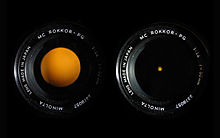
Lenses with apertures opening f/2.8 or wider are referred to as "fast" lenses, although the specific point has changed over time (for example, in the early 20th century aperture openings wider than f/6 were considered fast.[9] The fastest lenses for the common 35 mm film format in general production have apertures of f/1.2 or f/1.4, with more at f/1.8 and f/2.0, and many at f/2.8 or slower; f/1.0 is unusual, though sees some use. When comparing "fast" lenses, the image format used must be considered. Lenses designed for a small format such as half frame or APS-C need to project a much smaller image circle than a lens used for large format photography. Thus the optical elements built into the lens can be far smaller and cheaper.
In exceptional circumstances lenses can have even wider apertures with f-numbers smaller than 1.0; see lens speed: fast lenses for a detailed list. For instance, both the current Leica Noctilux-M 50mm ASPH and a 1960s-era Canon 50mm rangefinder lens have a maximum aperture of f/0.95.[10] Cheaper alternatives began appearing in the early 2010s, such as the Cosina Voigtländer f/0.95 Nokton (several in the 10.5–60 mm range) and f/0.8 (29 mm) Super Nokton manual focus lenses in the for the Micro Four-Thirds System,[11] and the Venus Optics (Laowa) Argus 35 mm f/0.95.[8]
Professional lenses for some movie cameras have f-numbers as small as f/0.75. Stanley Kubrick's film Barry Lyndon has scenes shot by candlelight with a NASA/Zeiss 50mm f/0.7,[12] the fastest lens in film history. Beyond the expense, these lenses have limited application due to the correspondingly shallower depth of field (DOF) – the scene must either be shallow, shot from a distance, or will be significantly defocused, though this may be the desired effect.
Zoom lenses typically have a maximum relative aperture (minimum f-number) of f/2.8 to f/6.3 through their range. High-end lenses will have a constant aperture, such as f/2.8 or f/4, which means that the relative aperture will stay the same throughout the zoom range. A more typical consumer zoom will have a variable maximum relative aperture since it is harder and more expensive to keep the maximum relative aperture proportional to the focal length at long focal lengths; f/3.5 to f/5.6 is an example of a common variable aperture range in a consumer zoom lens.
By contrast, the minimum aperture does not depend on the focal length – it is limited by how narrowly the aperture closes, not the lens design – and is instead generally chosen based on practicality: very small apertures have lower sharpness due to diffraction at aperture edges, while the added depth of field is not generally useful, and thus there is generally little benefit in using such apertures. Accordingly, DSLR lens typically have minimum aperture of f/16, f/22, or f/32, while large format may go down to f/64, as reflected in the name of Group f/64. Depth of field is a significant concern in macro photography, however, and there one sees smaller apertures. For example, the Canon MP-E 65mm can have effective aperture (due to magnification) as small as f/96. The pinhole optic for Lensbaby creative lenses has an aperture of just f/177.[13]






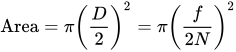
The amount of light captured by an optical system is proportional to the area of the entrance pupil that is the object space-side image of the aperture of the system, equal to:
Where the two equivalent forms are related via the f-number N = f / D, with focal length f and entrance pupil diameter D.
The focal length value is not required when comparing two lenses of the same focal length; a value of 1 can be used instead, and the other factors can be dropped as well, leaving area proportion to the reciprocal square of the f-number N.
If two cameras of different format sizes and focal lengths have the same angle of view, and the same aperture area, they gather the same amount of light from the scene. In that case, the relative focal-plane illuminance, however, would depend only on the f-number N, so it is less in the camera with the larger format, longer focal length, and higher f-number. This assumes both lenses have identical transmissivity.

Though as early as 1933 Torkel Korling had invented and patented for the Graflex large format reflex camera an automatic aperture control,[14] not all early 35mm single lens reflex cameras had the feature. With a small aperture, this darkened the viewfinder, making viewing, focusing, and composition difficult.[15] Korling's design enabled full-aperture viewing for accurate focus, closing to the pre-selected aperture opening when the shutter was fired and simultaneously synchronising the firing of a flash unit. From 1956 SLR camera manufacturers separately developed automatic aperture control (the Miranda T 'Pressure Automatic Diaphragm', and other solutions on the Exakta Varex IIa and Praktica FX2) allowing viewing at the lens's maximum aperture, stopping the lens down to the working aperture at the moment of exposure, and returning the lens to maximum aperture afterward.[16] The first SLR cameras with internal ("through-the-lens" or "TTL") meters (e.g., the Pentax Spotmatic) required that the lens be stopped down to the working aperture when taking a meter reading. Subsequent models soon incorporated mechanical coupling between the lens and the camera body, indicating the working aperture to the camera for exposure while allowing the lens to be at its maximum aperture for composition and focusing;[16] this feature became known as open-aperture metering.
For some lenses, including a few long telephotos, lenses mounted on bellows, and perspective-control and tilt/shift lenses, the mechanical linkage was impractical,[16] and automatic aperture control was not provided. Many such lenses incorporated a feature known as a "preset" aperture,[16][17] which allows the lens to be set to working aperture and then quickly switched between working aperture and full aperture without looking at the aperture control. A typical operation might be to establish rough composition, set the working aperture for metering, return to full aperture for a final check of focus and composition, and focusing, and finally, return to working aperture just before exposure. Although slightly easier than stopped-down metering, operation is less convenient than automatic operation. Preset aperture controls have taken several forms; the most common has been the use of essentially two lens aperture rings, with one ring setting the aperture and the other serving as a limit stop when switching to working aperture. Examples of lenses with this type of preset aperture control are the Nikon PC Nikkor 28 mm f/3.5 and the SMC Pentax Shift 6×7 75 mm f/4.5. The Nikon PC Micro-Nikkor 85 mm f/2.8D lens incorporates a mechanical pushbutton that sets working aperture when pressed and restores full aperture when pressed a second time.
Canon EF lenses, introduced in 1987,[18] have electromagnetic diaphragms,[19] eliminating the need for a mechanical linkage between the camera and the lens, and allowing automatic aperture control with the Canon TS-E tilt/shift lenses. Nikon PC-E perspective-control lenses,[20] introduced in 2008, also have electromagnetic diaphragms,[21] a feature extended to their E-type range in 2013.
Optimal aperture depends both on optics (the depth of the scene versus diffraction), and on the performance of the lens.
Optically, as a lens is stopped down, the defocus blur at the Depth of Field (DOF) limits decreases but diffraction blur increases. The presence of these two opposing factors implies a point at which the combined blur spot is minimized (Gibson 1975, 64); at that point, the f-number is optimal for image sharpness, for this given depth of field[22] – a wider aperture (lower f-number) causes more defocus, while a narrower aperture (higher f-number) causes more diffraction.
As a matter of performance, lenses often do not perform optimally when fully opened, and thus generally have better sharpness when stopped down some – this is sharpness in the plane of critical focus, setting aside issues of depth of field. Beyond a certain point, there is no further sharpness benefit to stopping down, and the diffraction occurred at the edges of the aperture begins to become significant for imaging quality. There is accordingly a sweet spot, generally in the f/4 – f/8 range, depending on lens, where sharpness is optimal, though some lenses are designed to perform optimally when wide open. How significant this varies between lenses, and opinions differ on how much practical impact this has.
While optimal aperture can be determined mechanically, how much sharpness is required depends on how the image will be used – if the final image is viewed under normal conditions (e.g., an 8″×10″ image viewed at 10″), it may suffice to determine the f-number using criteria for minimum required sharpness, and there may be no practical benefit from further reducing the size of the blur spot. But this may not be true if the final image is viewed under more demanding conditions, e.g., a very large final image viewed at normal distance, or a portion of an image enlarged to normal size (Hansma 1996). Hansma also suggests that the final-image size may not be known when a photograph is taken, and obtaining the maximum practicable sharpness allows the decision to make a large final image to be made at a later time; see also critical sharpness.

In many living optical systems, the eye consists of an iris which adjusts the size of the pupil, through which light enters. The iris is analogous to the diaphragm, and the pupil (which is the adjustable opening in the iris) the aperture. Refraction in the cornea causes the effective aperture (the entrance pupil in optics parlance) to differ slightly from the physical pupil diameter. The entrance pupil is typically about 4 mm in diameter, although it can range from as narrow as 2 mm (f/8.3) in diameter in a brightly lit place to 8 mm (f/2.1) in the dark as part of adaptation. In rare cases in some individuals are able to dilate their pupils even beyond 8 mm (in scotopic lighting, close to the physical limit of the iris. In humans, the average iris diameter is about 11.5 mm,[23] which naturally influences the maximal size of the pupil as well, where larger iris diameters would typically have pupils which are able to dilate to a wider extreme than those with smaller irises. Maximum dilated pupil size also decreases with age.

Megan Fox theme by PunisherV20
Download: MeganFox.p3t
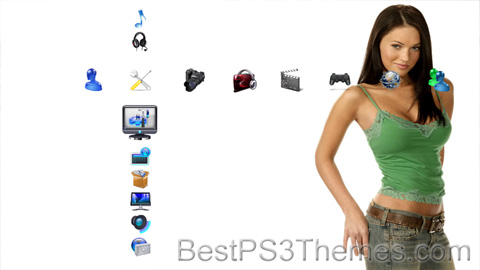
(9 backgrounds)
Megan Fox | |
|---|---|
 Fox in 2023 | |
| Born | Megan Denise Fox May 16, 1986 Oak Ridge, Tennessee, U.S. |
| Occupation | Actress |
| Years active | 2001–present |
| Spouse | |
| Children | 3 |
Megan Denise Fox[1] (born May 16, 1986) is an American actress. She made her acting debut in the family film Holiday in the Sun (2001), which was followed by numerous supporting roles in film and television, such as the teen musical comedy Confessions of a Teenage Drama Queen (2004), as well as a starring role in the ABC sitcom Hope & Faith (2004–2006). Her breakout role was as Mikaela Banes in the blockbuster action film Transformers (2007), which she reprised in its sequel Transformers: Revenge of the Fallen (2009).
Fox also portrayed the titular character in the horror comedy Jennifer's Body (2009), starred as April O'Neil in the superhero action film Teenage Mutant Ninja Turtles (2014) and its sequel Teenage Mutant Ninja Turtles: Out of the Shadows (2016), and appeared in the fifth and sixth seasons of the Fox sitcom New Girl (2016–2017).
Described as a sex symbol, Fox has made appearances in numerous magazines such as Maxim, Rolling Stone, and FHM.[2][3] She has received two Scream Awards and four Teen Choice Awards.
Megan Denise Fox was born on May 16, 1986,[1][4] in Oak Ridge, Tennessee,[5][6] to parents Gloria Darlene (née Cisson) and Franklin Thomas Fox.[7] She spent her early childhood in nearby Rockwood.[8] Fox's father, a parole officer, and her mother divorced when Fox was three years old.[5] Her mother later remarried, and Fox and her sister[9] were raised by her mother and her stepfather, Tony Tonachio.[10][11][12] She was raised "very strictly Pentecostal," but later attended Catholic school for 12 years.[13][14] She said that her parents were "very strict" and that she was not allowed to have a boyfriend[15] or invite friends to her house.[9] Fox described her stepfather as being "verbally, mentally, and emotionally abusive" until his death.[16] She revealed in an interview that she developed an eating disorder in her adolescence and struggled with manic depression, the latter of which "[ran] in my family, so there was definitely some wrestling with chemical imbalance going on."[17] Fox lived with her mother until she made enough money to support herself.[15]
Fox began her training in dance and drama at age five, in Kingston, Tennessee.[18] She attended a dance class at the community center there and was involved in Kingston Elementary School's chorus and the Kingston Clippers swim team. At age 10, after moving to St. Petersburg, Florida, Fox continued her training.[19][20] When she was 13 years old, Fox began modeling after winning several awards at the 1999 American Modeling and Talent Convention in Hilton Head, South Carolina.[21] Fox attended high school at Morningside Academy in Port St. Lucie[22] until her junior year when she attended St. Lucie West Centennial High School. [23] When she was 17 she tested out of school via correspondence, in order to move to Los Angeles, California.[9][15]
Fox spoke freely about her time in school, stating that in middle school she was bullied and had to eat lunch in the bathroom to avoid being "pelted with ketchup packets." She said that the problem was not her looks, but that she had "always gotten along better with boys" and that "rubbed some people the wrong way."[24] Fox also said that she was never popular in high school, and that "everyone hated me, and I was a total outcast, my friends were always guys, I have a very aggressive personality, and girls didn't like me for that. I've had only one great girlfriend my whole life." In the same interview, she mentions that she hated school and has "never been a big believer in formal education" and that "the education I was getting seemed irrelevant. So, I was sort of checked out on that part of it."[24]
In 2001, Fox made her acting debut in the romantic comedy Holiday in the Sun, as spoiled heiress Brianna Wallace and rival of Alex Stewart (Ashley Olsen), which was released direct-to-DVD on November 20, 2001. In the next several years, she guest-starred on the sitcoms What I Like About You and Two and a Half Men. Fox also appeared as an uncredited extra in the action film Bad Boys II (2003).
In 2004, Fox made her feature film debut opposite Lindsay Lohan in the musical comedy Confessions of a Teenage Drama Queen, playing the supporting role of Carla Santini, a rival of Lola (Lohan). She was also cast in a regular role on the ABC sitcom Hope & Faith, in which she portrayed Sydney Shanowski, replacing Nicole Paggi. Fox appeared in the second and third seasons, until the series was cancelled by ABC in May 2006.[25]
In 2007, Fox won the lead female role of Mikaela Banes in the 2007 live-action film Transformers, based on the toy and cartoon saga of the same name. Fox played the love interest of Shia LaBeouf's character Sam Witwicky. Fox was nominated for an MTV Movie Award in the category of "Breakthrough Performance", and was also nominated for three Teen Choice Awards.[25] She had signed on for two more Transformers sequels,[25][26] reprising her role as Mikaela in Transformers: Revenge of the Fallen. There was controversy surrounding Fox's appearance while filming the sequel when Michael Bay, the film's director, ordered the actress to gain ten pounds.[27] The film was released worldwide on June 24, 2009, to box office success.[28]
Fox was to star in the third installment, Transformers: Dark of the Moon, but was not included because of her statements comparing working under director Bay to working for Hitler. She confessed on GQ Magazine that she had lost approximately 30 pounds during filming due to consuming a primary diet of water and vinegar,[citation needed] and reportedly had a dispute over her visible loss of weight with the director on set.[29][30] Bay stated in June 2009 that Fox was fired on orders of executive producer Steven Spielberg,[31] a claim Spielberg denied.[32]

In 2009, Fox had her first lead role since the Transformers series; she portrayed the title character in Jennifer's Body, written by Academy Award–winning screenwriter Diablo Cody.[33] The film initially earned mixed to average reviews upon its release, with Fox's performance earning praise.[34] However, the film grew a cult following over time and was critically reassessed as a "forgotten feminist classic".[35] According to Cody, the film was marketed incorrectly by executives who focused their efforts on the young male audience.[36]
In April 2009, she began filming the western superhero film Jonah Hex, in which she portrayed Tallulah Black / Leila, a gun-wielding beauty and Jonah Hex's (Josh Brolin) love interest. The film was released on June 18, 2010.[37] Despite receiving top billing, Fox described her role in the film as being a cameo.[38] Jonah Hex was a critical and commercial failure in the U.S., with its international distribution cancelled after its poor performance.[39] The film was named the "worst picture of the year" by the Houston Film Critics Society.[40]
Fox starred alongside Mickey Rourke in the drama Passion Play. After premiering at the Toronto International Film Festival, its conventional theatrical distribution was bypassed for a direct-to-video release, with only two screens briefly showing the film to fulfill contractual obligations.[41] Rourke remarked that the film was "terrible. Another terrible movie."[42][43] Fox appeared with Dominic Monaghan in the music video for Eminem and Rihanna's single "Love the Way You Lie".[44] In 2012, Fox appeared briefly in Sacha Baron Cohen's comedy film The Dictator and had a featured role in Judd Apatow's comedy film This Is 40. She voiced the role of Lois Lane in the animated comedy film Robot Chicken DC Comics Special,[45] an episode of the television comedy series Robot Chicken that aired as a one-off special during Cartoon Network's Adult Swim programming block on September 9, 2012.

In January 2013, Fox was featured in a Brazilian television commercial for Brahma beer.[46] In February 2013, Fox set aside her differences with her former director Michael Bay and worked again with him on his reboot of Teenage Mutant Ninja Turtles (2014), starring as the lead human character of April O'Neil.[47]
In 2015, Fox was cast in the role of Amelia Delthanis in the Plarium video game, Stormfall: Rise of Balur.[48] In October 2015, it was confirmed that Fox would be temporarily replacing Zooey Deschanel in the television sitcom New Girl, following Deschanel's maternity leave.[49][50] She starred as Reagan Lucas, appearing in the fifth and sixth seasons of the series. Her performance earned positive reviews from critics.[51][52][53] In 2016, Fox reprised her role of April O'Neil in the sequel Teenage Mutant Ninja Turtles: Out of the Shadows.
On September 12, 2018, it was confirmed that Fox would star in the Korean War film The Battle of Jangsari, beside Korean actor Kim Myung-min. She played a lead role as Marguerite Higgins, an American news reporter.[54]
In 2019, Fox starred in the mystery-fantasy film Above the Shadows opposite Olivia Thirlby and Alan Ritchson, directed by Claudia Myers.[55] It was released on July 19, 2019, by Gravitas Ventures.[56] That same year, Fox appeared in Zeroville directed by James Franco, which was previously shot in 2014.[57] The film was panned by critics and performed poorly at the box office.[58]
In 2020, Fox starred opposite Josh Duhamel in the family comedy film Think Like a Dog, which was released on video on demand on June 9, 2020.[59] Also that year, she starred in the lead role of the action film Rogue, which was released on August 28, 2020.[60]
In 2021 she starred in the thrillers, Midnight in the Switchgrass opposite Emile Hirsch and Bruce Willis, directed by Randall Emmett,[61] and Till Death, directed by S.K. Dale.[62]
In 2022 Fox starred in the drama comedy Big Gold Brick, alongside Oscar Isaac, Andy García, Lucy Hale, and Emory Cohen, directed by Brian Petsos.[63][64] Fox also played a role in the film Taurus, a musical drama, alongside Machine Gun Kelly, Naomi Wild, and Lil Tjay.[65]
In 2023, Fox was featured on the cover of Sports Illustrated Swimsuit Issue.[66] Fox played a crime boss Alana in the 2023 thriller film Johnny & Clyde with Tyson Ritter.[67] Fox played Gina in the fourth Expendables film, Expend4bles, released in September of the same year.
In November 2023, Fox released her first book titled Pretty Boys Are Poisonous,[68] a collection of her own poetry.
Chris Lee of the Los Angeles Times called Fox a "sex symbol of the highest order" and said she was "the first bona fide sex symbol of the 21st century."[2] Craig Flaster of MTV stated, "Transformers broke Fox into the mainstream, immediately turning her into a household name and international sex symbol."[69] She has been featured on various magazine covers and "hottest" and "most beautiful woman" lists throughout the years, such as Maxim's Hot 100 lists and when FHM readers voted her the "Sexiest Woman in the World" in 2008.[2][3][70] People named her one of 2012's and 2017's Most Beautiful at Every Age.[71][72] Scholar Marc DiPaolo stated that Fox achieved instant fame as Mikaela in Transformers because a "highly sexualized, erotically idealized figure draped over a car or motorcycle invariably evokes lust in the heterosexual male onlooker" and Fox did this by leaning over a Camaro while wearing "a flimsy pink belly shirt" and short skirt, which read as "an unequivocal sex invite" to male viewers.[73] The editors of Men's Health also credited the Camaro scene with contributing to Fox's fame.[74]


Fox said all women in Hollywood are known and marketed as sex symbols, but that this is okay if the woman knows how to utilize the status.[75][76] She created a character for her public image because she was unwilling to sacrifice her true self to the world.[75][77] Scholars Wheeler Winston Dixon and Gwendolyn Audrey Foster disagreed that every woman in Hollywood is marketed as a sex symbol, and stated that Fox's "celebrity is based on what she admits is an entirely artificial construct designed for dissemination in the Internet age, a 21st-century media personality in every sense of the word."[75] Part of her persona included making outlandish comments,[77][78] which she said helped her reach her level of fame versus being "a typical starlet" who "said all the right things".[77] Her tattoos, which she began getting at age 19 as a form of self-expression,[79] helped popularize tattoo fashion.[80] She had over nine known tattoos, including a picture of Marilyn Monroe's face on her right forearm and a quote on her shoulder.[81] Author John Tehranian argued that Fox's Monroe tattoo enhanced her "implicit claims to Monroe's legacy as Hollywood's leading sex symbol."[82] Fox ended up removing the Monroe tattoo in a series of laser surgeries[83] because she felt that Monroe's life was full of negativity and she did not want to emulate it.[84]
The media often compared Fox to actress Angelina Jolie,[2] dubbing her the "next Angelina Jolie", which also affected her image.[77] Amid this and reports that she was to replace Jolie in a new Lara Croft film,[85] Fox commented that the comparisons indicate a lack of creativity on the part of the media,[76] and attributed them to both she and Jolie being brunette, having tattoos, cursing, and mentioning and joking about sex,[86][87] "which people find outrageous".[87] Lynn Hirschberg of The New York Times opined that "the Jolie comparison would probably have been made by the media eventually, but Fox sped up the process" by "linking herself to Jolie" and that she "enjoyed creating entertaining copy" by telling "tales of darkness and lust."[77]
In 2009, Fox's public image came under scrutiny when an unsigned letter from three crew members of Transformers defended director Michael Bay against accusations made by Fox about his on-set behavior, including a comparison with Adolf Hitler.[31][88] In response to the letter alleging that Fox's on-set behavior is unpleasant and contrasts her public persona, Bay stated he does not condone the letter or Fox's "outlandish quotes", but "her crazy quips are part of her crazy charm", and that they still work well together.[31] A production assistant who worked on Transformers also stated that he never saw Fox act inappropriately on set.[88] Fox said the letter's claims were false,[77] and that she had privately spoken with the parties involved. She said she was "very fortunate" to be a part of the franchise, and was looking forward to continuing her work.[88] DiPaolo concluded that Fox's criticism of the media sexually objectifying girls and women was in stark contrast to her sex symbol status and that "her defiance of director Michael Bay and frequent outspoken comments" stifled her career.[73]

The increased media exposure was difficult for Fox, who acknowledged being shy and insecure, to adjust to.[78][89] It also positioned her as a potential role model, and later led to her being typecast. She rejected being a formal role model, but said that she could make young girls feel "strong and intelligent and be outspoken and fight for what they think is right"[90] and that she was a different role model for girls that maybe America was not comfortable with.[91] She considered being typecast as attractive an opportunity to surprise people when she gives a good performance in a film,[90][76] but said she is interested in portraying less sexualized characters.[89] MTV's Craig Flaster said that although Fox has "been typecast as the big-budget sex symbol", she has shown comedic range.[69]
Fox's overexposure in the media led several men's websites, such as AskMen, to boycott her on August 4, 2009,[92] although some refused to do so, feeling that the boycott was a publicity stunt and therefore hypocritical.[93][94] In response to the media attention, Fox told magazine Nylon, in September of that year, that "[the studio] wanted to make sure [the film] would make $700 million, so they oversaturated the media with their stars" and that she did not "want to have people get completely sick of [her] before [she's] ever even done something legitimate."[95] She became much less prominent in the media by 2010, after starring in the less commercially successful films Jonah Hex and Passion Play.[96] That same year, Fox said, "My biggest regret is that I've assisted the media in making me into a cartoon character. I don't regret what has happened to me, but I regret the way I have dealt with it."[97] Dixon and Foster stated, "The problem [Fox] faces is that the [image] construct has replaced the real in the minds of the public; and once established, a media persona is hard to recalibrate."[75]
In 2009, Fox was targeted by a group of fashion-motivated criminals known as the "Bling Ring," who robbed her then-boyfriend Brian Austin Green's home for access to Fox's possessions.[98]
Fox has a form of brachydactyly called brachydactyly type D,[99] and has discussed her obsessive–compulsive disorder (OCD), insecurities, self-harming, and has acknowledged that she has low self-esteem.[100] In 2013, she said that her Christian faith is still very important to her and she believes it keeps her grounded.[101]
Fox and then-husband Green were supporters of Generosity Water, and funded the creation of over ten water wells for the organization.[102][103]
With regard to relationships and her sexuality, Fox said that she has a general distrust and dislike of men,[104] and that the perception of her as a "wild and crazy sexpot" is false because she is asocial; Fox stated that she would rather stay at home instead of going out,[105][106] and emphasized that she cannot have sex with someone she does not love.[97][105] She is bisexual, and said she believes that "all humans are born with the ability to be attracted to both sexes".[107] She stated in 2009, "I have no question in my mind about being bisexual. But I'm also a hypocrite: I would never date a girl who was bisexual, because that means they also sleep with men, and men are so dirty that I'd never want to sleep with a girl who had slept with a man."[108]
Fox told InStyle in July 2021: "A girl would come up to me and be like: 'You had a lot to do with me, like identifying and understanding that I was gay or understanding that I was bisexual...' And that, of course, is by far, like, the most moving, rewarding thing that I have experienced in my life! To be a part of something that helped people figure that out, or helped people deal with that, or feel better about that. One of my favorite things that I get called, is being like, a bi icon and that is one of the things I am the most proud of!"[109]
She has several tattoos, which includes the Chinese symbol for "strength" that is drawn on the back of her neck, a quote from the William Shakespeare play King Lear that reads "We will all laugh at gilded butterflies," the yin and yang symbol on her left wrist, and a crescent moon entwined with a star on her ankle. Fox also has a poem tattooed near her breast that reads "There once was a little girl, who never knew love until a boy broke her heart" and another tattoo on her back that quotes Friedrich Nietzsche: "And those who were seen dancing were thought to be insane by those who could not hear the music." She claims that she had it drawn in honor of her Passion Play costar Mickey Rourke but later clarified that it's "not necessarily a homage to him."[110] She also once had her ex-husband Brian Austin Green's first name tattooed on her hip, but later had
Heavy Throttle theme by PunisherV20
Download: HeavyThrottle.p3t
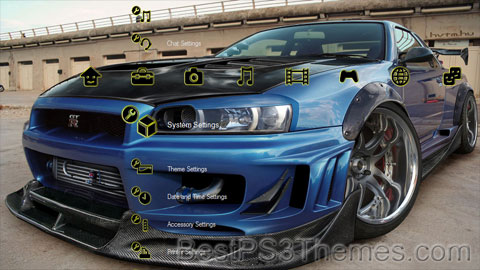
(7 backgrounds)
P3T Unpacker v0.12
Copyright (c) 2007. Anoop Menon
This program unpacks Playstation 3 Theme files (.p3t) so that you can touch-up an existing theme to your likings or use a certain wallpaper from it (as many themes have multiple). But remember, if you use content from another theme and release it, be sure to give credit!
Download for Windows: p3textractor.zip
Instructions:
Download p3textractor.zip from above. Extract the files to a folder with a program such as WinZip or WinRAR. Now there are multiple ways to extract the theme.
The first way is to simply open the p3t file with p3textractor.exe. If you don’t know how to do this, right click the p3t file and select Open With. Alternatively, open the p3t file and it will ask you to select a program to open with. Click Browse and find p3textractor.exe from where you previously extracted it to. It will open CMD and extract the theme to extracted.[filename]. After that, all you need to do for any future p3t files is open them and it will extract.
The second way is very simple. Just drag the p3t file to p3textractor.exe. It will open CMD and extract the theme to extracted.[filename].
For the third way, first put the p3t file you want to extract into the same folder as p3textractor.exe. Open CMD and browse to the folder with p3extractor.exe. Enter the following:
p3textractor filename.p3t [destination path]Replace filename with the name of the p3t file, and replace [destination path] with the name of the folder you want the files to be extracted to. A destination path is not required. By default it will extract to extracted.filename.
Tu Nero theme by Ghost47
Download: TuNero.p3t
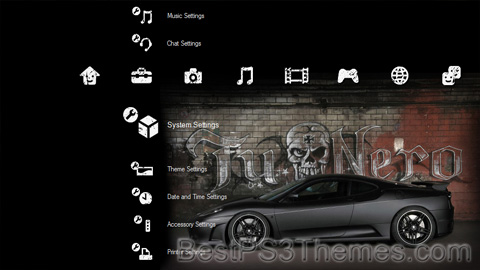
(5 backgrounds)
P3T Unpacker v0.12
Copyright (c) 2007. Anoop Menon
This program unpacks Playstation 3 Theme files (.p3t) so that you can touch-up an existing theme to your likings or use a certain wallpaper from it (as many themes have multiple). But remember, if you use content from another theme and release it, be sure to give credit!
Download for Windows: p3textractor.zip
Instructions:
Download p3textractor.zip from above. Extract the files to a folder with a program such as WinZip or WinRAR. Now there are multiple ways to extract the theme.
The first way is to simply open the p3t file with p3textractor.exe. If you don’t know how to do this, right click the p3t file and select Open With. Alternatively, open the p3t file and it will ask you to select a program to open with. Click Browse and find p3textractor.exe from where you previously extracted it to. It will open CMD and extract the theme to extracted.[filename]. After that, all you need to do for any future p3t files is open them and it will extract.
The second way is very simple. Just drag the p3t file to p3textractor.exe. It will open CMD and extract the theme to extracted.[filename].
For the third way, first put the p3t file you want to extract into the same folder as p3textractor.exe. Open CMD and browse to the folder with p3extractor.exe. Enter the following:
p3textractor filename.p3t [destination path]Replace filename with the name of the p3t file, and replace [destination path] with the name of the folder you want the files to be extracted to. A destination path is not required. By default it will extract to extracted.filename.
Metal Gear Solid IV v2.0 theme by –Voldo–
Download: MetalGearSolidIV2.0.p3t

(7 backgrounds)
P3T Unpacker v0.12
Copyright (c) 2007. Anoop Menon
This program unpacks Playstation 3 Theme files (.p3t) so that you can touch-up an existing theme to your likings or use a certain wallpaper from it (as many themes have multiple). But remember, if you use content from another theme and release it, be sure to give credit!
Download for Windows: p3textractor.zip
Instructions:
Download p3textractor.zip from above. Extract the files to a folder with a program such as WinZip or WinRAR. Now there are multiple ways to extract the theme.
The first way is to simply open the p3t file with p3textractor.exe. If you don’t know how to do this, right click the p3t file and select Open With. Alternatively, open the p3t file and it will ask you to select a program to open with. Click Browse and find p3textractor.exe from where you previously extracted it to. It will open CMD and extract the theme to extracted.[filename]. After that, all you need to do for any future p3t files is open them and it will extract.
The second way is very simple. Just drag the p3t file to p3textractor.exe. It will open CMD and extract the theme to extracted.[filename].
For the third way, first put the p3t file you want to extract into the same folder as p3textractor.exe. Open CMD and browse to the folder with p3extractor.exe. Enter the following:
p3textractor filename.p3t [destination path]Replace filename with the name of the p3t file, and replace [destination path] with the name of the folder you want the files to be extracted to. A destination path is not required. By default it will extract to extracted.filename.
Metal Gear Solid IV v1.0 theme by –Voldo–
Download: MetalGearSolidIV1.0.p3t

(7 backgrounds)
P3T Unpacker v0.12
Copyright (c) 2007. Anoop Menon
This program unpacks Playstation 3 Theme files (.p3t) so that you can touch-up an existing theme to your likings or use a certain wallpaper from it (as many themes have multiple). But remember, if you use content from another theme and release it, be sure to give credit!
Download for Windows: p3textractor.zip
Instructions:
Download p3textractor.zip from above. Extract the files to a folder with a program such as WinZip or WinRAR. Now there are multiple ways to extract the theme.
The first way is to simply open the p3t file with p3textractor.exe. If you don’t know how to do this, right click the p3t file and select Open With. Alternatively, open the p3t file and it will ask you to select a program to open with. Click Browse and find p3textractor.exe from where you previously extracted it to. It will open CMD and extract the theme to extracted.[filename]. After that, all you need to do for any future p3t files is open them and it will extract.
The second way is very simple. Just drag the p3t file to p3textractor.exe. It will open CMD and extract the theme to extracted.[filename].
For the third way, first put the p3t file you want to extract into the same folder as p3textractor.exe. Open CMD and browse to the folder with p3extractor.exe. Enter the following:
p3textractor filename.p3t [destination path]Replace filename with the name of the p3t file, and replace [destination path] with the name of the folder you want the files to be extracted to. A destination path is not required. By default it will extract to extracted.filename.