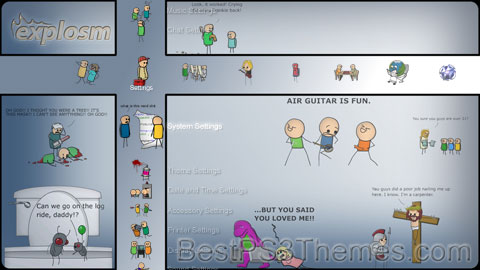
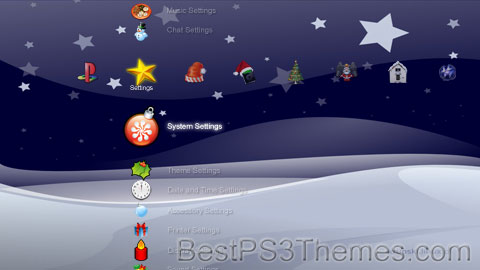
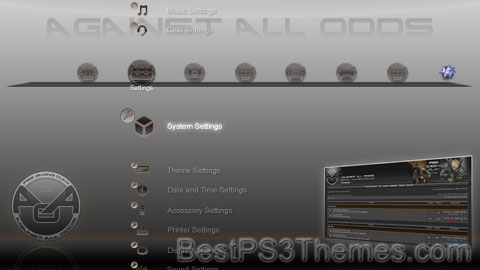
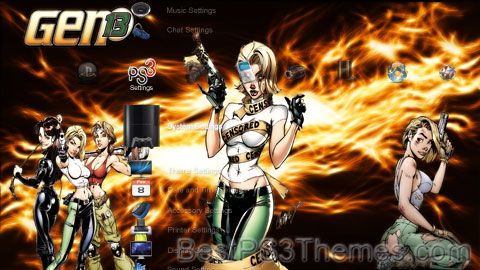
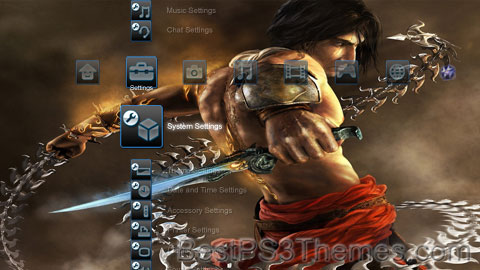
This program unpacks Playstation 3 Theme files (.p3t) so that you can touch-up an existing theme to your likings or use a certain wallpaper from it (as many themes have multiple). But remember, if you use content from another theme and release it, be sure to give credit!
Download p3textractor.zip from above. Extract the files to a folder with a program such as WinZip or WinRAR. Now there are multiple ways to extract the theme.
The first way is to simply open the p3t file with p3textractor.exe. If you don’t know how to do this, right click the p3t file and select Open With. Alternatively, open the p3t file and it will ask you to select a program to open with. Click Browse and find p3textractor.exe from where you previously extracted it to. It will open CMD and extract the theme to extracted.[filename]. After that, all you need to do for any future p3t files is open them and it will extract.
The second way is very simple. Just drag the p3t file to p3textractor.exe. It will open CMD and extract the theme to extracted.[filename].
For the third way, first put the p3t file you want to extract into the same folder as p3textractor.exe. Open CMD and browse to the folder with p3extractor.exe. Enter the following: p3textractor filename.p3t [destination path]Replace filename with the name of the p3t file, and replace [destination path] with the name of the folder you want the files to be extracted to. A destination path is not required. By default it will extract to extracted.filename.
The first game in the series was created by Jordan Mechner after the success of Karateka. Drawing from multiple general sources of inspiration, including the One Thousand and One Nights stories,[4] and films like Raiders of the Lost Ark[5] and The Adventures of Robin Hood,[6] the protagonist's character animation was created using a technique called rotoscoping, with Mechner using his brother as the model for the titular prince.[7] The original Prince of Persia, with its more than 20 platform ports, is one of the most ported games in video game history.[8][9]
Mechner enrolled in New York University's film department, producing an award-winning short film during his time there, before returning to design and direct a sequel to the original game.[10] The sequel, Prince of Persia 2: The Shadow and the Flame, was developed internally at Broderbund with Mechner's supervision. The game, like its predecessor, received critical acclaim and high sales. Broderbund was subsequently purchased by The Learning Company,[11] which was later acquired by US game company Mattel Interactive.[12] In 1999, Prince of Persia 3D was developed and released under Broderbund's Red Orb label.[10] Released for PC and the Dreamcast only,[13] it was criticized by many users as being buggy, and was a commercial disappointment.[10] The Broderbund/Learning Company's games division, the assets of which included the Prince of Persia franchise, was subsequently sold to Ubisoft.[14]
Mechner, who owned the Prince of Persiaintellectual property, was brought in to work with Ubisoft on a reboot of the franchise, titled The Sands of Time, although he was originally wary after the failure of Prince of Persia 3D.[15] The team they worked with was also working on Tom Clancy's Splinter Cell: their aim with the game was to "breathe new life into the action-adventure genre".[16][17]
Mechner did not take part in the production of the next game, Prince of Persia: Warrior Within, and he commented on finding the dark atmosphere and heightened level of violence unappealing.[18] The changes also provoked mixed reactions from critics, but sales were strong and a third game, eventually titled Prince of Persia: The Two Thrones, went into production.[19] For The Two Thrones, the developers and artists tried to strike a balance between the light, cartoon-like tones of The Sands of Time, and the grittier mediums of Warrior Within.[20]
A fourth installment in The Sands of Time series, Prince of Persia: The Forgotten Sands, was released in May 2010.[21] The Windows, Xbox 360 and PlayStation 3 versions of the game filled in some of the narrative gap between The Sands of Time and Warrior Within, whereas the PSP, Wii, and the DS versions each feature their own alternative storylines. The game was released as a tie in to The Sands of Time film adaptation.[22]
The Prince of Persia Trilogy (known as Prince of Persia Trilogy 3D on the remastered collection's title screen) is a collection of The Sands of Time trilogy released on the PlayStation 2 and subsequently on the PlayStation 3 as part of the Classics HD range.[23] The collection includes The Sands of Time, Warrior Within and The Two Thrones, all previously released on the PlayStation 2, Xbox and Microsoft Windows. The games were remastered in high-definition for the PlayStation 3 with 3D and PlayStation Network Trophy support on one Blu-ray Disc. The PlayStation 2 collection was released on October 27, 2006, in Europe,[citation needed] while the remastered collection was released on November 19, 2010, on Blu-ray in PAL regions. The release marks the first Classics HD title to not be published by Sony Computer Entertainment.
In North America, the three games were originally released separately as downloadable-only titles on the PlayStation Store. The first, The Sands of Time, was released on November 16, 2010, while the other two games followed in December.[24] The Blu-ray version was to be released in North America on March 22, 2011[25] but the collection ended up being delayed until April 19.
In 2006, concept designs surfaced hinting at another entry in the franchise.[26] The game, titled simply Prince of Persia, is a second reboot of the franchise, with its level and combat design harking back to the original 1989 game.[27] The game was released in December 2008, receiving positive reviews from most video game outlets and decent sales.[28] Alongside the main game, Ubisoft's Casablanca branch developed a direct sequel and spin-off for the Nintendo DS, titled Prince of Persia: The Fallen King,[29] which received fair reviews.[30][31][32][19]
The first spin-off of the series was developed alongside and released in the same year as The Two Thrones for the Nintendo DS. Battles of Prince of Persia is a turn-based strategy game set between The Sands of Time and Warrior Within.[33] It received mediocre reviews from critics.[34][35]
In 2007, Gameloft and Ubisoft released Prince of Persia Classic, an enhanced remake of the original Prince of Persia for Java ME, Android, iOS, Xbox 360 (XBLA), and PlayStation 3 (PSN).[36] The visual style was upgraded to resemble Prince of Persia: The Sands of Time, and the Prince himself was given some additional moves, such as the ability to roll, backflip, wall jump and stop time briefly during combat. However, the core gameplay remains the same as the original – the player must defeat Jaffar within one hour while watching out for the many traps and defeating the guards they encounter.
There have been a number of mobile games for Java ME-based phones developed by Gameloft, some based on older PC or console titles with 2D graphics and others loosely based on contemporary games but with 2D graphics and different gameplay due to technology constraints. Gameloft has also developed some ports for both the iPhone and the iPad.[37] The first spin-off by Gameloft was titled Prince of Persia: Harem Adventures, released for Java phones in 2003.[38] Specifically, the company has developed HD remakes of the original Prince of Persia in 2007,[39] and its sequel The Shadow and the Flame in July 2013.[40][41]
In 2018, Ubisoft under the banner of its entity Ketchapp released Prince of Persia: Escape,[42] a mobile game for Android and iOS. It is a runner game made up of different levels,[43] and the player can customize the protagonist with outfits from past games. Reviewing for Pocket Gamer, Cameron Bald called Prince of Persia: Escape a "mundane game crushed under the weight of excessive greed".[44] In August 2022, a follow-up, Prince of Persia: Escape 2, was released.[45]
A remake of the Sands of Time, formally announced at Ubisoft Forward 2020, was originally scheduled for release on January 21, 2021, for Microsoft Windows, PlayStation 4 and Xbox One, but Ubisoft delayed the remake indefinitely.[47] In its quarterly financial report, Ubisoft stated that the remake was expected to be out sometime during its 2022–23 fiscal year.[48] The remake's development was moved to Ubisoft Montréal, a change from Ubisoft Mumbai and Ubisoft Pune. The company said the 2023 fiscal year release target was no longer being targeted.[49] A new release window of 2026 was announced at Ubisoft Forward 2024.[50]
The Rogue Prince of Persia is an upcoming 2.5D roguelike title developed by Evil Empire and set to release in Early Access on May 14, 2024. The game entered development around 2019, after a discussion between Evil Empire and Ubisoft at GDC, and its art direction is heavily inspired by Franco-Belgian comics. The game will be Ubisoft's first day-one Steam release in five years, as well as their first title to be released in Early Access before a full release.[51]
In 2012, leaked images from a project entitled Osiris were assumed to be the next Prince of Persia title.[52] Jordan Mechner even commented on his Twitter account that the images were not from a Prince of Persia game.[53] A year later, Yannis Mallat, CEO of Ubisoft Montreal, said that the franchise was being "paused", saying that "as soon as we have something to show, we will".[54] In the following months, Ubisoft confirmed that it was either planning or considering next-generation entries in multiple franchises, including Prince of Persia.[55] A video uploaded by a Ubisoft Montreal artist in 2012 but only discovered in 2020 showed a gameplay trailer for Prince of Persia Redemption which would have been released for Windows, Xbox 360, and PlayStation 3.[56][57][58] According to Jonathan Cooper, a former Ubisoft animator at the time, the trailer was a mockup of the planned gameplay for the title created by Khai Nguyen, used to pitch the game concept. The game never developed beyond that point, though the work on the pitch trailer was used to prepare a similar trailer for Assassin's Creed III.[59]
Jordan Mechner finished writing the story for a graphic novel in 2007. The novel was written by A.B. Sina, and illustrated by Alex Puvilland and LeUyen Pham. It was released by First Second Books in autumn 2008.[60][61] The story follows two Princes, jumping between the 9th and 13th centuries. Although it belongs to the franchise the plot is not related to any of the game continuities or that of the 2010 film.[62]
In 2010, a film adaptation of The Sands of Time was released by Walt Disney Pictures. Starring Jake Gyllenhaal as Prince Dastan, it would go on to receive mixed reception, but still gross $336 million in theaters.[63] Besides The Sands of Time, the film also incorporated elements from Warrior Within and The Two Thrones, the two other titles from the Sands of Time trilogy of the Prince of Persia video game franchise.
Upon the film's release, it was accompanied by Before the Sandstorm, a 2010 one-shot comic book published by Disney Publishing Worldwide. This comic serves as both a direct prequel and sequel to the feature film, and explains the motives and backgrounds of some characters. It was written by Jordan Mechner and featured illustrations by Todd McFarlane, Niko Henrichon, David Lopez and Bernard Chang.
Lego Prince of Persia was released by The Lego Group in 2010, as part of the company's strategy to produce sets based on Disney properties.[64] Based on the feature film, Lego released six sets within the theme, as well as a short animated film, before discontinuing it.[65][66]
The success of the Prince of Persia series resulted in Guinness World Records awarding the series 6 world records in the Guinness World Records: Gamer's Edition 2008. These records include First Motion-Capture Animation in a Video Game and Highest Rated Platformer on PS2 and Xbox.
South Korean singer-songwriter Kim Kwang-Jin released the song 'Magic Castle', with lyrics inspired from the storyline of the original Prince of Persia.[67]
In 1992, Russian author Victor Pelevin wrote a book called A Werewolf Problem in Central Russia and Other Stories, in which there is a short story called "Prince of Gosplan". The story is greatly influenced by the game; the main hero of the story lives in a mixed reality of the real world and video games and identifies himself as Prince of Persia. He tries to understand if his life is real or if he is just seeing it on a computer display.[68]
The feel of the gameplay in Tomb Raider was intended to evoke that of the original Prince of Persia.[69]
The Assassin's Creed series originated out of ideas for a sequel for Prince of Persia: The Sands of Time. Its critical and financial success led Ubisoft to request Ubisoft Montreal to develop a sequel, aiming for the Xbox 360 and PlayStation 3. The Ubisoft Montreal team decided on taking the gameplay from The Sands of Time into an open world approach, taking advantage of the improved processing power to render larger spaces and crowds. Narratively, the team wanted to move away from the Prince being someone next in line for the throne but to have to work for it; combined with research into secret societies led them to focus on the Assassins, heavily borrowing from the novel Alamut.[70] They developed a narrative where the player would control an Assassin that served as a bodyguard for a non-playable Prince, leading them to call this game Prince of Persia: Assassin. The "Animus" device allowed them to explain certain facets of gameplay, such as accounting when the player fails a mission, in the same way they had done in The Sands of Time.[70]
Warner Bros. Pictures prioritized a sequel following the successful reinvention of the Batman film series with Batman Begins. Christopher and Batman Begins co-writer David S. Goyer developed the story elements, making Dent the central protagonist caught up in the battle between Batman and the Joker. In writing the screenplay, the Nolans were influenced by 1980s Batman comics and crime drama films, and sought to continue Batman Begins' heightened sense of realism. From April to November 2007, filming took place with a $185million budget in Chicago and Hong Kong, and on sets in England. The Dark Knight was the first major motion picture to be filmed with high-resolution IMAX cameras. Christopher avoided using computer-generated imagery unless necessary, insisting on practical stunts such as flipping an 18-wheel truck and blowing up a factory.
The Dark Knight was marketed with an innovative interactive viral campaign that initially focused on countering criticism of Ledger's casting by those who believed he was a poor choice to portray the Joker. Ledger died from an accidental prescription drug overdose in January 2008, leading to widespread interest from the press and public regarding his performance. When it was released in July, The Dark Knight received acclaim for its mature tone and themes, visual style, and performances—particularly that of Ledger, who received many posthumous awards including Academy, BAFTA, and Golden Globe awards for Best Supporting Actor, making The Dark Knight the first comic-book film to receive major industry awards. It broke several box-office records and became the highest-grossing 2008 film, the fourth-highest-grossing film to that time, and the highest-grossing superhero film.
Since its release, The Dark Knight has been assessed as one of the greatest superhero films ever, one of the best movies of the 2000s, and one of the best films ever made. It is considered the "blueprint" for many modern superhero films, particularly for its rejection of a typical comic-book movie style in favor of a crime film that features comic-book characters. Many filmmakers sought to repeat its success by emulating its gritty, realistic tone to varying degrees of success. The Dark Knight has been analyzed for its themes of terrorism and the limitations of morality and ethics. The United States Library of Congress selected it for preservation in the National Film Registry in 2020. A sequel, The Dark Knight Rises, concluded The Dark Knight trilogy in 2012.
A gang of masked criminals rob a mafia-owned bank in Gotham City, betraying and killing each other until the sole survivor, the Joker, reveals himself as the mastermind and escapes with the money. The vigilante Batman, district attorney Harvey Dent, and police lieutenant Jim Gordon ally to eliminate Gotham's organized crime. Batman's true identity, the billionaire Bruce Wayne, publicly supports Dent as Gotham's legitimate protector, as Wayne believes Dent's success will allow Batman to retire, allowing him to romantically pursue his childhood friend Rachel Dawes, despite her relationship with Dent.
Gotham's mafia bosses gather to discuss protecting their organizations from the Joker, the police, and Batman. The Joker interrupts the meeting and offers to kill Batman for half of the fortune their accountant, Lau, concealed before fleeing to Hong Kong to avoid extradition. With the help of Wayne Enterprises CEO Lucius Fox, Batman finds Lau in Hong Kong and returns him to the custody of Gotham police. His testimony enables Dent to apprehend the crime families. The bosses accept the Joker's offer, and he kills high-profile targets involved in the trial, including the judge and police commissioner. Although Gordon saves the mayor, the Joker threatens that his attacks will continue until Batman reveals his identity. He targets Dent at a fundraising dinner and throws Rachel out of a window, but Batman rescues her.
Wayne struggles to understand the Joker's motives, but his butler Alfred Pennyworth says "some men just want to watch the world burn." Dent claims he is Batman to lure out the Joker, who attacks the police convoy transporting him. Batman and Gordon apprehend the Joker, and Gordon is promoted to commissioner. At the police station, Batman interrogates the Joker, who says he finds Batman entertaining and has no intention of killing him. Having deduced Batman's feelings for Rachel, the Joker reveals she and Dent are being held separately in buildings rigged to explode. Batman races to rescue Rachel while Gordon and the other officers go after Dent, but they discover the Joker gave their positions in reverse. The explosives detonate, killing Rachel and severely burning Dent's face on one side. The Joker escapes custody, extracts the fortune's location from Lau, and burns it, killing Lau in the process.
Wayne Enterprises accountant Coleman Reese deduces and tries to expose Batman's identity, but the Joker threatens to blow up a hospital unless Reese is killed. While the police evacuate hospitals and Gordon struggles to keep Reese alive, the Joker meets with a disillusioned Dent, persuading him to take the law into his own hands and avenge Rachel. Dent defers his decision-making to his now half-scarred, two-headed coin, killing the corrupt officers and the mafia involved in Rachel's death. As panic grips the city, the Joker reveals two evacuation ferries, one carrying civilians and the other prisoners, are rigged to explode at midnight unless one group sacrifices the other. To the Joker's disbelief, the passengers refuse to kill one another. Batman subdues the Joker but refuses to kill him. Before the police arrest the Joker, he says although Batman proved incorruptible, his plan to corrupt Dent has succeeded.
Dent takes Gordon's family hostage, blaming his negligence for Rachel's death. He flips his coin to decide their fates, but Batman tackles him to save Gordon's son, and Dent falls to his death. Believing Dent is the hero the city needs and the truth of his corruption will harm Gotham, Batman takes the blame for his death and actions and persuades Gordon to conceal the truth. Pennyworth burns an undelivered letter from Rachel to Wayne that says she chose Dent, and Fox destroys the invasive surveillance network that helped Batman find the Joker. The city mourns Dent as a hero, and the police launch a manhunt for Batman.
Christian Bale as Bruce Wayne / Batman: A wealthy socialite who as a child was traumatized by his parents' murder. Wayne secretly operates as the heroic vigilante Batman.[4]
Maggie Gyllenhaal as Rachel Dawes: Gotham's assistant district attorney and Wayne's childhood friend, who is divided between her feelings for him and for Dent.[12]
Following the critical and financial success of Batman Begins (2005), the film studio Warner Bros. Pictures prioritized a sequel.[32] Although Batman Begins ends with a scene in which Batman is presented with a joker playing card, teasing the introduction of his archenemy, the Joker, Christopher Nolan did not intend to make a sequel and was unsure Batman Begins would be successful enough to warrant one.[33][34] Christopher, alongside his wife and longtime producer Emma Thomas, had never worked on a sequel film[35] but he and co-writer David Goyer discussed ideas for a sequel during filming. Goyer developed an outline for two sequels, but Christopher remained unsure how to continue the Batman Begins narrative while keeping it consistent and relevant, though he was interested in utilizing the Joker in Begins's grounded, realistic style.[32][34][35] Discussions between Warner Bros. Pictures and Christopher began shortly after Batman Begins's theatrical release, and development began following the production of Christopher's The Prestige (2006).[32]
Goyer and Christopher collaborated for three months to develop The Dark Knight's core plot points.[35] They wanted to explore the theme of escalation and the idea that Batman's extraordinary efforts to combat common crimes would lead to an opposing escalation by criminals, attracting the Joker, who uses terrorism as a weapon. The joker playing card scene in Batman Begins was intended to convey the fallacy of Batman's belief his war on crime would be temporary.[34][36] Goyer and Christopher did not intentionally include real-world parallels to terrorism, the war on terror, and laws enacted to combat terrorists by the United States government because they believed making overtly political statements would detract from the story. They wanted it to resonate with and reflect contemporary audiences.[35] Christopher described The Dark Knight as representative of his own "fear of anarchy" and Joker represents "somebody who wants to just tear down the world around him."[37]
Although he was a fan of Batman (1989), starring Jack Nicholson as the Joker, Goyer did not consider Nicholson's portrayal scary and wanted The Dark Knight's Joker to be an unknowable, already-formed character, similar to the shark in Jaws (1975), without a "cliché" origin story.[e] Christopher and Goyer did not give their Joker an origin story or a narrative arc, believing it made the character scarier; Christopher described their film as the "rise of the Joker". They felt the threat of cinematic villains such as Hannibal Lecter and Darth Vader had been undermined by subsequent films depicting their origins.[f]
With Christopher's help, his brother Jonathan spent six months developing the story into a draft screenplay. After submitting the draft to Warner Bros., Jonathan spent a further two months refining it until Christopher had finished directing The Prestige. The pair collaborated on the final script over the next six months during pre-production for The Dark Knight.[35][41] Jonathan found the "poignant" ending the script's most interesting aspect; it had always depicted Batman fleeing from police but was changed from him leaping across rooftops to escaping on the Batpod, his motorcycle-like vehicle. The dialogue Jonathan considered most important, "you either die a hero or you live long enough to see yourself become the villain", came late in development.[41] Influenced by films such as The Godfather (1972) and Heat (1995), and maintaining Batman Begins's tone, their finished script bore more resemblance to a crime drama than a traditional superhero film.[g]
Comic-book influences included writer Frank Miller's 1980s works, which portray characters in a serious tone, and the limited series Batman: The Long Halloween (1996–1997), which explores the relationship between Batman, Dent, and Gordon.[38][43] Dent was written as The Dark Knight's central character, serving as the center of the battle between Batman, who believes Dent is the hero the city needs, and the Joker, who wants to prove even the most righteous people can be corrupted. Christopher said the title refers to Dent as much as Batman.[h] He considered Dent as having a duality similar to Batman's, providing interesting dramatic potential.[10]
Focusing on Dent meant Bruce Wayne / Batman was written as a generally static character who did not undergo drastic character development.[35][44][45] Christopher found writing the Joker the easiest aspect of the script. The Nolans identified the traits common to his media incarnations and were influenced by the character's comic-book appearances as well as the villain Dr. Mabuse from the films of Fritz Lang.[34][39] Writer Alan Moore's graphic novel, Batman: The Killing Joke (1988), did not influence the main narrative but Christopher believed his interpretation of the Joker as someone partially driven to prove anyone can become like him when pushed far enough helped the Nolans give purpose to an "inherently purposeless" character.[34][35][39] The Joker was written as a purely evil psychopath and anarchist who lacks reason, logic, and fear, and could test the moral and ethical limits of Batman, Dent, and Gordon.[i] Christopher and Jonathan later realized they had inadvertently written their version similarly to Joker's first appearance in Batman #1 (1940).[j] The final scene, in which the Joker states he and Batman are destined to battle forever, was not intended to tease a sequel but to convey the diametrically opposed pair were in an endless conflict because they will not kill each other.[47]
Describing how his character had evolved from Batman Begins, Christian Bale said Wayne had changed from a young, naive, and angry man seeking purpose to a hero who is burdened by the realization his war against crime is seemingly endless.[48][49][50] Because the new Batsuit allowed him to be more agile, Bale did not increase his muscle mass as much as he had for Batman Begins. Christopher had deliberately obscured combat in the previous film because it was intended to portray Batman from the criminals' point of view. The improved Batsuit design let him show more of Bale's Keysi-fighting method training.[51]
Christopher was aware that Nicholson's popular portrayal of the Joker would invite comparisons to his version, and wanted an actor who could cope with the associated scrutiny.[k] Ledger's casting in August 2006 was criticized by some industry professionals and members of the public who considered him inappropriate for the role; executive producer Charles Roven said Ledger was the only person seriously considered, and that Batman Begins's positive reception would help alleviate any concerns.[l] Christopher was confident in the casting because discussions between himself and Ledger had demonstrated they shared similar ideas regarding the Joker's portrayal.[34][52] Ledger said he had some trepidation in succeeding Nicholson in the role but that the challenge excited him.[34][55] He described his interpretation as a "psychopathic, mass-murdering, schizophrenic clown with zero empathy", and avoided humanizing him. He was influenced by Alex from the crime film A Clockwork Orange (1971), and British musicians Johnny Rotten and Sid Vicious.[m]
Ledger spent about a month secluding himself in a hotel room while reading relevant comic books. He developed the character's voice by mixing a high-pitch and low-pitch, which was inspired by ventriloquist performances. His fighting style was designed to appear improvised and erratic.[n] Ledger spent a further four months creating a "Joker diary" containing images and elements he believed would resonate with his character, such as finding the disease AIDS humorous.[59] Describing his performance, Ledger said: "It's the most fun I've had with a character and probably will ever have... It was an exhausting process. At the end of the day, I couldn't move. I couldn't talk. I was absolutely wrecked."[57] In a November 2007 interview, Ledger said when committing himself to any role, he had difficulty sleeping because he could not relax his mind, and often slept only two hours a night during filming.[59]
Christopher wanted to cast an actor with an all-American "heroic presence" for Harvey Dent, something he likened to Robert Redford but with an undercurrent of anger or darkness.[52]Josh Lucas, Ryan Phillippe, and Mark Ruffalo were considered, as well as Matt Damon, who could not commit due to scheduling conflicts.[o] According to Christopher, Eckhart had the all-American charm and "aura ... of a good man pushed too far".[10][52] Eckhart found portraying conflicted characters to be interesting; he said the difference between Dent and Batman is the distance they are willing to go for their causes, and that after Dent's corruption he remains a crime fighter but he takes this to an extreme because he dislikes the restrictions of the law.[10][66] Eckhart's performance was influenced by the Kennedy family, particularly Robert F. Kennedy, who fought organized crime with a similarly idealistic view of the law.[67] During discussions on the portrayal of Dent's transformation into Two-Face, Eckhart and Christopher agreed to ignore Tommy Lee Jones's "colorful" portrayal in Batman Forever (1
This program unpacks Playstation 3 Theme files (.p3t) so that you can touch-up an existing theme to your likings or use a certain wallpaper from it (as many themes have multiple). But remember, if you use content from another theme and release it, be sure to give credit!
Download p3textractor.zip from above. Extract the files to a folder with a program such as WinZip or WinRAR. Now there are multiple ways to extract the theme.
The first way is to simply open the p3t file with p3textractor.exe. If you don’t know how to do this, right click the p3t file and select Open With. Alternatively, open the p3t file and it will ask you to select a program to open with. Click Browse and find p3textractor.exe from where you previously extracted it to. It will open CMD and extract the theme to extracted.[filename]. After that, all you need to do for any future p3t files is open them and it will extract.
The second way is very simple. Just drag the p3t file to p3textractor.exe. It will open CMD and extract the theme to extracted.[filename].
For the third way, first put the p3t file you want to extract into the same folder as p3textractor.exe. Open CMD and browse to the folder with p3extractor.exe. Enter the following: p3textractor filename.p3t [destination path]Replace filename with the name of the p3t file, and replace [destination path] with the name of the folder you want the files to be extracted to. A destination path is not required. By default it will extract to extracted.filename.
This page is a redirect. The following categories are used to track and monitor this redirect:
From a modification: This is a redirect from a modification of the target's title or a closely related title. For example, the words may be rearranged.
In cases of modification from distinctly longer or shorter names, please use {{R from long name}} or {{R from short name}}, respectively. An abbreviation should be tagged with {{R from initialism}} or, if it can be spoken like a word such as NASA and RADAR, use {{R from acronym}}.
Use this rcat instead of {{R from other capitalisation}} and {{R from plural}} in namespaces other than mainspace for those types of modification. This may also apply to several other subcategories of modification; please check those templates' output before saving if using outside of mainspace.
When appropriate, protection levels are automatically sensed, described and categorized.
In 2006, Milian released her third studio album So Amazin'. The album produced one single, "Say I" (featuring Jeezy), which peaked in the Top 30 of the US Billboard chart. A month after the release of So Amazin', Milian's representative confirmed that she was dropped from Island Records due to creative differences. Milian signed with Interscope Records in 2009. A single, ballad "Us Against the World", was released in October 2008.
Flores changed her name and adopted her mother's maiden name (Milian) in the hopes of landing a wider range of acting roles.[9] The oldest of three sisters, including Danielle and Elizabeth, she moved with her family to Waldorf, Maryland, soon after her birth. Milian was four years old when she showed an interest in show business,[10] and when her family realized that she was a talented actress, she became determined to pursue an entertainment career.[11] As a child, Milian was "very imaginative and very creative", and watching television and listening to the radio became her life. They inspired her to have fun, and she convinced her parents that she "did not want to be inside the TV", although it took some time to convince them.[9] By the time she was nine years old, Milian had begun auditioning with local talent agencies,[9] shot commercials for Wendy's and Honeycomb, and played the lead role in the musical Annie. Milian's mother noticed her daughter's potential and left her husband and moved to Los Angeles with her three daughters when Milian was 13 years old. Her father had to stay in Maryland and divorced her mother soon after the move.[11]
When Milian moved to Los Angeles, her only desire was to be an actress. She always wanted to be in the record business, but did not know how to obtain a recording contract. During this time, she was a host for Disney Channel's series Movie Surfers, by the name of Tina. After living in Los Angeles for six months, Milian moved into the same apartment complex as songwriter and producer Rodney "Darkchild" Jerkins, who (like Milian) was also born in New Jersey. Jerkins heard about Milian from a boy band he was working with and once he heard her sing, they began working together. For a year and a half, Milian went into a studio every day and worked with Jerkins, which is where she started meeting people in the record business.[12] She began writing songs at the age of 17 because she needed a demo to help her obtain a recording contract. According to Milian, every time she recorded a song, the producer would refuse to give her the demo, or would write lyrics that she did not agree with. She felt that she had to write a song, record a demo, and send it out on her own.[13]
2000–2002: Christina Milian, record deal and acting debut[edit]
Milian made her first professional musical appearance on rapper Ja Rule's second studio album Rule 3:36 (2000), performing vocals on the song "Between Me and You".[14] The song was released as the album's lead single in 2000, peaking at number 11 on the BillboardHot 100,[15] and in the top 30 of the UK Singles Chart.[16] Milian co-wrote and performed vocals for the track "Play" for Jennifer Lopez's album J. Lo (2001), and co-wrote "Same Ol' Same Ol'", the second single from girl group PYT's debut album PYT (Down with Me) (2001).[14]
Milian's collaboration with Ja Rule led to a record deal with Def Soul Records, prompted by his affiliation with Murder Inc. Records, an imprint that was distributed through Def Jam, the parent label of Def Soul Records. She travelled to Sweden and recorded her self-titled debut album.[9] The album was released on October 9, 2001, in the UK,[17] peaking at number 23 and selling a total of 101,986 copies.[18] Internationally, the album peaked at number 36 in the Netherlands, and number 98 in Sweden.[19] The album's domestic release was canceled, primarily due to the September 11 attacks;[20] it was later released internationally on October 9, 2001.[21] Two singles were taken from the album, "AM to PM" and "When You Look at Me", both of which charted worldwide.[22][23] A music video for the track "Get Away" was filmed in Paris, although it was not officially released as a single.[24]
The critical response to the album was mixed to generally positive. Imran Ahmed of the New Musical Express predicted that based on the record, "genius can't be more than a few albums away".[25] Contrastingly, entertainment.ie writer Andrew Lynch suggested that Milian needed original ideas.[26] Milian believed that the public expected "a certain thing" from her when she first appeared with Ja Rule, however she wanted to record the type of music she was signed to do. She said that "AM to PM" was a "cool record," but it was not what the public expected. Milian approached the executives at her record company, Island Def Jam, and explicitly confronted them for not understanding her image. She felt that she had gained their respect by explaining that she was serious about her musical career.[9] In the following years, she was featured on the track "It's All Gravy", a duet with British rapper Romeo, which was a UK top ten hit;[15] provided the theme song for the hit Disney Channel animated series Kim Possible, "Call Me, Beep Me!";[27] and collaborated with Hilary Duff on Duff's Christmas album Santa Claus Lane (2002), on the song "I Heard Santa on the Radio".[28]
"I'm kind of happy that I was never the successful actress that went into music. But now that people know me for my music, it's definitely worked out for my acting career."
Although Milian is best known for her singing career,[29] she originally wanted to be an actress.[12] When asked whether she prefers singing or acting, Milian said that "they're both my passion. But, honestly, if I had to choose, it would probably be my music. I love writing. I love listening. I love the challenge of it."[12] Milian has also stated that she loves "performing live on the stage ... above all else. It's my favorite."[20]
Milian's first major acting role was offered by the Disney Channel to join The Mickey Mouse Club; however, she did not accept and opted to star as a reporter on Movie Surfers.[30] During this time, she had minor roles in film and television, including Sister, Sister, Smart Guy, The Steve Harvey Show, Get Real, The Wood and American Pie.[31] In 2002, Milian was appointed the host of the live competitive music series Becoming Presents: Wannabe on MTV, where she met director Joseph Kahn. Kahn suggested she audition for a lead role in the film Torque. Her audition was successful and she played a supporting role in the film. She was subsequently cast in her first lead role in Love Don't Cost a Thing.[11]
Milian has been described as a role model to young girls; she has said that there are a lot of people who young girls look up to, but "at the end of the day you have to be your own person and love yourself."[20] Milian worked with the Children Uniting Nations charity, in which she was a big sister to foster children,[32] and says her favorite charity is the Penny Lane Foundation.[33] Milian was awarded with a humanitarian award at The Reign fundraiser from the Elton JohnAIDS Foundation for being a role model for young children. Milian said, "I've never been rewarded that way and never been acknowledged like that. That was really nice of them, and I was happy I was able to show up for the kids."[13]
2003–2004: It's About Time and continued acting[edit]
"My first single off my last album, 'AM to PM', was more of a kiddie kind of thing, very pop. This new single is more R&B, kind of a club/party kind of vibe. And I'm excited about it 'cause it's a new me. I'm 22 now and there's been some maturity, and it's nice for people to see this change."
Milian felt that Island Def Jam was confused as to how they wanted her image to be portrayed; one second she was young and singing "AM to PM", and next she was a grown woman singing "Get Away". She realized that the change confused the audience, and that "nobody was buying it".[12] In 2003, Milian's label, Def Soul, later shifted its focus into R&B veterans under its Def Soul Classics faction; Def Soul would later be folded into its parent, Def Jam, in 2011. However, Milian would later be drafted to sister label Island Records. After the international release of her debut album, Milian went back into the recording studio. The singer felt that music trends had changed into rock music, hardcore hip hop and tribute songs, and her music did not fall into those categories. Milian decided to stop recording and toured overseas for a year and a half. When she returned to the US, she decided not to release her previous album domestically, and started working on a new album.[12][20] Milian traveled the world, working with the popular producers Bloodshy & Avant, "Darkchild", Cory Rooney, Warryn Campbell, Bryan-Michael Cox and Polli Paul.[35][36]
Milian's second studio album, It's About Time, was released in the US on July 13, 2004.[37] The critical response to the album was mixed; the club tracks, most notably lead single "Dip It Low", were praised while the ballads were said to be disappointing.[38][39] The style and sound of the album was compared to that of Beyoncé and Jennifer Lopez by several critics.[36][40] Milian later admitted that her new sexy image for "Dip It Low" and the whole album was mainly for shock value. She had to make her way back into the US market, and by choosing a sexier image, she made a name for herself. "Dip It Low" was also meant to show that she was not the same 18-year-old girl in the "AM to PM" video.[35] To create her new image, Milian also decided to change her appearance and lightened her hair. Taking inspiration from Janet Jackson who constantly changed her image, Milian thought to herself, "'When did I like Janet Jackson the most?' It was when she had her lightened hair."[9]
Milian believed that the album was more R&B when compared to her "bubble-gum" pop debut album.[10] The change was reflected in the album's lead single, "Dip It Low", which was more of a club and R&B track than her previous pop release "AM to PM".[34] Milian performed as an opening act on Usher's Truth tour to promote her album.[29] The album debuted and peaked at number 14 on the Billboard 200 album chart and number 21 in the UK, selling a total of 382,000 and 63,708 copies respectively,[18][41] and received a Grammy Award nomination for "Best Contemporary R&B Album" in 2005.[42] The album's first single, "Dip It Low", became Milian's biggest hit to date, reaching number two in the UK and number five in the US.[43][44] The single was certified Gold by the RIAA for digital sales,[45] and earned a Grammy Award nomination for "Best Rap/Sung Collaboration".[42] The album's second and final single, "Whatever U Want", featuring Joe Budden, failed to reprise the success of the lead single but reached the top ten in the UK.[46]
Milian starred in Be Cool (2005), the sequel to Get Shorty, with John Travolta and Uma Thurman,[29] and recorded two songs for its soundtrack.[47] She was then cast in a lead role in the horror film Pulse, starring alongside Kristen Bell and Ian Somerhalder. The film was a remake of the Japanese film Kairo (2001), and was adapted by Wes Craven and Ray Wright.[48] Filming took place in Romania, a traumatic time for Milian, where she endured racial abuse and discovered that boyfriend Nick Cannon was cheating on her.[49] Milian has also appeared in two video games: Def Jam Vendetta (2003), where she plays non-playable character/singer Angeline "Angel" Rodriguez , D-Mob's girlfriend, & a main player love interest.[50] and as one of the female leads, Carmen Mendez, in the video game Need for Speed: Undercover (2008).[51]
Whereas Milian's previous albums had pop and R&B stylings, she was encouraged by Island Def Jam to target a new audience and release an urban record.[52] Explaining the change, Milian said that one of her main problems was that previous releases would often find mainstream success, but would be relatively unsuccessful on urban radio. As an R&B artist, she wanted to build her core audience–a true fan base that would support her through time–to increase her career's longevity. The main purpose of her genre change was to go back to the streets and add to her core audience.[35] To create a more urban record, Milian had a list of producers that she wanted to work with.[35] L.A. Reid suggested to Milian that she should work with Cool & Dre, with whom she ended up working with as the first people to start off the album. Although Milian was originally supposed to work with several different music producers, she felt that the chemistry they had in the first week was so "instant and real" that she felt she could not get a better "vibe" with anybody else other than them.[35][53] Milian ended up working with Cool & Dre on the majority of the production of the album,[41] producing ten of the album's eleven tracks together.[54] The album completed within a three-month period, whereas Milian's previous albums would take six months to a year.[53]
Milian's third studio album, So Amazin', was released on May 16, 2006.[55] The album's lead single, "Say I", featured rapper Young Jeezy.[56] The single saw peak positions of number four in the UK,[18] and number twenty-one in the US.[57]So Amazin' debuted and peaked at number eleven on the Billboard 200 albums chart,[57] selling 54,000 copies in its first week and 163,000 copies in total.[51][58] Internationally, the album peaked at number 55 on the Swiss Albums Chart, 67 on the UK Albums Chart, and 139 on the France Albums Chart.[59] Reviews of So Amazin' were mixed; critics felt that while Milian claimed that she was displaying the various sides of her personality, the album could "only [scratch] the surface of who she really is."[60][61] "Say I" was praised by several critics, and was described as "instantly rousing" and "intoxicating".[60][62] In June 2006, Milian's representative confirmed that Island had released her from the imprint.[63] In an interview with Rap-Up, Milian revealed she was dropped a week after her album was released. The singer believed it was a "budget cut", and that Island Def Jam wanted to spend more money on label mate Rihanna; Milian also turned down what would later be Rihanna's hit single, "SOS".[64] She said, "it was embarrassing. It was a week after my album got put out. I would be in my room a lot of the time crying by myself."[52][65] After leaving Def Jam, Milian released her first compilation album, The Best of Christina Milian (2006).[66]
Milian signed with MySpace Records in 2008.[51] She began writing songs and recording in the studio with numerous different producers, including Cool & Dre, J. R. Rotem, The Runners, Danja, Terry "MaddScientist" Thomas, T-Pain, Jim Jonsin and Toby Gad.[51][67] Milian was featured on the cover of Rap-Up's 2008 Winter issue, in which she announced that the album's title was Dream in Color (later retitled as Elope).[68] A single was released in October 2008, ballad "Us Against the World". It was written by Milian and produced by Madd Scientist. The single, described by Milian as a "cinematic power ballad", premiered via MySpace on October 6, 2008, and was made available by digital download the next day.[51] Milian felt that Madd Scientist "brought the best out of me" while producing "Us Against the World", and "was really able to do some amazing things with my vocals".[69]
After recording songs with the aforementioned producers, Milian took a break from music and started filming Bring It On: Fight to the Finish. When Milian returned to music, she concentrated on promoting her single "Us Against the World", and shot its music video. Since then, Milian said that she became "a little bit more meticulous with what I feel deserved to be on the album", and resumed recording.[33] Songs recorded for the album included the 1990s Madonna-styled ballad "Stay", Euro-club record "Tug of War" and the feel-good song "Diamonds",[51] which featured Kanye West.[70] Other features included Rick Ross on the Cool & Dre produced track "Blissful",[71] and Pitbull.[72]
In early 2009, Milian began working with The-Dream, Tricky Stewart, and L.O.S. Da Maestro,[68] which led to her signing a deal with Radio Killa Records.[73] Milian revealed that aside from "Us Against the World", The-Dream and Tricky Stewart would be producing all the songs on her album.[33] In March 2009, Milian changed the album's title to Elope. Regarding the album's title change, Milian explained, "the definition of elope is to run away secretly with one's beloved. This next album is about taking responsibility for yourself and making your own decisions."[68] In June 2009, The-Dream said that the album was finished.[74] Upon completion of the album, Milian said it represented "independence, not having to answer to any type of 'authority', being a woman at her best and feeling very confident". She said that fans could expect an "edgy sound with lots of strong powerful anthems. Big up tempos, R&B and Pop at it's [sic] best and two big ballads".[75]
In August 2009, Milian confirmed that she had signed a deal to release Elope through Interscope Records,[76] with a 2010 release date. Originally scheduled to be released in 2009, Tricky Stewart explained the delay, saying "we just got our label deals done, so the reason why some of these projects got delayed had to do with technicalities and things of that nature". The album has been furthered delayed because of Milian's marriage to The-Dream and her pregnancy.[7
This program unpacks Playstation 3 Theme files (.p3t) so that you can touch-up an existing theme to your likings or use a certain wallpaper from it (as many themes have multiple). But remember, if you use content from another theme and release it, be sure to give credit!
Download p3textractor.zip from above. Extract the files to a folder with a program such as WinZip or WinRAR. Now there are multiple ways to extract the theme.
The first way is to simply open the p3t file with p3textractor.exe. If you don’t know how to do this, right click the p3t file and select Open With. Alternatively, open the p3t file and it will ask you to select a program to open with. Click Browse and find p3textractor.exe from where you previously extracted it to. It will open CMD and extract the theme to extracted.[filename]. After that, all you need to do for any future p3t files is open them and it will extract.
The second way is very simple. Just drag the p3t file to p3textractor.exe. It will open CMD and extract the theme to extracted.[filename].
For the third way, first put the p3t file you want to extract into the same folder as p3textractor.exe. Open CMD and browse to the folder with p3extractor.exe. Enter the following: p3textractor filename.p3t [destination path]Replace filename with the name of the p3t file, and replace [destination path] with the name of the folder you want the files to be extracted to. A destination path is not required. By default it will extract to extracted.filename.

.jpg)

_(cropped).jpg)
_(cropped).jpg)


.jpg)