Megaman v1.1 w/ Custom Sounds

Megaman v1.1 theme by Caleb Frey (aka Frey)

Download: Megaman1.1.p3t
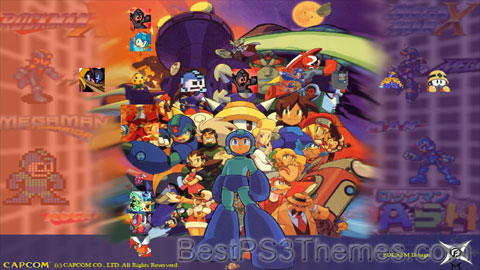
Megaman v1.1 Theme
(5 backgrounds)

P3T Unpacker v0.12
Copyright (c) 2007. Anoop Menon

This program unpacks Playstation 3 Theme files (.p3t) so that you can touch-up an existing theme to your likings or use a certain wallpaper from it (as many themes have multiple). But remember, if you use content from another theme and release it, be sure to give credit!

Download for Windows: p3textractor.zip

Instructions:

Download p3textractor.zip from above. Extract the files to a folder with a program such as WinZip or WinRAR. Now there are multiple ways to extract the theme.

The first way is to simply open the p3t file with p3textractor.exe. If you don’t know how to do this, right click the p3t file and select Open With. Alternatively, open the p3t file and it will ask you to select a program to open with. Click Browse and find p3textractor.exe from where you previously extracted it to. It will open CMD and extract the theme to extracted.[filename]. After that, all you need to do for any future p3t files is open them and it will extract.

The second way is very simple. Just drag the p3t file to p3textractor.exe. It will open CMD and extract the theme to extracted.[filename].

For the third way, first put the p3t file you want to extract into the same folder as p3textractor.exe. Open CMD and browse to the folder with p3extractor.exe. Enter the following:
p3textractor filename.p3t [destination path]Replace filename with the name of the p3t file, and replace [destination path] with the name of the folder you want the files to be extracted to. A destination path is not required. By default it will extract to extracted.filename.

Right Arm of the Devil Nero (DMC4)

Right Arm of the Devil Nero (DMC4) theme by Genesis

Download: RightArmoftheDevilNero.p3t
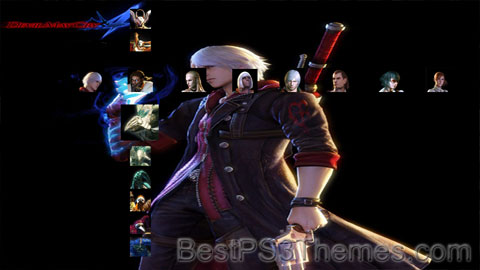
Right Arm of the Devil Nero (DMC4) Theme
(3 backgrounds)

P3T Unpacker v0.12
Copyright (c) 2007. Anoop Menon

This program unpacks Playstation 3 Theme files (.p3t) so that you can touch-up an existing theme to your likings or use a certain wallpaper from it (as many themes have multiple). But remember, if you use content from another theme and release it, be sure to give credit!

Download for Windows: p3textractor.zip

Instructions:

Download p3textractor.zip from above. Extract the files to a folder with a program such as WinZip or WinRAR. Now there are multiple ways to extract the theme.

The first way is to simply open the p3t file with p3textractor.exe. If you don’t know how to do this, right click the p3t file and select Open With. Alternatively, open the p3t file and it will ask you to select a program to open with. Click Browse and find p3textractor.exe from where you previously extracted it to. It will open CMD and extract the theme to extracted.[filename]. After that, all you need to do for any future p3t files is open them and it will extract.

The second way is very simple. Just drag the p3t file to p3textractor.exe. It will open CMD and extract the theme to extracted.[filename].

For the third way, first put the p3t file you want to extract into the same folder as p3textractor.exe. Open CMD and browse to the folder with p3extractor.exe. Enter the following:
p3textractor filename.p3t [destination path]Replace filename with the name of the p3t file, and replace [destination path] with the name of the folder you want the files to be extracted to. A destination path is not required. By default it will extract to extracted.filename.

Armored Core #2

Armored Core theme by Elvfam. Icons by Nebuloso

Download: ArmoredCore_2.p3t
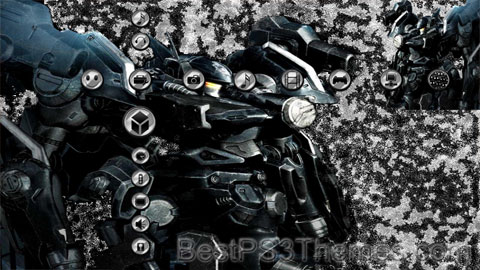
Armored Core Theme 2
(1 background)

Armored Core
Genre(s)Third-person shooter
Developer(s)FromSoftware
Publisher(s)
Platform(s)
First releaseArmored Core
July 10, 1997
Latest releaseArmored Core VI: Fires of Rubicon
August 25, 2023

Armored Core[a] is a third-person shooter mecha video game series developed by FromSoftware. The series centers on a silent protagonist who takes on work as a mercenary pilot in the far future, operating large robot combat units known as Armored Cores at the behest of corporate and private clients. As the player completes missions for these clients, they gain credits to improve their Armored Core and unlock further opportunities to make money. Some games include an "Arena" mode in which the player fights other Armored Core pilots in head-to-head battles, which can reward the player with further income or prestige.

Several story continuities exist, spread across 13 main games, seven spin-offs, and three remastered re-releases, with different releases divided by a different set of "generations" of sequels that starts with every numbered entry. The first game in the series, Armored Core, was released in 1997, while the most recent, Armored Core VI: Fires of Rubicon, was released in 2023.[1][2] The series has been released on the PlayStation, PlayStation 2, mobile phones, PlayStation Portable, PlayStation 3, Xbox 360, PlayStation 4, PlayStation 5, Windows, Xbox One, and Xbox Series X/S.

Premise[edit]

In the original continuity established by 1997's Armored Core through 2001's Armored Core 2: Another Age, Earth experienced a cataclysm known as the "Great Destruction" and humanity has been forced underground. Corporations begin fighting for dominance, leading to the increasing reliance on Armored Core pilots called Ravens.[3] Following the events of 1999's Armored Core: Master of Arena, humanity rebuilds and colonizes Mars. Through 2000's Armored Core 2 and its expansion, Another Age, the fledgling Earth government struggles to maintain power as opportunistic corporations exploit the power gap and rebel groups resist against the hegemony of government and business interests.[4][5]

The series was rebooted with 2002's Armored Core 3, beginning a new story arc that concluded with Armored Core: Last Raven in 2005. Following a global nuclear war, humanity has retreated underground. Following centuries of rule by an artificial intelligence called The Controller, its decay leads to the destruction of much of humanity's underground network, causing them to look toward the surface for safety.[6] By the end of 2003's Silent Line: Armored Core, humanity has fully returned to the surface of Earth.[7] The final two games of this continuity, 2004's Armored Core: Nexus and 2005's Armored Core: Last Raven involve the end of the existing power dynamic of corporations and Ravens fighting over the surface.[8][9]

2006's Armored Core 4 rebooted the series yet again. Here, corporations have seized control of Earth governments and are waging war across the surface for dominance. A war waged over the course of the game pollutes the environment, leading to the creation of floating cities in 2008's Armored Core: For Answer. Depending on the player's choices, humanity either barely survives the fallout of For Answer's conflict or is completely eradicated.[10][11]

The third continuity of the series continued with 2012's Armored Core V. A single corporation has dominance over a contaminated Earth and is being opposed by a resistance faction that seeks to overthrow them. 2013's Armored Core: Verdict Day details the outbreak of another war 100 years later following an apocalyptic event.[12][13]

Another continuity has begun with 2023's Armored Core VI: Fires of Rubicon. For the first time in the series, it takes place far away from Earth in a human-colonized solar system on the planet Rubicon 3. Decades prior to the game's start, a powerful resource called Coral was discovered, leading to significant technological advancements, but a disaster called the Fires of Ibis scorched the entire Rubicon system and left it highly contaminated. However, the Coral, thought to have all burned, has begun to reappear, bringing multiple corporations into conflict for control of it which, in turn, has brought the attention of mercenaries. Added into the conflict are the Planetary Closure Administration, an organization tasked with quarantining Rubicon, and the Rubicon Liberation Front, a resistance group who venerate the Coral, wishing to end its exploitation and free the planet.

Gameplay[edit]

Armored Core's missions can involve multiple objectives and pit the player against computer controlled opponents.

Within the core games of the franchise, the gameplay is generally focused on the player taking the role of a mech-piloting mercenary, taking on missions for various clients and gaining currency from completing them.[14] Missions can involve multiple objectives and pit the player against computer controlled opponents, some of which pilot mechs as well.[15] Upon completion of a mission, the operating costs of the mech, such as repairs and ammunition, are deducted from the total earnings of the player, as well as compensation for destroying valuable objects within the mission area. Likewise, if the player loses a mission, those same deductions occur from the player's direct balance.[16]

The game's mechs, called Armored Cores (or ACs for short), are highly customizable with hundreds of parts and weapons that can be purchased from an in-game shop or by fulfilling certain requirements.[17] Different parts can provide gameplay advantages in certain terrains or against certain enemies, which forces the player to put thought into how to approach the construction of their mech as each sortie often has different obstacles and hazards to overcome.[14] The customization of Armored Cores is strictly limited by multiple factors such as the maximum weight load of their leg parts, or the energy output of their generators supplying power to all equipped parts of the AC. As such, an Armored Core's performance varies depending on the parts which compose it.

Many of the franchise's games feature a branching storyline where taking on certain missions can block off others, with consequences of a player's decision in mission being relayed to them at the end of a mission. Certain games require multiple playthroughs to access additional contents, such as missions inaccessible during initial playthrough, and even different endings that adds additional lore and context to the games.[18]

An Arena mode introduced in Armored Core: Project Phantasma gave players the opportunity to fight opponents outside of missions for additional rewards. Project Phantasma also introduced the import feature, allowing players to retain their progress from a previous entry when starting a new one.[19] This import feature would become a mainstay of the franchise, with "expansion" titles like Silent Line: Armored Core allowing for importing save data.[20]

Multiplayer[edit]

Since its first release, the Armored Core games have featured multiplayer options in some form. In the original PlayStation era, local split-screen multiplayer modes were the primary method, generally featuring head-to-head battles.[21] A PlayStation Link Cable feature, allowing for the connection of two PlayStation consoles, was included in all three original Armored Core titles.[22]

With the PlayStation 2, split-screen and console linking continue to be the primary source of multiplayer. 2004's Armored Core: Nexus introduced the LAN multiplayer mode, in addition to connecting through their internet service and allowed up to 4 players to fight in matches together.[23]

Online multiplayer was first introduced in the Japanese release of Armored Core 2: Another Age, but was removed in other regions due to the PlayStation Network Adapter not being ready in time.[24] No PlayStation 2-era game after this release would include online play either, with the first game to do so being Armored Core 4.[10]

Games[edit]

Release timeline
1997Armored Core
Project Phantasma
1998
1999Master of Arena
2000Armored Core 2
20012: Another Age
2002Armored Core 3
2003Silent Line
2004Nexus
Nine Breaker
Formula Front
2005Last Raven
2006Armored Core 4
2007
2008For Answer
2009–2011
2012Armored Core V
2013Verdict Day
2014–2022
2023Armored Core VI: Fires of Rubicon

Armored Core[edit]

The original trilogy of Armored Core games were developed for the original PlayStation by FromSoftware and established many of the core themes and mechanics that would be found in the rest of the series. The debut title, Armored Core, was released on July 10, 1997, in Japan.[25] Story elements like corporate-funded conflicts, post-apocalyptic settings, and silent protagonists were introduced in the first game. The game's mechanics revolve around taking on missions from various clients for pay, using earned money to customize the player's Armored Core unit.[14]

Armored Core: Project Phantasma was released as a stand-alone expansion to the original game, released on December 4, 1997.[26] Project Phantasma introduced an Arena mechanic that would be expanded on in later titles, as well as an import mechanic that would become an important feature through the franchise. Players were able to import save data from earlier Armored Core games and bring their existing Armored Core units into the expansions.[19]

A second stand-alone expansion, Armored Core: Master of Arena, was released on February 4, 1999, and was the final game released for the original PlayStation.[27] It concluded the core arc of the original Armored Core and greatly expanded on the Arena mechanic introduced in Project Phantasma.[28] Like its predecessor, Master of Arena allowed players to import save files from both the original Armored Core and Project Phantasma to continue their progress.[29]

All three games from the original PlayStation era were re-released on the PlayStation Network in 2007 for the tenth anniversary of the original title.[30][31][32] The original Armored Core was also released on the Japanese PlayStation Classic in 2018.[33]

Armored Core 2[edit]

With the transition to the PlayStation 2, FromSoftware released Armored Core 2 as a launch title in Japan on August 3, 2000.[34] As a narrative sequel to the original trilogy, Armored Core 2 transitioned the series away from the post-apocalyptic setting and added more science fiction elements, such as Mars colonization. Much of the gameplay remained the same, including the mission structure, customization, and Arena modes.[35][4] The title did overhaul the visuals from the original game, taking advantage of the added power of the new console, but overall designs stayed similar.[36] Unlike Project Phantasma and Master of Arena, players could not import their saves to the new game.

Armored Core 2: Another Age was released on April 12, 2001, as a stand-alone expansion.[37] It allowed players to import their save files from Armored Core 2 and continue with their existing Armored Core units.[38] The game introduced movement controls using the DualShock analog sticks and cooperative mission mode.[39] The Japanese version of Armored Core 2 was the first title to include online broadband play, allowing players to fight each other over the internet.[24]

Armored Core 3[edit]

Armored Core 3 was released on April 4, 2002, and served as a reboot for the franchise.[40] The story returned to a post-apocalyptic setting and retained the core concept of corporate warfare and mercenary mission structure. Very little gameplay was changed from the earlier PlayStation 2 titles, instead focusing on incremental improvements and minor features like USB mice, computer-controlled allies, and surround sound.[6][41][42] Due to its nature as a reboot, players could not import save data from Armored Core 2 or Another Age.

A stand-alone expansion, Silent Line: Armored Core, was released on January 23, 2003, and was a direct sequel to Armored Core 3.[43] Like other expansions in the franchise, players could import their progress from Armored Core 3 into Silent Line, retaining their parts and credits from the earlier game.[20] Silent Line introduced new gameplay mechanics, including computer-controlled companions and a first person mode.[44][45]

Armored Core: Nexus was released on March 18, 2004, as a direct sequel to Silent Line.[46] Unlike its predecessor, Nexus was treated as a core entry rather than an expansion and did not allow for save data import.[47] While carrying over parts from 3 and Silent Line, mechanics changed significantly compared to past expansions. The heat mechanic introduced in Armored Core 2 was made much more influential, especially with the introduction of booster heat. All part stats were also totally redistributed. The game was the first in the franchise to include support for dual analog sticks. It also introduced a new LAN multiplayer mode that allowed up to 4 players to participate in matches against each other.[23]

Armored Core: Last Raven was released on August 4, 2005, and served as the conclusion to Armored Core 3's story arc.[48] The game is structured around a 24-hour clock that moves forward as missions progress. At the end of the 24-hour period, choices made by the player can alter the outcome of the plot.[49] The game introduced a component damage system, allowing for individual parts to be broken in combat.[50]

Armored Core 4[edit]

Armored Core 4 was released on December 21, 2006, for the PlayStation 3, serving as another reboot for the franchise. An Xbox 360 version, the first instance of a main title in the franchise being released outside of the PlayStation ecosystem, was released on March 22, 2007.[51] Gameplay in Armored Core 4 has been sped up and streamlined from its predecessors in an attempt to make the game more accessible to new players.[52] The game marks the first instance of online multiplayer outside of the Japanese release of Armored Core 2: Another Age.[53]

Armored Core: For Answer was released on March 19, 2008, as a standalone expansion to Armored Core 4.[54] It incorporates an online co-operative mode and a branching storyline.[55] The game was noted for its technical problems on the PlayStation 3 version.[56] Like Nexus, this game did not simply add content to its predecessor and changed gameplay by greatly increasing booster speeds and increasing generator performance.

Armored Core V[edit]

Armored Core V was released on January 26, 2012, for the PlayStation 3 and Xbox 360 and acts as indirect sequel to Armored Core 4 and Armored Core: For Answer.[57] The game focuses on the online multiplayer component and includes far fewer offline story missions than its predecessors.[12] In the game's online mode, players battle for territory in teams of up to 20 players. A co-operative mode is included for players to fight NPCs alongside other players for various rewards.[58]

Armored Core: Verdict Day was released on September 24, 2013, as a standalone expansion to Armored Core V.[59] The game retains its predecessor's multiplayer focus, though it allows players to create teams of AI companions instead of requiring teams composed entirely of players.[60] A full-length story mode returns alongside a newly implemented "hardcore mode", and players can import their saved games from Armored Core V to retain their personalized mechs.[61]

Armored Core VI: Fires of Rubicon[edit]

Armored Core VI: Fires of Rubicon was announced at The Game Awards 2022 on December 8. It is another reboot of the series, unrelated to any past games, set in an alternate future where humanity has developed an interstellar civilization. The player character, codenamed "C4-621" is an augmented Armored Core pilot sent to the distant planet Rubicon 3 to fight in a war between corporations, the government and the local inhabitants for the control of a highly valuable resource called "Coral" which only exists there. The game was released on PlayStation 4, PlayStation 5, Windows, Xbox One, and Xbox Series X/S on August 25, 2023.[62][63]

Spin-offs[edit]

In 2004, FromSoftware released two spin-offs from the main Armored Core series. The first, Armored Core: Nine Breaker was released on October 28, 2004, for the PlayStation 2.[64] Removing the focus from story-based missions, the game is instead built around an Arena mode where the player must compete with computer-controlled opponents to increase their rank.[65] Minigames designed as training exercises were included to allow players to practice specific skills.[66]

Armored Core: Formula Front was released on December 12, 2004, for the PlayStation Portable.[67] Like Nine Breaker, its focus was on Arena-style gameplay, though a new mechanic put a focus on building an artificial intelligence strategy for the Armored Core units to execute.[68] Formula Front was later released for the PlayStation 2 in Japan.[69]

Several mobile games were released in the Armored Core franchise from 2004 to 2008, but they were never released outside of Japan.[70] An American version of these mobile games was in development around 2005, but the title was never released.[71]

Other media[edit]

Armored Core: Tower City Blade is a manga by Fujimi Shobo based on the game. It was serialized in Dragon Age Pure between March 14 and April 14, 2007. A project called Armored Core: Fort Tower Song was to consist of a book and an anime also released in 2007. The book was completed but the anime was not.[72] From Software announced in 2011 that the anime had been canceled due to View Works shutting down.[73]

Legacy[edit]

The making of Armored Core solidified FromSoftware's development skills, and in July 1999, they released the multiplayer action game Frame Gride for the Sega Dreamcast.[74] The company's focus would shift from RPGs to mech games due in part to the success of the Armored Core series. In 2002, FromSoftware released the mech action game Murakumo: Renegade Mech Pursuit for the Xbox.[74] In 2004, they released another Xbox title, Metal Wolf Chaos. In 2005, FromSoftware would start to produce a series of licensed games based on the various anime properties under the banner Another Century's Episode.[75] Kenichiro Tsukuda, the producer of the Armored Core series produced a very similar video game called Daemon X Machina that was released for the Nintendo Switch and Microsoft Windows.[76]

Footnotes[edit]

Notes[edit]

  1. ^ Japanese: アーマード・コア, Hepburn: Āmādo Koa

References[edit]

  1. ^ Diaz, Ana (2022-12-08). "FromSoftware reveals a reboot for Armored Core". Polygon. Retrieved 2022-12-09.
  2. ^ Plunkett, Luke (2022-12-09). "Armored Core VI Announced, Which Isn't A Souls Game". Kotaku. Retrieved 2022-12-09.
  3. ^ Chang, Clint (November 4, 1997). "Armored Core Review". Game Revolution. CraveOnline. Archived from the original on October 18, 2012. Retrieved December 14, 2018.
  4. ^ a b

    Burst Angel

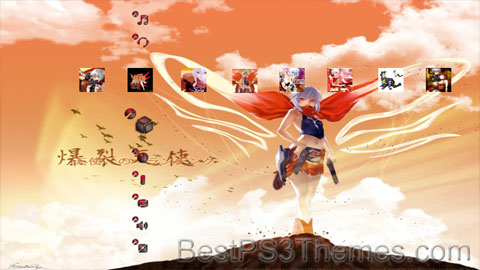
    Burst Angel theme by Kiri

    Download: BurstAngel.p3t

    Burst Angel Theme
    (7 backgrounds)

    Burst Angel
    Third DVD cover, featuring (from left to right) Meg, Jo, Amy and Sei
    爆裂天使
    (Bakuretsu Tenshi)
    Genre
    Anime television series
    Directed byKoichi Ohata
    Produced by
    • Naomi Nishiguchi
    • Naoshi Imamoto
    • Toshio Hatanaka
    Written byFumihiko Shimo
    Music byMasara Nishida
    StudioGonzo
    Licensed by
    Original networkTV Asahi
    English network
    Original run April 7, 2004 September 22, 2004
    Episodes24 (List of episodes)
    Manga
    Burst Angel: Angel's Adolescence
    Written byMinoru Murao [ja]
    Published byMediaWorks
    English publisher
    MagazineDengeki Comic Gao!
    DemographicShōnen
    Original runJanuary 27, 2004June 27, 2005
    Volumes3
    Original video animation
    Burst Angel: Infinity
    Directed byKoichi Ohata
    Written byFumihiko Shimo
    Music byMasara Nishida
    StudioGonzo
    Licensed by
    ReleasedMarch 23, 2007
    Runtime25 minutes
    icon Anime and manga portal

    Burst Angel (Japanese: 爆裂天使, Hepburn: Bakuretsu Tenshi) is a Japanese anime television series directed by Koichi Ohata, from a screenplay by Fumihiko Shimo. It was produced by the Gonzo animation studio. Burst Angel takes place in the near future, after a rise in criminal activity forced the Japanese government to allow citizens to possess firearms and establish the Recently Armed Police of Tokyo (RAPT). The series follows a band of four mercenaries, named Jo, Meg, Sei, and Amy. It was broadcast for 24-episodes on TV Asahi from April to September 2004. An original video animation (OVA), titled Burst Angel: Infinity, was released in 2007.

    Plot[edit]

    In the near future, due to an unusual rise in criminal activity, it has become legal to possess firearms in Japan so lawful citizens can protect themselves. At the same time, the government established the Recently Armed Police of Tokyo, whose methods are exterminating criminals rather than arresting them.

    The story opens with Kyohei Tachibana, a male college student at a culinary arts school with dreams of someday becoming a pastry chef, motorcycling down an inner city street and becoming caught up in a shoot-out between a mysterious silver-haired woman and a psycho gangster. Kyohei escapes unharmed and ends up working as a cook for Jo, Meg, Amy, and Sei in an effort to gather up enough money to travel to France. The girls, ranging in ages of eleven to nineteen, turn out to be pseudo-mercenary agents for a larger international group known as Bailan.

    Burst Angel focuses on the group as they investigate a series of mutated human monsters with glowing brains that cause various amounts of mayhem in Tokyo.

    Characters[edit]

    Main[edit]

    Three of the four girls (Jo, Meg, and Amy) are named after the March sisters in the novel Little Women.[4]

    Jo (ジョウ, )
    Voiced by: Akeno Watanabe (Japanese); Monica Rial[5] (English)
    Jo is the muscle of the group, as well as the pilot of Django, which she uses to carry out various missions for Sei and to help out her friends when they're in need, mainly Meg. Jo also puts Meg over anything else, which she stated when telling Meg that she fights for her. It is heavily implied throughout the series that she has romantic feelings for Meg. When she is not fighting, she enjoys watching horror or gore related movies. Jo would eventually rediscover her past as a genetically engineered war machine in human form. After being forced to surrender with Meg and others held hostage, Jo returns to the secret labs for reprogramming and conditioning at Hinode. Jo's counterpart, Maria, frees her and Meg to prove who was the strongest by re-staging the fight they were unable to finish in their past. After the fight between Maria and Jo, which pushes both of them to their limits, Maria loses her will to fight and is restored to her true humanity. Reunited with the group, Jo decides that she has to destroy RAPT. Against Meg's will, who is highly opposed to the idea after seeing her go through a lifetime of combat, Jo knocks Meg out for her own safety, bids her farewell, and leaves her jacket behind for her to remember her by.
    ADR Director Christopher Bevins comments that Jo is "like a female cross between Clint Eastwood and Wolverine".[5]
    Meg (メグ, Megu)
    Voiced by: Megumi Toyoguchi (Japanese); Jamie Marchi[5] (English)
    Meg has red hair (although in her first appearance chronologically in episode 14: "Wild Kids", she is portrayed as having black hair due to the monochrome setting) and dresses like a cowgirl. She carries a small revolver, and, at times, a large anti-tank rifle. Meg is highly prone to be captured, only to be rescued by Jo. She is the very best of friends with Jo and is 100% loyal only to her. Meg was once an orphan in New York City with several other children until she encountered Jo. Since then, Meg and Jo partnered and became bounty hunters together. Her personality is one of the main differences between anime and manga, while the anime tries to keep her relationship with Jo on the verge of friendly affection and subtle subtext, the manga prequel quite openly shows that Meg is experiencing a sexual attraction to her friend, fantasizing about their sex or even openly trying to seduce Jo. The other children appeared to have been adopted by a police officer. After she finds out Jo's origin, she feels that Jo should no longer fight. Jo however knocks her out and leaves her jacket with her. At the end of the series, Meg makes her way to the ruined RAPT HQ and sees Jo's scarf tied on a piece of debris. Meg then says her final goodbye to Jo. The final scene shows Meg in Jo's outfit, in a scene very much paralleling the beginning of the opening titles, only with an Orange Django behind her.
    In the Newtype magazine article, Meg is the "'spunky act now, ask questions later' gal" and that voice actor Jamie Marchi "brilliantly captured Meg's What-ever attitude".[5]
    Sei (セイ)
    Voiced by: Rie Tanaka (Japanese); Clarine Harp[5] (English)
    She is the kind leader of the group who hires Jo and Meg to become members of Bailan. She wears a long blue jacket and her black hair in a bun. Sei's grandfather runs Bailan and comes from a very powerful Chinese family. Sei was born and raised as a traditional Chinese girl and was trained in various ways of her clan/syndicate. After her grandfather stepped down as leader of the clan, their current clan members made a partnership with RAPT to preserve their clan. However, such actions not only disgusted Sei, she was also forced to do many things for RAPT in Bailan's name. She eventually rebelled against her own organization under the advice of her grandfather. Along with Jo she was caught in the explosion after destroying RAPT HQ and is presumably dead.
    In the Newtype magazine article, Bevins comments that Sei's character is cold, business-like, and notes that Clarine Harp's personality of sarcastic exterior, but most caring and fiercely loyal interior, "that's Sei to a T".[5]
    Amy (エイミー, Eimī)
    Voiced by: Mikako Takahashi (Japanese); Alison Retzloff[5] (English)
    A young genius in computers and technology. She was saved and recruited by Sei after her hacking drew attention from the authorities in her own country. It was through her hacking skills that Sei managed to recruit Jo and Meg. She often argues with Meg in a friendly way and loves scarfing down Kyohei's various treats. Her hair is light brown, and worn in pigtails. Amy's often seen carrying a pink stuffed animal that contains a laptop.
    In the Newtype magazine article, Bevins comments that "while Amy is just as brainy as Conan" (the title character in Case Closed, and also voiced by Retzloff), "she has a prissy, snotty demeanor that would give the young detective a migraine".[5]

    Supporting characters[edit]

    Kyohei Tachibana (立場無 恭平, Tachibana Kyōhei)
    Voiced by: Yūji Ueda (Japanese); Greg Ayres (English)
    A student attending a certified culinary school who is proficient in French, Chinese, Italian and Japanese cooking. Kyohei is often seen wearing his chef uniform and riding a small motor scooter which is destroyed by Jo on two occasions. He is hired by Sei as a cook for the girls because their last cook had left. He continues working for the team to earn money to go to France and try becoming a pastry chef.
    Leo Jinno (仁野 レオ, Jin'no Reo)
    Voiced by: Takayuki Sugō (Japanese); Mike McFarland (English)
    He is Django's mechanic. Leo hates that Jo plays rough with Django and that Meg annoys him when he's working. He has trouble controlling his urges to act like a child as seen when the team goes to Fortune Island Artificial Beach resort. There, he smashes a go-kart out of the raceway and down the street. Despite being the team's mechanic, he has seen combat on several occasion wielding a pair of sub-machine guns.
    Takane Katsu (勝 鷹音, Katsu Takane)
    Voiced by: Risa Hayamizu (Japanese); Caitlin Glass (English)
    A loud-mouthed, bike-riding police officer from Osaka. Takane is often seen riding a chopper and wears a uniform resembling that of a schoolgirl. She carries a large wooden sword, which she swings around often as it symbolizes her leadership of an all girl biker gang who often act as her deputies. She's also efficient at throwing handcuffs and subduing her target. Takane is quick to lose her temper and hates being in debt to anyone. She is also the daughter of the Police Chief of Osaka. After crossing paths with the team however, she becomes attached to the team and assists them any way she can as a debt to Jo even if it means disobeying her father.

    Antagonists[edit]

    Ishihara (石原)
    Voiced by: Katsuhisa Hōki (Japanese); Kent Williams (English)
    The governor of Tokyo and the founder of RAPT. Though he puts on the act of wanting to restore the city as a peaceful crime-free capital, in truth, he relies on ruthless methods for executing criminals and blames other companies and businesses for his shortcomings. Ishihara also makes a deal with Azuma Iriki that he would get total control of Osaka if he agreed to help the governor take over. He explains to Chief Katsu in "Tsutenkaku Tower, Drenched in Tears" that he established RAPT due to his jealousy over Osaka's less toxic community. After many scuffles with Jo's team, Glenford tries to kill Ishihara by trapping him inside a building and using a bomb to destroy it, after which, Glenford replaces him as governor. As it turns out, Ishihara actually survives the explosion and is mutated into a zombie-like beast. During his time as a mutant, Ishihara attacks the underground railways, burning for revenge against Glenford. After emerging from his iron grave, the Ishihara battles Bailan's forces in an organic mech form. After a short yet violent battle, Jo uses Django to kill the zombie.
    Ricky Glenford (リッキーグレンフォード, Rikkī Gurenfōdo)
    Voiced by: Yukitoshi Hori (Japanese); Jerry Russell (English)
    The leader of RAPT. He organized the creation of the "Genocide Angels" program which leads to the creation of Jo, Maria, and others like them. After organizing the assassination of Ishihara, he takes control of Tokyo and puts it under martial law. His true identity turns out to be a glowing brain placed in a cyborg body.
    Maria (マリア)
    Voiced by: Kyōko Hikami (Japanese); Colleen Clinkenbeard (English)
    She is a bio-weapon like Jo, but with even stronger and more violent tendencies. While Jo is more efficient with guns, Maria relies more on bladed weapons such as swords and cutting wire. In the past, both she and Jo were the remaining fighters in a combat exercise to determine the Syndicate's "Genocide Angel." Maria won by default, but as Jo was only rendered unconscious, Maria never felt like she truly defeated Jo. When Jo is captured by RAPT, Maria disobeys orders and kidnaps Meg to lure Jo into one final battle. She lures Jo onto an aircraft carrier similar to the one where Genocide Angel exercise was held. After a hand-to-hand battle, Jo won and Maria lost her will to fight. She asks Jo what she can do after she gains her humanity; Jo only tells her to live on. She then reunites Jo with Meg only to be surrounded by new RAPT Cybots. She tells Meg to escape with Jo while she fights off the new mechs and appears to have been shot dead.

    Other characters[edit]

    Jei Kokuren (ジェイ国連)
    Voiced by: Kazuya Ichijō (Japanese); Michael Sinterniklaas (English)
    A representative from Kokuren and Bailan's Japanese counterpart. His father and Sei's grandfather arrange for him and Sei to wed so that the white and black lotus can join together once again. However, Sei's grandfather respectfully declines Jei's request to have both the Bai Lan and Kokuren seals displayed together. Angry, he and his men attack Sei to try to obtain the Bai Lan seal by force. Jei obtains the seal and almost escapes, but he is stopped by Jo after shooting down the dragon head of the yacht making it crash onto Jei's boat.
    Chief Katsu (勝署長, Katsu shochō)
    Voiced by: Kazuhiko Kishino (Japanese); Brice Armstrong (English)
    The Chief is a well-respected man in Osaka with a great sense of honor and justice. Despite looking like he doesn't care for his daughter, Takane, he actually shows great concern for her. He shows great disgust towards the government of Tokyo and further towards Glenford and RAPT.
    Sam (サム, Samu)
    A police officer that Meg robbed when she was younger. Based on flashbacks, it is implied that Sam once had a family (a wife and daughter), that are now dead as he carries around his daughter's doll with him. He saves Charlie and Shirley from falling debris at the area Jo was fighting Lava, one of the "Genocide Angel" candidates. Afterward, he adopts all three children while Meg and Jo leave their own way.
    The Orphans
    There are four orphans, the eldest of whom is Meg. The next oldest is Dorothy, an African-American girl who usually aids Meg in her thefts. Then Charlie, a young Caucasian boy who is usually left to care for Shirley when Meg and Dorothy leave. He is the most cynical of the group. And finally, Shirley, a mute little girl and the youngest of the group. She is the one who finds an unconscious Jo and decides to take her home with them. She carries a book with a picture of an angel with silver hair; something she always points out to everyone and especially towards Jo who she shows great affection for.
    Akio (アキオ)
    Voiced by: Toshihide Tsuchiya (Japanese); Johnny Yong Bosch (English)
    An old friend and classmate of Kyohei who always defended him. He is found on the streets by Eiji, a Yakuza member. He takes Akio in and has a doctor convert him into a Cyberoid. He goes on a one man war against the Yakuza. Eiji agrees to a deal with the right-hand man of the Yakuza boss to kill Akio. Eiji fails and ends up being shot several times by an enraged Akio due his betrayal. He tells Kyohei what happened to him and how he became a Cyberoid. After killing off the Yakuza and the Boss, Akio battles Eiji now being converted to a Cyberoid. Akio kills Eiji though he dies in the process leaving Kyohei crying at the loss of his friend.
    Lover (ラヴァー, Ravā)
    Voiced by: Mayumi Asano (Japanese); Gwendolyn Lau (English)
    She is a bio-weapon along with Maria and Jo. Lover is one of the final three survivors in the "Genocide Angel" training exercise (which occurred before Jo is found by Shirley). During the exercise, she almost kills Jo and Maria with missiles from a fighter plane she hot-wired, but is countered by Jo, and ultimately defeated by Maria. However, all three survive the ordeal. She is then sent by the Syndicate to retrieve Jo, but fails.

    Media[edit]

    Anime[edit]

    Burst Angel, animated by Gonzo, directed by Koichi Ohata and written by Fumihiko Shimo, was broadcast for twenty-four episodes on TV Asahi from April 7 to September 22, 2004.[6] The opening theme for the series is "Loosey" by the Stripes while the ending theme is "Under the Sky" by Coudica in Japanese and Caitlin Glass in English.

    The complete collection of DVDs from Funimation have been released as of January 2, 2009. This DVD set includes episodes 1–24 and the OVA. The complete collection was later released on Blu-ray on September 29, 2009. The series was made available on PlayStation Network's Video store in 2008.[7][8] Following Funimation's merging with Crunchyroll, the series was added to the platform in September 2022.[9]

    Manga[edit]

    A manga prequel to the TV series,[10] titled Angel's Adolescence, was written and illustrated by Minoru Murao [ja]. It was serialized in MediaWorks' shōnen manga magazine Dengeki Comic Gao! from January 27, 2004,[11] to June 27, 2005.[a] MediaWorks collected its chapters in three tankōbon volumes, released from July 27, 2004,[14] to July 27, 2005.[15] The manga depicts the romantic relationship of Jo and Meg.[16][17]

    In 2008, Tokyopop licensed the manga for English release in North America,[18] The three volumes were released from September 9, 2008,[19] to May 12, 2009.[20] In August 2023, Titan Comics announced that they had licensed the manga, and the first volume is set to be released on May 21, 2024.[21]

    Original video animation[edit]

    An original video animation (OVA), titled Burst Angel: Infinity was released in Japan on March 23, 2007. The OVA deals is a side story revolving around Jo and Meg visiting Sam and her old gang in New York explaining the aftermath of episode 14 of the TV series. The OVA also includes a short preview titled Burst Angel Heavenly Moon Burst Crimson (爆裂天使 赤ク爆ス天ノ月) by Ugetsu Hakua showing the characters five years in the future, including Jo, Sei and Maria alive. The OVA was released by Funimation on November 13, 2007.[22]

    Notes[edit]

    1. ^ It finished in the magazine's August 2005 issue,[12] released on June 27 of that same year.[13]

    References[edit]

    1. ^ Luther, Katherine (May 8, 2005). "Burst Angel - Anime Sneak Peek". About.com. Archived from the original on April 13, 2014. Retrieved November 6, 2021.
    2. ^ a b Martin, Theron (May 8, 2019). "Burst Angel Blu-ray - Review". Anime News Network. Archived from the original on August 3, 2019. Retrieved October 3, 2019.
    3. ^ Arbogast, Samuel. "Burst Angel". T.H.E.M. Anime Reviews. Archived from the original on June 26, 2020. Retrieved June 23, 2020.
    4. ^ Friedman, Erica (June 23, 2007). "Burst Angel Anime, Volume 1 (English)". Okazu. Archived from the original on December 9, 2021. Retrieved December 8, 2021.
    5. ^ a b c d e f g h Johnston, Chris (2005). "City of Angels". Newtype USA. 4 (4): 34–35.
    6. ^ 爆裂天使. Media Arts Database (in Japanese). Agency for Cultural Affairs. Archived from the original on November 6, 2021. Retrieved November 6, 2021.
    7. ^ Loo, Egan (July 15, 2008). "Funimation, BONES Anime on PlayStation Video Service (Update 2)". Anime News Network. Archived from the original on February 5, 2023. Retrieved August 25, 2023.

      Kay Hanley

      Kay Hanley theme by Daniel Keen (DK One)

      Download: KayHanley.p3t

      Kay Hanley Theme
      (3 backgrounds)

      Kay Hanley
      Hanley at the 2024 WonderCon
      Hanley at the 2024 WonderCon
      Background information
      Born (1968-09-11) September 11, 1968 (age 55)
      Dorchester, Massachusetts, U.S.
      GenresRock, folk, pop, acoustic, alternative
      Instrument(s)Vocals, guitar
      Years active1990–present
      LabelsZoë Records
      De Guerre

      Kay Hanley (born September 11, 1968) is an American singer and songwriter. She is best known as the vocalist for the alternative rock band Letters to Cleo.

      Life and career[edit]

      Hanley grew up in Dorchester, Massachusetts,[1] across the street from the Wahlberg family. She attended school at St. Gregory's and Latin Academy. She has been lead singer/songwriter for rock band Letters To Cleo since 1990. The band name was inspired by Hanley's childhood penpal.

      In 1996, she co-starred alongside Gary Cherone in Boston Rock Opera's performance of Jesus Christ Superstar as Mary Magdalene.

      In 1999, Hanley appeared as herself in the film 10 Things I Hate About You, singing a cover version of Nick Lowe's "Cruel to Be Kind" to Heath Ledger and Julia Stiles at their characters' high school prom, in addition to performing original song "Come On" with Letters to Cleo during an earlier scene at a club. Towards the end of the 90s she began performing with her then-husband[2] and fellow Letters To Cleo member Michael Eisenstein outside of the band. Around the same time, she gave birth to their daughter, Zoe Mabel.

      Songwriting[edit]

      In 1999 Hanley began a shift in her music career. She wrote and performed songs for the Kids' WB cartoon series Generation O! along with the rest of Letters to Cleo and provided the singing voice for Rachael Leigh Cook's character Josie in the movie Josie and the Pussycats. In 2002, she released her first solo album, Cherry Marmalade. That same year, she appeared on the Dropkick Murphys/Face to Face split CD, providing guest vocals on the original version of the Dropkick Murphys song "The Dirty Glass".

      In 2003, Hanley was approached by Jun Senoue from Sega to co-write and perform on an original song for their upcoming entry in the Sonic the Hedgehog series, entitled Sonic Heroes. The result was the song "Follow Me."

      In 2004, Hanley released a follow-up to Cherry Marmalade, The Babydoll EP. That same year, she and her then-husband Michael Eisenstein had their second child, Henry Aaron, the name given in honor of baseball player Hank Aaron and their love for baseball.

      In August 2005, Hanley recorded a cover of Iggy Pop's "Lust for Life" for the soundtrack of the Reese Witherspoon film Just Like Heaven. In September 2005, she appeared on The Tonight Show with Jay Leno as part of a pre-taped man-on-the-street segment, singing a song about falling in love at Starbucks.

      Hanley is popular with fans of the New England Patriots thanks to the team at one point going 8–0 after she sang the pre-game National Anthem at Gillette Stadium. The streak came to an end when the Patriots lost on January 10, 2010, to the Baltimore Ravens. Hanley is also very involved with the Boston-based charity "Hot Stove, Cool Music," both as performer and spokesperson for the semi-annual event, which has raised over 6 million dollars for The Foundation To Be Named Later

      She sang the theme song [3] for My Friends Tigger & Pooh,[4] a half-hour Disney Channel TV show that premiered on Playhouse Disney on May 12, 2007, and "We Are Care Bears" from Care Bears: Oopsy Does It! and Care Bears to the Rescue.

      Hanley and longtime writing partner Michelle Lewis currently compose all-original songs for animated television shows such as the hit Disney series Doc McStuffins.,[5] Cartoon Network/WB's DC Super Hero Girls, and Harvey Girls Forever and Ada Twist, Scientist on Netflix. Hanley won a 2022 Emmy Award for songwriting on We The People.

      She and writing partners Michelle Lewis, Dan Petty, and Charlton Pettus created Kindergarten The Musical. In production at Disney Junior, the show will debut in fall 2024. Hanley serves as executive producer.

      She is co-executive director of Songwriters of North America, an LA-based non-profit which advocates for fair pay and other rights for songwriters. Due to her work with SONA in getting the Music Modernization Act passed into law in October 2018, Hanley was elected Vice Chair of the Mechanical Licensing Collective's Unclaimed Royalties Oversight Committee in August 2019

      On Thanksgiving Day 2007, Hanley sang a song called "Caring Changes The World" in the Macy's Thanksgiving Day Parade on the Care Bears float.

      In 2007–08, Hanley toured as a back-up singer with Miley Cyrus for Hannah Montana concerts and events.

      Hanley's latest album, Weaponize, was released May 27, 2008.

      Hanley co-wrote "Don't Wanna Be Famous" on the band The Dollyrots' eponymous album.

      In 2014, Kay Hanley appeared in the Parks and Recreation season 6 finale, performing her song "Here & Now" at the Pawnee-Eagleton Unity Concert. The character of Ben Wyatt, played by Adam Scott, is seen offstage in his Letters to Cleo t-shirt, blissfully watching the band as Hanley winks at him. Hanley is seen later in the episode entering Tom Haverford's new restaurant, Tom's Bistro.

      In 2020, at the height of the COVID-19 pandemic, she appeared as lead vocalist in a "distanced" music video, a cover of Donnie Iris's "Ah! Leah!"[6] Later that year, she appeared on Saving for a Custom Van, a tribute album for Adam Schlesinger, with whom she had worked on Josie and the Pussycats, following his death from COVID-19. She performed the Fountains of Wayne song "Radiation Vibe" in his memory.[7]

      Hanley married audio engineer Clayton Janes in 2021 in Bentonville, Arkansas.

      Oh 2023, Hanley and her fellow Letters to Cleo bandmate Tom Polce wrote the songs for “Subspace Rhapsody,” an episode of Star Trek: Strange New Worlds performed in the style of a broadway musical.

      Discography[edit]

      Letters to Cleo[edit]

      Pet Projects[edit]

      The title of this section indicates projects that both Hanley and Eisenstein have taken an active interest in developing, in terms of playing multiple roles, including production as well as composition and/or instrumentation.

      Year Artist Title Label Role
      2003 The Gentlemen Blondes Prefer the Gentlemen Sodapop Records Vocals
      2007 Murder Capitol of the World St. Jude's Revenge Dot Rat Vocals
      2008 Cruiserweight Big Bold Letters Doghouse/Siren Songs Composer, Background Vocals

      Solo[edit]

      Year Title Label
      2002 Cherry Marmalade Zoë Records
      2003 The Paradise - Boston, MA 5/30/03 (live) Instant Live[8]
      2004 The Babydoll EP
      The Paradise - Boston, MA 8/26/04 (live)
      2006 Kay Hanley / Scamper split single CD De Guerre/Scamper
      2008 Weaponize De Guerre

      Soundtracks[edit]

      Year Title Label
      1996 The Craft Sony
      1999 10 Things I Hate About You Hollywood Records
      2001 Music from the Motion Picture Josie and the Pussycats Sony
      2003 Sonic Heroes Pioneer/Geneon
      2005 Just Like Heaven Sony

      Special appearances[edit]

      Year Artist Title Label Role
      1995 Mary Karlzen Yelling at Mary Atlantic Records Background vocals
      2002 James Taylor October Road Sony Choir, chorus
      2006 Agnes Chan Forget Yourself Bungalo Records Background vocals
      Peter Gammons Never Slow Down, Never Grow Old Rounder Vocals
      2008 Lisa Loeb Camp Lisa Furious Rose Productions Vocal harmony
      2009 Will Dailey Torrent, Vols. 1 & 2 BS Background vocals
      2010 Lindsey Ray Goodbye from California LRay Composer
      The Posies Blood/Candy Rykodisc Vocals
      2011 Bowling for Soup Fishin' for Woos MRI Vocals, sounds
      Will Dailey Will Dailey & the Rivals Universal Republic Records Composer

      Filmography[edit]

      Year Title Role Type
      1999 10 Things I Hate About You Herself Cameo
      2000 Generation O! Molly O's singing voice Voice
      2001 Josie and the Pussycats Josie McCoy Singing voice
      2007–2008 My Friends Tigger & Pooh opening song performer (Season 1)

      Performer

      2008 Hannah Montana & Miley Cyrus: Best of Both Worlds Concert Herself Background vocals
      2014 Parks and Recreation Herself Cameo

      Further reading[edit]

      References[edit]

      1. ^ Jordan, Chris (August 18, 1995). "Dear Cleo". The Central New Jersey Home News. p. On the Go 5.
      2. ^ "Kay Hanley" The Quaz - Kay Hanley, a 2013 interview with author Jeff Pearlman in which Hanley indicates that her marriage to Eisenstein's ended within the three years prior to the date of the interview]
      3. ^ My Friends Tigger and Pooh Theme Song Music Video - Music - My Friends Tigger and Pooh - Playhouse Disney
      4. ^ Home - My Friends Tigger and Pooh - Playhouse Disney
      5. ^ "Doc McStuffins". IMDB.
      6. ^ "The Isolation Jams - Ah! Leah! (Feat. Kay Hanley)". YouTube.
      7. ^ Enis, Eli (June 16, 2020). "Adam Schlesinger Honored with New Tribute Album Featuring Jeff Rosenstock, Charly Bliss, Ted Leo, Rachel Bloom & More: Stream". consequence.net. Consequence of Sound. Retrieved October 18, 2022.
      8. ^ CD Universe listing

      External links[edit]

Ghost

Ghost theme by Creighton

Download: Ghost.p3t

Ghost Theme
(no backgrounds)

An engraving of the Hammersmith Ghost appears in Roger Kirby's Wonderful and Scientific Museum, a magazine published in 1804. The "ghost" turned out to be an old local cobbler who used a white sheet to get back at his apprentice for scaring his grandchildren.[1]

In folklore, a ghost is the soul or spirit of a dead person or non-human animal that is believed to be able to appear to the living. In ghostlore, descriptions of ghosts vary widely, from an invisible presence to translucent or barely visible wispy shapes to realistic, lifelike forms. The deliberate attempt to contact the spirit of a deceased person is known as necromancy, or in spiritism as a séance. Other terms associated with it are apparition, haunt, haint, phantom, poltergeist, shade, specter, spirit, spook, wraith, demon, and ghoul.

The belief in the existence of an afterlife, as well as manifestations of the spirits of the dead, is widespread, dating back to animism or ancestor worship in pre-literate cultures. Certain religious practices—funeral rites, exorcisms, and some practices of spiritualism and ritual magic—are specifically designed to rest the spirits of the dead. Ghosts are generally described as solitary, human-like essences, though stories of ghostly armies and the ghosts of animals other than humans have also been recounted.[2][3] They are believed to haunt particular locations, objects, or people they were associated with in life. According to a 2009 study by the Pew Research Center, 18% of Americans say they have seen a ghost.[4]

The overwhelming consensus of science is that there is no proof that ghosts exist.[5] Their existence is impossible to falsify,[5] and ghost hunting has been classified as pseudoscience.[6][7][8] Despite centuries of investigation, there is no scientific evidence that any location is inhabited by the spirits of the dead.[6][9] Historically, certain toxic and psychoactive plants (such as datura and hyoscyamus niger), whose use has long been associated with necromancy and the underworld, have been shown to contain anticholinergic compounds that are pharmacologically linked to dementia (specifically DLB) as well as histological patterns of neurodegeneration.[10][11] Recent research has indicated that ghost sightings may be related to degenerative brain diseases such as Alzheimer's disease.[12] Common prescription medication and over-the-counter drugs (such as sleep aids) may also, in rare instances, cause ghost-like hallucinations, particularly zolpidem and diphenhydramine.[13] Older reports linked carbon monoxide poisoning to ghost-like hallucinations.[14]

In folklore studies, ghosts fall within the motif index designation E200–E599 ("Ghosts and other revenants").

Terminology[edit]

The English word ghost continues Old English gāst. Stemming from Proto-Germanic *gaistaz, it is cognate with Old Frisian gāst, Old Saxon gēst, Old Dutch gēst, and Old High German geist. Although this form is not attested in North Germanic and East Germanic languages (the equivalent word in Gothic is ahma, Old Norse has andi m., önd f.), it appears to be a dental suffix derivative of pre-Germanic *ghois-d-oz ('fury, anger'), which is comparable to Sanskrit héḍas ('anger') and Avestan zōižda- ('terrible, ugly'). The prior Proto-Indo-European form is reconstructed as *ǵʰéys-d-os, from the root *ǵʰéys-, which is reflected in Old Norse geisa ('to rage') and *geiski ('fear'; cf. geiskafullr 'full of fear'), in Gothic usgaisjan ('to terrify') and usgaisnan ('to be terrified'), as well as in Avestan zōiš- (cf. zōišnu 'shivering, trembling').[15][16][17]

The Germanic word is recorded as masculine only, but likely continues a neuter s-stem. The original meaning of the Germanic word would thus have been an animating principle of the mind, in particular capable of excitation and fury (compare óðr). In Germanic paganism, "Germanic Mercury", and the later Odin, was at the same time the conductor of the dead and the "lord of fury" leading the Wild Hunt.

Besides denoting the human spirit or soul, both of the living and the deceased, the Old English word is used as a synonym of Latin spiritus also in the meaning of "breath" or "blast" from the earliest attestations (9th century). It could also denote any good or evil spirit, such as angels and demons; the Anglo-Saxon gospel refers to the demonic possession of Matthew 12:43 as se unclæna gast. Also from the Old English period, the word could denote the spirit of God, viz. the "Holy Ghost".

The now-prevailing sense of "the soul of a deceased person, spoken of as appearing in a visible form" only emerges in Middle English (14th century). The modern noun does, however, retain a wider field of application, extending on one hand to "soul", "spirit", "vital principle", "mind", or "psyche", the seat of feeling, thought, and moral judgement; on the other hand used figuratively of any shadowy outline, or fuzzy or unsubstantial image; in optics, photography, and cinematography especially, a flare, secondary image, or spurious signal.[18]

The synonym spook is a Dutch loanword, akin to Low German spôk (of uncertain etymology); it entered the English language via American English in the 19th century.[19][20][21][22] Alternative words in modern usage include spectre (altn. specter; from Latin spectrum), the Scottish wraith (of obscure origin), phantom (via French ultimately from Greek phantasma, compare fantasy) and apparition. The term shade in classical mythology translates Greek σκιά,[23] or Latin umbra,[24] in reference to the notion of spirits in the Greek underworld. The term poltergeist is a German word, literally a "noisy ghost", for a spirit said to manifest itself by invisibly moving and influencing objects.[25]

Wraith is a Scots word for ghost, spectre, or apparition. It appeared in Scottish Romanticist literature, and acquired the more general or figurative sense of portent or omen. In 18th- to 19th-century Scottish literature, it also applied to aquatic spirits. The word has no commonly accepted etymology; the OED notes "of obscure origin" only.[26] An association with the verb writhe was the etymology favored by J. R. R. Tolkien.[27] Tolkien's use of the word in the naming of the creatures known as the Ringwraiths has influenced later usage in fantasy literature. Bogey[28] or bogy/bogie is a term for a ghost, and appears in Scottish poet John Mayne's Hallowe'en in 1780.[29][30]

A revenant is a deceased person returning from the dead to haunt the living, either as a disembodied ghost or alternatively as an animated ("undead") corpse. Also related is the concept of a fetch, the visible ghost or spirit of a person yet alive.

Typology[edit]

Relief from a carved funerary lekythos at Athens showing Hermes as psychopomp conducting the soul of the deceased, Myrrhine into Hades (ca. 430-420 B.C.)

Anthropological context[edit]

A notion of the transcendent, supernatural, or numinous, usually involving entities like ghosts, demons, or deities, is a cultural universal.[31] In pre-literate folk religions, these beliefs are often summarized under animism and ancestor worship. Some people believe the ghost or spirit never leaves Earth until there is no-one left to remember the one who died.[32]

In many cultures, malignant, restless ghosts are distinguished from the more benign spirits involved in ancestor worship.[33]

Ancestor worship typically involves rites intended to prevent revenants, vengeful spirits of the dead, imagined as starving and envious of the living. Strategies for preventing revenants may either include sacrifice, i.e., giving the dead food and drink to pacify them, or magical banishment of the deceased to force them not to return. Ritual feeding of the dead is performed in traditions like the Chinese Ghost Festival or the Western All Souls' Day. Magical banishment of the dead is present in many of the world's burial customs. The bodies found in many tumuli (kurgan) had been ritually bound before burial,[34] and the custom of binding the dead persists, for example, in rural Anatolia.[35]

Nineteenth-century anthropologist James Frazer stated in his classic work The Golden Bough that souls were seen as the creature within that animated the body.[36]

Ghosts and the afterlife[edit]

Although the human soul was sometimes symbolically or literally depicted in ancient cultures as a bird or other animal, it appears to have been widely held that the soul was an exact reproduction of the body in every feature, even down to clothing the person wore. This is depicted in artwork from various ancient cultures, including such works as the Egyptian Book of the Dead, which shows deceased people in the afterlife appearing much as they did before death, including the style of dress.

Fear of ghosts[edit]

Yūrei (Japanese ghost) from the Hyakkai Zukan, c. 1737

While deceased ancestors are universally regarded as venerable, and often believed to have a continued presence in some form of afterlife, the spirit of a deceased person that persists in the material world (a ghost) is regarded as an unnatural or undesirable state of affairs and the idea of ghosts or revenants is associated with a reaction of fear. This is universally the case in pre-modern folk cultures, but fear of ghosts also remains an integral aspect of the modern ghost story, Gothic horror, and other horror fiction dealing with the supernatural.

Common attributes[edit]

Another widespread belief concerning ghosts is that they are composed of a misty, airy, or subtle material. Anthropologists link this idea to early beliefs that ghosts were the person within the person (the person's spirit), most noticeable in ancient cultures as a person's breath, which upon exhaling in colder climates appears visibly as a white mist.[32] This belief may have also fostered the metaphorical meaning of "breath" in certain languages, such as the Latin spiritus and the Greek pneuma, which by analogy became extended to mean the soul. In the Bible, God is depicted as synthesising Adam, as a living soul, from the dust of the Earth and the breath of God.

In many traditional accounts, ghosts were often thought to be deceased people looking for vengeance (vengeful ghosts), or imprisoned on earth for bad things they did during life. The appearance of a ghost has often been regarded as an omen or portent of death. Seeing one's own ghostly double or "fetch" is a related omen of death.[37] The impetus of haunting is commonly considered an unnatural death.[38]

Union Cemetery in Easton, Connecticut is home to the legend of the White Lady.

White ladies were reported to appear in many rural areas, and supposed to have died tragically or suffered trauma in life. White Lady legends are found around the world. Common to many of them is the theme of losing a child or husband and a sense of purity, as opposed to the Lady in Red ghost that is mostly attributed to a jilted lover or prostitute. The White Lady ghost is often associated with an individual family line or regarded as a harbinger of death similar to a banshee.[39][40][needs context]

Legends of ghost ships have existed since the 18th century; most notable of these is the Flying Dutchman. This theme has been used in literature in The Rime of the Ancient Mariner by Coleridge.

Ghosts are often depicted as being covered in a shroud and/or dragging chains.[41]

Locale[edit]

A place where ghosts are reported is described as haunted, and often seen as being inhabited by spirits of deceased who may have been former residents or were familiar with the property. Supernatural activity inside homes is said to be mainly associated with violent or tragic events in the building's past such as murder, accidental death, or suicide—sometimes in the recent or ancient past. However, not all hauntings are at a place of a violent death, or even on violent grounds. Many cultures and religions believe the essence of a being, such as the 'soul', continues to exist. Some religious views argue that the 'spirits' of those who have died have not 'passed over' and are trapped inside the property where their memories and energy are strong.

History[edit]

Ancient Sumerian cylinder seal impression showing the god Dumuzid being tortured in the Underworld by galla demons

Ancient Near East and Egypt[edit]

There are many references to ghosts in Mesopotamian religions – the religions of Sumer, Babylon, Assyria, and other early states in Mesopotamia. Traces of these beliefs survive in the later Abrahamic religions that came to dominate the region.[42] The concept of ghosts may p

Black Label Clan

Black Label Clan theme by capone

Download: BlackLabelClan.p3t

Black Label Clan Theme
(1 background)

P3T Unpacker v0.12
Copyright (c) 2007. Anoop Menon

This program unpacks Playstation 3 Theme files (.p3t) so that you can touch-up an existing theme to your likings or use a certain wallpaper from it (as many themes have multiple). But remember, if you use content from another theme and release it, be sure to give credit!

Download for Windows: p3textractor.zip

Instructions:

Download p3textractor.zip from above. Extract the files to a folder with a program such as WinZip or WinRAR. Now there are multiple ways to extract the theme.

The first way is to simply open the p3t file with p3textractor.exe. If you don’t know how to do this, right click the p3t file and select Open With. Alternatively, open the p3t file and it will ask you to select a program to open with. Click Browse and find p3textractor.exe from where you previously extracted it to. It will open CMD and extract the theme to extracted.[filename]. After that, all you need to do for any future p3t files is open them and it will extract.

The second way is very simple. Just drag the p3t file to p3textractor.exe. It will open CMD and extract the theme to extracted.[filename].

For the third way, first put the p3t file you want to extract into the same folder as p3textractor.exe. Open CMD and browse to the folder with p3extractor.exe. Enter the following:
p3textractor filename.p3t [destination path]Replace filename with the name of the p3t file, and replace [destination path] with the name of the folder you want the files to be extracted to. A destination path is not required. By default it will extract to extracted.filename.

vS-c0nc3pt

vS-c0nc3pt theme by Versus-

Download: vS-c0nc3pt.p3t

vS-c0nc3pt Theme
(3 backgrounds)

P3T Unpacker v0.12
Copyright (c) 2007. Anoop Menon

This program unpacks Playstation 3 Theme files (.p3t) so that you can touch-up an existing theme to your likings or use a certain wallpaper from it (as many themes have multiple). But remember, if you use content from another theme and release it, be sure to give credit!

Download for Windows: p3textractor.zip

Instructions:

Download p3textractor.zip from above. Extract the files to a folder with a program such as WinZip or WinRAR. Now there are multiple ways to extract the theme.

The first way is to simply open the p3t file with p3textractor.exe. If you don’t know how to do this, right click the p3t file and select Open With. Alternatively, open the p3t file and it will ask you to select a program to open with. Click Browse and find p3textractor.exe from where you previously extracted it to. It will open CMD and extract the theme to extracted.[filename]. After that, all you need to do for any future p3t files is open them and it will extract.

The second way is very simple. Just drag the p3t file to p3textractor.exe. It will open CMD and extract the theme to extracted.[filename].

For the third way, first put the p3t file you want to extract into the same folder as p3textractor.exe. Open CMD and browse to the folder with p3extractor.exe. Enter the following:
p3textractor filename.p3t [destination path]Replace filename with the name of the p3t file, and replace [destination path] with the name of the folder you want the files to be extracted to. A destination path is not required. By default it will extract to extracted.filename.

Cartoon #2

Cartoon theme by Elvfam. Icons by Rednave

Download: Cartoon_2.p3t
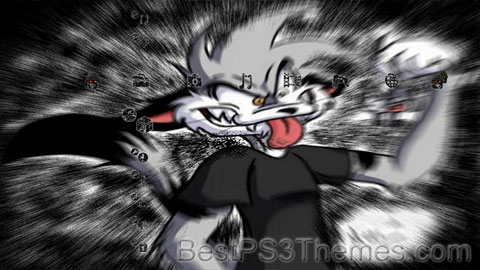
Cartoon Theme 2
(1 background)

A cartoon is a type of visual art that is typically drawn, frequently animated, in an unrealistic or semi-realistic style. The specific meaning has evolved, but the modern usage usually refers to either: an image or series of images intended for satire, caricature, or humor; or a motion picture that relies on a sequence of illustrations for its animation. Someone who creates cartoons in the first sense is called a cartoonist,[1] and in the second sense they are usually called an animator.

The concept originated in the Middle Ages, and first described a preparatory drawing for a piece of art, such as a painting, fresco, tapestry, or stained glass window. In the 19th century, beginning in Punch magazine in 1843, cartoon came to refer – ironically at first – to humorous artworks in magazines and newspapers. Then it also was used for political cartoons and comic strips. When the medium developed, in the early 20th century, it began to refer to animated films that resembled print cartoons.[2]

Fine art[edit]

Christ's Charge to Peter, one of the Raphael Cartoons, c. 1516, a full-size cartoon design for a tapestry

A cartoon (from Italian: cartone and Dutch: karton—words describing strong, heavy paper or pasteboard) is a full-size drawing made on sturdy paper as a design or modello for a painting, stained glass, or tapestry. Cartoons were typically used in the production of frescoes, to accurately link the component parts of the composition when painted on damp plaster over a series of days (giornate).[3] In media such as stained tapestry or stained glass, the cartoon was handed over by the artist to the skilled craftsmen who produced the final work.

Such cartoons often have pinpricks along the outlines of the design so that a bag of soot patted or "pounced" over a cartoon, held against the wall, would leave black dots on the plaster ("pouncing"). Cartoons by painters, such as the Raphael Cartoons in London, Francisco Goya's tapestry cartoons, and examples by Leonardo da Vinci, are highly prized in their own right. Tapestry cartoons, usually colored, could be placed behind the loom, where the weaver would replicate the design. As tapestries are worked from behind, a mirror could be placed behind the loom to allow the weaver to see their work; in such cases the cartoon was placed behind the weaver.[2][4]

Mass media[edit]

John Leech, Substance and Shadow (1843), published as Cartoon, No. 1 in Punch, the first use of the word cartoon to refer to a satirical drawing

In print media, a cartoon is a drawing or series of drawings, usually humorous in intent. This usage dates from 1843, when Punch magazine applied the term to satirical drawings in its pages,[5] particularly sketches by John Leech.[6] The first of these parodied the preparatory cartoons for grand historical frescoes in the then-new Palace of Westminster in London.[7]

Davy Jones' Locker, 1892 Punch cartoon by Sir John Tenniel

Sir John Tenniel—illustrator of Alice's Adventures in Wonderlandjoined Punch in 1850, and over 50 years contributed over two thousand cartoons.[8]

Cartoons can be divided into gag cartoons, which include editorial cartoons, and comic strips.

Modern single-panel gag cartoons, found in magazines, generally consist of a single drawing with a typeset caption positioned beneath, or, less often, a speech balloon.[9] Newspaper syndicates have also distributed single-panel gag cartoons by Mel Calman, Bill Holman, Gary Larson, George Lichty, Fred Neher and others. Many consider New Yorker cartoonist Peter Arno the father of the modern gag cartoon (as did Arno himself).[10] The roster of magazine gag cartoonists includes Charles Addams, Charles Barsotti, and Chon Day.

Bill Hoest, Jerry Marcus, and Virgil Partch began as magazine gag cartoonists and moved to syndicated comic strips. Richard Thompson illustrated numerous feature articles in The Washington Post before creating his Cul de Sac comic strip. The sports section of newspapers usually featured cartoons, sometimes including syndicated features such as Chester "Chet" Brown's All in Sport.

Editorial cartoons are found almost exclusively in news publications and news websites. Although they also employ humor, they are more serious in tone, commonly using irony or satire. The art usually acts as a visual metaphor to illustrate a point of view on current social or political topics. Editorial cartoons often include speech balloons and sometimes use multiple panels. Editorial cartoonists of note include Herblock, David Low, Jeff MacNelly, Mike Peters, and Gerald Scarfe.[2]

Comic strips, also known as cartoon strips in the United Kingdom, are found daily in newspapers worldwide, and are usually a short series of cartoon illustrations in sequence. In the United States, they are not commonly called "cartoons" themselves, but rather "comics" or "funnies". Nonetheless, the creators of comic strips—as well as comic books and graphic novels—are usually referred to as "cartoonists". Although humor is the most prevalent subject matter, adventure and drama are also represented in this medium. Some noteworthy cartoonists of humorous comic strips are Scott Adams, Charles Schulz, E. C. Segar, Mort Walker and Bill Watterson.[2]

Political[edit]

Political cartoons are like illustrated editorials that serve visual commentaries on political events. They offer subtle criticism which are cleverly quoted with humour and satire to the extent that the criticized does not get embittered.

The pictorial satire of William Hogarth is regarded as a precursor to the development of political cartoons in 18th century England.[11] George Townshend produced some of the first overtly political cartoons and caricatures in the 1750s.[11][12] The medium began to develop in the latter part of the 18th century under the direction of its great exponents, James Gillray and Thomas Rowlandson, both from London. Gillray explored the use of the medium for lampooning and caricature, and has been referred to as the father of the political cartoon.[13] By calling the king, prime ministers and generals to account for their behaviour, many of Gillray's satires were directed against George III, depicting him as a pretentious buffoon, while the bulk of his work was dedicated to ridiculing the ambitions of revolutionary France and Napoleon.[13] George Cruikshank became the leading cartoonist in the period following Gillray, from 1815 until the 1840s. His career was renowned for his social caricatures of English life for popular publications.

A cartoon showing a circle of men pointing their fingers at the man to their right with grimaces on their faces.
Nast depicts the Tweed Ring: "Who stole the people's money?" / "'Twas him."

By the mid 19th century, major political newspapers in many other countries featured cartoons commenting on the politics of the day. Thomas Nast, in New York City, showed how realistic German drawing techniques could redefine American cartooning.[14] His 160 cartoons relentlessly pursued the criminal characteristic of the Tweed machine in New York City, and helped bring it down. Indeed, Tweed was arrested in Spain when police identified him from Nast's cartoons.[15] In Britain, Sir John Tenniel was the toast of London.[16] In France under the July Monarchy, Honoré Daumier took up the new genre of political and social caricature, most famously lampooning the rotund King Louis Philippe.

Political cartoons can be humorous or satirical, sometimes with piercing effect. The target of the humor may complain, but can seldom fight back. Lawsuits have been very rare; the first successful lawsuit against a cartoonist in over a century in Britain came in 1921, when J. H. Thomas, the leader of the National Union of Railwaymen (NUR), initiated libel proceedings against the magazine of the British Communist Party. Thomas claimed defamation in the form of cartoons and words depicting the events of "Black Friday", when he allegedly betrayed the locked-out Miners' Federation. To Thomas, the framing of his image by the far left threatened to grievously degrade his character in the popular imagination. Soviet-inspired communism was a new element in European politics, and cartoonists unrestrained by tradition tested the boundaries of libel law. Thomas won the lawsuit and restored his reputation.[17]

Scientific[edit]

Cartoons such as xkcd have also found their place in the world of science, mathematics, and technology. For example, the cartoon Wonderlab looked at daily life in the chemistry lab. In the U.S., one well-known cartoonist for these fields is Sidney Harris. Many of Gary Larson's cartoons have a scientific flavor.

Comic books[edit]

The first comic-strip cartoons were of a humorous tone.[18] Notable early humor comics include the Swiss comic-strip book Mr. Vieux Bois (1837), the British strip Ally Sloper (first appearing in 1867) and the American strip Yellow Kid (first appearing in 1895).

In the United States in the 1930s, books with cartoons were magazine-format "American comic books" with original material, or occasionally reprints of newspaper comic strips.[19]

In Britain in the 1930s, adventure comic magazines became quite popular, especially those published by DC Thomson; the publisher sent observers around the country to talk to boys and learn what they wanted to read about. The story line in magazines, comic books and cinema that most appealed to boys was the glamorous heroism of British soldiers fighting wars that were exciting and just.[20] DC Thomson issued the first The Dandy Comic in December 1937. It had a revolutionary design that broke away from the usual children's comics that were published broadsheet in size and not very colourful. Thomson capitalized on its success with a similar product The Beano in 1938.[21]

On some occasions, new gag cartoons have been created for book publication.

Animation[edit]

a running horse (animated)
An animated cartoon horse, drawn by rotoscoping from Eadweard Muybridge's 19th-century photos

Because of the stylistic similarities between comic strips and early animated films, cartoon came to refer to animation, and the word cartoon is currently used in reference to both animated cartoons and gag cartoons.[22] While animation designates any style of illustrated images seen in rapid succession to give the impression of movement, the word "cartoon" is most often used as a descriptor for television programs and short films aimed at children, possibly featuring anthropomorphized animals,[23] superheroes, the adventures of child protagonists or related themes.

In the 1980s, cartoon was shortened to toon, referring to characters in animated productions. This term was popularized in 1988 by the combined live-action/animated film Who Framed Roger Rabbit, followed in 1990 by the animated TV series Tiny Toon Adventures.

See also[edit]

References[edit]

  1. ^ Merriam-Webster's Dictionary.
  2. ^ a b c d Becker 1959
  3. ^ Constable 1954, p. 115.
  4. ^ Adelson 1994, p. 330.
  5. ^ Punch.co.uk. "History of the Cartoon". Archived from the original on 2007-11-11. Retrieved 2007-11-01.
  6. ^ Adler & Hill 2008, p. 30.
  7. ^ "Substance and Shadow: Original Editorial Accompanying "Cartoon, No. I"". Victorian web.org. Retrieved 29 October 2023.
  8. ^ "Sir John Tenniel". National Portrait Gallery. Retrieved 26 August 2022.
  9. ^ Bishop 2009, p. 92.
  10. ^ Maslin, Michael (May 5, 2016). "The Peter Arno Cartoons That Help Rescue The New Yorker". The New Yorker. Retrieved 2018-09-16.
  11. ^ a b Press 1981, p. 34.
  12. ^ Chris Upton. "Birth of England's pocket cartoon". The Free Library.
  13. ^ a b Rowson 2015.
  14. ^ Adler & Hill 2008, p. 24.
  15. ^ Adler & Hill 2008, pp. 49–50.
  16. ^ Morris & Tenniel 2005, p. 344.
  17. ^ Samuel S. Hyde, "'Please, Sir, he called me "Jimmy!' Political Cartooning before the Law: 'Black Friday', J.H. Thomas, and the Communist Libel Trial of 1921", Contemporary British History (2011) 25(4), pp. 521–550.
  18. ^ Harvey, R. C. (2001). "Comedy at the Juncture of Word and Image". In Varnum, Robin; Gibbons, Christina T. (eds.). The Language of Comics: Word and Image. University Press of Mississippi. p. 77. ISBN 978-1-57806-414-4.

    Devil May Cry 4

    Devil May Cry 4 theme by lalilelelomgs

    Download: DevilMayCry4.p3t

    Devil May Cry 4 Theme
    (1 background, DMC background HD only)

    Devil May Cry 4
    Developer(s)Capcom
    Publisher(s)Capcom
    Director(s)Hideaki Itsuno
    Producer(s)Hiroyuki Kobayashi
    Writer(s)Bingo Morihashi
    Composer(s)
    SeriesDevil May Cry
    EngineMT Framework[1]
    Platform(s)
    Release
    January 31, 2008
    • PlayStation 3, Xbox 360
      • JP: January 31, 2008
      • NA: February 5, 2008
      • AU: February 7, 2008
      • EU: February 8, 2008
      Microsoft Windows
      • NA: July 8, 2008
      • AU: July 10, 2008
      • EU: July 11, 2008
      • JP: July 24, 2008
      Android, iOS
      • WW: February 3, 2011
      Shield Android TV
      • WW: 2016
    Genre(s)Action-adventure, hack and slash
    Mode(s)Single-player

    Devil May Cry 4[a] is a 2008 action-adventure game developed and published by Capcom. It was released for the PlayStation 3, Xbox 360, and Microsoft Windows platforms. It is the fourth installment in the Devil May Cry series and is written by Bingo Morihashi and directed by Hideaki Itsuno. The story follows Nero, a young man possessing demonic powers who is on a mission to stop the series' main character, Dante, after he assassinates the leader of the Order of the Sword. The player assumes the role of both Nero and Dante as they fight enemies using their demonic powers and a variety of weapons.

    Devil May Cry 4 is the first entry in the series to be released simultaneously for multiple consoles. During its development, Capcom focused on each version achieving the same visual quality using the MT Framework game engine. Around eighty people formed the team that created the game. Nero was introduced to attract the new gamers. Dante's popularity with gamers proved challenging because the developers needed to use him as a supporting character in the story.

    Critical reception to Devil May Cry 4 was positive. It was praised for its challenging difficulty, its visuals and Nero's characterization as a new protagonist. However, it was criticized for its backtracking in Dante's stages and a troublesome camera. The game sold over three million units worldwide, becoming the series' best-selling title before the release of its sequel. Bingo Morihashi adapted it into a two-volume light novel.

    It was released on iOS as Devil May Cry 4: Refrain in February 2011. A remastered version of the game was released in June 2015 as Devil May Cry 4: Special Edition which adds both English and Japanese voice tracks, improved visual effects and textures, in-game re-balancing, additional costumes, and three bonus playable characters: Vergil, Lady and Trish. A sequel, Devil May Cry 5, was released on March 8, 2019.

    Gameplay[edit]

    Gameplay in Devil May Cry 4 is like previous games in the series. The player must fight through levels called "missions", occasionally solving puzzles or gathering items. Performance in a mission is graded from "D", the lowest grade, to "A" then "S", "SS", and "SSS", the highest grade. Grades are based on items used, Red Orbs gathered, time taken, and the number of Style Points accumulated. Each Style Point grade has its own tag-word. The stylish grade shows up on the side of the screen and begins at "Deadly" (D); progresses through "Carnage" (C), "Brutal" (B), and "Atomic" (A); then, advances through one last bar of grades containing the phrases "Smokin'" (S), "Smokin' Style" (SS), and lastly "Smokin' Sick Style" (SSS). Stylish combat is the focus of the game, conveyed through unbroken combos of varied attacks while avoiding damage. The player must avoid enemy attacks to continue performing combos, often by memorizing attack patterns.[2] The Devil Trigger is a super state that enables the player to become more powerful adding a slow but steady health regeneration, with increased damage done. Devil Trigger can be activated by pressing the button to trigger it when the gauge is filled.[2]

    Some changes introduced in Devil May Cry 4 are the presence of two playable characters, Dante and Nero, and a slight modification to the shop system. A new currency, Proud Souls, is used to buy new abilities while Red Orbs are used to buy items. Proud Souls are rewarded at the end of missions; the amount varies depending on how well the player performed. The cost of abilities increases with the purchase of other abilities, though all abilities can be sold back for their original price.[2]

    Nero uses his Devil Bringer ability to parry Dante's attack. The green bar at the top shows Nero's health while the yellow one shows Dante's.

    The player plays as Nero throughout most of the game. He is equipped with the Red Queen sword, Blue Rose revolver, and the powers of his Devil Bringer. The Red Queen features an Exceed Gauge that can be charged up to the 3 stages, allowing for subsequent attacks that are more powerful than regular slashes, until the gauge empties. Nero also has the powers of his Devil Bringer and can use it to pull himself towards enemies or vice versa. The Devil Bringer may also be used for context-sensitive throw attacks, leading to high damage and various effects depending on the enemy. Nero's Devil Bringer also gains new abilities during the game, including being able to detect secret missions or caches of Red Orbs. Nero eventually gains the ability to use Devil Trigger after getting the katana known as Yamato. This increases his Devil Bringer's power changing its attacks into more powerful versions with different animations.[2]

    The player plays as Dante through seven missions, taking over halfway through the game. His gameplay is like that in Devil May Cry 3. He has access to multiple melee and ranged weapons which he gains after boss battles. He is able to cycle through them freely in combat and is no longer limited to equipping two weapons of each type as he was in the previous game. Dante also begins with his four styles, each of which grants him different abilities. But, unlike in Devil May Cry 3, he may now switch them at will with buttons or pads on the controller.[3] He also gains the Dark Slayer style near the end of his appearance, which only has one style level. Styles do not level up through experience as in the previous game, but instead must be upgraded like other skills in the shop screen in between missions or at statues. Dante can also enter Devil Trigger where he gains most of the benefits that Nero's Devil Trigger has. Since he does not have the Devil Bringer, he gets animation and property changes on some of his normal attacks instead.[2]

    Plot[edit]

    Nero is a young demon hunter who lives on the isolated island of Fortuna and is also a member of the Order of the Sword: a religious sect of knights who worship the Legendary Dark Knight Sparda as a God. Dante arrives, and murders The Order's leader, the High Priest Sanctus, in front of the entire congregation. At the same time, an army of demons invade the city, putting everyone, including Nero's love interest Kyrie, in danger. Tasked with stopping Dante by Kyrie's brother Credo,[4] the Captain of the Holy Knights, Nero's journey leads him to discover that he is in fact a descendant of Sparda himself, and Dante is not his enemy.[5] Under orders from Sanctus, Agnus, has been siphoning the power of the long lost Devil Arm Yamato, the sword of Dante's brother Vergil, to create a demonic army, and imbue high-ranking members of the Order with demonic power.[6] To Agnus' shock, the shattered Yamato restores itself in Nero's presence, and flies to Nero's aid.[7] With The Order's plans revealed, Agnus flees to inform the newly resurrected Sanctus.

    As Nero sets his sights on The Order, he discovers to his dismay that Credo is part of the conspiracy, until he ends up being deceived as well when they witness Kyrie being kidnapped by Sanctus. He intends to use a creature known as Savior to defeat the demon army he's created, as a means of strengthening the people's worship of Sparda. With the Sparda Sword already in his possession, and needing the blood of a descendant of Sparda along with the Yamato, Sanctus captures Nero to power The Savior's core.[8] Dante arrives, with Trish, who was revealed to be a spy within The Order, and makes a promise to the dying Credo to save Nero and Kyrie.[9] Splitting up, Trish evacuates Fortuna's human residents, while Dante destroys all the Hell Gates scattered over Fortuna, and defeats Agnus, reclaiming the Yamato sword for the last time. Confronting the Savior in a sky battle above Fortuna, Dante drives the Yamato through The Savior's chest,[10] where Nero recovers it inside, freeing himself and Kyrie, and defeating Sanctus.

    Nero is able to make peace with the power it has given him to protect those he cares about. Before Dante leaves, he decides to entrust Nero with the Yamato,[11] and Kyrie and Nero share their first kiss in the ruins of Fortuna.[12] Back at Dante's office, Lady arrives. As previously revealed in the game, it was Lady who sent Dante and Trish to Fortuna in the first place as The Order had begun butting in on some of her jobs, which was why Trish immediately went undercover to expose The Order's true colors. As Trish and Lady bicker over the small reward, Dante gets a phone call from a customer and the trio moves out of the office for a new mission.

    Development[edit]

    Vatican City was one of the main inspirations for the fictional city of Fortuna.

    Development of Devil May Cry 4 began shortly after its predecessor was a success.[13] A total of eighty people formed the development team.[14] The first teaser was that of Dante on a snowy peak shown at E3 2005,[15] while the Tokyo Game Show 2005 trailer showed Dante doing multiple moves in front of a camera,[16] both containing elements that were not included in the finished product. Capcom only made the E3 2005 video to confirm their staff had begun work on the game.[17] Since they had just finished Devil May Cry 3 and Devil May Cry 3: Special Edition, the developers initially were confused in regards to what they had to do in order to innovate the gameplay mechanics they developed previously.[18] The team wanted to introduce new gameplay elements and a new character allowed them to do this. This was the first Devil May Cry not to be released for PlayStation 2, because it was designed for the next generation of hardware. This allowed the team to try new play mechanics and expand the series' plot.[19] While not intending to send a religious message, members from the Capcom team did research in Vatican City and Istanbul.[20]

    On September 6, 2006, Japanese video game magazine Famitsu reported that the previous games' main character, Dante, would not be the protagonist in Devil May Cry 4. Instead, a new character named Nero, voiced and motion captured by Johnny Yong Bosch, took the lead.[21] The use of a new protagonist was discussed many times at Capcom but was not approved until producer Hiroyuki Kobayashi said that the Dante character had to be in the game.[18] Fearing negative feedback, as happened when Konami's stealth game Metal Gear Solid 2: Sons of Liberty introduced a new character, replacing protagonist Solid Snake with newcomer Raiden, producer Kobayashi said Capcom aimed to make Nero fun to play like Dante and intended to make him stronger at some point.[22]

    Two of the game's PC exclusive features are Turbo Mode (previously used only in Devil May Cry 3: Special Edition) giving the game a twenty percent speed boost, and a new difficulty mode called Legendary Dark Knight Mode which can display over 100 enemies in some missions at once.[23] Both features returned in the Devil May Cry 4: Special Edition release.[24]

    The PC version also has both DirectX 9 and DirectX 10 mode. It is labeled Games for Windows and runs on Windows XP, Vista, and Windows 7.[23] It assumes a Gamepad is present and only uses the mouse in the menus, providing the same interface as the Xbox 360 version.

    Engine[edit]

    Hiroyuki Kobayashi noted the production team began working with the game using a PC-based engine. He said that this was the first PlayStation 3 game developed by Capcom, and making this transition was a "hard step", particularly because no member of the production team was familiar with the console's capabilities.[25] Capcom justified the game's multi-platform crossover by emphasizing the Xbox 360's success in the North American and European markets, labeling the move as "natural". The final version of Devil May Cry 4 uses Capcom's internally developed MT Framework engine.[25] In a thread questioning the move on the official Capcom message board, the company's senior director of strategic planning and research, Christian Svensson, responded by saying that they were moved by people's strong feelings about the decision, but that it was the best decision for the company and consumers.[26] He also claimed that the contents would be identical, except that "the feel of the controller" may cause a slight difference.[27] Despite Capcom having already used the MT Framework to create two Xbox 360 games-Dead Rising and Lost Planet, the team found difficulties with this engine.[17] The developers first showed a demo of the game at Tokyo Game Show 2006 where Dante fought the boss character Berial. [28] The visuals satisfied the Capcom staff to the point where they called them a "miracle".[20]

    Itsuno said in the Famitsu article that the visuals attempt to deliver a satisfying feel of being in the air. The actions of Nero's Devil Bringer could not be done on second generation consoles, but they could be done on the new generation of consoles such as the PlayStation 3.[21] Kobayashi said the Xbox 360 and PlayStation 3 versions would be identical, although he did not comment on the PC version.[29] Kobayashi confirmed the PC version "would be great, because the same team is working on both".[27] The PlayStation 3 version requires the user to install 5GB of game data which takes 20 minutes and shortens the length of the loading screens throughout the game.[30]

    During production, new gameplay options were implemented to "keep up with fresh action games"; among these is the Devil Bringer's ability to bring enemies towards the characters.[31] Unlike Dante's progress in Devil May Cry 3, Nero was designed to become stronger by upgrading his Devil Bringer ability instead of receiving new weapons after defeating boss characters. During development the production team decided that Nero would be one of two main characters and that Dante was not going to be the only character from previous entries to appear in the series.[32] Producer Hiroyuki Kobashi noted before the game's release they wanted to make Dante seem significantly more powerful than Nero. This was done to create an obvious difference between the strength of a "veteran" when compared to a "rookie".[33] Unlike Devil May Cry 3, the game's difficulty would be the same in both the Japanese and European versions as the version released in North America.[32]

    Scenario and cast[edit]

    For the first time in the series Bingo Morihashi was the game's writer. He collaborated with film director Yuji Shimomura who worked on the earlier games. Morihashi had many issues with the making of the game to the point he quit Capcom. However, after Itsuno's asked him to return, he did so. He finished writing the game's events, which took a year. Morihashi had difficulties with the characterization of Nero, the new protagonist. Dante returned as a supporting character.[13][34] Itsuno was responsible for most of Kyrie's elements. She was envisioned as an "ordinary, cute heroine" who had a big impact on Nero despite not being a fighter. Her role was to motivate Nero and the player as the story progresses.[34]

    The writings of late manga artist Ramo Nakajima in the series Amagasaki City inspired Morihashi to write Nero's story; "I love you, so I protect the city you love." Love is the focus of the Devil May Cry series; Devil May Cry 4 focuses on Nero's love for Kyrie. While Devil May Cry 4 is a simple story similar to Hollywood movies involving a damsel in distress, the staff were satisfied with it because it also carried Morihashi's ideas well.[35] The Capcom staff created Nero as a new protagonist who would develop across the Devil May Cry series because Dante had become stronger with each game. Nero was created as a weaker character who develops new powers as the story progresses until he reaches Dante's level. This was done mostly through his "Devil Bringer" ability, which makes him stand out. Another reason for Nero's introduction was to attract new gamers to the franchise.[36]

    Before commencing the designs for the characters in Devil May Cry 4, character designer Tatsuya Yoshikawa consulted with several members of the staff who had worked on the series before to become familiar with previous elements. The characters were designed to emphasize their moves, which made the staff controlling their motions vital to the design.[33] Some of the antagonist's demonic forms in Devil May Cry 4 resemble angels. These characters were designed to be attractive to the game's audience while providing a contrast when compared to other demons in the game.[33] Yoshikawa noted that several of the boss characters presented some difficulty when creating them. He said that Nero's design was one of the biggest challenges he had experienced in his career, because the character had to be accepted by the public and fit in the series' universe.[33] Yoshikawa liked the interactions between Nero and Dante because of the balance the two playable characters make.[37]

    Yoshikawa also created another devil transformation, the Devil Trigger, for Nero. Unlike Dante's transformation that makes him look like a devil, Nero's Devil Trigger generates a creature situated behind his back. One that did not appear in the game turned Nero into a demon like Dante. Nero's hood covers one eye as a symbol whose interpretation is left up to the fans. Yoshikawa wanted to incorporate this into the game and hoped to make it into a figurine, but this was not possible.[38]

    Both main voice actors motion capture actors, Reuben Langdon and Bosch, expressed pleasure working as Dante and Nero, respectively with the former noting he made Dante like his younger Devil May Cry 3 persona but more mature. Langdon's inspiration for the character was Roy Focker of the anime series The Super Dimension Fortress Macross.[39][40]

    Music[edit]

    The soundtrack for Devil May Cry 4 was composed by Tetsuya Shibata, Shusaku Uchiyama, Kento Hasegawa, Akihiko Narita, Kota Suzuki, Rei Kondoh, Masayoshi "Chamy" Ishi, Masami Ueda and Shinichiro Sato.[41] Shibata said that since the release of Devil May Cry 3 he had wanted to emphasized lyrics in the fourth title.[42] The game is noted for its use of heavy metal songs.[43]

    Devil May Cry 4 Original Soundtrack is a three-disc, 104 track soundtrack. It was released in Japan on February 27, 2008.[44] [45] Female vocals are handled by Aubrey Ashburn (1-02) while male vocals are handled by Shawn "Shootie HG" McPherson of Hostile Groove (1-20 and 3-03) and Jason "ShyBoy" Arnold of Hypnogaja (1-13 and 3-38). Tetsuya Shibata is credited as the primary composer, with tracks composed by Shusaku Uchiyama, Kota Suzuki, Akihiko Narita, Rei Kondoh, Chamy Ishikawa and Shinichiro Satoh. The soundtrack was released in the US on November 25, 2008, with new artwork.[46]

    Marketing and release[edit]

    The first teaser trailer was shown at E3 2005, depicting Dante traveling through a snow-covered environment.[47] A more substantial trailer was released at that year's Tokyo Game Show, with a more rugged and older Dante in a city-like setting.[48] Both teasers show very little detail of the game itself. At the 2006 Tokyo Game Show, a more complete trailer debuted, along with a playable demo, featuring the character Nero.[49]

    A fourth trailer, released on December 17, 2007, revealed more gameplay and story detail, as well as information on new songs for the game. These included a new version of "Lock and Load", Dante's theme music from the first Devil May Cry, with new lyrics written and performed by Shawn "Shootie HG" McPherson, the lyricist and lead vocalist on the soundtrack of Devil May Cry 3: Dante's Awakening. Released with the Japanese version of the game is Japanese rock band, L'Arc-en-Ciel, and their new single, "Drink It Down", which is used as the Japanese opening for the game.[50] The company presented the game's first demo at an event titled "Capcom's Gamer's Day", where Kobayashi highlighted several of the game's features.[51] With the team focused on completing the game, a new demo was not produced in time for the 2007 E3 Media and Business Summit.[32]

    Collector's Edition[edit]

    A collector's edition of the game was released at the same time as the regular version. The North American version features a bonus disc containing the making of Devil May Cry 4, and an additional disc of the first four episodes of Devil May Cry: The Animated Series,[52] while the European and Australian versions include a signed artbook instead, titled Art of the Devil[53][54][55][56] A very small number of Collector's Edition packages were signed by the game's producer, Hiroyuki Kobayashi, on the back of the metal tin on Dante's left shoulder. This number was reported to be as low as only 100 signed copies for each console, for a total of 200 signed copies. Both versions were packaged in a steelbook case.[57]

    An iOS version called Devil May Cry 4: Refrain was announced January 11, 2011. It was released on February 3, 2011.[58]

    Reception[edit]

    Critical reception[edit]

    Devil May Cry 4 received favorable reviews, according to review aggregator Metacritic.[59][60][61] Japanese gaming magazine Famitsu gave the game a "Platinum" rank as part of its review. It praised the difficulty balance and gameplay options.[64]

    Devil May Cry 4 received praise for its hack and slash mechanics.[64][66][62][72][73] Xbox World Australia called it "the most solid of all of the Devil May Cry games" citing its responsive controls despite being the first game in the series to be released for the Xbox 360 and PlayStation 3.[72] PSM3 rated the game's degree of difficulty positively based on how the system ranks the player and the challenges the game offers.[73] 1UP.com praised the gameplay and "predictably slick" looks. However, sites often criticized the game's backtracking elements, a big issue found within the level design. Some criticized the theme songs.[62][72] The use of boss fights and the approach to the action's style was well received by GameSpot. They felt it would attract and appeal to gamers despite the backtracking issues.[66]

    As to the presentation, GameTrailers praised the voice acting, fight scenes, but criticized the corny dialogue.[68][66] GameSpy said the game succeeds thanks to its gameplay and visuals.[67] The introduction of Nero as new protagonist was well received.[65][71][66][67] Bosch's voice acting in the English-language version was also praised by GameZone and GameSpot.[74][66] Despite the similarities between Nero and Dante, IGN still found the new protagonist appealing based on how different his gameplay is from the returning hero's.[71] IGN agreed, finding Nero's story appealing.[71] The GameSpy review also praised the Nero character for "[bringing] something fresh to the franchise" and being "as diverse as DMC3 SE's Vergil".[67] When it came to the console version, IGN said fans would enjoy the video game, but might be disappointed that Dante had fewer weapons and missions than he did in Devil May Cry 3.[71] GameSpy also said that "it cheapens things a little to see that the team has opted to recycle assets in lieu of showing us more of this rich world". They did not find the soundtrack appealing.[67] Hyper's Dirk Watch commended the game for "looking great, combos galore and being more fun than Devil May Cry 3". However, he criticized it for "still playing like Devil May Cry 2" and for its "choppy pacing and level design".[75]

    The PC version received mixed reviews. 1UP.com appreciated the port's exclusive Legendary Dark Knight mode where the character is cornered by multiple enemies in a single battle. However, they felt that Capcom could have made a more comfortable controller as it had similar issues as the one from Resident Evil 4. They expected the developers to have put in more features.[76] While also appreciating Dark Knight and the Turbo mode that increased the game's speed, IGN said this port was only for hardcore fans of the series since it was not too different from the original console versions.

    Posts pagination