Balrog

Balrog theme by Wolfix

Download: Balrog.p3t
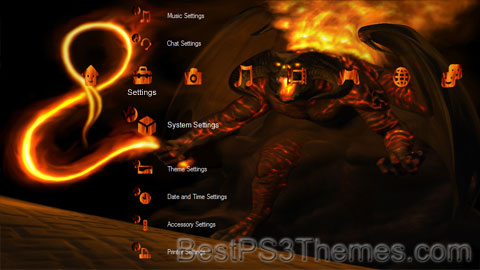
Balrog Theme
(1 background, SD only)

A Balrog (/ˈbælrɒɡ/) is a powerful demonic monster in J. R. R. Tolkien's Middle-earth. One first appeared in print in his high-fantasy novel The Lord of the Rings, where the Fellowship of the Ring encounter a Balrog known as Durin's Bane in the Mines of Moria. Balrogs appear also in Tolkien's The Silmarillion and his legendarium. Balrogs are tall and menacing beings who can shroud themselves in fire, darkness, and shadow. They are armed with fiery whips "of many thongs",[T 1] and occasionally use long swords.

In Tolkien's later conception, Balrogs could not be readily vanquished—a certain stature was required by the would-be hero. Only dragons rivalled their capacity for ferocity and destruction,[T 2] and during the First Age of Middle-earth, they were among the most feared of Morgoth's forces. Their power came from their nature as Maiar, angelic beings like the Valar, though of lesser power. Tolkien invented the name "Balrog", providing an in-universe etymology for it as a word in his invented Sindarin language. He may have gained the idea of a fire demon from his philological study of the Old English word Sigelwara, which he studied in detail in the 1930s. Balrogs appear in the film adaptations of The Lord of the Rings by Ralph Bakshi and Peter Jackson, in the streaming series The Rings of Power, and in computer and video games based on Middle-earth.

Context[edit]

According to the fictional history in The Silmarillion, the evil Vala Melkor corrupted lesser Maiar (angelic beings) to his service, as Balrogs, in the days of his splendour before the making of Arda.[T 3][T 4] Upon the awakening of the Elves, the Valar captured Melkor and destroyed his fortresses Utumno and Angband. But they overlooked the deepest pits, where, with many of Melkor's other allies, the Balrogs fled into hiding. When Melkor returned to Middle-earth from Valinor, now bearing the epithet Morgoth, he was attacked by the evil giant spider Ungoliant; his scream drew the Balrogs out of hiding to his rescue.[T 4]

Characteristics[edit]

Gandalf fighting the Balrog on the bridge of Khazad-dûm. Scraperboard illustration by Alexander Korotich, 1981

Tolkien's conception of Balrogs changed over time. In all his early writing, they are numerous. A host of a thousand is mentioned in the Quenta Silmarillion,[T 5] while at the storming of Gondolin Balrogs in the hundreds ride on the backs of the Dragons.[T 6] They are roughly of twice[T 7] human size,[T 8] and were rarely killed in battle.[T 9] They were fierce demons, associated with fire, armed with fiery whips of many thongs and claws like steel, and Morgoth delighted in using them to torture his captives.[T 10]

In the published version of The Lord of the Rings, however, Balrogs became altogether more sinister and more powerful. Christopher Tolkien notes the difference, saying that in earlier versions they were "less terrible and certainly more destructible". He quotes a very late marginal note[T 11] that was not incorporated into the text saying "at most seven" ever existed;[T 12] though in the Annals of Aman, written as late as 1958, Melkor still commands "a host of Balrogs".[T 13] In later writings they ceased to be creatures, but are instead Maiar, lesser Ainur like Gandalf or Sauron, spirits of fire whom Melkor had corrupted before the creation of the World.[T 3] Power of the order of Gandalf's was necessary to destroy them, as when Gandalf at the Bridge of Khazad-dûm tells the others "This is a foe beyond any of you."[T 14]

As Maiar, only their physical forms could be destroyed. Tolkien says of the Valar and the Maiar that they can change their shape at will, and move unclad in the raiment of the world, meaning invisible and without form.[T 15] But it seems that Morgoth, Sauron, and their associated Maiar could lose this ability: Morgoth, for example, was unable to heal his burns from the Silmarils or wounds from Fingolfin and the eagle Thorondor;[T 16] and Sauron lost his ability to assume a fair-seeming form after his physical body was destroyed in the downfall of Númenor.[T 17]

Tolkien does not address this specifically for Balrogs, though in his later conception, as at the Bridge of Khazad-dûm, the Balrog appears "like a great shadow, in the middle of which was a dark form, of man-shape maybe, yet greater". Though previously the Balrog had entered the "large square chamber" of Mazarbul, at the Bridge of Khazad-dûm it "drew itself to a great height, and its wings spread from wall to wall" in the vast hall.[T 14] The Balrog's size and shape, therefore, are not given precisely. When Gandalf threw it from the peak of Zirakzigil, the Balrog "broke the mountain-side where he smote it in his ruin".[T 18] Whether Balrogs had wings (and if so, whether they could fly) is unclear.[1] This is due both to Tolkien's changing conception of Balrogs, and to the imprecise but suggestive and possibly figurative description of the Balrog that confronted Gandalf.[T 14]

The Balrog of Moria used a flaming sword ("From out of the shadow a red sword leapt flaming") and a many-thonged whip that "whined and cracked" in its battle with Gandalf. In The Silmarillion, they also used black axes and maces.[T 19] Earlier writings also speak of steel claws and iron mail.[T 20]

In earlier drafts of The Lord of the Rings, some further indications of Tolkien's evolving conceptions appear, as when

A figure strode to the fissure, no more than man-high yet terror seemed to go before it. They could see the furnace-fire of its eyes from afar; its arms were very long; it had a red [?tongue].[T 21]

At this writing Tolkien contemplated an edict of the Valar concerning Balrogs, having Gandalf challenge the Balrog by saying "It is forbidden for any Balrog to come beneath the sky since Fionwë[a] son of Manwë overthrew Thangorodrim."[T 21]

Individual Balrogs[edit]

Gothmog[edit]

Gothmog at the Storming of Gondolin.[T 22] Artwork by Tom Loback

Gothmog is developed in successive versions of Silmarillion material. He is physically massive and strong, and in one version he is some 12 feet tall.[T 23] He wields a black axe and whip of flame as his weapons. He holds the titles of the Lord of the Balrogs, the High Captain of Angband, and Marshal of the Hosts. In the Second Battle, Dagor-nuin-Giliath, he leads a force that ambushes Fëanor and wounds him mortally.[T 24] He leads Balrogs, Orc-hosts, and Dragons as Morgoth's commander in the field in the Fifth Battle, Nírnaeth Arnoediad, and slays Fingon, High King of the Noldor. In that same battle, he captures Húrin of Dor-lómin, who had slain his personal guard of Battle-trolls, and brings him to Angband.[T 25] As Marshal of the Hosts, he is in command of the Storming of Gondolin. He is about to kill Tuor when Ecthelion of the Fountain, a Noldorin Elf-lord, intervenes. Gothmog fights Ecthelion in single combat, and they kill each other.[T 26]

In The Book of Lost Tales, Tolkien describes Kosomot, the original version of Gothmog, as a son of Morgoth and the ogress Fluithuin or Ulbandi.[T 27] Gothmog is Sindarin for "Dread Oppressor".[T 28] Kosomot is often considered Gothmog's Quenya name;[T 29] however, in the Quenya name-list of The Fall of Gondolin another version appears, Kosomoko.[T 30]

In Tolkien's early Lay of the Children of Húrin is "Lungorthin, Lord of Balrogs". This might be another name for Gothmog, though Christopher Tolkien thought it more likely that Lungorthin was simply "a Balrog lord".[T 31]

Durin's Bane[edit]

Durin's Bane, the Balrog in Moria

This Balrog appears in The Lord of the Rings, encountered by the Fellowship of the Ring in the Mines of Moria.[1] It survived the defeat of Morgoth in the War of Wrath, escaping to hide beneath the Misty Mountains.[T 32] For more than five millennia, the Balrog remained in its deep hiding place at the roots of Caradhras,[T 33] one of the Mountains of Moria, until in the Third Age, the mithril-miners of the Dwarf-kingdom of Khazad-dûm disturbed it. The Balrog killed Durin VI, the Dwarf-King of Khazad-dûm, whereafter it was called Durin's Bane by the Dwarves.[T 32][T 34] Avarice, principally for mithril, drove the dwarves to go too deep and awaken the Balrog.[2]

The Dwarves attempted to fight the Balrog, but its power was far too great for them. In their efforts to hold Khazad-dûm against it, many Dwarves were killed: Durin's successor Náin ruled for only a year. The survivors were forced to flee. This disaster reached the Silvan Elves of Lothlórien, many of whom fled the "Nameless Terror".[T 32] From this time Khazad-dûm was known as Moria, Sindarin for "Black Pit" or "Black Chasm".[T 35][T 36]

For another 500 years, Moria was left to the Balrog; though according to Unfinished Tales, Orcs crept in soon after the Dwarves were driven out, leading to Nimrodel's flight.[T 37] Sauron began to put his plans for war into effect, and he sent Orcs and Trolls to the Misty Mountains to bar the passes.[T 34]

During the reign of Thráin II, the Dwarves attempted to retake Moria in the War of the Dwarves and Orcs, culminating in the Battle of Azanulbizar before the eastern gate of Moria. This was a victory for the Dwarves, but the Balrog prevented them from reoccupying Moria. Dáin II Ironfoot, having slain the Orc Azog near the gate, perceived the terror of the Balrog within[T 32] and warned Thráin that Moria was unachievable until some greater force could remove the Balrog. The Dwarves departed and resumed their exile. Despite Dáin's warning, Balin made another attempt to retake Moria.[T 34] His party managed to start a colony, but was massacred a few years later.[T 14]

The Fellowship of the Ring travelled through Moria on the quest to destroy the One Ring in Mount Doom. They were attacked in the Chamber of Mazarbul by Orcs.[T 14] The Fellowship fled through a side door, but when the wizard Gandalf the Grey tried to place a "shutting spell" on the door to block the pursuit behind them, the Balrog entered the chamber on the other side and cast a "terrible" counterspell. Gandalf spoke a word of Command to stay the door, but the door shattered and the chamber collapsed. Gandalf was weakened by this encounter. The company fled with him, but the Orcs and the Balrog, taking a different route, caught up with them at the Bridge of Khazad-dûm. The Elf Legolas instantly recognized the Balrog and Gandalf tried to hold the bridge against it. As Gandalf faced the Balrog, he proclaimed, "You cannot pass, flame of Udûn!", and broke the bridge beneath the Balrog. As it fell, the Balrog wrapped its whip about Gandalf's knees, dragging him to the brink. As the Fellowship looked on in horror, Gandalf cried "Fly, you fools!" and plunged into the darkness below.[T 14]

After a long fall, the two crashed into a deep subterranean lake, which extinguished the flames of the Balrog's body; however it remained "a thing of slime, stronger than a strangling snake". They fought in the water; the Balrog clutched at Gandalf to strangle him, and Gandalf hewed the Balrog with his sword, until finally the Balrog fled into the primordial tunnels of Moria's underworld. Gandalf pursued the monster for eight days, until they climbed to the peak of Zirakzigil, where the Balrog was forced to turn and fight, its body erupting into new flame. Here they fought for two days and nights. In the end, the Balrog was defeated and cast down, breaking the mountainside where it fell "in ruin".[T 18] Gandalf himself died shortly afterwards, but he returned to Middle-earth with greater powers, as Gandalf the White, "until his task was finished". Critics such as Jerram Barrs have recognised this as a transfiguration similar to that of Jesus Christ, suggesting Gandalf's prophet-like status.[3]

The critic Clive Tolley notes that the contest between Gandalf and the Balrog on Durin's bridge somewhat recalls a shamanistic contest, but that a far closer parallel is medieval vision literature, giving the example of St Patrick's Purgatory, and even Dante's Divine Comedy.[4]

In-universe origins[edit]

The name "Balrog", but not the meaning, emerges early in Tolkien's work: it appears in The Fall of Gondolin, one of the earliest texts Tolkien wrote, around 1918. Tolkien began a poem in alliterative verse about the battle of Glorfindel with the Balrog in that text, where both were killed by falling into the abyss, just like Gandalf and the Balrog in The Lord of the Rings.[1]

An early list of names described Balrog as "an Orc-word with no pure equivalent in Tolkien's invented language of Quenya: 'borrowed Malaroko-' ".[T 38] In Gnomish (another of Tolkien's invented languages), Balrog is parsed as balc 'cruel' + graug 'demon', with a Quenya equivalent Malkarauke. Variant forms of the latter include Nalkarauke and Valkarauke.[T 39] By the 1940s, when Tolkien began writing The Lord of the Rings, he had come to think of Balrog as Noldorin balch 'cruel' + rhaug 'demon', with a Quenya equivalent Malarauko (from nwalya- 'to torture' + rauko 'demon').[T 40] The last etymology, appearing in the invented languages Quendi and Eldar, derives Balrog as the Sindarin translation of the Quenya form Valarauko (Demon of Might). This etymology was published in The Silmarillion.[T 41][T 42] Gandalf on the bridge of Khazad-dûm calls the Balrog "flame of Udûn" ( the Sindarin name of Morgoth's fortress Utumno).[T 14]

Real-world origins[edit]

Sigelwara[edit]

SilmarilHaradSigelwara LandAethiopiaSól (Germanic mythology)HearthSowilōsealcommons:File:Tolkien's Sigelwara Etymologies.svg
Imagemap with clickable links. Tolkien's Sigelwara etymologies, leading to major strands of his Legendarium including Balrogs and also the Silmarils and Haradrim.[T 43][5]

Tolkien was a professional philologist, a scholar of comparative and historical linguistics.[T 44] The Balrog and other concepts in his writings derived from the Old English word Sigelwara, used in texts such as the Codex Junius to mean "Aethiopian".[6][7] He wondered why the Anglo-Saxons would have had a word with this meaning, conjecturing that it had formerly had a different meaning. He emended the word to Sigelhearwan, and in his essay "Sigelwara Land",[T 43] explored in detail the two parts of the word. He stated that Sigel meant "both sun and jewel", the former as it was the name of the Sun rune *sowilō (ᛋ), the latter connotation from Latin sigillum, a seal.[5] He decided that Hearwa was related to Old English heorð, "hearth", and ultimately to Latin carbo, "soot". He suggested from all this that Sigelhearwan implied "rather the sons of Muspell than of Ham",[b] a class of demons in Northern mythology "with red-hot eyes that emitted sparks and faces black as soot".[T 43] The Tolkien scholar Tom Shippey states that this both "helped to naturalise the Balrog" and contributed to the Silmarils, which combined the nature of the sun and jewels.[8] The Aethiopians suggested to Tolkien the Haradrim, a dark southern race of men.[T 45][9]

Old Norse, Old English[edit]

A real-world etymological counterpart for the word "Balrog" existed long before Tolkien's languages, in Norse mythology; an epithet of the Norse god Odin was Báleygr, "fire-eyed".[10]

Joe Abbott, writing in Mythlore, notes that the Old Norse Voluspa mentions that the fire-demon Surt carries both a sword and a sviga laevi, a deadly whipping-stick or switch; he suggests that it is "a short step" from that to the Balrog's flaming whip.[1] Abbott makes a connection, too, with the Beowulf poet's account of the monster Grendel: he notes that Tolkien wrote that Grendel was "physical enough in form and power, but vaguely felt as belonging to a different order of being, one allied to the malevolent 'ghosts' of the dead", and compares this with Aragorn's description of the Balrog as "both a shadow and a flame, strong and terrible".[1]

Moria and the Battle of Maldon[edit]

Tolkien felt acutely the error made by the Anglo-Saxon commander, the ealdorman Byrhtnoth, at the Battle of Maldon, allowing the Vikings to step ashore and win the battle. Alexander Bruce, in Mythlore, comments that Tolkien may have used Gandalf's battle with the Balrog on the narrow bridge in Moria to "correct the behavior of the self-serving Byrhtnoth through the actions of the self-less Gandalf".[11] Bruce notes that the Tolkien scholar Janet Brennan Croft also contrasts the two leaders.[11][12]

Alexander Bruce's comparison of Gandalf's stand in Moria with Byrhtnoth's action in the Battle of Maldon[11]
Leader Encounter Action Result
Byrhtnoth Battle of Maldon Allows Viking enemy across causeway Army defeated, Byrhtnoth killed, English pay Danegeld tribute
Gandalf Bridge of Khazad-dûm Holds the bridge against the Balrog Both Gandalf and the Balrog fall into the abyss. The Fellowship escape.

The fall of Gondolin and the fall of Troy[edit]

There are multiple parallels between the Fall of Gondolin and the fall of Troy, as told in the Iliad, but again the tales differ. The Elf Ecthelion leads the charge against the Orcs, and fights Gothmog, the greatest Balrog; they wound each other and both fall into the king's fountain in Gondolin; both drown. Bruce compares this to how Aeneas rallies the Trojans, but fails, and sees king Priam perish.[13]

Adaptations[edit]

The Balrog in Peter Jackson's The Lord of the Rings: The Fellowship of the Ring

The Balrog in Ralph Bakshi's 1978 animated version was named Durin's Bane and had large wings like those of a bat.[14] Peter Jackson's 2001 and 2002 films The Fellowship of the Ring and The Two Towers had similar wings, expressing its "satanic, demonic nature".[14] Earlier artists such as Ted Nasmith had depicted Balrogs without wings; Jackson's films used the design of Tolkien illustrator John Howe, making wings standard, in the same way that Jackson has made pointed ears standard for elves.[14] A Balrog appears in The Lord of the Rings: The Rings of Power, with a similar visual design to Jackson's monster.[15]

Balrogs appear in Middle-earth computer and video games and merchandise. In the real-time strategy game The Lord of the Rings: The Battle for Middle-earth, and its sequel, both based on Jackson's movies, the Balrog can use its wings, although only in short leaps. In the role-playing game The Lord of the Rings: The Third Age, also based on the Jackson movies, the Balrog uses its wings to fly into the air, and comes crashing down, sending a damaging shockwave of flames at the player. In another game based on Jackson's movies, The Lord of the Rings: Conquest, the Balrog is a playable hero.[16][17]

A Balrog features in King Gizzard & the Lizard Wizard's 2017 album Murder of the Universe (2017) as a giant reanimated monster. Songwriter Stu Mackenzie explained: "It might not be the Balrog from Middle Earth, but he is a sort of fire demon."[18]

Early Dungeons & Dragons books featured Balrogs among other Middle-earth characters like Hobbits and Ents; after a lawsuit brought by the Tolkien Estate, these Tolkien-specific names were changed, the Balrogs becoming Balor, after the one-eyed monster of Irish mythology.[19]

In culture[edit]

A now-defunct fantasy writing prize, the Balrog Award, was named after the monsters.[20] The Japanese novel series Restaurant to Another World introduces a Balrog as a butler; this Balrog is described as polite.[21]

Notes[edit]

  1. ^ Eönwë in later versions
  2. ^ Tolkien meant that the Sigelhearwan were not just dark-skinned but also fiery.

References[edit]

Primary[edit]

  1. ^ Tolkien 1977 and its early drafts speak frequently of the whips of fire. The Lays of Beleriand describe Morgoth's prisoners tortured by Balrogs with scourges; and the Balrog in Moria (The Fellowship of the Ring, "The Bridge of Khazad-dûm") is armed explicitly with a "whip of many thongs" or strands.
  2. ^ Tolkien 1984b, "Turambar and the Foalókë", p.85: "yet of all are they [dragons] the most powerful, save it be the Balrogs only."
  3. ^ a b Tolkien 1977, "Valaquenta"
  4. ^ a b Tolkien 1977, ch. 3 "Of the Coming of the Elves and the Captivity of Melkor"
  5. ^

Devil May Cry 4 #4

Devil May Cry 4 theme by _8_

Download: DevilMayCry4_4.p3t
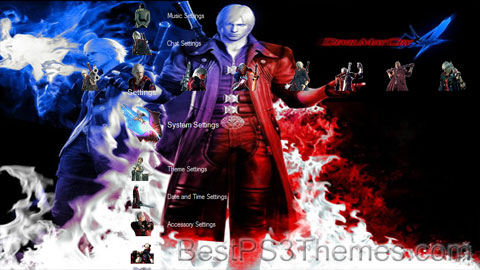
Devil May Cry 4 Theme 4
(2 backgrounds)

Devil May Cry 4
Developer(s)Capcom
Publisher(s)Capcom
Director(s)Hideaki Itsuno
Producer(s)Hiroyuki Kobayashi
Writer(s)Bingo Morihashi
Composer(s)
SeriesDevil May Cry
EngineMT Framework[1]
Platform(s)
Release
January 31, 2008
  • PlayStation 3, Xbox 360
    • JP: January 31, 2008
    • NA: February 5, 2008
    • AU: February 7, 2008
    • EU: February 8, 2008
    Microsoft Windows
    • NA: July 8, 2008
    • AU: July 10, 2008
    • EU: July 11, 2008
    • JP: July 24, 2008
    Android, iOS
    • WW: February 3, 2011
    Shield Android TV
    • WW: 2016
Genre(s)Action-adventure, hack and slash
Mode(s)Single-player

Devil May Cry 4[a] is a 2008 action-adventure game developed and published by Capcom. It was released for the PlayStation 3, Xbox 360, and Microsoft Windows platforms. It is the fourth installment in the Devil May Cry series and is written by Bingo Morihashi and directed by Hideaki Itsuno. The story follows Nero, a young man possessing demonic powers who is on a mission to stop the series' main character, Dante, after he assassinates the leader of the Order of the Sword. The player assumes the role of both Nero and Dante as they fight enemies using their demonic powers and a variety of weapons.

Devil May Cry 4 is the first entry in the series to be released simultaneously for multiple consoles. During its development, Capcom focused on each version achieving the same visual quality using the MT Framework game engine. Around eighty people formed the team that created the game. Nero was introduced to attract the new gamers. Dante's popularity with gamers proved challenging because the developers needed to use him as a supporting character in the story.

Critical reception to Devil May Cry 4 was positive. It was praised for its challenging difficulty, its visuals and Nero's characterization as a new protagonist. However, it was criticized for its backtracking in Dante's stages and a troublesome camera. The game sold over three million units worldwide, becoming the series' best-selling title before the release of its sequel. Bingo Morihashi adapted it into a two-volume light novel.

It was released on iOS as Devil May Cry 4: Refrain in February 2011. A remastered version of the game was released in June 2015 as Devil May Cry 4: Special Edition which adds both English and Japanese voice tracks, improved visual effects and textures, in-game re-balancing, additional costumes, and three bonus playable characters: Vergil, Lady and Trish. A sequel, Devil May Cry 5, was released on March 8, 2019.

Gameplay[edit]

Gameplay in Devil May Cry 4 is like previous games in the series. The player must fight through levels called "missions", occasionally solving puzzles or gathering items. Performance in a mission is graded from "D", the lowest grade, to "A" then "S", "SS", and "SSS", the highest grade. Grades are based on items used, Red Orbs gathered, time taken, and the number of Style Points accumulated. Each Style Point grade has its own tag-word. The stylish grade shows up on the side of the screen and begins at "Deadly" (D); progresses through "Carnage" (C), "Brutal" (B), and "Atomic" (A); then, advances through one last bar of grades containing the phrases "Smokin'" (S), "Smokin' Style" (SS), and lastly "Smokin' Sick Style" (SSS). Stylish combat is the focus of the game, conveyed through unbroken combos of varied attacks while avoiding damage. The player must avoid enemy attacks to continue performing combos, often by memorizing attack patterns.[2] The Devil Trigger is a super state that enables the player to become more powerful adding a slow but steady health regeneration, with increased damage done. Devil Trigger can be activated by pressing the button to trigger it when the gauge is filled.[2]

Some changes introduced in Devil May Cry 4 are the presence of two playable characters, Dante and Nero, and a slight modification to the shop system. A new currency, Proud Souls, is used to buy new abilities while Red Orbs are used to buy items. Proud Souls are rewarded at the end of missions; the amount varies depending on how well the player performed. The cost of abilities increases with the purchase of other abilities, though all abilities can be sold back for their original price.[2]

Nero uses his Devil Bringer ability to parry Dante's attack. The green bar at the top shows Nero's health while the yellow one shows Dante's.

The player plays as Nero throughout most of the game. He is equipped with the Red Queen sword, Blue Rose revolver, and the powers of his Devil Bringer. The Red Queen features an Exceed Gauge that can be charged up to the 3 stages, allowing for subsequent attacks that are more powerful than regular slashes, until the gauge empties. Nero also has the powers of his Devil Bringer and can use it to pull himself towards enemies or vice versa. The Devil Bringer may also be used for context-sensitive throw attacks, leading to high damage and various effects depending on the enemy. Nero's Devil Bringer also gains new abilities during the game, including being able to detect secret missions or caches of Red Orbs. Nero eventually gains the ability to use Devil Trigger after getting the katana known as Yamato. This increases his Devil Bringer's power changing its attacks into more powerful versions with different animations.[2]

The player plays as Dante through seven missions, taking over halfway through the game. His gameplay is like that in Devil May Cry 3. He has access to multiple melee and ranged weapons which he gains after boss battles. He is able to cycle through them freely in combat and is no longer limited to equipping two weapons of each type as he was in the previous game. Dante also begins with his four styles, each of which grants him different abilities. But, unlike in Devil May Cry 3, he may now switch them at will with buttons or pads on the controller.[3] He also gains the Dark Slayer style near the end of his appearance, which only has one style level. Styles do not level up through experience as in the previous game, but instead must be upgraded like other skills in the shop screen in between missions or at statues. Dante can also enter Devil Trigger where he gains most of the benefits that Nero's Devil Trigger has. Since he does not have the Devil Bringer, he gets animation and property changes on some of his normal attacks instead.[2]

Plot[edit]

Nero is a young demon hunter who lives on the isolated island of Fortuna and is also a member of the Order of the Sword: a religious sect of knights who worship the Legendary Dark Knight Sparda as a God. Dante arrives, and murders The Order's leader, the High Priest Sanctus, in front of the entire congregation. At the same time, an army of demons invade the city, putting everyone, including Nero's love interest Kyrie, in danger. Tasked with stopping Dante by Kyrie's brother Credo,[4] the Captain of the Holy Knights, Nero's journey leads him to discover that he is in fact a descendant of Sparda himself, and Dante is not his enemy.[5] Under orders from Sanctus, Agnus, has been siphoning the power of the long lost Devil Arm Yamato, the sword of Dante's brother Vergil, to create a demonic army, and imbue high-ranking members of the Order with demonic power.[6] To Agnus' shock, the shattered Yamato restores itself in Nero's presence, and flies to Nero's aid.[7] With The Order's plans revealed, Agnus flees to inform the newly resurrected Sanctus.

As Nero sets his sights on The Order, he discovers to his dismay that Credo is part of the conspiracy, until he ends up being deceived as well when they witness Kyrie being kidnapped by Sanctus. He intends to use a creature known as Savior to defeat the demon army he's created, as a means of strengthening the people's worship of Sparda. With the Sparda Sword already in his possession, and needing the blood of a descendant of Sparda along with the Yamato, Sanctus captures Nero to power The Savior's core.[8] Dante arrives, with Trish, who was revealed to be a spy within The Order, and makes a promise to the dying Credo to save Nero and Kyrie.[9] Splitting up, Trish evacuates Fortuna's human residents, while Dante destroys all the Hell Gates scattered over Fortuna, and defeats Agnus, reclaiming the Yamato sword for the last time. Confronting the Savior in a sky battle above Fortuna, Dante drives the Yamato through The Savior's chest,[10] where Nero recovers it inside, freeing himself and Kyrie, and defeating Sanctus.

Nero is able to make peace with the power it has given him to protect those he cares about. Before Dante leaves, he decides to entrust Nero with the Yamato,[11] and Kyrie and Nero share their first kiss in the ruins of Fortuna.[12] Back at Dante's office, Lady arrives. As previously revealed in the game, it was Lady who sent Dante and Trish to Fortuna in the first place as The Order had begun butting in on some of her jobs, which was why Trish immediately went undercover to expose The Order's true colors. As Trish and Lady bicker over the small reward, Dante gets a phone call from a customer and the trio moves out of the office for a new mission.

Development[edit]

Vatican City was one of the main inspirations for the fictional city of Fortuna.

Development of Devil May Cry 4 began shortly after its predecessor was a success.[13] A total of eighty people formed the development team.[14] The first teaser was that of Dante on a snowy peak shown at E3 2005,[15] while the Tokyo Game Show 2005 trailer showed Dante doing multiple moves in front of a camera,[16] both containing elements that were not included in the finished product. Capcom only made the E3 2005 video to confirm their staff had begun work on the game.[17] Since they had just finished Devil May Cry 3 and Devil May Cry 3: Special Edition, the developers initially were confused in regards to what they had to do in order to innovate the gameplay mechanics they developed previously.[18] The team wanted to introduce new gameplay elements and a new character allowed them to do this. This was the first Devil May Cry not to be released for PlayStation 2, because it was designed for the next generation of hardware. This allowed the team to try new play mechanics and expand the series' plot.[19] While not intending to send a religious message, members from the Capcom team did research in Vatican City and Istanbul.[20]

On September 6, 2006, Japanese video game magazine Famitsu reported that the previous games' main character, Dante, would not be the protagonist in Devil May Cry 4. Instead, a new character named Nero, voiced and motion captured by Johnny Yong Bosch, took the lead.[21] The use of a new protagonist was discussed many times at Capcom but was not approved until producer Hiroyuki Kobayashi said that the Dante character had to be in the game.[18] Fearing negative feedback, as happened when Konami's stealth game Metal Gear Solid 2: Sons of Liberty introduced a new character, replacing protagonist Solid Snake with newcomer Raiden, producer Kobayashi said Capcom aimed to make Nero fun to play like Dante and intended to make him stronger at some point.[22]

Two of the game's PC exclusive features are Turbo Mode (previously used only in Devil May Cry 3: Special Edition) giving the game a twenty percent speed boost, and a new difficulty mode called Legendary Dark Knight Mode which can display over 100 enemies in some missions at once.[23] Both features returned in the Devil May Cry 4: Special Edition release.[24]

The PC version also has both DirectX 9 and DirectX 10 mode. It is labeled Games for Windows and runs on Windows XP, Vista, and Windows 7.[23] It assumes a Gamepad is present and only uses the mouse in the menus, providing the same interface as the Xbox 360 version.

Engine[edit]

Hiroyuki Kobayashi noted the production team began working with the game using a PC-based engine. He said that this was the first PlayStation 3 game developed by Capcom, and making this transition was a "hard step", particularly because no member of the production team was familiar with the console's capabilities.[25] Capcom justified the game's multi-platform crossover by emphasizing the Xbox 360's success in the North American and European markets, labeling the move as "natural". The final version of Devil May Cry 4 uses Capcom's internally developed MT Framework engine.[25] In a thread questioning the move on the official Capcom message board, the company's senior director of strategic planning and research, Christian Svensson, responded by saying that they were moved by people's strong feelings about the decision, but that it was the best decision for the company and consumers.[26] He also claimed that the contents would be identical, except that "the feel of the controller" may cause a slight difference.[27] Despite Capcom having already used the MT Framework to create two Xbox 360 games-Dead Rising and Lost Planet, the team found difficulties with this engine.[17] The developers first showed a demo of the game at Tokyo Game Show 2006 where Dante fought the boss character Berial. [28] The visuals satisfied the Capcom staff to the point where they called them a "miracle".[20]

Itsuno said in the Famitsu article that the visuals attempt to deliver a satisfying feel of being in the air. The actions of Nero's Devil Bringer could not be done on second generation consoles, but they could be done on the new generation of consoles such as the PlayStation 3.[21] Kobayashi said the Xbox 360 and PlayStation 3 versions would be identical, although he did not comment on the PC version.[29] Kobayashi confirmed the PC version "would be great, because the same team is working on both".[27] The PlayStation 3 version requires the user to install 5GB of game data which takes 20 minutes and shortens the length of the loading screens throughout the game.[30]

During production, new gameplay options were implemented to "keep up with fresh action games"; among these is the Devil Bringer's ability to bring enemies towards the characters.[31] Unlike Dante's progress in Devil May Cry 3, Nero was designed to become stronger by upgrading his Devil Bringer ability instead of receiving new weapons after defeating boss characters. During development the production team decided that Nero would be one of two main characters and that Dante was not going to be the only character from previous entries to appear in the series.[32] Producer Hiroyuki Kobashi noted before the game's release they wanted to make Dante seem significantly more powerful than Nero. This was done to create an obvious difference between the strength of a "veteran" when compared to a "rookie".[33] Unlike Devil May Cry 3, the game's difficulty would be the same in both the Japanese and European versions as the version released in North America.[32]

Scenario and cast[edit]

For the first time in the series Bingo Morihashi was the game's writer. He collaborated with film director Yuji Shimomura who worked on the earlier games. Morihashi had many issues with the making of the game to the point he quit Capcom. However, after Itsuno's asked him to return, he did so. He finished writing the game's events, which took a year. Morihashi had difficulties with the characterization of Nero, the new protagonist. Dante returned as a supporting character.[13][34] Itsuno was responsible for most of Kyrie's elements. She was envisioned as an "ordinary, cute heroine" who had a big impact on Nero despite not being a fighter. Her role was to motivate Nero and the player as the story progresses.[34]

The writings of late manga artist Ramo Nakajima in the series Amagasaki City inspired Morihashi to write Nero's story; "I love you, so I protect the city you love." Love is the focus of the Devil May Cry series; Devil May Cry 4 focuses on Nero's love for Kyrie. While Devil May Cry 4 is a simple story similar to Hollywood movies involving a damsel in distress, the staff were satisfied with it because it also carried Morihashi's ideas well.[35] The Capcom staff created Nero as a new protagonist who would develop across the Devil May Cry series because Dante had become stronger with each game. Nero was created as a weaker character who develops new powers as the story progresses until he reaches Dante's level. This was done mostly through his "Devil Bringer" ability, which makes him stand out. Another reason for Nero's introduction was to attract new gamers to the franchise.[36]

Before commencing the designs for the characters in Devil May Cry 4, character designer Tatsuya Yoshikawa consulted with several members of the staff who had worked on the series before to become familiar with previous elements. The characters were designed to emphasize their moves, which made the staff controlling their motions vital to the design.[33] Some of the antagonist's demonic forms in Devil May Cry 4 resemble angels. These characters were designed to be attractive to the game's audience while providing a contrast when compared to other demons in the game.[33] Yoshikawa noted that several of the boss characters presented some difficulty when creating them. He said that Nero's design was one of the biggest challenges he had experienced in his career, because the character had to be accepted by the public and fit in the series' universe.[33] Yoshikawa liked the interactions between Nero and Dante because of the balance the two playable characters make.[37]

Yoshikawa also created another devil transformation, the Devil Trigger, for Nero. Unlike Dante's transformation that makes him look like a devil, Nero's Devil Trigger generates a creature situated behind his back. One that did not appear in the game turned Nero into a demon like Dante. Nero's hood covers one eye as a symbol whose interpretation is left up to the fans. Yoshikawa wanted to incorporate this into the game and hoped to make it into a figurine, but this was not possible.[38]

Both main voice actors motion capture actors, Reuben Langdon and Bosch, expressed pleasure working as Dante and Nero, respectively with the former noting he made Dante like his younger Devil May Cry 3 persona but more mature. Langdon's inspiration for the character was Roy Focker of the anime series The Super Dimension Fortress Macross.[39][40]

Music[edit]

The soundtrack for Devil May Cry 4 was composed by Tetsuya Shibata, Shusaku Uchiyama, Kento Hasegawa, Akihiko Narita, Kota Suzuki, Rei Kondoh, Masayoshi "Chamy" Ishi, Masami Ueda and Shinichiro Sato.[41] Shibata said that since the release of Devil May Cry 3 he had wanted to emphasized lyrics in the fourth title.[42] The game is noted for its use of heavy metal songs.[43]

Devil May Cry 4 Original Soundtrack is a three-disc, 104 track soundtrack. It was released in Japan on February 27, 2008.[44] [45] Female vocals are handled by Aubrey Ashburn (1-02) while male vocals are handled by Shawn "Shootie HG" McPherson of Hostile Groove (1-20 and 3-03) and Jason "ShyBoy" Arnold of Hypnogaja (1-13 and 3-38). Tetsuya Shibata is credited as the primary composer, with tracks composed by Shusaku Uchiyama, Kota Suzuki, Akihiko Narita, Rei Kondoh, Chamy Ishikawa and Shinichiro Satoh. The soundtrack was released in the US on November 25, 2008, with new artwork.[46]

Marketing and release[edit]

The first teaser trailer was shown at E3 2005, depicting Dante traveling through a snow-covered environment.[47] A more substantial trailer was released at that year's Tokyo Game Show, with a more rugged and older Dante in a city-like setting.[48] Both teasers show very little detail of the game itself. At the 2006 Tokyo Game Show, a more complete trailer debuted, along with a playable demo, featuring the character Nero.[49]

A fourth trailer, released on December 17, 2007, revealed more gameplay and story detail, as well as information on new songs for the game. These included a new version of "Lock and Load", Dante's theme music from the first Devil May Cry, with new lyrics written and performed by Shawn "Shootie HG" McPherson, the lyricist and lead vocalist on the soundtrack of Devil May Cry 3: Dante's Awakening. Released with the Japanese version of the game is Japanese rock band, L'Arc-en-Ciel, and their new single, "Drink It Down", which is used as the Japanese opening for the game.[50] The company presented the game's first demo at an event titled "Capcom's Gamer's Day", where Kobayashi highlighted several of the game's features.[51] With the team focused on completing the game, a new demo was not produced in time for the 2007 E3 Media and Business Summit.[32]

Collector's Edition[edit]

A collector's edition of the game was released at the same time as the regular version. The North American version features a bonus disc containing the making of Devil May Cry 4, and an additional disc of the first four episodes of Devil May Cry: The Animated Series,[52] while the European and Australian versions include a signed artbook instead, titled Art of the Devil[53][54][55][56] A very small number of Collector's Edition packages were signed by the game's producer, Hiroyuki Kobayashi, on the back of the metal tin on Dante's left shoulder. This number was reported to be as low as only 100 signed copies for each console, for a total of 200 signed copies. Both versions were packaged in a steelbook case.[57]

An iOS version called Devil May Cry 4: Refrain was announced January 11, 2011. It was released on February 3, 2011.[58]

Reception[edit]

Critical reception[edit]

Devil May Cry 4 received favorable reviews, according to review aggregator Metacritic.[59][60][61] Japanese gaming magazine Famitsu gave the game a "Platinum" rank as part of its review. It praised the difficulty balance and gameplay options.[64]

Devil May Cry 4 received praise for its hack and slash mechanics.[64][66][62][72][73] Xbox World Australia called it "the most solid of all of the Devil May Cry games" citing its responsive controls despite being the first game in the series to be released for the Xbox 360 and PlayStation 3.[72] PSM3 rated the game's degree of difficulty positively based on how the system ranks the player and the challenges the game offers.[73] 1UP.com praised the gameplay and "predictably slick" looks. However, sites often criticized the game's backtracking elements, a big issue found within the level design. Some criticized the theme songs.[62][72] The use of boss fights and the approach to the action's style was well received by GameSpot. They felt it would attract and appeal to gamers despite the backtracking issues.[66]

As to the presentation, GameTrailers praised the voice acting, fight scenes, but criticized the corny dialogue.[68][66] GameSpy said the game succeeds thanks to its gameplay and visuals.[67] The introduction of Nero as new protagonist was well received.[65][71][66][67] Bosch's voice acting in the English-language version was also praised by GameZone and GameSpot.[74][66] Despite the similarities between Nero and Dante, IGN still found the new protagonist appealing based on how different his gameplay is from the returning hero's.[71] IGN agreed, finding Nero's story appealing.[71] The GameSpy review also praised the Nero character for "[bringing] something fresh to the franchise" and being "as diverse as DMC3 SE's Vergil".[67] When it came to the console version, IGN said fans would enjoy the video game, but might be disappointed that Dante had fewer weapons and missions than he did in Devil May Cry 3.[71] GameSpy also said that "it cheapens things a little to see that the team has opted to recycle assets in lieu of showing us more of this rich world". They did not find the soundtrack appealing.[67] Hyper's Dirk Watch commended the game for "looking great, combos galore and being more fun than Devil May Cry 3". However, he criticized it for "still playing like Devil May Cry 2" and for its "choppy pacing and level design".[75]

The PC version received mixed reviews. 1UP.com appreciated the port's exclusive Legendary Dark Knight mode where the character is cornered by multiple enemies in a single battle. However, they felt that Capcom could have made a more comfortable controller as it had similar issues as the one from Resident Evil 4. They expected the developers to have put in more features.[76] While also appreciating Dark Knight and the Turbo mode that increased the game's speed, IGN said this port was only for hardcore fans of the series since it was not too different from the original console versions.

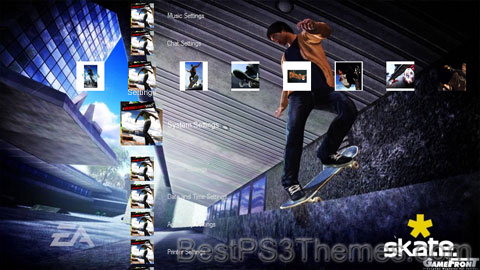
Skate

Skate theme by nosfe59400

Download: Skate.p3t

Skate Theme
(1 background)

Skate or Skates may refer to:

Fish[edit]

Sports[edit]

Ships[edit]

People[edit]

Other[edit]

See also[edit]

Bug-01

Bug-01 theme by BUG

Download: Bug-01.p3t

Bug-01 Theme
(1 background)

P3T Unpacker v0.12
Copyright (c) 2007. Anoop Menon

This program unpacks Playstation 3 Theme files (.p3t) so that you can touch-up an existing theme to your likings or use a certain wallpaper from it (as many themes have multiple). But remember, if you use content from another theme and release it, be sure to give credit!

Download for Windows: p3textractor.zip

Instructions:

Download p3textractor.zip from above. Extract the files to a folder with a program such as WinZip or WinRAR. Now there are multiple ways to extract the theme.

The first way is to simply open the p3t file with p3textractor.exe. If you don’t know how to do this, right click the p3t file and select Open With. Alternatively, open the p3t file and it will ask you to select a program to open with. Click Browse and find p3textractor.exe from where you previously extracted it to. It will open CMD and extract the theme to extracted.[filename]. After that, all you need to do for any future p3t files is open them and it will extract.

The second way is very simple. Just drag the p3t file to p3textractor.exe. It will open CMD and extract the theme to extracted.[filename].

For the third way, first put the p3t file you want to extract into the same folder as p3textractor.exe. Open CMD and browse to the folder with p3extractor.exe. Enter the following:
p3textractor filename.p3t [destination path]Replace filename with the name of the p3t file, and replace [destination path] with the name of the folder you want the files to be extracted to. A destination path is not required. By default it will extract to extracted.filename.

Assassin’s Creed #7

Assassin’s Creed theme by Paja

Download: AssassinsCreed_7.p3t
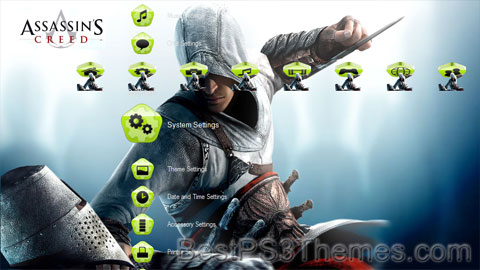
Assassin’s Creed Theme 7
(1 background)

Assassin's Creed
Genre(s)
Developer(s)
Publisher(s)Ubisoft
Creator(s)
First releaseAssassin's Creed
November 13, 2007
Latest releaseAssassin's Creed Nexus VR
November 16, 2023

Assassin's Creed is a historical action-adventure video game series and media franchise published by Ubisoft and developed mainly by its studio Ubisoft Montreal using the game engine Anvil and its more advanced derivatives. Created by Patrice Désilets, Jade Raymond, and Corey May, the Assassin's Creed video game series depicts a fictional millennia-old struggle between the Order of Assassins, who fight for peace and free will, and the Knights Templar, who desire peace through order and control. The series features historical fiction, science fiction, and fictional characters intertwined with real-world historical events and historical figures. In most games, players control a historical Assassin while also playing as an Assassin Initiate or someone caught in the Assassin–Templar conflict in the present-day framing story. Considered a spiritual successor to the Prince of Persia series, Assassin's Creed took inspiration from the novel Alamut by the Slovenian writer Vladimir Bartol, based on the historical Hashashin sect of the medieval Middle East.

The first Assassin's Creed game was released in 2007, and the series has featured thirteen main installments in total, the most recent being Assassin's Creed Mirage in 2023. Main games in the Assassin's Creed series are set in an open world and played from the third-person view. Gameplay revolves around combat, stealth, and exploration, including the use of parkour to navigate the environment. The games feature both main and side missions, and some titles also include competitive and cooperative multiplayer game modes.

A new story and occasionally new time periods are introduced in each entry, with the gameplay elements also evolving. There are three overarching story arcs in the series. The first five main games follow Desmond Miles, a descendant of several important Assassins throughout history, who uses a machine called the Animus to relive his ancestors' memories and find powerful artifacts called Pieces of Eden in an attempt to prevent a catastrophic event, referencing the 2012 phenomenon. From Assassin's Creed IV: Black Flag to Assassin's Creed Syndicate, Assassin initiates and employees of Abstergo (a company used as a front by the modern-day Templars) record genetic memories using the Helix software, helping the Templars and Assassins find new Pieces of Eden in the modern world. The next three games, Assassin's Creed Origins, Odyssey, and Valhalla, follow ex-Abstergo employee Layla Hassan on her own quest to save humanity from another disaster.

The main games in the Assassin's Creed franchise have received generally positive reviews for their ambition in visuals, game design, and narratives, with criticism for the yearly release cycle and frequent bugs, as well as the prioritising of role-playing mechanics in later titles. The series has received multiple awards and nominations, including multiple Game of the Year awards. It is commercially successful, selling over 200 million copies as of September 2022, becoming Ubisoft's best-selling franchise and one of the highest selling video game franchises of all time. While main titles are produced for major consoles and desktop platforms, multiple spin-off games have been released for consoles, mobiles, and handheld platforms. A series of art books, encyclopedias, comics, and novels have also been published. A live-action film adaptation of the series, titled Assassin's Creed, was released in 2016.

Development history[edit]

While the games in the series have had several narrative arcs, Ubisoft views the series as currently having three periods of development and design philosophy. Until 2015's Assassin's Creed Syndicate, the franchise was structured around single-player content, and while centering on open world spaces and several role-playing elements, were more action-adventure and stealth-oriented. Period two, covering from Assassin's Creed Origins to Assassin's Creed Mirage, brought in more role-playing elements and live-service features to increase player engagement. Period three will launch with Assassin's Creed Shadows, using lessons from the second period of development to make engrossing single-player games similar to the original titles but with features to allow players to share achievements and content with others, all to be backed by the Infinity hub system.[1]

Period one[edit]

The first Assassin's Creed game originated out of ideas for a sequel for Ubisoft's video game Prince of Persia: The Sands of Time, aiming for the seventh generation of video game consoles. The Ubisoft Montreal team decided to take the gameplay from The Sands of Time into an open-world approach, taking advantage of the improved processing power to render larger spaces and crowds. Narratively, the team wanted to move away from the Prince being someone next in line for the throne but to have to work for it; combined with research into secret societies led them to focus on the Order of Assassins, based upon the historical Hashashin sect of Ismaili, who were followers of Shia Islam, heavily borrowing from the novel Alamut.[2][3] Ubisoft developed a narrative where the player would control an Assassin escorting a non-playable Prince, leading them to call this game Prince of Persia: Assassin,[4] or Prince of Persia: Assassins.[5] Ubisoft was apprehensive to a Prince of Persia game without the Prince as the playable character, but this led the marketing division to suggest the name Assassin's Creed, playing off the creed of the Assassins, "nothing is true; everything is permitted". Ubisoft Montreal ran with this in creating a new intellectual property, eliminating the Prince, and basing it around the Assassins and the Knights Templar in the Holy Land during the 12th century. Additionally, in postulating what other assassinations they could account for throughout history, they came onto the idea of genetic memory and created the Animus device and modern storyline elements. This further allowed them to explain certain facets of gameplay, such as accounting for when the player character is killed, similar to The Sands of Time.[5]

After Assassin's Creed was released in 2007, Ubisoft Montreal said they looked to "rework the global structure" in developing the sequel, Assassin's Creed II. They felt that parkour was underutilized in the first game and designed the world in the sequel to feature freerun highways to make it easier to enter into parkour moves, for example using rooftops to escape pursuits.[6] The change in setting meant that the game would feature a new cast of characters, including a new protagonist, Ezio Auditore da Firenze. Assassin's Creed II also brought in more use of crowds to hide in plain sight that the developers had seen used in Hitman: Blood Money, adding more to the concept of social stealth as a gameplay option.[6] Finally, Ubisoft Montreal completely reworked the repetitive mission structure from the first game through numerous side activities, collectibles, and secrets. These additions became a central part of the series going forward as well as other Ubisoft games like Watch Dogs, Far Cry, and Tom Clancy's Ghost Recon.[6] Assassin's Creed II was followed by two sequels, Assassin's Creed: Brotherhood and Assassin's Creed: Revelations, which also featured Ezio as the main protagonist and introduced the ability for players to recruit NPCs as Assassins and manage them in missions.[6]

Assassin's Creed III originated from both Ubisoft Montreal, who wanted to progress the series' narrative forward in time, and to an unattached project that had been developed at Ubisoft Singapore and featured naval ship combat. As the main team had settled into the American Revolution period for the game, they found the ship-to-ship combat system fitted with the story and redesigned the setting to incorporate it further. Another major change in Assassin's Creed III was transitioning the parkour and freerun systems to work in the natural woodlands of 18th-century Massachusetts and New York. This further allowed the adding of trees and other vegetation within the city areas themselves, not just as part of the parkour systems, but to add more varied environments, which would continue as part of the series' ongoing design.[6]

For Assassin's Creed III's sequel, Assassin's Creed IV: Black Flag, the Ubisoft team built upon the foundation of its predecessor, particularly with regards to the naval gameplay, merging it seamlessly with the land-based gameplay.[6] The team also used the game as a chance to address aspects of the series' storyline. Choosing to focus on an outsider's perspective to the Assassin–Templar conflict, they set the game around the Golden Age of Piracy, with the protagonist, Edward Kenway, starting out as a pirate who initially becomes involved in the conflict with the prospect of wealth. Similarly, after the conclusion of Desmond Miles' story arc in Assassin's Creed III, the modern-day segments put players in the role of a nameless individual controlled from a first-person perspective. The team chose this approach because they believed it allowed players to more easily identify themselves in their character.[6] This trend would continue in the series until Assassin's Creed Syndicate.[6]

Development of Assassin's Creed Unity began shortly after the completion of Brotherhood in 2010,[7] with the core development team splitting off during the early stages of development on Assassin's Creed III.[8] As the first game in the series to be released exclusively for the eighth generation of video game consoles, Unity featured a graphical and gameplay overhaul. The setting chosen for the game was Paris during the early years of the French Revolution, with players taking control of a new Assassin named Arno Dorian.[7][8] After Unity, Ubisoft released Assassin's Creed Syndicate in 2015.[6]

Period two[edit]

After Syndicate, Ubisoft decided that the series needed a major reinvention across both gameplay and narrative. It was decided to make the next game, Assassin's Creed Origins, closer to a role-playing video game than a stealth-action game, which would also bring a game with many more hours of play than previous titles. Some long-standing features of the series were eliminated for this purpose, such as the social stealth mechanic. This changed how missions were presented — rather than being linearly directed through the Animus, the player character could meet various quest givers in the game's world to receive missions.[6] From the narrative side, Ubisoft placed the game before the formation of the Assassin Brotherhood in Ancient Egypt to make the player character, Bayek of Siwa, a medjay that people would respect and seek the help of.[6] The modern-day storyline also shifted back to a single character, Layla Hassan. The developers limited the number of playable sequences for her character compared to previous games but gave them more meaning, such as allowing the player to explore Layla's laptop with background information on the game's universe.[6]

Origins was followed in 2018 by Assassin's Creed Odyssey, which shifted the setting to Classical Greece and followed a similar approach to its predecessor but with more emphasis on the role-playing elements.[6] 2020's Assassin's Creed Valhalla, set in Medieval England and Norway during the Viking Age, continued the same style as Origins and Odyssey. The developers recognized feedback from the previous two games and brought back the social stealth elements, as well as the concept of a customizable home base that was first introduced in Assassin's Creed II.[6]

In 2023, Ubisoft released Assassin's Creed Mirage, a smaller title which sought to pay tribute to the franchise's earlier installments by focusing on stealth and assassinations over its predecessors' role-playing elements. The game started development as an expansion for Valhalla before being turned into a standalone release, and was set in 9th-century Baghdad during the Islamic Golden Age, a decade before the events of Valhalla, to which it served as a prequel.[9][10]

Future[edit]

In 2022, Ubisoft announced several additional games for the series. Assassin's Creed Infinity has been described by its executive producer, Marc-Alexis Côté, as a "new design philosophy" for the series,[1][11] as well as a hub that will provide the releases of future games.[12] The first two games to be included in Infinity will be Assassin's Creed Shadows, set in Japan during the Sengoku period,[9] and Assassin's Creed: Codename Hexe, rumoured to be set in Central Europe during the 16th century.[13]

Gameplay[edit]

An Assassin's Creed III demo showing the parkour gameplay

The Assassin's Creed games are centered around one or more fictional members of the Order of the Assassins. Their memories are experienced by an in-game character in the modern-day period through a device called the Animus and its derivations. The Animus allows the user to explore these memories passed down via genetics. Within the context of the game, this provides a diegetic interface to the real-world player of the game, showing them elements like health bars, a mini-map, and target objectives as if presented by the Animus. Additionally, should the player cause the historical character to die or fail a mission, this is rectified as desynchronization of the genetic memory, allowing the player to try the mission again. Through the Animus interface, the player can retry any past mission already completed; for example, in Assassin's Creed: Brotherhood, the player achieves better synchronization results by performing the mission in a specific manner, such as by only killing the mission's target. The Animus also imparts special abilities to the modern-day character that helps them to see their target in a crowd or other unique points of interest.[14][15]

While playing as the Assassin characters, the games are generally presented from a third-person view in an open world environment, focusing on stealth and parkour. The games use a mission structure to follow the main story, assigning the player to complete an assassination of public figureheads or a covert mission. Alternatively, several side missions are available, such as mapping out the expansive cities from a high perch followed by performing a leap of faith into a haystack below, collecting treasures hidden across the cities, exploring ruins for relics, building a brotherhood of assassins to perform other tasks, or funding the rebuilding of a city through purchasing and upgrading of shops and other features. At times, the player is in direct control of the modern-day character who, by nature of the Animus use, has learned Assassin techniques through the bleeding effect, as well as their genetic ability of Eagle Vision, which separates friend, foe, and assassination targets by illuminating people in different colors.[16][17]

The games use the concept of active versus passive moves, with active moves, such as running, climbing the sides of buildings, or jumping between rooftops, more likely to alert the attention of nearby guards. When the guards become alerted, the player must either fight them or break their line of sight and locate a hiding place, such as a haystack or a well, and wait until the guards' alert is reduced. The combat system allows for a number of unique weapons, armor, and moves, including the use of a hidden blade set in a bracer on the Assassin's arm, which can be used to perform surreptitious assassinations.[18]

Storyline[edit]

The logo of the fictional Abstergo Industries, whose slogan is "We change the world. Every day, in a hundred different ways."

Premise[edit]

The Assassin's Creed games primarily revolve around the rivalry and conflict between two ancient secret societies: the Order of Assassins, who represent freedom, and the Knights Templar, who represent order. Versions of these societies have existed for centuries, with the Assassins seeking to stop the Templars from gaining control of Pieces of Eden, artifacts that can override free will to control people.[19]

These artifacts are remnants of an ancient species pre-dating humanity called the Isu, or Precursors, which created humanity to live in peace alongside them. The Isu ensured humans could not rise against them by creating the Pieces of Eden to control them. When the first hybrid Isu-human beings emerged, named Adam and Eve, they were immune to the effects of the Pieces of Eden. They stole the Pieces of Eden, which led to a great war that ended when a massive solar flare devastated the surface of the Earth. The Isu began to die out while humanity thrived. Three Isu—Minerva, Juno, and Jupiter—attempted to prepare humanity for a solar flare they knew would come centuries later. Minerva and Jupiter prepared vaults from which humanity could activate a protective shield around Earth with the Pieces of Eden and the Eye, a means to communicate how to find and use these vaults; however, Juno saw humanity as a threat and attempted to sabotage Minerva and Jupiter's plan. Minerva and Jupiter were forced to destroy Juno, unaware she had hidden her consciousness to wake upon activation of the Eye. All that remained of the Isu were the traces of their memories in the world's mythologies, and religions, while the Pieces of Eden were lost to time.[19]

The series takes place in the modern era, in which the Templars have established the mega-corporation Abstergo Industries. Abstergo has developed a device, the Animus, whose user can relive the memories of their ancestors through their genetic material. Abstergo has kidnapped people who are descendants of past Assassins to locate the missing Pieces of Eden via the Animus.[19] A user of the Animus can move about in simulated memories as their ancestor, but performing actions outside the bounds of what their ancestor did can lead to desynchronization of the memory.[14][15] Extended use of the Animus creates a bleeding effect that gives users some of the skills and capabilities they experienced with their ancestor.[20]

Story arcs[edit]

Narrative chronology of the Assassin's Creed games[19]
Game Historical character
Period/era
Present-day character
Assassin's Creed Altaïr Ibn-LaʼAhad
Third Crusade
Desmond Miles
Assassin's Creed II Ezio Auditore da Firenze
Italian Renaissance
Assassin's Creed: Brotherhood
Assassin's Creed: Revelations Ezio Auditore da Firenze
Ottoman Civil War
Altaïr Ibn-LaʼAhad
Third Crusade & Mongol invasion of the Levant
Assassin's Creed III Haytham Kenway
French and Indian War
Ratonhnhaké:ton / Connor
American Revolution
Assassin's Creed IV: Black Flag Edward Kenway
Golden Age of Piracy
"Noob" / Abstergo researcher
Assassin's Creed Rogue Shay Patrick Cormac
French and Indian War
"Numbskull" / Helix researcher
Assassin's Creed Unity Arno Dorian
French Revolution
"The Initiate" / Helix player
Assassin's Creed Syndicate Jacob and Evie Frye
Victorian England
Lydia Frye
World War I
Assassin's Creed Origins Bayek and Aya
Ptolemaic Egypt
Layla Hassan
Assassin's Creed Odyssey Alexios / Kassandra
Peloponnesian War
Assassin's Creed Valhalla Eivor Varinsdottir
Viking invasion of England
Odin / Havi
Isu Era
Layla Hassan
Basim Ibn Ishaq
Assassin's Creed Mirage Basim Ibn Ishaq
Islamic Golden Age
Assassin's Creed Shadows Naoe and Yasuke
Sengoku period

The first five main games in the series focus on Desmond Miles, a bartender who learns he is a descendant of several important Assassins throughout history, including Altaïr Ibn-LaʼAhad from the Middle East during the Third Crusade; Ezio Auditore da Firenze from the Italian Renaissance during the late 15th and early 16th centuries; and Ratonhnhaké:ton (better known as Connor), a half-Mohawk, half-British Assassin during the American Revolution. Desmond is used by Abstergo to find Pieces of Eden but is freed by Lucy Stillman, an undercover agent for the Assassins. Lucy takes Desmond to meet Shaun Hastings and Rebecca Crane, two other members of the modern-day Assassins. The group is joined later by William Miles, Desmond's father. They continue to explore Desmond's memories and eventually discover the Eye and Minerva's warning of another possible solar flare. They also inadvertently free Juno, who then kills Lucy, revealed to be a double agent for the Templars. The group continues to find the vaults across the globe via Desmond's memories, and Desmond ultimately activates them in time to block the solar flare, at the cost of his own life.[19]

Starting with Assassin's Creed IV: Black Flag, William goes into exile, while Shaun and Rebecca continue to monitor Abstergo by posing as employees of one of their spin-off companies, Abstergo Entertainment. Abstergo has refined the Animus technology to allow anyone to experience genetic memories from the DNA material of another person, allowing Abstergo to continue their search for the Pieces of Eden under the guise of creating entertainment products. In Black Flag, the player assumes the role of an unnamed Abstergo employee tasked with scanning the memories of Edward Kenway, a privateer-turned-pirate during the Golden Age of Piracy and Connor's grandfather. During their investigation, the player is blackmailed into helping a fellow employee, John Standish, recover sensitive information and deliver it to the Assassins. John is later revealed to be a Sage, a human reincarnation of Juno's husband Aita, who is trying to resurrect her, though he is killed by Abstergo before his plan can come to fruition.[19] In Assassin's Creed Rogue, the player controls another Abstergo employee who is recruited by the Templars to clean their servers after the Assassins breach them and recover data on the life of Shay Patrick Cormac, an Assassin-turned-Templar from the 18th century. The Assassins are ultimately forced to go underground once more, and the player character is invited to join the Templars.[19]

By the time of Assassin's Creed Unity, Abstergo distributes its Animus product via a video game console named Helix, tapping into an extensive, unaware player base to help them locate more Pieces of Eden and determine the fates of various Sages as part of the Phoenix Project, an attempt to recreate the genetic structure of the Isu. The game's opening has players control an unnamed Templar during the downfall of the Templar Order, while the different "time anomalies" take them to Paris during the Belle Époque, World War II, and the Hundred Years' War. The Assassins locate select players and bring them in as Initiates to help their cause. In Unity, the player character is contacted by an Assassin named Bishop and asked to experience the memories of Arno Dorian, an Assassin active during the French Revolution, so that the modern-day Assassins can locate the body of a Sage and hide it from Abstergo.[19] Despite the Assassins' efforts, Abstergo collects enough samples of other Sages by the start of Assassin's Creed Syndicate to move forward with the Phoenix Project. Again, Bishop contacts the Initiate and asks them to explore the memories of Jacob and Evie Frye, twin Assassins from Victorian England, to locate a Piece of Eden known as the Shroud, which Abstergo needs to complete the process of recreating the Isu genetic structure. Although the Initiate manages to locate the Shroud, the Templars beat the Assassins to it.[19]

A new storyline is introduced in Assassin's Creed Origins focusing on Abstergo researcher Layla Hassan. Initially tasked with locating historical artifacts in Egypt, Layla stumbles upon the mummified corpses of the medjay Bayek and his wife Aya, co-founders of the Hidden Ones, the precursor organizati

Playstation Planet

Playstation Planet theme by kikanny

Download: PlaystationPlanet.p3t
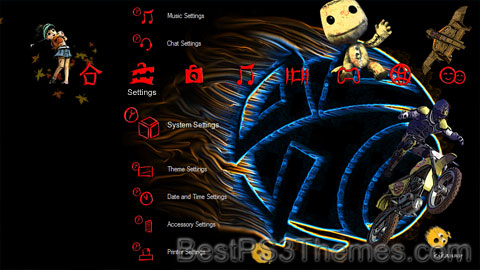
Playstation Planet Theme
(2 backgrounds)

P3T Unpacker v0.12
Copyright (c) 2007. Anoop Menon

This program unpacks Playstation 3 Theme files (.p3t) so that you can touch-up an existing theme to your likings or use a certain wallpaper from it (as many themes have multiple). But remember, if you use content from another theme and release it, be sure to give credit!

Download for Windows: p3textractor.zip

Instructions:

Download p3textractor.zip from above. Extract the files to a folder with a program such as WinZip or WinRAR. Now there are multiple ways to extract the theme.

The first way is to simply open the p3t file with p3textractor.exe. If you don’t know how to do this, right click the p3t file and select Open With. Alternatively, open the p3t file and it will ask you to select a program to open with. Click Browse and find p3textractor.exe from where you previously extracted it to. It will open CMD and extract the theme to extracted.[filename]. After that, all you need to do for any future p3t files is open them and it will extract.

The second way is very simple. Just drag the p3t file to p3textractor.exe. It will open CMD and extract the theme to extracted.[filename].

For the third way, first put the p3t file you want to extract into the same folder as p3textractor.exe. Open CMD and browse to the folder with p3extractor.exe. Enter the following:
p3textractor filename.p3t [destination path]Replace filename with the name of the p3t file, and replace [destination path] with the name of the folder you want the files to be extracted to. A destination path is not required. By default it will extract to extracted.filename.

HAZE – Mantel Global Industries

HAZE – Mantel Global Industries theme by SaintDaveUK

Download: HazeMGI.p3t
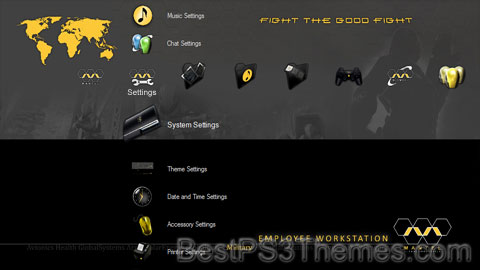
HAZE - Mantel Global Industries Theme
(9 backgrounds)

P3T Unpacker v0.12
Copyright (c) 2007. Anoop Menon

This program unpacks Playstation 3 Theme files (.p3t) so that you can touch-up an existing theme to your likings or use a certain wallpaper from it (as many themes have multiple). But remember, if you use content from another theme and release it, be sure to give credit!

Download for Windows: p3textractor.zip

Instructions:

Download p3textractor.zip from above. Extract the files to a folder with a program such as WinZip or WinRAR. Now there are multiple ways to extract the theme.

The first way is to simply open the p3t file with p3textractor.exe. If you don’t know how to do this, right click the p3t file and select Open With. Alternatively, open the p3t file and it will ask you to select a program to open with. Click Browse and find p3textractor.exe from where you previously extracted it to. It will open CMD and extract the theme to extracted.[filename]. After that, all you need to do for any future p3t files is open them and it will extract.

The second way is very simple. Just drag the p3t file to p3textractor.exe. It will open CMD and extract the theme to extracted.[filename].

For the third way, first put the p3t file you want to extract into the same folder as p3textractor.exe. Open CMD and browse to the folder with p3extractor.exe. Enter the following:
p3textractor filename.p3t [destination path]Replace filename with the name of the p3t file, and replace [destination path] with the name of the folder you want the files to be extracted to. A destination path is not required. By default it will extract to extracted.filename.

Tomb Raider Underworld V2.0

Tomb Raider Underworld V2.0 theme by –Voldo–

Download: TombRaiderUnderworldV2.p3t
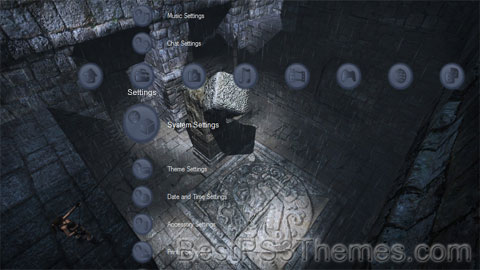
Tomb Raider Underworld V2.0 Theme
(5 backgrounds)

P3T Unpacker v0.12
Copyright (c) 2007. Anoop Menon

This program unpacks Playstation 3 Theme files (.p3t) so that you can touch-up an existing theme to your likings or use a certain wallpaper from it (as many themes have multiple). But remember, if you use content from another theme and release it, be sure to give credit!

Download for Windows: p3textractor.zip

Instructions:

Download p3textractor.zip from above. Extract the files to a folder with a program such as WinZip or WinRAR. Now there are multiple ways to extract the theme.

The first way is to simply open the p3t file with p3textractor.exe. If you don’t know how to do this, right click the p3t file and select Open With. Alternatively, open the p3t file and it will ask you to select a program to open with. Click Browse and find p3textractor.exe from where you previously extracted it to. It will open CMD and extract the theme to extracted.[filename]. After that, all you need to do for any future p3t files is open them and it will extract.

The second way is very simple. Just drag the p3t file to p3textractor.exe. It will open CMD and extract the theme to extracted.[filename].

For the third way, first put the p3t file you want to extract into the same folder as p3textractor.exe. Open CMD and browse to the folder with p3extractor.exe. Enter the following:
p3textractor filename.p3t [destination path]Replace filename with the name of the p3t file, and replace [destination path] with the name of the folder you want the files to be extracted to. A destination path is not required. By default it will extract to extracted.filename.