NFL Seahawks

NFL Seahawks theme by Nightfall24

Download: NFLSeahawks.p3t
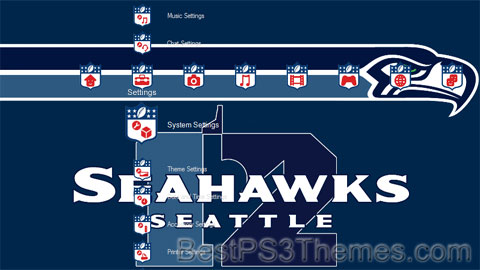
NFL Seahawks Theme
(1 background)

P3T Unpacker v0.12
Copyright (c) 2007. Anoop Menon

This program unpacks Playstation 3 Theme files (.p3t) so that you can touch-up an existing theme to your likings or use a certain wallpaper from it (as many themes have multiple). But remember, if you use content from another theme and release it, be sure to give credit!

Download for Windows: p3textractor.zip

Instructions:

Download p3textractor.zip from above. Extract the files to a folder with a program such as WinZip or WinRAR. Now there are multiple ways to extract the theme.

The first way is to simply open the p3t file with p3textractor.exe. If you don’t know how to do this, right click the p3t file and select Open With. Alternatively, open the p3t file and it will ask you to select a program to open with. Click Browse and find p3textractor.exe from where you previously extracted it to. It will open CMD and extract the theme to extracted.[filename]. After that, all you need to do for any future p3t files is open them and it will extract.

The second way is very simple. Just drag the p3t file to p3textractor.exe. It will open CMD and extract the theme to extracted.[filename].

For the third way, first put the p3t file you want to extract into the same folder as p3textractor.exe. Open CMD and browse to the folder with p3extractor.exe. Enter the following:
p3textractor filename.p3t [destination path]Replace filename with the name of the p3t file, and replace [destination path] with the name of the folder you want the files to be extracted to. A destination path is not required. By default it will extract to extracted.filename.

Future Is Now

Future Is Now theme by OPTIMUS

Download: FutureIsNow.p3t
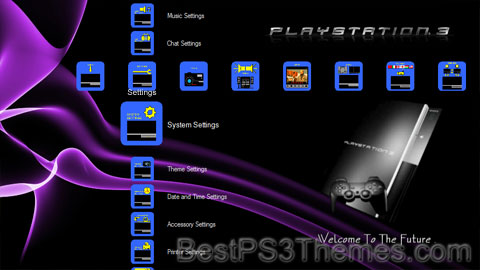
Future Is Now Theme
(1 background)

P3T Unpacker v0.12
Copyright (c) 2007. Anoop Menon

This program unpacks Playstation 3 Theme files (.p3t) so that you can touch-up an existing theme to your likings or use a certain wallpaper from it (as many themes have multiple). But remember, if you use content from another theme and release it, be sure to give credit!

Download for Windows: p3textractor.zip

Instructions:

Download p3textractor.zip from above. Extract the files to a folder with a program such as WinZip or WinRAR. Now there are multiple ways to extract the theme.

The first way is to simply open the p3t file with p3textractor.exe. If you don’t know how to do this, right click the p3t file and select Open With. Alternatively, open the p3t file and it will ask you to select a program to open with. Click Browse and find p3textractor.exe from where you previously extracted it to. It will open CMD and extract the theme to extracted.[filename]. After that, all you need to do for any future p3t files is open them and it will extract.

The second way is very simple. Just drag the p3t file to p3textractor.exe. It will open CMD and extract the theme to extracted.[filename].

For the third way, first put the p3t file you want to extract into the same folder as p3textractor.exe. Open CMD and browse to the folder with p3extractor.exe. Enter the following:
p3textractor filename.p3t [destination path]Replace filename with the name of the p3t file, and replace [destination path] with the name of the folder you want the files to be extracted to. A destination path is not required. By default it will extract to extracted.filename.

The Lost Lake

The Lost Lake theme by OPTIMUS

Download: TheLostLake.p3t
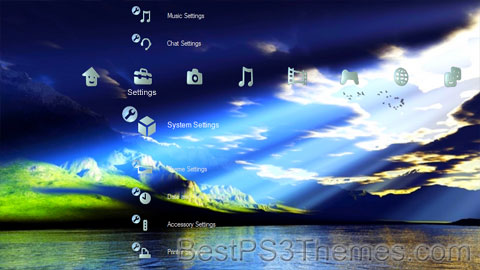
The Lost Lake Theme
(1 background)

P3T Unpacker v0.12
Copyright (c) 2007. Anoop Menon

This program unpacks Playstation 3 Theme files (.p3t) so that you can touch-up an existing theme to your likings or use a certain wallpaper from it (as many themes have multiple). But remember, if you use content from another theme and release it, be sure to give credit!

Download for Windows: p3textractor.zip

Instructions:

Download p3textractor.zip from above. Extract the files to a folder with a program such as WinZip or WinRAR. Now there are multiple ways to extract the theme.

The first way is to simply open the p3t file with p3textractor.exe. If you don’t know how to do this, right click the p3t file and select Open With. Alternatively, open the p3t file and it will ask you to select a program to open with. Click Browse and find p3textractor.exe from where you previously extracted it to. It will open CMD and extract the theme to extracted.[filename]. After that, all you need to do for any future p3t files is open them and it will extract.

The second way is very simple. Just drag the p3t file to p3textractor.exe. It will open CMD and extract the theme to extracted.[filename].

For the third way, first put the p3t file you want to extract into the same folder as p3textractor.exe. Open CMD and browse to the folder with p3extractor.exe. Enter the following:
p3textractor filename.p3t [destination path]Replace filename with the name of the p3t file, and replace [destination path] with the name of the folder you want the files to be extracted to. A destination path is not required. By default it will extract to extracted.filename.

Gran Turismo Prologue

Gran Turismo Prologue theme by nosfe59400

Download: GranTurismoPrologue.p3t
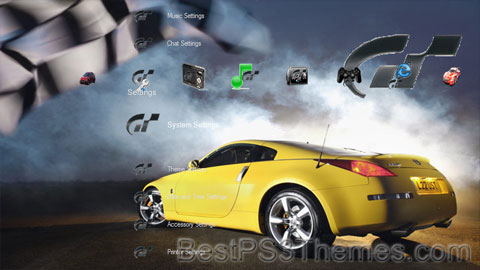
Gran Turismo Prologue Theme
(3 backgrounds)

P3T Unpacker v0.12
Copyright (c) 2007. Anoop Menon

This program unpacks Playstation 3 Theme files (.p3t) so that you can touch-up an existing theme to your likings or use a certain wallpaper from it (as many themes have multiple). But remember, if you use content from another theme and release it, be sure to give credit!

Download for Windows: p3textractor.zip

Instructions:

Download p3textractor.zip from above. Extract the files to a folder with a program such as WinZip or WinRAR. Now there are multiple ways to extract the theme.

The first way is to simply open the p3t file with p3textractor.exe. If you don’t know how to do this, right click the p3t file and select Open With. Alternatively, open the p3t file and it will ask you to select a program to open with. Click Browse and find p3textractor.exe from where you previously extracted it to. It will open CMD and extract the theme to extracted.[filename]. After that, all you need to do for any future p3t files is open them and it will extract.

The second way is very simple. Just drag the p3t file to p3textractor.exe. It will open CMD and extract the theme to extracted.[filename].

For the third way, first put the p3t file you want to extract into the same folder as p3textractor.exe. Open CMD and browse to the folder with p3extractor.exe. Enter the following:
p3textractor filename.p3t [destination path]Replace filename with the name of the p3t file, and replace [destination path] with the name of the folder you want the files to be extracted to. A destination path is not required. By default it will extract to extracted.filename.

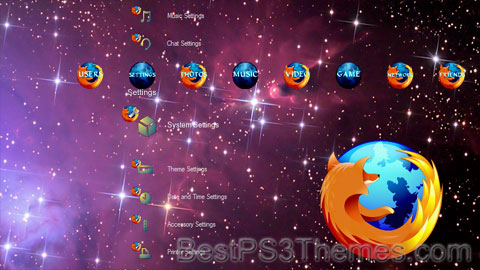
Firefox

Firefox theme by bracomadar

Download: Firefox.p3t

Firefox Theme
(1 background)

Mozilla Firefox
Developer(s)Mozilla Foundation and its contributors
Mozilla Corporation
Initial releaseNovember 9, 2004; 19 years ago (2004-11-09)
Stable release(s) [±]
Standard127.0.2[1] Edit this on Wikidata / June 25, 2024; 5 days ago (June 25, 2024)
Extended support release115.12.0esr[2] Edit this on Wikidata / June 11, 2024; 19 days ago (June 11, 2024)
Preview release(s) [±]
Beta & developer edition128.0b8[3] Edit this on Wikidata / June 26, 2024; 4 days ago (June 26, 2024)
Nightly129.0a1[4] Edit this on Wikidata / June 10, 2024; 20 days ago (June 10, 2024)
Repository
Written inC++, JavaScript, HTML, C, Rust, and others[5][6]
EnginesGecko, Quantum, and SpiderMonkey; WebKit on iOS
Operating systemLinux
macOS 10.15 or later
Windows 10 or later
Android 5.0 or later[7]
iOS 15.0 or later
Included withVarious Unix-like operating systems
Available in97 languages[8]
TypeWeb browser
LicenseMPL 2.0[9][10]
Websitemozilla.org/firefox

Mozilla Firefox, or simply Firefox, is a free and open-source[11] web browser developed by the Mozilla Foundation and its subsidiary, the Mozilla Corporation. It uses the Gecko rendering engine to display web pages, which implements current and anticipated web standards.[12] Firefox is available for Windows 10 or later versions, macOS, and Linux. Its unofficial ports are available for various Unix and Unix-like operating systems, including FreeBSD,[13] OpenBSD,[14] NetBSD,[15] and other platforms. It is also available for Android and iOS. However, as with all other iOS web browsers, the iOS version uses the WebKit layout engine instead of Gecko due to platform requirements. An optimized version is also available on the Amazon Fire TV as one of the two main browsers available with Amazon's Silk Browser.[16]

Firefox is the spiritual successor of Netscape Navigator, as the Mozilla community was created by Netscape in 1998, before its acquisition by AOL.[17] Firefox was created in 2002 under the codename "Phoenix" by members of the Mozilla community who desired a standalone browser rather than the Mozilla Application Suite bundle. During its beta phase, it proved to be popular with its testers and was praised for its speed, security, and add-ons compared to Microsoft's then-dominant Internet Explorer 6. It was released on November 9, 2004,[18] and challenged Internet Explorer's dominance with 60 million downloads within nine months.[19] In November 2017, Firefox began incorporating new technology under the code name "Quantum" to promote parallelism and a more intuitive user interface.[20]

Firefox usage share grew to a peak of 32.21% in November 2009,[21] with Firefox 3.5 overtaking Internet Explorer 7, although not all versions of Internet Explorer as a whole;[22][23] its usage then declined in competition with Google Chrome.[21] As of December 2023, according to StatCounter, it had a 6.7% usage share on traditional PCs (i.e. as a desktop browser), making it the fourth-most popular PC web browser after Google Chrome (62%), Safari (13%), and Microsoft Edge (11%).[24][25]

History[edit]

The project began as an experimental branch of the Mozilla project by Dave Hyatt, Joe Hewitt, and Blake Ross. They believed the commercial requirements of Netscape's sponsorship and developer-driven feature creep compromised the utility of the Mozilla browser.[26] To combat what they saw as the Mozilla Suite's software bloat, they created a standalone browser, with which they intended to replace the Mozilla Suite.[27] Version 0.1 was released on September 23, 2002.[28] On April 3, 2003, the Mozilla Organization announced that it planned to change its focus from the Mozilla Suite to Firefox and Thunderbird.[29]

Screenshot of Phoenix 0.1 on Windows XP

The Firefox project has undergone several name changes.[30] The nascent browser was originally named Phoenix, after the mythical bird that rose triumphantly from the ashes of its dead predecessor (in this case, from the "ashes" of Netscape Navigator, after it was sidelined by Microsoft Internet Explorer in the "First Browser War"). Phoenix was renamed in 2003 due to a trademark claim from Phoenix Technologies. The replacement name, Firebird, provoked an intense response from the Firebird database software project.[31][32] The Mozilla Foundation reassured them that the browser would always bear the name Mozilla Firebird to avoid confusion. After further pressure, Mozilla Firebird became Mozilla Firefox on February 9, 2004.[33] The name Firefox was said to be derived from a nickname of the red panda,[34] which became the mascot for the newly named project.[35] For the abbreviation of Firefox, Mozilla prefers Fx or fx, although it is often abbreviated as FF.[36]

The Firefox project went through many versions before version 1.0 and had already gained a great deal of acclaim from numerous media outlets, such as Forbes[37] and The Wall Street Journal.[38] Among Firefox's popular features were the integrated pop-up blocker, tabbed browsing, and an extension mechanism for adding functionality. Although these features have already been available for some time in other browsers such as the Mozilla Suite and Opera, Firefox was the first of these browsers to have achieved large-scale adoption.[citation needed] Firefox attracted attention as an alternative to Internet Explorer, which had come under fire for its alleged poor program design and insecurity—detractors cite IE's lack of support for certain Web standards, use of the potentially dangerous ActiveX component, and vulnerability to spyware and malware installation.[citation needed] Microsoft responded by releasing Windows XP Service Pack 2, which added several important security features to Internet Explorer 6.[39]

Version 1.0 of Firefox was released on November 9, 2004.[40] This was followed by version 1.5 in November 2005, version 2.0 in October 2006, version 3.0 in June 2008, version 3.5 in June 2009, version 3.6 in January 2010, and version 4.0 in March 2011. From version 5 onwards, the development and release model changed into a "rapid" one; by the end of 2011 the stable release was version 9, and by the end of 2012 it reached version 17.[41]

Major redesigns of its graphical user interface occurred on versions 4.0 (Strata) in March 2011, 29.0 (Australis) in April 2014, 57.0 (Photon) in November 2017, and 89.0 (Proton) in June 2021.

In 2016, Mozilla announced a project known as Quantum, which sought to improve Firefox's Gecko engine and other components to improve the browser's performance, modernize its architecture, and transition the browser to a multi-process model. These improvements came in the wake of decreasing market share to Google Chrome, as well as concerns that its performance was lapsing in comparison. Despite its improvements, these changes required existing add-ons for Firefox to be made incompatible with newer versions, in favor of a new extension system that is designed to be similar to Chrome and other recent browsers. Firefox 57, which was released in November 2017, was the first version to contain enhancements from Quantum, and has thus been named Firefox Quantum. A Mozilla executive stated that Quantum was the "biggest update" to the browser since version 1.0.[42][43][44] Unresponsive and crashing pages only affect other pages loaded within the same process. While Chrome uses separate processes for each loaded tab, Firefox distributes tabs over four processes by default (since Quantum), in order to balance memory consumption and performance. The process count can be adjusted, where more processes increase performance at the cost of memory, therefore suitable for computers with larger RAM capacity.[45][46]

On May 3, 2019, the expiration of an intermediate signing certificate on Mozilla servers caused Firefox to automatically disable and lock all browser extensions (add-ons).[47][48] Mozilla began the roll-out of a fix shortly thereafter, using their Mozilla Studies component.[47][48]

Support for Adobe Flash was dropped on January 6, 2021, with the release of Firefox 85. [49]

On June 1, 2021, Firefox's 'Proton' redesign was offered through its stable release channel[50] after being made available in the beta builds.[51] While users were initially allowed to revert to the old design through about:config, the corresponding key-value pairs reportedly stopped working in future builds, resulting in criticism.[52] These included accessibility concerns[53][54] despite Mozilla's claim to "continue to work with the accessibility community"[55] and are continuing issues.[56]

On January 13, 2022, an issue with Firefox's HTTP/3 implementation resulted in a widespread outage for multiple hours.[57]

On September 26, 2023, Firefox 118.0 introduced on-device translation of web page content. [58]

On January 23, 2024, along with the release of Firefox 122.0, Mozilla introduced an official APT repository for Debian-based Linux distributions.[59]

Features[edit]

Features of the desktop edition include tabbed browsing, full-screen mode, spell checking, incremental search, smart bookmarks, bookmarking and downloading through drag and drop,[60][61] a download manager, user profile management,[62] private browsing, bookmark tags, bookmark exporting,[63] offline mode,[64] a screenshot tool, web development tools, a "page info" feature which shows a list of page metadata and multimedia items,[65] a configuration menu at about:config for power users, and location-aware browsing (also known as "geolocation") based on a Google service.[66] Firefox has an integrated search system which uses Google by default in most markets.[67][68] DNS over HTTPS is another feature whose default behaviour is determined geographically.[69]

Firefox provides an environment for web developers in which they can use built-in tools, such as the Error Console or the DOM Inspector, and extensions, such as Firebug and more recently there has been an integration feature with Pocket. Firefox Hello was an implementation of WebRTC, added in October 2014, which allows users of Firefox and other compatible systems to have a video call, with the extra feature of screen and file sharing by sending a link to each other. Firefox Hello was scheduled to be removed in September 2016.[70]

Former features include a File Transfer Protocol (FTP) client for browsing file servers, the ability to block images from individual domains (until version 72),[71] a 3D page inspector (versions 11 to 46), tab grouping (until version 44), and the ability to add customized extra toolbars (until version 28).[72][73][74]

Browser extensions[edit]

Functions can be added through add-ons created by third-party developers. Add-ons are primarily coded using an HTML, CSS, JavaScript, with API known as WebExtensions, which is designed to be compatible with Google Chrome and Microsoft Edge extension systems.[75] Firefox previously supported add-ons using the XUL and XPCOM APIs, which allowed them to directly access and manipulate much of the browser's internal functionality. As compatibility was not included in the multi-process architecture, XUL add-ons have been deemed Legacy add-ons and are no longer supported on Firefox 57 "Quantum" and newer.[76][77]

Mozilla has occasionally installed extensions for users without their permission. This happened in 2017 when an extension designed to promote the show Mr. Robot was silently added in an update to Firefox.[78][79]

Themes[edit]

Firefox can have themes added to it, which users can create or download from third parties to change the appearance of the browser.[80][81]

Guest session[edit]

In 2013, Firefox for Android added a guest session mode, which wiped browsing data such as tabs, cookies, and history at the end of each guest session. Guest session data was kept even when restarting the browser or device, and deleted only upon a manual exit. The feature was removed in 2019, purportedly to "streamline the experience".[82][83]

Standards[edit]

The result of the Acid3 test on Firefox 17

Firefox implements many web standards, including HTML4 (almost full HTML5), XML, XHTML, MathML, SVG 1.1 (full),[84] SVG 2 (partial),[85][86] CSS (with extensions),[87] ECMAScript (JavaScript), DOM, XSLT, XPath, and APNG (Animated PNG) images with alpha transparency.[88] Firefox also implements standards proposals created by the WHATWG such as client-side storage,[89][90] and the canvas element.[91] These standards are implemented through the Gecko layout engine, and SpiderMonkey JavaScript engine. Firefox 4 was the first release to introduce significant HTML5 and CSS3 support.

Firefox has passed the Acid2 standards-compliance test since version 3.0.[92] Mozilla had originally stated that they did not intend for Firefox to pass the Acid3 test fully because they believed that the SVG fonts part of the test had become outdated and irrelevant, due to WOFF being agreed upon as a standard by all major browser makers.[93] Because the SVG font tests were removed from the Acid3 test in September 2011, Firefox 4 and greater scored 100/100.[94][95]

Firefox also implements "Safe Browsing,"[96] a proprietary protocol[97] from Google used to exchange data related with phishing and malware protection.

Firefox supports the playback of video content protected by HTML5 Encrypted Media Extensions (EME), since version 38. For security and privacy reasons, EME is implemented within a wrapper of open-source code that allows execution of a proprietary DRM module by Adobe Systems—Adobe Primetime Content Decryption Module (CDM). CDM runs within a "sandbox" environment to limit its access to the system and provide it a randomized device ID to prevent services from uniquely identifying the device for tracking purposes. The DRM module, once it has been downloaded, is enabled, and disabled in the same manner as other plug-ins. Since version 47,[98] "Google's Widevine CDM on Windows and Mac OS X so streaming services like Amazon Video can switch from Silverlight to encrypted HTML5 video" is also supported. Mozilla justified its partnership with Adobe and Google by stating:

Firefox downloads and enables the Adobe Primetime and Google Widevine CDMs by default to give users a smooth experience on sites that require DRM. Each CDM runs in a separate container called a sandbox and you will be notified when a CDM is in use. You can also disable each CDM and opt-out of future updates

— Watch DRM content on Firefox[99]

and that it is "an important step on Mozilla's roadmap to remove NPAPI plugin support."[100] Upon the introduction of EME support, builds of Firefox on Windows were also introduced that exclude support for EME.[101][102] The Free Software Foundation and Cory Doctorow condemned Mozilla's decision to support EME.[103]

Security[edit]

From its inception, Firefox was positioned as a security-focused browser. At the time, Internet Explorer, the dominant browser, was facing a security crisis. Multiple vulnerabilities had been found, and malware like Download.Ject could be installed simply by visiting a compromised website. The situation was so bad that the US Government issued a warning against using Internet Explorer.[104] Firefox, being less integrated with the operating system, was considered a safer alternative since it was less likely to have issues that could completely compromise a computer. This led to a significant increase in Firefox's popularity during the early 2000s as more secure alternative.[105][106] Moreover, Firefox was considered to have fewer actively exploitable security vulnerabilities compared to its competitors. In 2006, The Washington Post reported that exploit code for known security vulnerabilities in Internet Explorer were available for 284 days compared to only nine days for Firefox before the problem was fixed.[107] A Symantec study around the same period showed that even though Firefox had a higher number of vulnerabilities, on average vulnerabilities were fixed faster in Firefox than in other browsers during that period.[108]

During this period, Firefox used a monolithic architecture, like most browsers at the time. This meant all browser components ran in a single process with access to all system resources. This setup had multiple security issues. If a web page used too many resources, the entire Firefox process would hang or crash, affecting all tabs. Additionally, any exploit could easily access system resources, including user files. Between 2008 and 2012, most browsers shifted to a multiprocess architecture, isolating high-risk processes like rendering, media, GPU, and networking.[109] However, Firefox was slower to adopt this change. It wasn't until 2015 that Firefox started its Electrolysis (e10s) project to implement sandboxing across multiple components. This rewrite relied on interprocess communication using Chromium's interprocess communication library and placed various component including the rendering component in its own sandbox.[110] Firefox released this rewrite in to beta in August 2016, noting a 10-20% increase in memory usage, which was lower than Chrome's at the time.[111] However, the rewrite caused issues with their legacy extension API, which was not designed to work cross-process and required shim code to function correctly.[111] After over a year in beta, the rewrite was enabled by default all users of Firefox in November 2017.[112]

In 2012, Mozilla launched a new project called Servo to write a completely new and experimental browser engine utilizing memory safe techniques written in Rust.[113] In 2018, Mozilla opted to integrate parts of the Servo project into the Gecko engine in a project codenamed the Quantum project.[114] The project completely overhauled Firefox's page rendering code resulting in performance and stability gains while also improving the security of existing components.[115] Additionally, the older incompatible extension API was removed in favour of a WebExtension API that more

Red Fibres Remake

Red Fibres Remake theme by NIGHTMARE_1990

Download: RedFibresRemake.p3t
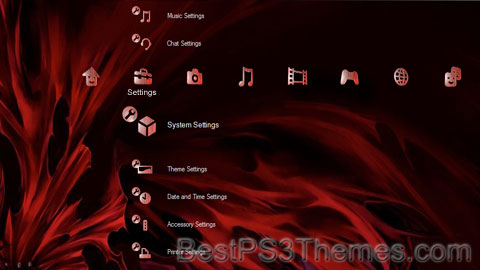
Red Fibres Remake Theme
(3 backgrounds)

P3T Unpacker v0.12
Copyright (c) 2007. Anoop Menon

This program unpacks Playstation 3 Theme files (.p3t) so that you can touch-up an existing theme to your likings or use a certain wallpaper from it (as many themes have multiple). But remember, if you use content from another theme and release it, be sure to give credit!

Download for Windows: p3textractor.zip

Instructions:

Download p3textractor.zip from above. Extract the files to a folder with a program such as WinZip or WinRAR. Now there are multiple ways to extract the theme.

The first way is to simply open the p3t file with p3textractor.exe. If you don’t know how to do this, right click the p3t file and select Open With. Alternatively, open the p3t file and it will ask you to select a program to open with. Click Browse and find p3textractor.exe from where you previously extracted it to. It will open CMD and extract the theme to extracted.[filename]. After that, all you need to do for any future p3t files is open them and it will extract.

The second way is very simple. Just drag the p3t file to p3textractor.exe. It will open CMD and extract the theme to extracted.[filename].

For the third way, first put the p3t file you want to extract into the same folder as p3textractor.exe. Open CMD and browse to the folder with p3extractor.exe. Enter the following:
p3textractor filename.p3t [destination path]Replace filename with the name of the p3t file, and replace [destination path] with the name of the folder you want the files to be extracted to. A destination path is not required. By default it will extract to extracted.filename.

Red Fibres

Red Fibres theme NIGHTMARE_1990

Download: RedFibres.p3t
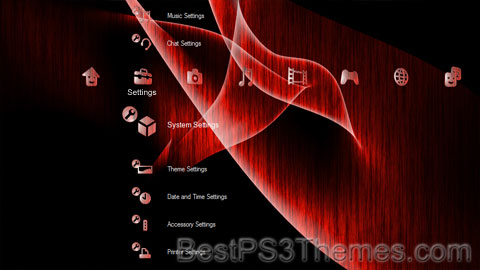
Red Fibres Theme
(3 backgrounds)

P3T Unpacker v0.12
Copyright (c) 2007. Anoop Menon

This program unpacks Playstation 3 Theme files (.p3t) so that you can touch-up an existing theme to your likings or use a certain wallpaper from it (as many themes have multiple). But remember, if you use content from another theme and release it, be sure to give credit!

Download for Windows: p3textractor.zip

Instructions:

Download p3textractor.zip from above. Extract the files to a folder with a program such as WinZip or WinRAR. Now there are multiple ways to extract the theme.

The first way is to simply open the p3t file with p3textractor.exe. If you don’t know how to do this, right click the p3t file and select Open With. Alternatively, open the p3t file and it will ask you to select a program to open with. Click Browse and find p3textractor.exe from where you previously extracted it to. It will open CMD and extract the theme to extracted.[filename]. After that, all you need to do for any future p3t files is open them and it will extract.

The second way is very simple. Just drag the p3t file to p3textractor.exe. It will open CMD and extract the theme to extracted.[filename].

For the third way, first put the p3t file you want to extract into the same folder as p3textractor.exe. Open CMD and browse to the folder with p3extractor.exe. Enter the following:
p3textractor filename.p3t [destination path]Replace filename with the name of the p3t file, and replace [destination path] with the name of the folder you want the files to be extracted to. A destination path is not required. By default it will extract to extracted.filename.

With The Sickness

With The Sickness theme by MrWeaselX3

Download: WithTheSickness.p3t
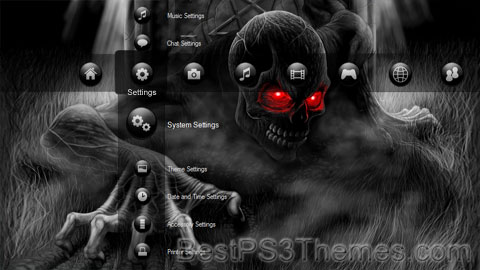
With The Sickness Theme
(1 background)

P3T Unpacker v0.12
Copyright (c) 2007. Anoop Menon

This program unpacks Playstation 3 Theme files (.p3t) so that you can touch-up an existing theme to your likings or use a certain wallpaper from it (as many themes have multiple). But remember, if you use content from another theme and release it, be sure to give credit!

Download for Windows: p3textractor.zip

Instructions:

Download p3textractor.zip from above. Extract the files to a folder with a program such as WinZip or WinRAR. Now there are multiple ways to extract the theme.

The first way is to simply open the p3t file with p3textractor.exe. If you don’t know how to do this, right click the p3t file and select Open With. Alternatively, open the p3t file and it will ask you to select a program to open with. Click Browse and find p3textractor.exe from where you previously extracted it to. It will open CMD and extract the theme to extracted.[filename]. After that, all you need to do for any future p3t files is open them and it will extract.

The second way is very simple. Just drag the p3t file to p3textractor.exe. It will open CMD and extract the theme to extracted.[filename].

For the third way, first put the p3t file you want to extract into the same folder as p3textractor.exe. Open CMD and browse to the folder with p3extractor.exe. Enter the following:
p3textractor filename.p3t [destination path]Replace filename with the name of the p3t file, and replace [destination path] with the name of the folder you want the files to be extracted to. A destination path is not required. By default it will extract to extracted.filename.

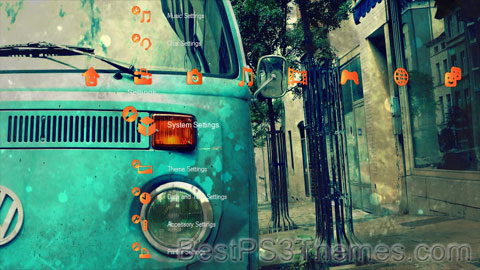
Volkswagen

Volkswagen theme by sim_17

Download: Volkswagen.p3t

Volkswagen Theme
(1 background)

Volkswagen
Company typeDivision
IndustryAutomotive
Founded28 May 1937; 87 years ago (1937-05-28)
FounderGerman Labour Front
Headquarters,
Germany
Area served
Worldwide
Key people
Thomas Schäfer (CEO, Volkswagen Passenger Cars)
Revenue279,232,000,000 Euro (2022) Edit this on Wikidata
22,124,000,000 Euro (2022) Edit this on Wikidata
15,836,000,000 Euro (2022) Edit this on Wikidata
ParentVolkswagen Group
Websitevw.com

Volkswagen (VW; German pronunciation: [ˈfɔlksˌvaːɡn̩] )[Note 1] is a German automobile manufacturer headquartered in Wolfsburg, Lower Saxony, Germany. Founded in 1937 by the German Labour Front under the Nazi Party and revived into the global brand it is known as today post-World War II by the British Army officer Ivan Hirst, it is known for the iconic Beetle and serves as the flagship brand of the Volkswagen Group, the largest automotive manufacturer by worldwide sales in 2016 and 2017.[1] The group's biggest market is China (including Hong Kong and Macau), which delivers 40 percent of its sales and profits.[2][3] Its name is derived from the German-language terms Volk and Wagen, translating to "people's car" when combined.

History[edit]

Ferdinand Porsche unveiling the "Volkswagen" concept to Adolf Hitler on 1 December 1934
6 May 1938: Adolf Hitler lays the foundation stone of the Volkswagen factory. On far right: Ferdinand Porsche

1932–1940: People's Car project[edit]

Volkswagen was established in 1937 by the German Labour Front (German: Deutsche Arbeitsfront) as part of the Strength Through Joy (German: Kraft durch Freude) program in Berlin.[4] In the early 1930s, cars were a luxury—most Germans could afford nothing more elaborate than a motorcycle, and only one German out of 50 owned a car. Seeking a potential new market, some car makers began independent "people's car" projects – the Mercedes 170H, BMW 3/15, Adler AutoBahn, Steyr 55 and Hanomag 1.3L, among others.

The growing trend was not nascent; Béla Barényi, a pioneering automotive engineer, is credited as already having conceived the basic design during the mid-1920s. Josef Ganz developed the Standard Superior (going as far as advertising it as the "German Volkswagen"). In Germany, the company Hanomag mass-produced the 2/10 PS "Kommissbrot", a small, cheap rear-engined car, from 1925 to 1928.[5] Also, in Czechoslovakia, the Hans Ledwinka-designed Tatra T77, a very popular car amongst the German elite, was becoming smaller and more affordable at each revision. Ferdinand Porsche, a well-known designer for high-end vehicles and race cars, had been trying for years to get a manufacturer interested in a small car suitable for a family. He built a car named the "Volksauto" from the ground up in 1933, using many popular ideas and several of his own, putting together a car with an air-cooled rear engine, torsion bar suspension, and a "beetle" shape, the front bonnet rounded for better aerodynamics (necessary as it had a small engine).[6]

VW logo during the 1930s, initials surrounded by a stylised cogwheel and a spinning propeller that looked like a swastika[7][8]

In 1934, with many of the above projects still in development or early stages of production, Adolf Hitler became involved, ordering the production of a basic vehicle capable of transporting two adults and three children at 100 km/h (62 mph). He wanted a car every German family would be able to afford.[6] The "People's Car" would be available through a savings plan at 990 ℛ︁ℳ︁ (US$396 in 1938)—about the price of a small motorcycle (the average income being around 32 ℛ︁ℳ︁ a week).[9][10]

It soon became apparent that private industry could not turn out a car for only 990 ℛ︁ℳ︁. Thus, Hitler chose to sponsor an all-new, state-owned factory using Ferdinand Porsche's design (with some of Hitler's design suggestions, including an air-cooled engine so nothing could freeze). The intention was that German families could buy the car through a savings scheme ("Fünf Mark die Woche musst du sparen, willst du im eigenen Wagen fahren" – "Five Marks a week you must set aside, if in your own car you wish to ride"), which around 336,000 people eventually paid into.[11] However, the project was not commercially viable, and only government support was able to keep it afloat.[12][Note 2] Due to the outbreak of war in 1939, none of the participants in the savings scheme ever received a car. In 1950, a lawsuit was issued that, after 12 years of trial, ultimately provided a credit of 12% off the list price of a new VW base model or 5-times less the value paid into the saving scheme.[13]

Prototypes of the car called the KdF-Wagen (from the German term Kraft durch Freude, meaning "Strength Through Joy") appeared from 1938 onwards. The first cars had been produced in Stuttgart. The car already had its distinctive round shape and air-cooled, flat-four, rear-mounted engine. The VW car was just one of many KdF programs, which included things such as tours and outings. The prefix Volks ("People's") was not just applied to cars, but also to other products in Germany—the Volksempfänger radio receiver for instance. On 28 May 1937, Gesellschaft zur Vorbereitung des Deutschen Volkswagens mbH ("Company for the Preparation of the German Volkswagen Ltd."), or Gezuvor[14] for short, was established in Berlin by the Deutsche Arbeitsfront, the national labour organization of the Nazi Party. More than a year later, on 16 September 1938, it was renamed to Volkswagenwerk GmbH.[15][16]

VW Type 82E

Erwin Komenda, the longstanding Auto Union chief designer, part of Ferdinand Porsche's hand-picked team,[6] developed the car body of the prototype, which was recognisably the Beetle known today. It was one of the first cars designed with the aid of a wind tunnel—a method used for German aircraft design since the early 1920s. The car designs were put through rigorous tests and achieved a record-breaking million miles of testing before being deemed finished.

The construction of the new factory started in May 1938 in the new town of "Stadt des KdF-Wagens" (renamed Wolfsburg after the war), which had been purpose-built for the factory workers.[15] This factory had only produced a handful of cars by the time war started in 1939. None were actually delivered to any holder of the completed saving stamp books, though one Type 1 Cabriolet was presented to Hitler on 20 April 1944 (his 55th birthday).[15]

1939–1944: Wartime production and Nazi concentration camp labour[edit]

War changed production to military vehicles—the Type 82 Kübelwagen ("Bucket car") utility vehicle (VW's most common wartime model), and the amphibious Schwimmwagen—manufactured for German forces. One of the first foreigners to drive a Volkswagen was the American war correspondent Ernie Pyle, who had the use of a captured Volkswagen for a few days after the Allied victory in Tunisia in May 1943.[17] As was common with much of the production in Nazi Germany during the war, slave labour was utilised in the Volkswagen plant, e.g. from Arbeitsdorf concentration camp. The company would admit in 1998 that it used 15,000 slaves during the war effort. German historians estimated that 80% of Volkswagen's wartime workforce was slave labour.[18] Many of the slaves were reported to have been supplied from the concentration camps upon request from plant managers. A lawsuit was filed in 1998 by survivors for restitution for the forced labour.[19] Volkswagen would set up a voluntary restitution fund.[20]

1945–1948: British military intervention[edit]

Volkswagen industrial plant in Wolfsburg, pictured in 2006

In April 1945, KdF-Stadt and its heavily bombed factory were captured by the United States armed forces and subsequently handed over to the British, within whose occupation zone the town and factory fell. The factory was placed under the control of British Army officer Major Ivan Hirst, REME, a civilian Military Governor with the occupying forces. At first, one plan was to use it for military vehicle maintenance, and possibly dismantle and ship it to Britain. Since it had been used for military production, (though not of KdF-Wagens) and had been in Hirst's words, a "political animal" rather than a commercial enterprise—technically making it liable for destruction under the terms of the Potsdam Agreement—the equipment could have been salvaged as war reparations. Allied dismantling policy changed in late 1946 to mid-1947, though heavy industry continued to be dismantled until 1951.[citation needed]

One of the factory's wartime 'KdF-Wagen' cars had been taken to the factory for repairs and abandoned there. Hirst had it repainted green and demonstrated it to British Army headquarters. Short of light transport, in September 1945 the British Army was persuaded to place a vital order for 20,000 cars. However, production facilities had been massively disrupted, there was a refugee crisis at and around the factory, and some parts (such as carburettors) were unavailable. Hirst and his German assistant Heinrich Nordhoff (who went on to run the Wolfsburg facility after the military government ended in 1949) helped to stabilise the acute social situation while simultaneously re-establishing production. Hirst, for example, used his engineering experience to arrange the manufacture of carburettors, the original producers being effectively 'lost' in the Soviet zone.[21] The first few hundred cars went to personnel from the occupying forces, and to Australia Post. Some British service personnel were allowed to take their Beetles back to the United Kingdom when they were demobilised.[22][better source needed]

In 1986, Hirst said that factory workers were, after many years of Nazi conditioning, initially reluctant to follow his orders; to counter this, he had his military uniform brought back from Britain and wore it in the factory, after which he reported having no problems even though he was no longer a soldier at the time but a civilian member of the military government.[citation needed]

The post-war industrial plans for Germany set out rules that governed which industries Germany was allowed to retain. These rules set German car production at a maximum of 10% of 1936 car production.[23] By 1946, the factory produced 1,000 cars a month even though it was still in disrepair. Owing to roof and window damage, production had to stop when it rained, and the company had to barter new vehicles for steel for production.[24]

The car and its town changed their Second World War-era names to "Volkswagen" and "Wolfsburg" respectively, and production increased. It was still unclear what was to become of the factory. It was offered to representatives from the American, Australian, British, and French motor industries who all rejected it. After an inspection of the plant, Sir William Rootes, head of the British Rootes Group, told Hirst the project would fail within two years, and that the car "...is quite unattractive to the average motorcar buyer, is too ugly and too noisy. If you think you're going to build cars in this place, you're a bloody fool, young man."[25] The official report said: "To build the car commercially would be a completely uneconomic enterprise."[26]

Volkswagen cogeneration plant

Ford representatives were equally critical. In March 1948, the British offered the Volkswagen company to Ford, free of charge. Henry Ford II, the son of Edsel Ford, travelled to West Germany for discussions. Heinz Nordhoff was also present, as well as Ernest Breech, chairman of the board for Ford. Henry Ford II looked to Breech for his opinion, and Breech said, "Mr. Ford, I don't think what we're being offered here is worth a damn!"[27] Ford passed on the offer, leaving Volkswagen to rebuild itself under Nordhoff's leadership.[28]

1948–1961: Icon of post-war West Germany[edit]

1949 Volkswagen "split rear window" Sedan
Volkswagen Cabriolet (1953)
Volkswagen Type 2 (T1)
An original 1300 Deluxe, circa 1966
In the later 1960s, as the worldwide demand for the Beetle finally began to diminish, a variety of successor designs were proposed and, in most cases, rejected by management.

From 1948, Volkswagen became an important element, symbolically and economically, of West German regeneration.[according to whom?] Heinrich Nordhoff (1899–1968), a former senior manager at Opel who had overseen civilian and military vehicle production in the 1930s and 1940s, was recruited to run the factory in 1948. In 1949, Major Hirst left the company—now re-formed as a trust controlled by the West German government and government of the State of Lower Saxony. The "Beetle" sedan or "peoples' car" Volkswagen is the Type 1. Apart from the introduction of the Volkswagen Type 2 commercial vehicle (van, pick-up, and camper), and the VW Karmann Ghia sports car, Nordhoff pursued the one-model policy until shortly before his death in 1968.

Volkswagens were first exhibited and sold in the United States in 1949 but sold only two units in America that first year. On entry to the US market, the VW was briefly sold as a Victory Wagon. Volkswagen of America was formed in April 1955 to standardise sales and service in the United States. Production of the Type 1 Volkswagen Beetle increased dramatically over the years, the total reaching one million in 1955.

The UK's first official Volkswagen importer, Colborne Garages of Ripley, Surrey, started business with importing parts for the models brought home by soldiers returning from Germany.[22]

Canadian Motors, Limited brought in Canada's first shipment of Volkswagens on 10 July 1952 (shipping order 143075).[citation needed] The order consisted of 12 vehicles, (3) model 11C, a black, green, and sand colour (3) 11GS, a chestnut brown and two azure blue, (2) 24A-M51 in red, (1) 21A in blue, (1) 23A in blue, (1) 22A beige colour, and one ambulance.[citation needed] Volkswagens were seen in Canada for the first time at the Canadian National Exhibition in August 1952 and were accepted enthusiastically. (At least one Type 2 bus from this order still exists, and is currently in France undergoing restoration).[citation needed] The first shipment for Volkswagen Canada reached Toronto in early December 1952. (At least one Type 1 from this first shipment still exists, and was driven on a nationwide tour for Volkswagen Canada's 60th year of business festivities in 2012).[citation needed]

By 1955, sales warranted the building of the Volkswagen plant on a 32-acre (13 ha) site on Scarborough's Golden Mile. To this, a 60,000-square-foot (5,600 m2) building with administration, showrooms, service, repairs and parts was built in 1957, with storage for $4,000,000 of parts.[citation needed]

In 1959, VW started production at a plant near São Paulo in Brazil.[29] Volkswagen do Brasil was accused of spying on workers during the time of the military dictatorship in the 1970s and informing police on oppositional activities. In 1976, mass arrests occurred and some VW employees were tortured. In 1979, Brazilian VW workers travelled to Wolfsburg to inform the CEO in person. In 2015, activists and former VW employees in Brazil spoke out in public accused the company's silence about the persecution of its workers. In fall 2016, VW commissioned an expert review of the situation due end of 2017.[30]

On 22 August 1960, Volkswagenwerk GmbH was renamed to Volkswagenwerk AG. Sales soared throughout the 1960s, peaking at the end of the decade thanks in part to the famous advertising campaigns by New York advertising agency Doyle, Dane Bernbach.[citation needed] Led by art director Helmut Krone, and copywriters Julian Koenig and Bob Levinson, Volkswagen advertisements became[when?] as popular as the car, using crisp layouts and witty copy to lure the younger, sophisticated consumers with whom the car became associated.[citation needed] Even though it was almost universally known as the Beetle (or the Bug), it was never officially labelled as such by the manufacturer, instead referred to as the Type 1.[31]

Although the car was becoming outdated, during the 1960s and early 1970s, American exports, innovative advertising, and a growing reputation for reliability helped production figures surpass the levels of the previous record-holder, the Ford Model T. On 17 February 1972, the 15,007,034th Beetle was sold. Volkswagen could now claim the world production record for the most-produced, single make of car in history. By 1973, total production was over 16 million.

To commemorate its passing the Ford Model T's record sales mark and its victories in the Baja 1000 Mexican races from 1967 to 1971, Volkswagen produced its first limited-edition Beetle. It was marketed as the "Baja Champion SE"[32] in the United States and the "Marathon" Superbeetle in the rest of the world. It featured unique "Marathon Blau" metallic blue paint, steel-pressed 10-spoke 15-inch (38 cm) magnesium-alloy wheels, a commemorative metal plate mounted on the glovebox and a certificate of authenticity presented to the original purchaser. Dealer-installed options for this limited-edition Superbeetle included the following: white stripes running the length of the rocker-panel, a special shifter knob, bumper overriders, tapered exhaust tips, fake walnut inserts in the dashboard (behind the steering wheel and the glovebox cover) as well as Bosch fog lights mounted on the front bumper.[citation needed]

1961–1973: Beetle to Golf[edit]

A 1963 VW Type 3 Notchback

The 1961 Type 1 Beetle had a 36 hp 1200cc four cylinder air-cooled flat-four opposed OHV engine made of aluminium alloy block and heads. By 1966, the Type 1 came with a 1300cc engine. By 1967 the Type 1 had a 1500cc engine, and 1600cc in 1970. The air-cooled engine lost favour in the United States market with the advent of unleaded petrol and smog controls. These air-cooled engines were commonly tuned to be fuel-rich in order to control engine over-heating, and this led to excessive carbon monoxide emissions. VW production equipment was eventually moved to Mexico where vehicle emissions were not regulated. Beetles were popular on the US West Coast where the limited-capacity cabin heating was less inconvenient. Beetles were popularised on the US West Coast as beach buggies and dune buggies.

VW expanded its product line in 1961 with the introduction of four Type 3 models (Karmann Ghia, Notchback, Fastback, and Variant) based on the new Type 3 mechanical underpinnings. The name 'Squareback' was used in the United States for the Variant.

In 1969 the larger Type 4 (411 and 412) models were introduced. These differed substantially from previous vehicles, with the notable introduction of monocoque/unibody construction, the option of a fully automatic transmission, electronic fuel injection, and a sturdier powerplant.

In 1964, Volkswagen acquired Auto Union, and in 1969, NSU Motorenwerke AG (NSU). The former company owned the historic Audi brand, which had disappeared after the Second World War. VW ultimately merged Auto Union and NSU to create the modern Audi company, and would go on to develop it as its luxury vehicle marque. The purchase of Auto Union and NSU was a pivotal point in Volkswagen's history, as both companies yielded the technological expertise that proved necessary for VW to survive when demand for its air-cooled models went into decline.

1970 VW Squareback (Type III)

Volkswagen added a "Super Beetle"[33] (the Type 131) to its lineup in 1971. The Type 131 differed from the standard Beetle in its use of a MacPherson strut front suspension instead of the usual torsion bars. The Super Beetle featured a new hooded, padded dash and curved windshield (from 1973 model year on up). Rack and pinion steering replaced recirculating ball steering gears in the model year 1975 and up. The front of the car was stretched 2 inches (51 mm) to allow the spare tire to lie flat, and the combination of these two features increased the usable front luggage space.

In 1973, Volkswagen introduced the military-themed Type 181, or "Trekker" in Europe, "Thing" in America, recalling the wartime Type 82. The military version was produced for the NATO-era German Army during the Cold War years of 1970 to 1979. The US Thing version only sold for two years, 1973 and 1974.

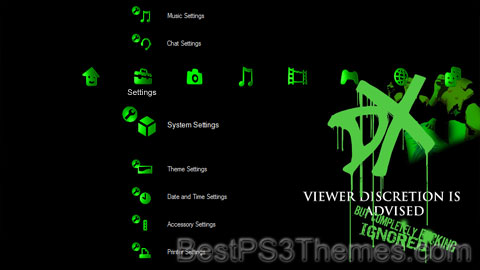
DX

DX theme by sim_17

Download: DX.p3t

DX Theme
(1 background)

DX may refer to:

In arts and entertainment[edit]

Businesses[edit]

In science, technology, and mathematics[edit]

Biology and medicine[edit]

Computing and telecommunications[edit]

  • Developer experience the experience of using a product or service from a developer's perspective
  • Dx an abbreviation used in relation to DOCSIS
  • DirectX, an application programming interface collection
  • Double word eXternal, in the context of 386DX and 486DX CPUs
  • DXing, in amateur and public radio
  • DX register, a 16-bit general-purpose X86 processor register
  • Digital transformation, the use of new digital technology in problem-solving applications

Photography[edit]

Vehicles[edit]

Other uses in science, technology, and mathematics[edit]

Other uses[edit]

See also[edit]