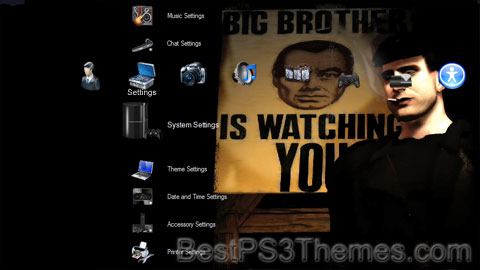
Big Brother Is Watching You theme by Sim24
Download: BigBrotherIsWatchingYou.p3t
(1 background)
Redirect to:

The #1 spot for Playstation themes!
Big Brother Is Watching You theme by Sim24
Download: BigBrotherIsWatchingYou.p3t

(1 background)
Redirect to:
Killzone 2 theme by Clcassar
Download: Killzone2_4.p3t
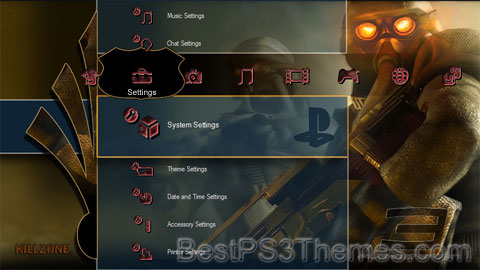
(7 backgrounds)
| Killzone 2 | |
|---|---|
| Developer(s) | Guerrilla Games |
| Publisher(s) | Sony Computer Entertainment |
| Director(s) | Mathijs de Jonge |
| Designer(s) | Neil Alphonso |
| Programmer(s) | Michiel van der Leeuw |
| Artist(s) | Jan-Bart van Beek Bas Uterwijk |
| Composer(s) | Joris de Man |
| Series | Killzone |
| Platform(s) | PlayStation 3 |
| Release | |
| Genre(s) | First-person shooter |
| Mode(s) | Single-player, multiplayer |
Killzone 2 is a 2009 first-person shooter developed by Guerrilla Games and published by Sony Computer Entertainment for the PlayStation 3. It is the second main installment in the Killzone series, following 2004's Killzone.
Similar to its predecessor, Killzone 2 takes place in the 24th century and chronicles the war between two human factions; the Vektans, and the Helghast. The game takes place two years after the events of Killzone and follows protagonist Tomas "Sev" Sevchenko as he and his unit battle the Helghast as the Vektans invade Helghan. The protagonist of Killzone and Killzone: Liberation, Cpt./Col. Jan Templar, returns in a supporting role, along with Rico Velasquez. Killzone 2 is played from a first-person view and allows the player to use a variety of weapons. It was released worldwide in February 2009.
Killzone 2 was widely anticipated prior to its release. It was critically acclaimed by critics and fans, who praised it as a superior title to the original Killzone. Additional praise was given to the game's visuals, action, multiplayer modes, soundtrack and atmosphere, although criticism was directed at the narrative. The game's critical and commercial success led to a sequel, Killzone 3, which was released in February 2011.
The official servers for Killzone 2 and Killzone 3 were shut down in March 2018. However, in 2021, a game preservation group called PSONE restored most of the game's online capability on their own set of servers.

The game is presented almost entirely from a first person perspective, aside from vehicular combat. Killzone 2 features a "lean and peek" cover system which allows the player to take cover behind an object and then pop out to fire at enemies. The "lean and peek" mechanic stays in first-person view at all times. It is also possible for the player to pilot vehicles at two points in the game: a tank and an exoskeleton. Many classic weapons and vehicles from previous Killzone installments return, such as the M82-G and the StA-52 LAR.[citation needed] The Sixaxis motion control feature is also utilized in performing certain actions such as turning a valve, arming an explosive charge and sniping.
Warzone, the title of the online multiplayer component of Killzone 2 has been developed by Guerrilla Games in conjunction with the game's single-player campaign.[citation needed] The online multiplayer gameplay is class-based, meaning the player can choose a class of character which is specialized for a specific role to better suit the player's needs in battle. There are 7 classes in total, in which the player can mix and match a main and sub ability according to their playing style, and can switch abilities upon death. There are 15 weapons available to the player, most of which cannot be used until the player reaches a certain rank. Two of these weapons are secondary firearms, and a further two weapons, the Boltgun and Flamethrower, are exclusive to the downloadable maps "Suljeva Cliffside" and "Arctower Landing".
Players play as either the ISA or Helghast, with a few gameplay differences. The character model and respawn points, and the "lean and peek" cover systems were removed. Each class levels up with experience gained from killing enemies or completing mission objectives. With enough experience, players unlock new weapons and skills, as well as a new class. Each class has two badges, the Primary badge selects the class and their specified skill. The secondary badge has an extra skill for the specified class but can be swapped to create own custom class.
Warzone plays out through dynamic matches where multiple game types are played in a single round. The game does not reset between game types, instead flowing between them, with the winning team determined by who wins the most modes. The game ships with five different game types including Assassination, Search & Retrieve, Search & Destroy, Bodycount and Capture & Hold.[1] Online matches can connect 2 to 32 players, and they can group into six squads of up to four players. If an online match does not have a full 32 players, computer-generated "bots" can be added in to create bigger teams (but only in an unranked match). Killzone 2 also offers a clan system, which allows clans of up to 64 players to compete for "Valor Points", an in-game currency that clans can use to bet on tournaments.
Players can also play offline against AIs with Skirmish mode and unranked online multiplayer, but there is no offline multiplayer mode for splitscreen players.
Eight multiplayer maps are included on disc at release,[2] but Guerrilla has released more maps as downloadable content. 6 more maps have been added to multiplayer since release via downloadable content purchasable from the PlayStation Store.
Two years after the attempted Helghast invasion of Vekta, an ISA fleet led by Colonel Jan Templar is sent to attack Pyrrhus, the capital city of Helghan, with the goal of deposing and arresting Emperor Scolar Visari on charges of war crimes. Among the ISA units taking part in the attack is Alpha Squad, led by Jan's old comrade Ricardo "Rico" Velasquez. Sergeant Tomas "Sev" Sevchenko, a veteran of the ISA "Legion" battalion, is assigned to serve as his second-in-command.
Tasked with securing Pyrrhus against the fierce resistance of the Helghan Second Army, the team quickly discovers that the Helghast are well prepared for an invasion. Using Helghan's harsh environment to their advantage, they have developed new weapons and equipment, none of which the ISA has ever seen before. Furthermore, the planet's fog-like atmosphere, gritty deserts, and constant storms pose almost as much of a threat to the invaders as the enemy themselves.
Led by Jan's flagship, the New Sun, the ISA bombard Pyrrhus as cover for a massive ground assault on the city. Despite stiff resistance from well-armed Helghast divisions, they steadily advance towards the Imperial Palace, ultimately capturing both Visari Square and the Helghan Military Academy. Just as the main convoy is set to attack the palace, Colonel Mael Radec, commander of the Second Army, activates a network of arc towers hidden beneath Pyrrhus, killing hundreds of ISA soldiers and breaking their momentum.
Dante Garza, a member of Alpha Squad and close friend of Tomas's, retrieves a piece of a destroyed tower and sends it to ISA researcher Evelyn Batton, who learns that the towers are powered by Petrusite, a mineral capable of generating and channeling electricity. She also identifies an old mining outpost on the outskirts of Pyrrhus where the Helghast have been secretly extracting it for military use.
While working to restore the outpost's communication antenna, Tomas and Rico are separated from the rest of Alpha Squad, allowing Radec's men to capture them. The two fight their way through the refinery where the captives were taken, stumbling upon an interrogation overseen by Radec himself. Oddly enough, he demands that Evelyn give him the launch codes to a set of stolen nuclear warheads in Helghast custody. Rico loses his temper and surprises Radec, saving the captives but leaving Garza mortally wounded when one of Radec's men Rico kills discharges his weapon and Garza is shot in the process. Blaming him for his friend's death, Tomas and the squad return to the New Sun.
Before Garza can be properly mourned, an elite Helghast battalion led by Radec mounts a surprise attack on the fleet, boarding or destroying several ships including the Sun. The ship's crew manages to evacuate, but Radec reaches the bridge, mortally wounds Jan and executes Evelyn, downloading the codes before they can be deleted. With the last of his strength and before succumbing to his wounds, Jan maneuvers the ship to crash into the center of Helghan's Petrusite distribution grid, causing it to explode and disrupt the arc network.
Seizing the opportunity, the survivors attempt to regroup, only to witness Visari detonate the warheads over Pyrrhus, destroying it and killing both the entire population and most of the remaining ISA forces.
With ISA captain Jason Narville leading an offensive on the remnants of the Second Army, Alpha Squad breaches the palace, where they encounter Radec and the imperial guard. After a pitched battle, the wounded commander and his men commit mass suicide out of disgrace, clearing the way to Visari's throne room.
As Tomas moves to arrest him, Visari gloats that he has still won, as the Helghast are now united against the ISA, and without him, they cannot be stopped. Overcome with guilt and wanting revenge for Templar and Garza's deaths, Rico kills him on the spot.
Weary from fighting, Tomas exits the palace and sits on the steps. Above him, a large armada belonging to the Helghan First Army begins its attack on what is left of the ISA invasion force.
At E3 2005, Killzone 2 was debuted with a trailer depicting soldiers landing in a hostile war-zone on Helghan and fighting Helghast forces. Critics in the media argued that the trailer shown at the trade show did not show actual gameplay footage, as its high level of visual detail has been argued to be impossible to render in real-time on the PlayStation 3 and the audio mix of the trailer was slightly delayed. SCEA's Vice President, Jack Tretton, stated that the footage of Killzone 2, that was believed to be pre-rendered, "is real gameplay everybody's seeing out there".[3] Several days later, Phil Harrison, SCE Europe's Vice President of Development, stated in an interview that all of the footage of PlayStation 3 games at E3 2005 were "running off video" which was "done to PS3 spec".[4] Further interviews eventually revealed the trailer was indeed a "target render", a prerendered video showing the developer's goals for the finished product.[5]
At the Game Developers Conference in 2007, a Killzone 2 teaser was shown behind closed doors, and was never released to the public. It featured various battles, destructible environments, and lighting effects among others.[6] Killzone 2 was shown to a panel of journalists at a special pre-E3 2007 event in Culver City, California, and then the next day to the public at Sony's E3 press conference.[7] An in-game trailer showing real-time gameplay of Killzone 2 was also released,[8] along with several videos of extended gameplay.[9] A number of media outlets since E3, such as the BBC, have referred to Killzone 2 as being "one of the most cinematic and immersive games ever produced on a console".[10] At the Leipzig Games Convention in 2007, Killzone 2 was presented in playable form to the media. It was the same demo level as shown at E3 2007, although journalists were allowed to play it hands-on.[11] At Sony's PlayStation Day 2008, the first level in Killzone 2's single-player campaign was presented, named "Corinth River".[12]
Michal Valient, a Senior Programmer at Guerrilla Games, presented details of their Killzone 2 proprietary game engine at a Developers Conference in July 2007.[13] As with many other titles published by SCE, including LittleBigPlanet and Infamous, Killzone 2 uses a deferred shading engine which enables far greater control over the game's characteristic lighting palette, while maximising processor throughput and limiting shader complexity. Other games to use similar approaches include Rockstar Games' Grand Theft Auto IV and GSC Game World's S.T.A.L.K.E.R.: Shadow of Chernobyl. However, this approach does create some additional problems, notably with respect to anti-aliasing and transparencies. The former was solved using a MSAA Quincunx (multisample anti-aliasing) solution, and the latter by the addition of a standard forward rendering path. The game's graphics were universally praised by critics.[14]
The animation was done in Maya 8.5 with some motion capture animations tweaked in MotionBuilder. 3D artists, animators and level designers used Maya as their production environment, which is unusual considering that most 3D games are produced using 3ds max. A large library of custom Maya tools and scripts was created to support these different disciplines.[15] Tools like "Hyperion", a lightmap rendering software, were used in place of Maya's viewport rendering software. In-game animation was assisted with another tool they created called "AnimationBlender" and particle effects were edited using a tool called "Particle Editor". They also created a tool called "ColorTweaker", which gave them the possibility to do color correction on the PS3 in real-time.[15]
Most of the animation was done using motion capture with some animations, reload animations for example, done by hand. Facial animation was done using blendshapes with bones for the jaw and the eyes. Lead tech artist, Paulus Bannink, explains that "The main reason for going with blendshapes was the relative ease with which they can be transferred to different faces, it would also provide a more artist friendly way of editing the facial animation rig.".[15] The cut scene facial animation was done using marker motion capture. In game dialog was done generically using MotionBuilder after audio files were plugged in. The game was developed not only by artists in Amsterdam, but also by people living in New Zealand, Australia, Japan, Korea, the UK and the US. The data files, gigabytes in size, were sent over the internet.[15]
Killzone 2's budget was originally US$20 million but rose to US$40–45 million at the end of the development, with a team of 120.[16][17][18][19]
| Killzone 2 (Original Soundtrack from the Video Game) | |
|---|---|
| Soundtrack album by | |
| Released | October 19, 2009 |
| Genre | Orchestral, Video game soundtrack |
| Length | 1:14:22 |
The score to Killzone 2 was composed by Joris de Man, who scored 60 minutes of in-game music and 30-minutes of live orchestral score for the game, recorded at Abbey Road Studios in London, with the Nimrod Studio Orchestra.[20] The score was produced and mixed by Rich Aitken, regular mix partner for Joris de Man and Marc Canham, at Nimrod Productions.
| No. | Title | Writer(s) | Length |
|---|---|---|---|
| 1. | "Opening - Birth of War (Retribution)" | Joris de Man | 3:40 |
| 2. | "The Second Helghan March (Helghan Forever)" | Joris de Man | 2:21 |
| 3. | "Battle Preparations" | Joris de Man | 1:33 |
| 4. | "Bridge is Down" | Joris de Man | 1:47 |
| 5. | "Ambush" | Joris de Man | 2:23 |
| 6. | "Protecting the Convoy" | Joris de Man | 3:14 |
| 7. | "Flight into Blood Meridian" | Joris de Man | 0:45 |
| 8. | "Fight Your Way Through" | Joris de Man | 3:21 |
| 9. | "Heavy Resistance" | Joris de Man | 1:32 |
| 10. | "An Unexpected Guest" | Joris de Man | 0:58 |
| 11. | "The Police Station" | Joris de Man | 2:33 |
| 12. | "Resistance on the Bridge" | Joris de Man | 0:53 |
| 13. | "Taking the Bridge" | Joris de Man | 3:03 |
| 14. | "Petrusite Revealed" | Joris de Man | 0:56 |
| 15. | "The Academy" | Joris de Man | 3:21 |
| 16. | "Fight the A.T.A.C." | Joris de Man | 1:59 |
| 17. | "A Day of Mourning" | Joris de Man | 2:36 |
| 18. | "Suljeva" | Joris de Man | 3:12 |
| 19. | "Next Stop Tharsis Refinery" | Joris de Man | 2:26 |
| 20. | "Question Time with Radec" | Joris de Man | 1:18 |
| 21. | "Dante Garza RIP" | Joris de Man | 1:58 |
| 22. | "Going Up" | Joris de Man | 2:07 |
| 23. | "Templar's Last Stand" | Joris de Man | 3:45 |
| 24. | "The Exoskeleton" | Joris de Man | 3:38 |
| 25. | "Nuked" | Joris de Man | 1:53 |
| 26. | "Radec's Personal Guards" | Joris de Man | 3:10 |
| 27. | "Visari's Lament" | Joris de Man | 4:41 |
| 28. | "End Credits Suite" | Joris de Man | 8:07 |
| 29. | "Fight the A.T.A.C. (Remix)" | Joris de Man | 1:12 |
Beta access was given to a select number of North American and European PlayStation Network subscribers. The beta consisted of three online multiplayer maps; "Blood Gracht" (small), "Radec Academy" (medium) and "Salamun Market" (large), with unlockable ranks and character classes ("badges"). Beta testers had their own statistics and have the ability to enter clan competitions. Beta access was private and thus could not be shared with other PlayStation Network accounts. Also, beta testers are tied with Sony Computer Entertainment Inc. by a non-disclosure agreement; therefore they were not allowed to reveal contents of the beta experience. A technical demo of one of Killzone 2's TV commercials, known as the "Bullet" trailer, was released on the PlayStation Store on April 2, 2009.[21] The demo features the commercial itself, the ability to shift camera angles and film speed, and several commentaries from key development staff at Guerrilla Games.
On February 5, 2009, SCEE released a single player demo of Killzone 2 on the European/Oceanic PlayStation Store.[22] The demo includes the first two sections of 'Corinth River' (the first level of the game) as well as the tutorial sequence from the final game.[23] A demo card, granting access to a Killzone 2 demo was also offered to US gamers who pre-ordered the game at GameStop. The US demo was also made available to those customers on February 5. In the North American version of PlayStation Home, if users found an avatar dressed in a Helghast costume, the avatar with the Helghast costume would give that user a code for the demo. This occurred on February 16.[24] On February 26, the demo was made available for download from the PlayStation Store in North America.
The servers for Killzone 2 and Killzone 3 were shut down on March 29, 2018. They have since been offline and can no longer be played online.[25]
In the North American version of PlayStation Home, if users pre-ordered Killzone 2 from Amazon.com, users received free male and female I.S.A. and Helghast uniforms for their avatar.[26] In the European version of PlayStation Home, if users participated in the "Killzone AM" event that took place on Saturday March 28, 2009, at 11 am CET for one full round, the Home Managers gave the participants a code for the Killzone 2 uniforms. Requirement was that users had to have a United Kingdom PSN account.[27] For a limited time in Japanese Home, users received an I.S.A. uniform for watching the Killzone 2 trailer and answering a questionnaire. To get the Helghast uniform in Japan, users had to do a pre-order. In Home's shopping complex, there are fourteen — seven for male and seven for female — Killzone 2 themed shirts available for purchase as well as the Helghast Tactician uniform. A costume for Radec was released on March 4, 2010, to the European Home and has been released in the North American.
Guerrilla Games have released a Killzone 2 themed apartment called the "Visari Throne Room" for Home. The Visari Throne Room apartment is based on the throne room inside Visari's Palace from the final mission of Killzone 2. For the Visari Throne Room, there are five pieces of furniture based on actual palace furnishings from Killzone 2: two types of Visari-style chairs, an administrative desk, a plant container with authentic Helghan vegetation, and a freestanding painting which portrays an important moment in the colonial history of the Helghast. The Visari Throne Room and matching furniture were made available to the European Home on July 2, 2009,[28] the North American on August 27, 2009,[29] and the Asian[30] and Japanese Home on October 9, 2009.[31]
On April 10, 2009[32] Hermen Hulst, Managing Director from Guerrilla Games announced on GameTrailers TV[citation needed] that Killzone 2 would get a DLC map pack named "Steel & Titanium" which would contain two new maps called Wasteland Bullet and Vekta Cruiser. With new gameplay elements and strategic twists.[33][34] The first DLC map pack was released on Thursday, April 30.[34][35] Hulst stated that the next Killzone 2 DLC map pack that they were releasing would have a 'Retro Vibe' to it.[citation needed]
The second map pack was officially announced on May 20, 2009 as "Flash and Thunder", and features two maps previously seen in Killzone called "Beach Head" and "The Southern Hills". Both maps followed the first map pack by bringing new gameplay elements and strategic twists; Beach Head, the wide open battlefield, with rain-filled trenches, and Southern Hills with its intermittent nuke explosion. It was released on June 11, 2009.[36] Both map packs have twelve trophies that go along with them, six for each map.
On July 10 the third map pack was officially announced, even though Sony stated that there were no plans for a third pack. The DLC "Napalm and Cordite" was released on July 23, 2009, it contained two new maps "Suljeva Cliffside" and "Arctower Landing", in addition to the maps the Flamethrower and the Boltgun both from singleplayer made their debut in multiplayer.[37] The Flamethrower is found in the Suljeva Cliffside map and the Boltgun is found in the Arctower Landing map. A multiplayer map pack bundle was also released to coincide with the release of Napalm and Cordite, containing all six maps from the DLC packs, for the price of four maps.[38] The downloadable content pack three has eight trophies that go along with it, four for each map which are for the new weapons. With the fifth anniversary of the original Killzone taking place, the map pack "Flash & Thunder" was reduced in price in North America and Europe.
| Aggregator | Score |
|---|---|
| Metacritic | 91/100[39] |
| Publication | Score | |||||||||||||||||||||||||||||||||||||||||||||||||||||||||||||||||||||||||||||||||||||||||||||||||||||||||||||||||||
|---|---|---|---|---|---|---|---|---|---|---|---|---|---|---|---|---|---|---|---|---|---|---|---|---|---|---|---|---|---|---|---|---|---|---|---|---|---|---|---|---|---|---|---|---|---|---|---|---|---|---|---|---|---|---|---|---|---|---|---|---|---|---|---|---|---|---|---|---|---|---|---|---|---|---|---|---|---|---|---|---|---|---|---|---|---|---|---|---|---|---|---|---|---|---|---|---|---|---|---|---|---|---|---|---|---|---|---|---|---|---|---|---|---|---|---|---|
| Destructoid | 9.5/10[40] | |||||||||||||||||||||||||||||||||||||||||||||||||||||||||||||||||||||||||||||||||||||||||||||||||||||||||||||||||||
| Edge | 7/10[41] | |||||||||||||||||||||||||||||||||||||||||||||||||||||||||||||||||||||||||||||||||||||||||||||||||||||||||||||||||||
| Eurogamer | 9/10[42] | |||||||||||||||||||||||||||||||||||||||||||||||||||||||||||||||||||||||||||||||||||||||||||||||||||||||||||||||||||
| Famitsu | 32/40[43] | |||||||||||||||||||||||||||||||||||||||||||||||||||||||||||||||||||||||||||||||||||||||||||||||||||||||||||||||||||
| Game Informer | 8.75/10[44] | |||||||||||||||||||||||||||||||||||||||||||||||||||||||||||||||||||||||||||||||||||||||||||||||||||||||||||||||||||
| GamePro | ||||||||||||||||||||||||||||||||||||||||||||||||||||||||||||||||||||||||||||||||||||||||||||||||||||||||||||||||||||
| GameRevolution | A−[46] | |||||||||||||||||||||||||||||||||||||||||||||||||||||||||||||||||||||||||||||||||||||||||||||||||||||||||||||||||||
| GameSpot | 9/10[14] | |||||||||||||||||||||||||||||||||||||||||||||||||||||||||||||||||||||||||||||||||||||||||||||||||||||||||||||||||||
| GameSpy | ||||||||||||||||||||||||||||||||||||||||||||||||||||||||||||||||||||||||||||||||||||||||||||||||||||||||||||||||||||
| GameTrailers | 9.2/10[48] | |||||||||||||||||||||||||||||||||||||||||||||||||||||||||||||||||||||||||||||||||||||||||||||||||||||||||||||||||||
| GameZone | 9.4/10[49] | |||||||||||||||||||||||||||||||||||||||||||||||||||||||||||||||||||||||||||||||||||||||||||||||||||||||||||||||||||
| Giant Bomb | Go Habs GoGo Habs Go theme by darknight27 Download: GoHabsGo.p3t
P3T Unpacker v0.12 This program unpacks Playstation 3 Theme files (.p3t) so that you can touch-up an existing theme to your likings or use a certain wallpaper from it (as many themes have multiple). But remember, if you use content from another theme and release it, be sure to give credit! Download for Windows: p3textractor.zip Instructions: Download p3textractor.zip from above. Extract the files to a folder with a program such as WinZip or WinRAR. Now there are multiple ways to extract the theme. The first way is to simply open the p3t file with p3textractor.exe. If you don’t know how to do this, right click the p3t file and select Open With. Alternatively, open the p3t file and it will ask you to select a program to open with. Click Browse and find p3textractor.exe from where you previously extracted it to. It will open CMD and extract the theme to extracted.[filename]. After that, all you need to do for any future p3t files is open them and it will extract. The second way is very simple. Just drag the p3t file to p3textractor.exe. It will open CMD and extract the theme to extracted.[filename]. For the third way, first put the p3t file you want to extract into the same folder as p3textractor.exe. Open CMD and browse to the folder with p3extractor.exe. Enter the following: WarWar theme by gaara Download: War.p3t
Clockwise from top-left: Ancient warfare: Stele of the Vultures, c. 2500 BCE Medieval warfare: Battle of Hastings, 1066 Early modern warfare: Retreat from Moscow, 1812 Industrial age warfare: Battle of the Somme, 1916 Modern warfare: Normandy landings, 1944 Nuclear warfare: Nuclear weapon test, 1954
War is an armed conflict[a] between states, governments, societies, or paramilitary groups such as mercenaries, insurgents, and militias. It is generally characterized by extreme violence, destruction, and mortality, using regular or irregular military forces. Warfare refers to the common activities and characteristics of types of war, or of wars in general.[2] Total war is warfare that is not restricted to purely legitimate military targets, and can result in massive civilian or other non-combatant suffering and casualties. While some war studies scholars consider war a universal and ancestral aspect of human nature,[3] others argue it is a result of specific socio-cultural, economic, or ecological circumstances.[4]
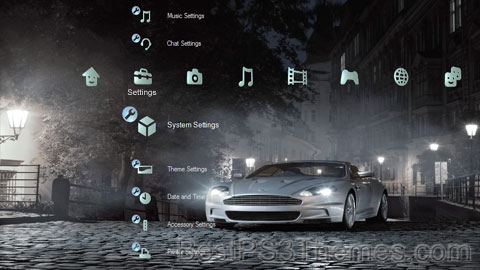
Aston Martin Lagonda Global Holdings PLC (/ˈæstən/) is a British manufacturer of luxury sports cars and grand tourers. Its predecessor was founded in 1913 by Lionel Martin and Robert Bamford. Steered from 1947 by David Brown, it became associated with expensive grand touring cars in the 1950s and 1960s, and with the fictional character James Bond following his use of a DB5 model in the 1964 film Goldfinger.[2] Their grand tourers and sports cars are regarded as a British cultural icon.[3] Aston Martin has held a royal warrant as purveyor of motorcars to Charles III (as Prince of Wales and later as King) since 1982,[4][5] and has over 160 car dealerships in 53 countries, making it a global automobile brand.[6] The company is traded on the London Stock Exchange and is a constituent of the FTSE 250 Index.[7] In 2003 it received the Queen's Award for Enterprise for outstanding contribution to international trade.[8] The company has survived seven bankruptcies throughout its history.[9] The headquarters and main production of its sports cars and grand tourers are in a 55-acre (22 ha) facility in Gaydon, Warwickshire, England, on the former site of RAF Gaydon, adjacent to the Jaguar Land Rover Gaydon Centre.[10] The old 3.6-acre (1.5 ha) facility in Newport Pagnell, Buckinghamshire is the present home of the Aston Martin Works classic car department, which focuses on heritage sales, service, spares and restoration operations.[11][12] The 90-acre (36 ha) factory in St Athan, Wales features three converted 'super-hangars' from MOD St Athan, and serves as the production site of Aston Martin's first-ever SUV, the DBX.[13][14] Aston Martin has been involved in motorsport at various points in its history, mainly in sports car racing,[15] and also in Formula One.[16] The Aston Martin brand is increasingly being used, mostly through licensing, on other products including a submarine,[17] real estate development,[18] and aircraft.[19] History[edit]Founding[edit]Aston Martin was founded in 1913 by Lionel Martin and Robert Bamford.[20] The two had joined forces as Bamford & Martin the previous year to sell cars made by Singer from premises in Callow Street, London where they also serviced GWK and Calthorpe vehicles. Martin raced specials at Aston Hill near Aston Clinton, and the pair decided to make their own vehicles.[21] The first car to be named Aston Martin was created by Martin by fitting a four-cylinder Coventry-Simplex engine to the chassis of a 1908 Isotta Fraschini.[22][23] They acquired premises at Henniker Mews[24] in Kensington and produced their first car in March 1915. Production could not start because of the outbreak of the First World War, when Martin joined the Admiralty and Bamford joined the Army Service Corps.[25] 1918–1939: Interwar years[edit]After the war they found new premises at Abingdon Road, Kensington and designed a new car. Bamford left in 1920 and Bamford & Martin was revitalised with funding from Louis Zborowski. In 1922, Bamford & Martin produced cars to compete in the French Grand Prix, which went on to set world speed and endurance records at Brooklands. Three works Team Cars with 16-valve twin cam engines were built for racing and record-breaking: chassis number 1914, later developed as the Green Pea; chassis number 1915, the Razor Blade record car; and chassis number 1916, later developed as the Halford Special.[26] Approximately 55 cars were built for sale in two configurations; long chassis and short chassis. Bamford & Martin went bankrupt in 1924 and was bought by Dorothea, Lady Charnwood, who put her son John Benson on the board. Bamford & Martin got into financial difficulty again in 1925 and Martin was forced to sell the company (Bamford had already left it in 1920).[27] Later that year, Bill Renwick, Augustus (Bert) Bertelli and investors including Lady Charnwood took control of the business. They renamed it Aston Martin Motors and moved it to the former Whitehead Aircraft Limited Hanworth works in Feltham. Renwick and Bertelli had been in partnership some years and had developed an overhead-cam four-cylinder engine using Renwick's patented combustion chamber design, which they had tested in an Enfield-Allday chassis. The only "Renwick and Bertelli" motor car made, it was known as "Buzzbox" and still survives.[28] The pair had planned to sell their engine to motor manufacturers, but having heard that Aston Martin was no longer in production realised they could capitalise on its reputation to jump-start the production of a completely new car.[28] Between 1926 and 1937 Bertelli was both technical director and designer of all new Aston Martins, since known as "Bertelli cars". They included the 1½-litre "T-type", "International", "Le Mans", "MKII" and its racing derivative, the "Ulster", and the 2-litre 15/98 and its racing derivative, the "Speed Model". Most were open two-seater sports cars bodied by Bert Bertelli's brother Enrico (Harry), with a small number of long-chassis four-seater tourers, dropheads and saloons also produced.[28] Bertelli was a competent driver keen to race his cars, one of few owner/manufacturer/drivers. The "LM" team cars were very successful in national and international motor racing including at Le Mans.[28] Financial problems reappeared in 1932. Aston Martin was rescued for a year by Lance Prideaux Brune before passing it on to Sir Arthur Sutherland. In 1936, Aston Martin decided to concentrate on road cars, producing just 700 until World War II halted work. Production shifted to aircraft components during the war.[29][30] 1947–1972: David Brown[edit]In 1947, old-established (1860) privately owned Huddersfield gear and machine tools manufacturer David Brown Limited bought Aston Martin, putting it under control of its Tractor Group. David Brown became Aston Martin's latest saviour.[31] He also acquired Lagonda,[32] without its factory, for its 2.6-litre W. O. Bentley-designed engine. Lagonda moved operations to Newport Pagnell and shared engines, resources and workshops. Aston Martin began to build the classic "DB" series of cars.[33] In April 1950, they announced planned production of their Le Mans prototype to be called the DB2,[34] followed by the DB2/4 in 1953, the DB2/4 MkII in 1955, the DB Mark III in 1957 and the Italian-styled 3.7 L DB4 in 1958.[33] While these models helped Aston Martin establish a good racing pedigree, the DB4 stood out and yielded the famous DB5 in 1963. Aston stayed true to its grand touring style with the DB6 (1965–70), and DBS (1967–1972).[33] The six-cylinder engines of these cars from 1954 up to 1965 were designed by Tadek Marek.[35] 1972–1975: William Willson[edit]Aston Martin was often financially troubled. In 1972, David Brown paid off all its debts, said to be £5 million or more, and handed it for £101 to Company Developments, a Birmingham-based investment bank consortium chaired by accountant William Willson.[36] More detail on this period may be read at Willson's biography. The worldwide recession, lack of working capital and the difficulties of developing an engine to meet California's exhaust emission requirements – it stopped the company's US sales – again pulled Aston Martin into receivership at the end of 1974. The company had employed 460 workers when the manufacturing plant closed.[37] 1975–1981: Sprague and Curtis[edit]The receiver sold the business in April 1975 for £1.05 million to North American businessman Peter Sprague of National Semiconductor, Toronto hotelier George Minden,[38] and Jeremy Turner, a London businessman,[39] who insisted to reporters that Aston Martin remained a British controlled business. Sprague later claimed he had fallen in love with the factory, not the cars, the workforce's craftsmanship dedication and intelligence. At this point, he and Minden had brought in investor Alan Curtis, a British office property developer, together with George Flather, a retired Sheffield steel magnate.[40] Six months later, in September 1975, the factory – shut down the previous December – re-opened under its new owner as Aston Martin Lagonda Limited with 100 employees, and planned to lift staff to 250 by the end of 1975.[37] In January 1976, AML revealed that it now held orders for 150 cars for the US, 100 for other markets and another 80 from a Japanese importing agency.[41] At the Geneva Motor Show, Fred Hartley, managing director and sales director for 13 years before that, announced he had resigned over "differences in marketing policy".[42] The new owners pushed Aston Martin into modernising its line, introducing the V8 Vantage in 1977, the convertible Volante in 1978, and the one-off Bulldog styled by William Towns in 1980. Towns also styled the futuristic new Lagonda saloon, based on the V8 model.[43] Curtis, who had a 42% stake in Aston Martin,[44] also brought about a change in direction from the usual customers who were Aston Martin fans, to successful young married businessmen. Prices had been increased by 25%.[40] There was speculation that AML was about to buy Italian automobile manufacturer Lamborghini.[45] At the end of the 1970s, there was widespread debate about running MG into the Aston Martin consortium. 85 Conservative MPs formed themselves into a pressure group to get British Leyland to release their grip and hand it over.[46] CH Industrials plc (car components) bought a 10% share in AML. But in July 1980, blaming a recession, AML cut back their workforce of 450 by more than 20%, making those people redundant.[47] 1981–1987: Victor Gauntlett[edit]In January 1981, there having been no satisfactory revival partners, Alan Curtis and Peter Sprague announced they had never intended to maintain a long-term financial stake in Aston Martin Lagonda and it was to be sold to Pace Petroleum's Victor Gauntlett. Sprague and Curtis pointed out that under their ownership AML finances had improved to where an offer for MG might have been feasible.[48] Gauntlett bought a 12.5% stake in Aston Martin for £500,000 via Pace Petroleum in 1980, with Tim Hearley of CH Industrials taking a similar share. Pace and CHI took over as joint 50/50 owners at the beginning of 1981, with Gauntlett as executive chairman. Gauntlett also led the sales team, and after some development and publicity when the Lagonda became the world's fastest four-seater production car, was able to sell the car in Oman, Kuwait, and Qatar.[49] In 1982, Aston Martin was granted a Royal Warrant of Appointment by the Prince of Wales.[5] Understanding that it would take some time to develop new Aston Martin products, they created an engineering service subsidiary to develop automotive products for other companies. It was decided to use a trade name of Salmons & Son, their in-house coachbuilder, Tickford, which Aston Martin had bought in 1955. Tickford's name had been long associated with expensive high-quality carriages and cars along with their folding roofs. New products included a Tickford Austin Metro, a Tickford Ford Capri and even Tickford train interiors, particularly on the Jaguar XJS.[49] Pace continued sponsoring racing events, and now sponsored all Aston Martin Owners Club events, taking a Tickford-engined Nimrod Group C car owned by AMOC President Viscount Downe, which came third in the Manufacturers Championship in both 1982 and 1983. It also finished seventh in the 1982 24 Hours of Le Mans race. However, sales of production cars were now at an all-time low of 30 cars produced in 1982.[49] As trading became tighter in the petroleum market, and Aston Martin was requiring more time and money, Gauntlett agreed to sell Hays/Pace to the Kuwait Investment Office in September 1983. As Aston Martin required greater investment, he also agreed to sell his share holding to American importer and Greek shipping tycoon Peter Livanos, who invested via his joint venture with Nick and John Papanicolaou, ALL Inc. Gauntlett remained chairman of AML, 55% of the stake was owned by ALL, with Tickford a 50/50 venture between ALL and CHI. The uneasy relationship was ended when ALL exercised options to buy a larger share in AML; CHI's residual shares were exchanged for CHI's complete ownership of Tickford, which retained the development of existing Aston Martin projects. In 1984, Papanicolaou's Titan shipping business was in trouble so Livanos's father George bought out the Papanicolaou's shares in ALL, while Gauntlett again became a shareholder with a 25% holding in AML. The deal valued Aston Martin/AML at £2 million, the year it built its 10,000th car.[49] Although as a result Aston Martin had to make 60 members of the workforce redundant, Gauntlett bought a stake in Italian styling house Zagato, and resurrected its collaboration with Aston Martin.[50] In 1986, Gauntlett negotiated the return of the fictional British secret agent James Bond to Aston Martin. Cubby Broccoli had chosen to recast the character using actor Timothy Dalton, in an attempt to re-root the Bond-brand back to a more Sean Connery-like feel. Gauntlett supplied his personal pre-production Vantage for use in the filming of The Living Daylights, and sold a Volante to Broccoli for use at his home in America. Gauntlett turned down the role of a KGB colonel in the film, however: "I would have loved to have done it but really could not afford the time."[51] 1987–2007: Ford Motor Company[edit]As Aston Martin needed funds to survive in the long term, Ford bought a 75% stake in the company in 1987, and bought the rest later.[52][53] In May of that year, Victor Gauntlett and Prince Michael of Kent were staying at the home of Contessa Maggi, the wife of the founder of the original Mille Miglia, while watching the revival event. Another house guest was Walter Hayes, vice-president of Ford of Europe. Despite problems over the previous acquisition of AC Cars, Hayes saw the potential of the brand and the discussion resulted in Ford taking a share holding in September 1987.[54] In 1988, having produced some 5,000 cars in 20 years, a revived economy and successful sales of limited edition Vantage, and 52 Volante Zagato coupés at £86,000 each; Aston Martin finally retired the ancient V8 and introduced the Virage range.[55] Although Gauntlett was contractually to stay as chairman for two years, his racing interests took the company back into sports car racing in 1989 with limited European success. However, with engine rule changes for the 1990 season and the launch of the new Volante model, Ford provided the limited supply of Cosworth engines to the Jaguar cars racing team. As the entry-level DB7 would require a large engineering input, Ford agreed to take full control of Aston Martin, and Gauntlett handed over Aston Martin's chairmanship to Hayes in 1991.[56] In 1992, the high-performance variant of the Virage called the Vantage was announced, and the following year Aston Martin renewed the DB range by announcing the DB7.[57] By 1993, Ford had fully acquired the company after having built a stake in 1987.[58] Ford placed Aston Martin in the Premier Automotive Group, invested in new manufacturing and ramped up production. In 1994, Ford opened a new factory at Banbury Road in Bloxham to manufacture the DB7. In 1995, Aston Martin produced a record 700 cars.[59] Until the Ford era, cars had been produced by hand coachbuilding craft methods, such as the English wheel. During the mid 1990s, the Special Projects Group, a secretive unit with Works Service at Newport Pagnell, created an array of special coach-built vehicles for the Brunei royal family.[60] In 1998, the 2,000th DB7 was built, and in 2002, the 6,000th, exceeding production of all of the previous DB series models. The DB7 range was revamped by the addition of more powerful V12 Vantage models in 1999, and in 2001, Aston Martin introduced the V12-engined flagship model called the Vanquish which succeeded the aging Virage (now called the V8 Coupé).[61] At the North American International Auto Show in Detroit, Michigan in 2003, Aston Martin introduced the V8 Vantage concept car. Expected to have few changes before its introduction in 2005, the Vantage brought back the classic V8 engine to allow Aston Martin to compete in a larger market. 2003 also saw the opening of the Gaydon factory, the first purpose-built factory in Aston Martin's history. The facility is situated on a 55-acre (22 ha) site of a former RAF V Bomber airbase, with an 8,000 m2 (86,000 sq ft) front building for offices, meeting rooms and customer reception, and a 35,000 m2 (380,000 sq ft) production building.[10][62] Also introduced in 2003 was the DB9 coupé, which replaced the ten-year-old DB7. A convertible version of the DB9, the DB9 Volante, was introduced at the 2004 Detroit auto show.[63] In October 2004, Aston Martin set up the dedicated 12,500 m2 (135,000 sq ft) Aston Martin Engine Plant (AMEP) within the Ford Germany Niehl, Cologne plant. With the capacity to produce up to 5,000 engines a year by 100 specially trained personnel, like traditional Aston Martin engine production from Newport Pagnell, assembly of each unit was entrusted to a single technician from a pool of 30, with V8 and V12 variants assembled in under 20 hours. By bringing engine production back to within Aston Martin, the promise was that Aston Martin would be able to produce small runs of higher performance variants' engines.[64][65] This expanded engine capacity allowed the entry-level V8 Vantage sports car to enter production at the Gaydon factory in 2006, joining the DB9 and DB9 Volante.[66] In December 2003, Aston Martin announced it would return to motor racing in 2005. A new division was created, called Aston Martin Racing, which became responsible, together with Prodrive, for the design, development, and management of the DBR9 program. The DBR9 competes in the GT class in sports car races, including the world-famous 24 Hours of Le Mans.[67] In 2006, an internal audit led Ford to consider divesting itself of parts of its Premier Automotive Group. After suggestions of selling Jaguar Cars, Land Rover, or Volvo Cars were weighed, Ford announced in August 2006 it had engaged UBS AG to sell all or part of Aston Martin at auction.[68] 2007–2018: Private Limited Company[edit]On 12 March 2007, a consortium led by Prodrive chairman David Richards purchased Aston Martin for £475 million (US$848 million).[69][70][71] The group included American investment banker John Sinders and two Kuwaiti companies namely Investment Dar and Adeem Investment.[72] Resident Evil #5Resident Evil theme by Yann Green Download: ResidentEvil_5.p3t
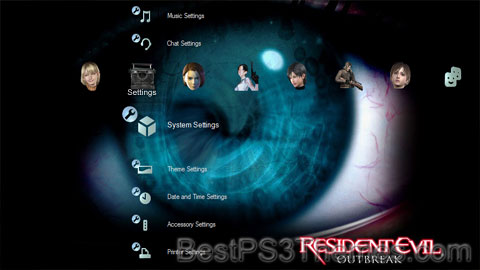
Resident Evil is a Japanese horror game series and media franchise created by Capcom. It consists of survival horror, third-person shooter and first-person shooter games, with players typically surviving in post-apocalyptic urban environments infested with mutant humanoids and bizarre animals (such as mutated dogs), zombies and other lethal creatures. The franchise has expanded into other media, most notably a live-action film series, as well as animated films, television series, comic books, novels, audiobooks, and merchandise including clothing, costumes, action figures and toys. Resident Evil is the highest-grossing horror franchise. The first Resident Evil game was created by Shinji Mikami and Tokuro Fujiwara for PlayStation, and released in 1996.[1][2] It is credited for defining the survival horror genre and returning zombies to popular culture. By the time of Resident Evil 4 (2005), the franchise shifted to more dynamic shooting action, achieved critical acclaim, and influenced the evolution of the survival horror and third-person genres, popularizing the "over-the-shoulder" third-person view.[3] The franchise returned to survival horror with Resident Evil 7: Biohazard (2017) and Resident Evil Village (2021), which used a first-person perspective. Capcom has also released four Resident Evil remakes: Resident Evil (2002), Resident Evil 2 (2019), Resident Evil 3 (2020) and Resident Evil 4 (2023). Resident Evil is Capcom's best-selling franchise and the best-selling horror game series, with 154 million copies sold worldwide, as of December 2023.[4] The first Resident Evil action film was released in 2002, starring Milla Jovovich, followed by five further sequels and a reboot, Welcome to Raccoon City (2021). The films have received mostly negative critical reviews, including on Rotten Tomatoes and some on Metacritic; however, some of the films have received mixed reviews on Metacritic. Nevertheless, the films have grossed more than $1.2 billion, making Resident Evil the third-highest-grossing video game film series. History[edit]The development of the first Resident Evil, released as Biohazard in Japan, began in 1993 when Capcom's Tokuro Fujiwara told Shinji Mikami and other co-workers to create a game using elements from Fujiwara's 1989 game Sweet Home on the Family Computer (Famicom) in Japan.[5][6] When in late 1994 marketing executives were setting up to release Biohazard in the United States, it was pointed out that securing the rights to the name Biohazard would be very difficult as a DOS game had been registered under that name, as well as a New York hardcore punk band called Biohazard. A contest was held among company personnel to choose a new name; this competition turned up Resident Evil, the name under which it was released in the west.[7] Resident Evil made its debut on the PlayStation in 1996 and was later ported to the Sega Saturn. The first entry in the series was the first game to be dubbed a "survival horror", a term coined for the new genre it initiated,[8] and its critical and commercial success[9] led to the production of two sequels, Resident Evil 2 in 1998 and Resident Evil 3: Nemesis in 1999, both for the PlayStation. A port of Resident Evil 2 was released for the Nintendo 64. In addition, ports of all three were released for Windows. The fourth game in the series, Resident Evil – Code: Veronica, was developed for the Dreamcast and released in 2000, followed by ports of Resident Evil 2 and Resident Evil 3: Nemesis. Resident Evil – Code: Veronica was later re-released for Dreamcast in Japan in an updated form as Code: Veronica Complete, which included slight changes, many of which revolved around story cutscenes. This updated version was later ported to the PlayStation 2 and GameCube under the title Code: Veronica X. Despite earlier announcements that the next game in the series would be released for the PlayStation 2, which resulted in the creation of an unrelated game titled Devil May Cry, series' creator and producer Shinji Mikami decided to make the series exclusively for the GameCube.[10] The next three games in the series—a remake of the original Resident Evil and the prequel Resident Evil Zero, both released in 2002, as well as Resident Evil 4 (2005)—were all released initially as GameCube exclusives. Resident Evil 4 was later released for Windows, PlayStation 2, and Wii. A trilogy of GunCon-compatible light gun games known as the Gun Survivor series featured first-person gameplay. The first, Resident Evil Survivor, was released in 2000 for the PlayStation and PC but received mediocre reviews.[11] The subsequent games, Resident Evil Survivor 2 – Code: Veronica and Resident Evil: Dead Aim, fared somewhat better.[12] Dead Aim is the fourth Gun Survivor game in Japan, with Gun Survivor 3 being the Dino Crisis spin-off Dino Stalker. In a similar vein, the Chronicles series features first-person gameplay, albeit on an on-rails path. Resident Evil: The Umbrella Chronicles was released in 2007 for the Wii, with a sequel, Resident Evil: The Darkside Chronicles released in 2009 (both were later ported to the PlayStation 3 in 2012).[13] Resident Evil Outbreak is an online game for the PlayStation 2, released in 2003, depicting a series of episodic storylines in Raccoon City set during the same period as Resident Evil 2 and Resident Evil 3: Nemesis. It was the first in the series and the first survival horror title to feature cooperative gameplay.[14] It was followed by a sequel, Resident Evil Outbreak: File #2. Raccoon City is a metropolis located in the Arklay Mountains of the Midwestern United States that succumbed to the deadly T-virus outbreak and was consequently destroyed via a nuclear missile attack issued by the United States government. The town served as a critical junction for the series' progression as one of the main catalysts to Umbrella's downfall and the entry point for some of the series' most notable characters. Resident Evil Gaiden is an action-adventure game for the Game Boy Color featuring a role-playing-style combat system. There have been several downloadable mobile games based on the Resident Evil series in Japan. Some of these mobile games have been released in North America and Europe through T-Mobile. At the Sony press conference during E3 2009, Resident Evil Portable was announced for the PlayStation Portable,[15][16][17] described as an all-new title being developed with "the PSP Go in mind" and "totally different for a Resident Evil game". No further announcements have been made, and the game is considered to have been canceled.[18][19] In 2009, Resident Evil 5 was released for PlayStation 3, Windows and Xbox 360, becoming the best selling game of the franchise despite mixed fan reception. Capcom revealed the third-person shooter Resident Evil: Operation Raccoon City, which was developed by Slant Six Games for the PlayStation 3, Xbox 360 and Windows and released in March 2012. A survival horror game for the Nintendo 3DS, Resident Evil: Revelations, was released in February 2012.[20] In October of the same year, the next numbered entry in the main series, Resident Evil 6, was released to mixed reviews,[21] but enthusiastic pre-order sales.[22] In 2013, producer Masachika Kawata said the Resident Evil franchise would return to focus on elements of horror and suspense over action, adding that "survival horror as a genre is never going to be on the same level, financially, as shooters and much more popular, mainstream games. At the same time, I think we need to have the confidence to put money behind these projects, and it doesn't mean we can't focus on what we need to do as a survival horror game to meet fan's needs."[23] Resident Evil: Revelations 2, an episodic game set between Resident Evil 5 and Resident Evil 6, was released in March 2015. A series of team-based multiplayer games were developed beginning with the poorly received Umbrella Corps, which was released in June 2016.[24] Resident Evil: Resistance was released in April 2020, followed by Resident Evil Re:Verse in October 2022, with both being available for free to those who bought Resident Evil 3 and Village respectively.[25][26] Using the new RE Engine, which would develop the next generation of Resident Evil games, the series continued to shift back towards more horror elements. The next mainline game, Resident Evil 7: Biohazard was released for Windows, PlayStation 4 and Xbox One in January 2017.[27][28] Set in a dilapidated mansion in Louisiana, the game uses a first-person perspective and emphasizes horror and exploration over action, unlike previous installments.[29][30][31][32] The first-person perspective continued in the eighth mainline game Resident Evil Village. Released in May 2021, the game, set in a mysterious European village, is a direct sequel to Resident Evil 7: Biohazard although it incorporates more action elements inspired from Resident Evil 4.[33][34] The game also marked the franchise's debut on PlayStation 5 and Xbox Series X/S[35] A new generation of remakes of older entries began in 2019 with a remake of Resident Evil 2, being released for the PlayStation 4, Windows, and Xbox One. The remake outsold the original game within a year, selling over five million copies.[36] Following in the success of the Resident Evil 2 remake, Capcom revealed a remake of Resident Evil 3: Nemesis in December 2019, known as Resident Evil 3. It was released in April 2020.[37] In June 2022, a remake of Resident Evil 4 was announced and released on March 24, 2023 for PlayStation 4, PlayStation 5, Xbox Series X/S, and PC.[38] Story overview[edit]The early Resident Evil games focused on the Umbrella Corporation, an international pharmaceutical company that secretly develops mutagenic viruses to further their "bio-organic weapons" (BOW) research. The company's viruses can transform humans into mindless zombies while also mutating plants and animals into horrifying monstrosities. The Umbrella Corporation uses its vast resources to effectively control Raccoon City, a fictional midwestern American city. In the original Resident Evil, members of an elite police task force, Special Tactics and Rescue Service (STARS), are lured to a derelict mansion on the outskirts of Raccoon City. The STARS team is mostly decimated by zombies and other BOWs, leaving only a handful of survivors, including Chris Redfield, Jill Valentine, and Albert Wesker. Chris and Jill explore the zombie-infested mansion and uncover a secret underground Umbrella research facility. Wesker reveals himself to be a double agent for Umbrella and betrays his comrades. However, Wesker is seemingly murdered by a Tyrant, a special BOW that is the culmination of the Umbrella Corporation's research.[39][40] Chris and Jill escape the mansion, but their testimony is ridiculed by Raccoon City's officials due to Umbrella's influence. Meanwhile, a separate viral outbreak occurs in another Umbrella research facility underneath Raccoon City. Most of the city's residents are infected and become zombies. Resident Evil 2 introduces two new protagonists, Leon S. Kennedy, a rookie police officer and Claire Redfield, the younger sister of Chris. Leon and Claire arrive in Raccoon City amidst the chaos of the viral outbreak. Leon is aided by Ada Wong, a corporate spy posing as an FBI agent, while Claire rescues Sherry Birkin, the daughter of two prominent Umbrella researchers. At the same time, Jill makes her escape from the city in Resident Evil 3: Nemesis. She is relentlessly pursued by a new Tyrant, Nemesis, who is deployed by Umbrella to eliminate all surviving STARS members. The U.S. Government destroys Raccoon City with a missile strike to sterilize the viral outbreak.[41] Leon, Claire, Sherry, Ada, and Jill escape the city before its eradication. Claire continues to look for Chris, whereas Leon is recruited to work for the U.S. Government. Resident Evil – Code: Veronica follows Claire as she escapes from a prison camp in the Southern Ocean and later reunites with Chris at an Umbrella research facility in Antarctica. Resident Evil 4 is set six years after the Raccoon City incident and focuses on Leon as he tries to rescue the U.S. President's daughter from a cult in Spain.[39][40] A government investigation into the Umbrella Corporation reveals its involvement in the Raccoon City disaster and leads to the company's dissolution. Despite the downfall of the Umbrella Corporation, the company's research and BOWs proliferate across the black market and lead to the rise of bioterrorism. Chris and Jill establish the Bioterrorism Security Assessment Alliance (BSAA) to combat these ever-growing threats on a global scale. Wesker is revealed to be alive and involved in the development of new potent viral agents and BOWs. In Resident Evil 5, Wesker seeks to unleash a highly mutagenic virus that will infect all of humanity. Chris and the BSAA confront and kill Wesker in Africa before he can fulfill his mission.[42] Resident Evil 6 features Leon and Chris meeting for the first time in the video game series.[43] The two work separately to triage bioterrorist attacks in the United States, Eastern Europe, and China. They are assisted by Sherry, Wesker's illegitimate son Jake Muller, Ada, and many members of the BSAA and U.S. government. Resident Evil 7: Biohazard and Resident Evil Village introduce a new protagonist, Ethan Winters, who becomes entangled in a bioterrorism incident while searching for his missing wife. He encounters Chris and the BSAA, who help him rescue his wife and defeat Eveline, a powerful BOW. Ethan, Mia, and their newborn daughter, Rosemary, are relocated to Eastern Europe but are abducted by a cult. Ethan ultimately sacrifices himself to destroy a fungal colony being weaponized by bioterrorists and save his family.[39][40][44] Gameplay[edit]The Resident Evil franchise has had a variety of control schemes and gameplay mechanics throughout its history. Puzzle-solving has figured prominently throughout the series.[45] Tank controls[edit]The first game introduced a control scheme that the player community has come to refer to as "tank controls" to the series. In a game with tank controls, players control movement relative to the position of the player character, rather than relative to the fixed virtual camera from which the player views the current scene.[46] Pressing up (for example on a D-pad, analog stick, or cursor movement keys) on the game controller moves the character in the direction being faced, pressing down backpedals, and left and right rotates the character.[46] This can feel counter-intuitive when the character is facing the camera, as the controls are essentially reversed in this state. This differs from many 3D games, in which characters move in the direction the player pushes the controls from the perspective of the camera.[46] Some critics have posited that the control scheme is intentionally clumsy, meant to enhance stress and exacerbate difficulty.[47] While the first three entries in the series featured this control scheme, the third, Resident Evil 3: Nemesis, saw some action-oriented additions. These included a 180 degree turn and dodge command that, according to GameSpot, "hinted at a new direction that the series would go in." Later games in the series, like Resident Evil 4, would feature a more fluid over-the-shoulder third-person camera instead of a fixed camera for each room, while Resident Evil 7 and Resident Evil Village are played from the first-person perspective. Third-person shooter gameplay[edit]Resident Evil 4 saw significant changes to the established gameplay, including switching from fixed camera perspectives to a tracking camera, and more action-oriented gameplay and mechanics. This was complemented by an abundance of ammunition and revised aiming and melee mechanics. Some critics claimed that this overhauled control scheme "made the game less scary."[47] The next two games in the franchise furthered the action-oriented mechanics: Resident Evil 5 featured cooperative play and added strafing, while Resident Evil 6 allowed players to move while aiming and shooting for the first time, fully abandoning the series' signature tank controls.[47] First-person shooter gameplay and VR[edit]Resident Evil 7 is the first main Resident Evil game to use the first-person perspective and to use virtual reality. It drew comparisons to modern survival horror games such as Outlast and PT.[47] The eighth main-series game, Resident Evil Village, also features a first-person perspective.[48] A VR version of Resident Evil 4 was released on the Oculus Quest 2 on October 21, 2021.[49] Other media[edit]The Resident Evil franchise features video games and tie-in merchandise and products, including various live-action and animated films, comic books, and novels. Films[edit]Live-action films[edit]From 2002 to 2016, six live-action Resident Evil films were produced, all written and produced by Paul W. S. Anderson. The films do not follow the games' premise but feature some game characters. The series' protagonist is Alice, an original character created for the films portrayed by Milla Jovovich. Despite a negative reaction from critics, the live-action film series has made over $1 billion worldwide.[50] They are, to date, the only video game adaptations to increase the amount of money made with each successive film.[51] The series holds the record for the "Most Live-Action Film Adaptations of a Video Game" in the 2012 Guinness World Records Gamer's Edition, which also described it as "the most successful movie series to be based on a video game."[14] A reboot, Resident Evil: Welcome to Raccoon City, was released on November 24, 2021, with Johannes Roberts as writer/director.[52] Animated films[edit]The first computer animated film for the franchise was Biohazard 4D-Executer. It was a short 3D film produced for Japanese theme parks and did not feature any characters from the game.[53] Starting in 2008, a series of feature-length computer-animated films have been released. These films take place in the same continuity with the games of the series, and feature characters such as Leon Kennedy, Claire Redfield, Ada Wong, Chris Redfield,
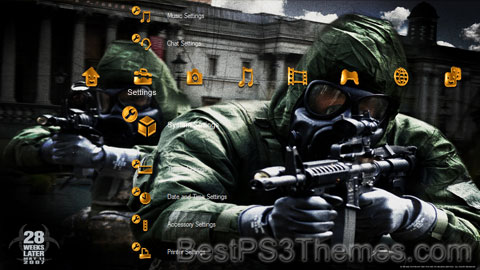
Ghost Recon Advanced Warfighter 2 version 2 theme by Blu-Ray-Cool Download: GRAW2_V2.p3t P3T Unpacker v0.12 This program unpacks Playstation 3 Theme files (.p3t) so that you can touch-up an existing theme to your likings or use a certain wallpaper from it (as many themes have multiple). But remember, if you use content from another theme and release it, be sure to give credit! Download for Windows: p3textractor.zip Instructions: Download p3textractor.zip from above. Extract the files to a folder with a program such as WinZip or WinRAR. Now there are multiple ways to extract the theme. The first way is to simply open the p3t file with p3textractor.exe. If you don’t know how to do this, right click the p3t file and select Open With. Alternatively, open the p3t file and it will ask you to select a program to open with. Click Browse and find p3textractor.exe from where you previously extracted it to. It will open CMD and extract the theme to extracted.[filename]. After that, all you need to do for any future p3t files is open them and it will extract. The second way is very simple. Just drag the p3t file to p3textractor.exe. It will open CMD and extract the theme to extracted.[filename]. For the third way, first put the p3t file you want to extract into the same folder as p3textractor.exe. Open CMD and browse to the folder with p3extractor.exe. Enter the following: Ghost Recon Advanced Warfighter 2 theme by Blu-Ray-Cool Download: GRAW2_2.p3t Redirect to: Blue theme by Ru$$ Download: Blue_2.p3t
Blue is one of the three primary colours in the RYB colour model (traditional colour theory), as well as in the RGB (additive) colour model.[2] It lies between violet and cyan on the spectrum of visible light. The term blue generally describes colours perceived by humans observing light with a dominant wavelength that’s between approximately 450 and 495 nanometres. Most blues contain a slight mixture of other colours; azure contains some green, while ultramarine contains some violet. The clear daytime sky and the deep sea appear blue because of an optical effect known as Rayleigh scattering. An optical effect called the Tyndall effect explains blue eyes. Distant objects appear more blue because of another optical effect called aerial perspective.
Blue has been an important colour in art and decoration since ancient times. The semi-precious stone lapis lazuli was used in ancient Egypt for jewellery and ornament and later, in the Renaissance, to make the pigment ultramarine, the most expensive of all pigments.[3] In the eighth century Chinese artists used cobalt blue to colour fine blue and white porcelain. In the Middle Ages, European artists used it in the windows of cathedrals. Europeans wore clothing coloured with the vegetable dye woad until it was replaced by the finer indigo from America. In the 19th century, synthetic blue dyes and pigments gradually replaced organic dyes and mineral pigments. Dark blue became a common colour for military uniforms and later, in the late 20th century, for business suits. Because blue has commonly been associated with harmony, it was chosen as the colour of the flags of the United Nations and the European Union.[4]
In the United States and Europe, blue is the colour that both men and women are most likely to choose as their favourite, with at least one recent survey showing the same across several other countries, including China, Malaysia, and Indonesia.[5][6] Past surveys in the US and Europe have found that blue is the colour most commonly associated with harmony, confidence, masculinity, knowledge, intelligence, calmness, distance, infinity, the imagination, cold, and sadness.[7]
The modern English word blue comes from Middle English bleu or blewe, from the Old French bleu, a word of Germanic origin, related to the Old High German word blao (meaning 'shimmering, lustrous').[8] In heraldry, the word azure is used for blue.[9]
In Russian, Spanish,[10] Mongolian, Irish, and some other languages, there is no single word for blue, but rather different words for light blue (голубой, goluboj; Celeste) and dark blue (синий, sinij; Azul) (see Colour term).
Several languages, including Japanese and Lakota Sioux, use the same word to describe blue and green. For example, in Vietnamese, the colour of both tree leaves and the sky is xanh. In Japanese, the word for blue (青, ao) is often used for colours that English speakers would refer to as green, such as the colour of a traffic signal meaning "go". In Lakota, the word tȟó is used for both blue and green, the two colours not being distinguished in older Lakota (for more on this subject, see Blue–green distinction in language).
Linguistic research indicates that languages do not begin by having a word for the colour blue.[11] Colour names often developed individually in natural languages, typically beginning with black and white (or dark and light), and then adding red, and only much later – usually as the last main category of colour accepted in a language – adding the colour blue, probably when blue pigments could be manufactured reliably in the culture using that language.[11]
The term blue generally describes colours perceived by humans observing light with a dominant wavelength between approximately 450 and 495 nanometres.[12] Blues with a higher frequency and thus a shorter wavelength gradually look more violet, while those with a lower frequency and a longer wavelength gradually appear more green. Purer blues are in the middle of this range, e.g., around 470 nanometres.
Isaac Newton included blue as one of the seven colours in his first description of the visible spectrum.[13] He chose seven colours because that was the number of notes in the musical scale, which he believed was related to the optical spectrum. He included indigo, the hue between blue and violet, as one of the separate colours, though today it is usually considered a hue of blue.[14]
In painting and traditional colour theory, blue is one of the three primary colours of pigments (red, yellow, blue), which can be mixed to form a wide gamut of colours. Red and blue mixed together form violet, blue and yellow together form green. Mixing all three primary colours together produces a dark brown. From the Renaissance onward, painters used this system to create their colours (see RYB colour model).
The RYB model was used for colour printing by Jacob Christoph Le Blon as early as 1725. Later, printers discovered that more accurate colours could be created by using combinations of cyan, magenta, yellow, and black ink, put onto separate inked plates and then overlaid one at a time onto paper. This method could produce almost all the colours in the spectrum with reasonable accuracy.
On the HSV colour wheel, the complement of blue is yellow; that is, a colour corresponding to an equal mixture of red and green light. On a colour wheel based on traditional colour theory (RYB) where blue was considered a primary colour, its complementary colour is considered to be orange (based on the Munsell colour wheel).[15]
In 1993, high-brightness blue LEDs were demonstrated by Shuji Nakamura of Nichia Corporation.[16][17][18] In parallel, Isamu Akasaki and Hiroshi Amano of Nagoya University were working on a new development which revolutionized LED lighting.[19][20]
Nakamura was awarded the 2006 Millennium Technology Prize for his invention.[21]
Nakamura, Hiroshi Amano and Isamu Akasaki were awarded the Nobel Prize in Physics in 2014 for the invention of an efficient blue LED.[22]
Lasers emitting in the blue region of the spectrum became widely available to the public in 2010 with the release of inexpensive high-powered 445–447 nm laser diode technology.[23] Previously the blue wavelengths were accessible only through DPSS which are comparatively expensive and inefficient, but still widely used by scientists for applications including optogenetics, Raman spectroscopy, and particle image velocimetry, due to their superior beam quality.[24] Blue gas lasers are also still commonly used for holography, DNA sequencing, optical pumping, among other scientific and medical applications.
Blue is the colour of light between violet and cyan on the visible spectrum. Hues of blue include indigo and ultramarine, closer to violet; pure blue, without any mixture of other colours; Azure, which is a lighter shade of blue, similar to the colour of the sky; Cyan, which is midway in the spectrum between blue and green, and the other blue-greens such as turquoise, teal, and aquamarine.
Blue also varies in shade or tint; darker shades of blue contain black or grey, while lighter tints contain white. Darker shades of blue include ultramarine, cobalt blue, navy blue, and Prussian blue; while lighter tints include sky blue, azure, and Egyptian blue (for a more complete list see the List of colours).
In nature, many blue phenomena arise from structural colouration, the result of interference between reflections from two or more surfaces of thin films, combined with refraction as light enters and exits such films. The geometry then determines that at certain angles, the light reflected from both surfaces interferes constructively, while at other angles, the light interferes destructively. Diverse colours therefore appear despite the absence of colourants.[25]
Egyptian blue, the first artificial pigment, was produced in the third millennium BC in Ancient Egypt. It is produced by heating pulverized sand, copper, and natron. It was used in tomb paintings and funereal objects to protect the dead in their afterlife. Prior to the 1700s, blue colourants for artwork were mainly based on lapis lazuli and the related mineral ultramarine. A breakthrough occurred in 1709 when German druggist and pigment maker Johann Jacob Diesbach discovered Prussian blue. The new blue arose from experiments involving heating dried blood with iron sulphides and was initially called Berliner Blau. By 1710 it was being used by the French painter Antoine Watteau, and later his successor Nicolas Lancret. It became immensely popular for the manufacture of wallpaper, and in the 19th century was widely used by French impressionist painters.[26] Beginning in the 1820s, Prussian blue was imported into Japan through the port of Nagasaki. It was called bero-ai, or Berlin blue, and it became popular because it did not fade like traditional Japanese blue pigment, ai-gami, made from the dayflower. Prussian blue was used by both Hokusai, in his wave paintings, and Hiroshige.[27]
In 1799 a French chemist, Louis Jacques Thénard, made a synthetic cobalt blue pigment which became immensely popular with painters.
In 1824 the Societé pour l'Encouragement d'Industrie in France offered a prize for the invention of an artificial ultramarine which could rival the natural colour made from lapis lazuli. The prize was won in 1826 by a chemist named Jean Baptiste Guimet, but he refused to reveal the formula of his colour. In 1828, another scientist, Christian Gmelin then a professor of chemistry in Tübingen, found the process and published his formula. This was the beginning of new industry to manufacture artificial ultramarine, which eventually almost completely replaced the natural product.[28]
In 1878 German chemists synthesized indigo. This product rapidly replaced natural indigo, wiping out vast farms growing indigo. It is now the blue of blue jeans. As the pace of organic chemistry accelerated, a succession of synthetic blue dyes were discovered including Indanthrone blue, which had even greater resistance to fading during washing or in the sun, and copper phthalocyanine.
Blue dyes are organic compounds, both synthetic and natural.[30] Woad and true indigo were once used but since the early 1900s, all indigo is synthetic. Produced on an industrial scale, indigo is the blue of blue jeans.
For food, the triarylmethane dye Brilliant blue FCF is used for candies. The search continues for stable, natural blue dyes suitable for the food industry.[30]
Blue pigments were once produced from minerals, especially lapis lazuli and its close relative ultramarine. These minerals were crushed, ground into powder, and then mixed with a quick-drying binding agent, such as egg yolk (tempera painting); or with a slow-drying oil, such as linseed oil, for oil painting. Two inorganic but synthetic blue pigments are cerulean blue (primarily cobalt(II) stanate: Co2SnO4) and Prussian blue (milori blue: primarily Fe7(CN)18). The chromophore in blue glass and glazes is cobalt(II). Diverse cobalt(II) salts such as cobalt carbonate or cobalt(II) aluminate are mixed with the silica prior to firing. The cobalt occupies sites otherwise filled with silicon.
Methyl blue is the dominant blue pigment in inks used in pens.[31] Blueprinting involves the production of Prussian blue in situ.
| |||||||||||||||||||||||||||||||||||||||||||||||||||||||||||||||||||||||||||||||||||||||||||||||||||||||||||||||||||