Sheffield Wednesday Football Club theme by wazzowl
Download: SWFC.p3t
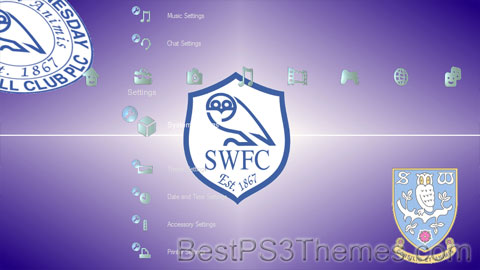
(4 backgrounds)
Redirect to:

The #1 spot for Playstation themes!
Pittsburgh Penguins theme by Rick Rickabaugh
Download: PittsburghPenguins_2.p3t
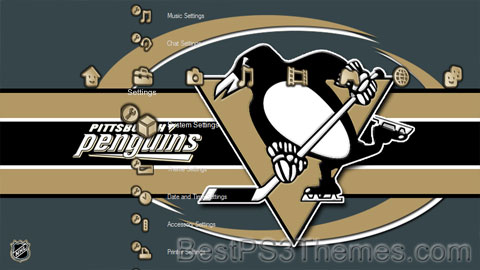
(3 backgrounds)
| Pittsburgh Penguins | |
|---|---|
| Conference | Eastern |
| Division | Metropolitan |
| Founded | 1967 |
| History | Pittsburgh Penguins 1967–present |
| Home arena | PPG Paints Arena |
| City | Pittsburgh, Pennsylvania |
| Team colors | Black, Pittsburgh gold, white[1][2][3] |
| Media | SportsNet Pittsburgh The X (105.9 FM) ESPN Pittsburgh (970 AM) Pittsburgh Penguins Radio Network |
| Owner(s) | Fenway Sports Group Mario Lemieux (minority)[4] |
| General manager | Kyle Dubas |
| Head coach | Mike Sullivan |
| Captain | Sidney Crosby |
| Minor league affiliates | Wilkes-Barre/Scranton Penguins (AHL) Wheeling Nailers (ECHL) |
| Stanley Cups | 5 (1990–91, 1991–92, 2008–09, 2015–16, 2016–17) |
| Conference championships | 6 (1990–91, 1991–92, 2007–08, 2008–09, 2015–16, 2016–17) |
| Presidents' Trophy | 1 (1992–93) |
| Division championships | 9 (1990–91, 1992–93, 1993–94, 1995–96, 1997–98, 2007–08, 2012–13, 2013–14, 2020–21) |
| Official website | nhl |
The Pittsburgh Penguins (colloquially known as the Pens) are a professional ice hockey team based in Pittsburgh. The Penguins compete in the National Hockey League (NHL) as a member of the Metropolitan Division of the Eastern Conference, and have played their home games at PPG Paints Arena, originally known as Consol Energy Center, since 2010. The team previously played at the Civic Arena, which was also known as Mellon Arena from 1999 to 2010, and by its nickname "the Igloo". The Penguins are affiliated with two minor league teams – the Wilkes-Barre/Scranton Penguins of the American Hockey League (AHL) and the Wheeling Nailers of the ECHL.
Founded during the 1967 expansion, the Penguins have qualified for six Stanley Cup Finals, winning the Stanley Cup five times – in 1991, 1992, 2009, 2016, and 2017. Along with the Edmonton Oilers, the Penguins are tied for the most Stanley Cup championships among the non-Original Six teams and sixth overall. With their Stanley Cup wins in 2016 and 2017, the Penguins became the first back-to-back champions in the salary cap era. Several of the team's former members have been inducted into the Hockey Hall of Fame, including co-owner Mario Lemieux, who purchased the Penguins in 1999 and brought the club out of bankruptcy. Lemieux, Jaromir Jagr, Sidney Crosby, and Evgeni Malkin have won the Hart Memorial Trophy while playing for the franchise.
Prior to the arrival of the Penguins, Pittsburgh had been the home of the NHL's Pittsburgh Pirates from 1925 to 1930 and of the American Hockey League's Pittsburgh Hornets franchise from 1936 to 1967 (with a short break from 1956 to 1961). In the spring of 1965, Jack McGregor, a state senator from Kittanning, Pennsylvania, began lobbying campaign contributors and community leaders to bring an NHL franchise back to Pittsburgh. The group focused on leveraging the NHL as an urban renewal tool for Pittsburgh. The senator formed a group of local investors that included H. J. Heinz Company heir H. J. Heinz III, Pittsburgh Steelers' owner Art Rooney and the Mellon family's Richard Mellon Scaife. The projected league expansion depended on securing votes from the then-current NHL owners; to ensure Pittsburgh would be selected as one of the expansion cities, McGregor enlisted Rooney to petition votes from James D. Norris, owner of the Chicago Black Hawks and his brother Bruce Norris, owner of the Detroit Red Wings. The effort was successful, and on February 8, 1966, the National Hockey League awarded an expansion team to Pittsburgh for the 1967–68 season. The Penguins paid $2.5 million ($23.8 million today) for their entry and $750,000 ($6.9 million today) more for start-up costs. The Civic Arena's capacity was boosted from 10,732 to 12,500 to meet the NHL requirements for expansion. The Pens also paid an indemnification bill to settle with the Detroit Red Wings, which owned the Pittsburgh Hornets franchise. The investor group named McGregor president and chief executive officer, and he represented Pittsburgh on the NHL's Board of Governors.[5][6]

A contest was held where 700 of 26,000 entries picked "Penguins" as the team's nickname, sharing its nickname with the athletic department of the newly named Youngstown State University in nearby Youngstown, Ohio. (Youngstown is part of the Penguins' territorial rights to this day, though they did briefly share them with the Cleveland Barons in the mid-1970s.) Mark Peters had the winning entry (which was inspired because the team was to play in the "Igloo", the nickname of the Pittsburgh Civic Arena),[7][8] a logo was chosen that had a penguin in front of a triangle, which symbolized the "Golden Triangle" of downtown Pittsburgh.[7][9] The Penguins' first general manager, Jack Riley, opened the first pre-season camp for the franchise in Brantford, Ontario,[10] on September 13, 1967, playing the franchise's first exhibition match in Brantford against the Philadelphia Flyers on September 23, 1967. Restrictive rules which kept most major talent with the existing "Original Six" teams hampered the Pens, along with the rest of the expansion teams. Beyond aging sniper Andy Bathgate, all-star defenseman Leo Boivin (who had begun his professional career with the Hornets) and New York Rangers' veteran Earl Ingarfield, a cast of former minor leaguers largely manned the first Penguins' team. Several players played for the Hornets the previous season: Bathgate, wingers Val Fonteyne and Ab McDonald, and goaltenders Hank Bassen and Joe Daley. George Sullivan was named the head coach for the club's first two seasons, and McDonald was named the team's first captain.[11]
On October 11, 1967, league president Clarence Campbell and McGregor jointly dropped the ceremonial first puck of the Penguins' opening home game against the Montreal Canadiens.[5] On October 21, 1967, they became the first team from the expansion class to defeat an Original Six team, as they defeated the Chicago Black Hawks 4–2. However, the Penguins went 27–34–13 and finished in fifth place in the West Division, missing the playoffs and ending with the third-worst record in the league. The team's best player proved to be longtime Cleveland Barons AHL goaltender Les Binkley, who recorded a 2.88 goals-against average and was second in the league with six shutouts. Defensive winger Ken Schinkel won the team's sole league honor, being named to represent the Penguins in the NHL All-Star Game. Bathgate led the team in scoring with 59 points but retired at season's end. McDonald, who led the team in goals and was second in team scoring, was also gone at season's end, traded to the St. Louis Blues in exchange for center Lou Angotti.[6]
The next season saw the team slip in the standings amid a sharp drop in form by Binkley, into sixth place and with the league's worst record. Several changes were made to improve the team, resulting in Boivin and several others being traded, and new players—including longtime future Pens star Jean Pronovost—making their debuts. No captain was named to replace McDonald; the team went with four alternate captains.

In the 1969 draft the Penguins selected Michel Briere who, although being chosen 26th, was soon drawing comparisons to Phil Esposito and Bobby Clarke. Joining the team in November, he finished as the second-place rookie scorer in the NHL (behind Bobby Clarke) with 44 points (57th overall), and third on the Penguins. Briere placed second in Calder Memorial Trophy voting for Rookie of the Year honors behind Chicago goaltender Tony Esposito. Briere led Pittsburgh to its first NHL playoff berth since the 1928 Pirates. The Penguins defeated the Oakland Seals in a four-game sweep in the quarterfinals, with Briere scoring the series-clinching goal in overtime. In the semi-final round, defending conference champions St. Louis Blues got the best of the Penguins during six games. Briere led the team in playoff scoring, recording five goals (including three game-winners) and eight points. Tragedy struck the Penguins just days after their playoff heroics. On May 15, 1970, Briere was in a car crash in his native Quebec, suffering brain trauma and slipping into a coma from which he would never recover; he died a year later. His number 21 jersey was never reissued, remaining out of circulation until it was formally retired in 2001.[6]
In the 1970–71 season, the Penguins finished five games out of the playoffs with a 21–37–20 record, the fourth-worst record in the league. Pittsburgh achieved a playoff berth in 1972, only to be swept by the Chicago Black Hawks in the first round. Except for a handful of players like Ken Schinkel, Pronovost, Syl Apps Jr., Keith McCreary, agitator Bryan Watson and goaltender Les Binkley, talent was thin, but enough for the Penguins to reach the playoffs in both 1970 and 1972. The Penguins battled the California Golden Seals for the division cellar in 1974, when Riley was fired as general manager and replaced by Jack Button. Button obtained Steve Durbano, Ab DeMarco, Bob "Battleship" Kelly and Bob Paradise through trades. The personnel moves proved successful, and the team improved to a 28–41–9 record, although they remained nine points away from a playoff berth.
However, in early 1975, the Penguins' creditors demanded payment of back debts, forcing the team into bankruptcy. The doors to the team's offices were padlocked, and it looked like the Penguins would fold or relocate.[12] Around the same time, rumors began circulating that the Penguins and the California Golden Seals were to be relocated to Seattle and Denver respectively, the two cities that were to have been the sites of an expansion for the 1976–77 season.[13] Through the intervention of a group that included former Minnesota North Stars head coach Wren Blair, the team was prevented from folding and remained in Pittsburgh, eventually being bought by shopping mall magnate Edward J. DeBartolo, Sr.

Beginning in the mid-1970s, Pittsburgh iced some powerful offensive clubs, led by the likes of the "Century Line" of Syl Apps, Lowell MacDonald and Jean Pronovost. They nearly reached the Stanley Cup semi-finals in 1975, but were ousted from the playoffs by the New York Islanders in one of the only four best-of-seven-game series in NHL history where a team came back from being down three games to none. As the 1970s wore on, a mediocre team defense neutralized the Penguins' success beyond the regular season. Baz Bastien, a former coach and general manager of the AHL's Hornets, later became general manager. The Penguins missed the playoffs in 1977–78. Bastien traded prime draft picks for several players whose best years were already behind them, and the team would suffer in the early 1980s as a result. The decade closed with a playoff appearance in 1979 and a rousing opening series win over the Buffalo Sabres before a second-round sweep at the hands of the Boston Bruins.[6]
The Penguins began the 1980s by changing their team colors; in January 1980, the team switched from wearing blue and white to their present-day scheme of black and gold to honor Pittsburgh's other sports teams, the Pittsburgh Pirates and the Pittsburgh Steelers, as well as the Flag of Pittsburgh. Both the Pirates and Steelers had worn black and gold for decades, and both had enjoyed world championship seasons. The Bruins protested this color change, claiming a monopoly on black and gold, but the Penguins defended their choice stating that the NHL Pirates also used black and gold as their team colors and that black and gold were Pittsburgh's traditional sporting colors. The NHL agreed, and Pittsburgh could use black and gold. The Penguins officially debuted the black and gold uniform in a game against the St. Louis Blues at the Civic Arena on January 30, 1980.[14] On the ice, the Penguins began the 1980s with defenseman Randy Carlyle, and prolific scorers Paul Gardner and Mike Bullard but little else.
During the early part of the decade, the Penguins made a habit of being a tough draw for higher-seeded opponents in the playoffs. In 1980, the 13th-seeded Penguins took the Bruins to the limit in their first-round playoff series. The following season, as the 15th seed, they lost the decisive game of their first-round series in overtime to the heavily favored St. Louis Blues. Then, in the 1982 playoffs, the Penguins held a 3–1 lead late in the fifth and final game of their playoff series against the reigning champions, the New York Islanders. However, the Islanders rallied to force overtime and won the series on a goal by John Tonelli, who had tied the game before.[15] It would be the Pens' final playoff appearance until 1989.

The team had the league's worst record in both the 1982–83 and 1983–84 seasons. With the team suffering financial problems, it seemed the Penguins would either fold or relocate. Mario Lemieux, one of the most highly touted NHL draft picks in history, was due to be drafted in the 1984 NHL Entry Draft. Heading towards the end of the season ahead of the New Jersey Devils, who were placed last, the Penguins made several questionable moves that appeared to weaken the team in the short term. They posted three six-game winless streaks in the last 21 games of the season and earned the right to draft Lemieux amidst protests from Devils' management.[16] Pittsburgh head coach Lou Angotti later admitted that a conscious decision was made to finish the season as the team with the worst record, saying in an interview with the Pittsburgh Post-Gazette that a mid-season lunch prompted the plan, because there was a high chance of the franchise folding if Lemieux was not drafted.[17] Other teams offered substantial trade packages for the draft choice, but the Penguins kept the pick and drafted Lemieux first overall. Lemieux paid dividends right away, scoring on his first-ever shot of his first-ever NHL shift in his first NHL game. However, the team spent four more years out of the playoffs after his arrival. In the late 1980s, the Penguins finally gave Lemieux a strong supporting cast, trading for superstar defenseman Paul Coffey from the Edmonton Oilers (after the Oilers' 1987 Stanley Cup win) and bringing in young talent like scorers Kevin Stevens, Rob Brown and John Cullen from the minors. The team finally acquired a top-flight goaltender with the acquisition of Tom Barrasso from Buffalo. All this talent had an immediate impact in helping Lemieux lead the Pens; but the team struggled to make the playoffs. The 1985–86 Pens missed the playoffs on the final day of the season by one game. In 1986–87, they missed the playoffs by just two games and saw four teams with equal or worse records qualify. In 1987–88, for the second time in a row, the Penguins missed the playoffs by one game.[11]
In 1989, Pittsburgh finally broke through the barrier and made the playoffs on the back of Lemieux leading the league in goals, assists and points. On December 31, 1988, Lemieux became the only player in history to score a goal in all five possible game situations in the same game (even strength, shorthanded, penalty shot, power play, and empty net). The Pens shocked the New York Rangers in a four-game sweep in the first round; however, the Philadelphia Flyers halted their progress in the second round. The seven-game defeat featured Lemieux scoring five goals in the fifth game.[11]
A herniated disc in Lemieux's back cut short his 1989–90 season, although he still amassed 123 points. However, the Penguins fell out of the playoff picture. They opted to strengthen their roster and support Lemieux in the 1990 off-season. Free-agent signings (Bryan Trottier) and trades (Joe Mullen, Larry Murphy, Ron Francis and Ulf Samuelsson) played a major part in this. Arguably no move was bigger during this time than when the Penguins drafted Jaromir Jagr with the fifth overall pick in the 1990 NHL Entry Draft. The first Czechoslovak player to be drafted into the NHL without first needing to defect to the West, Jagr became the Penguins' second franchise player, and quickly developed into a superstar offensive talent. The roster overhaul culminated in the Penguins winning their first Stanley Cup title by defeating the Minnesota North Stars in the Stanley Cup Finals in six games, punctuated by an 8–0 victory in the deciding game, the largest margin of victory in a final Stanley Cup game in over 80 years. After the 1991 Stanley Cup Finals, the Penguins met with President George H. W. Bush, the first NHL team ever to visit the White House.[18] The following season, the team lost coach Bob Johnson to cancer, and Scotty Bowman took over as coach. Under Bowman, they swept the Chicago Blackhawks to repeat as Stanley Cup champions in 1991–92.[6][11]
Cancer revisited the Penguins in 1993 when Lemieux was tragically diagnosed with Hodgkin lymphoma. Only two months after the diagnosis, missing 24 out of 84 games, he came back to win his fourth Art Ross Trophy as scoring champion with 160 points, edging out Pat LaFontaine and Adam Oates. Despite the off-ice difficulties, Pittsburgh finished with a 56–21–7 record, the franchise's best regular season ever, winning the Presidents' Trophy. After Lemieux's return, the team played better than it ever had before, winning an NHL-record 17 consecutive games. Despite all of this success, the New York Islanders eliminated them in the second round of Game 7 in overtime.[11][6]
The Penguins continued to be a formidable team throughout the 1990s. The stars of the Stanley Cup years were followed by the likes of forwards: Alexei Kovalev, Martin Straka, Aleksey Morozov, Robert Lang and Petr Nedved, and defensemen Sergei Zubov, Darius Kasparaitis and Kevin Hatcher. Despite the departure of many of the franchise's Stanley Cup-winning roster, the Penguins fielded enough talent to reach the first round of the playoffs in 1994 (where they lost to the Washington Capitals in six games), the second round in 1995 (where they lost to the New Jersey Devils in five games) and the conference finals in 1996 (where they lost to the Florida Panthers in seven games). The 1997 playoffs marked a turning point, as the Penguins suffered a first-round elimination at the hands of the rival Philadelphia Flyers in five games.[11]

On April 6, 1997, the franchise was rocked when Mario Lemieux, citing ongoing health concerns and his disapproval with the way NHL hockey was being officiated, announced he would retire at the conclusion of the 1997 playoffs. Lemieux was so respected in the NHL, and his achievements over the course of his career were so great, that he was inducted into the Hockey Hall of Fame in the year he retired, the three-year waiting period being waived. His departure was the first in a series of events that would once again lead the Penguins into regular season stagnation, and to the brink of financial ruin.
The Montreal Canadiens eliminated the team in the first round of the playoffs in 1998, despite being the second-seeded team in the East. The following year, their playoff run ended in the second round when they lost to the Toronto Maple Leafs in six games. In 2000, the Penguins stunned the highly touted Washington Capitals 4–1 in the first round, only to fall to the Philadelphia Flyers 4–2 in the second round.
By this time, the lofty contracts handed out during the early 1990s were catching up with the Penguins. At one point, the team owed over $90 million to numerous creditors, leading then-owners Howard Baldwin and Morris Belzberg (who bought the Penguins after their first Stanley Cup win) to ask the players to defer their salaries to help pay the bills. When the deferred salaries finally came due, combined with other financial pressures, the Penguins were forced to file for Chapter 11 bankruptcy in November 1998.
Lemieux then stepped in with an unusual proposal to buy the team out of bankruptcy. The Penguins owed Lemieux $32.5 million in deferred salary, making him the team's largest individual creditor. He proposed recovering this money by converting it into equity—enough to give him controlling interest. He also vowed to keep the team in Pittsburgh. The NHL and the courts agreed, and Lemieux (with help from supermarket tycoon Ronald Burkle) assumed control on September 3, 1999, saving the franchise for the second time.[6]
Lemieux again shocked the hockey world by announcing at a press conference on December 8, 2000, his intentions to return to the Penguins as an active player. On December 27, 2000, Lemieux stepped onto NHL ice for the first time in 44 months, officially becoming the first player–owner in NHL history. Lemieux helped lead the Penguins deep into the 2001 playoffs, highlighted by an overtime victory against the Buffalo Sabres in Game 7 of the second round. Darius Kasparaitis scored the series-clinching goal to advance the Penguins to the Eastern Conference Finals, where they lost in five games to the New Jersey Devils.[6]
The Penguins' attendance had dwindled in the late 1990s. In 19
Heroes theme by Sim24
Download: Heroes_3.p3t

(6 backgrounds)
Heroes or Héroes may refer to:
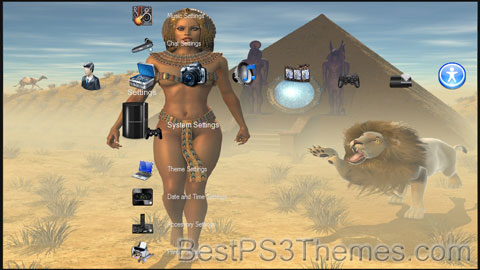
Egypt theme by Sim24
Download: Egypt.p3t

(4 backgrounds)
Arab Republic of Egypt | |
|---|---|
| Anthem: "Bilady, Bilady, Bilady" "بلادي، بلادي، بلادي" (English: "My country, my country, my country") | |
| Capital and largest city | Cairo 30°2′N 31°13′E / 30.033°N 31.217°E |
| Official languages | Arabic[1] |
| National language | Egyptian Arabic[a] |
| Religion | See Religion in Egypt[b] |
| Demonym(s) | Egyptian |
| Government | Unitary semi-presidential republic under an authoritarian regime[6][7][8][9][10] |
| Abdel Fattah el-Sisi | |
| Mostafa Madbouly | |
| Legislature | Parliament |
| Senate | |
| House of Representatives | |
| Establishment | |
| c. 3150 BC | |
• Fall of Memphis | 343 BC |
| 639–642 | |
| 1171/4–1517 | |
• Muhammad Ali dynasty inaugurated | 9 July 1805[13] |
| 28 February 1922 | |
| 23 July 1952 | |
• Republic declared | 18 June 1953 |
| 18 January 2014 | |
| Area | |
• Total | 1,010,408[14][15] km2 (390,121 sq mi) (30th) |
• Water (%) | 0.632 |
| Population | |
• 2024[16] estimate | |
• 2017[17] census | |
• Density | 106.67/km2 (276.3/sq mi) (107th) |
| GDP (PPP) | 2024 estimate |
• Total | |
• Per capita | |
| GDP (nominal) | 2024 estimate |
• Total | |
• Per capita | |
| Gini (2017) | medium |
| HDI (2022) | high (105th) |
| Currency | Egyptian pound (LE/E£/£E) (EGP) |
| Time zone | UTC+2[c] (EGY) |
• Summer (DST) | UTC+3 |
| Driving side | right |
| Calling code | +20 |
| ISO 3166 code | EG |
| Internet TLD | |
Egypt (Arabic: مصر Miṣr [mesˁr], Egyptian Arabic pronunciation: [mɑsˤr]), officially the Arab Republic of Egypt, is a transcontinental country spanning the northeast corner of Africa and the Sinai Peninsula in the southwest corner of Asia. It is bordered by the Mediterranean Sea to the north, the Gaza Strip of Palestine and Israel to the northeast, the Red Sea to the east, Sudan to the south, and Libya to the west. The Gulf of Aqaba in the northeast separates Egypt from Jordan and Saudi Arabia. Cairo is the capital and largest city of Egypt, while Alexandria, the second-largest city, is an important industrial and tourist hub at the Mediterranean coast.[20] At approximately 100 million inhabitants, Egypt is the 14th-most populated country in the world, and the third-most populated in Africa.
Egypt has one of the longest histories of any country, tracing its heritage along the Nile Delta back to the 6th–4th millennia BCE. Considered a cradle of civilisation, Ancient Egypt saw some of the earliest developments of writing, agriculture, urbanisation, organised religion and central government.[21] Egypt was an early and important centre of Christianity, later adopting Islam from the seventh century onwards. Cairo became the capital of the Fatimid Caliphate in the tenth century, and of the Mamluk Sultanate in the 13th century. Egypt then became part of the Ottoman Empire in 1517, before its local ruler Muhammad Ali established modern Egypt as an autonomous Khedivate in 1867.
The country was then occupied by the British Empire and gained independence in 1922 as a monarchy. Following the 1952 revolution, Egypt declared itself a republic. For a brief period between 1958 and 1961 Egypt merged with Syria to form the United Arab Republic. Egypt fought several armed conflicts with Israel in 1948, 1956, 1967 and 1973, and occupied the Gaza Strip intermittently until 1967. In 1978, Egypt signed the Camp David Accords, which recognised Israel in exchange for its withdrawal from the occupied Sinai. After the Arab Spring, which led to the 2011 Egyptian revolution and overthrow of Hosni Mubarak, the country faced a protracted period of political unrest; this included the election in 2012 of a brief, short-lived Muslim Brotherhood-aligned Islamist government spearheaded by Mohamed Morsi, and its subsequent overthrow after mass protests in 2013.
Egypt's current government, a semi-presidential republic led by president Abdel Fattah el-Sisi since he was elected in 2014, has been described by a number of watchdogs as authoritarian and responsible for perpetuating the country's poor human rights record. Islam is the official religion of Egypt, and Arabic is its official language.[1] The great majority of its people live near the banks of the Nile River, an area of about 40,000 square kilometres (15,000 sq mi), where the only arable land is found. The large regions of the Sahara desert, which constitute most of Egypt's territory, are sparsely inhabited. About 43% of Egypt's residents live across the country's urban areas,[22] with most spread across the densely populated centres of greater Cairo, Alexandria and other major cities in the Nile Delta. Egypt is considered to be a regional power in North Africa, the Middle East and the Muslim world, and a middle power worldwide.[23] It is a developing country having a diversified economy, which is the largest in Africa, the 38th-largest economy by nominal GDP and 127th by nominal GDP per capita.[24] Egypt is a founding member of the United Nations, the Non-Aligned Movement, the Arab League, the African Union, Organisation of Islamic Cooperation, World Youth Forum, and a member of BRICS.
| |
Grand Theft Auto IV theme by SvenDLier
Download: GTAIV_7.p3t
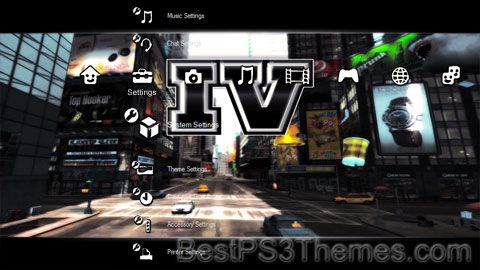
(12 backgrounds)
| Grand Theft Auto IV | |
|---|---|
| Developer(s) | Rockstar North[a] |
| Publisher(s) | Rockstar Games |
| Producer(s) | Leslie Benzies |
| Programmer(s) |
|
| Artist(s) | Aaron Garbut |
| Writer(s) |
|
| Composer(s) | Michael Hunter |
| Series | Grand Theft Auto |
| Engine | RAGE |
| Platform(s) | |
| Release | PlayStation 3, Xbox 360
|
| Genre(s) | Action-adventure |
| Mode(s) | Single-player, multiplayer |
Grand Theft Auto IV is a 2008 action-adventure game developed by Rockstar North and published by Rockstar Games. It is the sixth main entry in the Grand Theft Auto series, following 2004's Grand Theft Auto: San Andreas, and the eleventh entry overall. Set in the fictional Liberty City, based on New York City, the single-player story follows Eastern European war veteran Niko Bellic and his attempts to escape his past while under pressure from high-profile criminals. The open world design lets players freely roam Liberty City, consisting of three main islands, and the neighbouring state of Alderney, which is based on New Jersey.
The game is played from a third-person perspective and its world is navigated on foot and by vehicle. Throughout the single-player mode, players control Niko Bellic. An online multiplayer mode is also included with the game, allowing up to 32 players to engage in both cooperative and competitive gameplay in a recreation of the single-player setting.[b] Two expansion packs were later released for the game, The Lost and Damned and The Ballad of Gay Tony, which both feature new plots that are interconnected with the main Grand Theft Auto IV storyline, and follow new protagonists.
Development of Grand Theft Auto IV began soon after the release of San Andreas and was shared between many of Rockstar's studios worldwide. The game introduced a shift to a more realistic and detailed style and tone for the series. Unlike previous entries, Grand Theft Auto IV lacked a strong cinematic influence, as the team attempted an original approach to the story. As part of their research for the open world, the development team conducted extensive field research in New York, capturing over 100,000 photographs and several hours of video. The developers considered the world to be the most important element of the game; though not the largest map in the series, they considered it comparable in scope due to its verticality and level of detail. The budget climbed to over US$100 million, making it one of the most expensive video games to develop.
Grand Theft Auto IV was released for the PlayStation 3 and Xbox 360 consoles in April 2008, and for Windows in December. Upon release, the game received critical acclaim, with praise particularly directed at the narrative and open-world design. Grand Theft Auto IV broke industry sales records and became the fastest-selling entertainment product in history at the time, earning US$310 million in its first day and US$500 million in its first week. Considered one of the most significant titles of the seventh generation of video games, and by many critics as one of the greatest video games of all time, it won year-end accolades, including Game of the Year awards from several gaming publications. It is among the best-selling video games with over 25 million copies sold by 2013. The game generated controversy, with criticism directed at the game's depiction of violence and players' ability to drink-drive. Its successor, Grand Theft Auto V, was released in September 2013.
Grand Theft Auto IV is an action-adventure game played from a third-person perspective.[2] Players complete missions—linear scenarios with set objectives—to progress through the story. It is possible to have several active missions running at one time, as some require players to wait for further instructions or events. Outside of missions, players can freely roam the game's open world and complete optional side missions.[3] Composed of the fictional city of Liberty City, the world is larger in area than most earlier Grand Theft Auto series entries.[4] At the beginning of the game, players can only explore the first island—composed of Dukes and Broker—with all other islands unlocking as the story progresses.[5]
Players use melee attacks, firearms and explosives to fight enemies, and may run, jump, swim or use vehicles to navigate the game's world. There is a first-person perspective option when using vehicles. In combat, auto-aim and a cover system can be used as assistance against enemies. Should players take damage, their health meter can be fully regenerated by consuming food or drinks, using medical kits, or calling for paramedics.[6] If players commit crimes, the game's law enforcement agencies may respond as indicated by a "wanted" meter in the head-up display (HUD). On the meter, the displayed stars indicate the current wanted level (for example, at the maximum six-star level, efforts by law enforcement to incapacitate players become very aggressive). Law enforcement officers will search for players who leave the wanted vicinity. The wanted meter enters a cool-down mode and eventually recedes when players are hidden from the officers' line of sight.[7]

The game's cover system allows players to move between cover, to fire blindly, aim freely, and target a specific enemy. Individual body parts can also be targeted.[8] Melee attacks include additional moves, such as dodging, blocking, disarming an opponent and counter-attacking. Body armour can be used to absorb gunshots and explosive damage, but is used up in the process. When health is entirely depleted, gameplay stops, and players respawn at the nearest hospital.[6]
The single-player mode lets players control an Eastern European war veteran, Niko Bellic. During the story, Niko meets and befriends various new characters. They can then perform favours for Niko whenever he asks; for example, his cousin Roman, who owns a taxi service, can send one of his cabs to take Niko to any destination around the city. Cabs are always available during gameplay for quick travel to a destination. Throughout the course of the game, players are also faced with morality choices, which alter the storyline appropriately depending on the player's choice. While free roaming the game world, players may engage in context-specific activities such as bowling or darts. Other available activities include a vigilante mini-game, and in-game television programming.[9][10][11] Niko has a cell phone for contacting friends and starting activities.[12] The cell phone is also used to access the game's online multiplayer mode, and to enter cheat codes.[13] To access the in-game Internet, which allows Niko to send and receive emails and set up prospective dates with potential girlfriends, Niko can use Internet cafés located around the city.[14] The game also features a subway system, allowing players to quickly traverse through the game's world.[15]
The online multiplayer mode for Grand Theft Auto IV allows up to 32 players[b] to freely roam across the map. Players decide which game mode they wish to play, including deathmatches and street races. Both cooperative and competitive game modes are available, split into ranked and unranked matches.[16] For players to level up through ranks, in-game money has to be earned. The game also features a Free Mode, in which players have the entire map open to explore, with no end goal or mission to complete. Hosts of the game can control many variables, such as police presence, traffic, and weapons.[17] The multiplayer mode was discontinued on Windows in 2020.[18]
Grand Theft Auto IV takes place in 2008, within a redesigned version of Liberty City. The design of the city focuses on a recreation of four of the boroughs of New York City: Broker (based on Brooklyn), Dukes (Queens), Bohan (The Bronx), and Algonquin (Manhattan). The setting also includes the neighbouring state of Alderney (based on New Jersey).[19] Initially, bridges are locked down due to a terrorist threat, and police constantly pursue players if the bridges are crossed. The blockades are lifted as the story progresses, allowing the player to traverse between islands safely.
Grand Theft Auto IV is set in the fictional "HD Universe", which mirrors and parodies the real world. The previous games formed fictional universes of their own,[c] which despite having many similarities with the HD Universe, are considered to be different continuities. Hence, the Liberty City depicted in Grand Theft Auto IV is different from its previous renditions, and the game itself serves as a reboot for the series. The new timeline established by Grand Theft Auto IV would continue with two expansion packs, The Lost and Damned and The Ballad of Gay Tony, and a sequel, Grand Theft Auto V, as well as its online component, Grand Theft Auto Online.[21][22][23] The handheld game Grand Theft Auto: Chinatown Wars is also considered part of the HD Universe, because it features the same map as Grand Theft Auto IV, except for Alderney.[24]
Niko Bellic, an Eastern European ex-soldier,[25] arrives in Liberty City aboard a cargo ship, the Platypus, to escape his criminal past, pursue the American Dream, and search for the man who betrayed his unit to an ambush during a war ten years prior. Reuniting with his cousin Roman, he discovers that his tales of riches were lies concealing his small, dirty apartment, unprofitable taxi company, gambling debts, and disputes with loan sharks. Niko begins assisting Roman with his problems, which leads him to make his first criminal contacts in the city. He befriends Yardies second-in-command Little Jacob and is forced to work for Vlad Glebov, Roman's Russian loan shark, whom Niko eventually kills upon learning he had slept with Roman's girlfriend, Mallorie.
In retaliation, Niko and Roman are kidnapped by Russian mobsters on orders of their boss Mikhail Faustin and his lieutenant, Dimitri Rascalov. Indifferent to Vlad's murder, Faustin releases them and employs Niko as a hitman, eventually ordering him to kill the son of Russian crime lord Kenny Petrović. When Petrović threatens retaliation, Dimitri convinces Niko to assassinate Faustin. However, he then betrays and brings Niko to his former employer, Ray Bulgarin, who accuses Niko of stealing from him during a botched human trafficking job years earlier. Niko denies the allegation and a firefight ensues, allowing Dimitri and Bulgarin to escape.
Dimitri's men burn down Niko and Roman's apartment and taxi company, forcing them to flee to Bohan. While Niko finds work with several local drug lords, Dimitri kidnaps Roman in a failed attempt to lure Niko into a trap. Later, Niko discovers that his romantic interest, a woman named Michelle, is a government agent, who then entraps him into working for her agency. In exchange for the murders of several known or suspected terrorists, the agency clears Niko's criminal record and assists him in searching for the traitor he seeks. Niko and Roman's fortunes improve when the latter receives a large amount of insurance money from his destroyed business, which he uses to rebuild it and buy an apartment in Algonquin. Roman also proposes to Mallorie, who accepts.
While working for the Irish Mob, Niko befriends gangster Patrick "Packie" McReary and helps him and his brothers carry out various jobs, including a major bank robbery. Niko is later hired by Ray Boccino, a caporegime in the Pegorino crime family, to oversee a diamond deal, which goes awry. Boccino repays Niko by helping him find his ex-comrade Florian Cravic, now known as Bernie Crane, who claims he was not the one to betray their unit. Niko concludes that the traitor was Darko Brevic, the only other survivor. Niko continues working for the Mafia in Liberty City and eventually earns the trust of Don Jimmy Pegorino, who orders Niko to kill Boccino after suspecting him of being a police informant. Niko also helps Packie kidnap Don Giovanni Ancelotti's daughter to ransom her for the diamonds, but Bulgarin intercepts the exchange. In the ensuing firefight, the diamonds are lost.
Eventually, the government agents find Darko in Romania and bring him to Liberty City for Niko to decide his fate. Afterwards, Niko is summoned by Pegorino for one final favour: to help with a highly lucrative heroin deal in collusion with Dimitri. Niko must either agree to work with Dimitri or exact revenge on him.[26] If Niko goes through with the deal, Dimitri betrays him again,[27] kills Pegorino,[28] and attempts to kill Niko via an assassin at Roman's wedding, but accidentally kills Roman;[29] Niko retaliates by tracking and murdering Dimitri.[28] If Niko chooses to exact revenge, he kills Dimitri aboard the Platypus,[30] prompting a furious Pegorino to target Niko but accidentally kill Packie's sister Kate, whom Niko had been dating, at Roman's wedding;[29] Niko retaliates by tracking and murdering Pegorino.[31] Later, either Mallorie or Roman tells Niko that Mallorie is pregnant.

Preliminary work on Grand Theft Auto IV began in November 2004,[32] a month after the release of Grand Theft Auto: San Andreas.[33] Rockstar president Sam Houser felt that following up San Andreas was "a nightmare".[34] Rockstar North, the core 220-person team behind the game, co-opted studios owned by parent company Rockstar Games to facilitate development between a full team of over 1,000,[35] including 50 employees at Rockstar NYC, 40 at Rockstar Lincoln, 10 at Rockstar San Diego, and around 600–700 working part-time internally and externally.[36] Some key members of the development team worked 12-hour days during production, often without holidays.[35] The team decided to continue the numbering scheme absent from the previous two main games to represent the same leap in production as Grand Theft Auto 2 (1999) to Grand Theft Auto III (2001).[33] Development of Grand Theft Auto IV ceased by 21 April 2008 when the game was submitted for manufacturing.[37] Producer Leslie Benzies estimated that the budget of the development efforts exceeded US$100 million, making Grand Theft Auto IV one of the most expensive video games ever made.[35]
The game's setting, Liberty City, is based on New York City. The team did not look at the previous renditions of Liberty City as inspiration, wanting it to retain the "general feel" but nothing else.[38] The map is roughly three times the size of Grand Theft Auto III's.[38] The developers originally considered using the entire state of New York, before restricting it to Manhattan, and then expanding it out again. They considered including more suburbs with woods, and would regularly vote on which areas to include.[39] Art director Aaron Garbut said that the team chose the setting because of the detail and variety it provided, describing New York as "an amazing, diverse, vibrant, cinematic city".[40] Writer Dan Houser added that the team "wanted to be somewhere where we had a foothold" due to the amount of research required for the world; Rockstar Games's main headquarters are located in New York.[41] The team consciously avoided a precise recreation of New York City to allow for more enjoyable game design,[32] selecting the areas that they felt "characterised it the best".[40] Garbut wanted to capture a caricature of the city as he felt that most people were familiar with "the highlights" from film or literature but did not need to know the areas precisely.[40] The city was not built with specific missions in mind; the area was created first, and missions implemented later.[42]
To achieve a realistic environment, 60–70 employees from Rockstar North travelled to New York for research: first at the beginning of the project in March or April 2005 for a week and a half,[39] and a smaller trip in 2007.[38] Police officers who previously worked the beat drove the team around Washington Heights.[39] A full-time research team based in New York handled further requests for information, such as the ethnic minority of a neighbourhood or videos of traffic patterns. Videos shot in New York were played on televisions at the Rockstar North offices "so while they worked they could look up and there was New York".[39] Benzies claimed that the team took over 100,000 photographs on location in New York,[35] though Garbut estimates that they took around 250,000.[38] They also studied architectural plans for apartments, used satellite images to determine city block layout, researched sales figures for models of cars, and read books that detailed the city's infrastructure, including its subways, sewers, and garbage disposal.[43] Hove Beach is based on Brighton Beach, which Sam Houser found "pretty incredible" and unusual; the name is based on the English city Brighton and Hove, made up of the former neighbouring towns Brighton and Hove.[44] Houser appreciated that Brighton Beach was home to several Eastern Europeans due to the nature of the game's characters.[44]
Dan Houser described Liberty City as "the biggest character" of the game.[40] The Grand Theft Auto IV rendition of Liberty City is more detailed and larger in size than most earlier entries in the series; although smaller than San Andreas, the setting of the previous main game, the developers considered it comparable in scope due to city's verticality, number of buildings, and level of detail.[45] The team wanted less dead spots and irrelevant spaces, such as the wide open deserts in San Andreas.[32] They wanted the game to be "a more focused experience" than San Andreas, and Dan Houser felt that the limited activities of New York allowed this.[33] The team felt that the addition of Niko's mobile phone added to the immersion of the world and represented society's shifted focus on phones.[33] The in-game brands and products are designed over several years; the billboards were implemented in the game around six months prior to release.[38]
The game's script, written by Dan Houser and Rupert Humphries, is about 1,000 pages.[35] Approximately 660 actors provided voices for the game over 80,000 lines of dialogue.[39] After conceiving the character and setting, Dan Houser spoke with his brother Sam Houser and Leslie Benzies to bounce story ideas before writing a rough synopsis, a six-paged, detailed document. Once the synopsis was reworked, the designers broke it into missions, represented by a large flow document demonstrating each section. The writers then work on the introductions to the missions; the gameplay dialogue comes much later.[41] Unlike previous Grand Theft Auto games, Grand Theft Auto IV does not have cinematic influences. "We were consciously trying to go, well, if video games are going to develop into the next stage, then the thing isn't to try and do a loving tribute or reference other stuff," said Dan Houser.[41] He said that the writers wanted something "fresh and new and not something that was obviously derived from [a] movie".[41] Dan Houser felt that the quality of the writing had to improve alongside the advancements in graphics and technology. He noted that the improvements in facial animation allowed for slower-paced cutscenes.[40] The unique dialogue that plays when a mission is retried was to ensure that the gameplay felt "less canned and less like Groundhog Day".[40]
Dan Houser described Niko Bellic as "a more rounded character" than those in previous games.[40] He felt that his dual personality—often saving innocent people, while also being a "cold-hearted killer"—made him more relatable.[40] He also felt that Niko's unfamiliarity with Liberty City allowed for the player to relate to him more, only driven by his vague past and relationship with Roman. When deciding on Niko's background, the writers felt that being an immigrant could lead to more dangerous situations, and therefore more enjoyable missions; after discussions with criminal experts, Dan Houser found that "the real scary characters are not born in America anymore".[40] He felt that Niko's outsider view of American culture was "fun".[40] The team wanted Niko to be "more of an anti hero than a hero, capable of making positive actions within his criminal world".[46] They wanted his demeanour to reflect the weight of his past and choices.[46]
Niko's design underwent a few changes, but was finalised early in development.[47] His outfit underwent several changes based on Eastern Europeans, particularly photographs of men fighting in winter wars in Yugoslavia and Chechnya. The primary motivation for the design was a face to convey the appropriate emotions and a body that could move nicely with the new animations.[40] The in-game purchasable outfits were also designed to fit with the character.[33] The team ensured that the gameplay choices presented to the player were not too extensive, as they still had to make sense to the character, who is driven by the people around him. Dan Houser felt that the missions in San Andreas had become too linear, and wanted to present choices to the player in Grand Theft Auto IV.[40]
The writers found that Niko needed a motivation to come to America, so they created his cousin, Roman. Dan Houser felt that the two could not be brothers as there would be a deeper level of familiarity than necessary. He described the two as a double act, with Roman's fantasist charm playing off Niko's tough cynicism. The team gave other non-playable characters (NPCs) more definable behaviours and dialogue to make them feel more alive. The writers initially considered having a smaller group of characters, but found that the story became boring and that players were less likely to explore the world. The stranger characters found in the game world were based on the "crazy people" that populate New York, according to Dan Houser, which in previous games were only able to be captured through radio stations or mild pedestrian behaviours.[38] The team based the ethnicities, clothing, and behaviours of the NPCs on the photographs and videos that they captured around New York, divided into different areas;[40] they created mood boards for each location.[38] The NPCs also converse in different languages.[39]
Grand Theft Auto IV sees a shift in the series to a more realistic and detailed style and tone, partly a result of the transition to consoles which offered high-definition graphics and the new and improved capabilities of such consoles. The development team worked to represent the upgrade in quality across all design aspects while maintaining the coherence of the previous games.[32] The team took the game's development as an opportunity to "strip things back and start again", refining the art style without losing the style of the series;[40] they distanced the game from the "cartoon-like style" of its predecessors while creating a new style that was consistent across all aspects of the game.[48] Garbut found the increased demand of detail brought on by the advanced technology daunting.[49] A technique used to make the visuals look real was to avoid harsh edges, instead blending surfaces together to make the world look dirty and lived-in.[50] The props department created multiple variations of different objects to make the world more interesting and unique.[40] G
Race Driver: Grid version 1 theme by SvenDLier
Download: RaceDriverGridV1.p3t

(3 backgrounds)
P3T Unpacker v0.12
Copyright (c) 2007. Anoop Menon
This program unpacks Playstation 3 Theme files (.p3t) so that you can touch-up an existing theme to your likings or use a certain wallpaper from it (as many themes have multiple). But remember, if you use content from another theme and release it, be sure to give credit!
Download for Windows: p3textractor.zip
Instructions:
Download p3textractor.zip from above. Extract the files to a folder with a program such as WinZip or WinRAR. Now there are multiple ways to extract the theme.
The first way is to simply open the p3t file with p3textractor.exe. If you don’t know how to do this, right click the p3t file and select Open With. Alternatively, open the p3t file and it will ask you to select a program to open with. Click Browse and find p3textractor.exe from where you previously extracted it to. It will open CMD and extract the theme to extracted.[filename]. After that, all you need to do for any future p3t files is open them and it will extract.
The second way is very simple. Just drag the p3t file to p3textractor.exe. It will open CMD and extract the theme to extracted.[filename].
For the third way, first put the p3t file you want to extract into the same folder as p3textractor.exe. Open CMD and browse to the folder with p3extractor.exe. Enter the following:
p3textractor filename.p3t [destination path]Replace filename with the name of the p3t file, and replace [destination path] with the name of the folder you want the files to be extracted to. A destination path is not required. By default it will extract to extracted.filename.
HOME version 1 theme by SvenDLier
Download: HOMEv1.p3t

(1 background)
P3T Unpacker v0.12
Copyright (c) 2007. Anoop Menon
This program unpacks Playstation 3 Theme files (.p3t) so that you can touch-up an existing theme to your likings or use a certain wallpaper from it (as many themes have multiple). But remember, if you use content from another theme and release it, be sure to give credit!
Download for Windows: p3textractor.zip
Instructions:
Download p3textractor.zip from above. Extract the files to a folder with a program such as WinZip or WinRAR. Now there are multiple ways to extract the theme.
The first way is to simply open the p3t file with p3textractor.exe. If you don’t know how to do this, right click the p3t file and select Open With. Alternatively, open the p3t file and it will ask you to select a program to open with. Click Browse and find p3textractor.exe from where you previously extracted it to. It will open CMD and extract the theme to extracted.[filename]. After that, all you need to do for any future p3t files is open them and it will extract.
The second way is very simple. Just drag the p3t file to p3textractor.exe. It will open CMD and extract the theme to extracted.[filename].
For the third way, first put the p3t file you want to extract into the same folder as p3textractor.exe. Open CMD and browse to the folder with p3extractor.exe. Enter the following:
p3textractor filename.p3t [destination path]Replace filename with the name of the p3t file, and replace [destination path] with the name of the folder you want the files to be extracted to. A destination path is not required. By default it will extract to extracted.filename.
Machine Head theme by toppdogg
Download: MachineHead.p3t
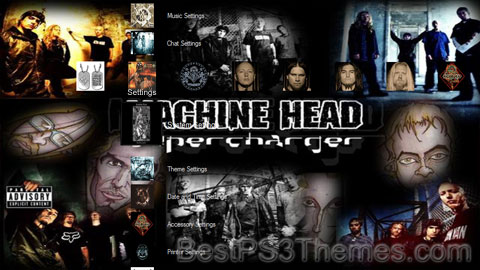
(16 backgrounds)
Redirect to: