Dead Space theme by Ramman
Download: DeadSpace.p3t
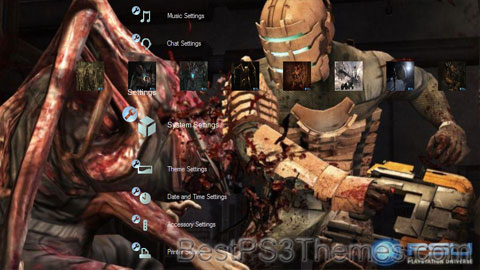
(1 background)
| Dead Space | |
|---|---|
| Created by | Glen Schofield |
| Original work | Dead Space |
| Owner | Electronic Arts |
| Years | 2008–present |
| Print publications | |
| Novel(s) | Dead Space: Martyr (2010) see § Print media |
| Comics | Dead Space |
| Films and television | |
| Direct-to-video | Dead Space: Downfall (2008) Dead Space: Aftermath (2011) |
| Games | |
| Video game(s) | see § Main series |
| Audio | |
| Soundtrack(s) | see Music of the Dead Space series |
| Official website | |
| ea | |
Dead Space is a science fiction/horror franchise created and directed by Glen Schofield. Dead Space was developed by Visceral Games and published and owned by Electronic Arts. The franchise's chronology is not presented in a linear format; each installment in the Dead Space franchise is a continuation or addition to a continuing storyline, with sections of the storyline presented in prequels or sequels, sometimes presented in other media from the originating video game series, which includes two films and several comic books and novels.
Primarily set in a 26th century science fiction universe featuring environments, weapons, and characters typical of the genre, the Dead Space franchise centers on a series of video games beginning with the release of the first Dead Space, which centers on starship engineer Isaac Clarke and mutated undead horrors that surround him. A central theme in the games is the fictional cult religion "Unitology" and its fanatical adherents, who believe that information about an alien artifact called the "Marker" is being suppressed by "EarthGov", the central political administration of Earth. Their primary goal is to use the Marker as a means to bring about the "Convergence", or complete destruction of humanity, with the Marker and its malevolent influence being the source of the undead monsters encountered by the series' protagonists.
The Dead Space video game series has been positively received; the first game in particular won a number of industry awards for the varied elements of its gameplay and development, and is often regarded as one of the best video games of all time by critics. From a commercial perspective, EA considered the video game series as a whole to have underperformed. After the financial disappointment of 2013's Dead Space 3, no further media for the franchise was produced until a remake of the first game was developed by Motive Studio and released on January 27, 2023.
Media[edit]
| Year | Title | Developer | Platforms |
|---|---|---|---|
| 2008 | Dead Space[a] | EA Redwood Shores | Xbox 360,[1] PlayStation 3,[2] Microsoft Windows[3] |
| 2009 | Dead Space: Extraction[b] | Visceral Games | Wii, PlayStation 3 |
| 2010 | Dead Space Ignition[c] | Xbox 360,[4] PlayStation 3[4] | |
| 2011 | Dead Space 2[d] | Microsoft Windows, PlayStation 3, Xbox 360 | |
| Dead Space[e] | IronMonkey Studios | iOS,[5] Android,[6] BlackBerry PlayBook, BlackBerry 10 | |
| 2013 | Dead Space 3 | Visceral Games | Microsoft Windows, PlayStation 3, Xbox 360 |
| 2023 | Dead Space[f] | Motive Studio | Microsoft Windows, PlayStation 5, Xbox Series X/S |
| |||
Main series[edit]
| 2008 | Dead Space |
|---|---|
| 2009 | Dead Space: Extraction |
| 2010 | Dead Space Ignition |
| 2011 | Dead Space 2 |
| Dead Space (mobile) | |
| 2012 | |
| 2013 | Dead Space 3 |
| 2014 | |
| 2015 | |
| 2016 | |
| 2017 | |
| 2018 | |
| 2019 | |
| 2020 | |
| 2021 | |
| 2022 | |
| 2023 | Dead Space (remake) |
Dead Space[edit]
Systems engineer Isaac Clarke joins a search and rescue team for the USG Ishimura, which had gone radio-silent, after receiving a message from his girlfriend Nicole. Their ship suffers damage when attempting to dock with the Ishimura; while the rest of the crew assess the situation and search for a means to leave the Ishimura, Isaac explores the ship to look for Nicole. The ship is overrun by Necromorphs, forcing Isaac to defend himself by weaponizing his mining tools and "Resource Integration Gear" (RIG) spacesuit capabilities. Due to the Red Marker's influence, Isaac experiences recurring visions of Nicole, who guides him to return the Marker to the planet. Towards the end of the game, it is revealed that one of the rescue team members, Kendra Daniels, is a double agent. She betrays Isaac, but is killed by a large Necromorph creature before she can escape, while Isaac commandeers her ship and escapes Aegis VII after defeating the creature and allowing the Marker to be destroyed by a sabotage attempt he had initiated earlier. The sole survivor of the entire ordeal, Isaac soon hears something behind him and looks back to see a horrific hallucination of Nicole.
Dead Space 2[edit]
Dead Space 2 reveals that Isaac has become mentally disturbed and unstable after he destroyed the Red Marker on Aegis VII, and that he was captured by EarthGov and taken to the Sprawl, a massive space-station built into the remains of Titan, Saturn's largest moon. Once there, EarthGov scientists extract information from his mind to build another Marker, and he is later confined to a hospital on the Sprawl due to a dementia-like mental illness caused by the first Marker. A Necromorph outbreak in the Sprawl instigated by the Marker copy soon occurs, thrusting Isaac into a struggle to survive the Necromorph epidemic. Haunted by hallucinations of the deceased Nicole Brennan, Isaac manages to destroy the Marker copy and undo its influence on his mind. Isaac succeeds in escaping with another survivor, Ellie Langford, before the explosive destruction of the station, and goes into hiding from EarthGov authorities as his mind still retains information about the Markers.
Dead Space 3[edit]
Dead Space 3 occurs a few years later. While Isaac Clarke and Ellie Langford returned to Earth and dated for a while, their relationship fell apart. As he is struggling with the breakup in his apartment on the moon, Unitologists led by Jacob Danik activate a Marker near the colony, causing a Necromorph outbreak. Isaac is rescued and enlisted by EarthGov soldiers to help locate Langford, who had traveled to Tau Volantis, one of Earth's oldest off-world colonies, in search of the true origins of the Markers and a means to stop the Necromorph scourge once and for all.
Dead Space remake[edit]
Rumors of a revival of Dead Space within EA appeared in early 2021. Venture Beat reported in July that this revival was a remake of the first game, in the same vein as the Resident Evil 2 remake, and would be a relaunch of the franchise. EA confirmed the remake of Dead Space, under development by Motive Studio, in their EA Play event the same month.[8][9] It was released on January 27, 2023.
Spin-offs[edit]
Dead Space: Extraction[edit]
A prequel to the first Dead Space, Dead Space: Extraction follows a group of colonists from the Aegis VII colony who are beset by Necromorphs created when the Red Marker is removed. Originally released as a rail shooter title for the Nintendo Wii in 2009, a port with PlayStation Move support for the PlayStation 3 was later released as a downloadable game on the PlayStation Network in 2011. It was also bundled with copies of the limited editions of Dead Space 2 for the PlayStation 3.
Dead Space Ignition[edit]
A prequel to Dead Space 2 released in 2010, Dead Space Ignition is an action puzzle video game which follows Franco Delille, an engineer who witnesses the initial Necromorph outbreak on the Sprawl. The ending of Ignition directly sets up the opening of Dead Space 2, where Delille is ordered to find and free Isaac Clarke from an EarthGov asylum, only to be killed and transformed into a Necromorph.
Dead Space (mobile game)[edit]
A 2011 tie-in to Dead Space 2 developed by IronMonkey Studios, Dead Space was a mobile title about a newly converted Unitologist on a mission in the mines of Titan Station. The game features an appearance from Titan Station's director Hans Tiedemann, a major antagonist of Dead Space 2, and provides context behind the Necromorph infestation of the Sprawl. It has since been removed from all mobile app storefronts.[10]
Setting[edit]
The Dead Space franchise is set in the future, where humanity has been able to colonize other planets.[11] By the 23rd century, humanity has used up most of Earth's natural resources, and the world governing body, EarthGov, has fleets of "planet crackers", giant mining spaceships that harvest resources by breaking apart other planets, to gather materials for humanity to sustain itself.[11] During the 23rd century, EarthGov researchers find a double helix-shaped alien artifact in the Chicxulub crater, which they call the Marker. The Marker emits a persistent electromagnetic field from seemingly no source, which researchers believe could be used to provide limitless energy and solve Earth's ecological crisis. Work begins to reverse engineer the Marker on various research stations across the colonies, but they are forced to use bismuth instead of an unidentified alien material, resulting in these duplicates being colored red instead of black as the original.
The project was highly classified, but the lead researcher Michael Altman leaks its existence to the world.[11] EarthGov assassinates Altman hoping to quell the news, but it is too late: Altman is seen as a martyr, and his belief of what the Marker means for humanity form the basis of a new cult-like religion, Unitology, that rapidly spreads across Earth and the colonies.[11] Unitologists believe that by worshipping the Marker, they will discover the true origin and meaning of human life.[11] They also believe that the Marker grants eternal life and will help to unify humanity, as to "make us whole", in an event known as the "Convergence".
The EarthGov researchers also discover that the electromagnetic fields sent by the Marker and its duplicates cause living people to suffer paranoia and hallucinations, while also causing the dead to reanimate, becoming "Necromorphs", biological monstrosities which rise to attack the living. EarthGov immediately terminates the Marker project and abandons all research stations where the work had been done, covering up their locations, knowing as they do that the followers of Unitology would desperately want to seek these Markers out in order to advance their beliefs and bring about Convergence.
In the 26th century, a planet-cracker vessel mining the world of Aegis VII called the USG Ishimura discovers a Red Marker buried near an abandoned colony.[11] The Ishimura captain, a devout Unitologist, ordered his crew to bring the Marker aboard the ship, which causes the crew to become paranoid, turn on each other, and leads to a Necromorph infestation onboard the Ishimura.[11] Among the crew of the Ishimura is a medical officer named Nicole Brennan, who sends a cryptic distress signal to her significant other out of desperation.
Gameplay[edit]
The Dead Space games franchise follow the survival horror genre, with the player character visible at all times. All menu interfaces are diegetic, produced by the character's "Resource Integration Gear" spacesuit for ease of communication with other characters. For instance, the character's hit point meter, built into the spine of his suit, is intended to allow co-workers to monitor his health, and when the character moves into depressurized areas, a readout on his back displays his remaining seconds of oxygen. All sound is removed from gameplay during these segments, save those which would be transferred to the character's ears by the vibrations of his RIG, such as rounds fired from his weapon. Since the menus are diegetic, opening them does not pause gameplay.
The character's RIG can be outfitted with two special abilities for use in combat and puzzle-solving. The "Kinesis" module allows the character to retrieve, levitate and transport objects, often heavier or more distant ones than could be accessed normally. These objects may also be expelled at high speed for use as improvised projectiles. The "Stasis" module causes its target to undergo an extreme slowdown for a short period of time, allowing characters to dart through rapidly moving obstacles such as fan blades, or hinder onrushing enemies. The RIG also has a slot-based inventory for carrying weapons, ammunition, healing items, and other objects.
Gunplay is influenced by the franchise's antagonists. Because Necromorphs are re-animated and re-purposed corpses, lacking dependence on nervous, respiratory, and circulatory systems, the conventions of stopping power are largely irrelevant to them. Thus, instead of targeting foes' heads or center of mass, players are encouraged to engage in "strategic dismemberment" by shooting off their arms and legs. Some Necromorphs can be easily defeated in this manner, but others may change attack patterns or even spawn entirely new enemies when slain. Relatedly, the game's weapons are characterized as being repurposed power tools[12] or mining implements, such as plasma cutters, rotary saws, and gravitic repulsion tools, though an increasing amount of dedicated military ordnance becomes available as the franchise progresses. Ammunition tends to be uncommon, thus necessitating careful usage of the tools at hand.
In the first two games, RIGs and weapons can be upgraded at bench workstations. Players can also visit vending machines to buy or sell items for in-game currency, and upload new schematics to those stores in order to unlock new items. This was changed in the third installment, where the store was scrapped entirely; new "Suit Kiosks" allow the player to upgrade their RIG, and bench functionality was expanded to allow players to craft their own weapons, often by cobbling together parts and resources scavenged through gameplay.
Each type of Necromorph has a unique way of slaying the player character, customized to whatever claws, blades, fangs, or probosces they happen to possess.
Development[edit]

Electronic Arts (EA) Redwood Shores had developed a number of movie and tie-in games, though they desired to make their own intellectual property. Around 2005, the studio presented the idea of making a second sequel to System Shock to EA executives but had not gotten much support until the release of Resident Evil 4 in 2005, which quickly became a top-selling title. That success led them to revise their System Shock concept, making it more a horror-driven game set in space, and which EA was more open to as to try to capture a similar type of success. The aim was to create, in Glen Schofield's words, "the most terrifying game we could acquire". The subsequent game became Dead Space, released in 2008.[13] Dead Space did well, leading EA to rebrand Redwood Shores as Visceral Games in 2009 and operate as a "genre" studio.[14]
During the development for Dead Space, EA Redwood Shores (now Visceral Games) gave Isaac a portmanteau name from the science fiction writers Isaac Asimov and Arthur C. Clarke.[15] During development for Dead Space 2, Visceral Games decided to give Isaac a voice and chose Gunner Wright.[16][17][18][19][20] As Wright's performance was motion captured, this influenced Clarke's appearance and movement in the game.[21]
The concept behind the fictional religion of Unitology, which has its own scripture of some kind, is supposed to represent people's illogical thinking about things they don't understand, such as the Marker and the Necromorphs. While it is not meant as a criticism of religion itself, it draws on the falsehoods and corruption that may be hidden inside one.[22] In response to comparisons which have been made by commentators between the fictional Unitology and the real-world Scientology, the developers have stated that they simply meant to portray Unitology as a secretive cult, with the name similarity causing unfortunate implications.[23][24]
While Visceral tried to recreate a similar experience with Dante's Inferno, the title did not perform as well, and EA instead had Visceral return to make the sequel Dead Space 2, released in 2011.[25] While it was critically well-received, the title was said to have not performed well financially due to a large development budget.[26][25] EA had Visceral continue to make Dead Space 3, but asked the studio to make key changes to draw more people to the title, such as adding co-op and introducing gameplay elements to help make the title faster, an aspect in direct conflict with the slow pacing of survival-horror games.
Visceral had planned out ideas for a fourth Dead Space game, but at that point, EA transitioned the studio to work on other existing projects, shelving the series after the developer's closure in October 2017.[25] According to former creative director Ben Wanat, their idea of Dead Space 4 was based on concepts from the flotilla section in Dead Space 3, where the player would need to go between the remnants of dead starships to collect parts needed to allow their own craft to survive and gain faster-than-light travel abilities in order to get to a new system. The game would have been a hybrid between non-linear and linear storytelling: while the order of star systems the player visited would have been set by the game, how they proceeded within each system would have been more open. They had considered switching from Isaac to Ellie Langford as the protagonist for the proposed sequel.[27]
In July 2021, EA announced that a remake of the first game with its proprietary Frostbite Engine was under development by Motive Studio.[9]
Music[edit]
Jason Graves was the main composer of the music for all mainline entries in the series and the majority of spin-off titles. Other composers have been involved in the series; Grave's recurring collaborator Rod Abernethy acted as an early advisor for the titular first game, James Hannigan co-composed the score for Dead Space 3, while Seth Podowitz and Christopher Tin were the respective composers for the movies Dead Space: Downfall and Dead Space: Aftermath.
Major characters[edit]
Isaac Clarke[edit]
Isaac Clarke is the lead character of the Dead Space main series video games. Originally a ship system engineer, his life changes for the worse when a seemingly-routine repair mission becomes a struggle to survive the Necromorph scourge. He originally volunteered the mission to make contact with his girlfriend, who is stationed on the USG Ishimura. Clarke is a silent protagonist in the first game, and is voiced by Gunner Wright in the sequels and the first game's remake.[12]
Nicole Brennan[edit]
Nicole is a medical officer aboard the USG Ishimura and Isaac's girlfriend. She appears at Isaac's side at times of struggle, but later logs reveal that she committed suicide long before Isaac arrived; her appearances have actually been hallucinations created by the Markers with the intent of manipulating Isaac into furthering their agenda. She appears in a similar guise over the course of the second game, serving as a sympathetic antagonist. She is voiced by Iyari Limon in the first game and Tanya Clarke in the second.
Nolan Stross[edit]
Nolan Stross appears in Dead Space 2 and is one of the protagonists in the animated feature Dead Space: Aftermath. Stross was once a high-ranking scientist but suffered from dementia after coming into contact with the Red Marker, and was placed in a psychiatric ward of a hospital on Titan Station. While he and Isaac Clarke attempt to band together to destroy the Marker causing the events of the second game, his madness gets the better of him, and Isaac is forced to kill him. He is voiced by Curt Cornelius. Like Isaac Clarke, the character is named after two science fiction authors, in this case, William F. Nolan and Charles Stross.
Ellie Langford[edit]
Ellie is a major non-player character in Dead Space 2 and Dead Space 3. In the first sequel, she and Isaac work together to escape the Titan Sprawl, and between the two games, they begin a romance. However, by the time of the second sequel, they have separated, partially because Isaac is hesitant to wager his life stopping the Markers. Ellie, with the help of Earth Defense Force Captain Robert Norton, discovers evidence that the planet Tau Volantis is the Marker homeworld; she sends Norton to recruit Isaac, kicking off the events of the third game. She is voiced by and modeled after actress Sonita Henry.[28]
John Carver[edit]
Sgt. John Carver is a character in Dead Space 3, and the protagonist of the tie-in graphic novel Dead Space: Liberation. The graphic novel depicts his past as a loyal EarthGov soldier with troubled home life. Damara and Dylan, his wife and son, are killed by Dead Space 3 antagonist Jacob Danik, and Carver joins forces with Ellie Langford to prevent Danik from triggering Convergence. He is voiced by and modeled after Ricardo Chavira.
Under normal circumstances, Carver is a non-player character, dispensing advice and guidance to Isaac but not assisting in gameplay. However, Dead Space 3 features "drop-in drop-out" co-operative multiplayer: the game's single-player campaign can at any time become a co-operative experience if a second player joins via Xbox Live or other networking services. If a second player does join, Carver is that player's in-game character; as such, he is seamlessly written in and out of the campaign at any time to facilitate the presence (or absence) of said other player. Additionally, if a second player is present, side missions become available that deal with Carver's guilt concerning the way he treated his family, as well as over their deaths.
Adaptations[edit]
The Dead Space franchise includes various types of adaptations and merchandise outside of the video games. EA's multimedia efforts to market the franchise includes novels, comic books, animated films, and other licensed products like action figures of series protagonist Isaac Clarke.[29][30][31]
Print media[edit]
Comic books[edit]
The Dead Space franchise has been adapted into literary format, beginning with a comic book miniseries which serve as a prequel to both the first Dead Space game and the Dead Space: Downfall film. It was written by Antony Johnston, illustrated by Ben Templesmith and published by Image Comics between March and August 2008.
Other published literary works from the franchise include the 2010 comic book Dead Space: Salvage by Antony Johnston, and follows a band of ill-fated scavengers known as the Magpies who discover the seemingly abandoned mining ship USG Ishimura following the events of the first game; and Dead Space: Liberation, a 2013 comic book by Ian Edginton which provides the backstory for the Dead Space 3 character John Carver.
Novels[edit]
Dead Space: Martyr by B. K. Evenson is a 2010 novel which explores the origins of Unitology as well as the initial discovery of the original Black Marker by humanity. Set roughly 200 years before the events of the video game series, Martyr tells the story of geophysicist Michael Altman, who discovers a mysterious signal within the Chicxulub crater and after secretly obtaining a piece of the Marker, leaks it to the public and spreads the visions he received from it.
The second novel by Everson, the 2012 Dead Space: Catalyst, is set two hundred and fifty years after the events of Martyr, where EarthGov decides to tamper with dangerous technology from the Black Marker in the hopes of saving humanity from an energy and resource crisis.
Film[edit]
Dead Space: Downfall[edit]
Dead Space: Downfall is a 2008 animated film prequel to the first game which takes place after the limited comic series of the same name was released direct-to-video in October 2009, before seeing a television showing on Starz Encore the following month. It details the events leading to the Necromorph infestation on the USG Ishimura following the transportation of the Red Marker from the Aegis VII Colony to the ship.
Dead Space: Aftermath[edit]
Dead Space: Aftermath is the 2011 animated film sequel to Downfall and the first game. EarthGov exposes an unsuspecting crew of individuals to the remaining shards of the destroyed Marker and is depic
Digitized Fun
Digitized Fun theme by DarkDub
Download: DigitizedFun.p3t

(6 backgrounds)
P3T Unpacker v0.12
Copyright (c) 2007. Anoop Menon
This program unpacks Playstation 3 Theme files (.p3t) so that you can touch-up an existing theme to your likings or use a certain wallpaper from it (as many themes have multiple). But remember, if you use content from another theme and release it, be sure to give credit!
Download for Windows: p3textractor.zip
Instructions:
Download p3textractor.zip from above. Extract the files to a folder with a program such as WinZip or WinRAR. Now there are multiple ways to extract the theme.
The first way is to simply open the p3t file with p3textractor.exe. If you don’t know how to do this, right click the p3t file and select Open With. Alternatively, open the p3t file and it will ask you to select a program to open with. Click Browse and find p3textractor.exe from where you previously extracted it to. It will open CMD and extract the theme to extracted.[filename]. After that, all you need to do for any future p3t files is open them and it will extract.
The second way is very simple. Just drag the p3t file to p3textractor.exe. It will open CMD and extract the theme to extracted.[filename].
For the third way, first put the p3t file you want to extract into the same folder as p3textractor.exe. Open CMD and browse to the folder with p3extractor.exe. Enter the following:
p3textractor filename.p3t [destination path]Replace filename with the name of the p3t file, and replace [destination path] with the name of the folder you want the files to be extracted to. A destination path is not required. By default it will extract to extracted.filename.
Smoke and Metal
Smoke and Metal theme by Jabyaeye
Download: SmokeandMetal.p3t
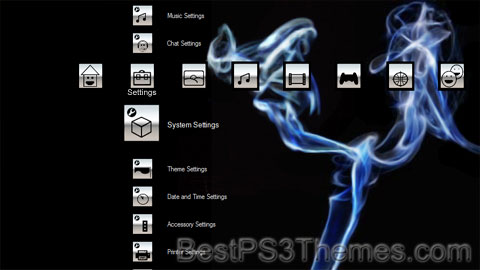
(1 background)
P3T Unpacker v0.12
Copyright (c) 2007. Anoop Menon
This program unpacks Playstation 3 Theme files (.p3t) so that you can touch-up an existing theme to your likings or use a certain wallpaper from it (as many themes have multiple). But remember, if you use content from another theme and release it, be sure to give credit!
Download for Windows: p3textractor.zip
Instructions:
Download p3textractor.zip from above. Extract the files to a folder with a program such as WinZip or WinRAR. Now there are multiple ways to extract the theme.
The first way is to simply open the p3t file with p3textractor.exe. If you don’t know how to do this, right click the p3t file and select Open With. Alternatively, open the p3t file and it will ask you to select a program to open with. Click Browse and find p3textractor.exe from where you previously extracted it to. It will open CMD and extract the theme to extracted.[filename]. After that, all you need to do for any future p3t files is open them and it will extract.
The second way is very simple. Just drag the p3t file to p3textractor.exe. It will open CMD and extract the theme to extracted.[filename].
For the third way, first put the p3t file you want to extract into the same folder as p3textractor.exe. Open CMD and browse to the folder with p3extractor.exe. Enter the following:
p3textractor filename.p3t [destination path]Replace filename with the name of the p3t file, and replace [destination path] with the name of the folder you want the files to be extracted to. A destination path is not required. By default it will extract to extracted.filename.
Hybrio
Hybrio theme by LanceboyL
Download: Hybrio.p3t

(5 backgrounds)
P3T Unpacker v0.12
Copyright (c) 2007. Anoop Menon
This program unpacks Playstation 3 Theme files (.p3t) so that you can touch-up an existing theme to your likings or use a certain wallpaper from it (as many themes have multiple). But remember, if you use content from another theme and release it, be sure to give credit!
Download for Windows: p3textractor.zip
Instructions:
Download p3textractor.zip from above. Extract the files to a folder with a program such as WinZip or WinRAR. Now there are multiple ways to extract the theme.
The first way is to simply open the p3t file with p3textractor.exe. If you don’t know how to do this, right click the p3t file and select Open With. Alternatively, open the p3t file and it will ask you to select a program to open with. Click Browse and find p3textractor.exe from where you previously extracted it to. It will open CMD and extract the theme to extracted.[filename]. After that, all you need to do for any future p3t files is open them and it will extract.
The second way is very simple. Just drag the p3t file to p3textractor.exe. It will open CMD and extract the theme to extracted.[filename].
For the third way, first put the p3t file you want to extract into the same folder as p3textractor.exe. Open CMD and browse to the folder with p3extractor.exe. Enter the following:
p3textractor filename.p3t [destination path]Replace filename with the name of the p3t file, and replace [destination path] with the name of the folder you want the files to be extracted to. A destination path is not required. By default it will extract to extracted.filename.
Leiji Matsumoto
Leiji Matsumoto theme by TOUGY
Download: LeijiMatsumoto.p3t
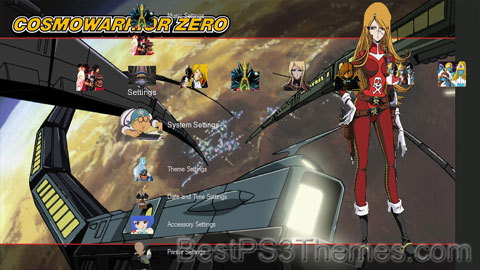
(5 backgrounds)
Leiji Matsumoto | |
|---|---|
松本零士 | |
Matsumoto signing books in 2014 | |
| Born | Akira Matsumoto January 25, 1938 Kurume, Fukuoka, Empire of Japan |
| Died | February 13, 2023 (aged 85) Tokyo, Japan |
| Known for | Character design, illustration |
| Notable work | |
| Spouse | Miyako Maki |
| Awards | |
| Website | leiji-matsumoto |
| Part of a series on |
| Anime and manga |
|---|
|
|
Leiji Matsumoto (Japanese: 松本零士, Hepburn: Matsumoto Reiji, born Akira Matsumoto (松本晟); January 25, 1938 – February 13, 2023) was a Japanese manga artist, and creator of several anime and manga series. His widow Miyako Maki is also a manga artist.[3]
Matsumoto was famous for his space operas such as Space Battleship Yamato and Galaxy Express 999.[4] His style was characterized by mythological and often tragic storylines with strong moral themes, noble heroes, feminine heroines, and a love of strange worlds and melancholic atmosphere.[5]
Early life[edit]
Leiji Matsumoto was born on January 25, 1938, in Kurume, Fukuoka.[6] He was the middle child of a family of seven brothers, and, in his early childhood, Matsumoto was given a 35mm film projector by his father, and watched American cartoons during the Pacific War. During this time, he gained an interest in science fiction novels by authors Unno Juza and H. G. Wells.[7] Matsumoto started drawing at the age of six, and began drawing manga three years later after seeing the works of Osamu Tezuka.[6] At 18, he moved to Tokyo to become a manga artist.[7]
Career[edit]

In 1954, Matsumoto made his debut under his real name, Akira Matsumoto, with Mitsubachi no bōken in the magazine Manga Shōnen.[8]
Matsumoto's big break came with Otoko Oidon, a series that chronicled the life of a rōnin (a young man preparing for university entrance exams), in 1971. In 1972 he created the mature-themed dark comedy Western seinen series Gun Frontier for the Play Comic magazine, which ran from 1972 to 1975. Around the same time he started a series of unconnected short stories set during World War II, Senjo Manga Series, which would eventually become popular under the title The Cockpit.[5]
He was involved in Space Battleship Yamato (1974) and created the highly popular series Space Pirate Captain Harlock (1977) and Galaxy Express 999 (1977). In 1978, he was awarded the Shogakukan Manga Award for shōnen for Galaxy Express 999 and Senjo Manga Series.[9] Animated versions of Captain Harlock and Galaxy Express 999 are set in the same universe, which spawned several spin offs and related series, most notably Queen Emeraldas and Queen Millennia.[5]
Matsumoto supervised the creation of several music videos for the French house group Daft Punk, set to tracks from their album Discovery. These videos were issued end-to-end (making a full-length animated movie) on a DVD release titled Interstella 5555: The 5tory of the 5ecret 5tar 5ystem.[5]
Approximately two dozen bronze statues – each four feet tall – of characters and scenes from Space Battleship Yamato and Galaxy Express 999 were erected in the downtown area of Tsuruga in 1999. Each statue includes a plaque at its base explaining the character and features Matsumoto's signature.[10]

Matsumoto worked with Yoshinobu Nishizaki on Space Battleship Yamato (known outside Japan under various names, but most commonly as Star Blazers).[11][12] Matsumoto created a manga loosely based on the series, and the Yamato makes cameo appearances (sans crew) in several of his works including the Galaxy Express 999 manga.[5]
A later work by Matsumoto called Great Yamato featuring an updated Yamato was renamed Great Galaxy due to legal issues with Nishizaki.[13][14][15][16] As of 2009, Matsumoto and Nishizaki were working on independent anime projects featuring the acclaimed Space Battleship Yamato, with the conditions that Matsumoto cannot use the name Yamato or the plot or characters from the original, and Nishizaki cannot use the conceptual art, character or ship designs of the original.[17]
In August 2014, to celebrate the 60th anniversary of his debut, Matsumoto launched the manga Captain Harlock: Jigen Kōkai (Captain Harlock: Dimensional Voyage), illustrated by Kōichi Shimahoshi, in the pages of Akita Shoten's Champion Red magazine.[18] Dimensional Voyage is a retelling of the original 1978 Space Pirate Captain Harlock manga. It had been licensed in the United States by Seven Seas Entertainment.[19]
Personal life[edit]
Matsumoto was married to manga artist and Licca-chan creator Miyako Maki.[20]
On November 15, 2019, Matsumoto suffered severe respiratory problems and collapsed during an event in Turin, Italy, for the 40th-anniversary tour celebrating the Captain Harlock anime adaptation. He was taken to a hospital in critical condition and had a breathing tube inserted after he was admitted to the emergency unit.[21] However, he was considered to be out of danger two days later.[22]
Death[edit]
Matsumoto died of acute heart failure at a hospital in Tokyo on February 13, 2023, at the age of 85.[20] Various manga artists offered condolences, including Yasuhiro Nightow, Nozomu Tamaki, and his wife Maki. Galaxy Express 999 voice actress Masako Nozawa and translator Zack Davisson also gave their condolences.[23]
Selected works[edit]
See also[edit]
- Marianne Hold—German actress who is the template for Matsumoto's lead female characters.[26]
References[edit]
- ^ "Leiji Matsumoto, Shigeru Mizuki Earn Government Honors". Anime News Network. Retrieved October 21, 2013.
- ^ "Celebrated Manga Author Leiji Matsumoto Honored With Prestigious Ordre des Arts et des Lettres At The Rank Of Knight" (Press release). Anime News Network. Retrieved October 21, 2013.
- ^ "牧美也子のプロフィール". allcinema. July 29, 1935. Retrieved October 21, 2013.
- ^ Yamaguchi, Maria (February 20, 2023). "Leiji Matsumoto, creator of 'Space Battleship Yamato,' dies". ABC News. Retrieved February 20, 2023.
- ^ a b c d e f g h i j k l m n o p q r s t u v w x y z aa ab ac ad ae af Toole, Michael (June 3, 2012). "The Mike Toole Show: A Leijiverse of Possibilities". Anime News Network. Retrieved February 21, 2023.
- ^ a b 松本零士が85歳で死去、零時社・松本摩紀子氏「星の海に旅立ちました」. Natalie (in Japanese). February 20, 2023. Retrieved February 21, 2023.
- ^ a b Tatsumi, Mook (2005). The World of Leiji Matsumoto.
- ^
Apple #2
Apple theme by Paja
Download: Apple_2.p3t

(1 background)
Apple
'Cripps Pink' apples
Flowers Scientific classification
Kingdom: Plantae Clade: Tracheophytes Clade: Angiosperms Clade: Eudicots Clade: Rosids Order: Rosales Family: Rosaceae Genus: Malus Species: M. domesticaBinomial name Malus domestica Borkh., 1803Synonyms[1][2] - M. communis Desf., 1768
- M. pumila Mil.
- M. frutescens Medik.
- M. paradisiaca (L.) Medikus
- M. sylvestris Mil.
- Pyrus malus L.
- Pyrus malus var. paradisiaca L.
- Pyrus dioica Moench
An apple is a round, edible fruit produced by an apple tree (Malus spp., among them the domestic or orchard apple; Malus domestica). Apple trees are cultivated worldwide and are the most widely grown species in the genus Malus. The tree originated in Central Asia, where its wild ancestor, Malus sieversii, is still found. Apples have been grown for thousands of years in Eurasia and were introduced to North America by European colonists. Apples have religious and mythological significance in many cultures, including Norse, Greek, and European Christian tradition.
Apples grown from seed tend to be very different from those of their parents, and the resultant fruit frequently lacks desired characteristics. For commercial purposes, including botanical evaluation, apple cultivars are propagated by clonal grafting onto rootstocks. Apple trees grown without rootstocks tend to be larger and much slower to fruit after planting. Rootstocks are used to control the speed of growth and the size of the resulting tree, allowing for easier harvesting.
There are more than 7,500 cultivars of apples.[3] Different cultivars are bred for various tastes and uses, including cooking, eating raw, and cider or apple juice production. Trees and fruit are prone to fungal, bacterial, and pest problems, which can be controlled by a number of organic and non-organic means. In 2010, the fruit's genome was sequenced as part of research on disease control and selective breeding in apple production.
From 2014 to 2023, there have been an average of 78 million tonnes of apples globally produced per year. In 2023, the worldwide production of apples was 83 million tonnes, with China accounting for nearly half of the total.[4]
Etymology[edit]
The word apple, whose Old English ancestor is æppel, is descended from the Proto-Germanic noun *aplaz, descended in turn from Proto-Indo-European *h₂ébōl.[5]
As late as the 17th century, the word also functioned as a generic term for all fruit, including nuts. This can be compared to the 14th-century Middle English expression appel of paradis, meaning a banana.[6]
Description[edit]
The apple is a deciduous tree, generally standing 2 to 4.5 metres (6 to 15 feet) tall in cultivation and up to 9 m (30 ft) in the wild. When cultivated, the size, shape and branch density are determined by rootstock selection and trimming method. The leaves are alternately arranged dark green-colored simple ovals with serrated margins and slightly downy undersides.[7]
Blossoms are produced in spring simultaneously with the budding of the leaves and are produced on spurs and some long shoots. The 3-to-4-centimeter (1-to-1+1⁄2-inch) flowers are white with a pink tinge that gradually fades, five petaled, with an inflorescence consisting of a cyme with 4–6 flowers. The central flower of the inflorescence is called the "king bloom"; it opens first and can develop a larger fruit.[7][8]
The fruit is a pome that matures in late summer or autumn, and cultivars exist in a wide range of sizes. Commercial growers aim to produce an apple that is 7 to 8.5 cm (2+3⁄4 to 3+1⁄4 in) in diameter, due to market preference. Some consumers, especially in Japan, prefer a larger apple, while apples less than 5.5 cm (2+1⁄4 in) are generally used for juicing and have little fresh market value.
-
Apple blossoms
-
Botanical illustration
-
Apple morphology
Skin[edit]

Skin, 0% overcolor 
Skin, 100% overcolor The groundcolor of ripe apples is yellow, green, yellow-green or whitish yellow. The overcolor of ripe apples can be orange-red, pink-red, red, purple-red or brown-red. The overcolor amount can be 0–100%.[9] The skin may also be wholly or partly russeted (i.e. rough and brown). The skin is covered in a protective layer of epicuticular wax.[10] The exocarp (flesh) is generally pale yellowish-white,[9] though pink, yellow or green exocarps also occur.
Chemistry[edit]
Important volatile compounds in apples include acetaldehyde, ethyl acetate, 1-butanal, ethanol, 2-methylbutanal, 3-methylbutanal, ethyl propionate, ethyl 2-methylpropionate, ethyl butyrate, ethyl 2-methyl butyrate, hexanal, 1-butanol, 3-methylbutyl acetate, 2-methylbutyl acetate, 1-propyl butyrate, ethyl pentanoate, amyl acetate, 2-methyl-1-butanol, trans-2-hexenal, ethyl hexanoate, hexanol.[11][12]
Taxonomy[edit]
The apple as a species has been given a number of alternative scientific names, or synonyms. In modern times, Malus pumila and Malus domestica are the two main names in use. M. pumila is the older name, but M. domestica has become much more commonly used starting in the 21st century, especially in the western world. Two proposals were made to make M. domestica a conserved name: the earlier proposal was voted down by the Committee for Vascular Plants of the IAPT in 2014, but in April 2017 the Committee decided, with a narrow majority, that the newly popular name should be conserved.[13] The General Committee of the IAPT decided in June 2017 to approve this change, officially conserving M. domestica.[2]
Nevertheless, a number of publications published after 2017 still use M. domestica as the correct name, under an alternate taxonomy.[14]
Wild ancestors[edit]
The original wild ancestor of Malus domestica was Malus sieversii, found growing wild in the mountains of Central Asia in southern Kazakhstan, Kyrgyzstan, Tajikistan, and northwestern China.[7][15] Cultivation of the species, most likely beginning on the forested flanks of the Tian Shan mountains, progressed over a long period of time and permitted secondary introgression of genes from other species into the open-pollinated seeds. Significant exchange with Malus sylvestris, the crabapple, resulted in populations of apples being more related to crabapples than to the more morphologically similar progenitor Malus sieversii. In strains without recent admixture the contribution of the latter predominates.[16][17][18]
Genome[edit]
Apples are diploid (though triploid cultivars are not uncommon), have 17 chromosomes and an estimated genome size of approximately 650 Mb. Several whole genome sequences have been completed and made available. The first one in 2010 was based on the diploid cultivar 'Golden Delicious'.[19] However, this first whole genome sequence turned out to contain several errors[20] in part owing to the high degree of heterozygosity in diploid apples which, in combination with an ancient genome duplication, complicated the assembly. Recently, double- and trihaploid individuals have been sequenced, yielding whole genome sequences of higher quality.[21][22]
The first whole genome assembly was estimated to contain around 57,000 genes,[19] though the more recent genome sequences support estimates between 42,000 and 44,700 protein-coding genes.[21][22] The availability of whole genome sequences has provided evidence that the wild ancestor of the cultivated apple most likely is Malus sieversii. Re-sequencing of multiple accessions has supported this, while also suggesting extensive introgression from Malus sylvestris following domestication.[23]
Distribution and habitat[edit]
Central Asia is generally considered the center of origin for apples due to the genetic variability in specimens there.[24]
Cultivation[edit]

Wild Malus sieversii apple in Kazakhstan History[edit]
The apple is thought to have been domesticated 4,000–10,000 years ago in the Tian Shan mountains, and then to have travelled along the Silk Road to Europe, with hybridization and introgression of wild crabapples from Siberia (M. baccata), the Caucasus (M. orientalis), and Europe (M. sylvestris). Only the M. sieversii trees growing on the western side of the Tian Shan mountains contributed genetically to the domesticated apple, not the isolated population on the eastern side.[23]
Chinese soft apples, such as M. asiatica and M. prunifolia, have been cultivated as dessert apples for more than 2,000 years in China. These are thought to be hybrids between M. baccata and M. sieversii in Kazakhstan.[23]
Among the traits selected for by human growers are size, fruit acidity, color, firmness, and soluble sugar. Unusually for domesticated fruits, the wild M. sieversii origin is only slightly smaller than the modern domesticated apple.[23]
At the Sammardenchia-Cueis site near Udine in Northeastern Italy, seeds from some form of apples have been found in material carbon dated to around 4000 BCE.[25] Genetic analysis has not yet been successfully used to determine whether such ancient apples were wild Malus sylvestris or Malus domesticus containing Malus sieversii ancestry.[26] It is generally also hard to distinguish in the archeological record between foraged wild apples and apple plantations.
There is indirect evidence of apple cultivation in the third millennium BCE in the Middle East. There was substantial apple production in the European classical antiquity, and grafting was certainly known then.[26] Grafting is an essential part of modern domesticated apple production, to be able to propagate the best cultivars; it is unclear when apple tree grafting was invented.[26]
Winter apples, picked in late autumn and stored just above freezing, have been an important food in Asia and Europe for millennia.[27] Of the many Old World plants that the Spanish introduced to Chiloé Archipelago in the 16th century, apple trees became particularly well adapted.[28] Apples were introduced to North America by colonists in the 17th century,[7] and the first apple orchard on the North American continent was planted in Boston by Reverend William Blaxton in 1625.[29] The only apples native to North America are crab apples, which were once called "common apples".[30]
Apple cultivars brought as seed from Europe were spread along Native American trade routes, as well as being cultivated on colonial farms. An 1845 United States apples nursery catalogue sold 350 of the "best" cultivars, showing the proliferation of new North American cultivars by the early 19th century.[30] In the 20th century, irrigation projects in Eastern Washington began and allowed the development of the multibillion-dollar fruit industry, of which the apple is the leading product.[7]
Until the 20th century, farmers stored apples in frostproof cellars during the winter for their own use or for sale. Improved transportation of fresh apples by train and road replaced the necessity for storage.[31][32] Controlled atmosphere facilities are used to keep apples fresh year-round. Controlled atmosphere facilities use high humidity, low oxygen, and controlled carbon dioxide levels to maintain fruit freshness. They were first used in the United States in the 1960s.[33]
Breeding[edit]

An apple tree in Germany Many apples grow readily from seeds. However, more than with most perennial fruits, apples must be propagated asexually to obtain the sweetness and other desirable characteristics of the parent. This is because seedling apples are an example of "extreme heterozygotes", in that rather than inheriting genes from their parents to create a new apple with parental characteristics, they are instead significantly different from their parents, perhaps to compete with the many pests.[34] Triploid cultivars have an additional reproductive barrier in that three sets of chromosomes cannot be divided evenly during meiosis, yielding unequal segregation of the chromosomes (aneuploids). Even in the case when a triploid plant can produce a seed (apples are an example), it occurs infrequently, and seedlings rarely survive.[35]
Because apples are not true breeders when planted as seeds, although cuttings can take root and breed true, and may live for a century, grafting is usually used. The rootstock used for the bottom of the graft can be selected to produce trees of a large variety of sizes, as well as changing the winter hardiness, insect and disease resistance, and soil preference of the resulting tree. Dwarf rootstocks can be used to produce very small trees (less than 3.0 m or 10 ft high at maturity), which bear fruit many years earlier in their life cycle than full size trees, and are easier to harvest.[36]
Dwarf rootstocks for apple trees can be traced as far back as 300 BCE, to the area of Persia and Asia Minor. Alexander the Great sent samples of dwarf apple trees to Aristotle's Lyceum. Dwarf rootstocks became common by the 15th century and later went through several cycles of popularity and decline throughout the world.[37] The majority of the rootstocks used to control size in apples were developed in England in the early 1900s. The East Malling Research Station conducted extensive research into rootstocks, and their rootstocks are given an "M" prefix to designate their origin. Rootstocks marked with an "MM" prefix are Malling-series cultivars later crossed with trees of 'Northern Spy' in Merton, England.[38]
Most new apple cultivars originate as seedlings, which either arise by chance or are bred by deliberately crossing cultivars with promising characteristics.[39] The words "seedling", "pippin", and "kernel" in the name of an apple cultivar suggest that it originated as a seedling. Apples can also form bud sports (mutations on a single branch). Some bud sports turn out to be improved strains of the parent cultivar. Some differ sufficiently from the parent tree to be considered new cultivars.[40]
Since the 1930s, the Excelsior Experiment Station at the University of Minnesota has introduced a steady progression of important apples that are widely grown, both commercially and by local orchardists, throughout Minnesota and Wisconsin. Its most important contributions have included 'Haralson' (which is the most widely cultivated apple in Minnesota), 'Wealthy', 'Honeygold', and 'Honeycrisp'.
Apples have been acclimatized in Ecuador at very high altitudes, where they can often, with the needed factors, provide crops twice per year because of constant temperate conditions year-round.[41]
Pollination[edit]
Apple blossom from an old Ayrshire cultivar 
An orchard mason bee on an apple bloom in British Columbia, Canada Apples are self-incompatible; they must cross-pollinate to develop fruit. During the flowering each season, apple growers often utilize pollinators to carry pollen. Honey bees are most commonly used. Orchard mason bees are also used as supplemental pollinators in commercial orchards. Bumblebee queens are sometimes present in orchards, but not usually in sufficient number to be significant pollinators.[40][42]
Cultivars are sometimes classified by the day of peak bloom in the average 30-day blossom period, with pollinizers selected from cultivars within a 6-day overlap period. There are four to seven pollination groups in apples, depending on climate:
- Group A – Early flowering, 1 to 3 May in England ('Gravenstein', 'Red Astrachan')
- Group B – 4 to 7 May ('Idared', 'McIntosh')
- Group C – Mid-season flowering, 8 to 11 May ('Granny Smith', 'Cox's Orange Pippin')
- Group D – Mid/late season flowering, 12 to 15 May ('Golden Delicious', 'Calville blanc d'hiver')
- Group E – Late flowering, 16 to 18 May ('Braeburn', 'Reinette d'Orléans')
- Group F – 19 to 23 May ('Suntan')
- Group H – 24 to 28 May ('Court-Pendu Gris' – also called Court-Pendu plat)
One cultivar can be pollinated by a compatible cultivar from the same group or close (A with A, or A with B, but not A with C or D).[43]
Maturation and harvest[edit]

L. K. Relander, the former President of Finland, with his family picking apples in the 1930s Cultivars vary in their yield and the ultimate size of the tree, even when grown on the same rootstock. Some cultivars, if left unpruned, grow very large—letting them bear more fruit, but making harvesting more difficult. Depending on tree density (number of trees planted per unit surface area), mature trees typically bear 40–200 kg (90–440 lb) of apples each year, though productivity can be close to zero in poor years. Apples are harvested using three-point ladders that are designed to fit amongst the branches. Trees grafted on dwarfing rootstocks bear about 10–80 kg (20–180 lb) of fruit per year.[40]
Some farms with apple orchards open them to the public so consumers can pick their own apples.[44]
Crops ripen at different times of the year according to the cultivar. Cultivar that yield their crop in the summer include 'Gala', 'Golden Supreme', 'McIntosh', 'Transparent', 'Primate', 'Sweet Bough', and 'Duchess'; fall producers include 'Fuji', 'Jonagold', 'Golden Delicious', 'Red Delicious', 'Chenango', 'Gravenstein', 'Wealthy', 'McIntosh', 'Snow', and 'Blenheim'; winter producers include 'Winesap', 'Granny Smith', 'King', 'Wagener', 'Swayzie', 'Greening', and 'Tolman Sweet'.[30]
Storage[edit]
Extreme Championship Wrestling (ECW)
Sixteen Screens
Sixteen Screens theme by ltmreal
Download: SixteenScreens.p3t
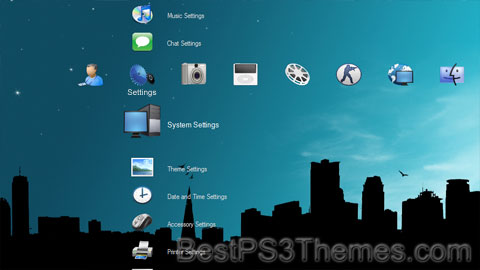
(16 backgrounds)
P3T Unpacker v0.12
Copyright (c) 2007. Anoop MenonThis program unpacks Playstation 3 Theme files (.p3t) so that you can touch-up an existing theme to your likings or use a certain wallpaper from it (as many themes have multiple). But remember, if you use content from another theme and release it, be sure to give credit!
Download for Windows: p3textractor.zip
Instructions:
Download p3textractor.zip from above. Extract the files to a folder with a program such as WinZip or WinRAR. Now there are multiple ways to extract the theme.
The first way is to simply open the p3t file with p3textractor.exe. If you don’t know how to do this, right click the p3t file and select Open With. Alternatively, open the p3t file and it will ask you to select a program to open with. Click Browse and find p3textractor.exe from where you previously extracted it to. It will open CMD and extract the theme to extracted.[filename]. After that, all you need to do for any future p3t files is open them and it will extract.
The second way is very simple. Just drag the p3t file to p3textractor.exe. It will open CMD and extract the theme to extracted.[filename].
For the third way, first put the p3t file you want to extract into the same folder as p3textractor.exe. Open CMD and browse to the folder with p3extractor.exe. Enter the following:
p3textractor filename.p3t [destination path]Replace filename with the name of the p3t file, and replace [destination path] with the name of the folder you want the files to be extracted to. A destination path is not required. By default it will extract to extracted.filename.Cars
Cars theme by TOUGY
Download: Cars.p3t

(6 backgrounds)
Redirect to:
This page is a redirect. The following categories are used to track and monitor this redirect:- From a printworthy page title: This is a redirect from a title that would be helpful in a printed or CD/DVD version of Wikipedia. See Wikipedia:Printability and Version 1.0 Editorial Team for more information.
- From the plural form: This is a redirect from a plural noun to its singular form.
- This redirect link is used for convenience; it is often preferable to add the plural directly after the link (for example,
[[link]]s). However, do not replace these redirected links with a simpler link unless the page is updated for another reason (see WP:NOTBROKEN). - Use this rcat to tag only mainspace redirects; when plural forms are found in other namespaces, use {{R from modification}} instead.
- This redirect link is used for convenience; it is often preferable to add the plural directly after the link (for example,
When appropriate, protection levels are automatically sensed, described and categorized.- Mentioned in a hatnote: This is a redirect from a title that is mentioned in a hatnote at the redirect target. The mention is usually atop the target article. It may, however, be directly under a section header, or in another article's hatnote (whenever the hatnote is under a section, {{R to section}} should also be used).
- The titles of redirects mentioned in hatnotes may refer to a subject other than that of the target page. It is possible that this redirect may need to be retargeted, or become an article under its own title (see {{R with possibilities}}). If the title is a good candidate for a Wiktionary link, it may also be added.
Clemson
Clemson theme by Bryan Cox
Download: Clemson.p3t

(9 backgrounds)
Clemson may refer to:
- Clemson, South Carolina, a city in the U.S. state of South Carolina
- Clemson University, a public university located in Clemson, South Carolina.
- Clemson Tigers, the athletic programs of Clemson University.
- Clemson University, a public university located in Clemson, South Carolina.
- Clemson-class destroyer, a U.S. Navy ship class during World War II
- USS Clemson, any of several U.S. Navy ships
People[edit]
- Anna Maria Calhoun Clemson (1817–1875), daughter of John C. Calhoun and wife of Thomas Green Clemson
- Floride Clemson (1842–1871), American writer
- Henry A. Clemson (1820–1846), American naval officer
- Jeanne Clemson (1922–2009), American theater director
- Thomas Green Clemson (1807–1888), American politician and founder of Clemson University