Resistance: Fall of Man theme by Draicus
Download: ResistanceFallOfMan_4.p3t
(1 background)
| Resistance: Fall of Man | |
|---|---|
European cover art | |
| Developer(s) | Insomniac Games |
| Publisher(s) | Sony Computer Entertainment |
| Director(s) | Ted Price[1] |
| Designer(s) | Colin Munson[2] |
| Writer(s) | Josh Wall[2] |
| Composer(s) | David Bergeaud |
| Series | Resistance |
| Platform(s) | PlayStation 3 |
| Release | |
| Genre(s) | First-person shooter |
| Mode(s) | Single-player, multiplayer |
Resistance: Fall of Man is a 2006 first-person shooter video game for the PlayStation 3. It was developed by Insomniac Games and published by Sony Computer Entertainment. The game is set in an alternate history 1951, and follows Sergeant Nathan Hale as he and the human resistance forces attempt to drive a mysterious alien-like invasion out of the United Kingdom. The story continues in Resistance 2.
The game was originally developed under the title I-8, as it was the eighth title to be in production by Insomniac Games. It was released as a PlayStation 3 launch title in the United States on November 17, 2006 and in the PAL region on March 23, 2007. Resistance had positive critical reception, garnering particular praise in view of its status as a launch title[3] and winning several awards. As of 2007, the game sold more than 2.1 million copies.[4]
Sony and Insomniac Games became embattled with the Church of England for using interior shots of Manchester Cathedral to recreate the building within the game, as well as "promoting violence" within the building.
The game, along with its sequels Resistance 2 and Resistance 3, shut down its online servers on April 8, 2014. Digital versions of the first two games were released after the servers' closure in Europe.
Plot[edit]
In the 1900s, an insect-like alien race known as the Chimera arrive in Russia. Using advanced technology, they infect hundreds of civilians and subject them to artificial evolution, creating a diverse army of creatures ranging from simple foot soldiers to spider-like giants. By 1949, all of Europe has fallen to the Chimera. 12 months later, a vast invasion force tunnels under the English Channel, conquering much of England and leaving only scattered pockets of human resistance.
In 1951, the United States, despite taking a position of neutrality in the conflict, finally elects to deploy a task force to assist the UK as part of "Operation Deliverance". Among the soldiers is Army Ranger Sgt. Nathan Hale. However, soon after landing in York, he and his squad are ambushed by enemy troops, who infect them with the Chimera virus. Hale, the only survivor, discovers that he has an innate resistance to full infection. Instead, he gains increased strength and faster reflexes, the ability to instantly heal light injuries, and gold-colored irises, a common trait of the Chimera.
Sent to a Chimera conversion center in Grimsby, Hale meets British intelligence officer Captain Rachel Parker and helps her escape. In turn, Parker allows him to accompany British forces launching an offensive in Manchester to recover a missing convoy. The convoy's cargo is subsequently transferred to a resistance command center in Cheshire, which soon comes under attack from the Chimera. While attempting to provide assistance, Hale is separated from Parker and ends up fighting off the attack single-handedly. He then investigates the cargo, which turns out to be an Angel, a powerful creature that directs the Chimera's hive mind. The Angel tries to use its telepathy to control Hale, forcing him to kill it.
Hale then links up with Lieutenant Stephen Cartwright, a UK Royal Marines Commando. The two of them learn that the Chimera have established a series of metallic towers throughout Britain, connected by a network of tunnels and power conduits. To make the matter even more puzzling, Parker learns that the towers were excavated, not built. After the Chimera destroy the last British command post in Bristol, Hale undertakes a solo mission into the tunnels, following them all the way to a nexus point in London. Recognizing that the towers are altering the Earth's climate, Hale concludes that destroying them is the key to victory.
Under Parker and Cartwright's leadership, a massive joint American-British force of soldiers enters London and storms the central tower. Despite their best efforts, the Chimera rally themselves and initiate a counterattack, killing countless soldiers and leaving Cartwright seriously wounded. Against all odds, Hale destroys the tower's power core, causing it to ignite in a massive explosion. This triggers a chain reaction, destroying the other towers and leading to a mass extinction of the Chimera in the UK, ending their threat.
As Hale's body is never found, the US Army lists him as killed in action. Parker is not convinced, though, and believes that he may somehow have survived. In a post-credits scene, Hale is indeed still alive. He is shown walking through the snow when a squad of unknown soldiers surround him. Hale briefly contemplates suicide with his last grenade, but ultimately surrenders himself to their custody.
Gameplay[edit]
This section needs additional citations for verification. (March 2009) |

Resistance: Fall of Man is a first-person shooter set in an alternate history. Many of its gameplay features stem from this, most notably the weapons. Some weapons are based on real weapons circa the 1950s, while some weapons are futuristically altered in accordance with the game's storyline. Insomniac Games has combined its passion for creating exotic weapons and vehicles, such as those found in the Ratchet and Clank series, with its proprietary development engine and physics system to create unique human and Chimeran weaponry. Each weapon provides a unique play style and strategy. An example of this is found with the Auger (Chimeran). The primary fire for this weapon is simple rapid fire, but the bullets burrow through walls, actually coming out stronger on the other side, opening up a whole new level of strategy. The secondary fire creates a barrier that is resistant to all bullets but its own. In addition to the usual short- and long-range weapons, the game features several different types of grenades, with both historical and futuristic varieties. For example, one grenade, known as the Backlash grenade, is capable of creating a dome-shaped barrier, where the player can enter for cover. The barrier reflects shots from opposing Chimera except projectiles from very powerful enemies. Some weapons are not available on the first play-through of the game but can be found at certain locations on replaying the game.[5]
The game features melee attacks, and the motion sensing feature of the SIXAXIS controller is used for a number of things including shaking off enemies that grab onto the player, shaking off tags and flames in multiplayer, and quickly bringing up a map or leaderboard in a multiplayer match. The player also has access to turrets and a drivable jeep with a gun turret on certain levels. The game was also on Sony's list of titles to receive an online update to support the vibration feature of the DualShock 3 controller for Japan, North America, and Europe.
There are also skill points that can be earned throughout the single player game. These are awarded for certain actions[5] that are hinted at by their titles; however, the specific details are not revealed until the skill point is actually earned. There are generic skill points that can be earned during any single level, and some that are specific to certain levels of the game. Each task is worth a different number of points which are used to unlock additional media for the game. The requirements for the skill points are not told to the player until unlocked making it more difficult to achieve these points
In addition, multiple Intel documents can be found scattered throughout each level. These give the player an insight into what has happened, is happening, and will happen.
Multiplayer[edit]
Resistance: Fall of Man featured a multiplayer mode for up to 40 players online and up to 4 players offline.
Multiplayer games had little to no latency (subject to player's connection and host location), even while playing the 40 player online due to the implementation of dedicated servers across the PlayStation Network.[6]
The multiplayer version of the game also enabled players to create their own clan, create their own matches (custom games) or join pre-set games (Ranked Games). While in games, players could talk to their team mates by using a Bluetooth or USB headset. Text chat was also enabled in pre-game lobbies.
The online multiplayer had an integrated friends system which allowed players to add one another without becoming friends on the PSN. The online friends list showed a player's friend to be either In Lobby, staging or in-game. From here players could Invite to Game, Invite to Party or Send a Message. This in game system allowed for user-friendly interaction between friends and bypassed the need for players to exit the game to talk to friends; a feature that was absent from most other PS3 titles, until system firmware 2.40 was released.
The online servers for the game (and the sequels) were closed on March 28, 2014 and the online multiplayer is now unavailable. The closure also disabled the game updates, as it used a different updating system, through the multiplayer servers.[7] However, a workaround was found in 2021 and released on April 2022.[8]
Downloadable content[edit]
On June 7, 2007, a spokesperson from SCEA posted a message on MyResistance.net, informing players that complications had arisen and that the Worldwide Update and map pack had been delayed for an unspecified amount of time. However, the spokesperson did mention that it was only for a short period of time.[9]
In addition to the above maps, Insomniac made available two additional maps on June 29, 2007 in one map pack for $7.99 USD, $8.99 CAD, £2.99 GBP, €4.49 and $7.45 AU.
An additional map pack was released on November 29, 2007 that includes two additional maps for the price of $4.99 USD.
As of December 11, 2008, all map packs for Resistance: FoM were made available for free as a holiday gift from Insomniac due to the release of Resistance 2.
All map packs are available for local split-screen multiplayer.
The map packs were removed from PlayStation Store on March 2014, although only in Europe. They're still available on PlayStation Store in USA although they cannot be used because of the aforementioned server closure. Since the game used a different system to download the game updates (by entering the multiplayer modes, unlike most titles which search for updates from the XMB or after starting them), and since the updates were required for DLC compatibility, the map packs became usable only by people who downloaded the updates before the server closure, on March 2014. Shortly after the closure of the game servers, a digital version of the game was released on PlayStation Store, exclusively in Europe. It comes with all game updates and map packs, and full compatibility with savegames from the physical edition.
Maps[edit]
There are many different places the player can play during the game, all of which are based on places in England. The maps all vary in size and some of the more popular locations such as "Nottingham" and "Grimsby" come in four different sizes.
Just a few days after releasing Patch 6, Insomniac Games unveiled two new maps for Resistance: Fall of Man for the PS3. The two maps, Bracknell and Axbridge, will be suitable to all types of games and can accommodate from 8 to 40 players per round.
Bracknell is an all-interior map where players battle it out amidst the backdrop of Chimeran node and Widowmaker breeding grounds, perfect for vertical and close-quarters combat. Axbridge, on the other hand, is a narrow corridor with two human bases on each end. Aside from good sniping spots, the Axbridge map also provides the perfect venue for close-quarters combat.
Rumble[edit]
In November 2007, an update for the game was made available that enabled rumble functionality for DualShock 3 controllers.[10] However, it is no longer available for download after the online multiplayer servers shut down on April 8, 2014. It is currently available only with the digital version of the game, released in Europe.[citation needed]
Ranked Matches[edit]
Ranked matches automatically place players in a match from a chosen category. The matches intend to group players whose ranks are the same or very close together, to make the matches competitive. Ranked matches give the player experience, which will allow the player to move up different ranks. As the player moves up ranks, special rewards are unlocked for their character.
There are three categories the player can choose from, each with its own modes with one the player will automatically be placed in. The three categories are:
Free-for-all: In this category there is a deathmatch mode, which is a simple free-for all deathmatch. There is also conversion mode, an elimination game type.
Team Deathmatch, is the second selectable category which directly takes the player to a Team Deathmatch where two teams battle to see who can get to the point objective first (Normal scoring) by killing the members of the opposing team. Map Pack Mayhem was recently added to the Team Deathmatch game mode.
Team Objective: When selecting this category the player will either be taken to a Meltdown, Capture the Flag, Breach or Assault game type. The most common mode the player is automatically taken to is Meltdown, in which two teams fight to capture nodes.
Custom Matches[edit]
The multiplayer for Resistance also allows highly customizable unranked matches, known as 'Custom' matches, allowing the hosts to set different parameters such as hit points and weapon sets. Custom matches already in progress can also be joined. The player may use a search filter that finds matches meeting the player's chosen criteria. Other players can also be invited to games using the buddy list. Custom games grant less XP than Ranked matches.
Offline modes[edit]
The offline (splitscreen) multiplayer also features a range of modes, These include: Deathmatch, Team-Deathmatch, Capture the Flag, Breach, Assault, Meltdown and Skirmish.
In all of these modes the player can decide the map they play the game on, the time limit, the number of lives, the teams (if applicable), the points limit and plenty of other variables.
Resistance's competitive multiplayer does not feature the vehicles found in the game's Campaign mode.
Resistance: Fall Of Man also features an offline co-operative mode that allows players to play through the campaign mode with a friend.
Different species[edit]
While playing in multiplayer, the player will either be assigned to the Human or Chimera species, each of which has its strengths and weaknesses.
Development[edit]
The game was previously known as I-8 when a demo of the game was first shown in E3 2005 as a World War II-inspired, alien-infested first-person shooter. Insomniac Games, who developed the Spyro and Ratchet & Clank series of video games, were going to be developers of the game. A new demo was shown by Sony Computer Entertainment in the Game Developers Conference (GDC) in March 2006. The new demo was in real-time, demonstrating the gameplay, graphics and effects like bump mapping. Insomniac was said to "love the Blu-ray's contribution of tremendous space to gaming". The team also "loved the multiple simultaneous processor units".[11]
Officially-renamed Resistance (Fall of Man), it was unveiled as part of Phil Harrison's "Beyond the Box" keynote address, and was fully playable on the GDC stage. Insomniac President Ted Price spoke about the benefits of PlayStation 3, the advantages of Blu-ray storage, and the reasons that his team at Insomniac decided to develop for Sony Computer Entertainment in the next generation. It was also officially revealed that Resistance would be released before the end of 2006, but no information about it being a launch title.[12]
Reception[edit]
| Aggregator | Score |
|---|---|
| Metacritic | 86/100[3] |
| Publication | Score |
|---|---|
| 1Up.com | A−[13] |
| Edge | 7/10[14] |
| Electronic Gaming Monthly | 8.5/10[15] |
| Eurogamer | (US) 7/10[16] (UK) 6/10[17] |
| Famitsu | 33/40[18] |
| Game Informer | 9.5/10[19] |
| GamePro | |
| GameRevolution | B+[21] |
| GameSpot | 8.6/10[22] |
| GameSpy | |
| GameTrailers | 9/10[24] |
| GameZone | 9.5/10[25] |
| IGN | (US) 9.1/10[26] (AU) 8.4/10[27] (UK) 8/10[28] |
| Official U.S. PlayStation Magazine | 9/10[29] |
| The Sydney Morning Herald | |
| USA Today |
| Publication | Award |
|---|---|
| IGN | PlayStation 3 Game of the Year of 2006,[32] Best First-Person Shooter, Graphics Technology, Original Score, Use of Sound, Online Multiplayer on PlayStation 3 in 2006 |
| GameSpot | Best and Worst of 2006 – Winner of Best PlayStation 3 game[33] |
| Game Informer | Game of the month award (Tie) and top 50 games of 2006 |
| GameSpy | PlayStation 3 Game of The Year, Shooter and Online Multiplayer[34] |
Resistance: Fall of Man received a "Platinum" sales award from the Entertainment and Leisure Software Publishers Association (ELSPA),[35] indicating sales of at least 300,000 copies in the United Kingdom.[36] As of September 30, 2007, the game sold more than 2.1 million copies worldwide.[4]
Resistance: Fall of Man received "generally favorable reviews" according to the review aggregation website Metacritic.[3]
Within the first few hours of the PS3's Japanese launch, the game had already received praise from some publications. Famitsu gave the game a score of 33 out of 40.[18] IGN was the first Western site to review the game, with reviewer Jeremy Dunham declaring that while other consoles had to wait years to get their killer app, "PlayStation 3 users get theirs on day one."[26]
Following closely GameBrink.com posted their review.[37] However, the scores at the time of European launch were less brilliant. Eurogamer's UK review complained that, while functional, and even occasionally entertaining, the game completely failed to innovate.[17]
411Mania gave it a score of 9.6 out of 10 and said that it initially "felt like Call of Duty, but as I progressed through the game, I found that there was substantially more. The game plays it by the numbers in many ways but it's very polished and fun. The multiplayer will keep you occupied for months. Any PS3 owner will do themselves a disservice by not picking up this game."[38] USA Today gave it a score of four stars out of five, saying, "Easily the best game for the new Sony PlayStation 3 game console, Resistance: Fall of Man is a first-person shooter that lets you, as an American soldier stationed in the United Kingdom, lead the fight to rid the world of a vicious alien race."[31] Maxim similarly gave it a score of eight out of ten, saying that the game "managed to exceed our lofty expectations, but only by an wirey [sic] crotch hair."[39] The Sydney Morning Herald also gave it four stars out of five and called it "an accomplished shooter providing many fun online modes, engaging solo missions and superb weapons."[30] However, The New York Times gave it an average review, saying that "In spite of rave reviews it’s a fairly pedestrian humans-versus-aliens first-person shooter that brings nothing new to the genre. The artificial intelligence of combatants is lackluster, and the semi-sepia-toned graphics are surprisingly unimpressive, no better than what you would see on the five-year-old Xbox."[40]
During the 10th Annual Interactive Achievement Awards, the Academy of Interactive Arts & Sciences nominated Resistance for "First-Person Action Game of the Year" and "Outstanding Achievement in Visual Engineering".[41]
Manchester Cathedral controversy[edit]
Following the game's release, a level containing a shootout against aliens within an unidentified, abandoned church was purported to be an unauthorized depiction of Manchester Cathedral by leaders of the Church of England.[42] They claimed its depiction to be desecration and copyright infringement, and that it was inappropriate of Sony to allow players to fire guns in a city with a gun problem, making several legal threats.[43] While apologizing for any perceived offense, Sony countered that the game took place in an alternate, fictional universe, and that the building was never intended to depict the cathedral.[42] Nevertheless, the cathedral drew up a set of rules requiring game developers to ask for permission to use religious spaces.[44] Georgia Tech professor and Persuasive Games CEO Ian Bogost defended use of the cathedral in the game, believing the set piece to be significant to the story, and called Sony disappointing for apologizing.[45] The church leaders were called "uninformed" by critics, who stated that they mistook "science fiction for simulated murder".[46]
In analyzing the legal grounds for the complaint, Alex Chapman of Campbell Hooper solicitors cited a provision in the UK's
Kingdom Hearts Fan Dub theme by Kh2lover10 Download: KingdomHeartsFanDub.p3t P3T Unpacker v0.12 This program unpacks Playstation 3 Theme files (.p3t) so that you can touch-up an existing theme to your likings or use a certain wallpaper from it (as many themes have multiple). But remember, if you use content from another theme and release it, be sure to give credit! Download for Windows: p3textractor.zip Instructions: Download p3textractor.zip from above. Extract the files to a folder with a program such as WinZip or WinRAR. Now there are multiple ways to extract the theme. The first way is to simply open the p3t file with p3textractor.exe. If you don’t know how to do this, right click the p3t file and select Open With. Alternatively, open the p3t file and it will ask you to select a program to open with. Click Browse and find p3textractor.exe from where you previously extracted it to. It will open CMD and extract the theme to extracted.[filename]. After that, all you need to do for any future p3t files is open them and it will extract. The second way is very simple. Just drag the p3t file to p3textractor.exe. It will open CMD and extract the theme to extracted.[filename]. For the third way, first put the p3t file you want to extract into the same folder as p3textractor.exe. Open CMD and browse to the folder with p3extractor.exe. Enter the following: PixelJunk Monsters theme by Q-Games Download: PixelJunkMonsters_2.p3t PixelJunk Monsters is a tower defense video game developed by Q-Games for the PlayStation 3. The second game in the PixelJunk series, it was originally released in Japan on December 6, 2007 and worldwide by Sony Computer Entertainment on the PlayStation Store on January 24, 2008.[1] The game was released for the PlayStation Portable under the title PixelJunk Monsters Deluxe.
PixelJunk Monsters Encore, an expansion pack for the game, was released on April 24, 2008 in Japan;[citation needed] May 8, 2008 in North America; and May 15, 2008 in Europe.[2]
In 2013, an enhanced version developed by Double Eleven titled PixelJunk Monsters Ultimate HD was released in 2013 for the PlayStation Vita, Windows, Mac OS X and Linux. In May 2016, a port of the original game also developed by Double Eleven was released for the Wii U.[3]
In 2018, PixelJunk Monsters 2 was released, incorporating 3D graphics and new features.
Gameplay in PixelJunk Monsters has similarities to various tower defense titles. The objective is to build defense towers along the enemies' path to keep them from reaching a hut, or base. Several small creatures dwell at the base. For each enemy that survives the defense towers and reaches the hut, one creature is killed. If all creatures are wiped out, the level is failed.
Towers have distinct attributes, such as rapid fire, long range, air-focused, etc. Destroyed enemies usually drop coins and occasionally give gems, which then can be used to upgrade and research new towers.
There are a total of 21 different levels (36 with the expansion pack) at 3 stages of difficulty. There are also 3 special stages that unlock unique abilities for the player character. Several "Trophy Challenges" were also added to the game after a patch.
Unlike more traditional tower defense games, the player controls a character around the screen, collecting coins and building towers. This replaces the standard cursor controls. A second player can also join in and assist in building towers.
The PixelJunk Monsters Encore expansion pack includes an additional 15 levels, including layouts inspired by classic arcade games such as Pac-Man and Space Invaders. There are also small tweaks to gameplay; for instance, the ice tower is unlocked at the beginning of every level and the Tesla tower is less expensive to purchase.
A new version of PixelJunk Monsters was available for the PlayStation Portable. Titled PixelJunk Monsters Deluxe, it has been described by Dylan Cuthbert as the "ultimate version" of the game. It contains all of the level content from the original game and its Encore expansion pack, as well as new levels, enemies, and towers. Additional music, videos, concept art, and other special features are also included.[4]
The music for the game was developed by Otograph. On May 22, 2008, a soundtrack album for the game titled Dive into PixelJunk Monsters was released via the PlayStation Store. It is the first audio album to be released through PSN.
The PlayStation 3 version of PixelJunk Monsters, Encore, Deluxe, and the Vita version of Ultimate received "favorable" reviews, while the PC version of Ultimate and the Wii U version of PixelJunk Monsters received "average" reviews, according to the review aggregation website Metacritic.[5][6][7][8][9][10]
Jeff Gordon theme by ryanindy124 Download: JeffGordon.p3t
Business and motorsport
Jeffery Michael Gordon[2] (born August 4, 1971) is an American stock car racing executive and former professional stock car racing driver who currently serves as the vice chairman of Hendrick Motorsports. He raced full-time from 1993 to 2015, driving the No. 24 Chevrolet for Hendrick Motorsports in the former NASCAR Winston Cup Series and Sprint Cup Series (now called NASCAR Cup Series), and also served as a substitute driver for Dale Earnhardt Jr. in the No. 88 Chevrolet for Hendrick Motorsports in select races during the 2016 season.[3] He is regarded as one of the best and most influential drivers in NASCAR history, helping the sport reach mainstream popularity.
Gordon started his professional racing career in the Busch Series with Hugh Connerty Racing, followed by Bill Davis Racing, winning three races, and began racing full-time in the NASCAR Winston Cup Series for Hendrick Motorsports in 1993. He is a four-time Cup Series champion, having won the title in 1995, 1997, 1998, and 2001. He also won the Daytona 500 three times in 1997, 1999, and 2005. Gordon has completed three career Grand Slams and has won a total of sixteen Crown Jewel races (three Daytona 500s, four Talladega 500s, three Coca-Cola 600s, and six Southern 500s), both of which are all-time records.
He is third on the all-time Cup wins list with 93 career wins, while having the record for the most wins in NASCAR's modern era (1972–present) and the most wins in one modern era season, with 13 during the 1998 NASCAR Winston Cup Series. Gordon's 81 pole positions led all active drivers and is third all-time, and also a modern era record; Gordon won at least one pole in 23 consecutive seasons, making this a NASCAR record. Other records include the most restrictor plate track wins with 12 and the most road course wins with 9,[4] and he was the active "iron man" leader for consecutive races participated in with 797 through the 2015 season.[5]
In 1998, NASCAR named Gordon to its 50 Greatest Drivers list. Ten years later in a 2008 article, ESPN's Terry Blount ranked him 10th in the 25 Greatest Drivers of All-Time.[6] Foxsports.com named him as the fifth best NASCAR driver of all time.[7] He was inducted into the NASCAR Hall of Fame in 2019. As of 2016, Gordon was considered the highest-paid NASCAR driver ever and the 18th highest-paid athlete of all-time with $515 million in career earnings, per Forbes.[8]
Gordon, along with Rick Hendrick, co-owns the No. 48 Chevrolet previously driven by Jimmie Johnson, who won seven Cup championships from 2006 to 2010, 2013, and in 2016. Gordon also has an equity stake in the No. 24 team.[9] Gordon also owned a Busch Series team between 1999 and 2000, Gordon/Evernham Motorsports (co-owned with Ray Evernham; later solely owned as JG Motorsports), winning twice.
Gordon is of Scotch-Irish descent,[10] and was born in Vallejo, California to parents Carol Ann Bickford (née Houston) and William Grinnell Gordon of Vacaville, California. Gordon's mother and biological father divorced when he was six months old.[11] His stepfather, John Bickford, married his mother in the 1970s.[12] He has a sister, Kim, who is older by four years.[13] His younger cousin, James Bickford, competed in the K&N Pro Series West.[14] Gordon attended Tri-West Hendricks High School in Lizton, Indiana and was on the school's cross country team;[15] he graduated in 1989.[16]
When he was four years old,[17] Gordon rode a BMX bike that his stepfather bought for him[16] and began racing quarter midgets at the age of five. The Roy Hayer Memorial Race Track (previously the Cracker Jack Track) in Rio Linda, California is noted as the first track Gordon ever competed on. By the age of six, Gordon had won 35 main events and set five track records.[18] In 1979 Gordon won 51 quarter midget races. When he was 11, Gordon won all 25 of the karting races he entered.[15] At age 12, Gordon became bored with cars and decided to start a career in waterskiing before switching back to driving one year later.[19] In 1986, Gordon began racing sprint cars, winning three races. The next year, Gordon was awarded a USAC license at age 16, the youngest driver to do so.[15]
During the 1980s,[15] Gordon and his family had to overcome an insurance hurdle. The minimum age for driving the sprint cars was 16, and his persistence paid off with an all Florida speed weeks. Supporting his career choice, Gordon's family moved from Vallejo to Pittsboro, Indiana, where there were more opportunities for younger racers. In the late 80's, he drove in the World of Outlaws series and picked up some feature wins. He became the youngest driver in the World of Outlaws at the time.[20] He also won races at Bloomington and Eldora Speedways.[21] After graduating from high school in 1989, he quickly changed and went to Bloomington to race that night.[22][16] Before the age of 18, Gordon had already won three short-track races and was awarded USAC Midget Car Racing Rookie of the Year in 1989. That season was highlighted by winning Night Before the 500 midget car race on the day before the Indianapolis 500.[23] During the decade, Gordon also ran sprint cars in Australia and New Zealand.[15] In 1990, Gordon won his second consecutive Night Before the 500, the Hut Hundred, and the Belleville Midget Nationals on his way to winning the USAC national Midget title.[23] In 1991, Gordon captured the USAC Silver Crown, and at the age of 20 became the youngest driver to win the season championship.[23] He also won the 4 Crown Nationals midget car race that season.[23] In his midget car career between 1989 and 1992, he finished in the Top 3 in 22 of 40 USAC midget car events.[23] In 1992, Gordon competed in the Slim Jim All Pro Series' Winchester 400, but finished 24th after crashing on lap 172.[24] The following year, he ran a Featherlite Southwest Tour race at Sears Point Raceway, finishing 29th after suffering an engine failure.[25]
In the early 1990s, Gordon expressed interest in IndyCar racing, but was not able to find a ride due to low funding.[19] However, former Formula One driver Jackie Stewart offered Gordon a test drive in Europe, in what Gordon assumed was Formula Three or Formula 3000; Gordon did not perform the test due to being in contact with NASCAR.[26]
In 1990, Gordon met Hugh Connerty, who owned some Hooters restaurants and was also a partner in Outback Steakhouse. Connerty secured some sponsorship for a car through Outback, and they tested for the last few Busch Grand National races left in 1990. Ray Evernham was called in to work with Gordon in his stock car debut. His first Busch race came on October 20, 1990 at North Carolina Motor Speedway in the AC-Delco 200. Gordon drove the No. 67 Outback Steakhouse Pontiac for Connerty. Gordon ran the second fastest lap during qualifying and started on the outside of the front row of the field. Gordon would, however, get involved in a wreck on lap 33. He ended up with a 39th-place finish.[27]
In 1991 and 1992, Gordon began racing in the Busch Series full-time, driving Ford Thunderbirds for Bill Davis Racing. In his first year as a Busch driver he won Rookie of the Year. In 1992, Gordon set a NASCAR record by capturing 11 poles in one season.[16] He was sponsored by Carolina Ford Dealers in 1991 and Baby Ruth in 1992.[28]
In 1999, Gordon along with Cup crew chief Evernham formed Gordon/Evernham Motorsports (GEM) in the Busch Series with Gordon and Rick Hendrick's son Ricky Hendrick as drivers, the Rainbow Warriors as pit crew and Patrick Donahue as crew chief.[29] The co-owned team received a full sponsorship from Pepsi and ran six races with Gordon as driver and Evernham as crew chief. GEM only survived one year as Evernham left Hendrick Motorsports, citing tension between him and the team,[30] ending one of the most dominant driver/crew-chief combinations in NASCAR history. Gordon extended his Busch experiment one more year, through 2000 as co-owner, with Rick Hendrick buying Evernham's half, and GEM becoming JG Motorsports. In two seasons, Gordon won twice, in 1999 at the Outback Steakhouse 200, the inaugural race[31] at Phoenix,[32] and 2000 at Homestead.[33]
In 1992, Roush Racing owner Jack Roush planned to sign Gordon, but Gordon's stepfather John Bickford had insisted that Roush hire Ray Evernham; due to Roush's policy of hiring his own crew chiefs, Bickford declined.[34] Later in the year, Rick Hendrick watched Gordon race in a Busch Series event at Atlanta Motor Speedway, and Gordon joined Hendrick Motorsports two days later.[35] Gordon made his Winston Cup debut in the season-ending race, the Hooters 500 at Atlanta, finishing 31st after a crash.[36]
The following year, Gordon began competing full-time in the Winston Cup Series, driving the No. 24 car for Hendrick. He was originally supposed to race the No. 46, but complications with licensing related to Days of Thunder forced Gordon to the 24.[37] He opened the season with a win in the Gatorade Twin 125's race,[38] while also recording his first-career pole position at the fall Charlotte race,[39] and concluded 1993 with a 14th-place points finish and the Rookie of the Year Award.[16] Gordon's early success in the sport reshaped the paradigm and eventually gave younger drivers an opportunity to compete in NASCAR. However, during the season, many doubted Gordon's ability to compete at such a level at such a young age because of his tendency to push the cars too hard and crash. His last-place finish at the 1993 First Union 400 was a firm example of this theory.[40] Additionally, driver Darrell Waltrip wrote he told Hendrick during the season that Gordon had "hit everything but the pace car that year."[41]
In 1994, Gordon won the Busch Clash exhibition race at Daytona.[42] In May, Gordon won the pole for the Coca-Cola 600, and eventually the race after electing to take two tires on a green flag pit stop.[43] Three months later, he scored a hometown victory at the inaugural Brickyard 400, capitalizing on Ernie Irvan's tire going down late in the race.[44]
Indianapolis 500 theme by ryanindy124 Download: Indianapolis500.p3t
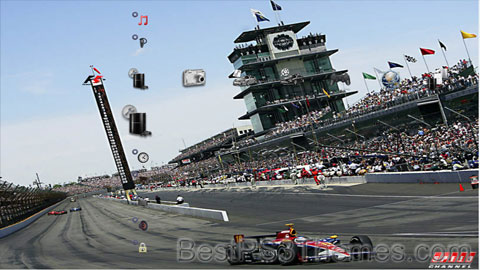
The Indianapolis 500, formally known as the Indianapolis 500-Mile Race,[1][2] and commonly shortened to Indy 500, is an annual automobile race held at the Indianapolis Motor Speedway in Speedway, Indiana, United States, an enclave suburb of Indianapolis. The event is traditionally held over Memorial Day weekend, usually the last weekend of May. It is contested as part of the IndyCar Series, the top level of American open-wheel car racing, a formula colloquially known as "Indy car racing". The track itself is nicknamed the "Brickyard", as the racing surface was first paved in brick in the fall of 1909. One yard of brick remains exposed at the start/finish line. The event, billed as The Greatest Spectacle in Racing,[3] is considered part of the Triple Crown of Motorsport along with the 24 Hours of Le Mans and the Monaco Grand Prix, with which it typically shares a date.[4]
The inaugural race was held in 1911 and was won by Ray Harroun. The event celebrated its 100th anniversary in 2011, and the 100th running was held in 2016. The event was put on hiatus twice, from 1917 to 1918 due to World War I and from 1942 to 1945 due to World War II. In two different periods, the race was part of FIA World Championships; between 1925 and 1928, the World Manufacturers' Championship and between 1950 and 1960, the World Drivers' Championship.
Josef Newgarden, the winner in 2023–2024, is the reigning champion. The most successful drivers are A. J. Foyt, Al Unser Sr., Rick Mears and Hélio Castroneves, each of whom has won the race four times. The active driver with the most victories is Castroneves. Rick Mears holds the record for most career pole positions with six. The most successful car owner is Roger Penske, owner of the Indianapolis Motor Speedway and Team Penske, which has 20 total wins and 18 poles. Penske also has five wins at the IndyCar Grand Prix, held on the combined road course.
The event is steeped in tradition, in pre-race ceremonies, post-race celebrations, and race procedure. The most noteworthy and most popular traditions are the 33-car field lining up three-wide for the start, the annual singing of the chorus of "Back Home Again in Indiana", and the victory lane bottle of milk. Also unique is that qualifying requires the driver to complete four, rather than one, timed laps, and the time trials are conducted on a separate weekend. The official attendance is not disclosed by Speedway management, but the permanent seating capacity is upwards of 250,000, and infield patrons raise the total race-day attendance to a range of approximately 300,000–350,000.[5]
The Indianapolis Motor Speedway complex was built in 1909 as a gravel-and-tar track and hosted a smattering of small events, including ones for motorcycles.[6] The first long-distance event, in "fearful conditions", was the 100-lap Prest-O-Lite Trophy in 1909, won by Bob Burman in a Buick.[7] The breakup of the track surface led to two fatal accidents in the first two long-distance events (a 250 mi (400 km) and 300 mi (480 km), which was shortened to 235 mi (378 km) after two severe wrecks).[8]
That these spectacles had attracted 15,000 paying customers (and crowds of up to 40,000)[9] persuaded principal owner Carl G. Fisher to spend $155,000[10] on repaving the track with 3.2 million bricks;[11] he also added a 33-inch (0.84 m) concrete wall around the track's circumference.[10] During the 1910 Decoration Day weekend, the first events on the newly paved circuit drew 60,000 spectators; Ray Harroun won the 200-mile (320 km) Wheeler-Schebler Trophy in a Marmon.[10]
The crowds grew progressively smaller for the rest of the season, however, so the track owners chose to focus on a single race, and considered a 24-hour contest, in the fashion of Le Mans, or a one-thousand-mile (1,600 km) event.[10] They decided on 500 miles (800 km), the estimated distance a race car could run before dark descended on the track,[12] and a spectacular purse of $25,000, equivalent to 82.93 pounds (37.62 kg) of pure gold.[10] The combination allowed the track to rapidly acquire a privileged status for automobile races.
The first "500" was held at the Speedway in 1911 on Decoration Day, May 30,[13] (as it was known from its inception in 1868 to 1967, when federal law made "Memorial Day" the official name), run to a 600-cubic-inch (9,800 cc) maximum engine size formula.[10] It saw a field of 40 starters,[10] with Harroun piloting a Marmon Model 32-based Wasp racer—outfitted with his invention, the rear-view mirror.[14] Harroun (with relief from Cyrus Patschke)[15] was declared the winner, although Ralph Mulford protested the official result. Eighty thousand spectators were in attendance, and an annual tradition had been established. Many considered Harroun to be a hazard during the race, as he was the only driver in the race driving without a riding mechanic, who checked the oil pressure and let the driver know when traffic was coming.[16]
In 1912, the purse was raised to $50,000,[15] the field was limited to 33 (where it remains), and a riding mechanic was made mandatory.[17] This second event was won by Joe Dawson in a National,[18] after Ralph DePalma's Mercedes broke.[15] Although the first race was won by an American driver at the wheel of an American car, European makers such as the Italian Fiat or French Peugeot companies soon developed their vehicles to try to win the event, which they did from 1912 to 1919. The 1913 event saw a change to a 450-cubic-inch (7,400 cc) maximum engine size.[15]
After World War I, the native drivers and manufacturers regained their dominance of the race, and engineer Harry Miller set himself up as the most competitive of the post-war builders.[19] His technical developments allowed him to be indirectly connected to a history of success that would last into the mid-1970s.[citation needed]
For musical entertainment before the start of the race, the Purdue All-American Marching Band has been the host band of the race since 1919. In 1946, American operatic tenor and car enthusiast James Melton started the tradition of singing "Back Home Again in Indiana" with the Purdue Band before the race when asked to do so on the spur of the moment by Speedway president Tony Hulman. This tradition has continued through the years, notably by actor and singer Jim Nabors from 1972 until 2014.[20] Nabors announced in 2014, citing health-related reasons, that the 2014 Indy 500 would be the last at which he would sing the song. In 2015, the a cappella group Straight No Chaser sang the song before the race, and in the two races held after Nabors' retirement (and before he became the regular singer), the singing of the song was done on a rotating basis, with the Spring 2014 winner of The Voice Josh Kaufman performing in 2016.[21] However, the Speedway has returned to a standard singer with Jim Cornelison doing it since 2017.[22]
Following the European trends, engine sizes were limited to 183 cu in (3,000 cc) during 1920–1922, 122 cu in (2,000 cc) for 1923–1925, and 91 cu in (1,490 cc) in 1926–1929.[15] The 1920 race was won by Gaston Chevrolet in a Frontenac, prepared by his brothers, powered by the first eight-cylinder engine to win the 500.[15] For 1923, riding mechanics were no longer required.[23] A supercharged car, ID, first won the race in 1924.[23] In 1925, Pete DePaolo was the first to win at an average over 100 mph (160 km/h), with a speed of 101.13 mph (162.75 km/h).[15]
In the early 1920s, Miller built his 3.0-liter (183 in3) engine, inspired by the Peugeot Grand Prix engine which had been serviced in his shop by Fred Offenhauser in 1914, installing it in Jimmy Murphy's Duesenberg and allowing him to win the 1922 edition of the race.[19] Miller then created his own automobiles, which shared the 'Miller' designation, which, in turn, were powered by supercharged versions of his 2.0- and 1.5-liter (122 and 91 in3) engine single-seaters, winning four more races for the engine up to 1929 (two of them, 1926 and 1928, in Miller chassis).[24] The engines powered another seven winners until 1938 (two of them, 1930 and 1932, in Miller chassis), then ran at first with stock-type motors before later being adjusted to the international 3.0-liter formula.
After purchasing the Speedway in 1927, Eddie Rickenbacker prohibited supercharging and increased the displacement limit to 366 cu in (6,000 cc), while also re-introducing the riding mechanic.[23]
In 1935, Miller's former employees, Fred Offenhauser and Leo Goossen, had already achieved their first win with the soon-to-become famous 4-cylinder Offenhauser or "Offy" engine. This motor was forever connected with the Brickyard's history with a to-date record total of 27 wins, in both naturally aspirated and supercharged form, and winning a likewise record-holding 18 consecutive years between 1947 and 1964.[25]
Meanwhile, European manufacturers, gone from the Indianapolis 500 for nearly two decades, made a brief return just before World War II, with the competitive Maserati 8CTF allowing Wilbur Shaw to become the first driver to win consecutively at Indianapolis, in 1939 and 1940.[26][27] With the 500 having been a part of the World Drivers' Championship between 1950 and 1960,[28][29] Ferrari made a discreet appearance at the 1952 event with Alberto Ascari,[30] but European entries were few and far between during those days. Among the Formula One drivers who did drive at the speedway was five-time world champion Argentinian Juan Manuel Fangio, though he failed to qualify for the 1958 race.
It was not until the Indianapolis 500 was removed from the World Championship calendar that European entries made their return. In 1963, technical innovator Colin Chapman brought his Team Lotus to Indianapolis for the first time, attracted by the large monetary prizes, far bigger than the usual at a European event. Racing a mid-engined car, Scotsman Jim Clark was second in his first attempt in 1963,[31] dominated in 1964 until suffering suspension failure on lap 47, and completely dominated the race in 1965, a victory which also interrupted the success of the Offy, and giving the 4.2-liter Ford V8 its first success at the race.[32] The following year, 1966, saw another British win, this time Graham Hill in a Lola-Ford.[33]
The Offenhauser engine was also paired with a European maker, McLaren, obtaining three wins for the chassis, one with the Penske team in 1972 with driver Mark Donohue,[34] and two for the McLaren works team in 1974[35] and 1976 with Johnny Rutherford.[36] This was also the last time the Offy would win a race, its competitiveness steadily decreasing until its final appearance in 1983. American drivers continued to fill the majority of entries at the Brickyard in the following years, but European technology had taken over. Starting in 1978, most chassis and engines were European, with the only American-based chassis to win during the CART era being the Wildcat and Galmer[37] (which was technically built in Bicester, England) in 1982 and 1992, respectively. Ford and Chevrolet engines were built in the UK by Cosworth and Ilmor, respectively.
As of 2023, the most recent active Formula One driver to have entered the 500 is Fernando Alonso, who drove in the 2017 race. Alonso was the first Formula One driver to enter the 500 since Teo Fabi in 1984.
After foreign cars became the norm, foreign drivers began competing in the Indianapolis 500 regularly, choosing the United States as their primary base for their motor racing activities. Brazilian Emerson Fittipaldi, Italian Teo Fabi, and Colombian Roberto Guerrero were able to obtain good outings in the 1980s, as was Dutchman Arie Luyendyk. In 1993, reigning Formula One World Champion Nigel Mansell shocked the racing world by leaving Formula One for CART. While he came in only third in the 500, he won the 1993 CART championship.[38] Foreign-born drivers became a regular fixture of Indianapolis in the years to follow. Despite the increase in foreign drivers commonly being associated with the CART era, three of the first six Indianapolis 500 winners were non-American drivers.
In 2009, the Indianapolis Motor Speedway began a three-year-long "Centennial Era" to celebrate the 100th anniversary of the opening of the track (1909), and the 100th anniversary of the first Indy 500 (1911).[39] As a gesture to the nostalgic Centennial Era celebration (2009–2011), tickets for the 2009 race donned the moniker "93rd 500 Mile International Sweepstakes".[40] It is the first time since 1980 that the "Sweepstakes" title has been used. In May 2009, the ordinal (93rd) was used very sparingly, and for the first time since 1981, was not identified on the annual logo. Instead, in most instances in print, television, and radio, the race was referred to as the "2009 Indianapolis 500". Since the race was not held during the United States' participation in the two World Wars (1917–1918, 1942–1945), the advertised Centennial Era occurred during the 93rd to 95th runnings. To avoid confusion between the 100th anniversary, and the actual number of times the race has been run, references to the ordinal during the Centennial Era were curtailed.
In the 2014 meeting, the road course became part of the race meeting for the first time. The GMR Grand Prix road course event, and the three upper tiers of Road to Indy, participated in road course events at the Speedway during the first week of activities.
Six years later, in 2016, the race celebrated its 100th running with about 350,000 in attendance.[41]
Four local actors were hired to portray the Founding Four of James Allison, Carl Fisher, Frank Wheeler, and Arthur Newby during multiple Centennial Era events and the 100th race. Harold Hefner (Allison), Tom Harrison (Fisher), Jeff Angel (Wheeler), and Matthew Allen (Newby).[42]
In 2020, the race was delayed for the first time from its usual Memorial Day running to August due to the COVID-19 pandemic. There was no audience in attendance, so as to comply with pandemic guidelines. The road course race was moved to the NASCAR weekend in July (which led to an IndyCar road course race added to the NASCAR weekend permanently in 2021), and the support races on the road course moved to its own September weekend. As races were cancelled because of local restrictions, the Speedway added two more road course races in October as part of the Intercontinental GT Challenge meeting, where attendance was capped to 10,000 per event.[43]
In 2024, the race was delayed for over four hours due to heavy rain and thunderstorms in the area.[44]
The race was originally advertised as the "International 500-Mile Sweepstakes Race"[13] from 1911 to 1916. However, from its inception, the race has been widely known as the Indianapolis 500 or, more simply "the 500", as for many years, it was the only noteworthy auto race of such distance. In 1919, the race was referred to as the "Liberty Sweepstakes" following WWI.[45] From 1920 to 1980, the race officially reverted to the "International Sweepstakes" moniker, as printed on the tickets and other paraphernalia, with slight variations over the years.
Following WWII, the race was commonly recognized as "The 500", "The 500-Mile Race", "Indianapolis 500-Mile Race", "Indianapolis 500", or the simple form "Indy 500". Usually the ordinal (e.g. "50th") preceded it. Often the race was also advertised on the radio as the "Annual Memorial Day race", or similar variations. By the late 20th century, the term "Indy 500" had slowly emerged as the most common and most popularly used moniker. As such, since 2016, the official race logo has used the contemporary and colloquial term "Indy 500".
For the 1981 race, the name "65th Indianapolis 500-Mile Race" was officially adopted, with all references as the "International Sweepstakes" dropped. Since 1981, the race has been formally advertised in this fashion, complete with a unique annual logo with the ordinal almost always included. Around that same time, in the wake of the 1979 entry controversy, and the formation of CART, the race changed to an invitational event, rather than an Open, rendering the "sweepstakes" description inappropriate.
For nearly a century, the race eschewed any sort of naming rights or title sponsor, a move, though uncommon in the modern sports world, that was well received by fans. This tradition finally ended in 2016 when a presenting sponsor, PennGrade, was added for the first time. In the 21st century, the facility has also slowly added sponsorship ads on the retaining walls and infield grass. The ESPN-produced ABC telecast of the event did not recognize this sponsorship and instead had Firestone Tires as its presenting sponsorship.[46]
The Borg-Warner Trophy, introduced in 1936,[47] proclaims the event as the "Indianapolis 500-Mile Race", with no reference at all to the name "International Sweepstakes".
The Indianapolis 500 is held annually at the Indianapolis Motor Speedway, a 2.5-mile (4 km) oval circuit. The track is a rounded rectangle, with four distinct turns of identical dimensions, connected by four straightaways (two long straightaways and two "short chutes"). Traditionally, the field consists of 33 starters, aligned in a starting grid of eleven rows of three cars apiece. Drivers race 200 laps, counter-clockwise around the circuit, for a distance of 500 miles (800 km). Since its inception in < One Piece theme by BlackOps Download: OnePiece_2.p3t
One Piece (stylized in all caps) is a Japanese manga series written and illustrated by Eiichiro Oda. It has been serialized in Shueisha's shōnen manga magazine Weekly Shōnen Jump since July 1997, with its individual chapters compiled in 108 tankōbon volumes as of March 2024[update]. The story follows the adventures of Monkey D. Luffy and his crew, the Straw Hat Pirates, where he explores the Grand Line in search of the mythical treasure known as the "One Piece" in order to become the next King of the Pirates.
The manga spawned a media franchise, having been adapted into a festival film by Production I.G, and an anime series by Toei Animation, which began broadcasting in 1999. Additionally, Toei has developed fourteen animated feature films, one original video animation, and thirteen television specials. Several companies have developed various types of merchandising and media, such as a trading card game and numerous video games. The manga series was licensed for an English language release in North America and the United Kingdom by Viz Media and in Australia by Madman Entertainment. The anime series was licensed by 4Kids Entertainment for an English-language release in North America in 2004 before the license was dropped and subsequently acquired by Funimation in 2007.
One Piece has received praise for its storytelling, world-building, art, characterization, and humor. It has received many awards and is ranked by critics, reviewers, and readers as one of the best manga of all time. By August 2022, it had over 516.6 million copies in circulation in 61 countries and regions worldwide, making it the best-selling manga series in history, and the best-selling comic series printed in book volume. Several volumes of the manga have broken publishing records, including the highest initial print run of any book in Japan. In 2015 and 2022, One Piece set the Guinness World Record for "the most copies published for the same comic book series by a single author". It was the best-selling manga for eleven consecutive years from 2008 to 2018, and is the only manga that had an initial print of volumes of above 3 million continuously for more than 10 years, as well as the only that had achieved more than 1 million copies sold in all of its over 100 published tankōbon volumes. One Piece is the only manga whose volumes have ranked first every year in Oricon's weekly comic chart existence since 2008.
The world of One Piece is populated by humans and other races such as dwarves (more akin to faeries in size), giants, merfolk, fish-men, long-limbed tribes, long-necked people known as the Snakeneck Tribe, and animal people (known as "Minks"). The world is governed by an intercontinental organization known as the World Government, consisting of dozens of member countries. The Navy is the sea military branch of the World Government that protects the known seas from pirates and other criminals. There is also Cipher Pol which is a group of agencies within the World Government that are their secret police. While pirates are major opponents against the Government, the ones who really challenge their rule are the Revolutionary Army who seeks to overthrow them. The central tension of the series pits the World Government and their forces against pirates. The series regularly emphasizes moral ambiguity over the label "pirate", which includes cruel villains, but also any individuals that do not submit to the World Government's authoritarian—and often morally ambiguous—rule. The One Piece world also has supernormal characteristics like Devil Fruits,[Jp 1] which are mysterious fruits that grant whoever eats them transformative powers. Another supernatural power is Haki,[Jp 2] which grants its users enhanced willpower, observation, and fighting abilities, and it is one of the only effective methods of inflicting bodily harm on certain Devil Fruit users.
The world itself consists of two vast oceans divided by a massive mountain range called the Red Line.[Jp 3] Within the oceans is a second global phenomenon known as the Grand Line,[Jp 4] which is a sea that runs perpendicular to the Red Line and is bounded by the Calm Belt,[Jp 5] strips of calm ocean infested with huge ship-eating monsters known as Sea Kings.[Jp 6] These geographical barriers divide the world into four seas: North Blue,[Jp 7] East Blue,[Jp 8] West Blue,[Jp 9] and South Blue.[Jp 10] Passage between the four seas, and the Grand Line, is therefore difficult. Unique and mystical features enable transport between the seas, such as the use of Sea Prism Stone[Jp 11] employed by government ships to mask their presence as they traverse the Calm Belt, or the Reverse Mountain[Jp 12] where water from the four seas flows uphill before merging into a rapidly flowing and dangerous canal that enters the Grand Line. The Grand Line itself is split into two separate halves with the Red Line between being Paradise[Jp 13] and the New World.[Jp 14]
The series focuses on Monkey D. Luffy—a young man made of rubber after unintentionally eating a Devil Fruit—who sets off on a journey from the East Blue Sea to find the deceased King of the Pirates Gol D. Roger's ultimate treasure known as the "One Piece", and take over his prior title. In an effort to organize his own crew, the Straw Hat Pirates,[Jp 15] Luffy rescues and befriends a pirate hunter and swordsman named Roronoa Zoro, and they head off in search of the titular treasure. They are joined in their journey by Nami, a money-obsessed thief and navigator; Usopp, a sniper and compulsive liar; and Sanji, an amorous but chivalrous cook. They acquire a ship, the Going Merry[Jp 16]—later replaced by the Thousand Sunny[Jp 17]—and engage in confrontations with notorious pirates. As Luffy and his crew set out on their adventures, others join the crew later in the series, including Tony Tony Chopper, an anthropomorphized reindeer doctor; Nico Robin, an archaeologist and former Baroque Works assassin; Franky, a cyborg shipwright; Brook, a skeleton musician and swordsman; and Jimbei, a whale shark-type fish-man and former member of the Seven Warlords of the Sea who becomes their helmsman. Together, they encounter other pirates, bounty hunters, criminal organizations, revolutionaries, secret agents, different types of scientists, soldiers of the morally-ambiguous World Government, and various other friends and foes, as they sail the seas in pursuit of their dreams.
Eiichiro Oda's interest in pirates began in his childhood, watching the animated series Vicky the Viking, which inspired him to want to draw a manga series about pirates.[2] The reading of pirate biographies influenced Oda to incorporate the characteristics of real-life pirates into many of the characters in One Piece; for example, the character Marshall D. Teach is based on and named after the historical pirate Edward "Blackbeard" Teach.[3] Apart from the history of piracy, Oda's biggest influence is Akira Toriyama and his series Dragon Ball, which is one of his favorite manga.[4] He was also inspired by The Wizard of Oz, claiming not to endure stories where the reward of adventure is the adventure itself, opting for a story where travel is important, but even more important is the goal.[5]
While working as an assistant to Nobuhiro Watsuki, Oda began writing One Piece in 1996.[6] It started as two one-shot stories entitled Romance Dawn[6]—which would later be used as the title for One Piece's first chapter and volume. They both featured the character of Luffy, and included elements that would appear later in the main series. The first of these short stories was published in August 1996 in Akamaru Jump, and reprinted in 2002 in One Piece Red guidebook. The second was published in the 41st issue of Weekly Shōnen Jump in 1996, and reprinted in 1998 in Oda's short story collection, Wanted![7] In an interview with TBS, Takanori Asada, the original editor of One Piece, revealed that the manga was rejected by Weekly Shōnen Jump three times before Shueisha agreed to publish the series.[8]
Oda's primary inspiration for the concept of Devil Fruits was Doraemon; the Fruits' abilities and uses reflect Oda's daily life and his personal fantasies, similar to that of Doraemon's gadgets, such as the Gum-Gum Fruit being inspired by Oda's laziness.[9] When designing the outward appearance of Devil Fruits Oda thinks of something that would fulfill a human desire; he added that he does not see why he would draw a Devil Fruit unless the fruit's appearance would entice one to eat it.[10] The names of many special attacks, as well as other concepts in the manga, consist of a form of punning in which phrases written in kanji are paired with an idiosyncratic reading. The names of some characters' techniques are often mixed with other languages, and the names of several of Zoro's sword techniques are designed as jokes; they look fearsome when read by sight but sound like kinds of food when read aloud. For example, Zoro's signature move is Onigiri, which is written as demon cut but is pronounced the same as rice ball in Japanese. Eisaku Inoue, the animation director, has said that the creators did not use these kanji readings in the anime since they "might have cut down the laughs by about half".[11] Nevertheless, Konosuke Uda, the director, said that he believes that the creators "made the anime pretty close to the manga".[11]
Oda was "sensitive" about how his work would be translated.[12] In many instances, the English version of the One Piece manga uses one onomatopoeia for multiple onomatopoeia used in the Japanese version. For instance, "saaa" (the sound of light rain, close to a mist) and "zaaa" (the sound of pouring rain) are both translated as "fshhhhhhh".[13] Unlike other manga artists, Oda draws everything that moves himself to create a consistent look while leaving his staff to draw the backgrounds based on sketches he has drawn.[14] This workload forces him to keep tight production rates, starting from five in the morning until two in the morning the next day, with short breaks only for meals. Oda's work program includes the first three days of the week dedicated to the writing of the storyboard and the remaining time for the definitive inking of the boards and for the possible coloring.[15] When a reader asked who Nami was in love with, Oda replied that there would hardly be any love affairs within Luffy's crew. The author also explained he deliberately avoids including them in One Piece since the series is a shōnen manga and the boys who read it are not interested in love stories.[16]
Oda revealed that he originally planned One Piece to last five years, and that he had already planned the ending. However, he found it would take longer than he had expected as Oda realized that he liked the story too much to end it in that period of time.[17] In 2016, nineteen years after the start of serialization, the author said that the manga has reached 65% of the story he intends to tell.[18] In July 2018, on the occasion of the twenty-first anniversary of One Piece, Oda said that the manga has reached 80% of the plot,[19] while in January 2019, he said that One Piece is on its way to the conclusion, but that it could exceed the 100th volume.[20] In August 2019, Oda said that, according to his predictions, the manga will end between 2024 and 2025.[21] However, Oda stated that the ending would be what he had decided in the beginning; he is committed to seeing it through.[22] In a television special aired in Japan, Oda said he would be willing to change the ending if the fans were to be able to predict it.[5] In August 2020, Shueisha announced in the year's 35th issue of Weekly Shōnen Jump that One Piece was "headed toward the upcoming final saga."[23] On January 4, 2021, One Piece reached its thousandth chapter.[24][25][26] In June 2022, Oda announced that the manga would enter a one-month break to prepare for its 25th anniversary and its final saga, set to begin with the release of chapter 1054.[27]
Written and illustrated by Eiichiro Oda, One Piece has been serialized by Shueisha in the shōnen manga anthology Weekly Shōnen Jump since July 22, 1997.[28][29] Shueisha has collected its chapters into individual tankōbon volumes. The first volume was released on December 24, 1997.[30] By March 4, 2024, a total of 108 volumes have been released.[31]
The first English translation of One Piece was released by Viz Media in November 2002, who published its chapters in the manga anthology Shonen Jump, and later collected in volumes since June 30, 2003.[32][33][34] In 2009, Viz announced the release of five volumes per month during the first half of 2010 to catch up with the serialization in Japan.[35] Following the discontinuation of the print Shonen Jump, Viz began releasing One Piece chapterwise in its digital successor Weekly Shonen Jump on January 30, 2012.[36] Following the digital Weekly Shonen Jump's cancelation in December 2018, Viz Media started simultaneously publishing One Piece through its Shonen Jump service, and by Shueisha through Manga Plus, in January 2019.[37][38]
In the United Kingdom, the volumes were published by Gollancz Manga, starting in March 2006,[39] until Viz Media took it over after the fourteenth volume.[40][41] In Australia and New Zealand, the English volumes have been distributed by Madman Entertainment since November 10, 2008.[42] In Poland, Japonica Polonica Fantastica is publishing the manga,[43] Glénat in France,[44] Panini Comics in Mexico,[45] LARP Editores and later by Ivrea in Argentina,[46][47] Planeta de Libros in Spain,[48] Edizioni Star Comics in Italy,[49] and Sangatsu Manga in Finland.[50]
Oda teamed up with Akira Toriyama to create a single crossover of One Piece and Toriyama's Dragon Ball. Entitled Cross Epoch, the one-shot was published in the December 25, 2006, issue of Weekly Shōnen Jump and the April 2011 issue of the English Shonen Jump.[51] Oda collaborated with Mitsutoshi Shimabukuro, author of Toriko, for a crossover one-shot of their series titled Taste of the Devil Fruit (実食! 悪魔の実!!, Jitsushoku! Akuma no Mi!!, lit. 'The True Food! Devil Fruit!!'),[52] which ran in the April 4, 2011, issue of Weekly Shōnen Jump. The spin-off series One Piece Party (ワンピースパーティー, Wan Pīsu Pātī), written by Ei Andō in a super deformed art style, began serialization in the January 2015 issue of Saikyō Jump.[53] Its final chapter was published on Shōnen Jump+ on February 2, 2021.[54]
One Piece: Defeat Him! The Pirate Ganzack! was produced by Production I.G for the 1998 Jump Super Anime Tour and was directed by Gorō Taniguchi.[55] Luffy, Nami, and Zoro are attacked by a sea monster that destroys their boat and separates them. Luffy is found on an island beach, where he saves a little girl, Medaka, from two pirates. All the villagers, including Medaka's father have been abducted by Ganzack and his crew and forced into labor. After hearing that Ganzack also stole all the food, Luffy and Zoro rush out to retrieve it. As they fight the pirates, one of them kidnaps Medaka. A fight starts between Luffy and Ganzack, ending with Luffy's capture. Meanwhile, Zoro is forced to give up after a threat is made to kill all the villagers. They rise up against Ganzack, and while the islanders and pirates fight, Nami unlocks the three captives. Ganzack defeats the rebellion and reveals his armored battleship. The Straw Hat Pirates are forced to fight Ganzack once more to prevent him from destroying the island.
A second film, One Piece: Romance Dawn Story, was produced by Toei Animation in July 2008 for the Jump Super Anime Tour. It is 34 minutes in length and based on the first version of Romance Dawn.[56][7] It includes the Straw Hat Pirates up to Brook and their second ship, the Thousand Sunny. In search for food for his crew, Luffy arrives at a port after defeating a pirate named Crescent Moon Gally on the way. There he meets a girl named Silk, who was abandoned by attacking pirates as a baby and raised by the mayor. Her upbringing causes her to value the town as her "treasure". The villagers mistake Luffy for Gally and capture him just as the real Gally returns. Gally throws Luffy in the water and plans to destroy the town, but Silk saves him and Luffy pursues Gally. His crew arrives to help him, and with their help he recovers the treasure for the town, acquires food, and destroys Gally's ship. The film was later released as a triple feature DVD with Dragon Ball: Yo! Son Goku and His Friends Return!! and Tegami Bachi: Light and Blue Night, that was available only though a mail-in offer exclusively to Japanese residents.[57]
The One Piece Film Strong World: Episode 0 original video animation adapts the manga's special "Chapter 0", which shows how things were before and after the death of Roger. It received a limited release of three thousand DVDs as a collaboration with the House Foods brand.[58]
An anime television series adaptation produced by Toei Animation premiered on Fuji Television on October 20, 1999;[59] the series reached its 1,000th episode in November 2021.[60]
In December 2023 at the Jump Festa '24 event, it was announced that Wit Studio would be producing an anime series remake for Netflix, restarting from the East Blue story arc, to commemorate the 25th anniversary of the original anime series. The remake will be titled The One Piece.[61]
Fourteen animated theatrical films based on the One Piece series have been released. The films are typically released in March to coincide with the spring vacation of Japanese schools.[62] The films feature self-contained, completely original plots, or alternate retellings of story arcs with animation of a higher quality than what the weekly anime allows. The first three films were typically double features paired up with other anime films, and were thus usually an hour or less in length. The films themselves offer contradictions in both chronology and design that make them incompatible with a single continuity. Funimation has licensed the eighth, tenth, and twelfth films for release in North America, and these films have received in-house dubs by the company.[63][64]
On July 21, 2017, Weekly Shōnen Jump editor-in-chief Hiroyuki Nakano announced that Tomorrow Studios (a partnership between Marty Adelstein and ITV Studios) and Shueisha would commence production of an American live-action television adaptation of Eiichiro Oda's One Piece manga series as part of the series' 20th anniversary celebrations.[65][66] Eiichiro Oda served as executive producer for the series alongside Tomorrow Studios CEO Adelstein and Becky Clements.[66] The series would reportedly begin with the East Blue arc.[67]
In January 2020, Oda revealed that Netflix ordered a first season consisting of ten episodes.[68] On May 19, 2020, producer Marty Adelstein revealed during an interview with SyFy Wire, that the series was originally set to begin filming in Cape Town sometime around August, but has since been delayed to around September due to COVID-19. He also revealed that, during the same interview, all ten scripts had been written for the series and they were set to begin casting sometime in June.[69] However, executive producer Matt Owens stated in September 2020 that casting had not yet commenced.[70] On September 15, 2023, Oda revealed that the show has been renewed for the second season.[71]
In March 2021, production started up again with showrunner Steven Maeda revealing that the series codename is Project Roger.[72] In November 2021, it was announced that the casting for the series includes Iñaki Godoy as Monkey D. Luffy, Mackenyu as Roronoa Zoro, Emily Rudd as Nami, Jacob Romero Gibson as Usopp and Taz Skylar as Sanji.[73][74] In March 2022, Netflix added Morgan Davies as Koby, Ilia Isorelýs Paulino as Alvida, Aidan Scott as Helmeppo, Jeff Ward as Buggy, McKinley Belcher III as Arlong, Vincent Regan as
Weapons theme by Dann Download: Weapons.p3t Redirect to: The Simpsons theme by jéjé Download: Simpsons_4.p3t Redirect to:
Lucy Pinder theme by stu2b2 Download: LucyPinder_5.p3t
Lucy Katherine Pinder[1] (born 20 December 1983)[1] is a British actress and model. She rose to international fame for her work as a glamour model in men's magazines, and made her film debut in the comedy horror Strippers vs Werewolves (2012), which was followed by supporting roles in several films.
Pinder began her career in 2003 after being discovered by a freelance photographer on Bournemouth beach, and has appeared in such publications as the Daily Star tabloid newspaper[2] and magazines FHM,[1] Loaded and Nuts.
Pinder first appeared topless in Nuts in 2007, and was responsible for a weekly advice column in Nuts, entitled "The Truth About Women".[3] With vital statistics of 32F-26-34,[4] the Australian magazine Ralph declared that she had the "Best Breasts in the World" in 2007.[2] Pinder has appeared on FHM's list of the "100 Sexiest Women in the World" 2007 (No. 92), 2006 (No. 35), and 2005 (No. 16),[1] and, in 2010, she was head of the Bennetts Babe Squad.[5] In addition, Pinder has appeared on the cover of several DVDs and in photo shoots for magazines, such as Loaded and Maxim.[6][7]
In 2004, Pinder appeared on Living TV's series I'm Famous and Frightened!, spending the weekend at Bolsover Castle in Derbyshire investigating ghosts and spirits.[8] Pinder appeared in the music video for the 4-4-2 song "Come On England" along with Michelle Marsh.[9]
On 31 December 2005, Pinder appeared on Sky Sports as a celebrity soccerette on Soccer AM,[2] during which she wore a Southampton F.C. jersey.[1] She also sat on the sofa answering questions on topics such as modelling and football.[10]
In September 2007, Pinder appeared as a contestant on a special edition of The Weakest Link, entitled "Wags and Glamour Girls".[11]
On 15 January 2008, Pinder made her presenter debut for Nuts TV. She presented the Nuts TV live show on six further occasions in February and March 2008 and also presented Overexposed, which was a series on Nuts TV giving hints and tips to the aspiring amateur glamour photographer.[12] Subsequently, she has appeared on the MTV channel's TMF, presenting, in conjunction with Kayleigh Pearson, Pinder and Pearson's Late-Night Love-in – a "countdown of saucy music videos."[12] In February 2008, Pinder made a cameo appearance, along with Michelle Marsh, in Hotel Babylon on BBC One.[12]
From 2 January 2009, Pinder appeared in the sixth series of Celebrity Big Brother.[1] She revealed that "thick" people irritate her. She was the first housemate to be voted out,[2] on 9 January (Day 8) with 57% of the public vote.[13] Pinder declared her wish to leave the Big Brother house after being driven to distraction by the constant rapping of housemate Coolio.[14]
In February 2010, Pinder appeared on BBC Three's The Real Hustle Undercover, in which she pulled a switch on an unsuspecting punter.[12]
Pinder began her professional film career in 2012, when she played her first supporting role in the comedy horror Strippers vs Werewolves.[15] In 2016, Pinder made her Bollywood debut with the film Waarrior Savitri.[16]
Pinder has worked closely with a number of wildlife charities, getting involved in fundraising for TigerTime, the David Shepherd Wildlife Foundation, and International Animal Rescue.[17] She was also an ambassador for Kick 4 Life, a charity that uses football to fight poverty and disease in developing countries.[18] She has also produced original works of art for sale in charity auctions for Keech Hospice Care[19] and the Sports for All campaign.[20]
Pinder has also volunteered her time at Cats Protection as part of the charity's campaign "I'm A Celebrity... Let Me Volunteer!",[21] and she was a judge for National Cat Awards in the "Hero Cat" category in 2012.[22]
Pinder has worked with Help for Heroes, a British charity launched in 2007 to help provide better facilities for British servicemen and women who have been wounded or injured in the line of duty,[23] and she has appeared in the 2011 and 2014 Hot Shots Calendar.[24]
Pinder and Rhian Sugden continue to support the Male Cancer Awareness Campaign, and they took part in the five-mile "London Strut" awareness initiative in December 2013.[25]
Pinder supported the "Stars & Stripes 2014 Celebrity Auction" by donating an original drawing of hers that was auctioned off, with the proceeds going to TigerTime.[26]
Kingdom Hearts Fan Dub

(1 background)
Copyright (c) 2007. Anoop Menon
p3textractor filename.p3t [destination path]Replace filename with the name of the p3t file, and replace [destination path] with the name of the folder you want the files to be extracted to. A destination path is not required. By default it will extract to extracted.filename.PixelJunk Monsters #2
![]()
(1 background)
PixelJunk Monsters ![]()
Developer(s) Q-Games[a]
Double Eleven (Ultimate HD, Wii U)Publisher(s) Series PixelJunk Platform(s) PlayStation 3
PlayStation Portable
PlayStation Vita
Microsoft Windows
Mac OS X
Linux
Wii URelease
PSP
Ultimate HD
PlayStation Vita
Microsoft Windows
August 26, 2013
Mac OS X & Linux
October 1, 2013
Wii U
May 19, 2016Genre(s) Tower defense Mode(s) Single-player; Two player co-op (local) Gameplay[edit]

Encore[edit]
Deluxe[edit]
Soundtrack[edit]
Dive into PixelJunk Monsters Studio album by Released May 22, 2008 Length 40:53
Track listing
Reception[edit]
Aggregator Score PC PS Vita PS3 PSP Wii U Metacritic 72/100[5] 84/100[6] 83/100[7]
(E.) 82/100[8]86/100[9] 73/100[10] Publication Score PC PS Vita PS3 PSP Wii U 1Up.com N/A N/A A[11] A[12] N/A Destructoid N/A N/A N/A 9/10[13] N/A Edge N/A N/A 7/10[14] N/A N/A Eurogamer N/A N/A 8/10[15] N/A N/A GamePro N/A N/A ![]()
![]()
![]()
![]()
[16]N/A N/A GameSpot N/A N/A 7.5/10[17]
(E.) 7/10[18]8/10[19] N/A GameZone N/A N/A 8/10[20] 9/10[21] N/A IGN N/A 9/10[22] 8.5/10[23]
(E.) 7.9/10[24]9/10[25] N/A Nintendo Life N/A N/A N/A N/A 8/10[26] PlayStation Official Magazine – UK N/A 8/10[27] 7/10[28] 8/10[29] N/A The A.V. Club N/A N/A B[30] N/A N/A Notes[edit]
References[edit]
Jeff Gordon

(5 backgrounds)
![]()
This article is part of a series about
Jeff Gordon
![]()
Early life and career[edit]
NASCAR[edit]
Busch Series[edit]

Cup Series[edit]
Early career (1992–1994)[edit]
Indianapolis 500

(8 backgrounds)
![]()
![]()
IndyCar Series Venue Indianapolis Motor Speedway Location Speedway, Indiana, U.S. Corporate sponsor Gainbridge Insurance Agency (2019–present) First race 1911 First IndyCar race 1996 Distance 500 miles (805 km) Laps 200 Previous names 500-Mile International Sweepstakes (1911–1915, 1920–1941, 1946–1980)
300-Mile International Sweepstakes (1916)
Liberty Sweepstakes (1919)Most wins (driver) A. J. Foyt (4)
Al Unser (4)
Rick Mears (4)
Hélio Castroneves (4)Most wins (team) Penske (20) Most wins (manufacturer) Chassis: Dallara (22)
Engine: Offenhauser (27)
Tires: Firestone (81)Circuit information Surface Asphalt Length 2.5 mi (4.0 km) Turns 4 Lap record 37.895 sec (237.498 mph; 382.182 km/h) (Arie Luyendyk, Reynard/Ford-Cosworth XB, 1996) History[edit]
Early years[edit]

![]()
Miller and Offenhauser[edit]

European incursions and links to Formula One[edit]
World Series[edit]

Centennial Era[edit]

Race name[edit]
Winners[edit]
Race specifics[edit]

One Piece #2

(4 backgrounds)
One Piece ![]()
Genre Manga Written by Eiichiro Oda Published by Shueisha English publisher Imprint Jump Comics Magazine Weekly Shōnen Jump English magazine Demographic Shōnen Original run July 22, 1997 – present Volumes 108 Anime television series
Media franchise
Synopsis[edit]
Setting[edit]

Premise[edit]
Production[edit]
Concept and creation[edit]
Development[edit]
Conclusion[edit]
Media[edit]
Manga[edit]
Spin-offs and crossovers[edit]
Anime[edit]
Festival films and original video animation[edit]
1999 TV series[edit]
Upcoming TV series[edit]
Theatrical films[edit]
Live-action series[edit]
Weapons

(4 backgrounds)
[[link]]s). However, do not replace these redirected links with a simpler link unless the page is updated for another reason (see WP:NOTBROKEN).Simpsons #4

(3 backgrounds)
Dragonball Z #3
Lucy Pinder #5

(13 backgrounds)
![]()
Born
20 December 1983Occupations Years active 2003–present Modeling information Height 165 cm (5 ft 5 in) Hair color Brown Eye color Brown Agency McLean-Williams Limited Career[edit]
2003–2010: Modeling and television appearances[edit]


2012–present: Film career[edit]
![]()
Charity work[edit]

Filmography[edit]
Year
Title
Role
Notes
2012
Strippers vs Werewolves
Carmilla
2014
The Seventeenth Kind
Melissa
2015
Age of Kill
Jenna
LiveJustine
Justine Cyfiawnder
2016
Waarrior Savitri
Candy
Bollywood debut
2017
Dangerous Game
Nicola
Fanged Up
Kathyn
Sharknado 5: Global Swarming
Swedish Ambassador
Television film
2021
A Suburban Fairytale
Dawn
Me, Myself and Di
Diana Vickers
2022
The Bystanders
Julia
2023
Nightmare on 34th Street
Louise
Year
Title
Role
Notes
2004
Dream Team
Herself
2005
I'm Famous and Frightened!
Season 4, episode 1
Soccer AM
1 episode (31 December 2005)
2006
Bo! in the USA
Series 5, episode 3
2007
Book at Bedtime with Lucy Pinder
Approx. 30 episodes
The Weakest Link
1 episode (8 September 2007)
2008
Hotel Babylon
Season 3, episode 1
2009
Celebrity Big Brother
Season 6, episodes 1–11, 27, 28
Hell's Kitchen
Season 4, episode 9
2010
Big Brother's Little Brother
1 episode (13 January 2010)
The Real Hustle
Nicole
Season 8, episode 7
2018
The Royals
Bridget
Season 4, episode 2: "Confess Yourself to Heaven"
Year
Title
Role
Venue
2018
Worth a Flutter
Paige/Emily
Hope Theatre
Year
Title
Artist
Album
2004
"Come On England"
4-4-2
Non-album single
References[edit]