Eye of Judgment Fire

Eye of Judgment (Judgement) Fire theme by Xehos

Download: EyeofJudgmentFire.p3t
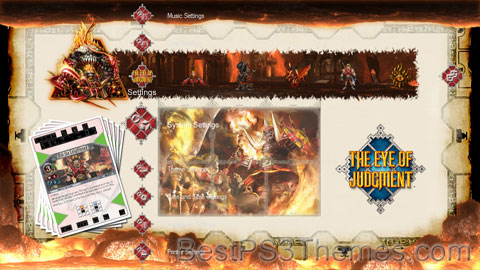
Eye of Judgement Fire Theme
(4 backgrounds)

P3T Unpacker v0.12
Copyright (c) 2007. Anoop Menon

This program unpacks Playstation 3 Theme files (.p3t) so that you can touch-up an existing theme to your likings or use a certain wallpaper from it (as many themes have multiple). But remember, if you use content from another theme and release it, be sure to give credit!

Download for Windows: p3textractor.zip

Instructions:

Download p3textractor.zip from above. Extract the files to a folder with a program such as WinZip or WinRAR. Now there are multiple ways to extract the theme.

The first way is to simply open the p3t file with p3textractor.exe. If you don’t know how to do this, right click the p3t file and select Open With. Alternatively, open the p3t file and it will ask you to select a program to open with. Click Browse and find p3textractor.exe from where you previously extracted it to. It will open CMD and extract the theme to extracted.[filename]. After that, all you need to do for any future p3t files is open them and it will extract.

The second way is very simple. Just drag the p3t file to p3textractor.exe. It will open CMD and extract the theme to extracted.[filename].

For the third way, first put the p3t file you want to extract into the same folder as p3textractor.exe. Open CMD and browse to the folder with p3extractor.exe. Enter the following:
p3textractor filename.p3t [destination path]Replace filename with the name of the p3t file, and replace [destination path] with the name of the folder you want the files to be extracted to. A destination path is not required. By default it will extract to extracted.filename.

Eye Of Judgment Wood

Eye Of Judgment (Judgement) Wood theme by Xehos

Download: EyeofJudgmentWood.p3t
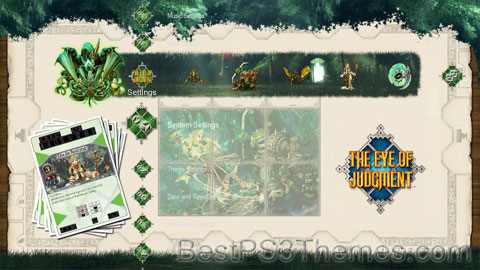
Eye Of Judgement Wood Theme
(4 backgrounds)

P3T Unpacker v0.12
Copyright (c) 2007. Anoop Menon

This program unpacks Playstation 3 Theme files (.p3t) so that you can touch-up an existing theme to your likings or use a certain wallpaper from it (as many themes have multiple). But remember, if you use content from another theme and release it, be sure to give credit!

Download for Windows: p3textractor.zip

Instructions:

Download p3textractor.zip from above. Extract the files to a folder with a program such as WinZip or WinRAR. Now there are multiple ways to extract the theme.

The first way is to simply open the p3t file with p3textractor.exe. If you don’t know how to do this, right click the p3t file and select Open With. Alternatively, open the p3t file and it will ask you to select a program to open with. Click Browse and find p3textractor.exe from where you previously extracted it to. It will open CMD and extract the theme to extracted.[filename]. After that, all you need to do for any future p3t files is open them and it will extract.

The second way is very simple. Just drag the p3t file to p3textractor.exe. It will open CMD and extract the theme to extracted.[filename].

For the third way, first put the p3t file you want to extract into the same folder as p3textractor.exe. Open CMD and browse to the folder with p3extractor.exe. Enter the following:
p3textractor filename.p3t [destination path]Replace filename with the name of the p3t file, and replace [destination path] with the name of the folder you want the files to be extracted to. A destination path is not required. By default it will extract to extracted.filename.

Soul Reaver versionD

Soul Reaver versionD theme by Deemy

Download: SoulReaver_versionD.p3t
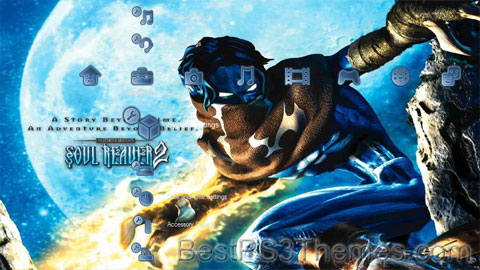
Soul Reaver versionD Theme
(6 backgrounds)

P3T Unpacker v0.12
Copyright (c) 2007. Anoop Menon

This program unpacks Playstation 3 Theme files (.p3t) so that you can touch-up an existing theme to your likings or use a certain wallpaper from it (as many themes have multiple). But remember, if you use content from another theme and release it, be sure to give credit!

Download for Windows: p3textractor.zip

Instructions:

Download p3textractor.zip from above. Extract the files to a folder with a program such as WinZip or WinRAR. Now there are multiple ways to extract the theme.

The first way is to simply open the p3t file with p3textractor.exe. If you don’t know how to do this, right click the p3t file and select Open With. Alternatively, open the p3t file and it will ask you to select a program to open with. Click Browse and find p3textractor.exe from where you previously extracted it to. It will open CMD and extract the theme to extracted.[filename]. After that, all you need to do for any future p3t files is open them and it will extract.

The second way is very simple. Just drag the p3t file to p3textractor.exe. It will open CMD and extract the theme to extracted.[filename].

For the third way, first put the p3t file you want to extract into the same folder as p3textractor.exe. Open CMD and browse to the folder with p3extractor.exe. Enter the following:
p3textractor filename.p3t [destination path]Replace filename with the name of the p3t file, and replace [destination path] with the name of the folder you want the files to be extracted to. A destination path is not required. By default it will extract to extracted.filename.

Final Fantasy XII #2

Final Fantasy XII theme by DominatorCGI

Download: FinalFantasyXII_2.p3t
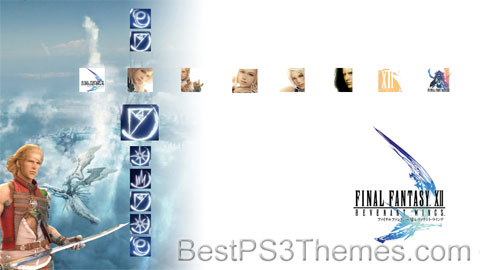
Final Fantasy XII Theme 2
(1 background)

Final Fantasy XII
An armor-clad man with a long cape holds two curved swords. He stands above the logo of Final Fantasy XII. The piece is done in a pastel watercolor style with a large vertical streak on the right side fading from peach to pink to blue.
Japanese and European box art for Final Fantasy XII, designed by Yoshitaka Amano
Developer(s)Square Enix
Publisher(s)Square Enix
Director(s)
Designer(s)Hiroyuki Ito
Programmer(s)Takashi Katano
Artist(s)
Writer(s)
Composer(s)
SeriesFinal Fantasy
Ivalice Alliance
Platform(s)
Release
March 16, 2006
    • PlayStation 2
      • JP: March 16, 2006
      • NA: October 31, 2006
      • AU: February 22, 2007
      • EU: February 23, 2007
      International Zodiac Job System
    • PlayStation 2
      • JP: August 9, 2007
      The Zodiac Age
    • PlayStation 4
      • WW: July 11, 2017
      • JP: July 13, 2017
      Windows
      • WW: February 2, 2018
      Switch, Xbox One
      • JP: April 25, 2019
      • WW: April 30, 2019
Genre(s)Role-playing
Mode(s)Single-player

Final Fantasy XII[a] is a role-playing video game developed and published by Square Enix. The twelfth main installment of the Final Fantasy series, it was first released for the PlayStation 2 in 2006. It introduced several innovations to the series: an open world; a seamless battle system; a controllable camera; a customizable "gambit" system, which lets the player control the artificial intelligence (AI) of characters in battle; a "license" system, which determines what abilities and equipment can be used by characters; and hunting side quests, which allows the player to find and defeat increasingly difficult monsters in the game's open world. Final Fantasy XII also includes elements from previous games in the series, such as Chocobos and Moogles.

The game takes place in Ivalice, where the empires of Archadia and Rozarria are waging an endless war. Dalmasca, a small kingdom, is caught between the warring nations. When Dalmasca is annexed by Archadia, its princess, Ashe, creates a resistance movement. During the struggle, she meets Vaan, a young adventurer who dreams of becoming a sky pirate in command of an airship. They are quickly joined by a band of allies; together, they rally against the tyranny of the Archadian Empire.

Final Fantasy XII was both a critical and commercial success, earning several Game of the Year awards and selling over six million copies on the PlayStation 2 by November 2009. In 2007, a sequel titled Final Fantasy XII: Revenant Wings was released for the Nintendo DS and, in that same year, an expanded version of Final Fantasy XII, titled Final Fantasy XII International Zodiac Job System, was released on the PlayStation 2 exclusively in Japan. A high-definition remaster of the International Zodiac Job System version, The Zodiac Age, was released worldwide for the PlayStation 4 in July 2017, for Windows in February 2018, and for the Nintendo Switch and Xbox One in April 2019.

Gameplay[edit]

Throughout the game, the player directly controls the on-screen character from a third-person perspective to interact with people, objects, and enemies. Unlike previous games in the series, the player can also control the camera with the right analog stick, allowing for a 360° view of the surroundings.[1] While in towns and cities, the player may only see from the perspective of Vaan, but any character may be controlled in the field. The world of Final Fantasy XII is rendered to scale relative to the characters in it; instead of a caricature of the character roaming around miniature terrain, as found in the earlier Final Fantasy games, every area is represented proportionally. The player navigates the overworld on foot, Chocobo, or by airship.[2] Players may save their game to a memory card using save crystals or gate crystals, and may use the latter to teleport between gate crystals.[3] An in-game bestiary provides incidental information about the world of Final Fantasy XII.[4]

Final Fantasy XII restructures the system of earning gil, the currency of the Final Fantasy games; instead of gil, most enemies drop "loot" which can be sold at shops.[5] This ties into a new battle mechanic which rewards the player with improved loot for slaying a particular type of enemy multiple times in a row.[6] Selling different types of loot also unlocks a bazaar option in shops, which provides items at a lower cost, or items exclusive to the bazaar.[5]

Battle system[edit]

A man wielding a sword and a woman wielding a spear fight two armored horse-like monsters.
In Active Dimension Battle (ADB), characters move freely and attack as soon as they are ready. Blue lines depict the player's targets and red lines depict those of the enemies.

Excluding the massively multiplayer online role-playing game Final Fantasy XI, Final Fantasy XII is the first entry in the main Final Fantasy series not to include random encounters.[7] Instead, enemies are visible in the overworld and the player may choose to fight or avoid them. Battles unfold in real time using the "Active Dimension Battle" (ADB) system. Battles begin when the party comes within range of an aggressive enemy, the party attacks an enemy, or a story event initiates a confrontation.[7] When a character or enemy begins an action, target lines connect characters to other party members or enemies; different colors represent the different types of action.[8] The player may swap to and issue commands to any of the three characters in the party, but guest characters are controlled by artificial intelligence (AI).[9] Battle commands are initiated through a series of menus, and include Attack, Magicks, Technicks, Mist, Gambits, and Items. The player may switch any active character with an inactive character at any time, unless the active character is targeted by an attack or ability. Characters who are knocked out may also be substituted.

A new feature in the game is the "gambit" system, which allows the player to program each character to perform certain commands in battle in response to specified conditions.[10] Using gambits, the player may set reactions to different stimuli for each character. Each gambit consists of three parts: a target, an action, and a priority. The target specifies which ally or foe to act on and the condition for applying the action. For example, the target "Ally: HP < 70%" causes the character to target any ally whose hit points have fallen below 70%. The action is the command to be performed on the target. The priority determines which gambit to perform when multiple gambits are triggered. These heuristics guide the characters when acting autonomously, though player-directed commands are always given top priority.[10]

In Final Fantasy XII, a mysterious phenomenon known as "Mist" is the key energy which allows characters to cast summoning magic and perform "Quickenings". After defeating an Esper in combat, the player will be able to summon it to the battlefield.[11] Similar to Final Fantasy X, the summoned creatures become active participants in battle,[11] as opposed to the cinematic attacks seen in previous games in the series. Unlike X, however, Espers follow hidden gambits, rather than the player's direct command.[11] The summoner remains an active member in the fight, able to attack and cast support magic, instead of leaving the party or standing idle while the summoned creature fights.[11] An Esper will leave the battle if either the summoner or itself is knocked out, its time limit expires, or it executes its special attack.[11] Some Espers have origins in Final Fantasy Tactics and Tactics Advance and others are derived from the final bosses of previous Final Fantasy games such as Chaos, the final boss of the first Final Fantasy, and Zeromus, the final boss of Final Fantasy IV.

Final Fantasy XII introduces "Quickenings", a new Limit Break system unique compared to those in previous games in the series.[12] Characters learn Quickenings by progressing to specific panels on the License Board.[12] Each character can learn three Quickenings, which are unique to that character.[12] Characters may string together Quickenings into large combo attacks, called Mist Chains, via timed button presses.[12] If a Mist Chain reaches a certain length, a final strike will be initiated at the end of the Quickening cycle, called a Concurrence.[12]

The License Board; raised panel icons indicate acquired licenses.

Growth system[edit]

As in many role-playing games (RPGs), characters "level up" each time they earn a set number of experience points from defeating enemies; each level gained increases the character's statistics and improves performance in battle.[13] Statistics include hit points, the amount of damage a character can receive; strength, the power of the character's physical attacks; and magic, the potency of the character's magical spells.[13]

In addition to leveling up, players may improve their characters via the License Board. The License Board is an array of panels that contain "licenses" which allow a character to perform certain actions.[14] The board is split into two parts; the upper part comprises Magick, Technick, Accessory, and Augment (stat increases and other permanent buffs) licenses, and the bottom part comprises mostly Weapon and Armor licenses.[15] To use a Magick, Technick, or piece of equipment, the character must obtain its corresponding license by spending the required amount of LP (License Points).[14] LP are earned in battle along with the experience points. Like the Sphere Grid in Final Fantasy X, all characters may obtain all licenses on the board, but each Quickening and Esper license may only be activated by a single character.[16]

Plot[edit]

Setting[edit]

Final Fantasy XII is set within the land of Ivalice during an age when "magic was commonplace" and "airships plied the skies, crowding out the heavens". At this time, magicite, a magic-rich mineral, is commonly used in magic spells[17] and in powering airships—a popular form of transportation in Ivalice.[18] Ivalice is divided into three continents:[19] Ordalia, Valendia, and Kerwon.[1] Ordalia is located in the western part of Ivalice. The Rozarrian Empire makes its home in the vast inland plains of this continent as the eastern portion of it is largely desert and "jagd"—lawless regions so rich in Mist, the ethereal manifestation of magicite, that airships cannot function.[20] Valendia is the home of Imperial Archadia, where lush highlands dot the landscape.[21] Central to the story is Dalmasca, a small kingdom between the two continents and empires. Located in the middle of the Galtean Peninsula of Ordalia, Dalmasca is surrounded by an expanse of desert. The temperate climate of Dalmasca differs from the cold environs of Kerwon to the south and the lush plains of Valendia and Ordalia.[22] During this time, Ivalice is beset by the pending war between the forces of Rozarria and Archadia. Caught between the two powerful Empires, Dalmasca and a number of smaller nations have already been subjugated by Archadia two years before the game begins.

Characters[edit]

The six main playable characters in Final Fantasy XII are Vaan (Bobby Edner/Kouhei Takeda), an energetic orphan of Rabanastre who dreams of becoming a sky pirate; Ashe (Kari Wahlgren/Mie Sonozaki), a determined princess of Dalmasca who lost her father and her husband in the Archadian invasion; Basch (Keith Ferguson/Rikiya Koyama), a disgraced knight of Dalmasca charged with treason for slaying the king; Balthier (Gideon Emery/Hiroaki Hirata), a gentlemanly sky pirate who pilots his airship, the Strahl; Fran (Nicole Fantl/Rika Fukami), Balthier's partner and a Viera exile whose knowledge extends to legends and myths; and Penelo (Catherine Taber/Marina Kozawa), Vaan's childhood friend who accompanies him on journeys to "keep an eye on him".[23]

The Archadian Empire is ruled by House Solidor, headed by Emperor Gramis (Roger L. Jackson/Hidekatsu Shibata).[24] The emperor's sons are Vayne (Elijah Alexander/Nobuo Tobita) and Larsa (Johnny McKeown/Yuka Imai), the former a military genius and the game's main antagonist, and the latter a charismatic seeker of peace. Judge Magisters, upholders of Archadian law,[24] protect House Solidor and execute every command issued by the ruling family. The technological marvels of airships and synthetic nethicite—a form of magicite that absorbs Mist—are thanks to Doctor Cid (John Rafter Lee/Chikao Ōtsuka), a prominent researcher from Archadia.[24] The Resistance against Archadia includes Dalmascan knight Vossler (Nolan North/Masaki Terasoma), an ally of Basch; Marquis Halim Ondore IV (Tom Kane/Akio Nojima), the game's narrator and ruler of the skycity Bhujerba; Reddas (Phil LaMarr/Takayuki Sugo), a sky pirate based in the port at Balfonheim; and the Rozarrian Empire, of which Al-Cid Margrace (David Rasner/Norio Wakamoto) is a prince of the ruling family.[24] The mythos of Final Fantasy XII revolves around a character known as Dynast-King Raithwall, a man who once united Ivalice to create the Galtean Alliance in ages past.

Story[edit]

In Dalmasca's capital city of Rabanastre, Princess Ashelia (Ashe) of Dalmasca and Prince Rasler of Nabradia have just wed, as the Archadian Empire invades the two countries. Rasler is killed in the war, the city of Nabudis is destroyed in a single explosion, and the Dalmascan King Raminas is assassinated moments after signing a treaty of surrender. Marquis Ondore announces that the assassin was Dalmascan captain Basch, who has been sentenced to death, and that Princess Ashe has committed suicide.[25]

Two years later, Vaan, a Rabanastre street urchin, ignores his friend Penelo's objections and infiltrates the palace during a dinner celebrating the appointment of Archadian prince Vayne Solidor as consul. In the treasury he finds a piece of magicite, a powerful magical crystal. He is discovered by Balthier and Fran, a pair of sky pirates looking for the magicite. The three escape as Dalmascan Resistance forces assault the palace, and in the sewers they meet the Resistance leader, Amalia, before being captured by Archadian forces. In the dungeons they meet Basch, who was imprisoned but not killed, and who states his twin brother Gabranth was the one to kill the king. The four then escape together back to Rabanastre. There they discover Penelo has been kidnapped and taken to the floating city of Bhujerba.

In Bhujerba, they meet Lamont, a curious boy who is Vayne's younger brother, Larsa, in disguise.[26] After they rescue Penelo, Basch confronts the Marquis over his lies, but the party is captured and detained aboard the Archadian airship Leviathan, headed by Judge Ghis. On the Leviathan, the party is reunited with Amalia, who is revealed to be Princess Ashe.[27] Ghis takes the magicite, which is revealed to be a royal Dalmascan artifact, "deifacted nethicite". The party escapes, but as Ashe had planned to use the magicite as proof that she was the princess,[28] the group journeys to collect another of the pieces of nethicite, the Dawn Shard.[29] They are again captured by Ghis; when he tries to use the Dawn Shard in the Leviathan rather than the "manufacted" (artificially made) magicite it normally uses, his entire airship fleet is destroyed in a mirror of the destruction of Nabudis, and the party flees again.

They encounter Larsa, who seeks a peace treaty between Dalmasca and the empire. The group and Larsa go to Mt. Bur-Omisace to seek the Gran Kiltias Anastasis, Ivalice's religious leader, and beg his approval of Ashe as queen of Dalmasca.[30] There they also meet Al-Cid Margrace, who is in talks with Larsa to avert a war between Rozarria and Archadia.[31][32] Their plans are curtailed when Anastasis is killed by Archadia, and soon afterwards the Archadian emperor Gramis dies and Vayne ascends the throne.[33]

The party journeys to Archadia, where they discover Doctor Cid, the creator of manufacted magicite, who directs them to go to Giruvegan to find the source of nethicite.[34][35] In Giruvegan, Ashe encounters the makers of nethicite, the immortal Occuria, who "pull the strings of history"; they give her the Treaty Blade to cut new pieces from the Sun-cryst, the source of all nethicite and its power.[36] She learns that Venat, one of the Occuria, has defected to put the "reins of History back in the hands of Man", manipulating Vayne in his quest to conquer Ivalice and leading Cid to create manufacted magicite to reduce the relative power of the Occuria.[37][38]

Ashe and the party journey to the Sun-cryst, where she decides not to take her revenge by following the Occuria's wishes, but instead destroy the Sun-cryst.[39] The party defeats Gabranth, who reveals that he killed King Raminas, and destroys the crystal.[40] Al-Cid tells them that the Dalmascan Resistance, led by Ondore, is about to fight Archadia in Rabanastre, but the Archadian forces now include the Sky Fortress Bahamut. They infiltrate the Bahamut, and find Larsa failing to dissuade his brother Vayne from his plans for war.[41] They defeat Vayne and Venat, and Ashe and Larsa announce the end of the conflict to the battlefield.[42] Larsa becomes the Archadian emperor and Ashe the Queen of Dalmasca; Basch replaces his brother Gabranth as Larsa's protector; Vaan and Penelo fly an airship to meet Balthier and Fran for another adventure.[43]

Development[edit]

Akitoshi Kawazu (left) and Hiroshi Minagawa at the Final Fantasy XII London HMV Launch Party in 2007

Development for Final Fantasy XII began in December 2000 and was headed by Final Fantasy Tactics director Yasumi Matsuno and Final Fantasy IX director Hiroyuki Ito.[44][45][46] Matsuno provided the original concept and plot but was forced to bow out a year before release due to health concerns.[47] The team was restructured as a consequence: the new directorial duo consisted of Ito and Hiroshi Minagawa, while Akitoshi Kawazu of SaGa series fame became the game's executive producer.[48][49] Series creator Hironobu Sakaguchi was disappointed by Matsuno's departure and declined to play the game beyond its introduction.[50]

The desire to move away from random encounters was present since the beginning of development.[51] This desire fueled the development of the Active Dimension Battle system so players could seamlessly move from battle to exploration. The gambit system was conceived early on as a way to facilitate this change.[51] Battle system designer Hiroshi Tomomatsu said that it gradually moved away from a complex and rigid formula to the more flexible form seen in the final version of the game.[52] Ito drew inspiration for gambits from plays in American football where each team member has a specific job to do based on the conditions and desired outcome. As for the license system, he explained that needing "licenses" to perform certain actions was a natural extension of the rigid structured society of Archadia, as epitomized by its Judges.[51]

At the early stages of development, Minagawa revealed that numerous ideas and features were planned for the game, but were dropped from the final stages due to certain constraints and hardware limitations. Some of these included the ability for a second player to join in the gameplay, enabling a two-player mode. Another idea that was given a considerable amount of thought was the ability to recruit non-player characters to join in the mob hunts. Due to the technical limitations of the console and multiple number of characters joining the fray, the development phase took longer than expected, causing delays.[53]

Design inspiration came from a mix of medieval Mediterranean countries as demonstrated by the architectural styles found throughout Ivalice along with many of the races populating the region.[54] The art team, led by art directors Hideo Minaba and Isamu Kamikokuryō, visited Turkey, which influenced the game's Mediterranean-style setting.[55] The developers also used styles and deco from other sources including areas in India and New York City.[55][56] Of note is the use of Sanskrit in the city of Bhujerba. Phrases such as "svagatam" (welcome) and titles like "parijanah" (guide) are lifted directly from Sanskrit. Minaba mentions that the team tried to bring out Arabic culture in the design of the game.[57] War is a prominent theme of the game and the developers stated that the cutscene battles are influenced by Ancient Rome.[56] When asked to comment on the fan observation of Star Wars similarities, Minaba replied that although he was a fan of the series, it was not necessarily an influence to the game's designs.[55] It has also been noted that the similarities originate from The Hidden Fortress, the 1958 Akira Kurosawa film that inspired Star Wars.[58][59]

The developers initially planned to return to the "big-headed" character designs of previous Final Fantasy games, but settled on similar proportions as characters in Vagrant Story, the team's previous game, as development progressed.[60] Basch was the first character designed and the developers considered him the "hero" of the story at the time. Vaan and Penelo were added last and became the heroes in the final version of the plot.[60] The developers were motivated by the commercial failure of Vagrant Story, which featured a "strong man in his prime" as the protagonist, and switched the focus to a younger protagonist as a result.[60][61] Vaan's early designs were described as effeminate, but with the casting of Kouhei Takeda as his voice and motion capture actor, Vaan became less feminine and more "active, upbeat, bright and positive".[62] Comments were made about the similarity between character designer Akihiko Yoshida's creations and those of Tetsuya Nomura, another Square Enix character designer. Yoshida felt this comparison was sparked by the choice of color used by both artists, which was based on maintaining consistent color between the characters and the environments.[62] Non-human characters and races play a prominent role in the game,[57] which was influenced by an interest in history among the developers.[55]

Miwa Shoda wrote a storyline for the game premised on the basis of the cutscenes and world setting that had already been finished when she joined the team. Scenario writer Daisuke Watanabe in turn fleshed out Shoda's plot into a script.[63] During the English localization process, Alexander O. Smith, who had previously worked on Vagrant Story and Final Fantasy X, acted as producer and translator.[64] While still preserving the meaning behind the Japanese script, Smith made the decision to use different dialects of English to reproduce the regional differences in pronunciation found in the Japanese version.[65][66] He also tried to distance the game from the "flat reads" found in other dubbed work by casting voice actors who had experience in theatre work.[66] In terms of general changes, the localization team introduced widescreen 16:9 ratio support and reinserted scenes that were left out of the original Japanese version for political reasons and to preserve an "All Ages" CERO rating.[67][68]

A playable demo of the game was shipped with the North American release of Dragon Quest VIII in November 2005.[69] To commemorate the release of Final Fantasy XII, playable demos of the English version were available at DigitalLife's Gaming Pavilion in New York City on October 11, 2006, a day dubbed "Final Fantasy XII Gamer's Day".[70] Additionally, Square Enix gave fans the chance to cosplay as characters from XII. Each person was asked to show Square Enix three photos of his or her costume for a chance to win a trip to New York and participate in the Final Fantasy XII Gamer's Day event.[71]

Final Fantasy XII once held the Guinness World Record for longest development period in a video game production, with a total of five years, spanning from 2001 until its release in 2006.[72] At a Final Fantasy XII "postmortem" at MIT in March 2009, Hiroshi Minagawa mentioned that several years of production were devoted to the creation of

Final Fantasy XII

Final Fantasy XII theme by DominatorCGI

Download: FinalFantasyXII.p3t
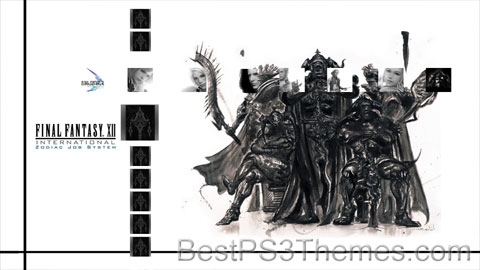
Final Fantasy XII Theme
(1 background)

Final Fantasy XII
An armor-clad man with a long cape holds two curved swords. He stands above the logo of Final Fantasy XII. The piece is done in a pastel watercolor style with a large vertical streak on the right side fading from peach to pink to blue.
Japanese and European box art for Final Fantasy XII, designed by Yoshitaka Amano
Developer(s)Square Enix
Publisher(s)Square Enix
Director(s)
Designer(s)Hiroyuki Ito
Programmer(s)Takashi Katano
Artist(s)
Writer(s)
Composer(s)
SeriesFinal Fantasy
Ivalice Alliance
Platform(s)
Release
March 16, 2006
    • PlayStation 2
      • JP: March 16, 2006
      • NA: October 31, 2006
      • AU: February 22, 2007
      • EU: February 23, 2007
      International Zodiac Job System
    • PlayStation 2
      • JP: August 9, 2007
      The Zodiac Age
    • PlayStation 4
      • WW: July 11, 2017
      • JP: July 13, 2017
      Windows
      • WW: February 2, 2018
      Switch, Xbox One
      • JP: April 25, 2019
      • WW: April 30, 2019
Genre(s)Role-playing
Mode(s)Single-player

Final Fantasy XII[a] is a role-playing video game developed and published by Square Enix. The twelfth main installment of the Final Fantasy series, it was first released for the PlayStation 2 in 2006. It introduced several innovations to the series: an open world; a seamless battle system; a controllable camera; a customizable "gambit" system, which lets the player control the artificial intelligence (AI) of characters in battle; a "license" system, which determines what abilities and equipment can be used by characters; and hunting side quests, which allows the player to find and defeat increasingly difficult monsters in the game's open world. Final Fantasy XII also includes elements from previous games in the series, such as Chocobos and Moogles.

The game takes place in Ivalice, where the empires of Archadia and Rozarria are waging an endless war. Dalmasca, a small kingdom, is caught between the warring nations. When Dalmasca is annexed by Archadia, its princess, Ashe, creates a resistance movement. During the struggle, she meets Vaan, a young adventurer who dreams of becoming a sky pirate in command of an airship. They are quickly joined by a band of allies; together, they rally against the tyranny of the Archadian Empire.

Final Fantasy XII was both a critical and commercial success, earning several Game of the Year awards and selling over six million copies on the PlayStation 2 by November 2009. In 2007, a sequel titled Final Fantasy XII: Revenant Wings was released for the Nintendo DS and, in that same year, an expanded version of Final Fantasy XII, titled Final Fantasy XII International Zodiac Job System, was released on the PlayStation 2 exclusively in Japan. A high-definition remaster of the International Zodiac Job System version, The Zodiac Age, was released worldwide for the PlayStation 4 in July 2017, for Windows in February 2018, and for the Nintendo Switch and Xbox One in April 2019.

Gameplay[edit]

Throughout the game, the player directly controls the on-screen character from a third-person perspective to interact with people, objects, and enemies. Unlike previous games in the series, the player can also control the camera with the right analog stick, allowing for a 360° view of the surroundings.[1] While in towns and cities, the player may only see from the perspective of Vaan, but any character may be controlled in the field. The world of Final Fantasy XII is rendered to scale relative to the characters in it; instead of a caricature of the character roaming around miniature terrain, as found in the earlier Final Fantasy games, every area is represented proportionally. The player navigates the overworld on foot, Chocobo, or by airship.[2] Players may save their game to a memory card using save crystals or gate crystals, and may use the latter to teleport between gate crystals.[3] An in-game bestiary provides incidental information about the world of Final Fantasy XII.[4]

Final Fantasy XII restructures the system of earning gil, the currency of the Final Fantasy games; instead of gil, most enemies drop "loot" which can be sold at shops.[5] This ties into a new battle mechanic which rewards the player with improved loot for slaying a particular type of enemy multiple times in a row.[6] Selling different types of loot also unlocks a bazaar option in shops, which provides items at a lower cost, or items exclusive to the bazaar.[5]

Battle system[edit]

A man wielding a sword and a woman wielding a spear fight two armored horse-like monsters.
In Active Dimension Battle (ADB), characters move freely and attack as soon as they are ready. Blue lines depict the player's targets and red lines depict those of the enemies.

Excluding the massively multiplayer online role-playing game Final Fantasy XI, Final Fantasy XII is the first entry in the main Final Fantasy series not to include random encounters.[7] Instead, enemies are visible in the overworld and the player may choose to fight or avoid them. Battles unfold in real time using the "Active Dimension Battle" (ADB) system. Battles begin when the party comes within range of an aggressive enemy, the party attacks an enemy, or a story event initiates a confrontation.[7] When a character or enemy begins an action, target lines connect characters to other party members or enemies; different colors represent the different types of action.[8] The player may swap to and issue commands to any of the three characters in the party, but guest characters are controlled by artificial intelligence (AI).[9] Battle commands are initiated through a series of menus, and include Attack, Magicks, Technicks, Mist, Gambits, and Items. The player may switch any active character with an inactive character at any time, unless the active character is targeted by an attack or ability. Characters who are knocked out may also be substituted.

A new feature in the game is the "gambit" system, which allows the player to program each character to perform certain commands in battle in response to specified conditions.[10] Using gambits, the player may set reactions to different stimuli for each character. Each gambit consists of three parts: a target, an action, and a priority. The target specifies which ally or foe to act on and the condition for applying the action. For example, the target "Ally: HP < 70%" causes the character to target any ally whose hit points have fallen below 70%. The action is the command to be performed on the target. The priority determines which gambit to perform when multiple gambits are triggered. These heuristics guide the characters when acting autonomously, though player-directed commands are always given top priority.[10]

In Final Fantasy XII, a mysterious phenomenon known as "Mist" is the key energy which allows characters to cast summoning magic and perform "Quickenings". After defeating an Esper in combat, the player will be able to summon it to the battlefield.[11] Similar to Final Fantasy X, the summoned creatures become active participants in battle,[11] as opposed to the cinematic attacks seen in previous games in the series. Unlike X, however, Espers follow hidden gambits, rather than the player's direct command.[11] The summoner remains an active member in the fight, able to attack and cast support magic, instead of leaving the party or standing idle while the summoned creature fights.[11] An Esper will leave the battle if either the summoner or itself is knocked out, its time limit expires, or it executes its special attack.[11] Some Espers have origins in Final Fantasy Tactics and Tactics Advance and others are derived from the final bosses of previous Final Fantasy games such as Chaos, the final boss of the first Final Fantasy, and Zeromus, the final boss of Final Fantasy IV.

Final Fantasy XII introduces "Quickenings", a new Limit Break system unique compared to those in previous games in the series.[12] Characters learn Quickenings by progressing to specific panels on the License Board.[12] Each character can learn three Quickenings, which are unique to that character.[12] Characters may string together Quickenings into large combo attacks, called Mist Chains, via timed button presses.[12] If a Mist Chain reaches a certain length, a final strike will be initiated at the end of the Quickening cycle, called a Concurrence.[12]

The License Board; raised panel icons indicate acquired licenses.

Growth system[edit]

As in many role-playing games (RPGs), characters "level up" each time they earn a set number of experience points from defeating enemies; each level gained increases the character's statistics and improves performance in battle.[13] Statistics include hit points, the amount of damage a character can receive; strength, the power of the character's physical attacks; and magic, the potency of the character's magical spells.[13]

In addition to leveling up, players may improve their characters via the License Board. The License Board is an array of panels that contain "licenses" which allow a character to perform certain actions.[14] The board is split into two parts; the upper part comprises Magick, Technick, Accessory, and Augment (stat increases and other permanent buffs) licenses, and the bottom part comprises mostly Weapon and Armor licenses.[15] To use a Magick, Technick, or piece of equipment, the character must obtain its corresponding license by spending the required amount of LP (License Points).[14] LP are earned in battle along with the experience points. Like the Sphere Grid in Final Fantasy X, all characters may obtain all licenses on the board, but each Quickening and Esper license may only be activated by a single character.[16]

Plot[edit]

Setting[edit]

Final Fantasy XII is set within the land of Ivalice during an age when "magic was commonplace" and "airships plied the skies, crowding out the heavens". At this time, magicite, a magic-rich mineral, is commonly used in magic spells[17] and in powering airships—a popular form of transportation in Ivalice.[18] Ivalice is divided into three continents:[19] Ordalia, Valendia, and Kerwon.[1] Ordalia is located in the western part of Ivalice. The Rozarrian Empire makes its home in the vast inland plains of this continent as the eastern portion of it is largely desert and "jagd"—lawless regions so rich in Mist, the ethereal manifestation of magicite, that airships cannot function.[20] Valendia is the home of Imperial Archadia, where lush highlands dot the landscape.[21] Central to the story is Dalmasca, a small kingdom between the two continents and empires. Located in the middle of the Galtean Peninsula of Ordalia, Dalmasca is surrounded by an expanse of desert. The temperate climate of Dalmasca differs from the cold environs of Kerwon to the south and the lush plains of Valendia and Ordalia.[22] During this time, Ivalice is beset by the pending war between the forces of Rozarria and Archadia. Caught between the two powerful Empires, Dalmasca and a number of smaller nations have already been subjugated by Archadia two years before the game begins.

Characters[edit]

The six main playable characters in Final Fantasy XII are Vaan (Bobby Edner/Kouhei Takeda), an energetic orphan of Rabanastre who dreams of becoming a sky pirate; Ashe (Kari Wahlgren/Mie Sonozaki), a determined princess of Dalmasca who lost her father and her husband in the Archadian invasion; Basch (Keith Ferguson/Rikiya Koyama), a disgraced knight of Dalmasca charged with treason for slaying the king; Balthier (Gideon Emery/Hiroaki Hirata), a gentlemanly sky pirate who pilots his airship, the Strahl; Fran (Nicole Fantl/Rika Fukami), Balthier's partner and a Viera exile whose knowledge extends to legends and myths; and Penelo (Catherine Taber/Marina Kozawa), Vaan's childhood friend who accompanies him on journeys to "keep an eye on him".[23]

The Archadian Empire is ruled by House Solidor, headed by Emperor Gramis (Roger L. Jackson/Hidekatsu Shibata).[24] The emperor's sons are Vayne (Elijah Alexander/Nobuo Tobita) and Larsa (Johnny McKeown/Yuka Imai), the former a military genius and the game's main antagonist, and the latter a charismatic seeker of peace. Judge Magisters, upholders of Archadian law,[24] protect House Solidor and execute every command issued by the ruling family. The technological marvels of airships and synthetic nethicite—a form of magicite that absorbs Mist—are thanks to Doctor Cid (John Rafter Lee/Chikao Ōtsuka), a prominent researcher from Archadia.[24] The Resistance against Archadia includes Dalmascan knight Vossler (Nolan North/Masaki Terasoma), an ally of Basch; Marquis Halim Ondore IV (Tom Kane/Akio Nojima), the game's narrator and ruler of the skycity Bhujerba; Reddas (Phil LaMarr/Takayuki Sugo), a sky pirate based in the port at Balfonheim; and the Rozarrian Empire, of which Al-Cid Margrace (David Rasner/Norio Wakamoto) is a prince of the ruling family.[24] The mythos of Final Fantasy XII revolves around a character known as Dynast-King Raithwall, a man who once united Ivalice to create the Galtean Alliance in ages past.

Story[edit]

In Dalmasca's capital city of Rabanastre, Princess Ashelia (Ashe) of Dalmasca and Prince Rasler of Nabradia have just wed, as the Archadian Empire invades the two countries. Rasler is killed in the war, the city of Nabudis is destroyed in a single explosion, and the Dalmascan King Raminas is assassinated moments after signing a treaty of surrender. Marquis Ondore announces that the assassin was Dalmascan captain Basch, who has been sentenced to death, and that Princess Ashe has committed suicide.[25]

Two years later, Vaan, a Rabanastre street urchin, ignores his friend Penelo's objections and infiltrates the palace during a dinner celebrating the appointment of Archadian prince Vayne Solidor as consul. In the treasury he finds a piece of magicite, a powerful magical crystal. He is discovered by Balthier and Fran, a pair of sky pirates looking for the magicite. The three escape as Dalmascan Resistance forces assault the palace, and in the sewers they meet the Resistance leader, Amalia, before being captured by Archadian forces. In the dungeons they meet Basch, who was imprisoned but not killed, and who states his twin brother Gabranth was the one to kill the king. The four then escape together back to Rabanastre. There they discover Penelo has been kidnapped and taken to the floating city of Bhujerba.

In Bhujerba, they meet Lamont, a curious boy who is Vayne's younger brother, Larsa, in disguise.[26] After they rescue Penelo, Basch confronts the Marquis over his lies, but the party is captured and detained aboard the Archadian airship Leviathan, headed by Judge Ghis. On the Leviathan, the party is reunited with Amalia, who is revealed to be Princess Ashe.[27] Ghis takes the magicite, which is revealed to be a royal Dalmascan artifact, "deifacted nethicite". The party escapes, but as Ashe had planned to use the magicite as proof that she was the princess,[28] the group journeys to collect another of the pieces of nethicite, the Dawn Shard.[29] They are again captured by Ghis; when he tries to use the Dawn Shard in the Leviathan rather than the "manufacted" (artificially made) magicite it normally uses, his entire airship fleet is destroyed in a mirror of the destruction of Nabudis, and the party flees again.

They encounter Larsa, who seeks a peace treaty between Dalmasca and the empire. The group and Larsa go to Mt. Bur-Omisace to seek the Gran Kiltias Anastasis, Ivalice's religious leader, and beg his approval of Ashe as queen of Dalmasca.[30] There they also meet Al-Cid Margrace, who is in talks with Larsa to avert a war between Rozarria and Archadia.[31][32] Their plans are curtailed when Anastasis is killed by Archadia, and soon afterwards the Archadian emperor Gramis dies and Vayne ascends the throne.[33]

The party journeys to Archadia, where they discover Doctor Cid, the creator of manufacted magicite, who directs them to go to Giruvegan to find the source of nethicite.[34][35] In Giruvegan, Ashe encounters the makers of nethicite, the immortal Occuria, who "pull the strings of history"; they give her the Treaty Blade to cut new pieces from the Sun-cryst, the source of all nethicite and its power.[36] She learns that Venat, one of the Occuria, has defected to put the "reins of History back in the hands of Man", manipulating Vayne in his quest to conquer Ivalice and leading Cid to create manufacted magicite to reduce the relative power of the Occuria.[37][38]

Ashe and the party journey to the Sun-cryst, where she decides not to take her revenge by following the Occuria's wishes, but instead destroy the Sun-cryst.[39] The party defeats Gabranth, who reveals that he killed King Raminas, and destroys the crystal.[40] Al-Cid tells them that the Dalmascan Resistance, led by Ondore, is about to fight Archadia in Rabanastre, but the Archadian forces now include the Sky Fortress Bahamut. They infiltrate the Bahamut, and find Larsa failing to dissuade his brother Vayne from his plans for war.[41] They defeat Vayne and Venat, and Ashe and Larsa announce the end of the conflict to the battlefield.[42] Larsa becomes the Archadian emperor and Ashe the Queen of Dalmasca; Basch replaces his brother Gabranth as Larsa's protector; Vaan and Penelo fly an airship to meet Balthier and Fran for another adventure.[43]

Development[edit]

Akitoshi Kawazu (left) and Hiroshi Minagawa at the Final Fantasy XII London HMV Launch Party in 2007

Development for Final Fantasy XII began in December 2000 and was headed by Final Fantasy Tactics director Yasumi Matsuno and Final Fantasy IX director Hiroyuki Ito.[44][45][46] Matsuno provided the original concept and plot but was forced to bow out a year before release due to health concerns.[47] The team was restructured as a consequence: the new directorial duo consisted of Ito and Hiroshi Minagawa, while Akitoshi Kawazu of SaGa series fame became the game's executive producer.[48][49] Series creator Hironobu Sakaguchi was disappointed by Matsuno's departure and declined to play the game beyond its introduction.[50]

The desire to move away from random encounters was present since the beginning of development.[51] This desire fueled the development of the Active Dimension Battle system so players could seamlessly move from battle to exploration. The gambit system was conceived early on as a way to facilitate this change.[51] Battle system designer Hiroshi Tomomatsu said that it gradually moved away from a complex and rigid formula to the more flexible form seen in the final version of the game.[52] Ito drew inspiration for gambits from plays in American football where each team member has a specific job to do based on the conditions and desired outcome. As for the license system, he explained that needing "licenses" to perform certain actions was a natural extension of the rigid structured society of Archadia, as epitomized by its Judges.[51]

At the early stages of development, Minagawa revealed that numerous ideas and features were planned for the game, but were dropped from the final stages due to certain constraints and hardware limitations. Some of these included the ability for a second player to join in the gameplay, enabling a two-player mode. Another idea that was given a considerable amount of thought was the ability to recruit non-player characters to join in the mob hunts. Due to the technical limitations of the console and multiple number of characters joining the fray, the development phase took longer than expected, causing delays.[53]

Design inspiration came from a mix of medieval Mediterranean countries as demonstrated by the architectural styles found throughout Ivalice along with many of the races populating the region.[54] The art team, led by art directors Hideo Minaba and Isamu Kamikokuryō, visited Turkey, which influenced the game's Mediterranean-style setting.[55] The developers also used styles and deco from other sources including areas in India and New York City.[55][56] Of note is the use of Sanskrit in the city of Bhujerba. Phrases such as "svagatam" (welcome) and titles like "parijanah" (guide) are lifted directly from Sanskrit. Minaba mentions that the team tried to bring out Arabic culture in the design of the game.[57] War is a prominent theme of the game and the developers stated that the cutscene battles are influenced by Ancient Rome.[56] When asked to comment on the fan observation of Star Wars similarities, Minaba replied that although he was a fan of the series, it was not necessarily an influence to the game's designs.[55] It has also been noted that the similarities originate from The Hidden Fortress, the 1958 Akira Kurosawa film that inspired Star Wars.[58][59]

The developers initially planned to return to the "big-headed" character designs of previous Final Fantasy games, but settled on similar proportions as characters in Vagrant Story, the team's previous game, as development progressed.[60] Basch was the first character designed and the developers considered him the "hero" of the story at the time. Vaan and Penelo were added last and became the heroes in the final version of the plot.[60] The developers were motivated by the commercial failure of Vagrant Story, which featured a "strong man in his prime" as the protagonist, and switched the focus to a younger protagonist as a result.[60][61] Vaan's early designs were described as effeminate, but with the casting of Kouhei Takeda as his voice and motion capture actor, Vaan became less feminine and more "active, upbeat, bright and positive".[62] Comments were made about the similarity between character designer Akihiko Yoshida's creations and those of Tetsuya Nomura, another Square Enix character designer. Yoshida felt this comparison was sparked by the choice of color used by both artists, which was based on maintaining consistent color between the characters and the environments.[62] Non-human characters and races play a prominent role in the game,[57] which was influenced by an interest in history among the developers.[55]

Miwa Shoda wrote a storyline for the game premised on the basis of the cutscenes and world setting that had already been finished when she joined the team. Scenario writer Daisuke Watanabe in turn fleshed out Shoda's plot into a script.[63] During the English localization process, Alexander O. Smith, who had previously worked on Vagrant Story and Final Fantasy X, acted as producer and translator.[64] While still preserving the meaning behind the Japanese script, Smith made the decision to use different dialects of English to reproduce the regional differences in pronunciation found in the Japanese version.[65][66] He also tried to distance the game from the "flat reads" found in other dubbed work by casting voice actors who had experience in theatre work.[66] In terms of general changes, the localization team introduced widescreen 16:9 ratio support and reinserted scenes that were left out of the original Japanese version for political reasons and to preserve an "All Ages" CERO rating.[67][68]

A playable demo of the game was shipped with the North American release of Dragon Quest VIII in November 2005.[69] To commemorate the release of Final Fantasy XII, playable demos of the English version were available at DigitalLife's Gaming Pavilion in New York City on October 11, 2006, a day dubbed "Final Fantasy XII Gamer's Day".[70] Additionally, Square Enix gave fans the chance to cosplay as characters from XII. Each person was asked to show Square Enix three photos of his or her costume for a chance to win a trip to New York and participate in the Final Fantasy XII Gamer's Day event.[71]

Final Fantasy XII once held the Guinness World Record for longest development period in a video game production, with a total of five years, spanning from 2001 until its release in 2006.[72] At a Final Fantasy XII "postmortem" at MIT in March 2009, Hiroshi Minagawa mentioned that several years of production were devoted to the creation of

Medal of Honor #2

Medal of Honor theme by DominatorCGI

Download: MedalofHonor_2.p3t
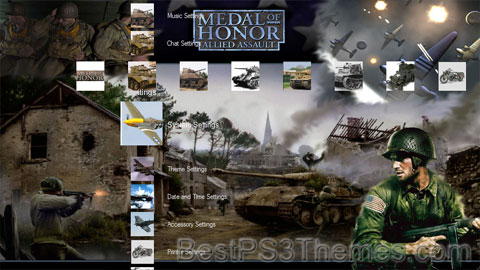
Medal of Honor Theme 2
(1 background)

Medal of Honor
Medals of Honor of three of the six military departments
TypeMilitary medal with neck ribbon
(decoration)
Awarded forConspicuous gallantry and intrepidity at the risk of life above and beyond the call of duty[1][2][a]
Presented byThe president of the United States in the name of the United States Congress[3]
EligibilityUnited States Armed Forces service members
StatusCurrently awarded
EstablishedNaval Service and Marine Corps: December 21, 1861[4]
Army: July 12, 1862[5]
Air Force: August 10, 1956[6]
Coast Guard: July 25, 1963[7]
Space Force: January 1, 2021[8]
First awardedMarch 25, 1863[b]
Last awardedSeptember 5, 2023[9]
Total awarded posthumously618[10]
Total recipients3,536[11]


Precedence
Next (lower)Army: Distinguished Service Cross
Naval Service: Navy Cross
Air and Space Forces: Air Force Cross
Coast Guard: Coast Guard Cross

The Medal of Honor (MOH) is the United States Armed Forces' highest military decoration and is awarded to recognize American soldiers, sailors, marines, airmen, guardians, and coast guardsmen who have distinguished themselves by acts of valor.[1][12] The medal is normally awarded by the President of the United States (the commander in chief of the armed forces) and is presented "in the name of the United States Congress." It is often, not strictly correctly, referred to as the Congressional Medal of Honor.[13][14]

There are three distinct variants of the medal: one for the Army, awarded to soldiers; one for the Naval Service, awarded to sailors, marines, and coast guardsmen; and one for the Air and Space Forces, awarded to airmen and guardians.[1][15] The Medal of Honor was introduced for the Naval Service in 1861,[16] soon followed by the Army's version in 1862.[17] The Air Force used the Army's version until they received their own distinctive version in 1965.[18] The Medal of Honor is the oldest continuously issued combat decoration of the United States Armed Forces.[19] The President typically presents the Medal of Honor at a formal ceremony intended to represent the gratitude of the American people, with posthumous presentations made to the primary next of kin.[20][21][22]

As of September 2023, there have been 3,536 Medals of Honor awarded, with over 40% awarded for actions during the American Civil War.[11] A total of 911 Army medals were revoked after Congress authorized a review in 1917, and a number of Navy medals were also revoked prior to the turn of the century—none of these are included in this total except for those that were subsequently restored.[23] In 1990, Congress designated March 25 annually as Medal of Honor Day.[24]

History[edit]

Medal of Honor (without the suspension ribbon) awarded to Seaman John Ortega in 1864.
Medal of Honor awarded posthumously in 1866 to John Morehead Scott, one of the Andrews Raiders

In 1861, early in the American Civil War, a proposal for a battlefield decoration for valor was submitted to Lieutenant General Winfield Scott, the Commanding General of the United States Army, by Lieutenant Colonel Edward D. Townsend, an assistant adjutant at the Department of War and Scott's chief of staff.[25] Scott, however, was strongly against the American republic's awarding medals for valor, a European monarchical tradition.[25] After Scott retired in October 1861, however, Secretary of the Navy Gideon Welles adopted the idea of a decoration to recognize and honor distinguished naval service.[25]

On December 9, 1861, Iowa Senator James W. Grimes, Chairman on the Committee on Naval Affairs,[26] introduced bill S. 82.[27][28] The bill included a provision authorizing 200 "medals of honor,"[29] "to be bestowed upon such petty officers, seamen, landsmen, and marines as shall most distinguish themselves by their gallantry in action and other seaman-like qualities during the present war...."[30] On December 21, the bill was passed and signed into law by President Abraham Lincoln. Secretary Welles directed the Philadelphia Mint to design the new military decoration.[31][32][33] On May 15, 1862, the United States Department of the Navy ordered 175 medals ($1.85 each) from the U.S. Mint in Philadelphia with "Personal Valor" inscribed on the back of each one.[34]

On February 15, 1862, Senator Henry Wilson, the chairman of the Senate Committee on Military Affairs and the Militia, introduced a resolution (equivalent to a bill) for a Medal of Honor for the Army.[35] The resolution (equivalent to a modern Act of Congress) was approved by Congress and signed into law on July 12, 1862.[35] This measure provided for awarding a medal of honor "to such non-commissioned officers and privates as shall most distinguish themselves by their gallantry in action and other soldier-like qualities during the present insurrection."[35] By mid-November the Department of War contracted with Philadelphia silversmith William Wilson and Son, who had been responsible for the Navy's design, to prepare 2,000 medals for the Army ($2.00 each) to be struck at the mint.[36] The Army's version had "The Congress to" written on the back of the medal. Both versions were made of copper and coated with bronze, which "gave them a reddish tint."[37][38]

On March 3, 1863, Congress made the Army Medal of Honor a permanent decoration by passing legislation permitting the award to such soldiers "as have most distinguished or who may hereafter most distinguish themselves in action."[39] The same legislation also authorized the medal for officers of the Army.[40] On March 25, the Secretary of War presented the first Medals of Honor to six U.S. Army volunteers in his office.[41]

In 1896, the ribbon of the Army's version of the Medal of Honor was redesigned with all stripes being vertical.[42] Again, in 1904 the planchet of the Army's version of the Medal of Honor was redesigned by General George Lewis Gillespie.[42] The purpose of the redesign was to help distinguish the Medal of Honor from other medals,[43] particularly the membership insignia issued by the Grand Army of the Republic.[44]

In 1917, based on the report of the Medal of Honor Review Board, established by Congress in 1916, 911 recipients were stricken from the Army's Medal of Honor list because the medal had been awarded inappropriately.[45] Among them were William Frederick "Buffalo Bill" Cody and Mary Edwards Walker. In 1977, the Army's board for correction of military records unilaterally restored Walker's medal at the request of a relative.[46] The board had no authority to overturn a statute, and the restoration violated not only the period law during the Civil War, but also the law requiring revocation in 1916, and modern law in 1977.[46] As a reaction to Walker's restoration, a relative of Cody's requested the same action from the Army's board for correction, and it reinstated the medals for Cody and four other civilian scouts on June 12, 1989.[47] Subsequent litigation over the Garlin Conner award, which was recommended by the Army's board for correction of military records in 2015, established that the correction boards lack the authority to unilaterally award medals of honor. In Conner's case, the board merely recommended the medal, which was then referred to the Senior Army Decorations Board, and ultimately to the Secretary of the Army, the Secretary of Defense, and the President, who requested a waiver be passed by Congress.[48]

A separate Coast Guard Medal of Honor was authorized in 1963 but was not designed or awarded.[49][7] A separate design for a version of the medal for the Department of the Air Force was authorized in 1956,[50] designed on April 14, 1965,[18] and first awarded in January 1967.[18] Previously, airmen of the U.S. Air Force received the Army's version of the medal.[51]

Appearance[edit]

There are three versions of the Medal of Honor, one for each of the military departments of the Department of Defense (DoD): the Department of the Army, Department of the Navy (Naval Service), and Department of the Air Force (Air and Space Forces). Members of the Coast Guard, part of the Department of Homeland Security, are eligible to receive the Naval version. Each medal is constructed differently, and the components are made from gilding metals and red brass alloys with some gold plating, enamel, and bronze pieces. The United States Congress considered a bill in 2004 which would require the Medal of Honor to be made with 90% gold, the same composition as the lesser-known Congressional Gold Medal, but the measure was dropped.[52]

Army Medal of Honor
Naval Medal of Honor
Air and Space Forces Medal of Honor

Army variant[edit]

The Army's version is described by the Institute of Heraldry as "a gold five-pointed star, each point tipped with trefoils, 1+12 inches [3.8 cm] wide, surrounded by a green laurel wreath and suspended from a gold bar inscribed VALOR, surmounted by an eagle. In the center of the star, Minerva's head surrounded by the words UNITED STATES OF AMERICA. On each ray of the star is a green oak leaf. On the reverse is a bar engraved THE CONGRESS TO with a space for engraving the name of the recipient."[53] The pendant and suspension bar are made of gilding metal, with the eye, jump rings, and suspension ring made of red brass.[54] The finish on the pendant and suspension bar is hard enameled, gold plated, and rose gold plated, with polished highlights.[54]

Naval variant[edit]

The Naval version is described as "a five-pointed bronze star, tipped with trefoils containing a crown of laurel and oak. In the center is Minerva, personifying the United States, standing with her left hand resting on fasces and her right hand holding a shield emblazoned with the shield from the coat of arms of the United States. She repulses Discord, represented by snakes (originally, she was repulsing the snakes of secession). The medal is suspended from the flukes of an anchor. It is made of solid red brass, oxidized and buffed.[55]

Air and Space Forces variant[edit]

The Air and Space Forces version is described as "within a wreath of green laurel, a gold five-pointed star, one point down, tipped with trefoils and each point containing a crown of laurel and oak on a green background. Centered on the star, an annulet of 34 stars is a representation of the head of the Statue of Liberty. The star is suspended from a bar inscribed with the word VALOR above an adaptation of Jupiter's thunderbolt from the Department of the Air Force's seal. The pendant is made of gilding metal.[56] The connecting bar, hinge, and pin are made of bronze.[56] The finish on the pendant and suspension bar is hard enameled, gold plated, and rose gold plated, with buffed relief.[56]

Historic versions[edit]

The Medal of Honor has evolved in appearance over time. The upside-down star design of the Naval version's pendant adopted in early 1862 has not changed since its inception. The Army's 1862 version followed and was identical to the Naval version except an eagle perched atop cannons was used instead of an anchor to connect the pendant to the suspension ribbon. The medals featured a female allegory of the Union, with a shield in her right hand that she used to fend off a crouching attacker and serpents. In her left hand, she held a fasces. There are 34 stars surrounding the scene, representing the number of states in the union at the time.[57] In 1896, the Army version changed the ribbon's design and colors due to misuse and imitation by nonmilitary organizations.[53] In 1904, the Army "Gillespie" version introduced a smaller redesigned star and the ribbon was changed to the light blue pattern with white stars seen today.[53] The 1904 Army version also introduced a bar with the word "Valor" above the star.[57] In 1913, the Naval version adopted the same ribbon pattern.

After World War I, the Department of the Navy decided to separate the Medal of Honor into two versions, one for combat and one for non-combat. This was an attempt to circumvent the requirement enacted in 1919 that recipients participate "in action involving actual conflict with the enemy," which would have foreclosed non-combat awards.[58] By treating the 1919 Medal of Honor as a separate award from its Civil War counterpart, this allowed the Department of the Navy to claim that it was not literally in violation of the 1919 law.[59] The original upside-down star was designated as the non-combat version and a new pattern of the medal pendant, in cross form, was designed by the Tiffany Company in 1919. Secretary of the Navy Josephus Daniels selected Tiffany after snubbing the Commission of Fine Arts, which had submitted drawings that Daniels criticized as "un-American".[60] The so-called Tiffany Cross was to be presented to a sailor or marine who "in action involving actual conflict with the enemy, distinguish[es] himself conspicuously by gallantry and intrepidity at the risk of his life above and beyond the call of duty."[61] Despite the "actual conflict" guidelines, the Tiffany Cross was awarded to Navy CDR (later RADM) Richard E. Byrd and Floyd Bennett for their flight to the North Pole in 1926. The decision was controversial within the Navy's Bureau of Navigation (which handled personnel administration), and officials considered asking the attorney general of the United States for an advisory opinion on the matter.[62] Byrd himself apparently disliked the Tiffany Cross, and eventually requested the alternate version of the medal from President Herbert Hoover in 1930.[63] The Tiffany Cross itself was not popular among recipients—one author reflected that it was "the most short-lived, legally contentious, and unpopular version of the Medal of Honor in American history."[60] In 1942, in response to a lawsuit, the Department of the Navy requested an amendment to expressly allow noncombat awards of the Medal of Honor.[64] When the amendment passed, the Department of the Navy returned to using only the original 1862 inverted 5-point star design and retired the Tiffany Cross.[65]

In 1944, the suspension ribbons for both versions were replaced with the now-familiar neck ribbon.[53] When the Air and Space Force's version was designed in 1965,[18] it incorporated similar elements and design from the Army version. At the Department of the Air Force leadership's insistence, the new medal depicted the Statue of Liberty's image in place of Minerva on the medal and changed the connecting device from an eagle to Jupiter's thunderbolt flanked with wings as found on the Department of the Air Force's seal.[66][67][68] The Air Force diverged from the traditional depiction of Minerva in part due to a desire to distinguish itself from the Army, including the Institute of Heraldry that traditionally designs awards, but which falls under the Army.[68]

Neck ribbon, service ribbon and lapel button[edit]

Service ribbon
Lapel button

On May 2, 1896, Congress authorized a "ribbon to be worn with the medal and [a] rosette or knot to be worn in lieu of the medal."[33][53][69][70] The service ribbon is light blue with five white stars in the form of an "M."[53] It is placed first in the top position in the order of precedence and is worn for situations other than full-dress military uniform.[53] The lapel button is a 12-inch (13 mm), six-sided light blue bowknot rosette with thirteen white stars and may be worn on appropriate civilian clothing on the left lapel.[53]

Since 1944, the Medal of Honor has been attached to a light blue colored moiré silk neck ribbon that is 1+316 in (30 mm) in width and 21+34 in (550 mm) in length.[2][71] The center of the ribbon displays thirteen white stars in the form of three chevron. Both the top and middle chevrons are made up of 5 stars, with the bottom chevron made of 3 stars. The medal itself differs by branch:

  • Army: A gold five pointed star, each point tipped with trefoils, 1½ inches wide, surrounded by a green laurel wreath and suspended from a gold bar inscribed "VALOR" surmounted by an eagle.  In the center of the star, Minerva's head surrounded by the words "UNITED STATES OF AMERICA."  On each ray of the star is a green oak leaf.  On the reverse is a bar engraved "THE CONGRESS TO" with a space for engraving the name of the recipient.[72]
  • Navy: The current Navy Medal of Honor is a five-pointed bronze star, tipped with trefoils containing a crown of laurel and oak. In the center is Minerva, personifying the United States, standing with left hand resting of fasces and right hand holding a shield blazoned with the shield from the coat of arms of the United States. She repulses Discord, represented by snakes. The medal is suspended from the flukes of an anchor.[73]
  • Air Force: Within a wreath of green laurel, a gold five-pointed star, one point down, tipped with trefoils and each point containing a crown of laurel and oak on a green background. Centered on the star, an annulet of 34 stars is a representation of the head of the Statue of Liberty. The star is suspended from a bar inscribed with the word "VALOR" above an adaptation of the thunderbolt from the Air Force Coat of Arms.[74]

The Medal of Honor is one of only two United States military awards suspended from a neck ribbon.[75] The other is the Commander's Degree of the Legion of Merit, and is usually awarded to individuals serving foreign governments.[76][77]

Devices[edit]

In 2011, Department of Defense instructions in regard to the Medal of Honor were amended to read "for each succeeding act that would otherwise justify award of the Medal of Honor, the individual receiving the subsequent award is authorized to wear an additional Medal of Honor ribbon and/or a 'V' device on the Medal of Honor suspension ribbon" (the "V" device is a 14-inch-high (6.4 mm) bronze miniature letter "V" with serifs that denotes valor). The Medal of Honor was the only decoration authorized to use the "V" device (none were ever issued) to designate subsequent awards in such a fashion. Nineteen individuals, all now deceased, were double Medal of Honor recipients.[78] In July 2014, DoD instructions were changed to read, "A separate MOH is presented to an individual for each succeeding act that justified award," removing the authorization for the "V" device.[79]

Medal of Honor Flag[edit]

Medal of Honor Flag

On October 23, 2002, Pub. L.Tooltip Public Law (United States) 107–248 (text) (PDF) was enacted, modifying 36 U.S.C. § 903, authorizing a Medal of Honor Flag to be presented to each person to whom a Medal of Honor is awarded. In the case of a posthumous award, the flag will be presented to whomever the Medal of Honor is presented to, which in most cases will be the primary

Pro Evolution Soccer 2008 #3

Pro Evolution Soccer 2008 theme by Jack Revill

Download: PES2008_3.p3t
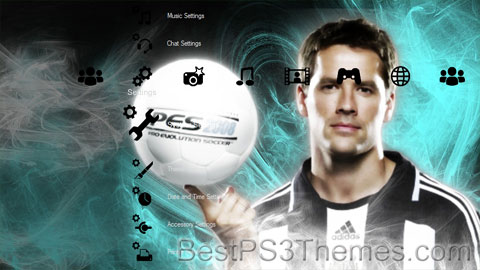
Pro Evolution Soccer 2008 Theme 3
(1 background)

Pro Evolution Soccer 2008[2]
European cover, featuring Newcastle United's Michael Owen and Portugal's Cristiano Ronaldo
Developer(s)Konami
Publisher(s)Konami
SeriesPro Evolution Soccer
Platform(s)
ReleaseNintendo DS
  • JP: October 25, 2007
  • EU: February 1, 2008
  • AU: March 7, 2008
  • NA: March 11, 2008
PlayStation 2, PlayStation 3 & Xbox 360
  • EU: October 26, 2007
  • AU: November 8, 2007
  • JP: November 22, 2007
  • AS: November 22, 2007 (PS3)[1]
  • NA: March 11, 2008
Windows
  • EU: October 26, 2007
  • AU: November 21, 2007
PlayStation Portable
  • JP: January 24, 2008
  • EU: February 29, 2008
  • AU: March 7, 2008
  • NA: March 11, 2008
Wii
  • JP: February 21, 2008
  • NA: March 18, 2008
  • EU: March 28, 2008
  • AU: April 17, 2008
Mobile
Genre(s)Sports game
Mode(s)Single-player, multiplayer

Pro Evolution Soccer 2008[2] (PES 2008), known as World Soccer: Winning Eleven 2008 in Asia and sometimes called World Soccer: Winning Eleven 11 (PS2) in North America, is an association football video game in the Pro Evolution Soccer series by Konami. The game was announced on 18 June 2007. Its title is different from the other Pro Evolution Soccer games in that it is of a year and not a version; this was due to EA Sports' FIFA series naming their titles with two digit numbers (i.e. 07, 08), which would seem that PES was a year behind FIFA (to non-fans which had no knowledge of the previous games of the franchise). It was released for Windows, Wii, Nintendo DS, PlayStation 3, PlayStation 2, PlayStation Portable, Xbox 360 And mobile. The game sold 6.37 million units worldwide. PES 2008 was succeeded by Pro Evolution Soccer 2009. This was the first game of the series to be released for the PS3 and Wii, as well as the first game in the series to be internationally available on a Nintendo home console.

Wii version[edit]

The Nintendo Wii version of PES 2008 (named Winning Eleven Play Maker 2008 in Japan) differs radically from the other versions. The basic gameplay is centered around pointing the Wii Remote at the screen and directing players by dragging them with the on-screen cursor, and passing is done by simply pointing to the desired space or player and pressing a button. This allows for a more tactical approach to the game, as there is almost complete freedom in moving any player on the screen anywhere, and much more tactics and maneuvers can be used in the attacking game than ever before.

This version omits the Master League mode for the Champions Road, which lets the player tour a slew of different leagues around Europe, and when a games is won, it is possible to acquire players from the defeated teams. Also, it features an online mode that Konami called "the best online experience" when compared to the other versions.[3]

Teams[edit]

Unlicensed leagues[edit]

The leagues below are partially unlicensed, and some teams from these leagues are unlicensed:

Licensed leagues[edit]

The leagues below are fully licensed, and all teams from these leagues are licensed:

Generic Teams[edit]

There is also a separate league with 18 generic teams (Team A, Team B etc.), which can be edited fully, like in the previous game. This is thought to be due to the fact that Konami failed to get the rights to the German Bundesliga, and is usually made into the Bundesliga or another league of one's preference by patch makers. However, most people use this to put their edited players into playable teams from the start instead of having to play through Master League to purchase them or alternatively edit the existing non-generic teams. This feature does not appear in the Wii version of the game.

Covers[edit]

Portugal and (at the time) Manchester United player Cristiano Ronaldo is included on all PES 2008 covers, along with Newcastle United striker Michael Owen in the UK, Juventus goalkeeper Gianluigi Buffon in Italy, West Ham United defender Lucas Neill in Australia, and Chelsea F.C. striker Didier Drogba in France.[4] Also in Japanese version, the cover art only Cristiano Ronaldo himself.

Commentators[edit]

Jon Champion and Mark Lawrenson provide the English commentary for the first time, replacing long-time commentary team Peter Brackley and Trevor Brooking, who commentated from Pro Evolution Soccers 2 to 6.[5] Also in the Japanese version, Jon Kabira and Tsuyoshi Kitazawa continue as commentators among Masahiro Fukuda and the pitch reporter was Florent Dabadie.

Reception[edit]

The game sold 6.37 million units worldwide in 2007. Its sales were very close to rival FIFA 2008, which sold 6.55 million units in 2007.[56]

The PlayStation 2 and Xbox 360 releases of Pro Evolution Soccer 2008 each received a "Platinum" sales award from the Entertainment and Leisure Software Publishers Association (ELSPA),[57] indicating sales of at least 300,000 copies per version in the United Kingdom.[58] Pro Evolution Soccer 2008 sold approximately 104,654 copies since its debut in Japan.[59] It debuted at #5 in the UK game charts before moving to #3 in the second week after a 34% increase in sales.[60]

The game was met with positive to mixed reception. GameRankings and Metacritic gave it a score of 83.60% and 83 out of 100 for the Wii version;[48][54] 82.58% and 82 out of 100 for the PlayStation 2 version;[44][50] 79.74% and 80 out of 100 for the PSP version;[46][52] 78.50% for the PC version;[43] 75.53% and 76 out of 100 for the Xbox 360 version;[47][53] 73.46% and 74 out of 100 for the PlayStation 3 version;[45][51] and 58.57% and 58 out of 100 for the DS version.[42][49]

It was awarded Best Sports Game for the Wii by IGN in its 2008 video game awards.[61] It was also nominated for Wii Game of the Year by IGN.[62]

References[edit]

  1. ^ "Pro Evolution Soccer 2008 Release Information for PlayStation 3". GameFAQs. Archived from the original on September 24, 2015. Retrieved April 9, 2015.
  2. ^ a b Gibbon, David (June 19, 2007). "'Pro Evolution Soccer 2008' revealed". Digital Spy. Archived from the original on April 14, 2015. Retrieved April 9, 2015.
  3. ^

    PS3 AmazinHitz Vol. 1

    PS3 AmazinHitz Vol. 1 theme by Neil Anand

    Download: PS3AmazinHitzVol1.p3t
    PS3 AmazinHitz Vol.1 Theme
    (7 backgrounds)

    P3T Unpacker v0.12
    Copyright (c) 2007. Anoop Menon

    This program unpacks Playstation 3 Theme files (.p3t) so that you can touch-up an existing theme to your likings or use a certain wallpaper from it (as many themes have multiple). But remember, if you use content from another theme and release it, be sure to give credit!

    Download for Windows: p3textractor.zip

    Instructions:

    Download p3textractor.zip from above. Extract the files to a folder with a program such as WinZip or WinRAR. Now there are multiple ways to extract the theme.

    The first way is to simply open the p3t file with p3textractor.exe. If you don’t know how to do this, right click the p3t file and select Open With. Alternatively, open the p3t file and it will ask you to select a program to open with. Click Browse and find p3textractor.exe from where you previously extracted it to. It will open CMD and extract the theme to extracted.[filename]. After that, all you need to do for any future p3t files is open them and it will extract.

    The second way is very simple. Just drag the p3t file to p3textractor.exe. It will open CMD and extract the theme to extracted.[filename].

    For the third way, first put the p3t file you want to extract into the same folder as p3textractor.exe. Open CMD and browse to the folder with p3extractor.exe. Enter the following:
    p3textractor filename.p3t [destination path]Replace filename with the name of the p3t file, and replace [destination path] with the name of the folder you want the files to be extracted to. A destination path is not required. By default it will extract to extracted.filename.

Prince of Persia: The Sands of Time

Prince of Persia: The Sands of Time theme by kwauzzie

Download: POPTheSandsofTime.p3t
Prince of Persia: The Sands of Time Theme
(5 backgrounds)

Prince of Persia:
The Sands of Time
Developer(s)Ubisoft Montreal
Publisher(s)Ubisoft
Director(s)Patrice Désilets
Producer(s)Yannis Mallat
Designer(s)Jordan Mechner
Programmer(s)Claude Langlais
Artist(s)Raphaël Lacoste
Writer(s)Jordan Mechner
Composer(s)Stuart Chatwood
SeriesPrince of Persia
EngineJade
Platform(s)Game Boy Advance
PlayStation 2
GameCube
Xbox
Windows
Mobile
ReleaseGame Boy Advance
  • NA: 28 October 2003
  • EU: 14 November 2003
PlayStation 2
  • NA: 11 November 2003
  • EU: 21 November 2003
Xbox
  • NA: 11 November 2003
  • EU: 20 February 2004
GameCube
  • NA: 18 November 2003
  • EU: 20 February 2004
Mobile
  • NA: 21 November 2003
Microsoft Windows
  • NA: 2 December 2003
  • EU: 5 December 2003
Genre(s)Action-adventure, platform
Mode(s)Single-player

Prince of Persia: The Sands of Time is an action-adventure video game developed by Ubisoft Montreal and published by Ubisoft. The game was released on the Game Boy Advance, PlayStation 2, GameCube, Xbox and Windows in November 2003. The Sands of Time is a reboot of the Prince of Persia series created by Jordan Mechner. Mechner served as creative consultant, designer, and scenario writer for The Sands of Time.

The game follows an unnamed Prince whose father sacks an ancient city at the instigation of a traitorous Vizier. During the attack, the Prince obtains an artifact called the Dagger of Time, while his father's army captures an hourglass containing the mysterious Sands of Time. Visiting the palace of the Sultan of Azad to present the Sands as a gift, the Vizier tricks the Prince into releasing the Sands, transforming the people of Azad into savage monsters under his control. Together with Farah, a young Princess who knows the power of the Sands, the Prince works to correct his mistake and foil the Vizier's evil plans. The gameplay revolves around the Prince's platforming abilities, broken up by fights with the creatures created by the Sands. A key mechanic in the game is using the Dagger to rewind time if the Prince makes a mistake while platforming and use it to kill and freeze enemies.

Concept work began in spring of 2001, after Ubisoft acquired the Prince of Persia catalog. After Mechner was brought on board, production began in June of that year. After the initial story draft was scrapped as it was too complex, the team began with four guiding concepts, including the ability to rewind time: this idea grew into the Dagger, the Sands, and the various powers related to them. Mechner's script drew inspiration from the Shahnameh, with the main focus on creating a simple narrative that worked with the pace of gameplay. The game used Ubisoft's Jade engine, originally designed for Beyond Good & Evil, another game published by the company. Production was troubled, with the team facing problems with the engine structure and delays with environment assets, while also managing to create an effective tester network to seek out the game's bugs. In 2004, a version for mobile phones was developed and published in North America by Gameloft.

Upon release, it received critical acclaim, being nominated for and winning numerous awards and has been recognized by many as one of the greatest video games ever made. Sales of the title were initially slow, but it eventually became a commercial success. Its success prompted the development of a sequel, Prince of Persia: Warrior Within, which was released in November 2004. Further games set in the Sands of Time continuity have been developed, and is generally cited as the reason for the Prince of Persia series' return to fame. As of 2014, the game has sold over 14 million copies worldwide, across all platforms. A remake is currently in development.

On Monday 10 June 2024, during its Ubisoft Forward event in Los Angeles, Ubisoft revealed a short cinematic confirming that the Prince of Persia: The Sands of Time remake project was still in active development, with a new release window of 2026.[1]

Gameplay[edit]

The Prince in combat with Sands Monsters. Shown are the battle interface and the Dagger's available Sand chambers.

Prince of Persia: The Sands of Time is an action-adventure puzzle-platformer. The player controls the main protagonist, an unnamed Prince from a kingdom in Persia. Environments are seen through a controllable third-person view. The camera's view changes to different positions triggered by entering certain areas or performing actions.[2][3] The Prince can be moved in all directions, and he is able to manipulate large objects such as blocks and levers connected to mechanisms. His health and power meter are represented in the top left-hand corner of the screen. The Prince restores health by drinking water from pools and fountains; total loss of health from injuries by traps or enemies results in a game over. Collecting Sands increases the Prince's power, and drinking from hidden magic fountains increases the Prince's maximum health.[2][4] During several points in the game, the Prince is assisted by his companion Farah, controlled by artificial intelligence, who fires a bow at enemies, though her arrows can also hit the Prince if he strays into her line of fire. Monsters will attack her, and if she is killed, the game also ends.[2][5]

During exploration, the Prince navigates areas filled with traps: these traps include spike pits, arrow traps, wall-mounted blades and saws, and spinning spiked stakes. The Prince's main contextual move is wall-running, an action where he runs up onto and along a wall for a set distance, either to land on or jump off to a platform. The Prince's other acrobatic abilities include climbing along and across ledges, walking along beams, swinging on and jumping from poles, jumping onto and between pillars, and swinging on ropes.[2][4][6] Large environmental puzzles are encountered during the Prince's journey, extending across multiple areas in large rooms. Many puzzles are cooperative, requiring Farah's help to complete them.[6] In combat, the Prince fights monsters created by the Sands infecting the Palace's inhabitants with dual wielded melee weapons, his sword and Dagger of Time, each controlled by a single button. With the sword, a single command contextually triggers different moves depending on position and directional movement, while other special moves such as a somersault attack and bouncing off walls into enemies require additional commands. After being damaged by the sword, enemies can only be killed by stabbing them with the Dagger of Time, which gathers up the Sands inside them.[2][7]

The Sands the Prince collects from enemies and the environment are tied to his magical abilities, themselves connected with the Dagger. The most basic (and defensive) power is Rewind, the ability for the Prince to rewind time by up to ten seconds to reverse fatal game-ending mistakes such as missteps in platforming, getting overwhelmed by enemies or losing Farah. In combat, once the Dagger develops special power "tanks", the Prince can also use any of three more offensive Sand Powers that can slow time immediately around him, freeze time for a single enemy, or freeze time completely so that he can attack his enemies at great speed while they are unable to move. Each use of power uses up one Sand Tank, and when empty, all powers become inaccessible until more Sand is collected. More powerful abilities, such as freezing time, are powered by Power Tanks. Increasing their number unlocks new Sand-based powers. Starting out with a small amount of Sand available to him, its capacity can be increased by collecting Sand from enemies, along with Sand Clouds scattered around the palace. Large columns of Sand within the Palace grant visions of future areas and act as save points.[2]

Portable versions[edit]

The Game Boy Advance version shares basic elements with its console counterparts. Displayed from a side-scrolling view, the Prince navigates the palace of Azad using his acrobatic skills. The Rewind ability is still present to save the Prince's life, and is also involved in solving some puzzles and fighting bosses. New moves and abilities are gained by the Prince by performing moves and solving puzzles. Farah is featured as a second playable character in some sections, with switching between the two being key to some puzzles.[8] There are also light role-playing gameplay elements, such as debuff-inducing attacks, as well as combat statistics that can be enhanced by leveling up from saving citizens from the Sands' influence.[9] The mobile version is similarly a side-scroller, featuring simple puzzles and traps. The powers linked to the Sands are absent, but enemies must still be killed by stabbing them with the Dagger. There are three enemy types: archers, flying enemies, and foot soldiers.[10]

Plot[edit]

The game is set in Persia during the 9th century AD, and begins with the Prince narrating to an unseen listener about his adventures.[5][11] The Prince and the army of his father Shahraman are passing through India to visit the Sultan of Azad. The Vizier of a local Maharaja, wanting to prevent his death using a substance known as the Sands of Time, entices them into attacking the Maharaja's palace, where the Sands are stored. During the fight, the Prince loots an artifact called the Dagger of Time, and the Maharaja's daughter Farah is taken as a gift for the Sultan of Azad. Visiting Azad, the Vizier tricks the Prince into releasing the Sands, turning everyone but the Prince, the Vizier and Farah (protected by the Dagger, a staff and a medallion respectively) into monsters.[12] The Vizier attempts to seize the Dagger from the Prince, but he escapes and eventually allies with Farah to undo the damage he has caused and prevent the Sands from covering the world, even though he has doubts about her loyalties and motives.[12][13]

Despite mistrusting each other, the Prince and Farah gradually fall in love. After navigating the palace of Azad and reaching the hourglass of the Sands in the Tower of Dawn, the Prince hesitates when following Farah's instructions on containing the Sands, unsure of whether to trust her as he has reoccurring visions of her stealing the Dagger from him.[14] The Vizier ambushes them and they barely escape with the Dagger, ending up in a tomb beneath the city. As they try to find their way out of the tomb, Farah recounts a childhood story to the Prince that she has never told anyone else. Eventually finding shelter in a mysterious bathhouse, Farah seduces the Prince into the bath and they spend the night together. When the Prince wakes back in the palace, he realizes that Farah stole the Dagger while he was asleep and left the Prince her medallion to protect himself. He follows her and only just manages to catch her as she is driven over a ledge above the hourglass by monsters by grabbing the blade of the Dagger she holds, cutting his hand. To save the Prince, Farah releases the Dagger and allows herself to fall to her death. As the Prince mourns over her with the Dagger back in his wounded hands, the Vizier offers him eternal life in exchange for the weapon. The Prince refuses and stabs the hourglass with the Dagger.[15]

Time rewinds to before the attack on the Maharaja's palace, and the Prince, still in possession of the Dagger and his memories, runs ahead to warn Farah of the Vizier's treachery. It is now revealed that the Prince has been recounting his tale to Farah, and as he finishes, the Vizier enters to kill him. The Prince kills the Vizier and returns the Dagger to Farah, who believes his narrative was just a story. The Prince passionately kisses Farah but she rebukes him because she no longer has any memory of ever having fallen in love with him. The Prince promptly rewinds time to undo his kiss. In parting, the Prince mentions a private word Farah told him during their time in the tomb, leaving her amazed and proving to her that what he had told her was indeed real.[16]

Development[edit]

The development of the initial concept work for The Sands of Time began in the second quarter of 2001, after Ubisoft had bought the Prince of Persia license. While Ubisoft held the Prince of Persia catalog, the actual IP still belonged to the series original creator Jordan Mechner, but he was initially unwilling to return to the series after poor experiences with Prince of Persia 3D. The game was developed by Ubisoft Montreal, which was also a year into developing Tom Clancy's Splinter Cell.[17][18] After some mock assets had been created, Ubisoft asked Mechner to come and help develop the game, showing them their concepts and the assets as AVIs. Mechner was impressed by Ubisoft's work and came on board as a creative consultant. He soon became more involved with the project, becoming the game's designer and writer. Full production began in June 2001, and at its peak was worked on by a staff of 65 people, internally known as "PoP Team".[17][19] Development ran parallel to that of Splinter Cell, and as part of their research, the development team read One Thousand and One Nights, a collection of stories originating from the Middle East that Mechner had previously used as inspiration when designing the original Prince of Persia.[5][17][18][20] Over the course of production, the team ran through over 150 different versions before the retail version.[19]

The Sands of Time was announced in March 2003.[21] It was released for the PlayStation 2, Xbox, GameCube, Game Boy Advance and Windows. The versions were released gradually between October and November the same year. The Game Boy Advance version of the game was released in North America on October 28 and in Europe on November 14.[22][23] Scheduled for release in North America on November 11,[24][25][26] the PlayStation 2 and Xbox versions were shipped to stores on November 6 and November 10, respectively.[27][28] The PlayStation 2 version was released in Europe on November 21.[29] The GameCube and Windows versions were released on November 18 and December 2, with the Windows version releasing three days later in Europe.[30][31][32] The GameCube and Xbox versions were released in Europe the following year on February 20, 2004.[33] The various versions had multiple differences in both graphics and control options. The GameCube and Xbox versions included a documentary about the making of the game. The PC port came with support for EAX, EAX2, and EAX3 Advanced HD. Gameloft developed a version of the game for mobile phones, which was released in April 2004. Two versions were developed for higher and lower-spec mobile phones.[34][35] Connecting the GameCube and Game Boy Advance versions of the game gave access to a port of the original Prince of Persia with the GameCube version, along with the ability for the Prince to automatically regenerate health.[36] The PS2 version was released in Japan on September 2, 2004. The game was published in the region by Sony Computer Entertainment Japan, who were impressed by both the quality and the praise it earned in the west.[37][38]

Design[edit]

The game's title was thought up by the production team, but the original story built around the title proved impossible to work. The original draft had nine characters (including the Prince, two love interests, two villains, and two helper characters) representing different political factions, and the setting of the Prince's own palace home instead of in another kingdom. This storyline ultimately impeded other aspects of development, and so was scrapped. In starting over, the team returned to "The Sands of Time" title and concept. They decided upon four key elements for the game: "Unity of time and place", with the game taking place over twenty-four hours within the palace of Azad; "Acrobatics", referring to the gameplay and how the setting was constructed around this concept; "Combat", with the palace being filled with monsters to give the game and story a fast-paced feeling; and "Rewind", the ability to turn back and manipulate time.[12] One of the early decisions made by the production team was not to refer to Prince of Persia 3D in any degree in designing the gameplay, instead looking to the 1989 original for reference. They intended to capture the original feeling of platforming an adventure in a 3D environment. The Rewind mechanic began as a gameplay wish for the title, surviving the initial rewrite of the story and becoming key to both story and gameplay. The Dagger of Time and the Sands were both born from the need to explain this mechanic in-game. The initial concept was simply using the Dagger to rewind time and dispatch enemies, but its powers were gradually expanded into its current roster.[20] The main character's acrobatics were designed to be novel to the video game medium, inspired by similar stunts performed in Crouching Tiger, Hidden Dragon and The Matrix. A video game which provided inspiration for the acrobatic feats of the Prince was Tony Hawk's Pro Skater. Elements such as using ladders as part of combat, and riding on a magic carpet or a horse were axed early in development. The Rewind function was suggested by the game's director Patrice Désilets based on experiences playing Donald Duck: Goin' Quackers, where he had wished to rewind after making a mistake rather than restarting the entire level.[19]

The game design was also influenced by Ico. According to Désilets, they "spent an entire day going through [Ico], the entire team together sitting down, looking at it, playing it, discussing it, brainstorming" and they particularly liked "how the castle in Ico seems real and you always know where you are, so we tried to have this a little bit also in the second palace". It also influenced the interaction between the player and the lead female character, but with some changes. According to Désilets, Farah "has some behaviors to help you out, but we didn't want for her to become a key just like in Ico, a key to a door all the time".[39][40]

Pre-production was originally estimated at ten months, but ultimately extended to fourteen months. Each time a new movement or ability was created for the Prince, it required adjustments to multiple other systems, as leaving them alone would have damaged the game. They also needed to make adjustments to the enemy and partner artificial intelligence, and they did not have time to polish those systems. All this meant that the debugging started much later than originally scheduled. The Prince had over 780 scripted movements, far more than any other character in the game. This caused problems with creating the movements for other characters.[17] To make the character movements realistic, the team used motion capture to animate their movements.[41] Art director Raphael Lacoste did not join the team until July 2002, well into the game's production, resulting in multiple delays in creating the game's environments. This issue was compounded by the need to produce a demo for the 2003 Electronic Entertainment Expo, then to deliver an entire game at the same if not a higher quality than the demo.[17] Each environment needed to work for the Prince's set of movements and abilities: the work needed involved checking each rewind sequence, and each of the Prince's movement in and effect on the environment worked. These issues were compounded by the late delivery of environmental maps. In hindsight, producer Yannis Mallat lamented the fact that they did not have enough time to work out the problems caused by these issues. Despite these problems, other parts of production including play-testing, management of creative tools, and the integrated testing system worked smoothly. A cited example was the team discovering a tester that was good at finding severe bugs, so they included her in one of their testing groups, giving her a development kit she could use to sort out those bugs. This was replicated, and managed to greatly increase the amount of bugs that could be found and fixed. The development team's enthusiasm was also high, which enabled the problems during development to be overcome.[17] During the aftermath of E3, the team considered release The Sands of Time as two games so they could include all the desired content, but the idea was dropped. Another element that needed to be cut after the demo was a griffin boss that would appear three times during the Prince's journey;[19] such boss would appear in the Game Boy Advance version instead.

The game used an updated version of the company's Jade engine, designed for Beyond Good & Evil. When the team saw the capacities of the Jade engine, they decided to use it for The Sands of Time. For The Sands of Time, the team made improvements to the engine by adding additional walking and running animations, enabling smoother character movement. They also made custom animations for the character. The engine made editing and fine-tuning the game very easy due to its easy-to-use tools. Using this as a base, they were able to focus on rapid integration of new elements into the game, and were also able to do quick testing and adjustments. The team developed "substance" and "glow" systems, which respectively enabled natural movements of cloth and gave the lightning effects a "magical" feel.[42] The way the engine was structured, with all assets in a single accessible folder, proved problematic when alterations needed to be made or new features added, as the team size meant too many people were accessing the engine and were causing data to be overwritten, files to be corrupted, and the whole system to crash. They attempted to solve the problem using a "data monkey" solution which would allow for simultaneous access, but it came late in development and they did not risk making such a radical change to the system. Instead, they set up a file server to manage check-in times, which could allow for management of access and prioritisation of critical work.[17]

Writing[edit]

Jordan Mechner, scenario writer and game designer for The Sands of Time, at WonderCon 2010

Mechner created the scenario and wrote the game's script.[12] While doing his research for the script, Mechner read a translation of the Shahnameh, an epic poem written by Ferdowsi between the 10th and 11th century. Reading it through helped Mechner visualise the new Prince as a more mature character than the original. Despite this, Mechner felt that the character could not fully shed the "happy-go-lucky" elements of One Thousand and One Nights. In retrospect, Mechner also felt that this inability to resolve this inherent conflict gave the character his charm. Mechner also included specific references in the Prince's dialogue to stories from the Shahnameh.[5] The story and the Prince were created for newcomers to the series. The main scenario was based around second chances, while an unstated anti-war theme was also included by Mechner and showcased in the game's opening level.[5][12] Mechner created the Dagger of Time as a combined gameplay and narrative device within the four core concepts created by the team. Its acquisition by the Prince was directly inspired by the opening of Raiders of the Lost Ark, which had previously inspired his portrayal of the Prince in the original Prince of Persia. The palace of Azad was crafted to be the Prince's "playground", while some scenes which developed the Prince's portrayal (the opening attack on the Maharaja's palace, activating Azad's traps on the instructions of a deranged guard) were deliberately meant to be morally dubious to the player while increasing empathy with the character.[12]

Mechner's main preoccupation for this new storyline was keeping the narrative simple and engaging, using his preferred writing style of keeping cutscenes short and working as much of the story as possible into the gameplay. He also aimed to mix narrative and gameplay genres that might normally clash with one-another. The three main characters he created were the hero (the Prince), the villain (the Vizier) and the love interest and sidekick (Farah). Two non-playable authority figures (the Prince's father Shahraman and the Sultan of Azad) were included to add weight to the Prince's burden as they were transformed into monsters by the Sands. The three artefacts each character used (the Dagger, Farah's medallion and the Vizier's staff) were created to explain their survival of the Sands' release, with the Dagger also becoming integral to gameplay. The Prince's narration was both difficult and satisfying for Mechner. It needed to be written to work on two levels: first to be understandable for first-time players, and to gain greater significance upon future playthroughs. The narration also served to give gentle hints to the player, and expand upon the setting and add depth to the experience. Among his cited reference points for the narration were the 1940s version of The Thief of Bagdad, the works of Edgar Allan Poe, and films such as Double Indemnity and Sunset Boulevard. The Prince's interactions with Farah were also an important factor. As part of the character interaction, Farah was deliberately designed not to be a perfect archer, sometimes hitting the Prince if he strayed into her line of fire. Despite this, unspecified features planned for her needed to be cut.[12]

Audio[edit]

Yuri Lowenthal voiced the Prince in The Sands of Time, returning for subsequent games set within the continuity.

The music for The Sands of Time was composed by Stuart Chatwood of the Canadian rock band The Tea Party.[3][43] Chatwood was chosen for the role as Ubisoft wanted music that had Persian elements in it to fit the setting, while not being pure Persian music. When he was approached, Chatwood expanded his music library as part of his research. To achieve the desired effect, rock elements were mixed with Middle Eastern music and melodies, along with Indian elements. Chatwood used different instruments, including an Indian tabla and strings, along with vocal tracks by Cindy Gomez and Maryem Tollar.[3][43] A soundtrack album for the game, Prince of Persia: The Sands of Time Original Soundtrack, was released in Japan on 20 October 2004 by Scitron Digital Content.[44] Tracks from the game were included in an album featuring music from both The Sands of Time and its two sequels Warrior Within and The Two Thrones. The album was released on 1 December 2005 as a pre-order bonus for the PS2 and Xbox versions of The Two Thrones.[45] A larger compilation album featuring music from the three games was released digitally by Ubisoft on January 3, 2011.[46]

For the sound effects, the team worked with sound company Dane Tracks to create most of the game's sound effects, with the rest being done by Ubisoft Montreal. To make the enemies in the game stand out, the sound team mixed "organic and evil" sound effects with whispering sounds, rather than using sound effects associated with the undead.[3] Mechner supervised the game's voice recording.[18] The recording took place at L. A. Vox and Ubisoft Montreal's sound studios.[47] One of the unconventional choices made by the team was not to halt gameplay during in-game dialogue, meaning players could miss large portions of character interaction. In addition to story-based dialogue and banter, context-specific dialogue was written for certain situations. Over one thousand lines of dialogue were written, though over half of them were cut. To help with voice recording, the recording team created a graph to help the actors playing the Prince and Farah time their exchanges correctly. Aside from some exceptions which played in sequence, all comments made by Farah when the Prince did a specific thing were stand-alone responses.[12]

The actors were chosen for their roles based on how well their voices matched the characters.[47] The Prince was voiced by Yuri Lowenthal, whose performance was proven popular and would return to voice the character in future games set after The Sands of Time. Speaking in a 2008 interview, Lowenthal felt "that [he] in a way originated that role".[48] Farah was voiced by Joanna Wasick.[47] Lowenthal and Wasick recorded their dialogue in separate studios.[49]

Reception[edit]

Sales[edit]

By the end of 2003, sales of Prince of Persia: The Sands of Time had reached 2 million copies, and Ubisoft highlighted the game's success in Europe in a quarterly business report.[50] Europe accounted for 1.1 million sales by February 2004;[51] worldwide sales rose to 2.4 million units by the end of March.[52] During its North American debut, the game suffered from poor sales: by December, the PS2 version had sold 218,000 copies, the Xbox version 128,000 copies, and the GameCube version 85,000 copies. Its combined sales since release at that time totaled 272,000 (PS2), 172,000 (Xbox), and 100,000 copies (GameCube). It was speculated that its sales were negatively affected by the concurrent release of Beyond Good & Evil, alongside other prominent releases at the time. In response to this, Ubisoft offered copies of their other games free with purchases of The Sands of Time, providing a boost to sales.[53] By July 2006, the game's PlayStation 2 version alone had sold 700,000 copies in North America, bringing an estimated revenue of $24 million.[54] During its week of release in Japan, the game reached seventh place in the charts, selling 14,000 copies. This was noted as being high for a western game released in Japan. By the end of 2004, it had sold 26,116 copies.[38][55] It received a "Gold" sales award from the Entertainment and Leisure Software Publishers Association (ELSPA),[56] indicating sales of at least 200,000 copies in the United Kingdom.[57] As of 2014, the game has sold over 14 million copies worldwide, across all platforms.[58]

Critical reviews[edit]